ISSN: 2008-8191. pp. 41-64
Exploring Language Learning Strategy Use: The Role
of Multiple Intelligences, L2 Proficiency and Gender
A. Roohani
Assistant Professor, TEFL Shahrekord University email: [email protected]
S. Rabiei M.A., TEFL Shahrekord University email: [email protected]
Abstract
Multiple intelligences (MI), second/foreign (L2) proficiency and gender are postulated to contribute to language learning strategies (LLS). This study, first, examined whether there was any relationship between Iranian EFL learners’ LLS, on the one hand, and their MI, L2 proficiency, on the other hand. In so doing, it explored the relationship of the overall L2 strategy as well as individual strategy types with overall MI and individual intelligence types. Second, it explored the extent to which MI, L2 (i.e. English) proficiency, and gender would predict the EFL learners’ LLS. To these ends, 90 undergraduate EFL learners from several universities participated in this study. To collect the data, Strategy Inventory for Language Learning, Multiple Intelligences Developmental Assessment Scale, and a language proficiency test were used. Pearson product moment correlation and multiple regression analysis revealed a significantly positive relationship between the learners’ LLS and their MI and a weak relationship between L2 proficiency and LLS. Also, significant correlations were found between some strategy types and several individual intelligences with the highest correlation between intrapersonal intelligence and cognitive strategies, and the lowest one between naturalist intelligence and affective strategies. Besides, MI made a unique and positive contribution to L2 strategy use while proficiency and gender, though found as positive predictors, failed to make a significant contribution.
Keywords: strategies, proficiency, multiple intelligences, gender
1. Introduction
In the 1990s, there was a shift of emphasis in language methodology from the teachers and teaching to the learners and the learning process (Lessard-Clouston, 1997). In the same line, a shift of attention took place in second/foreign language (L2) learning research from the products of language learning to the processes through which learning would take place (Oxford, 1990). As a result of such a shift, the concept of strategies, particularly learning strategies and language learning strategies, derived originally from information-processing model of cognitive psychology, gained significance (Williams & Burden, 1997). Consequently, L2 researchers started to turn their attention to the role that strategies play in the facilitation of L2 learning process.
Language learning strategy/strategies (LLS) are "specific actions taken by the learner to make learning easier, faster, more enjoyable, more self-directed, more effective, and more transferable to new situations" (Oxford, 1990, p. 8). LLS are important for both language teachers and learners; they can play a central role in the lightening the L2 teachers’ burden since an awareness of these strategies can help language learners manage their own process of L2 learning and assist "shift the responsibility for learning off the shoulders of the teachers onto those of the learners" (Cohen, 1998, p. 21). Also, if L2 learners follow some certain strategies, they can perform better (O’Mally & Chamot, 1990). However, the question that remains with us is whether any learner differences (i.e. learner variables) can affect the effectiveness of LLS in L2 teaching/learning.
One learner variable, which has taken on an increasing importance in L2 learning, is intelligence. Just until 1980s, among the sources which addressed individual differences in L2 learners, little reference was made to this learner variable and, as Akbari and Hosseini (2008) state, "if intelligence was mentioned, it was, in the majority of cases to refute its existence and argue against its importance" (pp. 142-143). Traditionally, intelligence was viewed as a single unique factor (i.e. general or g factor), taking solely verbal and mathematical capacities of individuals into account, hence failing to count for language learners’ potentials for further growth. Henceforth, in recent decades, Gardner (1983, 1999) has proposed a broader model/theory of intelligence, labeled as Multiple Intelligence(s) (MI), which views intelligence as a combination of different components. In this view,
throughout the school day." Thus, it is potentially worth shedding light on the relationship of MI with LLS and recognizing its contribution to LLS use in L2 context, given that there is some evidence (e.g. Haley, 2004) that both LLS and MI variables can result in L2 learners’ motivation and their academic achievement. In so doing, it seems logical to take the role of gender and language proficiency variables into consideration as they can be among many determining factors in language learning (Brantmeier, Schuller, Wilde, & Kinginger, 2007). Indeed, the role of gender and L2 proficiency in the LLS use is not quite uncontroversial. While some studies (e.g. Goh & Foong, 1997; Yilmaz, 2010) have suggested the superiority of female language learners in strategy use, a few studies (e.g. Tercanlioglu, 2004) have acknowledged male’s superiority. There are also several other studies (e.g. Aliakbari & Hayatzadeh, 2008; Khamkhien, 2010) undermining the role of gender in language strategy use. Likewise, some studies on the relationship between strategy use and language proficiency (e.g. Griffiths, 2008; Oxford & Ehrman, 1995) have indicated that more proficient language learners use L2 strategies more than less proficient ones. But a few other studies (e.g. Akbari & Hosseini, 2008; Rezaei & Almasian, 2007) have failed to demonstrate any significant effect for language proficiency. Consequently, there leaves a room for more research to bring all the three learner variables (MI, gender and language proficiency) together, and see to what extent they can contribute to language learning strategy use in L2 contexts such as that of Iran where Iranian EFL learners have had little or no contact with native speakers of English. It is believed that, as Gowans (1999) asserts, uncovering variables affecting or relating to LLS can contribute to language learners’ communicative abilities and success in L2 learning.
2. Literature Review 2.1 Language learning strategy
(1985) and Oxford (1990) introduced their taxonomies of language learning strategies, LLS became a subject of much empirical research.
Similar to Rubin, Oxford (1990), whose taxonomy was "perhaps the most comprehensive classification of learning strategies" (Ellis, 1994, p. 539), provided two broad classes of LLS: direct and indirect strategies. Direct strategies are those that need mental "processing of the language" (p. 37), and can result in the direct involvement of learners with the target language. In contrast, indirect strategies are those strategies that "support and manage language learning without directly involving the target language" (p. 135). She divided direct strategies into memory, cognitive, and compensation categories. While memory strategies enable learners "to store and retrieve new information" (p. 37), cognitive strategies help learners "to understand and produce new language by many different means" (p. 37); compensation strategies cause learners "to use the language despite their often gaps in knowledge" (p. 37). The indirect class of Oxford’s taxonomy includes metacognitive, social and affective strategies. Metacognitive strategies enable students "to control their own cognition—that is, to coordinate the learning process by using functions such as centering, arranging, planning, and evaluating" (p. 135) while affective strategies allow them "to regulate emotions, motivations, and attitudes" (p. 135). And social strategies are related to learning through interaction, which provide learners with opportunities to have exposure with the target language.
Since 1990, a cluster of factors have been explored in L2 contexts to see their effects on or relationships with learners’ strategy use. Among these factors, proficiency (e.g. Green & Oxford, 1995; Griffiths, 2008; Hong-Nam & Leavell, 2006; Rahimi, Riazi & Saif, 2008; Yang, 2007), gender (e.g. Aliakbari & Hayatzadeh, 2008; Hong-Nam & Leavell 2006; Khamkhien, 2010; Yilmaz, 2010), personality and learning styles (e.g. Gowans, 1999; Liyanage, 2004) have been the subject of investigation.
intermediate level reported more use of learning strategies than beginning and advanced levels. But, the results obtained by Fewell (2010), who examined the relationship between language learning strategy use and proficiency in a Japanese EFL context, showed more similarities in patterns of language learning strategy utilization among high proficiency first-year college learners than low proficiency learners. As to the gender and language proficiency, Taguchi (2002) investigated the relationship between learners’ factors and the choice of LLS among English learners in both an EFL context (Japan) and an ESL context (Australia). He found gender, together with the levels of English proficiency, and motivation to be the main factors affecting the strategy use in both contexts. Also, Hong-Nam and Leavell (2006), who focused on differences in strategy use across gender and nationality with 55 ESL students in the US, concluded that both gender and English proficiency could be important in strategy use.
markedly contrast, perhaps, due to contexts or designs of studies, which leaves room for more research.
2.2 Multiple intelligences
In 1904, Charles Spearman, introduced a novel concept of intelligence known as general intelligence. His theory has asserted "that each person has a certain general level of intellectual ability, which the person can demonstrate in most areas of endeavor" (Willis, Dumont, & Kaufman, 2011, p. 40). Based on his idea, intelligence is composed of a general factor (g), which is "a universal inborn ability and leads to success in life" (Spearman, 1904, cited in Pal, Pal, & Tourani, 2004, p. 182). However, g intelligence and IQ tests, which were founded on the idea that intelligence was a single and unchanged capacity, were criticized for their narrow conceptualization of intelligence (Davis, Christodoulou, Seider, & Gardner, 2011), and their failing to measure learners’ abilities in the real world (Hoerr, 2000). This was enough to motivate Gardner (1983) to propose that human brain was composed of different separate modules, or better to say, intelligences which could work autonomously one from the other. Thus, Gardner (1983, 2011) propounded the theory of MI, which assumed eight distinct intelligences:
1.
Linguistic/verbal: It refers to the ability to reflect on the use of language in everyday life.2.
Logical/mathematical: It demonstrates the expertise in calculation, reasoning, quantification, complex mathematical/logical operation, inference, and hypothesis testing.3.
Spatial/visual: It includes the capacity for accurate perceptions of visual world.4.
Bodily/kinesthetic: It encompasses the ability to use skillfully one’s body for the expression of ideas and feelings.5.
Musical: It refers to the expertise in understanding sounds, rhythms, melodies, and rhymes.6.
Intrapersonal: It includes the knowledge and understanding which one may have about his/her self.7.
Interpersonal: It includes the knowledge and understanding which an individual may possess of other people.8.
Naturalist: It encompasses the recognition and classification of individuals, species, and ecological relationships.students’ English proficiency. Results indicated that implementation of MI and CL in EFL classes failed to result in a significant increase in the students’ language proficiency. Also, in the context of Iran, Razmjoo (2008), who examined the relationship between language proficiency in English and MI among the PhD Candidates in Shiraz University, reported no significant relationship between the two variables. But, in another study, Razmjoo, Sahragard, and Sadri (2009) reported a relationship between MI and EFL learners' vocabulary learning knowledge and vocabulary learning strategies. Moreover, Akbari and Hosseini (2008) investigated the relationship between EFL learners’ MI, on one hand, and their proficiency and LLS, on the other hand. Results demonstrated that there was a significant relationship between the learners’ strategy use and their MI. Also, in a study with 229 Iranian EFL high school students, Hajhashemi, Parastesh and Yazdi Amirkhiz (2011) investigated the relationship between LLS and MI. Results revealed that there was a significant relationship between the two variables even though it was very low; the highest correlation was found between MI and metacognitive strategies.
MI has been studied in relation to a number of variables relating to language learning and teaching (e.g. Akbari & Hosseini, 2008; Razmjoo, 2008; Razmjoo et al., 2009; Saricaoglu & Arikan, 2009). In general, the findings of the studies on MI have underscored the importance of intelligences and cognitive dimensions of mind in the process of language learning. The MI studies have rightly tried to show that language should not be seen as limited to a linguistic perspective. The contributions of the aforementioned studies should be recognized. However, to the best of the researchers’ current knowledge, none of the above studies have so far brought MI, gender and L2 proficiency variables together and to investigate their relationships with, and their contributions to, L2 learners’ LLS, particularly in an EFL context like that of Iran which is quite different from other Asian countries. This further step can shed light on the aforementioned results, and perhaps reconcile the inconsistency between some findings of the above studies, helping L2 teachers and materials developers to take better actions to adopt or adapt language teaching materials, hence opening door to more effective L2 teaching.
2.3 Purpose of the study
(O’Mally & Chamot, 1990). Speaking of the value of these factors, one agrees with MacIntyre and Noels (1996, p. 384), who state that "knowing the factors that facilitate or hinder strategy use may be an important first step toward more effective strategy training" to develop L2 learners’ communicative competence. Given the increasing attention to the new model of intelligence (i.e. Gardner’s MI) with its focus on the plurality of intellects, and its applications in language learning, as well as reviewing the related literature where there is no definite conclusion regarding the role of gender and language proficiency in L2 learners’ strategy use, this study, then, examines the relationships of MI and L2 proficiency (i.e. English) with LLS and the extent to which MI, gender and L2 proficiency can contribute to the use of LLS. In so doing, it investigates the EFL learners’ MI and LSS profiles. Accordingly, the following research questions are addressed in the present study:
1. What are the Iranian EFL learners’ LLS and MI profiles?
2. Is there any significant relationship between Iranian EFL learners’ MI and language proficiency, on the one hand, and language learning strategy use, on the other hand?
3. Is there any significant relationship between different intelligences (i.e. interpersonal, intrapersonal, linguistic, musical, spatial, kinesthetic, naturalist, and mathematical intelligences) and different strategy types (i.e. memory, cognitive, compensation, metacognitive, social, and affective strategies) among the Iranian EFL learners? 4. Which variable(s) (i.e. gender, proficiency, and MI) can significantly
predict the Iranian EFL learners’ language learning strategy use?
3. Methodology 3.1 Participants
3.2 Instrumentation
This study made use of the following instruments for data collection:
Test of English as a Foreign Language. In order to determine the participants’ proficiency scores, the researchers used Test of English as a Foreign Language (TOEFL, 2003). This valid paper-based test is composed of multiple-choice questions with four possible answers per question. There are three sections: listening comprehension (50 items), structure and written expression (40 items) and reading comprehension (50 items). For scoring the test, 'number-right' procedure was used. In the present study, number-right scores were not converted to scaled scores using 'converted score' charts of TOEFL. Thus, the total scores in the present study ranged from zero to 140. The overall reliability of the test in the current study (with the sample of 90 EFL participants) was estimated to be high (0.90) through Cronbach’s Alpha.
questions which take less than an hour to complete. It taps eight types of intelligences: musical (14 items), kinesthetic (12 items), mathematical (18 items), interpersonal (18 items), intrapersonal (9 items), spatial (15 items), linguistic (20 items), and naturalist (13 items) intelligences. Example 1 shows one sample item from the interpersonal component of the test.
Example 1: Are you ever a leader for doing things at school among friends or at work?
(a) Rarely (b) Every once in a while (c) Sometimes (d) Often (e) Almost all the time (f) I do not know
The validity of the test was examined in terms of content, construct, concurrent, and predictive validity as well as contrasted criterion groups (Shearer, 1996, 2011). Hosseini (2003) also translated MIDAS and validated it through content, construct, and predictive validity. This valid Persian version was utilized in the present study to ensure that the EFL participants would miss no items due to their possible limited English proficiency. In the current study, the reliability of the test was found to be 0.92, which was commensurate with the requirements for a reliable test by Larson-Hall (2010).
3.3 Procedures
The data were collected in three stages during three weeks in 2011. In stage one, the proficiency test was administered to the 120 undergraduate EFL learners at the aforementioned universities where they could be accessed by the present researchers to obtain their English proficiency scores. All the sections of the test (i.e. listening comprehension, structure and written expression and reading comprehension) were administered in one session in the language laboratory of the above-mentioned universities within two weeks during the second semester of 2011 academic year. In stage two, the SILL was administered to the same participants to find out about their strategy use. Finally, MIDAS was administered to them to find out their MI profiles. The data in stage two and three were collected in two sessions within a week after collecting the needed data on the participants' English proficiency.
4. Results
Table 1. Descriptive statistics of the LLS and Its components Strategy
Types
N Minimum Maximum Mean Std. Deviation
Memory 90 1.22 3.86 2.45 0.54
Cognitive 90 1.00 3.57 2.57 0.45
Compensation 90 1.33 3.67 2.47 0.51
Metacognitive 90 1.67 5.33 3.01 0.63
Affective 90 1.17 3.50 2.27 0.50
Social 90 1.00 4.00 2.52 0.64
Total 90 1.23 3.99 2.55 0.60
The mean scores of different strategies ranged from 2.27 to 3.01 and the total mean score was 2.55, indicating that the performance of the participants on different strategy types varied little and the mean scores of strategies were close to the possible middle point on a 5-point scale. The minimum score was related to the social and cognitive strategy types while the maximum score belonged to the metacognitive type, with the highest mean score; the mean score of the social strategies was lower than that of the metacognitive and cognitive strategies. Also, the lowest mean score belonged to the affective type. Moreover, the social and metacognitive strategies were reported to have the highest standard deviations, indicating the higher variance of scores on these two strategy types.
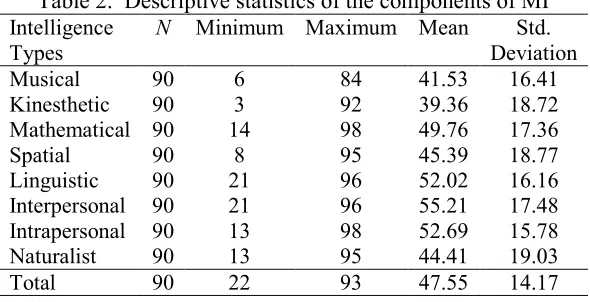
According to Table 2, the minimum intelligence score belonged to the kinesthetic intelligence while the maximum intelligence score belonged to both mathematical and intrapersonal intelligences. The highest standard deviation was related to the naturalist intelligence, indicating the higher variance of MI scores on this intelligence. Moreover, the highest mean score was on the interpersonal and intrapersonal intelligences while the lowest mean score was on kinesthetic (39.36) intelligence.
Table 2. Descriptive statistics of the components of MI Intelligence
Types
N Minimum Maximum Mean Std. Deviation
Musical 90 6 84 41.53 16.41
Kinesthetic 90 3 92 39.36 18.72
Mathematical 90 14 98 49.76 17.36
Spatial 90 8 95 45.39 18.77
Linguistic 90 21 96 52.02 16.16
Interpersonal 90 21 96 55.21 17.48
Intrapersonal 90 13 98 52.69 15.78
Naturalist 90 13 95 44.41 19.03
As to the descriptive statistics of the proficiency scores, the scores ranged from 54 to 126. The mean score of the sample was 87.64, which was a little above the possible middle point (70), and the standard deviation of the scores was about 15, suggesting some variation in the participants’ English proficiency scores.
To address the second research question, intended to examine the relationship of proficiency and MI with LLS use, Pearson product moment correlation coefficients were obtained. As displayed in Table 3, the correlation coefficient between LLS and English proficiency was found to be positive, but not statistically significant (r= 0.12, p= .330), and it was, following Cohen’s (1988) guidelines, low. Additionally, there was a significant positive correlation (r= 0.46, **p < .01) between LLS and MI, which was, in Cohen’s (1988) terms, a medium one.
Table 3. Correlation of LLSs with proficiency and MI
Proficiency MI
LLSs 0.12a 0.46b
atwo-tailed, p= .330 btwo-tailed, **p< .01
To further analyze the data and find answers to the third research question of the study, correlations between different individual intelligence and overall strategy use scores as well as correlations between individual intelligence and individual strategy type scores were calculated using, again, Pearson product moment correlational analysis.
Table 4. Correlations between different intelligences and different strategy types
Variables M
em or y M eta -c og nit iv e C og nit iv e C om pe ns ati on A ffe cti ve S oc ia l O ve ra ll M I
Musical 0.20 0.21a 0.36b 0.37b 0.12 0.18 0.31b Kinesthetic 0.22a 0.29b 0.41
atwo-tailed, *p< .05 btwo-tailed, **p< .01
As Table 4 reveals, the highest significant correlations were found between the intrapersonal intelligence and cognitive strategies (r= 0.49,**p
< 0.01), as well as the linguistic intelligence and compensation strategies (r
= 0.48, **p < 0.01) while the lowest relationship existed between the naturalist intelligence and affective strategies (r = 0.03). Besides, the linguistic and intrapersonal intelligences had the highest positive correlations and the naturalist intelligence had the lowest positive correlation with the overall strategies. In sum, the compensation strategies showed significant correlations with all intelligences while linguistic intelligence showed the highest correlations with the components of LLS.
The last research question intended to seek which independent variables (i.e. proficiency, gender, and MI) could make a unique contribution to the EFL learner participants’ strategy use. Therefore, multiple regression procedure was conducted. The R2value was found to be
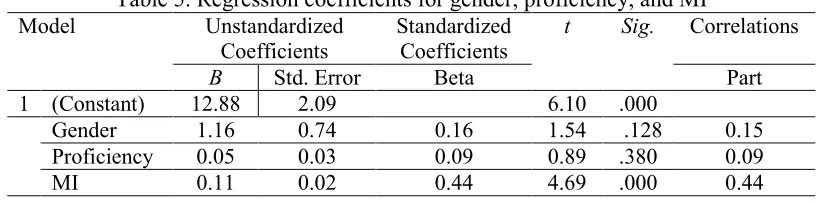
0.25, demonstrating that the model containing gender, proficiency, and MI variables could predict 25% of the variance in the participants’ strategy use. As to the amount of contribution of each of the above independent variables to strategy use, as Table 5 demonstrates, the largest Beta value was related to the MI (+= 0.44, t= 4.70, *p < .01), meaning that MI made a stronger contribution. The Beta value for the gender was slightly low, indicating that it made less contribution. And, the proficiency with a Beta value of 0.09 made the least contribution. Additionally, when the part correlation coefficients were obtained (see Table 5), MI with a part correlation coefficient of 0.44, and the squared value of about 0.19, uniquely explained 19% of the variance in the strategy use, followed by the gender variable (with 2.2% of the unique variance).
Table 5. Regression coefficients for gender, proficiency, and MI Model Unstandardized
Coefficients
Standardized Coefficients
t Sig. Correlations
B Std. Error Beta Part
1 (Constant) 12.88 2.09 6.10 .000
Gender 1.16 0.74 0.16 1.54 .128 0.15
Proficiency 0.05 0.03 0.09 0.89 .380 0.09
MI 0.11 0.02 0.44 4.69 .000 0.44
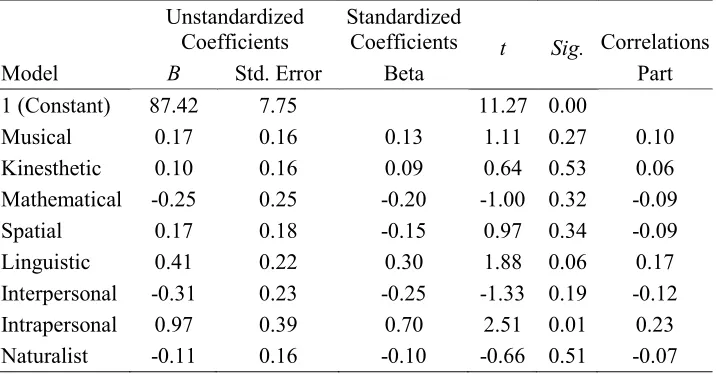
illustrates, the intrapersonal intelligence had the largest Beta value, hence, making the strongest unique contribution to the language learning strategy use. The highest squared values of the part coefficients belonged to the intrapersonal and linguistic types, uniquely sharing about 5% and 3% of the variance with the LLS scores. In contrast, the kinesthetic and naturalist intelligences showed the lowest unique contributions.
Table 6. Regression analysis for the individual intelligences
Model
Unstandardized Coefficients
Standardized
Coefficients t Sig. Correlations
B Std. Error Beta Part
1 (Constant) 87.42 7.75 11.27 0.00
Musical 0.17 0.16 0.13 1.11 0.27 0.10
Kinesthetic 0.10 0.16 0.09 0.64 0.53 0.06 Mathematical -0.25 0.25 -0.20 -1.00 0.32 -0.09
Spatial 0.17 0.18 -0.15 0.97 0.34 -0.09
Linguistic 0.41 0.22 0.30 1.88 0.06 0.17 Interpersonal -0.31 0.23 -0.25 -1.33 0.19 -0.12 Intrapersonal 0.97 0.39 0.70 2.51 0.01 0.23 Naturalist -0.11 0.16 -0.10 -0.66 0.51 -0.07
5. Discussion
little access to native speakers of the target language. Moreover, it is possible that most participants of the study perceived themselves as the good master of their own learning to a large extent, so they reported to employ metacognitive strategies more; research (e.g. Gerami & Baighlou, 2011; Shokrpour & Nasiri, 2011) which has examined the application of language learning strategies by successful and unsuccessful Iranian EFL students has shown that the successful and more proficient language learners tend to use this type of strategy more. Moreover, as Zare (2010) points out, it is important for many Iranian EFL learners to receive high grades on their examinations; examinations are considered as an important and tangible gatekeeper for many EFL students. Therefore, it can be assumed that in this context they tend to work hard on their own to plan and monitor their foreign language learning. The above assertions can hold true, given that the results of several other studies (e.g. Hajhashemi et al., 2011; Liyanage et al., 2012; Rahimi et al., 2008; Zare, 2010) are in agreement with the above finding of the present study.
The results of the present study, in line with the results obtained by Gerami et al. (2011) and Zare (2010), revealed that the affective strategies were the least favored strategies. The participants reported using fewer strategies for controlling their emotions and maintaining a positive attitude towards their learning experiences. It is believed that many Iranian EFL learners are mostly afraid of committing errors while using a foreign language. They, consequently, may avoid communicating in the target language or to participate in classroom discussion. Perhaps, as Hong-Nam and Leavell (2006) argue, "Asian cultural mores encourage listening to others and discourage public discussion of feelings" (p. 409). In fact, some EFL students may never volunteer to speak English in classroom unless they are asked or forced to. As Zare (2010) argues, because they are much concerned about what others may judge about their weak performance or errors, they avoid doing whatever seems face-threatening. Also, many Iranian EFL teachers tend to focus on students’ performance at the expense of affective factors which can influence the learning process to some extent.
caution should be taken since, as Nolen (2003) asserts, an individual has each intelligence to a certain level, but as a result of the exposure to specific instructional materials good for a certain intelligence type, this intelligence type fosters to a higher level in the individual. The role of context can then account for different results. In light of this view, the result of the present study is a little different from Hashemi’s (2010) results in that in her study senior university students were stronger at bodily-kinesthetic intelligence.
Based on the results of the current study, the relationship between English proficiency and language learning strategy use was positive, but its strength was not strong. The positive relationship is what was expected to be observed due to the idea that both variables would deal with certain aspects of language. Those with higher level of English proficiency can enjoy a better English strategy use, but this does not mean a high level of L2 proficiency can result in high level of L2 learning strategy use in L2 learners. The weak correlation obtained in the present study suggests that there is some variance which is not shared by the two variables. The strategy inventory used in the present study included six strategy types or subscales. It can be assumed that the subscales such as 'cognitive strategy' which concerns deep language processing, such as analysis and synthesis of linguistic data, can share more variance and have a higher correlation with L2 proficiency, but other subscales such as 'affective type' which are less cognitively and linguistically related share little variance with L2 proficiency, hence lowering the correlation coefficient between English proficiency and language learning strategy use. Another explanation might be the restricted range of strategy use scores in the present study. Furthermore, the above results are partially supported by the results of the study done by Rezaei and Almasian (2007), who reported no significant correlation between the two variables. However, the results of the present study partially contrast with those of Rahimi et al.'s (2008) study, which reported a significantly high correlation between the level of L2 proficiency and language strategy use. Therefore, the relationship between L2 strategy use and proficiency should be interpreted with caution, given that the English proficiency test in the present study was limited to just listening, structure and written expression, and reading parts.
to some aspects of language use, such as communication skills (linguistic, interpersonal), metacognition (intrapersonal), general cognitive abilities (logical-mathematical) and nonverbal language (spatial). Additionally, linguistic and intrapersonal intelligences had the highest correlation with the overall strategy use. Also, the correlation between the intrapersonal intelligence and cognitive strategies was the highest. The above results are justified since linguistic intelligence is "the understanding of phonology, syntax, and semantics of language, and its pragmatic uses to convince others of a course of actions, help one to remember information, explain or communicate knowledge, and reflect upon language itself" (Armstrong, 2003, pp. 13-14), so the common variance between the linguistic intelligence and LLS was not against expectation. Similarly, intrapersonal intelligence helps individuals evaluate, or critique information, how to analyze and do certain language learning tasks, and reflect on the language learning process. Thus, intrapersonal intelligence can be associated with language learning strategies, particularly the cognitive ones which concern analyzing and reasoning with the goal of improving their L2 knowledge. In contrast, the naturalist intelligence had the lowest correlation with the strategies, particularly the affective ones. This finding is hardly surprising since one’s abilities of communicating with other creatures and love of nature have less to do with language learning strategy use; L2 learners often use the capacities of other intelligences when they employ strategies for compensating the gaps in their L2 knowledge.
affective variables considered as the quintessence of L2 learning are facets of intrapersonal intelligence (Smith, 2001). It should be noted that as the results of the correlations demonstrated, it was expected that some individual intelligences (e.g. naturalist and spatial intelligences), which had less to do with language learning strategy use, would not make a significant contribution to L2 strategy use per se. Also, as to the gender and proficiency variables, it should be noted that even though the standardized coefficients (Beta values) were not very high, their small contributions cannot totally be ignored since a small correlation in educational settings can sometimes mean a lot, given that both acted as a positive predicator in the present study. Meanwhile, the findings of the present study are in agreement with the results of Nisbet, Tindall, and Arroyo’s (2005) and Rahimi et al.’s (2008) study in which EFL learners’ overall strategy use was not strongly affected by the gender variable. On the other hand, the present study partially contrasts with Rahimi et al.’s (2008) study in which English proficiency was found to be a strong predictor of EFL learners’ strategy use. More research is, perhaps, required before a strong conclusion is made about the precise degree of contribution of L2 proficiency to L2 strategy use.
6. Conclusion
of activities to address dominant intelligences, including intrapersonal and interpersonal ones, in their own contexts. The students strong at interpersonal intelligence tend to have group working, solve their problems in cooperation with others, and, for the most part, be in contact with others, but the students strong at intrapersonal intelligence might benefit from such activities as keeping journals and diaries, reflecting and doing self-paced projects. If MI-based instruction is used in L2 classroom, materials can be taught "through a variety of well-woven and integrated intelligences in lessons in the classroom" (Chen, 2005, p. 151); MI-based curriculum in language teaching can account for some contextual and cultural differences L2 teachers may encounter in teaching students having different social or cultural backgrounds and preferences. Furthermore, given that most EFL students are generally assumed to be passive in Iranian educational settings (Shirani Bidabadi & Yamat, 2010), strategies-based instruction aligned with MI-based curriculum can be useful; Iranian L2 teachers should take into account learners’ favored strategies in their teaching and, consequently, suggest activities designed to help learners make maximum use of their language learning strategies.
7. Limitations of the Study
The issue with multiple regression is generalizability. As Pallant (2007) states, with a small sample size, one can get results that may not be generalizable with other samples. Tabachnick and Fidell (200) recommend that 75 cases are needed in the multiple regression if one has three independent variables in the regression. Although the sample in the present study included 90 participants, the results of the study might still suffer from such a sample. Furthermore, to elicit information regarding participants’ MI and LLS, the current study used two self-report questionnaires, the participants' responses might not have quite reflected how they would actually think or behave. Thus, the above interpretations are limited, but by no means invalid, because our observations of performance are indirect and relative.
References
Akbari, R., & Hosseini, K. (2008). Multiple intelligences and language learning strategies: Investigating possible relations. System, 36, 141-155.
Armstrong, T. (2003). The multiple intelligences of reading and writing: Making the words come alive. Alexandria, VA: ASCD.
Armstrong, T. (2009). Multiple Intelligences in the classroom (3rd
Ed.).Virginia: ASCD.
BaR, G., & Beyhan, Ö. (2010). Effects of multiple intelligences supported project-based learning on students’ achievement levels and attitudes towards English lesson. International Electronic Journal of Elementary Education, 2(3), 366-386.
Brantmeier, C., Schueller, J. Wilde, J. A., & Kinginger, C. (2007). Gender equity in foreign and second language learning. In S. S. Klein (Ed.).
Handbook for achieving gender equity through education (pp. 305-334). Mahwah, NJ: Lawrence Erlbaum Associates.
Brown, H. D. (2007). Principles of language learning and teaching (5th Ed.).
New York: Pearson Education.
Canale, M., & Swain, M. (1980). Theoretical bases of communicative approaches to second language teaching and testing. Applied Linguistics, 1, 1-47.
Chen, S. (2005). Cooperative learning, multiple intelligences and proficiency: Application in college English language teaching and learning. Unpublished doctorial dissertation, Australian Catholic University, Australia.
Cohen, J. W. (1988). Statistical power analysis for the behavioral sciences
(2nd Ed.). Hillsdale, NJ: Lawrence Erlbaum Associates.
Cohen, A. D. (1998). Strategies in learning and using a second language. Essex: Longman.
Davis, K., Christodoulou, J., Seider, S., & Gardner, H. (2011). The theory of multiple intelligence. In R. J. Sternberg & S. B. Kaufman, (Eds.). The
Cambridge handbook of intelligence (pp. 39-57). Cambridge:
Cambridge University Press.
Ellis, R. (1994). The study of second language acquisition. Oxford: Oxford University Press.
Fewell, N. (2010). Language learning strategies and English language proficiency: An investigation of Japanese EFL university students.
TESOL Journal, 2, 159-174.
Gardner, H. (1983). Frames of mind: The theory of multiple intelligences (1st Ed.).New York: Basic Books.
Gardner, H. (1999). Intelligence reframed: Multiple intelligences for the 21st century. New York: Basic Books.
Gardner, H. (2011). Frames of mind: The theory of multiple intelligences
Gerami, M. H., & Baighlou, S. M. G. (2011). Language learning strategies used by successful and unsuccessful Iranian EFL students. Procedia Social and Behavioral Sciences, 29, 1567-1576.
Goh, C. C. M., & Foong, K. P. (1997). Chinese ESL students’ learning strategies: A look at frequency, proficiency and gender. Hong Kong Journal of Applied Linguistics, 2(1), 39-53.
Gowans, C. J. (1999). Second language learning strategies and factors affecting their use: A qualitative study of the experiences of
missionaries in Nepal. Unpublished master’s thesis, Victoria
University of Technology, Australia.
Green, J., & Oxford, R. (1995). A closer look at learning strategies, L2 proficiency, and gender. TESOL Quarterly,29, 261-297.
Grenfell, M., & Macaro, E. (2011). Claims and critiques. In A. D. Cohen & E. Macaro (Eds.), Language learner strategies (pp. 9-28). Oxford: Oxford University Press.
Griffiths, C. (2008). Lessons from good language learners. Cambridge: Cambridge University Press.
Hajhashemi, K., Parastesh Ghmbavani, F., & Yazdi Amirkhiz, S. Y. (2011). The relationship between Iranian EFL high school students’ multiple intelligences scores and their use of learning strategies. English Language Teaching, 4, 214-222.
Hashemi, A. (2010). On the relationship between multiple intelligences and reading comprehension tasks: An authentic MI theory-based
assessment. Retrieved March 10, 2010, from
http://faculty.ksu.edu.sa/aljarf/Documents/.../Akram%20Hashemi.pdf Haley, M. H. (2004). Learner-centered instruction and the theory of multiple
intelligences with second language learners. Teachers College Record, 106(1), 163-180.
Hoerr, T. R. (2000). Becoming a multiple intelligences school. Alexandria, VA: ASCD.
Hong-Nam, K. & Leavell, A. (2006). Language learning strategy use of ESL students in an intensive English learning context. System, 34, 399-415. Hosseini, C. (2003). The relationship between Iranian EFL students’
multiple intelligences and their use of language learning strategies. Unpublished master’s thesis, Tarbiat Modares University, Tehran, Iran.
Khamkhien, A. (2010). Factors affecting language learning strategy reported usage by Thai and Vietnamese EFL learners. Electronic Journal of Foreign Language Teaching, 7(1), 66-85.
Lessard-Clouston, M. (1997). Language learning strategies: An overview for L2 teachers. The Internet TESL Journal, 12. Retrieved November 20, 2011 from: http://iteslj.org/Articles/Lessard-Clouston-Strategy.html Liyanage, I. J. B. (2004). An exploration of language learning strategies and
learner variables of Sri Lankan learners of English as a second
language with special reference to their personality types.
Unpublished doctoral dissertation, Griffith University, Queensland, Australia.
Liyanage, I., Bartlett, B., Birch, G., & Tao, T. (2012). "To be or not to be" metacognitive: Learning EFL strategically. Electronic Journal of Foreign Language Teaching, 9(1), 5-25.
MacIntyre, P. D., & Noels, K. A. (1996). Using social-psychological variables to predict the use of language learning strategies. Foreign Language Annals, 29(3), 373-386.
Nisbet, D. L., Tindall, E. R., & Arroyo, A. A. (2005). Language learning strategies and English proficiency of Chinese university students.
Foreign Language Annals, 38(1), 100-107.
Nolen, J. L. (2003). Multiple intelligences in the classroom. Education, 124(1), 115-119.
O’Malley, J. M., & Chamot, A. U. (1990). Learning strategies in second language acquisition. Cambridge: Cambridge University Press.
O’Malley, J. M., Chamot, A. U., Stewner-Manzares, G., Kupper, L., & Russo, R. P. (1985). Learning strategy applications with students of English as a second language. TESOL Quarterly, 19(3), 557-584. Oxford, R. (1990). Language learning strategies: What every teacher should
know. Boston: Heinle and Heinle Publishers.
Oxford, R. (1996). Employing a questionnaire to assess the use of language learning strategies. Applied Language Learning, 7(1&2), 25-45. Oxford, R., & Burry-Stock, J. B. (1995). Assessing the use of language
learning strategies worldwide with ESL/EFL version of the Strategy Inventory for Language Learning (SILL). System, 23(1), 1-23.
Oxford, R., & Ehrman, M. (1995). Adult language learning strategies in an intensive foreign language program in the United States. System, 23(3), 359-386.
Oxford, R., & Nyikos, M. (1989). Variables affecting choice of language learning strategies by university students. Modern Language Journal,
73(3), 291-300.
Pal, H. R., Pal, A., & Tourani, P. (2004). Theories of intelligence.
Everyman’s Science, 39(3), 181-192.
Paris, S. G., & Winograd, P. (1990). How metacognition can promote academic learning and instruction. In B. F. Jones & L. Idol (Eds.).
Dimensions of Thinking and Cognitive Instruction (pp. 15-51).
Hillsdale, NJ: Erbaum.
Rahimi, M., & Riazi, A. (2005). Iranian EFL learners’ pattern of language learning strategy use. Journal of Asia TEFL, 2(1), 103-129.
Rahimi, M., Riazi, A., & Saif, S. (2008). An investigation into the factors affecting the use of language learning strategies by Persian EFL learners. CJAL,11(2) 31-60.
Razmjoo, S. A. (2008). On the relationship between multiple intelligences and language proficiency. The Reading Matrix, 8(2), 155-174.
Razmjoo, S. A., Sahragard, R., & Sadri, M. (2009). On the relationship between multiple intelligences, vocabulary learning knowledge and vocabulary learning strategies among the Iranian EFL learners. The Iranian EFL Journal Quarterly, 3, 82-110.
Rezaei, A. A., & Almasian, M. (2007). Creativity, language learning strategies and language proficiency [Special issue]. Pazhuhesh-e Zabanha-ye Khareji, 32, 65-76.
Richards, J. & Rodgers, T. (2001). Approaches and methods in language teaching. Cambridge: Cambridge University Press.
Saricaoglu, A., & Arikan, A. (2009). A study of multiple intelligences, foreign language success and some selected variables. Theory and Practice in Education, 5(2), 110-122.
Shearer, B. (1996). Multiple intelligences developmental assessment scale. Kent, OH: Greyden Press.
Shearer, B. (2011). The MIDAS: Handbook of multiple intelligences in the classroom. Ohio, USA: M. I. Research and Consulting, Inc.
Shirani Bidabadi, F., & Yamat, H. (2010). Learning style preferences by Iranian EFL freshman university students. Procedia Social and Behavioral Sciences, 7, 219-226.
Shokrpour, N., & Nasiri, E. (2011). The use of cognitive and metacognitive reading strategies by Iranian IELTS test takers in the reading section of the test. European Journal of Social Science,22(1), 126-134.
Smith, E. (2001). Implications of multiple intelligence theory for second language learning. Post-Script, 2(1), 32-52.
Tabachnick, B. G., & Fidell, L. S. (2007). Using multivariate statistics (5th Ed.). Boston: Pearson Education.
Tahmasebi, A. (1999). Vocabulary learning strategy and the level of language proficiency. Unpublished master’s thesis, Tarbiat Modares University, Tehran, Iran.
Tercanlioglu, L. (2004). Exploring gender effect on adult foreign language learning strategies. Issues in Educational Research, 14, 183-193.
Williams, M., & Burden, R. L. (1997). Psychology for language teachers: A social constructivist approach. Cambridge: Cambridge University Press.
Willis, J. O., Dumont, R., & Kaufman, A. S. (2011).Factor-analytic models of intelligence. In R. J. Sternberg & S. B. Kaufman, (Eds.). The
Cambridge handbook of intelligence (pp. 39-57). Cambridge:
Cambridge University Press.
Yang, M. N. (2007). Language learning strategies for junior college students in Taiwan: Investigating ethnicity and proficiency. Asian EFL Journal, 9(3), 35-57.
Yilmaz, C. (2010). The relationship between language learning strategies, gender, proficiency and self-efficacy beliefs: A study of ELT learners in Turkey. Procedia Social and Behavioral Sciences, 2, 682-687. Zare, P. (2010). An investigation into language learning strategy use and