ISSN 2324-805X E-ISSN 2324-8068 Published by Redfame Publishing URL: http://jets.redfame.com
The Influences of Pre-testing Reviews and Delays on
Differential-associative Processing versus Conditions in which
Students chose their Learning Strategy
Brenda Hannon
Department of Psychology and Sociology, Texas A&M – Kingsville, USA
Correspondence: Brenda Hannon, Department of Psychology and Sociology, Texas A&M-Kingville, Kingsville, Texas, 78363, USA. Tel: 1-361-593-2698. E-mail: [email protected]
Received: July 31, 2013 Accepted: August 16, 2013 Online Published: September 20, 2013 doi:10.11114/jets.v1i2.225 URL: http://dx.doi.org/10.11114/jets.v1i2.225
Abstract
Recent studies show that a new strategy called differential-associative processing is effective for learning related concepts; however, our knowledge about differential-associative processing is still limited. Therefore the goals of the present study are to assess the duration of knowledge that is acquired from using differential-associative processing, to determine whether the efficacy of differential-associative processing changes with the addition of a 10-minute pre-testing review, and to compare differential-associate processing to two conditions in which students select their own learning strategy. The results revealed that differential-associative processing was a better strategy for learning related concepts than were either of the two comparison conditions. They also revealed that a 10-minute pre-testing review had a positive additive influence on differential-associative processing. Finally, although the knowledge acquired from using differential-associative processing declined with an increase in delay between learning and testing, the speed of this decline was equivalent to the speed of the decline observed for both comparison conditions.
Keywords: differential-associative processing, learning strategy, similar concepts 1. Introduction
Table 1. A Sample Pair of Related Concepts PROJECTIVE TESTS
A personality test composed of unstructured stimuli that can be perceived and responded to in many ways. They tend to be tests that present subjects with ambiguous figures (e.g., ink blots) and then measure subjective responses. People who use these kinds of tests assume that responses will reflect aspects of personality. It is relatively difficult to transform the responses of these tests into numerical scores.
OBJECTIVE TESTS
They are a type of personality test. They tend to be paper-and-pencil tests containing clear, specific questions, statements, or concepts that can be responded to with true-false, yes-no, or multiple choice answers. It is easy to transform test responses into numerical scores.
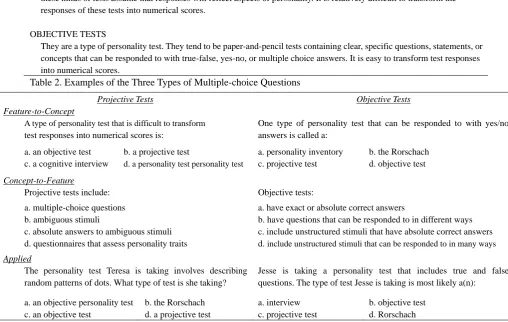
Table 2. Examples of the Three Types of Multiple-choice Questions
Projective Tests Objective Tests
Feature-to-Concept
A type of personality test that is difficult to transform test responses into numerical scores is:
One type of personality test that can be responded to with yes/no answers is called a:
a. an objective test b. a projective test a. personality inventory b. the Rorschach c. a cognitive interview d. a personality test personality test c. projective test d. objective test Concept-to-Feature
Projective tests include: Objective tests:
a. multiple-choice questions b. ambiguous stimuli
c. absolute answers to ambiguous stimuli d. questionnaires that assess personality traits
a. have exact or absolute correct answers
b. have questions that can be responded to in different ways c. include unstructured stimuli that have absolute correct answers d. include unstructured stimuli that can be responded to in many ways Applied
The personality test Teresa is taking involves describing random patterns of dots. What type of test is she taking?
Jesse is taking a personality test that includes true and false questions. The type of test Jesse is taking is most likely a(n): a. an objective personality test b. the Rorschach a. interview b. objective test
c. an objective test d. a projective test c. projective test d. Rorschach
One learning strategy that embraces the latter issue is differential-associative processing. Differential-associative processing itself is based on premises of two well-established cognitive theories, namely the distinctiveness hypothesis (e.g., Epstein, Phillips & Johnson, 1975; Mantylă, 1986; Radvansky, 2006) and the associative strength theory (e.g., Hall¸ 1991; Hall, Mitchell, Graham, & Lavis, 2003). Briefly, the distinctiveness hypothesis proposes that when the to-be-learned information is learned in a distinct or unique manner this to-be-learned information is remembered better than when it is not learned distinctively; see Hannon (2012) and Hannon et al., (2010) for more on the distinctiveness hypothesis. Thus, according to the distinctiveness hypothesis, the correct answer (i.e., ambiguous stimuli)for the multiple-choice question Projective tests include: a. multiple-choice questions; b. ambiguous stimuli; c. absolute answers to ambiguous stimuli; d. questionnaires that assess personality traits will be easier to identify if it (i.e., ambiguous stimuli) is previously encoded in a distinctive manner. According to the associative strength theory, cues for retrieving to-be-learned information, like the question stems exampled in Table 2, are more effective if they have been repetitively linked or ‟associated‟ with other to-be-remembered information. For instance, the question stem „A type of personality test that is difficult to transform test responses into numerical scores is:‟ will be more effective as a retrieval cue for the correct answer projective tests if the concept feature is difficult to transform test responses into numerical scores and the concept‟s name projective tests were previously related or associated during learning.
Differential-associative processing itself includes two major steps: (i) a differential processing step that involves identifying important differences in the definitions for two related concepts, and (ii) an association step that involves each feature of an identified difference with the name of its respective concept. Consider, for example, the definitions for projective tests and objective tests depicted in Table 1. During the differential processing step a student might identify the difference projective tests assess subjective responses; objective tests include true-false, yes-no or multiple choice questions; see Table 3 for other examples of differences. This identification of critical differences between the definitions for projective tests and objective tests makes these critical differences distinctive in the memory traces of each concept (Hannon, 2012; Hannon et al., 2010). Thus when answering questions like those in Table 2, students are more likely to remember the critical differences and are therefore less likely to be entrapped by the alternative lures in the multiple-choice questions.
Table 3. Examples of Student Responses for Differential-associative Processing Condition.
1. It is relatively difficult to transform the responses of projective tests into numerical scores; it is relatively easy to transform the responses of objective tests into numerical scores.
2. Projective tests assess subjective responses; objective tests include true-false, yes-no, or multiple choice questions
3. Projective tests are composed of unstructured stimuli; objective tests tend to be paper-and-pencil tests containing clear, specific statements or concepts
During the association step a research assistant provides the student one feature (i.e., half of the identified difference) at a time. For example, the research assistant might provide the student with the feature this type of test assesses subjective responses. At this point, the student is asked to respond with the name of the correct concept, for example projective tests. Presumably by associating the critical differentiating features with their respective concepts the strengths of the association between these critical features and their respective concept name are increased (Hannon, 2012; Hannon et al., 2010). Thus when answering multiple-choice questions like those in Table 2, students are less likely to be uncertain about which feature is associated with which concept and consequently, are more likely to answer the questions correctly.
In another study Hannon et al. (2010) compared the efficacy of differential-associative processing with three other learning strategies, namely a text-based elaboration condition, a condition in which both similarities and differences were generated, and a control condition in which students learned the definitions of related concepts using a strategy of their own choice. Hannon et al. observed that differential-associative processing was a much better learning strategy then were any of the other three learning strategies.
As successful as these preliminary studies are there are, nevertheless, some limitations. For example, there are two alternative explanations for Hannon et al.‟s (2010) finding that differential-associative processing is more effective for learning related concepts than is a control condition in which students used a learning strategy of their own choice. First, because students in Hannon et al.‟s differential-associative processing condition viewed the definitions of the concepts twice whereas students in their control condition viewed the definitions only once, distributed practice can explain Hannon et al.‟s findings rather than differential-associative processing per se (See Baddeley, 1990 for more on distributed practice). Second, because students in Hannon et al.‟s differential-associative processing condition spent more time learning the definitions than students in their control condition, differences in total time spent learning the concepts can also explain Hannon et al.‟s findings rather than differential-associative processing per se.
In addition, because all the experiments in Hannon (2012) and Hannon et al.‟s (2012) studies assessed the efficacy of differential-associative processing immediately after learning the definitions of the concepts, we do not know how robust the knowledge is that is acquired by using differential-associative processing. For example, does this knowledge last beyond immediate testing? Understanding the extent that knowledge endures after using differential-associative processing is important, especially in academic learning settings because if it does not endure than students are better off selecting an alternative learning strategy. Finally none of the previous studies examined whether the mnemonic value of differential-associative processing changes with the addition of a 10-minute review just before testing. The value of acquiring this knowledge is also a practical one because many students spend a few minutes reviewing their notes just prior to an examination.
Thus the goals of the present study are (i) to assess whether the knowledge acquired using differential-associative processing lasts beyond immediate testing, (ii) to determine whether the mnemonic value of differential-associative processing changes with the addition of a 10-minute review just before testing, and (iii) to compare the mnemonic value of differential-associative processing with two different types of control conditions. The first control condition, called the paired-presentation control condition, presents the definitions for pairs of related concepts simultaneously in the middle of a computer screen much like the definitions for
projective tests and objective tests are depicted in Table 1.However, unlike the control condition used in Hannon et al.‟s study, this paired-presentation control condition presents the definitions for the related concepts twice. The second control condition, called the single-presentation control condition, presents the definitions for the concepts individually in the middle of a computer screen. This control condition also presented the definitions of the concepts two times. This control condition was selected because the presentation of the definitions is more analogous to how students study (Hannon et al., 2010).
2. Method
2.1 Participants
Two hundred and seventeen students, who were attending a university in southern Texas, received $30.00 for their participation. The data for one student in the single-presentation control condition was removed because this student did not return for the second session. The remaining 216 students were fluent English speakers who were free of any learning disability. One hundred and forty-four students were tested individually in a single session while the other 72 students were tested individually in two sessions. The average age for the 216 students was 18.62 years (SD = 0.79) and 112 of the students were male and 104were female.
2.2 Design
variables, pre-testing review and type of multiple-choice question were within-subjects variables. Finally, the total experiment time ranged from 1.25 to 2.25 hours.
Students were randomly assigned to the differential-associative processing condition, the paired-presentation control condition, or the single-presentation control condition, which are described below. Students were also randomly assigned to the no delay, 30-minute delay, and the one-day delay conditions. Because type of learning and length of delay were between-subjects variables, 24 students completed the no delay differential-associative processing condition, 24 students completed the 30-minute delay differential-associative processing condition, 24 students completed the one-day delay differential-associative processing condition, 24 students completed the no delay paired-presentation control condition,24 students completed the 30-minute delay paired-presentation control condition, 24 students completed the one-day delay paired-presentation control condition, 24 students completed the no delay single-presentation condition, 24 students completed the 30-minute delay single-presentation condition, 24 students completed the one-day delay single-presentation condition.
2.3 Concept Definition Processing Task
2.3.1 Materials
The definitions of concepts and accompanying multiple-choice questions that were used in the present study were a subset of stimuli used by Hannon (2012) and Hannon et al. (2010). Briefly, the present study included 16 pairs of definitions of related concepts that were taken or adapted from Abnormal Psychology, Memory, Cognitive Psychology, and Introductory to Psychology textbooks (e.g., Bernstein et al., 1994; Davison & Neale, 1990; Haberlandt, 1999; Matlin, 2003; Myers, 1992; Nairne, 2003; Reed, 2004). Some of the properties of the definitions of the pairs of concepts were: (i) the definitions were only a few sentences in length, (ii) the pairs of concepts represented different content areas of Psychology (i.e., Cognition, Health, Learning, Abnormal, Personality, and Social Psychology), (iii) each pair of definitions included at least two identifiable differences, and (iv) the definitions in each pair of concepts were semantically related. Examples of pairs of concepts include:
genotype-phenotype, objective tests-projective tests, egoistic suicide-anomic suicide, and retrograde amnesia-anterograde amnesia. See Table 1 for the definitions for a pair of related concepts.
The definitions for the pairs of concepts were divided into two sets of eight unique pairs each. Because there were two sets of concepts but each student completed only a single set, the two sets of concepts were counterbalanced equally across the three learning strategy conditions, differential-associative processing, paired-presentation control, and the single-presentation control. For the differential-associative processing and paired-presentation control conditions, the pairs of definitions were randomly presented in the middle of the computer screen one pair at a time, much like the pair of definitions depicted in Table 1.For the single-presentation control condition the definitions of the concepts were randomly presented individually in the middle of a computer screen. For all three learning strategy conditions the presentation time was recorded by the computer.
Each set of eight concepts was also divided into two subsets. Students reviewed their notes about the definitions of the concepts for one subset of definitions (i.e., four pairs of definitions) just prior to testing; the other subset of definitions (i.e., the other four pairs of definitions) was not reviewed just prior to testing. The two subsets of definitions of concepts were counterbalanced such that an equal number of students reviewed each subset of concepts.
Forty-eight four-choice multiple-choice questions accompanied each set of eight pairs of concepts. See Table 2 for examples. As noted by Hannon (2012) and Hannon et al. (2010), the multiple-choice questions were taken or adapted from Introductory Psychology test banks. Each question appeared separately in the center of a computer screen and it remained there until the student responded by selecting one of the four question choices. The response selection and response accuracy was recorded by the computer. Because there were 3 questions for each concept, 2 concepts in each pair of concepts, and 8 pairs of concepts in each set of concepts, 48 multiple-choice questions followed each set of 8 pairs of concepts (i.e., 3 * 2 * 8 = 48 multiple-choice questions per set of concepts). There were also three types of multiple-choice questions, namely feature-to-concept questions, concept-to-feature
questions, and applied questions. These three types of multiple-choice questions were included because (i) multiple-choice test banks routinely assess knowledge about concepts using these three types of questions and (ii) the present study wished to keep the stimuli as ecologically valid as possible. As Table 2 shows, for a
In order to ensure that each multiple-choice question had some level of difficulty, all students answered the 48 multiple-choice questions for the eight pairs of definitions of concepts that they did not study (i.e., if a student learned the definitions for set one, they answered the multiple-choice questions for set two without learning the definitions in advance). The results revealed a mean performance of 39% (SD = 11%), which is equivalent to the 38% (SD = 12%) observed by Hannon et al., (2010).
Finally, students in the paired-presentation and single-presentation control conditions completed short pre- and post-study questionnaires. These questionnaires inquired about the learning strategies that students typically used to learn their course information. Specifically, the pre-study questionnaire asked: (1) What strategies students used to learn concepts when studying for tests and (2) What strategy is used the most. The post-study questionnaire asked: (1) What strategies the students used to learn the definitions of the concepts in the present study and (2) Was this the same strategy that students used to learn concepts in their introductory courses.
2.3.2 Procedure
Regardless of the learning condition, each student completed a specific sequence of tasks. First, in order to introduce the students to their pre-assigned learning condition (i.e., differential-associative processing, paired-presentation control, or single-presentation control), students practiced their assigned learning strategy by learning the definitions of four pairs of psychological concepts. During this step students received feedback about their strategy use and students did not complete multiple-choice questions. Next, students learned the definitions of the eight critical pairs of psychological concepts using their pre-assigned learning strategy. During this step the research assistant recorded the information that a student generated during learning. For many of the strategies, such as keywords, the research assistant simply recorded the information generated by the student. For differential-associative processing the research assistant recorded the differences. For rehearsal (i.e., repeating the definitions) the research did not record anything as the students were given a copy of the pertinent definitions during the review phase. Third, there was a pre-determined delay; for some students this delay was 0 minutes in length while for other students it was either 30 minutes in length or an entire day. During the 30-minute delay students were asked to preoccupy themselves. Most students chose to text friends or read a magazine. Fourth, students reviewed their notes, which were recorded by the research assistant earlier, for four pairs of definitions of concepts that they learned during step two. Fifth, students answered multiple-choice questions that assessed their knowledge about the eight critical pairs of concepts. Sixth, all students completed a demographic questionnaire. Finally, all students finished multiple-choice questions about the definitions for an additional eight pairs of concepts. Because students had not viewed the definitions for this second set of concepts in advance, these questions served as a baseline about students‟ knowledge of the definitions of concepts.
The differential-associative processing condition included three steps. In the first step, the definitions for a pair of concepts were presented simultaneously in the middle of a computer screen and students were instructed to read the definitions aloud. In the second step students identified two differences between the definitions of the concepts. For example, for the concepts projective tests-objective tests students might generate the differences (i) it is relatively difficult to transform the responses of projective tests into numerical scores but it is relatively easy to transform the responses of objective tests into numerical scores and (ii) projective tests assess subjective responses whereas objective tests include true-false, yes-no, or multiple choice questions. See Table 3 for another example. All responses were recorded by the research assistant and students were given as much time as needed to identify the differences. Students were not provided hints about differences between the concepts. Because there was a possibility of students generating incorrect differences, the percent of incorrect differences was calculated. In total, students generated incorrect differences < 3.0% of the time. Students repeated step two for all eight critical pairs of definitions. During the third step, which occurred immediately after identifying two differences for all the pairs of concepts in a set, students completed the association phase. During this step, the research assistant stated a feature for a concept (e.g., they assess subjective responses) and the student identified the concept label for that feature (e.g., projective tests). Students were allowed to refer to the definitions of the relevant pair of concepts as they were completing this step. After associating the four features for the first pair of concepts, students repeated this association phase for the seven remaining pairs of concepts in a set.
of concepts in the middle of a computer screen. During this step, students were asked to spend more time learning the definitions of the concepts using the same learning strategy that they used during steps two and three. Students repeated this fourth step until they had again learned all eight pairs of definitions for the critical concepts. The final step was the post-test questionnaire, which was administered after the multiple-choice questions were answered. The single-presentation control condition included five steps. In the first step, students completed the pre-test questionnaire that was described in the materials section. Next, students read aloud a single definition for a concept that was randomly presented individually in the middle of a computer screen. During the third step, while the definition for a concept was still in the middle of the computer screen, students learned the definition using a strategy of their own choice. This learning strategy choice was also recorded by the research assistant. Students were given as much time as they needed to learn a definition. Students repeated steps two and three until all 16 definitions were learned (i.e., 8 pairs of definitions = 16 individual definitions). During the fourth step, students were again presented the same definitions for the concepts. Each definition for a concept was again presented in the middle of a computer screen. During this step, students were asked to spend more time learning the definition of a concept using the same learning strategy that they had used during step two. Students repeated this step until all 16 definitions were again learned. The fifth step was the post-test questionnaire, which was administered after the multiple-choice questions were answered.
3. Results
3.1 Questionnaires about Strategy Choices
The first goal was to assess the learning strategy choices in the paired- and single-presentation control conditions. In general, ninety-nine percent of the students used the same strategy that they use in their classes. More specifically, 91.2% of the students simply rehearsed or re-read the concepts and the remaining 8.8% used either analogies, associations, keywords, or some variation of elaboration. When strategy choices for the paired-presentation control condition and single-presentation control condition were considered separately, the frequency of the choices of learning strategies were identical in the two control conditions.
3.2 Analysis of Data
The alpha level was set to .05 for the Analysis of Variance (i.e., ANOVAs) and effect sizes were calculated with eta-squared (i.e., η2). Based on guidelines specified by Cohen (1988), an η2 ≥ .14 was considered to be a large effect that is rare in the behavioral sciences, an η2 between .06 and .139 was considered to be a medium effect, an
η2
between .011 and .059 was considered to be a small effect, and an η2 ≤ .01 was considered to be a trivial effect. See Runyon, Coleman and Pittenger (2000) for a discussion of effect sizes; see Hannon (2012), Hannon et al., (2010), and Hannon and Daneman (2001; 2007) for calculations and applications of effect sizes using eta-squared. In order to control for experiment-wise error, the alpha level was set to .02 for all t-tests and all t-tests were also two-tailed. Effect sizes in the form of d were calculated for all significant t-tests. Based on the guidelines specified by Runyon et al. (2000), a d > .80 was considered to be a large effect that is rare in the behavioral sciences, a d
between .40 and .79 was considered to be a medium effect, an a d between .20 and .40 was considered to be a small effect and a d ≤ .20 was considered as trivial. Because effect sizes for t-tests are based on a subset of the data rather than all of the data, like eta-squared, comparisons between d-values and eta-squared are not recommended. The number of correct responses on the multiple-choice questions was calculated for each student. These accuracy scores were submitted to a 3 x 3 x 3 x 2 ANOVA with type of learning (differential-associative processing, paired-presentation control, single-presentation control) and delay (no delay, 30-minute delay, 1-day delay) as between-subjects variables and type of question (concept-to-feature, feature-to-concept, applied) and type of review (review, no review) as within-subjects variables.
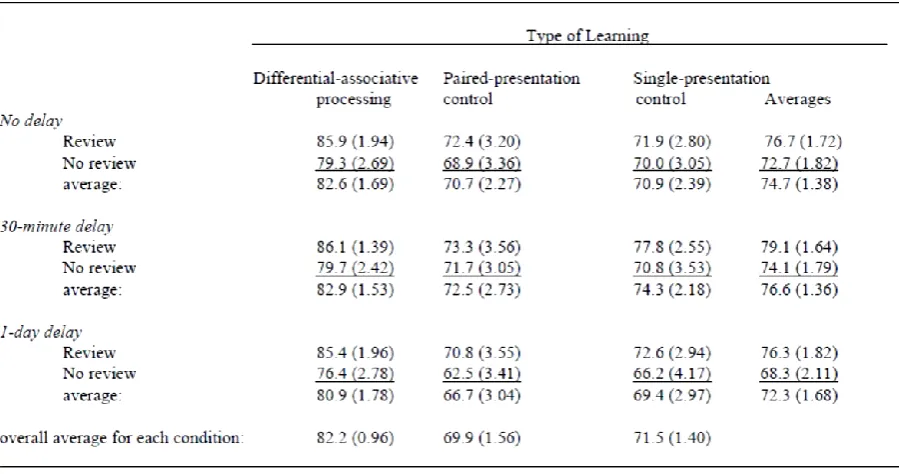
As Table 4 shows, differential-associative processing was a better strategy for learning definitions of related concepts than were the other two types of learning conditions. That is, there was a main effect of condition such that students who learned concepts using differential-associative processing answered 82.2% of the multiple-choice questions correctly whereas students who learned concepts using a strategy of their own choice in the paired- and single-presentation conditions answered 69.9% and 71.5% of the questions correctly respectively,
Table 4. Percentage of Correct Responses to Multiple-Choice Questions as a Function of Type of Learning, Delay, and Whether Notes were Reviewed Prior to Testing
Note. Standard errors are in brackets. For each set of numbers in the “Averages column (i.e., last column)”, the first number represents the percent correct for the review condition averaged across the three learning conditions, the second number represents the percent correct for the no review condition averaged across the three learning conditions, and the third number represents the percent correct for the type of delay averaged across the three learning conditions and the two review conditions. The “overall average for each condition” is the average for each learning condition. Thus the first number is the average percent correct for differential-associative processing, the second number is the average percent correct for the pair-presentation control condition, and the third number is the average percent correct for the single-presentation control condition.
Table 5. Percentage of Correct Answers as a Function of Type of Question
Type of Question: Percent Correct
Feature-to-concept 77.7 (0.98)
Concept-to-feature 74.8 (0.97)
Applied 71.1 (1.11)
Note. Standard errors are in brackets. N = 216.
There was also a main effect for review, F (1, 207) = 20.98, MSE = 65.79, η2= .02 such that more questions were answered in the review condition than in the no review condition, 77.4% versus 71.7% respectively. Additionally, as Table 5 shows, there was a main effect of question type, F (2, 414) = 24.28, MSE = 29.96, η2= .02 such that more feature-to-concept questions were answered correctly than concept-to-feature questions (i.e., 77.7% versus 74.8% respectively), t (215) = 3.35, d = .20, and more concept-to-feature questions were answered correctly than applied questions (i.e., 74.8% versus 71.1% respectively), t (215) = 3.88, d =.24 (i.e., feature-to-concept > concept-to-feature > applied).
delay and one-day delay conditions, max t(142) = 2.06, p < .02, but there was no significant difference between the no review no delay and no review 30-minute delay conditions.
In addition, none of the six two-way interactions (i.e., type of learning X delay, type of learning X review, type of learning X question type, delay X review, delay X type of question, and review X type of question), the four three-way interactions (i.e.*, type of learning X delay X review, type of learning X delay X type of question, type of learning X review X type of question, delay X review X type of question), or the four-way interaction (i.e., type of learning X delay X review X type of question) were significant, maximum F = 1.28 to minimum F = .25, all
p‟s > .27.Indeed, the effect sizes for all of these interactions were also trivial by Cohen‟s standards, all η2<.008. Thus, the results of the present study revealed only main effects for (i) type of learning strategy, (ii) review, (iii) type of question, and (iv) delay.
In order to ensure that total time could not be an alternative explanation for the positive findings of differential-associative processing, the total time to learn the definitions of the concepts was submitted to a 3 x 3 x 2 ANOVA with type of learning strategy (differential-associative processing, paired-presentation control condition, single-presentation control condition) and delay (no delay, 30-minute, one day) as between-subjects variables and pre-testing review (10-minute review, no review) as a within-subjects variable. The results revealed no significant effects. Specifically, the effect for condition was not significant, F (2, 207) = 2.12, MSE = 297939, p
= .12, and the remaining six effects had F’s< 1.0. Thus, although students in the differential-associative processing condition performed better than students in the paired- and single-presentation control conditions, it was not because the students spent more time learning the definitions.
4. Discussion
Introductory courses are inundated with definitions of related concepts (Hannon et al., 2010); yet, until recently, no study has examined which learning strategy might be best for successfully learning this type of material. The goal of the present study was to further explore the properties of differential-associative processing, a learning strategy that has proven to be effective for learning definitions of related concepts. More specifically, the present study assessed whether the knowledge acquired using differential-associative processing lasts beyond immediate testing, (ii) assessed whether the mnemonic value of differential-associative processing changes with the addition of a 10-minute review just before testing, and (iii) compared the mnemonic value of differential-associative processing with two different types of control conditions in which students selected the strategy of their own choice. The present study revealed positive outcomes for differential-associative processing for all three goals.
More specifically, the present results revealed that performance on multiple-choice questions in the differential-associative processing condition was better than performance on multiple-choice questions in either the paired-presentation control condition or single-presentation control conditions. This finding is consistent with previous research which also showed that differential-associative processing is a more effective learning strategy than is a strategy of a student‟s own choice (Hannon, 2012; Hannon et al., 2010). However, the present result also extends previous research in two important ways. First as noted in the introduction, although Hannon et al. (2010) compared the mnemonic value of differential-associative processing to that of a control condition, the definitions for the pairs of related concepts were presented twice in Hannon et al.‟s differential-associative processing condition but only once in their control condition. Thus, Hannon et al.‟s finding that performance in a differential-associative processing was better than that in a control condition can be attributed to the multiple presentations of the definitions in the differential-associative processing condition and not differential-associative processing per se. The present study eliminated this explanation because the definitions of the pairs of related concepts were presented two times in both the paired- and single-presentation control conditions.
Second, the total time to learn the definitions of pairs of related concepts in Hannon et al.‟s (2010) study was greater than the total time to learn the same definitions in their control condition. Thus, Hannon et al.‟s finding that performance in a differential-associative processing was better than performance in a control condition could be attributed to the total time students spent learning the definitions and not differential-associative processing per se. The present study eliminates this explanation because the total times to learn the definitions of related concepts in the differential-associative processing, paired-presentation control condition, and the single-presentation control condition were equivalent.
10-minute review. From a practical perspective, for differential-associative processing this finding shows that other factors, such as pre-testing reviewing, can have a positive, additive influence on differential-associative processing. For the other two learning conditions, paired- and single-presentation control conditions, it shows that pre-testing reviewing also has a positive additive influence on performance on multiple-choice questions. It should also be noted that the present study is not the first study to observe positive influence for reviewing just prior to studying. Indeed reviewing is one component of SQ3R (i.e., survey, question, read, recite, review), an established learning and teaching strategy (e.g., Carlston, 2011; Lipston & Wixton, 2003; McCormick & Cooper, 1991). Thus, one avenue for future research might be to compare the mnemonic benefit of differential-associative processing versus SQ3R as effective strategies for learning definitions of pairs of related concepts.
Finally, the results revealed that performance in the no delay and 30-minute delay conditions was significantly greater than performance in the one-day delay condition. However, length of delay between learning and testing did not interact with any other factors (i.e., type of learning, review, type of question). The lack of interactions between length of delay and other factors suggests that delay has a consistent negative influence on all of the different types of learning strategies. Thus, although the results suggest that differential-associative processing is negatively influenced by longer delays between learning and testing, this negative influence is not greater than or lesser than that for other learning strategies.
Taken as a whole, the present research adds to a growing literature assessing the effectiveness of learning strategies. One such strategy, called retrieval practice, involves repeatedly recalling to-be-tested information (e.g., Roediger & Karpicke, 2006a; 2006b). For example, if the to-be-tested information is a short passage, the student will re-read the passage and complete multiple recalls of the passage before testing. In general, research suggests that in comparison to repeated re-reading, repeatedly recalling of to-be-tested information results in higher performance (Roediger & Karpicke, 2006a). Research also suggests that retrieval practice results in greater learning than does elaborative studying with concept mapping (Karpicke & Blunt, 2011).
Because of these positive findings for retrieval practice, one plausible avenue for future research might be to compare the efficacies of retrieval practice and differential-associative processing using definitions of pairs of related concepts. On the one hand, it is possible that both strategies are equally effective given that both differential-associative processing and retrieval practice are more effective for learning than repeating the to-be-learned -information. Additionally, both differential-associative processing and retrieval practice result in greater learning than do other forms of elaborative processing. On the other hand, as noted in the introduction with definitions of related concepts it is important that the to-be-learned information overlaps with the to-be-tested information (Hannon et al., 2010). While one of the fundamental underlying premises of differential-associate processing is that differential-associative processing focuses on the critical to-be-learned information that overlaps with the to-be-tested information, retrieval practice does not attend to this overlap. Rather, retrieval practice focuses on practicing information that a learner believes will be tested. Consequently, it is highly possible that when the efficacies of these two strategies are compared differential-associative processing will be a more successful learning strategy than retrieval practice, especially when the to-be-learned information is definitions of related concepts.
Of course, the present study also has limitations. One limitation is that both the present and previous studies have used only definitions of related concepts and multiple-choice questions taken from Introductory to Psychology textbooks and test banks. Although many students take introductory psychology courses and thus, the stimuli used in the present study are important and ecologically valid, it is important to determine whether differential-associative processing is equally effective on definitions and questions taken from other courses such as biology or chemistry. Another limitation is that the present study used only pairs of definitions of related concepts. It would be interesting to determine whether differential-associative processing is equally as effective with three, four, or even five definitions of related concepts. Yet another limitation is that presently differential-associative processing has been assessed in a laboratory. It would be interesting to examine whether differential-associative processing can be administered to a group of students, perhaps in a classroom. Similarly, it would be interesting to examine whether differential-associative processing can be used as an instructional method where a teacher might ask students to generate differences between related concepts.
Acknowledgements
This research was funded by a NIMH grant to Dr. Brenda Hannon (i.e., SC1 GM081087-03S1). I thank Sarah Schirmer and Stephanie Keller for their invaluable assistance with booking participants, running participants, scoring data and manuscript preparation.
References
Adams, L. T., Kasserman, J. E., Yearwood, A. A., Perfetto, G. A., Bransford, J. D., & Franks, J. J. (1988). Memory access: The effects of fact-orientated versus problem-orientated acquisition. Memory & Cognition, 16, 167-175.
Baddeley, A. (1990). Human memory: Theory and practice. Boston, MA: Allyn and Bacon.
Bernstein, D. A., Clarke-Stewart, A., Roy, E. J., Srull, T. K., & Wickens, C. D. (1994). Psychology, third edition. Boston, MA: Houghton Muffin Company.
Cohen, J. (1988). Statistical power analysis for the behavioral sciences. (2nd ed.). New York: Academic Press. Davidson, G. C., & Neal, J. M. (1990). Abnormal psychology, fifth edition. New York, NY: John Wiley & Sons. Epstein, M. L., Phillips, W. D., & Johnson, S. J. (1975). Recall of related and unrelated word pairs as a function of
processing level. Journal of Experimental Psychology: Human Learning and Memory, 1, 149-152. Haberlandt, K. (1999). Human memory: Exploration and application. Boston, MA: Allyn and Bacon. Hall, G. (1991). Perceptual and associative learning. Oxford: Oxford University Press, Clarendon Press. Hall, G., Mitchell, C., Graham, S., & Lavis, Y. (2003). Acquired equivalence and distinctiveness in human
discrimination learning: Evidence for associative mediation. Journal of Experimental Psychology: General, 132, 266-276.
Hamilton, R. (1989). The effects of learner-generated elaborations on concept learning from prose. Journal of Experimental Education, 57, 205-217.
Hannon. (2012). Differential-associative processing or elaboration: Which strategy is best for learning the definitions of similar and unrelated pairs of concepts? Learning and Instruction, 22, 299-310. http://dx.doi.org/10.1016/j.learninstruc.2011.11.005
Hannon, B., & Craik, F. I. M. (2001). Encoding specificity revisited: The role of semantics. Canadian Journal of Psychology, 55, 231-243.
Hannon, B., & Daneman, M. (2001). Susceptibility to semantic illusions: An individual-differences perspective.
Memory and Cognition, 19, 449-461.
Hannon, B., & Daneman, M. (2007). Prospective memory: The relative effects of encoding, retrieval and the match between encoding and retrieval. Memory, 15, 572-604. http://dx.doi.org/10.1080/09658210701407281 Hannon, B., Lozano, G., Frias, S., Picallo-Hernandez, S., & Fuhrman, R. (2010). Differential-associative processing: A new strategy for learning highly-similar concepts. Applied Cognitive Psychology, 24,
1222-1244. http://dx.doi.org/10.1002/acp.1625
Just, M. A., & Carpenter, P. A. (1988). The psychology of reading and language comprehension. Newton, MA: Allyn and Bacon.
Kaartinen, S., & Kumpulainen, K. (2002). Collaborative inquiry and the construction of explanations in the learning of science. Learning & Instruction, 12, 189-212.
Karpicke, J. D., & Blunt, J. D. (2011). Response to comment on ''Retrieval practice produces more learning than elaborative studying with concept mapping''. Science, 334, 453. http://dx.doi.org/10.1126/science.1199327 Lipston, M. Y., & Wixton, K. K. (2003). Assessment and instruction of reading and writing disability. (3rd edition).
NY: Longman.
Mäntylä, T. (1986). Optimizing cue effectiveness: Recall of 500 ad 600 incidentally learned words. Journal of Experimental Psychology: Learning, Memory, and Cognition, 12, 66-77.
Matlin, M. (2003). Cognition, third edition. Toronto, Ontario: Harcourt Brace Publishers.
McCormick, S., & Cooper, J. O. (1991). Can SQ3R facilitate secondary learning disabled students‟ reading comprehension of expository text? Three experiments. Reading Psychology, 12, 239-271.
Nairne, J. S. (2003). Psychology: The adaptive mind, third edition. Belmont, CA: Thomson-Wadsworth. Radvansky, G. (2006). Human memory. New York: New York: Pearson.
Reed, S. K. (2004). Cognition: Theory and applications, sixth edition. Belmont, CA: Wadsworth-Thomson. Roediger, H. L., & Karpicke, J. D. (2006a). Test-enhanced learning: Taking memory tests improves long-term
retention. Psychological Science, 17, 249-255. http://dx.doi.org/10.1111/j.1467-9280.2006.01693.x. Roediger, H. L., & Karpicke, J. D. (2006b). The power of testing memory: Basic research and implications for
educational practice. Perspectives on Psychological Science, 1, 181-210.
http://dx.doi.org/10.1111/j.1745-6916.2006.00012.x.
Runyon, R. P., Coleman, K. A., & Pittenger, D. J. (2000). Fundamentals of behavioral statistics (9th ed.). Boston: McGraw-Hill Higher Education.
Simpson, M. L., Olejnik, S., Tam, A. Y., & Supattathum, S. (1994). Elaborative verbal rehearsals and college students‟ cognitive performance. Journal of Educational Psychology, 86, 267-278.
Tennyson, R. D., & Cocchiarella, M. (1986). An empirically based instructional design theory for teaching concepts. Review of Educational Research, 56, 40-71.
Tennyson, R. D., & Park, O. (1980). Teaching concepts: A review of instructional design research literature.
Review of Educational Research, 50, 55-70.
Tulving, E., & Thomson, D. M. (1973). Encoding specificity and retrieval processes in episodic memory.
Psychological Review, 80, 352-373.
Woloshyn, V. E., Wood, E., & Willoughby, T. (1994). Considering prior knowledge when using elaborative interrogation. Applied Cognitive Psychology, 8, 25-36.