CAUSES OF CONFLICTS IN CONSTRUCTION PROJECTS IN NIGERIA:
CONSULTANT’S AND CONTRACTOR’S PERSPECTIVE
O. A. Ejohwomu
1, O. S. Oshodi
2and M. K. Onifade
3,*1,3DEPARTMENT OF MANAGEMENT TECHNOLOGY,BELLS UNIVERSITY OF TECHNOLOGY,OTA,OGUN STATE.NIGERIA 2DEPARTMENT OF ARCHITECTURE AND CIVIL ENGINEERING,CITY UNIVERSITY OF HONG KONG,HONGKONG E-mail addresses:1[email protected],2[email protected], 3[email protected]
ABSTRACT
Construction projects are prone to conflicts. This is due to the multiplicity of individuals handling different phases of the projects. Empirical evidence from previous studies shows that conflicts affects projects outcomes, if not properly managed. Identification of the significant causes of conflicts is critical to minimizing the likelihood of conflicts occurring in projects. Thus, this study was aimed at identifying and assessing causes of conflicts in Nigeria based on the perception of consultants and contractors. To achieve the study’s objectives, a 64-item questionnaire was used to collect information on experiences of construction professionals on the causes of conflicts in Nigerian construction projects. Responses from 69 professionals working for consultants and contractors were analysed. Seven significant causes of conflicts in the Nigerian context were identified. Based on the survey results, poor financial projections on the client’s side was identified as the most significant cause of conflicts. Furthermore, it was found that there are no difference in the perception of both groups of respondents. Taken together, these findings support strong recommendations on the need for effective management of finance on the client side, and engagement of experienced consultants in project. Implementation of these recommendations will minimize the likelihood of conflicts occurring in construction projects.
Keywords: Conflict, construction projects, consultants, contractors, Nigeria.
1. INTRODUCTION
Construction projects involve several actors. These actors can be classified as internal (e.g. consultant, client and contractor) or external (stakeholders who do not partake in the construction process such as users). Research has shown, risks is inherent in construction projects and are more when compared with projects in other industries [1]. However, it must be noted that unmanaged risk results into conflicts [2], exacerbated the fragmented nature of the construction industry.
Conflict is described as "any divergence of interests, objectives or priorities between individuals, groups, or organisations; or non-conformance to requirement of a task, activity or process” [3]. A generally accepted definition of conflict is lacking. However, a common definition that emerges from the definitions found in literature shows that conflicts is any disagreements which arise amongst individual due to non-convergence of ideas, interest and concerns. It is evident that conflicts in construction projects arise
due to due to differences in interest, concerns, training, and perception of individuals [2], [4]. Human interactions in construction projects (design, planning and construction phase) portend conflicts. This is supported by assertions from various studies which show that conflicts arise in construction projects due to adversarial relationships, multi-disciplinary nature and differences in interest of project participant in the construction industry [5]–[7].
There is a general consensus that conflicts yield dysfunctional project outcomes. Empirically, it has been shown that project actors have great impact on project performance. Hence, a breakdown of relations amongst project actors leads to poor performance [8]. The evident implication of which is low productivity, low morale, distrust, communication problems, requirement instability, rework and disputes [9], [10]. However, Leung and colleagues contend conflicts yield can also yield functional project outcomes (in terms of improved decision making, trust, team creativity, stakeholder satisfaction and group performance)[11].
Vol. 35, No. 2, April 2016, pp. 270 – 277 Copyright© Faculty of Engineering, University of Nigeria, Nsukka,
Print ISSN: 0331-8443, Electronic ISSN: 2467-8821 www.nijotech.com
Furthermore, evidence suggests conflicts must be managed (i.e. keeping conflicts within allowable limits) so as to make optimize its functional outcomes [12].
Based on the foregoing, it is evident that conflicts and its management are essential components for improving project outcomes. Awakul and Ogunlana [12] emphasized the need to identify causes of conflicts, as this will improve conflict avoidance and resolution, and ultimately lead to improved project performance. Several studies have been conducted to identify causes of conflicts in Hong Kong [6], [13]; Thailand [12]; and Korea [2]. However, [14] analysed conflicts in traditional and integrated project procurement methods in Nigerian construction industry. The present study fills a gap in the literature by providing insights into the causes of conflicts in Nigerian construction projects. Thus, it is imperative to identify common causes of conflicts in Nigerian construction industry.The aim of the present study is to identify and assess the causes of conflicts in construction projects in Nigeria, based on the perspective of two project stakeholders (consultant and contractors).Therefore, this study will address the following questions: what are the significant causes of conflicts in Nigerian construction industry? What is the level of agreement on causes of conflict based on the perception of contractors and consultants?
2. LITERATURE REVIEW
2.1 Concept of Conflict, Claim and Disputes
Several authors have used the term conflict, claim and dispute interchangeably in construction-related literature. Acharya et al. [2] point out the differences in conflict, claim and disputes; which is presented in Figure 1.
Figure 1: Risk, conflict, claim and dispute continuum model, Source: Acharya, et al. [2]
Based on Figure 1, it can clearly be seen that conflict and conflict management is an essential ingredient in construction management. Thus, in order to reduce the negative impact of claims and disputes on
construction projects, there is a need to identify causes of conflicts in construction projects in Nigeria.
2.2 Categories of Conflicts
Several classifications of conflicts in construction projects are presented in literature. Awakul and Ogunlana [12] classified conflicts in projects based on origin. The study classified conflicts into internal and interface conflicts. Similarly Dada [14] categorized conflicts into internal and external conflicts. Both studies viewed internal conflicts as conflicts that occur within parties to the contract, such as clients, contractors, and consultants. In contrast, interface (external) conflict refers to conflict between project participants and external stakeholders (users, people affected by project etc.). However, Mahalingam and Levitt [15] classifies conflicts into different phases of construction projects namely: planning, design and construction phase. Similarly, Acharya, et al. [2] presents a more detailed classification of conflicts in construction. Conflicts were classified into client, consultant, contractor, third party and other project related conflict. However, it must be emphasized here that the classifications presented by Acharya, et al. [12] and Mahalingam and Levitt [15] tends to present a more robust classification, however, these classes tend to overlap each other. Thus, classification of conflicts to internal and external, is simpler and will reduce the likelihood of any overlap.
2.3 Causes of Conflicts
Numerous research works have identified causes of conflicts in construction projects in several countries. Awakul and Ogunlana [12] identifies 23 factors leading to interface conflicts in large construction projects in Thailand. Acharya, et al. [2] identifies 43 causes of conflicts in Korean construction projects. Consoli [16] identifies causes of conflicts in private prison projects in Australia. Recently, Ntiyakunze [17] identifies 63 causes of conflicts in building projects in Tanzania
Recent studies have shown identified causes of conflicts to include: ambiguity in specifications, personality clash amongst project participant, choice of procurement method, relationship amongst project participant, differing site conditions, local people obstruction, difference in change order evaluation, excessive quantity of works, size and duration of the project, the complexity of the contract documents, interdependence of task, changed conditions, poor communication, limited (scarce) resources, financial issues, cultural differences, non-convergence of interest, insufficient project management skill, inadequate design, labour issues, third party concerns, politics, feeling of injustice, poor public relation, low level of awareness of benefits of projects, relationship problems, failure of sharing risk, gender (male dominance), lack of continuous improvement, inadequate training, lack of effective Environmental Impact Assessment (EIA), unforeseen site conditions, violation of contract conditions, incomplete project information, poor evaluation of completed works, discrepancies in bills of quantities, difference in legal system and interpretation of law, inadequacy of technical specification, government intervention, insufficient client integration, introduction of design innovations and force majeure events [2], [12], [16], [19]–[25] .
However, it must be noted that the seven causes identified in Wilemon’s study are still corroborated by recent studies. In addition to this seven factors, recent studies have identified several other issues leading to conflicts. Thus, recent studies have presented a more robust collection of likely causes of conflicts in construction projects in several countries.
3. METHODOLOGY
In order to achieve the study objectives, the study methods used literature search, semi-structured interviews and questionnaire surveys. A literature review was undertaken to identify causes of conflicts in construction projects. Furthermore, semi-structured interviews were conducted with three professionals in the construction industry to validate the causes identified from literature. These 3 individuals selected had varying Nigerian construction industry experience of not less than 5 years. Questionnaire survey was used because it can be used to gather information from Large samples. This is similar to methods used in earlier studies [2], [12], [17]. However, Consoli [16] study used a qualitative approach because its main focus was private prison
projects in Australia. Thus, in order to carry out an industry wide study a questionnaire survey is the preferred option.
Furthermore, unlike previous studies such as Acharya,
et al. [2] and Ntiyakunze [17] which covered clients, consultants and contractors. This study focuses on contractor and consultants. This is because most client organisations are usually one-off and as such may not have specialized in-house construction professionals. Thus, most clients engage consultants as their agents.
3.1 Questionnaire Design
The study's instrument was designed based upon literature survey to obtain causes of conflicts in the Nigerian construction industry. Based on extensive review of related literature, semi-structured interviews (3) and authors' construction field experience, 64 causes of conflicts were identified as study's variables. Respondents were asked to rate the causes of conflict according to the following scale: 1 is very low, 2 is low, 3 is moderate, 4 is high, 5 is very high.
The questionnaire was contained in two parts. The first part was about demographical data of respondents and the second part was about identifying causes of conflicts. The questionnaire was designed in a five-point Likert scale to get the perception of professionals involved in construction (contractor's and consultant's).
3.2 Questionnaire Distribution
Two major project participants (i.e. consultant and contractor group) were the target population of this study. The respondents were identified through personal contact and referrals. The questionnaires were delivered directly to respondents. The filled questionnaire were retrieved two weeks after the initial administration.
Table 1: Demographic data of respondents
Consultant Contractor Overall Nr % Nr % Nr %
Educational training
Project manager 8 11.6 14 20.3 22 31.9
Others 9 13 5 7.2 14 20.3
Architect 7 10.1 5 7.2 12 17.4
Civil/Structural Engineer
2 2.9 8 11.6 10 14.5
Quantity Surveyor 5 7.2 2 2.9 7 10.1
Surveyor 0 0 3 4.3 3 4.30
Services Engineer 0 0 1 1.4 1 1.4
Highest qualification obtained
OND 2 2.9 2 2.9 4 5.8
HND/BSc. 25 36.2 21 30.4 46 66.7
PGD 0 0 4 5.8 4 5.8
MSc. 4 5.8 11 15.9 15 21.7
Respondent’s years of experience
Less than 5 years 12 17.4 5 7.2 17 24.6
6-10 years 7 10.1 18 26.1 25 36.2
11-15 years 5 7.2 9 13.0 14 20.3
16-20 years 0 0 4 5.8 4 5.8
More than 20 years 7 10.1 2 2.9 9 13.0
Overall 31 55.1 38 44.9 69 100
Source: Field study(2013)
4. DATA ANALYSIS
The mean scores obtained from Statistical Package for Social Scientist (SPSS) were ranked and used to address survey questions. Furthermore, inferential statistics were used to test, the level of agreement between the two sets of respondents (contractor and consultant).
Based on the mean scores the factors are classified as “important” (significant) factors that have mean score higher than 4.0 those with 4.0-3.0 mean scores were considered as moderately important. However, factors with mean score less than 3.0, were considered as unimportant. The independent t-test at 5 percent significance level was further conducted to confirm the difference in the perception of contractors and consultants.
4.1 Results of Survey
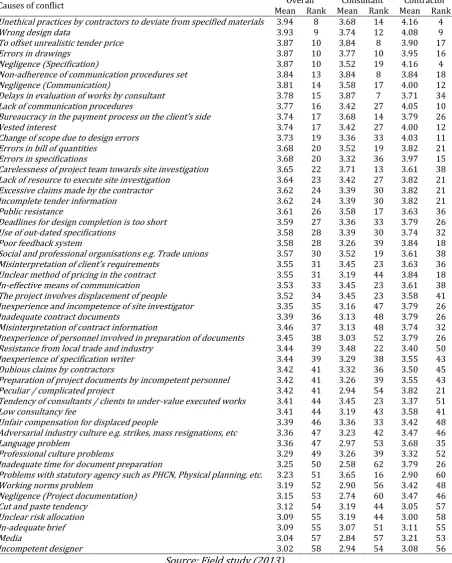
The mean score of all 64 perceived causes of conflicts are presented in Tables 2-4. Table 2 shows mean scores and ranking of significant causes of conflicts in Nigerian construction projects. Table 3 shows mean score and ranking of unimportant factors. While, Table 4 shows mean scores and ranking of moderately important factors.
4.2 Significant Causes of Conflicts
Seven significant causes of conflicts in Nigerian construction industry, have been identified based on the survey results. The significant factors are presented in Table 2, and which are: poor financial projections on the client’s side; poor public relationship between the project people and the public; lack of funds; change of scope of works due client requirement instability; deliberate blockage of information flow; cheap design hired instead of quality and inadequate contract provisions for enforcement of timely payments. The factors have corresponding mean scores of 4.33, 4.26, 4.16, 4.10, 4.04, 4.04 and 4.04 respectively.
However, six conflict factors were identified as unimportant. The mean score values were less than 3.0, this results indicates that these factors are unimportant causes of conflicts in Nigerian construction industry as perceived by construction professionals. The unimportant factors are: superficial investigation of site conditions (2.91), inadequate contract administration (2.90), wrong interpretation of site investigation (2.83), tendency of contractor claiming high prices (2.78), unsuitable contract type (2.75) and inexperience of the designer (2.65).
Next section presents results of independent t-test, which compared the perception of the population groups on their difference in perception of the seven significant causes of conflicts.
Table 2: Significant causes of conflicts
Causes of conflict Mean Rank Mean Rank Mean Rank Overall Consultant Contractor
Poor financial projections on the client’s side 4.33 1 4.36 1 4.32 2
Poor public relationship between the project people and the public 4.26 2 3.77 10 4.66 1
Lack of funds 4.16 3 4.19 2 4.13 6
Change of scope of works due client requirement instability 4.10 4 3.97 4 4.21 3
Deliberate blockage of information flow 4.04 5 3.97 4 4.11 8
Cheap design hired instead of quality 4.04 5 4.10 3 4.00 12
Table 3: Unimportant causes of conflicts
Causes of conflict Overall Consultant Contractor Mean Rank Mean Rank Mean Rank
Superficial investigation of site conditions 2.91 59 2.84 57 2.97 59
Inadequate contract administration 2.90 60 2.58 62 3.16 54
Wrong interpretation of site investigation 2.83 61 2.84 57 2.82 62
Tendency of contractor claiming high prices 2.78 62 3.10 50 2.53 64
Unsuitable contract type 2.75 63 2.68 61 2.82 62
Inexperience of the designer 2.65 64 2.42 64 2.84 61
Source: Field study (2013)
Table 4: Moderately important causes of conflicts
Causes of conflict Overall Consultant Contractor Mean Rank Mean Rank Mean Rank
Unethical practices by contractors to deviate from specified materials 3.94 8 3.68 14 4.16 4
Wrong design data 3.93 9 3.74 12 4.08 9
To offset unrealistic tender price 3.87 10 3.84 8 3.90 17
Errors in drawings 3.87 10 3.77 10 3.95 16
Negligence (Specification) 3.87 10 3.52 19 4.16 4
Non-adherence of communication procedures set 3.84 13 3.84 8 3.84 18
Negligence (Communication) 3.81 14 3.58 17 4.00 12
Delays in evaluation of works by consultant 3.78 15 3.87 7 3.71 34
Lack of communication procedures 3.77 16 3.42 27 4.05 10
Bureaucracy in the payment process on the client’s side 3.74 17 3.68 14 3.79 26
Vested interest 3.74 17 3.42 27 4.00 12
Change of scope due to design errors 3.73 19 3.36 33 4.03 11
Errors in bill of quantities 3.68 20 3.52 19 3.82 21
Errors in specifications 3.68 20 3.32 36 3.97 15
Carelessness of project team towards site investigation 3.65 22 3.71 13 3.61 38
Lack of resource to execute site investigation 3.64 23 3.42 27 3.82 21
Excessive claims made by the contractor 3.62 24 3.39 30 3.82 21
Incomplete tender information 3.62 24 3.39 30 3.82 21
Public resistance 3.61 26 3.58 17 3.63 36
Deadlines for design completion is too short 3.59 27 3.36 33 3.79 26
Use of out-dated specifications 3.58 28 3.39 30 3.74 32
Poor feedback system 3.58 28 3.26 39 3.84 18
Social and professional organisations e.g. Trade unions 3.57 30 3.52 19 3.61 38
Misinterpretation of client’s requirements 3.55 31 3.45 23 3.63 36
Unclear method of pricing in the contract 3.55 31 3.19 44 3.84 18
In-effective means of communication 3.53 33 3.45 23 3.61 38
The project involves displacement of people 3.52 34 3.45 23 3.58 41
Inexperience and incompetence of site investigator 3.35 35 3.16 47 3.79 26
Inadequate contract documents 3.39 36 3.13 48 3.79 26
Misinterpretation of contract information 3.46 37 3.13 48 3.74 32
Inexperience of personnel involved in preparation of documents 3.45 38 3.03 52 3.79 26
Resistance from local trade and industry 3.44 39 3.48 22 3.40 50
Inexperience of specification writer 3.44 39 3.29 38 3.55 43
Dubious claims by contractors 3.42 41 3.32 36 3.50 45
Preparation of project documents by incompetent personnel 3.42 41 3.26 39 3.55 43
Peculiar / complicated project 3.42 41 2.94 54 3.82 21
Tendency of consultants / clients to under-value executed works 3.41 44 3.45 23 3.37 51
Low consultancy fee 3.41 44 3.19 43 3.58 41
Unfair compensation for displaced people 3.39 46 3.36 33 3.42 48
Adversarial industry culture e.g. strikes, mass resignations, etc 3.36 47 3.23 42 3.47 46
Language problem 3.36 47 2.97 53 3.68 35
Professional culture problems 3.29 49 3.26 39 3.32 52
Inadequate time for document preparation 3.25 50 2.58 62 3.79 26
Problems with statutory agency such as PHCN, Physical planning, etc. 3.23 51 3.65 16 2.90 60
Working norms problem 3.19 52 2.90 56 3.42 48
Negligence (Project documentation) 3.15 53 2.74 60 3.47 46
Cut and paste tendency 3.12 54 3.19 44 3.05 57
Unclear risk allocation 3.09 55 3.19 44 3.00 58
In-adequate brief 3.09 55 3.07 51 3.11 55
Media 3.04 57 2.84 57 3.21 53
Incompetent designer 3.02 58 2.94 54 3.08 56
4.3 Independent t-Test
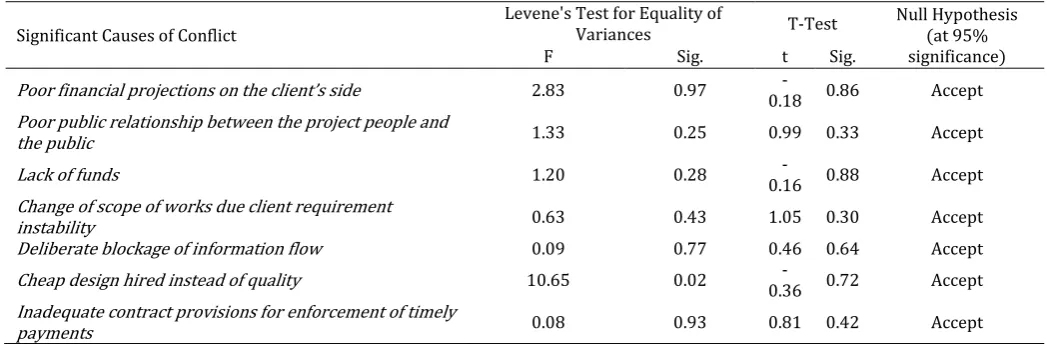
A test for reliability of data was performed before T-test; a Cronbach alpha value of 0.951 indicates the results of the survey were reliable and can be used for further statistical analysis. An independent t-test at 5 percent significance level was performed to detect the difference in significant causes of conflicts between the perception of contractors and consultants.
According to Table 5, the mean scores are not significantly different statistically (all p > 0.05) with respect to all seven factors. Thus, the T-test results support that the seven factors are significant as per criteria from previous section.
Similarly, while observing the mean score results presented in Table 2, the result shows that for top two ranks, rank 1 "Poor financial projections on the client’s side" (mean scores are 4.36 and 4.32), and rank 2 "Poor public relationship between the project people and the public" (mean scores are 3.77 and 4.66), the two organisational groups tended to agree with the statement.
5. DISCUSSION OF RESULTS
The survey results presented in Tables 2-4 shows many interesting insights. It can be seen that there are no differences in perception of contractors and consultants about the significant causes of conflicts. Poor financial projections on the client’s side, poor public relationship between the project people and the public, lack of funds, change of scope of works due to client requirement instability, deliberate blockage of information flow, cheap design hired instead of quality and inadequate contract provisions for enforcement of timely payments were identified as the most significant causes of conflicts in construction projects. The results are similar to the results of
Acharya, et al. [2] which found that differing site condition, public interruption, differences in change order evaluation, design errors, excessive contract quantities variation and double meaning of specifications were the significant causes of conflict in Korean construction industry. There are also similarities with Dada [14] results, which identified administrative issue, resources for project execution and personality issues as the most frequent source of conflict in Nigeria.
However, there is a contrast with Acharya, et al. [2] result which showed there are differences in perception of client, consultant and contractor. This difference might have occurred, because of this study’s participant (consultant and contractors) and study area.
6. CONCLUSION
There is a general consensus that construction projects are plagued with risk. In order to manage conflicts properly, there is a need to identify causes of conflict. Thus, this necessitated this study. Acharya, et al. [2] asserts unmanaged conflicts results into claims and counterclaims which ultimately affect project success. Thus, this study was to identify the causes of conflicts in Nigerian construction industry. A survey instrument was developed and responses from 69 respondents were collected. Sixty-four factors causing conflicts were identified from literature review, interviews and authors' experience.
Based on the survey results, seven significant causes of conflict in Nigerian construction industry were identified. The result seemed to be consistent with results of other similar studies though there might be differences in ranking.
Table 5: Independent T-test results
Significant Causes of Conflict
Levene's Test for Equality of
Variances T-Test
Null Hypothesis (at 95% significance) F Sig. t Sig.
Poor financial projections on the client’s side 2.83 0.97 0.18 - 0.86 Accept
Poor public relationship between the project people and
the public 1.33 0.25 0.99 0.33 Accept
Lack of funds 1.20 0.28
-0.16 0.88 Accept
Change of scope of works due client requirement
instability 0.63 0.43 1.05 0.30 Accept
Deliberate blockage of information flow 0.09 0.77 0.46 0.64 Accept
Cheap design hired instead of quality 10.65 0.02
-0.36 0.72 Accept
Inadequate contract provisions for enforcement of timely
An independent T-test at 5 percent significance level showed that there are no differences in the perception of consultants and contractors. The findings showed that poor financial projections on the client’s side as the main cause of conflicts. Furthermore, finance-related, relationship and communication problem, client requirement instability, design-related and contract related problems are the major categories of factors leading to conflicts. Thus, the findings show that poor financial projections on the client’s side and poor relationship between project people and public are the main sources of project conflict. It is imperative for clients and professionals in the construction industry to address these factors so as to improve project success. Regarding other conflicting factors, it is recommended that clients engage project consultant based on experience rather than pricing. This will ensure that project conflict are reduced to barest minimum and keep within acceptable limits. The main weakness of this study was the small sample. This affects the ability to generalize the results of this study to a larger population. It is important to emphasize at this point that low response rate is a major characteristics of survey research. However, the respondents to the study are contractors and consultants which represent major participants in construction projects. The study provides some insights into the causes of conflicts in the Nigerian context. What is now needed is a cross-national study involving a large sample covering the whole construction sector in Nigeria. This will provide empirical evidence that can be generalized to the Nigerian situation.
7. REFERENCES
[1] Zhi, H. “Risk management for overseas construction projects,” Int. J. Proj. Manag., vol. 13, no. 4, pp. 231– 237, Aug. 1995.
[2] Acharya, N. K. Lee, Y. D. and Im, H. M. “Conflicting factors in construction projects: Korean perspective,” Eng. Constr. Archit. Manag., vol. 13, no. 6, pp. 543–566, 2006.
[3] Gardiner,P. D. and Simmons, J. E. “Analysis of conflict and change in construction projects,” Constr. Manag. Econ., vol. 10, no. 6, pp. 459–478, 1992.
[4] Lester, A. “Project Management, Planning and Control,” Project Management, Planning and Control, vol. 5th. Butterworth-Heinemann, Burlington, 2007.
[5] Fenn, P. Lowe, D. and Speck, C. “Conflict and
dispute in construction,” Constr. Manag. Econ., vol. 15, no. 6, pp. 513–518, 1997.
[6] Kumaraswamy, M. M. “Conflicts, claims and disputes in construction,” Eng. Constr. Archit. Manag., vol. 4, no. 2, pp. 95–111, 1997.
[7] Jaffar, N. Abdul Tharim, A. H. and Shuib, M. N. “Factors of conflict in construction industry: A literature review,” in Procedia Engineering, 2011, vol. 20, pp. 193–202.
[8] Meng, X. “The effect of relationship management on project performance in construction,” Int. J. Proj. Manag., vol. 30, no. 2, pp. 188–198, Feb. 2012.
[9] Love, P. E. D. and Edwards, D. J. “Determinants of rework in building construction projects,” Eng. Constr. Archit. Manag., vol. 11, no. 4, pp. 259–274, 2004.
[10] Liu, J. Y. C., Chen, H.-G., Chen, C. C. and Sheu, T. S. “Relationships among interpersonal conflict, requirements uncertainty, and software project performance,” Int. J. Proj. Manag., vol. 29, no. 5, pp. 547–556, 2011.
[11] Leung, M. Liu, A. M. M. and Ng, S. T. “Is there a relationship between construction conflicts and participants’ satisfaction?,” Eng. Constr. Archit. Manag., vol. 12, no. 2, pp. 149–167, 2005.
[12] Awakul, P. and Ogunlana, S. O. “The effect of attitudinal differences on interface conflicts in large scale construction projects: A case study,” Constr. Manag. Econ., vol. 20, no. 4, pp. 365–377, 2002.
[13] Kumaraswamy, M. M. “Consequences of construction conflict: A Hong Kong Perspective,” J. Manag. Eng., vol. 14, no. 3, pp. 66–74, 1998.
[14] Dada, M. O. “Analysis of Conflict Centers in Projects Procured with Traditional and Integrated Methods in Nigeria,” J. Eng. Proj. Prod. Manag., vol. 2, no. 2, pp. 66–77, 2012.
[15] Mahalingam, A. and Levitt, R. E. “Institutional theory as a framework for analyzing conflicts on global projects,” J. Constr. Eng. Manag., vol. 133, no. 7, pp. 517–528, 2007.
[16] Consoli, G. G. S. “Conflict and managing consortia in private prison projects in Australia - Private prison operator responses,” Int. J. Proj. Manag., vol. 24, no. 1, pp. 75–82, 2006.
[17] Ntiyakunze, S. K. “Conflicts in Building Projects in Tanzania:Analysis of Causes and Management Approaches,” Department of Real Estate and Construction Management, Royal Institute of Technology, Stockholm, Sweden, 2011.
[18] Kerzner, H. Project management: A systems approach to planning, scheduling, and controlling, vol. 7th. NewYork: John Wiley & Sons, Inc., 2001.
Contracts,” J. Constr. Eng. Manag., vol. 129, no. 4, pp. 375–381, Aug. 2003.
[20] Harmon, K. M. J. “Conflicts between Owner and Contractors: Proposed Intervention Process,” J. Manag. Eng., vol. 19, no. 3, pp. 121–125, Jul. 2003.
[21] Galea, N. and Loosemore, M. “Men and conflict in the construction industry,” in Proceedings of 22nd Annual ARCOM Conference, 2006, pp. 843–850.
[22] Sambasivan, M. and Soon, Y. W. “Causes and effects of delays in Malaysian construction industry,” Int. J. Proj. Manag., vol. 25, no. 5, pp. 517–526, Jul. 2007.
[23] Ruuska, I. and Teigland, R. “Ensuring project
success through collective competence and creative conflict in public–private partnerships – A case study of Bygga Villa, a Swedish triple helix e-government initiative,” Int. J. Proj. Manag., vol. 27, no. 4, pp. 323–334, May 2009.
[24] Mahato, B. K. and Ogunlana, S. O. “Conflict dynamics in a dam construction project: a case study,” Built Environ. Proj. Asset Manag., vol. 1, no. 2, pp. 176– 194, 2011.
![Figure 1. projects in Thailand. Acharya, et al. [2] identifies 43](https://thumb-us.123doks.com/thumbv2/123dok_us/10027919.1989590/2.595.48.289.565.683/figure-projects-thailand-acharya-et-al-identifies.webp)