16
ISSN 1392-2785 ENGINEERING ECONOMICS. 2007. No 1 (51) THEECONOMICCONDITIONSOFENTERPRISEFUNCTIONING
The State Support for small and Medium Sized Companies: General and Practical
Aspects of Lithuania
Rūta Adamonienė
1, Jekaterina Trifonova
21 Kauno technologijos universitetas K. Donelaičio g. 73, LT-44029, Kaunas
2 Vytauto Didžiojo universitetas
K. Donelaičio g. 58, LT-44248, Kaunas
The purpose of this paper is to identify development possibilities of small and medium sized business in Lithuania.
The analysis includes the discussion of the peculiari-ties of state financial support in Lithuania. The major forms of state support, such as tax exemptions; financial support: credits on easy terms, total or partial covering of interest rate, guarantee reassurance and sponsion, credit insurance, risk venture capital investments in SME, com-pensation of some expenditures (such as firm establish-ment, researches, guarantee taxes, credit insurance fees, quality certification and etc.), subsidies for the creation of workplaces; easy term consultations, trainings, qualifica-tion improvement and re-skilling for firms owners and em-ployees and employers; business incubators, business cen-ters, technological parks and their offered services: INVEGA (SCS Investment and business Guarantees), SME Development Funds are presented. Some other national, county and municipal support forms are defined.
As the opportunities of this paper are rather limited and don’t allow to evaluate SMEs position on Lithuanian level, Kaunas county was selected with the hope that through the survey results it could be possible to under-stand the common tendencies for SMEs in Lithuania. The next section presents the research of Kaunas district SME, which helped to identify the main problems of this sector and allow foreseeing some possible methods for the current situation improvement.
The last part is devoted to the project of intensifica-tion of SME development possibilities. The major atten-tion was devoted to SME development promoting meas-ures that does not require large financial investments and satisfy SME need presented in the survey.
Keywords: SME, financial support, business incubator, business center, SME development.
Introduction
Small and medium sized business in Lithuania is con-sidered as one of the most promising sectors of the coun-try‟s economy. That is why it is important to stimulate the establishment of new enterprises of this sector and inten-sity of their activities. From the very beginning of Lithua-nian independence redressing business people complain that the conditions for business development are not favor-able. This topic is always analyzed in scientific literature
with the purpose to understand the reasons which trouble the development of SME in Lithuania and to find out pos-sible ways to eliminate the SME growth barriers.
The increasing importance of SME sector and its im-pact on world economic development conditioned the enlarged scientists and state management institutions at-tention, analyzing SME development processes, tenden-cies and perspectives and looking for the effective tech-niques to increase the benefits to national economical and social development from SME.
In Lithuania SME development problems elimination is very important: Lithuanian SME development agency is founded, national and regional business development projects are framed, institutions for technical and finan-cial support to SME are and being established, SME de-velopment and encouragement programs of international institutions are implementing. The major purpose of all these measures is to create a favorable business environ-ment for SME developenviron-ment.
Lithuanian integration into European Union raised new requirements to all economy sectors and SME. That is way an actual problem is to evaluate the current SME situation in Lithuania, identify problems SME faces mostly and to suggest methods how to intensify SME development possibilities.
The purpose of the paper – to identify the major forms of state support to SME sector and to evaluate the current situation of SME sector. To achieve this goal, some tasks are formulated:
to view the most popular and common state sup-port forms for SME in Lithuania;
to evaluate the SME development possibilities in Lithuania.
to suggest possible solutions for SME develop-ment limiting problems.
Research object – state support for SME in Lithuania.
Research methods: statistical data analyses, ques-tionnaire, telephone inquiry and interview.
Possibilities to get state support for SME
representatives in Lithuania
17 being designed.
In Lithuania from the beginning of the independence the major attention of National economy development policy is devoted to SME. Small and medium sized busi-ness growth in the state strategy up to the 2015 SME de-velopment is a compound Lithuanian activity.
Lithuanian small and medium sized business law sets the criteria for SME and available forms of support. As one of the support areas on the national level the tax ex-emptions are used. These financial exex-emptions are con-nected with the areas which the State could directly influ-ence: tax decrease, expenditures compensation. One more very popular state support possibility – financial support from SME development Funds.
State support for SME is given according to the na-tional, county and municipal SME development grams. The preparation and implementation of these pro-grams are financed from national or municipal budgets and Funds sources. Preparing and implementing SME development programs the priority is devoted to small enterprises (and micro firms among them).
For the SME representative these state support forms could be acceptable:
1) tax exemptions and charge exemptions;
2) financial support: credits on easy terms, total or partial covering of interest rate, guarantee reassur-ance and sponsion, credit insurreassur-ance, risk venture capital investments in SME, compensation of some expenditures (such as firm establishment, re-searches, guarantee taxes, credit insurance fees, quality certification and etc.), subsidies for the creation of workplaces;
3) easy term consultations, trainings, qualification improvement and re-skilling for firms owners and employees and employers;
4) establishment of business incubators, business centers, technological parks and their offered services;
5) all other national, county and municipal defined support forms.
Businessmen willing to start their own business or to expand their already operating business often face the business financing problem. Having the aim to improve the business financing possibilities the Government of the Republic of Lithuania established a guarantee institution – UAB “Investicijų ir verslo garantijos” (CSC Investment and Business Guarantees, INVEGA). The Ministry of the Economy is the founder and supervisor of INVEGA. INVEGA provides guarantees for bank loans for SMEs and administers loan interest subsidies for SMEs. Apart INVEGA, the Ministry of the Economy has established business information centers and business incubators, which provide a wide range of services: information, con-sultations, trainings, advertising; organize exhibitions, assist in foreign partner search.
The Law on Small and Medium-Sized Business es-tablished small and medium-sized business (hereinafter SMB) entities and forms of assistance applied to them. One of the forms of assistance is financial support using small and medium-sized business promotion fund re-sources.
Municipal institutions (local governments) may grant such financial support to small and medium sized business development using SMB promotion funds. The municipalities started to provide financial support to SMB in 1998. Initially, 26 municipalities out of total 56 provided funds to SMB promotion, in 2000 the number of municipalities supporting SMB grew up to 41 out of total 60, and in 2004 this number grew up to 56. Other mu-nicipalities provide support to SMB by allocating a share of funds received from privatization of municipal assets or other sources.
Within 1998-2004 the number of municipalities ow-ing SMB funds, as well as the total amount of funds for SMB promotion increased. All these institutions (as well as SME development funds) are municipal institutions.
Since 1998 not only the number of municipalities, which have SME development fund had grown but also the devoted sums, which SME sector gets (from 1.5 mln. Lt in 1998 up to 6.5 mln. Lt in 2005).
In year 2005 municipalities planned to allocate about 7.8 mln Lt to SMB development funds. The main tenden-cies of the use of these funds continue to remain un-changed. As in preceding years, the municipalities will use these resources for privileged loans, subsidies of in-terest, promotion of the establishment of new workplaces, support of business development measures, i.e. organiza-tion of conferences, fairs, business missions, promoorganiza-tion of dissemination of business information and other objec-tives.
It is important to mention that financial support pro-vided by the municipal SMB promotion funds may be used by small and medium-sized entities registered on the territory of the respective municipality.
SME promotion funds prepare different programs, which could help to implement small and medium sized business support and development measures. Different training courses, consultations for SME representatives are organized, partly paying for this trainings, seminars and consultations.
From the statistics data it is easily seen, that not only the number of SME support institutions is constantly growing, but also the range of services is getting wider, because business information is not less important than lack of capital. But SME representatives feel that they need more support, especially for the business beginners, because business information is quit expensive and not easy to get. So the prime necessity is to raise the qualifi-cation of business incubators‟ and business information centers‟ employees that they could provide information on business planning, business psychology, business fi-nancial opportunities, partners, programs. Basic training programs on business start, management, planning, finan-cial analyses, quality management, search for finanfinan-cial sources and business law could be useful.
18 solutions of business regulation problems and strengthen business institutional infrastructure.
The survey on SMEs support and business
promotion resources demand in Kaunas County
With an eye to find out the major state support forms for SMEs and the level of implementation of EU Struc-tural funds sources, in March, 2006 the authors of this article prepared and performed Kaunas county small and medium sized business survey (100 enterprises were in-terviewed). As far as the opportunities of this article are rather limited and don‟t allow to evaluate SMEs position on Lithuanian level Kaunas county was selected with the hope that through the achieved results it could be possible to understand general tendencies for SMEs in Lithuania. For the data processing, results evaluation and presenta-tion the Excel program was used. Below the major results of the survey are provided:
the first figure represents the level of usage of state support among SMEs.
Figure 1. SMEs usage of state support Kaunas County, March 2006
SMEs mostly use tax exemptions (25 per cent of re-spondents), all the other state support forms uses 5-10 per cent of SMEs. 20 per cent of the respondents don‟t an-swer to this question and even 15 per cent of SMEs never uses state support at all. During the telephone inquiry the common reasons for that were founded out (see figure 2):
Figure 2. Common reasons why SMEs don‟t use state financial
support Kaunas County, March 2006
The majority of respondents mentioned the difficult and long procedures of getting state support (37 per cent) and complained about the lack of information about dif-ferent state support forms. Only 8 per cent of all SMEs
stated that they don‟t feel any need of state support for their business. But almost all respondent wished to get state support and mentioned the following state support directions (see figure 3).
SME promotion opportunities in Lithuania
(Kaunas case)
Small and medium size business (SMB) in Lithuania, as in other developed countries, is accepted as one of the main economic developments and national competitive ability growth factor. SME development directly influ-ence the state opportunities to take part in world eco-nomical processes, which are influenced by globalization, integration and hyper competition forces, and general welfare of the citizens (Acs, Morck, Yeung, 1997).
Figure 3. State support directions wanted by SMEs Kaunas County, March 2006
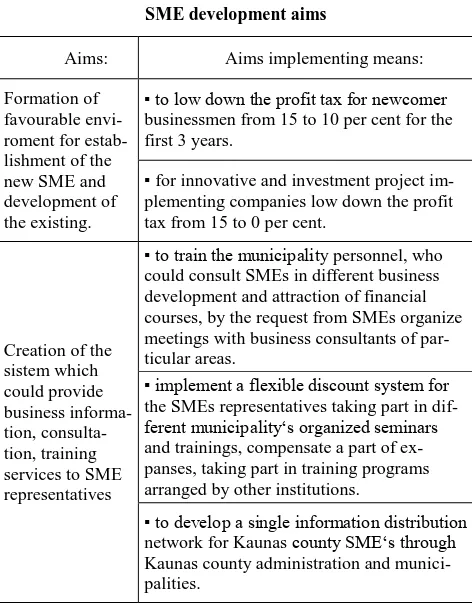
Table
SME development aims
Aims: Aims implementing means:
Formation of favourable envi-roment for estab-lishment of the new SME and development of the existing.
▪ to low down the profit tax for newcomer businessmen from 15 to 10 per cent for the first 3 years.
▪ for innovative and investment project im-plementing companies low down the profit tax from 15 to 0 per cent.
Creation of the sistem which could provide business informa-tion, consulta-tion, training services to SME representatives
▪ to train the municipality personnel, who could consult SMEs in different business development and attraction of financial courses, by the request from SMEs organize meetings with business consultants of par-ticular areas.
▪ implement a flexible discount system for the SMEs representatives taking part in dif-ferent municipality„s organized seminars and trainings, compensate a part of ex-panses, taking part in training programs arranged by other institutions.
▪ to develop a single information distribution network for Kaunas county SME„s through Kaunas county administration and munici-palities.
The main SME development purpose – to expand
Tax exemptions
25% Help for the establishment
of new workplaces
10%
Services of Business Incubators
10% Services of
business information
centers 5% Business, expo
rt and industry promoting
special programs 10 % INVEGA services 5% don't use
15%
didn't answer 20%
Exebition costs finansing
18% “Single window”
aplication 7%
Interst rate partly finansing
6% Sim plification of tax
paym ents 12%
Trainings, consultations,
re-qualification 13% Partly finansing of business projects
8% State guarantees for
loans
5% Didn't answ er
1% Methodical help in
project preparation for EU Structural
Funds 5%
Free business inform atios
3%
Tax exem ptions 22%
Exebition costs finansing
18% “Single w indow ”
aplication 7%
Interst rate partly finansing
6% Sim plification of tax
paym ents 12%
Trainings, consultations,
re-qualification 13% Partly finansing of business projects
8% State guarantees for
loans
5% Didn't answ er 1% Methodical help in
project preparation for EU Structural
Funds 5% Free business
inform atios 3%
19 small and medium business, strengthen national competi-tive capacity and insure the economy growth and welfare creation.
To reach this purpose it is necessary to take into con-sideration consistent and intensive SME development in Lithuania and not only motivate enterprise and the estab-lishment of new companies, but also make favorable con-ditions for already existing companies for development and spread. Table shows the main aims of SME develop-ment.
To implement these aims in series and effectively it is purposeful to separate them into tasks and short terms aims (Aleknevičienė, 2004).
For the formulation of other aims it is worth to use this aim-formation (Pačesa N., 2002):
Activate enterprise action, stimulate advantages of SME sector and make favorable assumptions in business environment to establish new companies and encourage them to develop;.
Decrease the negative impact of business envi-ronment factors and help to solve and eliminate the disadvantages of SME, which limit business function and development.
Detailed tasks are the background for the SME de-velopment program to accept. Systematically and pur-posefully implementing these tasks, it is possible to achieve fast and good results giving development of eco-nomics.
Effective SME development and its successful im-plementation may insure further increase in Lithuanian economics and better integration into EU.
Before the formulation of Lithuanian SME develop-ment strategy, it is necessary to consider these 2 SME stimulation directions:
formation of SME environment; sponsorship of SME representatives.
Formation of the business environment, which could positively influence the establishment of new companies, investment and development, is a very important task (Acs, Audretsch, 1993). The implementation of this task could insure the business development and economy growth. This is a state future investment in general welfare.
In time and purposefully made tax reduction or ex-emption later will dividend as a successful investment with the results – effectively functioning and growing companies, increase in new workplaces, the increase in-come of state budget.
Business information distribution by Internet, regu-larly updated program with legal and economical infor-mation, the preparation of a database for SME could save information search time and expenditures for small and medium size business representatives.
It is supposed, that in Kaunas county administration and in all municipalities is purposeful to organize SME subdivision, which could take care of SMEs and their problems. The employees of this subdivision could pro-vide information about business registration, reorganiza-tion, liquidareorganiza-tion, and all other important questions. By this, the model of “single window” could be imple-mented. The main aim of this model – to provide single
and understandable action chain, which could effectively and quickly solve problems of visitors. The implementa-tion of this model in Lithuanian municipalities could pro-vide visitors with opportunity to order necessary services not only be telephone, but also by Internet and e-mail.
In Vilnius municipality the principle of “single win-dow‟ is already being implemented (“Single window” means, that you get all necessary information at one place, and from one person, who is responsible for get-ting information from others and provides it to that per-son, who needs it). For the SME representatives of Kau-nas county administration and municipalities application of this model could help to get quickly the necessary in-formation and solve problems. To implement “single window” in Kaunas it is suggested to use below described model.
In Kaunas county administration it is worth to select a phone line with a short number. It is important, that all call should be assessable by the regular tariffs according to the phone plan of the caller with the purpose not to increase the communication expenditures of the small and medium companies.
According to the “single window” implementation in Vilnius, it is suggested to provide business consultations by:
phone (as the information serves 118, with the ex-ception, that information would be provided only to SMEs);
internet (opportunity to ask questions and get re-plies by e-mail, forum or FAQ (frequently asked questions);
directly in the municipality with the help of the SME subdivision employee.
Information provision by all these means would re-quire the cooperation and collaboration of different insti-tutions, but it allows to save time for businessmen and to “survive in the information flows”.
One more reason of the implementation of “single window” principle in Vilnius is to decrease the level of corruption, because all documents are collected at one place and visitors don‟t have any contacts with the deci-sion taking people. By decrease of corruption and bu-reaucracy the administrative procedures become less complicated as well.
With the purpose to incorporate the public into deci-sion making, Vilnius municipality established Public in-terest representative committee, in which influential, in public life taking part citizens work (Perednienė, 2005). It is supposed, that Kaunas could also use this experience at town and county levels.
Science and innovation are two priorities. Their de-velopment could ensure the increase in national competi-tion and growth of economy. People and ideas assume the major importance. Without enough attention to their de-velopment the competition level could decrease and visa verse, additional attention could help to bring up intellec-tual citizens with original ideas. This could help Lithua-nia to become an influential state among EU members.
20 their establishment, the SME supporting institutions could better coordinate their actions, take part in common projects, share experience and cooperate. The example of such cooperation – “Business plan competition”, which was initiated by Vilnius North town technology park and joined together Kaunas technological institution regional business incubator, Šiauliai university science and tech-nology park, Klaipėda science and techtech-nology park.
But the support system, with the background of SME support centers situated in different country regions has two major disadvantages:
it is very expensive for the state;
state institutions, as a rule, are not very effective. That is why it is worth to establish a virtual business incubator with the purpose to supply SME businessmen with information, to organize seminars and trainings with the help of cheap and effective Internet support. Tradi-tional incubators are expensive and some times not effec-tive way to promote SME according to dynamic business environment conditions. The authors of the paper suggest to establish a virtual „Business club“, where SME repre-sentatives could together solve problems, with the help of businessmen unification organizations to initiate different corrections and riders in law acts, jointly implement pro-jects. It is supposed, that this initiative could implement Small and medium size business promotion agency, with the help of which SME representatives could take part in the virtual discussions. If this “Business club” was estab-lished in Kaunas county, it would be only in this region registered SMEs could have access to it.
But all this business measures are not essential for success and competition. The major ones are knowledge and information, which should be effectively presented and updated. With the help of the Internet it is possible to update databases, training programs and virtual consulta-tions, prepare and publish different development pro-grams for export, innovation, tourism and so on.
This directive of SME promotion would be directed to particular sectors of economy and motivate SMEs to be more active. So, by this, SME promotion would be pointed to perspectives, important state and national areas. It is very important in the case of limited financial sources.
To achieve above stated aims, the complex of the presented measures does not require huge financial and intellectual sources. The lack of these sources even could block and disrupt SMEs and the development of this sec-tor. That is why, promoting SMEs the question of sources gets high importance.
Aiming to approve the validity of the suggested measures in case of limited financial sources, it is worth to concentrate attention on those measures, which require less financing, but give better results and benefits for the formation of business environment.
Conclusions
As the experience of other developed countries shows, small and medium size business is the major force of state economy and the guarantee of social stability. SMEs abun-dance is the feature of growing and competitive economy and the state support for SMEs is a separate part of
eco-nomical policy. The range of forms and methods of sup-port for SMEs is really large and the state policy in this area is an important task of the state inside policy.
As the research showed, SMEs representatives of Kaunas county feel the lack of information about state support forms and are not active in applying both for state support and EU structural funds. As the main reason of being passive they mentioned the lack of internal sources. It is supposed that SMEs in other Lithuanian counties have the same or very similar problems.
The majority of SMEs even if they have enough in-formation about state support and other services for SME sector, don‟t use the opportunity to get them. Among the major problems the difficult procedures and the lack of qualified personnel, who could fill in the application form or frame the project, are mentioned. That is why it is really important, that state financial support for SMEs should be well organized and easily accessed.
In the paper presented SME development promoting measures doe not require large financial investments, but the perspectives of SME development of Lithuania in some cases depends on the implementation of suggested measures.
References
1. Acs, Z.J. Small Firms and Entrepreneurship: An East-West Perspec-tive. Z.J.Acs, D.B. Audretsch. Cambridge University Press, 1993 2. Acs, Z.J. Evolution, Community and the Global Economy. Z.J.Acs,
R.Morck, B.Yeung. Office of Advocacy, Small Business Adminis-tration,1997
3. Aleknevičienė, V. Įmonės finansų valdymas. Kaunas: Akademija, 2004.
4. Audretsch, D.B. Small Firms and Efficiency. Office of Advocacy, Small Business Administration, 1997
5. Banienė, V. Smulkaus verslo plėtojimas. V.Banienė, S.Stoškus. Kaunas: Technologija, 1994
6. Baršauskas, P. Smulkaus ir vidutinio verslo politika Europos Sąjungoje ir Lietuvoje. Kaunas: Technologija, 2002
7. Damašienė, V. Smulkaus ir vidutinio verslo integracijos į Europos Sąjungos ūkį problemos. V.Damašienė, D.Cibulskienė // Organizacijų vadyba: sisteminiai tyrimai. Kaunas: VDU, Nr. 23, 2002
8. Eidukevičius, N. Parama smulkiam ir vidutiniam verslui: dabartis ir perspektyvos. Lietuvos ūkis, 2002
9. Europos Sąjungos parama – bendras darbas Lietuvos ateičiai. Vil-nius: Alora, 2001
10. Juozaitienė, L. Verslo ir vadybos įvadas. L.Juozaitienė, S.Stapon-kienė. Šiauliai: Šiaulių universiteto leidykla. 2002
11. Kardelis, K. Mokslinių tyrimų metodologija ir metodai, Kaunas: Judex, 2002
12. Integracijos ţinios, 2004. Nr. 7-8
13. Lukaševičius, K. Maţųjų ir vidutinių įmonių vadyba. K.Luka-ševičius, B.Martinkus. Kaunas: Technologija, 2001
14. Masalskis, K. "Idealus" smulkaus ir vidutinio verslo infrastruktūros modelis // Organizacijų vadyba: sisteminiai tyrimai. Kaunas: VDU, Nr. 4, 1997
15. Pačėsa N. Smulkaus ir vidutinio verslo plėtros tendencijos – naujos ekonomikos pradţia // Organizacijų vadyba: sisteminiai tyrimai. Kaunas: VDU, Nr. 22, 2002
16. Petrauskas A. Smulkaus ir vidutinio verslo subjektai ir jiems tei-kiamos paramos formos // Apskaitos, audito ir mokesčių aktualijos, Nr. 26, 2001
17. Savanevičienė A. Smulkaus verslo kūrimo ir vystymo skatinimo galimybės ir problematika // Ekonomika ir vadyba – 98. Kaunas: Technologija, 1998
21 formos ir glimybės Lietuvje. Kaunas : Technologija, 2001
19. Simanavičienė Ţ. Verslo prieţiūros institucijos. Kaunas: Technolo-gija, 2002
20. Smulkus ir vidutinis verslas Lietuvoje ir Vidurio Europoje // A.Šemeta, V. Lapėnienė, O.Grigienė ir kt. Vilnius: Statistikos ty-rimai, 2002
21. Sūdţius, V. Smulkaus ir vidutinio verslo administravimas ir val-dymas. – Vilnius, Kronta, 2001
22. Statistikos departamentas prie LR Vyriausybės Verslo plėtra: nuo-monės, tendencijos, problemos. Vilnius, Metodinis leidybinis cen-tras, 1999
23. Verslo ţinynas. Prieiga per internetą: <http://www.svv.lt/index.php/lt/30770/> 24. Kaip pradėti verslą. Prieiga per internetą: <
http://www.svv.lt/index.php/lt/32276/>
25. Informacinis verslo konsultanto ţinynas. Prieiga per internetą: <http://www.svv.lt/index.php/lt/34255/>
26. Lietuvos smulkaus ir vidutinio verslo būklė. Prieiga per internetą: <http://www.svv.lt/index.php/lt/32278/>
27. Lietuvos smulkaus ir vidutinio verslo plėtros agentūra. Prieiga per internetą: <http://www.svv.lt/index.php/lt/31924/>
Rūta Adamonienė, Jekaterina Trifonova
Valstybės parama smulkiajam ir vidutiniam verslui: bendras ir prak-tinis aspektai
Santrauka
Smulkusis ir vidutinis verslas (SVV) Lietuvoje, kaip ir išsivy-sčiusiame pasaulyje, tampa visuotinai pripaţintu, vienu iš esminių ekonominio augimo ir nacionalinio konkurencingumo didinimo vei k-snių. SVV plėtra turi tiesioginę įtaką valstybės gebėjimui lygiaver-tiškai dalyvauti pasaulio ekonominiuose procesuose, veikiamuose globalizacijos, integracijos ir hiperkonkurencijos jėgų, bei lemia piliečių visuotinės gerovės sukūrimo perspektyvą.
Auganti smulkiojo ir vidutinio verslo svarba bei įtaka eko-nominiam pasaulinio ūkio vystymuisi lemia didesnį mokslininkų ir valstybės valdymo institucijų dėmesį analizuojant SVV plėtros proce-sus, tendencijas ir perspektyvas bei ieškant efektyvių SVV naudos nacionalinei ekonominei ir socialinei plėtrai didinimo būdų.
Lietuvoje smulkiojo ir vidutinio verslo plėtros problemų sprendimas ūkio valdyme uţima svarbią vietą: įkurta Lietuvos SVV plėtros agentūra, sukurti nacionaliniai ir regioniniai verslo plėtros projektai, kuriamos institucijos, privalėsiančios uţtikrinti techninę ir finansinę pagalbą SVV subjektams, realizuojamos tarptautinių insti-tucijų SVV rėmimo ir skatinimo programos. Pagrindinis visų šių priemonių tikslas – sukurti palankią aplinką smulkiojo ir vidutinio verslo plėtrai.
Lietuvos integracija į Europos Sąjungą kelia naujų reikalavimuų visiems ekonomikos sektoriams ir SVV. Todėl aktualu įvertinti esamą smulkiojo ir vidutinio verslo situaciją Lietuvoje, identifikuoti proble-mas, su kuriomis daţniausiai susiduria SVV įmonės, bei pasiūlyti būdus, kaip vystyti SVV sektorių ir spręsti jo finansavimo uţdavinius.
Straipsnio tikslas – nustatyti pagrindines smulkiojo ir visutinio verslo plėtros galimybes Lietuvoje.
Lietuvoje šiuo metu dar tik formuojasi Vakarų valstybėse (JAV, Vokietijoje, D. Britanijoje ir kt. ES šalyse) nusistovėję smulkiojo verslo rėmimo modeliai.
Lietuvos Respublikos Vyriausybės ūkio vystymo politikoje jau nuo pirmųjų nepriklausomybės metų SVV plėtrai skiriama daug dė-mesio. Smulkiojo ir vidutinio verslo plėtotės iki 2015 metų strategi-joje SVV plėtra pateikiama kaip viena iš sudedamųjų Lietuvos Re-spublikos Vyriausybės veiklos krypčių.
Valstybės pagalba smulkiojo ir vidutinio verslo subjektams
teikiama pagal Vyriausybės, apskričių ar savivaldybių smulkiojo ir vidutinio verslo plėtros programas. Smulkiojo ir vidutinio verslo plėtros programų rengimas ir įgyvendinimas finansuojami iš valsty-bės ar savivaldybių biudţetų bei piniginių fondų lėšų. Rengiant ir įgyvendinant smulkiojo ir vidutinio verslo plėtros programas, finan-suojamas iš valstybės biudţeto, pirmumas teikiamas maţoms įmonėms (tarp jų ir mikroįmonėms).
Pirmoje straipsnio dalyje pateikiama informacija apie Valstybės teikiamos paramos priemonių įvairovę, mastus ir formas: 1) mokesčių lengvatos (jei jos nustatytos įstatymuose), rinkliavų lengvatos; 2) fi -nansinė parama: lengvatinių kreditų teikimas, dalinis ar visiškas palūkanų dengimas, garantijų teikimas, kreditų draudimas, rizikos ka-pitalo investavimas į smulkiąsias ir vidutines įmones, tam tikrų išlai-dų (steigimo, tyrimų, garantijų mokesčių, kreditų draudimo įmokų, kokybės sertifikatų įsigijimo ir kitų išlaidų) kompensavimas, sub -sidijos darbo vietoms kurti; 3) įmonių savininkų, įmonių organų narių bei darbuotojų konsultavimo, mokymo, kvalifikacijos kėlimo ar perk-valifikavimo paslaugos lengvatinėmis sąlygomis; 4) verslo inkubato-rių, verslo centrų, technologinių parkų steigimas ir jų teikiamos pas-laugos; 5) Vyriausybės, apskričių viršininkų ar savivaldybių nustat y-tos kiy-tos pagalbos formos.
Laiku ir tikslingai suteikta mokesčių lengvata vėliau atsiperka kaip sėkminga investicija, kurios pasekmė – rezultatyviai veikiančios ir augančios įmonės, darbo vietų gausėjimas ir išaugusios valstybės biudţeto pajamos.
Siekiant išsiaiškinti pagrindines smulkiojo ir vidutinio verslo prak-tiškai naudojamas valstybės paramos formas bei ES struktūrinių fondų lėšų pasavinimo mastus, 2006 metais kovo mėnesį buvo atliktas Kauno apskrities smulkiojo ir vidutinio verslo tyrimas. SVV uţima ryškią eko-nomikos dalį, o šio darbo galimybės yra ribotos ir neleidţia įvertinti SVV problemų Lietuvos mastu. Todėl šio sektoriaus vystymosi bei finan-savimo problemoms Lietuvoje atskleisti buvo pasirinkta Kauno apskritis, siekiant per gautus rezultatus įţvelgti SVV problemas Lietuvoje.
Antroje dalyje, įvertinus per apklausą gautus duomenis, aprašomi tyrimo rezultatai; jie parodė, kad daţniausia SVV įmonės pasinaudoja siūlomomis mokesčių lengvatomis (taip padarė 25 proc. respondentų), kitomis valstybės pagalbos formomis pasinaudojo po 5 -10 proc. apklaustųjų. 20 proc. apklaustųjų į šį klausimą neatsakė ir net 15 proc. respondentų pareiškė, kad valstybės pagalba nesinaudoja. Tyrimo metu nustatytos pagrindinės SVV plėtros kliūtys: varginan-čios valstybės paramos gavimo procedūras (37 proc.) ir informacijos apie teikiamas valstybės pagalbos SVV įmonėms formas stoka.
Trečioje dalyje pateikiami galimi smulkiojo ir vidutinio verslo kliūčių šalinimo ir plėtros skatinimo būdai. Teikiant pasiūlymus, atsiţvelgiama į pasaulines smulkiojo ir vidutinio verslo tendencijas, šio verslo sektoriaus galimybes Lietuvoje. Pagrindinis dėmesys buvo skirtas didelių finansinių investicijų nereikalaujančioms priemonėms: interaktyvaus verslo inkubatoriaus steigimas, virtualiojo “Verslo klubo” steigimas, verslo inkubatorių ir verslo centrų bendradarbia-vimo skatinimas kuriant apskrities SVV paramos centrus, diegiant, “vieno langelio” principą savivaldybėse bei apskrities administraci-jose (pagal Vilniaus miesto savivaldybės sėkmingą pavyzdį).
Verslo priemonės nėra esminiai verslo sėkmės ir konkurencin-gumo veiksniai. Daug svarbesnio yra ţinios ir informacija, o jos gali būti teikiamos tinkamai organizuotų ir nuolat atnaujinamų informacinių bazių, mokymo programų ir virtualiųjų konsultacijų būdu internete.
Suformuluotiems tikslams pasiekti reikalingų priemonių kom-plekso įgyvendinimas reikalauja didelių finansinių ir intelektinių išteklių, kurių trūkumas gali sustabdyti ar net suţlugdyti SVV plėtrą. Todėl, remiant SVV subjektus ir šio sektoriaus plėtrą, išteklių nusta-tymo klausimas tampa ypač aktualus.
Siekiant uţtikrinti priemonių pagrįstumą veikiant ribotų finan-sinių išteklių sąlygomis, daugiausia dėmesio reikia kreipti į maţiau-siai finansavimo reikalaujančias, bet didţiausios naudos duodančias, palankios verslo aplinkos formavimą uţtikrinančias priemones. Raktaţodţiai: SVV, finansinė parama, verslo inkubatorius, verslo centras,
SVV plėtra.
The article has been reviewed.