51
ISSN 1392-2785 ENGINEERING ECONOMICS. 2007. No 5 (55) COMMERCE OF ENGINEERING DECISIONS
Estimation of Loyalty Programmes from Customers’ Point of View: Cases of
Three Retail Store Chains
Liudmila Bagdonienė, Rasa Jakštaitė
Kauno technologijos universitetas K. Donelaičio g. 20, LT-44239, Kaunas
Long-term relationships between organization and customers and their loyalty become the most significant assumption of nowadays business success. To achieve customer loyalty and enhance it loyalty programmes are created and implemented. It gains special importance in those fields of activities where competition is strong and supply is standard. But loyalty programme by itself does not guarantee success. Whether it reaches organization’s aims first of all depends on the main thing if the pro-gramme is beneficial to its participants. The article deals with how loyalty programmes are estimated by Maxima, Iki and Norfos mažmena retail store chains’ customers.
In the first part of the article concept of customer loyalty, essence of loyalty programme and how its value is perceived by customer are analyzed in theoretical level; in the second part – results of Maxima, Iki and Norfos mažmena retail store chains’ loyalty programme content analysis and questionnaire investigation of cus-tomers are presented. Research shows that Maxima, Iki and Norfos mažmena retail store chains’ loyalty pro-grammes are closed; basis of reward (most often finan-cial) is amount of points which depend on how much money customers spend on buying goods. Similar forms of investigated retail store chains’ loyalty programmes do not create special attractiveness which would stimu-late customers to be loyal to certain retail store chain. Results of questionnaire investigation prove hypothesis that through discounts investigated retail store chains’ loyalty programmes more stimulate sales than enhance loyalty. Most respondents point that participation in loy-alty programmes is beneficial financially but none of them mentioned getting emotional or social value. It means that loyalty of programme participants is rational, so it can be not long-term. Almost one third of respon-dents states that declared benefit of loyalty programme is bigger than a real one. Possibility of retail store chains’ loyalty programmes to grow loyal behaviour is doubted because only half of respondents buy in the store in which they have loyalty card. Almost one third of respondents has loyalty cards of two-three retail store chains; most of them do their shopping not far from their living/work place or where goods are cheaper. Just a little bit more than a third of Maxima LT and Iki retail store chains’ loyalty programmes participants are satisfied by the ser-vices they get but only half of them have intent to recom-mend these programmes to people they know. Value of loyalty programmes is doubtful even to the respondents who do not participate in any investigated programme while investigation was in progress. Loyalty programmes
orientated into sales stimulation and offered by retail store chains lose their attractiveness in the eyes of a cus-tomer. It means that to attract independent customers and even more important “to tie” them, retail store chains need a lot of organizational efforts and financial re-sources. All of that will increase costs of creating and implementing loyalty programmes, that is why retail store chains should choose another type of loyalty programme or look for new instruments to enhance loyalty.
Keywords: loyalty, loyalty programme, customer perceived value, retail store chains, estimation of loyalty programme form participants’ point of view.
Introduction
Long-term relationship between organization and customers becomes the most significant leverage of suc-cess in nowadays business: customer loyalty makes as-sumptions to increase market share and profit, thus to fasten business development, too (Naumann et al., 2001). According to Hoisington and Naumann (2003), it is im-portant not only financial result of customer loyalty but also better image of organization that has positive effect on attracting new customers.
Loyalty programmes with the aim to achieve favour of customers began to develop in the 9th decade of XXth century and still are popular until now. Different aspects of the programmes were rather broadly analysed in publi-cations of western scientists. Butcher (2004) studies how creating loyalty programmes helps to nurture faithfulness of customers based not only on material benefit but more on emotions, trust and partnership. Leenheer et al. (2006) measure the impact of loyalty programmes on consumer loyalty while controlling for endogeneity due to selt-selecting members; Banasiewicz (2005) reviews the cur-rent state of loyalty programme planning and analytics; Lacey and Sneath (2006) examine the fairness of loyalty programme to consumers regarding emerging criticisms of loyalty programmes; Stauss et al. (2005) analyse the negative effects of loyalty programmes; Lewis (2004) investigates the influence of loyalty programmes on cus-tomer retention, Bolton et al. (2000) inquire implications of loyalty programme membership and service experi-ences for customer retention and value, etc.
(bene-52 fit) than they can get in competing retail store chains by purchasing goods or services. Leenheer et al. (2006), Turner and Wilson (2006), Bellizzi and Bristol (2004), Kumar and Rao (2003), Wright and Sparks (1999) and others study peculiarities of loyalty programmes in the field of retail store chains.
In Lithuania issues of loyalty programmes offered to retail store chain‟s customers were studied by Bagdo-nienė and Jakštaitė (2005; 2006; 2007), VaitekūBagdo-nienė (2006), Arnatkevičiūtė and Klebanskaja (2005), Kuit-inauskas (2004), etc. It is important to mention that de-spite of variety of researched loyalty programmes‟ as-pects, researches that reveal factors of loyalty programme success are not often. Benavent et al. (2000) maintain that properly set aims of loyalty programme and properly chosen target group of participants determine success of loyalty programme. Wansik and Seed (2001) accent that success of loyalty programme depends on how its value is accepted by participants of the programme. Loyalty pro-grammes in retail store chains are common for long time. Even before a decade customer loyalty programmemes were accepted as part of UK contemporary life (Wor-thington, 1996). In the United States almost 80% of all households have at least one retail store chain‟s loyalty card, in Canada this is even 90% (Leenheer et al., 2006). Wright and Sparks (1999) stress, that analysis of card holdings indicates a degree of card saturation within the retail market. Nunes and Drèze (2006) the typical retail store loyalty programme do not reward loyal behaviour; it rewards card ownership. So we can formulate such a problem: can retail store chains‟ customers to penetrate value of loyalty programme and participation in loyalty programme to enhance their loyalty? The aim of the pa-per is to reveal how customers evaluate loyalty pro-grammes of retail store chains such as Maxima, Iki and Norfos mažmena. Methods of the research are: explora-tory research of literature, content analysis, questionnaire investigation, systematic and comparative analysis.
Concept of customer loyalty
Customer loyalty is the highest valuable result of marketing efforts (Bellizzi, Bristol, 2004), thus the de-velopment of customer loyalty has become an important focus on marketing strategy. The customer loyalty is winning the confidence of the customer in favour of an organization so that the relationship becomes a win-win situation for both the organization as well as the cus-tomer. Rowley (2005) affirms the benefits of customer loyalty to provider inclusive lower customer price sensi-tivity, reduced expenditure on attracting new customers and improved organization‟s profitability. Dowling and Uncles (1997) note that loyal customers pass on favour-able word-of-mouth comments about a company or prod-uct.
The customer loyalty is termed as customer commit-ment to do business with particular organization, purchas-ing their goods or/and services repeatedly and recom-mending the products and services to friends, acquaintan-ces and associates (Turner, Wilson, 2006). But Reichheld (2003) highlights that loyalty is more than just repeat purchase. Someone who keeps buying may be doing so
out of inertia, indifference or exit barriers rather than loyalty. Hallowell (1996) stresses, that customer loyalty has evidence not only as behaviour but also as attitude. The latter as a certain belief and feeling stimulates to re-act in a certain way towards things, people and events, determines attachment to goods, service or organization. A richer understanding of the attitudinal component of loyalty is crucial, as it has been shown to be linked to future usage, enhanced word-of-mouth recommendations, and ultimately to customer profitability (Wirtz et al., 2007). Loyalty based on the attitude is less faithful than loyal behaviour; moreover both attitude and behaviour are changing over time (Dick, Basu, 1994). In other words loyalty is not a static state. According to Gamble et al. (2002), customer loyalty has emotional and rational background. Emotional loyalty is determined by feelings, expectations, relations with staff of the organization, whereas rational loyalty is determined by thinking, avail-ability of information and its understanding, cognition of organization activities‟ processes. Cognitional processes as integrate part of loyalty are accented by Yu and Dean (2000).
Dick and Basu (1994) created a framework of four different categories of loyalty, based on the factor of be-haviour and attitude: true loyalty, spurious loyalty, latent loyalty and no loyalty, Sopanen (1996) – six types: mo-nopoly loyalty, inertia loyalty, convenience loyalty, price loyalty, incentivised loyalty and emotional loyalty. Cur-rasi and Kennedy (2002) highlight that customers can be loyal forcibly when they have not another choice ( prison-ers), can be loyal in several cases (detached loyalists), can be venally loyal (purchased loyalists), can be loyal from satisfaction (satisfied loyalists) and can be loyal implicitly (apostles). Heskett (2002) points one more level of loyalty – ownership, when customer as owner takes responsibility for further success of goods and ser-vices.
Variety of loyalty categories shows not only different possibilities of choice to customers, different degree of obligation and different level of satisfaction, but also dif-ferent interest to participate in loyalty programme. Vaitiekūnienė (2006) stresses that the most effective pro-grammes are those propro-grammes, when balance between stimulation of behavioural loyalty and stimulation of emotional loyalty is kept. So, before making managerial decisions, it is important to identify category of loyalty properly.
53 Development of loyalty programmes goes through several steps – from setting up a target group to prepara-tion of concept of programme success. At the beginning of programme development, organization should know what can be considered as a programme success and how to measure it, because success is not separable from the set aims (Butcher, 2004; Benavent et al., 2000).
According to Wansik and Seed (2001), the main cri-teria of loyalty programme success should be cus-tomer„s perceivable value, which, as Reicheld (1996) stresses, is background to his/her loyalty. Perceivable value stimulates customer to purchase goods and/or ser-vices and stops from looking for other alternative deals (Pura, 2005). The loyalty programme must enhance the value proposition of the product or service (Dowling and Uncles, 1997). So, perceivable value should be re-flected in concept of loyalty programme‟s success (Arantola, 2002).
Is loyalty programme unambiguously useful market-ing instrument? Dowlmarket-ing and Uncles (1997) take notice of some lessons from loyalty programmes: these pro-grammes can directly enhance the product/service value proposition, and/or broaden the availability of the prod-uct/service, and/or neutralize a competitor‟s programme. Mauri (2003) notices loyalty programmes and their loy-alty cards, which allow retailers to transform cold data on consumer behaviour into warm relationships and eventu-ally into genuine customer loyalty, founded on mutual understanding and trust. Dowling and Uncles (1997) no-tice that it is a mistake to introduce a loyalty programme if a company sells parity brand in a competitive market. Leenheer et al. (2006) stress, that most loyalty pro-grammes do not turn all disloyal customers into loyal or make customers exclusively loyal. But this does not mean that a loyalty programme cannot be a useful tool.
Customers’ perceivable value of loyalty
programme
Ulaga and Eggert (2005) identify four recurring char-acteristics of value: 1) customer value is a subjective concept, 2) it is conceptualised as trade-off between benefits and sacrifices, 3) benefits and sacrifices can be multifaceted, and 4) value perceptions are relative to competition.
Customer value is defined as trade-off between the benefits and the sacrifices in a market exchange (Zeithaml, et al., 2006; Ulaga, Eggert, 2005; Grönroos, 2004; Bettinger, 2002; etc.). According to scientists, value is a miscellaneous benefit that is perceived by cus-tomer and is estimated comparing it with costs of achiev-ing benefit. Definition of value is complicated because perceivable value is changing continuously (Griffin, 2004; Grönroos, 2004). Benefit obtained by customer can be material or intangible, costs – monetary or non-monetary (time, search, learning, emotional and physi-cal), related with financial, social and/or psychological risk (Khalifa, 2004). Ravald and Grönroos (1996) distin-guish indirect and psychological costs. According to sci-entists, it is possible to create more value in two ways: increasing benefit to customer or diminishing possible costs. Increasing benefit to customer means that core
goods/services are supplemented by things that are im-portant to customer (for example, delivering goods home, education programmes to customer, etc.). Benefit and costs are two related elements, so, increased benefit should diminish perceived costs too. In case of diminish-ing costs, it is possible to reduce price of goods/services or to make more convenient conditions to purchase goods or services (for example, self-service). According to Ra-vald and Grönroos (1996), the optimal variant creating value for target group should be combination of cost leadership and differentiation. Scientists highlight that cost leadership does not mean that organization should compete only by price; conversely, organization should look for ways how to create more value by offering com-petitive price.
Customers join loyalty programme only when obtain-able benefit exceeds the costs (input) of loyalty pro-gramme. O‟Brien and Jones (1995) suggest that there are five elements which combine to determine a loyalty pro-gramme‟s value: cash value of the redemption rewards, the range of choice of these rewards, the aspirational value of the rewards, the perceived likelihood of achiev-ing the rewards, and the ease of use of the loyalty card. To this list Dowling and Uncles (1997) add the psycho-logical benefits of taking part in the programme and par-ticipating in accumulating (collecting) points, O‟Malley (1998) – relevance (the extends to which rewards are achievable); end convenience (ease of participation in the programme) elements. It means that the potential of a loyalty programme to attract members depends not only on the value of the rewards it offers, but also on when the rewards are available (Dowling and Uncles, 1997).
Therefore value of loyalty programme is created by financial and non-financial privileges which proper set-ting is chosen according to research of customers‟ expec-tations and priorities. Financial privileges to customer are discounts, gifts, free services related with supply of or-ganization, etc., non-financial – special status, special attention, services not-related with supply of organization and supporting status of programme participant, etc. Mat-evičiūtė (2005) states that organizations implementing loyalty programmes cannot be narrow in providing dis-counts because competitors often do the same, so further price will be the main factor of choosing organization. Financial privileges are more valuable when customers are high-involved (Yi and Jeon, 2003). In other words, privileges should be attractive to potential participant of loyalty programme and should distinguish from privi-leges of competing organizations. Otherwise they can be copied easily, participants habituate to them quickly and organization does not avoid increasing costs (Arnatke-vičiūtė, Klebanskaja, 2005).
Costs (input) of loyalty programme‟s participant can be fee of membership, providing personal information, duties of programme participant and even price of privi-leges.
54
Methodology of the research
Empirical research has been accomplished by the fol-lowing two steps:
1) conditions (nature of programme, input of poten-tial participant, privileges rewarding loyalty) of Maxima LT, Iki and Norfos mažmena retail store chains‟ loyalty programmes were analysed; 2) participants of Maxima LT, Iki and Norfos
mažmena retail store chains‟ loyalty programmes were investigated.
The tasks for questionnaire investigation were set: 1) to compare how participants and other buyers of
Maxima LT, Iki and Norfos mažmena retail store chains evaluate loyalty programmes;
2) to find out differences between estimation of in-vestigated retail store chains‟ loyalty programmes; 3) to determine influence of demographical factors to
estimation of retail store chains‟ loyalty pro-grammes.
Before questionnaire investigation hypothesis was set: investigated retail store chains‟ loyalty programmes perform functions more as stimulating sales than enhanc-ing loyalty.
Handy non-probability sample of respondents have been chosen for questionnaire investigation. In the inves-tigation 336 respondents from such towns as Vilnius, Kaunas and Mažeikiai have participated (accordingly 104, 124, 108). Data of questionnaire investigation were processed using statistical package of data analysis SPSS 13.0. Hypothesis of variables independence were tested using χ2 criteria. Decision of variables independence was
made referring to p value. When p value was less than 0.05, hypothesis of variables independence was rejected – variables were dependent statistically (Čekanavičius and Murauskas, 2001).
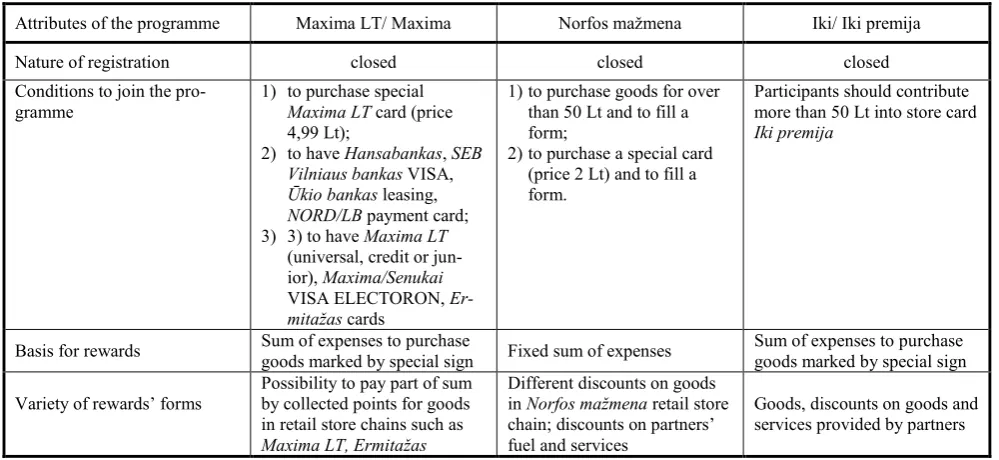
Table 1
Summary of forms of Maxima LT, Iki and Norfos mažmena loyalty programmes and their privileges
Attributes of the programme Maxima LT/ Maxima Norfos mažmena Iki/ Iki premija
Nature of registration closed closed closed
Conditions to join the pro-gramme
1) to purchase special
Maxima LT card (price 4,99 Lt);
2) to have Hansabankas, SEB
Vilniaus bankas VISA, Ūkio bankas leasing, NORD/LB payment card;
3) 3) to have Maxima LT
(universal, credit or
jun-ior), Maxima/Senukai
VISA ELECTORON,
Er-mitažas cards
1)to purchase goods for over
than 50 Lt and to fill a form;
2)to purchase a special card
(price 2 Lt) and to fill a form.
Participants should contribute more than 50 Lt into store card Iki premija
Basis for rewards Sum of expenses to purchase goods marked by special sign Fixed sum of expenses Sum of expenses to purchase goods marked by special sign
Variety of rewards‟ forms Possibility to pay part of sum by collected points for goods in retail store chains such as Maxima LT, Ermitažas
Different discounts on goods in Norfos mažmena retail store chain; discounts on partners‟ fuel and services
Goods, discounts on goods and services provided by partners
Results of the research
Nature of loyalty programmes, privileges and basis of giving privileges of Maxima LT, Iki and Norfosmažmena retail store chains‟ loyalty programmes are summarized in Table 1. As we can see from Table 1, loyalty pro-grammes are closed and basis of giving privileges is con-crete sum of points counted when goods are purchased. Amount of loyalty programmes‟ points usually depends on sum of expenses spend purchasing goods. Privileges rewarding participants‟ loyalty are rather traditional. In all investigated retail store chains cards are used for ac-counting of participants‟ purchasing. In our opinion, privileges given not only by programme organizer but also by its partners have positive influence; for example, Norfos mažmena retail store chaingives discounts on fuel in chains of petrol stations Neste A24 and Lukoil, in the latter car-wash service is cheaper too. Iki retail store chain has especially big number of loyalty programme‟s partners. The loyalty programme of this retail store chain
offers special loyalty programme Iki premija for old age pensioners, socially supported people and disable people. Loyalty programme Maximum of Maxima LT retail store chain is known for the fact that it is possible to become a participant of the programme when getting or changing credit or payment card in the bank. It allows increase availability of the loyalty programme. Thus, summarizing results of content analysis of Maxima LT, Iki and Norfos mažmena retail store chains‟ loyalty programmes, as-sumption can be made that there are not many differences between their offered loyalty programmes which can ef-fectively stimulate sales. So these programmes do not distinguish by their exclusive attractiveness because of their similarities.
55 from Vilnius). The rest 46.7% of all respondents haven‟t got any loyalty card of investigated retail store chains. But these respondents can be considered as potential par-ticipants of loyalty programmes, so their estimation of loyalty programmes is also important and are analysed in parallel with estimation of the participants. Table 2 shows which retail store chains‟ loyalty cards respondents have. As we can see from Table 2, the most popular is Norfos mažmena retail store chain‟s loyalty programme (42.5% of all participants have its loyalty card). But almost a third (26.9%) of all participants participates in several retail store chains‟ loyalty programmes and has their loy-alty cards. Analysing behaviour of all participants, it is identified that only 45.8% of them purchase goods in the retail store chain of which loyalty programme they par-ticipate. More often they purchase goods in retail store chains which are not far from home (58.3%) or not far from workplace (10.4%); or where goods are cheaper (12.5%). Even if we estimate that satisfaction of retail store chain service (16.7%) can be trait of loyal behav-iour, customers should be very deliberately considered as loyal customers. In our opinion, referring to Currasi and Kennedy (2002) classification, they should be labelled as venally loyal.
Table 2
Distribution of respondents according to participation in retail store chains’ loyalty programmes (%)
Retail store chains
Living place of respondents
Kaunas Mažeikiai Vilnius
Maxima LT 14.0 5.0 0.6
Iki 5.0 3.4 0.6
Norfos mažmena 9.5 11.2 21.8
Maxima LT, Iki,
Nor-fos mažmena 0.6 0.0 2.8
Maxima LT, Iki 1.7 0.6 0.0
Iki, Norfos mažmena 1.7 0.6 4.5
Maxima LT, Norfos
mažmena 2.2 3.9 7.8
Satisfaction and loyalty are usually close related fac-tors, so it should mean that participants of retail store chain‟s loyalty programme are satisfied with supply and quality of goods and services and etc. of their own chain. Results of investigation show that only 39.7% of partici-pants of Maxima LT retail store chain‟s loyalty programme are satisfied with the store chain. Even smaller part of Iki and Norfos mažmena retail store chains‟ loyalty pro-grammes‟ participants is satisfied with those chains (ac-cordingly 32.5% and 26.4%). These respondents who par-ticipate in several retail store chains‟ loyalty programmes do not express special satisfaction to any of these retail store chains; only Maxima LT retail store chain has a little bit more satisfied participants. The results confirm once again that investigated retail store chain‟s programmes have obvious traits of sales stimulation programme.
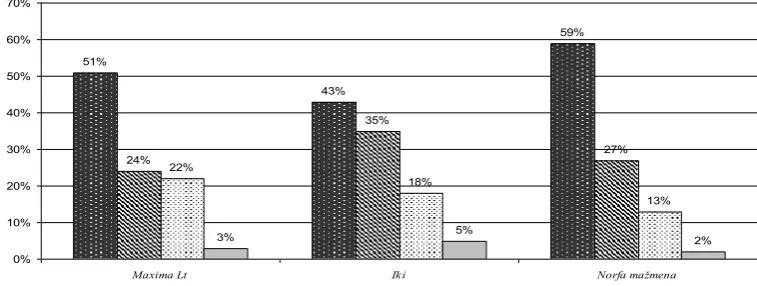
Results of exploratory research of literature show that loyalty programme creates multi-component value and cus-tomer‟s commitment to organization is enhanced by emo-tional/social value of loyalty programme. Unfortunately none of respondents point that they feel that they are treated as special clients of retail store chains. Most of them (52%) point that they get financial benefit, 29% of respondents do not notice significant benefit from loyalty programmes, and 18% of respondents think that declared benefit is bigger than a real one. Figure represents how estimation of loyalty pro-grammes depends on that, by which retail store chain it is offered. As we can see from Figure, most of respondents, who think that loyalty programmes are beneficial finan-cially, participate in Norfos mažmena retail store chain‟s programme, less of respondents – in Iki retail store chain‟s programme. What declared benefit is bigger than a real one, most of all as respondents pointed, taking part in Maxima LT retail store chain‟s loyalty programme, and least of them – Norfos mažmena retail store chain‟s loyalty programme‟s participants.
Estimation of retail store chains‟ loyalty programmes has statistically significant difference depending on respon-dents‟ living place. Most of respondents (59%), who main-tain that loyalty programmes are beneficial financially, live in Mažeikiai, least of them (42%) – in Kaunas (p = 0,005, χ2 = 18,480, df = 6). Therefore, most of respondents (27%), who point that declared benefit is bigger that a real one, live in Kaunas, least of them (5%) – in Mažeikiai.
51%
43%
59%
24%
35%
27% 22%
18%
13%
3% 5% 2%
0% 10% 20% 30% 40% 50% 60% 70%
Maxima Lt Iki Norfa mažmena
Beneficial financially Think that declared benefit is bigger than a real one Do not notice obvious benefit Other
56 Participant‟s efforts perceived as costs influence per-ceivable value of loyalty programme. Respondents, who have participated in the investigation, gain loyalty cards when they fill a form in the store of retail store chain (47.6%) or purchase goods for certain sum of money (28.3%). It should be noted that respondents could be-come participants of loyalty programme when they get new bank card or pay the certain fee (accordingly 13.1% and 11.5%). In other words, respondents do not need spe-cial efforts to become participants of loyalty programme. In our opinion it can be valuated positively because diffi-culties to join the programme make it less attractive but otherwise the fact shows that creators of loyalty pro-grammes do not segment the market.
Tendency to recommend participation in retail store chains‟ loyalty programmes to other customers is trait of loyal behaviour. But only 47% of participants of Maxima LT retail store chain‟s loyalty programme, 43% of Iki retail store chain‟s loyalty programme‟s participants and 53% of Norfos mažmena retail store chain‟s loyalty pro-gramme‟s participants have intent to recommend joining the programme to other customers. The most loyal par-ticipants, who got intent in recommending, are Norfos mažmena retail store chain‟s loyalty programme partici-pants (26.4%). Only 10% of Iki retail store chain‟s loy-alty programme‟s participants and 26% of Maxima LT retail store chain‟s loyalty programme‟s participants have such an intention. In our opinion, once again results show that it is assumed customer loyalty but not a real one.
Analysis of the investigation results shows that esti-mation of loyalty programme also depends on revenue per month for one family member (p = 0,043, χ2 = 29,484, df = 18). Financial benefit of the programme is accented by respondents which incomes are less than 700 Lt per month for one family member; on the other hand, respondents, which incomes are more than 700 Lt per month for one family member, state that declared benefit is bigger than a real one. It means that now existing retail store chains‟ loyalty programmes are more attractive to people with small incomes. Other demographical factors (age, education, social and family state) have not impact on programmes‟ evaluation.
As it was mentioned before, it is important how loyalty programmes are estimated not only by participants but also by those who do not participate in any retail store chain‟s programme. The reason pointed why respondents do not participate in programme usually is that they are not inter-ested in them (45%). Almost third part (26%) of these re-spondents has doubt of its benefit. The biggest part of people who are not interested in participating and have doubts of loyalty programmes‟ benefit consists of respondents who live in Vilnius (accordingly 40% and 47.4%). Besides, re-spondents point not willing to be “tied” to the certain retail store chain or state that loyalty programmes are not relevant to them. In our opinion, seeking to increase amount of loyal customers, retail store chains should consider about loyalty programme‟s concept from the beginning again.
Conclusions
1. Customer loyalty programme as efficient market-ing instrument is significant to both organization
and customer. Loyalty programme helps to in-crease market share and profitability of activities to organization, and to customer – to get more value. Organization seeking to combine its own and customers‟ interests can create loyalty pro-grammes based on estimation, reward, partnership, discounts, collaboration and coalition.
2. Loyalty programme‟s success should be estimated not only by organization but also by customers‟ point of view. Estimation of customer perceivable value depending on needs, values, financial re-sources, conditions of consumption and other fac-tors is subjective and dynamic. Value is multi-component, perceivable as ratio between benefit and costs. Customer will join the programme if gained benefit covers costs. Benefit is created by financial and non-material privileges for rewarding loyalty; costs are considered such as fee of mem-bership, loosing privacy within providing personal information and etc.
3. Maxima LT, Iki and Norfos mažmena retail store chains‟ loyalty programmes are closed; basis of privileges are points which earning depends on sum spend on goods; privileges are based on fi-nancial benefit. Keeping on mind standard retail store chains‟ supply, similarities of programmes do not create special attractiveness to customers. This fault is partly compensated by the fact that re-tail store chains offer discounts on their partners‟ (especially petrol station) goods and services to participants of loyalty programmes.
4. Results of questionnaire investigation prove hy-pothesis that through discounts investigated retail store chains loyalty programmes more stimulate sales than enhance loyalty. The most of respon-dents‟ point that participation in loyalty pro-grammes is beneficial financially but none of them mentioned getting emotional or social value. It means that loyalty of programme participants is rational, so it can not be long-term. Almost a third of respondents‟ states that declared benefit of loy-alty programme is bigger than a real one. Possibil-ity of retail store chains‟ loyalty programmes to enhance loyal behaviour is doubted because only half of respondents buy in the store which loyalty card he/she has. Almost a third of respondents has loyalty cards of two-three retail store chains; most of them do their shopping not far from their liv-ing/work place or where goods are cheaper. Just a little bit more than third part of Maxima LT and Iki retail store chains‟ loyalty programmes‟ partici-pants are satisfied by the services they get but only half of them have intent to recommend these pro-grammes to people they know. Value of loyalty programmes is doubtful even to respondents who do not participate in any investigated programme while investigation was in progress.
57 lot of organizational efforts and financial re-sources. All of that will increase costs of creating and implementing loyalty programmes, that is why retail store chains should choose another type of loyalty programme or look for new instruments to enhance loyalty.
References
1. Arantola, H. Relationship drivers in provider – consumer
relation-ships: empirical studies of customer loyalty programmes. Helsing-fors, 2002.
2. Arnatkevičiūtė, K. Vartotojų susigrąžinimo problemos
telekomunikacijų tinkle: AB „Lietuvos telekomo“ atvejis / K. Arnatkevičiūtė, N. Klebanskaja // Organizacijų vadyba, 2005, No 34, p. 7-18.
3. Bagdonienė, L. The principles of developing customer loyalty
programmes / L. Bagdonienė, R. Jakštaitė // Business development possibilities in the new European area. Scientifics proceedings, 23-24 September, 2005, p. 9-13.
4. Bagdonienė, L. Customer loyalty programmes: purpose, means and
development / L. Bagdonienė, R. Jakštaitė // Organizacijų vadyba: sisteminiai tyrimai, 2006, No 37, p. 21-35.
5. Bagdonienė, L. Lietuvos prekybos tinklų lojalumo programų
verti-nimas vartotojų požiūriu / L. Bagdonienė, R. Jakštaitė // Ekonomi-ka ir vadyba 2007, p. 285-291.
6. Banasiewicz, A. Loyalty programme planning and analytics //
Journal of Consumer Marketing, 2005, No 22/6, p. 332-339.
7. Benavent, Ch. Analysis of the efficiency of loyalty programmes: a
case study / Ch. Benavent, L. Meyer-Waarden, D. Crié. Prieiga per internetą:
<http://www.univ-pau.fr/~benavent/Publications/Cards.PDF>
8. Bellizzi, J. A. An assessment of supermarket loyalty cards in one
major US market / J. A. Bellizzi, T. Bristol // Journal of Consumer Marketing, 2004, No 21, p. 144 – 154.
9. Bettinger, C. Earning shareholder, customer and employee loyalty.
Prieiga per internetą:
<http://www.wib.org/PDFs/BPS_02_Handouts/Bettinger-Gen.PDF>
10. Butcher, S. Программы лояльности и клуб постоянных
клиентов (второе издание). Вильямс, 2004.
11. Bolton, R. N. Implications of loyalty programme memeberships
and service experiences for customer retention and value/ R. N. Bolton, M. D. Kannan // Journal of the academy of marketing science, 2000, No 1, p. 95-108.
12. Currasi, C. F. From prisoniers to apostles: typology of repeat buyers
and loyal customers in service businesses / C. F. Currasi, K. N. Ken-nedy // Journal of Services Marketing, 2002, No16 (4), p. 322-341.
13. Čekanavičius, V. Statistika ir jos taikymai / V. Čekanavičius, G.
Murauskas // Vilnius: TEV, 2001.
14. Dick, A. Customer loyalty: toward an integrated conceptual
framework / A. Dick, K. Basu // Journal of the Academy of Mar-keting Science, 1994, No 22, p. 99-113.
15. Dowling, G. R. Do Customer Loyalty Programmes Really Work?/
G. R. Dowling, M. Uncles // Sloan Management Review, 1997, No 38 (4), p. 71-82.
16. Gamble, P. Up close and personal? Customer relationship
market-ing@work/ P. R. Gamble, M. Stone, N. Woodcook // Kogan Page, 1999.
17. Griffin, J. 12 Laws of Customer Loyalty. Prieiga per internetą:
<http://www.marketingprofs.com/login/signup.asp?source=/4/griffin1.asp>
18. Grönroos, Ch. The relationship marketing process: communication,
interaction, dialogue, value // Journal of Business & Industrial Marketing, 2004, No.19 (2), p. 99-113.
19. Hallowell, R. The relationships of customer satisfaction, customer
loyalty, and profitability: an empirical study // International Journal of Service Industry Management, 1996, No 7, p. 27-42.
20. Heskett, J. Beyond customer loyalty // Managing Service Quality,
2002, No12 (6), 355-357 p.
21. Hoisington, S. The loyalty elephant / S. Hoisington, E. Naumann //
Quality Progress, 2003, February, p. 33-41.
22. Khalifa, A. Customer value: a review of recent literature and an
integrative configuration // Management Decision, 2004, No 42 (5), p. 645-666.
23. Kuitinauskas, M. Mūšiai dėl lojalumo // Reklamos ir marketingo
idėjos, 2004, No 3, p. 71-73.
24. Kumar, N. Effect of loyalty card programmes on supermarket prices/ N.
Kumar, R. Rao. Prieiga per internetą:
<http://groups.haas.berkeley.edu/marketing/PAPERS/sics/loyalty.pdf>
25. Lacey, R. Customer loyalty programmes: are they fair to
cosu-mers?/ R. Lacey, J. Z. Sneath // Journal of Consumer Marketing, 2006, No 23/7, p. 458-464.
26. Leenheer, J. Do Loyalty Programmes Really Enhance Behavioral
Loyalty? an Empirical Analysis Accounting for Self-Selecting Members / J. Leenheer, H. J. van Heerde, T.H.A. Bijmolt, A. Smidts // ERIM Report Series Reference No. ERS-2006-076-MKT. Prieiga per internetą: <http://ssrn.com/abstract=969532>
27. Lewis, M. The influeence of loyalty programmes and short-term
promotions on customer retention// Journal of Marketing Research, August 2004, p. 281-292.
28. Matevičiūtė, A. Ką gali papasakoti lojalumo programos?//
Marke-tingas, 2005, No 12, p. 46-52.
29. Mauri, Ch. Card Loyalty. A New Emerging Issue In Grocery
Re-tailing// Journal of Retailing and Consumer Services, 2003, No 1, p. 13-25.
30. Naumann, E. How to Implement a Customer Satisfaction
Pro-gramme / E. Naumann, D. Jackson, M. Rosenbaum // Business Ho-rizons, 2001, January-February, p. 37-44.
31. Nunes, J. C. Your Loyalty Programme is BetrayingYou / J. C. Nunes,
X. Drèze // Harvard Business Review, April, 2006, p. 124-131.
32. O'Brien, L. Do Rewards Really Create Loyalty? / L. O'Brien, C.
Jones // Long range planning, 1995, No 4, p. 130-131.
33. O‟Malley, L. Can loyalty schemes really build loyalty? //
Market-ing Intelligence & PlannMarket-ing, 1998, No 16/1, p. 47-55.
34. Pura, M. Linking perceived value and loyalty in location-based
mobile services // Managing Service Quality, 2005, No 15 (6), p. 509-538.
35. Ravald, A. The value concept and relationship marketing/ A.
Ra-vald, Ch. Grönroos // European Journal of Marketing, 1996, No 30 (2), p. 19-30.
36. Reicheld, F. The quest for loyalty. Prieiga per internetą:
<http://pubs.acs.org/hotartcl/chemtech/96/dec/quest.html>
37. Reicheld, F. The one number you need to grow// Harvard Business
Review, 2003, No 6, p. 46-54.
38. Rowley, J. The four Cs of customer loyalty // Marketing
Intelli-gence & Planning, 2005, No 6, p. 574-581.
39. Schmid, J. Loyalty marketing: Boom or bust? // Target Marketing,
1997, August, 20, 8; Career and Technical Education, p. 34-37.
40. Stauss, B. Customer frustration in loyalty programmes/ B. Stauss,
M. Schmidt, A. Schoeler // International Journal of Service Indus-try Management, 2005, No 3, p. 229-252.
41. Sopanen, B. Enhancing customer loyalty // Retail Week, 1996,
December, p. 21-24.
42. Turner, J.J. Grocery loyalty: Tesco Clubcard and its impact on
loyalty/ J. J. Turner, K. Wilson // British Food Journal, 2006, Vol. No 11, p. 958-964.
43. Zeithaml, V. A. Services Marketing: Integrating Customer Focus
Across the Firm / V. A. Zeithaml, M. J. Bitner, D. D. Gremler (4th ed.). New York: McGraw-Hill, 2006.
44. Yi, Y., Jeon, H. Effects of loyalty programmes on value perception,
programme loyalty, and brand loyalty / Y. Yi, H. Jeon // Journal of the Academy of Marketing Science, 2003, No 31 (3), p. 229-240.
45. Yu, Y. The contribution of emotional satisfaction to consumer
loyalty / Y. Yu, A. Dean // International Journal of Service Industry Management, 2001, No 3, p. 234 -250.
46. Ulaga, W. Relationship value in business markets: the construct
and its dimensions/ W. Ulaga, A. Eggert // Journal of Business-to-Business Marketing, 2005, No 12 (1), p. 73-99.
47. Vaitiekūnienė, J. Lojalumo programos: kaip išlaikyti klientą //
Verslo žinios, 2006 m. kovo 30 d., p. 16.
48. Wansik, B. Making Brand Loyalty Programmes Succeed/ B. Wansik,
58
49. Wirtz, J. How effective are loyalty reward programmes in driving
share of wallet? / J. Wirtz, A. S. Mattila, M. O. Lwin // Journal of Service Research, 2007, No 4, p. 327-334.
50. Wright, C. Loyalty saturation in retailing: exploring the end of
retail loyalty card / C. Wright, L. Sparks // International Journal of Retail & Distribution Management, 1999, No 10, p. 429-439.
51. Worthinhgton, S. Smart cards and retailers – who stands to benefit?
// International Journal of Retail & Distribution Management, 1996, Vol. 24/9, p. 27-34.
Liudmila Bagdonienė, Rasa Jakštaitė
Lojalumo programų vertinimas vartotojų požiūriu: trijų Lietuvos prekybos tinklų atvejis
Santrauka
Ilgalaikiai organizacijos ryšiai su vartotojais ir šių lojalumas tam-pa reikšmingiausiu šiuolaikinio verslo sėkmės svertu. Vartotojų lojalu-mas sudaro prielaidas didinti rinkos dalį, pelną, taigi ir spartinti verslo plėtrą. Organizacijai svarbus ne tik finansinis vartotojų lojalumo rezul-tatas, bet ir geresnis jos įvaizdis, teigiamai veikiantis naujų vartotojų pritraukimą. Laimėti ir stiprinti vartotojų ištikimybę padeda lojalumo programos, kurios įgauna ypatingą reikšmę tose srityse, kur konkuren-cija stipri, o pasiūla standartinė, pavyzdžiui, mažmeninėje prekyboje. Lojalumo programų ypatumus mažmeninės prekybos sektoriuje anali-zuoja Leenheer ir kt. (2006), Turner ir Wilson (2006), Bellizzi ir Bristol (2004), Kumar ir Rao (2003), Wright ir Sparks (1999) ir kt. Lietuvoje šia problematika domisi Bagdonienė ir Jakštaitė (2005; 2006; 2007), Vaitiekūnienė (2006), Arnatkevičiūtė ir Klebanskaja (2005), Kuitinaus-kas (2004) ir kt. Lojalumo programų vertinimas vartotojų požiūriu ir Vakaruose, ir Lietuvoje tyrinėjamas nedažnai, nors mokslininkai akcen-tuoja, kad lojalumo programų sėkmė priklauso nuo to, ar naudinga (vertinga) ji yra dalyviams. Tai, kad šiandieniai vartotojai turi kelių ar net keliolikos prekybos tinklų lojalumo korteles, verčia abejoti, ar
pro-gramos gali padėti išugdyti lojalų pirkėją. Straipsnyje keliama
proble-ma: ar įžvelgia mažmeninės prekybos lojalumo programos naudą
varto-tojas ir ar dalyvavimas sustiprina vartotojo lojalumą. Straipsnio tikslas
– atskleisti, kaip Lietuvos prekybos tinklų Maxima, Iki ir Norfos
maž-mena lojalumo programas vertina vartotojai. Iškelta hipotezė: tiriamų
prekybos tinklų lojalumo programos atlieka daugiau pardavimų skati-nimo nei vartotojų lojalumo stipriskati-nimo funkcijas.
Straipsnis sudarytas iš dviejų dalių. Pirmojoje dalyje teoriniu lygmeniu analizuojama vartotojo lojalumo koncepcija, lojalumo pro-gramos esmė ir tai, kaip jos vertę suvokia vartotojas; antrojoje –
pateikiami trijų Lietuvos prekybos inklų – Maxima Lt, Iki ir Norfos
mažmena – turinio analizės ir vartotojų apklausos rezultatai. Vartotojo lojalumo koncepcijai atskleisti remiamasi Bellizi ir Bristol (2004), Rowley (2005), Dowling ir Uncles (1997), Turner ir Wilson (2006), Reicheld (2003) ir kt. mokslininkų nuostatomis. Mokslinės literatūros analizė leidžia tvirtinti, kad vartotojų lojalumas yra aukščiausiai vertinamas marketingo pastangų rezultatas. Turėda-ma lojalių vartotojų, organizacija gali suTurėda-mažinti išlaidas naujiems vartotojams pritraukti, taikyti lankstesnę kainodarą, nes lojalūs varto-tojai mažiau jautrūs kainai, tikėtis iš jų gerų atsiliepimų, skatinančių nevartotojus pirkti organizacijos siūlomas prekes ir paslaugas. Varto-tojų lojalumas pasireiškia elgsena ir nuostata, turi emocinį arba ra-cionalųjį pagrindą. Lojalumas nėra statinė būsena, laikui bėgant, jis kinta. Mokslinėje literatūroje plačiai diskutuojama lojalumo kategori-jų įvairovė ir kategori-jų kaita. Tai rodo ne tik nevienodas vartotokategori-jų pasirinki-mo galimybes, jų įsipareigojipasirinki-mo organizacijai laipsnį ir pasitenkini-mo lygį, bet ir dalyvavipasitenkini-mo lojalupasitenkini-mo prograpasitenkini-moje suinteresuotumą.
Vartotojų lojalumui ugdyti kuriamos ir įgyvendinamos lojalumo programos. Jų esmei, įvairovei ir kūrimo principams bei eigai atskleisti straipsnio autorės remiasi Wirtz ir kt. (2007), Leenheer ir kt. (2006), Kuitinausko (2004), Butcher (2004), Benavent, Meyer-Waarden ir Crié (2000), Wansik ir Seed (2001), Reicheld (1996), Pura (2005), Dowling ir Uncles (1997) darbais. Lojalumo programa – tai marketingų integruotų veiksmų, skirtų programos dalyvių lojalumui sustiprinti, visuma.
Praktiš-kai pasitaiko nemaža lojalumo programų įvairovė: įvertinimo,
apdovano-jimo, partnerystės, nuolaidų, bendradarbiavimo ir koalicijos. Lojalumo programų kūrimas pereina keletą etapų – nuo tikslinių dalyvių nustatymo
iki programos sėkmės koncepcijos parengimo.Pagrindinis lojalumo
pro-gramos sėkmės kriterijus turėtų būti vartotojo suvokiama vertė, kuri yra jo lojalumo pagrindas.
Vartotojo suvokiama lojalumo programos vertė atskleidžiama re-miantis Ulaga ir Eggert (2005) Zeithaml, Bitner ir Gremler (2006), Grönroos (2004), Bettinger (2002), Griffin (2004), Khalifa (2004). Ra-vald ir Grönroos (1996), O‟Brien ir Jones (1995) O‟Malley (1998), Yi ir Jeon (2003), Matevičiūtės (2005), Arnatkevičiūtės ir Klebanskajos (2005) požiūriais. Dauguma minėtų mokslininkų laikosi nuostatos, kad, vertė – tai įvairialypė nauda, kurią vartotojas suvokia ir įvertina tik palyginęs su sąnaudomis jai gauti. Vertės supratimą apsunkina tai, kad jos suvokimas nuolat keičiasi. Sukurti didesnę vertę vartotojui galima didinant naudą vartotojui arba mažinant jo galimas sąnaudas. Naudos vartotojui didini-mas reiškia, kad pagrindinė prekė (paslauga) papildoma tuo, kas svarbu ir naudinga vartotojui. Kadangi nauda ir sąnaudos yra du susiję elementai, tai naudos didinimas turėtų sumažinti ir vartotojo suvokiamas sąnaudas. Mažinant sąnaudas, galima sumažinti prekės (paslaugos) kainą, sudaryti sąlygas vartotojams patogiau įsigyti prekę ar naudotis paslauga.
Vartotojas įsitraukia į lojalumo programą, kai jos nauda viršija są-naudas. Moksliniais tyrimais įrodyta, kad lojalumo programos nauda gali būti ne tik piniginė. Vartotojui taip pat svarbi nauda, kurią jis įgyja su galimybe pasirinkti atlygį. Nauda priklauso ir nuo to, ko tikisi pro-gramos dalyvis bei kaip suvokia tai, ką gauna dalyvaudamas programo-je, taip pat ir nuo, ar lengva, ar sunku prisijungti prie programos. Be minėtų lojalumo programos naudos elementų, mokslininkai akcentuoja ir psichologinę vertę, kurią lemia priklausomybės (bendrumo) pojūtis. Lojalumo programos dalyvio sąnaudos (indėlis) gali būti narystės mo-kestis, asmeninės informacijos suteikimas, kuris vartotojo gali būti suprantamas kaip privatumo pažeidimas, programos dalyvio pareigos ir netgi atlygio kaina. Lojalumo programos vertė nusistovi rinkoje, o ne ją siūlančioje organizacijoje. Kitaip tariant, vertė yra ne tai, ką siūlo teikė-jas, bet tai, ką suvokia gaunąs vartotojas.
Siekiant ištirti, kaip Lietuvos didžiųjų prekybos tinklų siūlomas lojalumo progrmas vertina vartotojai, atliktas dvietapis empirinis
tyri-mas. Pirmajame etape atlikta prekybos tinklų Maxima LT, Iki ir Norfos
mažmena lojalumų programų turinio analizė, antrajame – apklausti tiriamų prekybos tinklų pirkėjai. Atliekant anketinę apklausą buvo siekiama palyginti, kaip lojalumo programas vertina jų dalyviai ir pir-kėjai, nedalyvaujantys programose, išaiškinti tiriamų prekybos tinklų lojalumo programų vertinimo skirtumus ir nustatyti demografinių po-žymių įtaką prekybos tinklų lojalumo programų vertinimui. Anketinei apklausai pasirinkta paranki netikimybinė respondentų atranka. Tyrime dalyvavo 336 respondentai iš Vilniaus, Kauno ir Mažeikių.
Atlikus Maxima LT, Iki ir Norfos mažmena prekybos tinklų
lo-jalumo programų turinio analizę, nustatyta, kad jos yra uždaros, atly-gio pagrindas – taškų skaičius, kuris priklauso nuo pinigų sumos prekėms įsigyti, atlygis dažniausiai finansinis. Visos nagrinėtos pro-gramos panašios, todėl nesukuria ypatingo patrauklumo, kuris skatin-tų vartotoją būti lojaliam konkrečiam prekybos tinklui. Šį ribotumą iš dalies kompensuoja tai, kad lojalumo programų dalyviai įgyja teisę pirkti prekybos tinklų partnerių prekių ir paslaugų su nuolaidomis.
Anketinės apklausos rezultatai patvirtina iškeltą hipotezę, kad tiria-mų prekybos tinklų lojalumo programos turi daugiau pardavitiria-mų skatini-mo per nuolaidas nei lojaluskatini-mo stipriniskatini-mo paskirtį. Dauguma respondentų patvirtino, kad dalyvavimas prekybos tinklų lojalumo programose vertin-gas finansiškai, tačiau nė vienas nenurodė programos emocinės ar sociali-nės vertės. Tai reiškia, kad programų dalyvių lojalumas racionalus, todėl gali būti neilgalaikis. Beveik trečdalis respondentų teigia, kad skelbiama lojalumo programos nauda didesnė nei reali. Abejoti prekybos tinklų lojalumo programų galimybėmis ugdyti lojalią elgseną verčia ir tai, kad tik pusė respondentų perka tame prekybos tinkle, kurio kortelę turi. Be-veik trečdalis apklaustųjų naudojasi dviejų trijų tinklų kortelėmis, daugu-ma jų linkę prekes pirkti netoli gyvenamosios ir (ar) darbo vietos arba
ten, kur jos pigesnės. Vos daugiau nei trečdalis Maxima LT ir Iki
preky-bos tinklų lojalumo programų dalyvių patenkinti jų veikla, tik apie pusę jų turi ketinimų rekomenduoti šias programas pažįstamiems. Lojalumo programų verte abejoja ir tie respondentai, kurie apklausos metu nedaly-vavo nė vienoje tirtų programų. Prekybos tinklų siūlomos į pardavimų skatinimą nukreiptos lojalumo programos praranda patrauklumą vartoto-jui. Tai reiškia, kad pritraukti nepriklausomus pirkėjus, svarbiausia – juos
prisirišti, prekybos tinklams reikės nemažai organizacinių pastangų ir finansinių išteklių. Visa tai didins lojalumo programų kūrimo ir įgyvendi-nimo sąnaudas, todėl prekybos tinklai turės rinktis kitą lojalumo progra-mos tipą arba ieškoti naujų lojalumą stiprinančių instrumentų.
Raktažodžiai:lojalumas, lojalumo programa, vartotojo suvokiama vertė,
prekybos tinklai, lojalumo programų dalyvių vertinimas.