IAUTECH JOURNAL OF ENGINEER,NG ANDTECIINOLOGY 3(1) 2OO5:1,E- il
DEVELOPING GOOD QUALITY CASTING-SAI\DS F'ROM NIGERIAN
SOILS
A.Olaniyan and K.A. Yusuff
Mechanical Engineering Departrnent, The Polytechnlc, Ibadan
ABSTRACT
The suitability and the range of application of Termite soil in sand moulds have been investigated both experimentally and practically through castings (Ferrous and non-ferrous) of engineering components. The experimental terts were conducted in accordqnce with the Americanfoundry society specifications to determine the moulding properties. The experimental results of the termite soil based sands and bentonite based sands were compared and various sand conditions based on the comparison were selected for castings of bronze, aluminum and cast iron. The investigation show that 37.5%, 40%o and 45%o termite soil at 594 to 7.596 moistule contents, and 8% to I0% bentonite at 2?6 to 4%o moisture contents are comparable in terms of their mouldingproperties, and these are in good correlationwith the standard properties. The practical castings revealed that the sand conditions between 30% and 40ol termite soil at 6% to 8% moisture content are most recommended for castings of engineering comp otent s.
INTRODUCTION
There are some twenty-four identified species of termites in Nigeria, the list covering all the ecological zones from the mangrove forest to the Sudan Savannah. Most of the termite soils erect light brown chimney-shaped soils, which tower above the ground, sometimesup to 3mhighinthe Mangrove forests, Rain forests and forested areas of the Savannah. In the southern Guinea Savannah, around Mokwa and Bida in Niger State of Nigeria, they tower as high as l0m, forming cathedral spines with prominent ribs on the outside (Omo-Malaka,1977)
From the analysis of the termite soil, it was shown that the mounds are generally enriched in clay and the metallic minerals, particularly potassium, calcium and magnesium, relative to the surrounding soils (Omo-Malaka, 1973). This probably explains why termite soils show a high degree of bond and have been used for "hard-surfacing" oftennis lawns in village schools.
In accordance with the experimental findings, Nwajagu and Okafor, (1980) on a study of the moutding properties of sand bonded by Ukpor clay shows that up to l4o/o Ukpor clay as binder and 4o/o water ensured good combination of all properties studied. This has rightly indicated a promising excellent bonding properties on Nigerian soils.
The present study is to establish to what extent the applicable range of the moulding characteristics already existing in natural composite soils especially the termite soil.
EXPERIMENTAL PROCEDURE
Sand testingdetects anyvariation from the standard quality and adjustment of the sand mixtures of specific requirement can be made to reduce the number of bad castings. Sand testing also improves surface finish by making the choice of sand mixtures
to give a desired surface finish, this sand testing is one of the dominating factors in the foundry.
The termite soil was crushed, ground dry and sieved into powdered form using (710-530) cm sieve si ze. T he sa nd sample w as mixed i n varying proportions and tested under different conditions of moisture content against the bulk properties. The mining and milling operations of the silica sand, termite soil and water were carried out on Fisdale Laboratory Mill. These were done to secure even distribution of constituents and a smooth lump free constituency.
The Specimen Prcprretion
Standard specimens (Davies, 1960) were used to determine all the bulk properties at room temperature, the 50.8mm diameter x 50.8mm high (2in x 2in) cylin&ical specimens were prepared by ramming the sand using the ramming machine.
Physical Prooertics Determination
Determinetion of Moisture content in the Moulding Sand:
The moisture content was determined by using the Risdale-Dieter moisture teller. The percentage moisture content was calculated from:
Percentage moisture content: L- M xl0Q L
Where, L is the initial weight of the sample and M is the final weight after drying
Grain shape Determination:
hatnn Abolade/LAUTECH Journal of Engineering and Technotogy 3(1) 2005; 48 - g
R,cletive Density:
The value of relative density was :;tcrmined using the relatron:
R.elative density (RD) = Mass of substance Mass of equal volume of water
l.stimation of clay contents:
To estimate clay content requires the :!'moval of clay from sand grains by vigorous agrtation in water and the addition of a deflocculating agent to the water to maintain the clay in suspension jurrng test.
I gnition Loss Determination : 'ihe
percentage loss on ignition : P - O x 100 (%) P
Where, P is the initial mass of sample and Q rs the final mass of sample.
Sieve Analysis and Fineness of the Sands:
Using sieve number l.7mm to 0.053mm. Ihe grain fineness number was calculated from:
A,F.S. Grain Fineness Number (GFN): I (ai x fr) Iai Where, ai: Y, weight retained and fi : multiplier of each sieve
h : height of the test specimen, P : pressure of air in cm of water
a = area of closs-section of specimen in cm2' t = time in minute, for exhaustion of 200m1 of air
through the sand specimen.
Since, v = 200m1, h : 50.8mm and a = 20.262cm2 P : l0 atmospheric pressure
Therefore, Pn = 19Q"! t (sec) Shatter Index:
This is a measure of that property of moulding sand, which aids satisfactory lift during pattern withdrawal. The tests were carried out on Risdale Shatter Index tester.
Shatter Index = Weisht retained on the sieve Total weight of sand sample
Flowability
The flowability of a moulding sand is a measure of its ability to flow around and over a pattem during ramming. The flowability was determined inside the same apparatus that the 50.8mm x 50.8mm specimen was made. Instead of taking the specimen out of the cylinder after the third drop of the weight (i.e. the normal ramming), the weight was dropped for the fourth time and the indicator was set into position. The fifth ramming was done and the reading on the indicator was recorded as percentage fl owability.
Bulk Density:
This is a measure of the total mass of the moulding sand that gives AFS specimen. The bulk is estimated from the expression.
Bulk density = Mass : 4y Volume d'h W h e r e , h : d = 5 0 . 8 x 1 0 - 3 m
Therefore, Bulk density :9711x M (kg/m3) Where M is the mass of sand to give AFS specimen.
RESULTS AND DISCUSSIONS
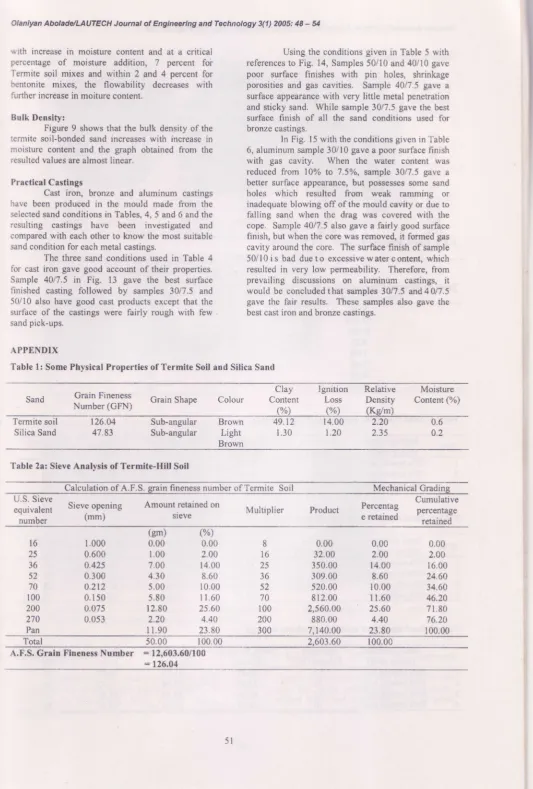
Some of the physical properties of termite soil are shown in the Table 1. The corresponding values for the percentage loss on ignition are 14 and L20 r espectively. This shows a c lear d ifference in the percentage loss on ignition, which implies a high content of organic materials which can burn off on the introduction of molten metal to form the basis for the collapsibility of the mould as investigated by Omo-Malaka (1977). The distribution of sand grains for the two sand samples are given in the Tables 2a and 2b and plotted as shown in Fig. l.
Mechanical grading:
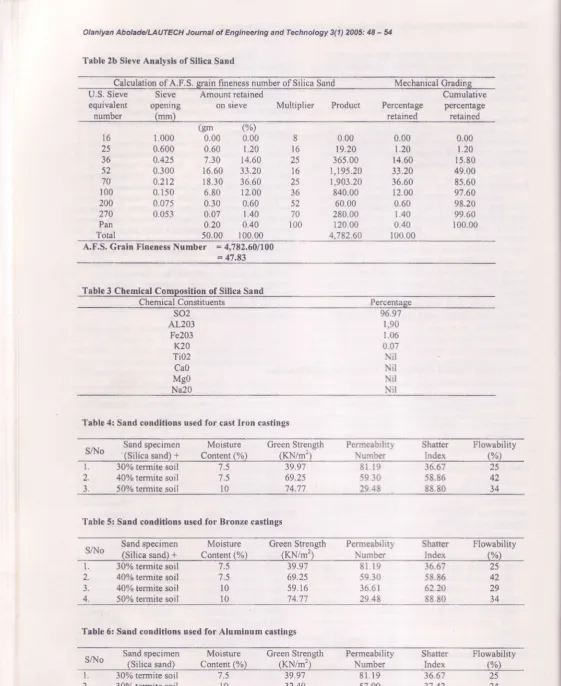
Tables 2a and 2b show the sieve analysis of Termite soil and siiica sand respectively. The GNF of the Termite soil is higher than that of silica sand. This difference in values resulted from the variation in grain size, grain shape and distribution of the sands.
Bulk Properties Determination
Determination of green and dry compressive strengths:
To determine the green strength, the specimen was tested immediately after ramming before the water dries out. The test was carried out using the Rinsdale Dieter. pendulum nrachine, an AFS standard Zin x 2in (50.8mm x 50.8mm) test specimen was inserted between the compressron heads. At the point where the specimen breaks, the reading was taken for the green compressive strengths.
For dry compressive strength, three standard test oieces were made for each. baked in the oven for about two hours at l20oC and allowed to cool to the ambient temperature before standard dry compression strength test was carried out on them.
Determination of Green and Dry Shear Strengths: Like in the determination of compression strength test, specimens for the green and dry shear strength were prepared in the same manner, Readings were taken appropriately.
Permeability number
The permeability number of moulding sand is an indication of the porosity of moulding sand.
P e r m e a b i l i t y ( P n ) : V x h P x a x t
Where,V = volumeof air in milliliter (ml) passing through the specimen,
Olantyan Abolade/LAUTECH Journal of Englneering antl Technology 3(1) 2005: 18 - 51
Fig. I shows, the cumulative grading curves of Termite soil and silica sand. The curves show similar characteristics, But the silica sand curve, shows more increase in the cumulative percentage retain with increasing sieve opening than that of Termite soil. The graph of the Termite soil is almost linear at one stage of sieve openings, that is, between 0.150 and 0.425 millimeters, In line with Balogun et al. (1980), the former result may indicate that the silica sand has less bond than Termite soil.
Clay Content:
From the result obtained in Table 1, the clay content of termite soil (49J2%) has suggested that it can be used as binder in moulding sand, since the amount and type of clay also have a great influence on the strength and other properties of moulding sand. [Nwajagu and Okafor, 1980]
Chemical Analysis:
The silica sand has higher percentage of silica {96.97To). This according to Burns (1989), favours their better performance when used in synthetic sand praclice.
Green and Dry Strengths:
Figures 3a, 5a and 3b , 5b show the influence of silica sand and moisture content on green compression and shear strengths of termite soil and bentonite powder respectively.
Judging from the bonding characteristics of the two binders. The bentonite curves appeared to be more perfect than the termite soil curves. The bonding ability of the bentonite is more effective at lower moisture around L5 to 3 percents, while that of termite soil required high moisture before the bonding properties became more active; around 3 - 5 percents.
In Figs. 3b and 5b, the variation in strength due to the increase in moisture content accounts for the difference in their bonding capabilities. The other properties of sand that affects the strength are grain shape, the grain size and distribution. These sizes and shapes of the particles of binding material are important factors in the ability of the clay to absorb wate.r and spread in a thin film around the sand grain. The thinner and more adhesive the film, the betterthe bonds and the less excessive the clay wasted in filling up the spaces above the grains of sand.. The bonding power ofa clay is the degree of cohesiveness it exhibits in holding the grains of mouiding sand together. Clay with the smallest particle size and higher moisture absorption properties gives the highest bond strength and cohesiveness to the sand mixures [Mathew and Aku, 19841. AIso, Omo-Malaka (1977), discussed that when water is added to the sand mixture, the sfrength increases and with further addition of the water content, the snength decreases at a critical v alue of water I Omo- M alaku | 97 7 7.
Figures lOa and 10b show the variation in green and dry compression strengths with percentage binder content at a fixed moisture content. In figure
l0b, the dry strength decreases and at a critical value of 37.5Y, for 3Yo water content and the value of40% for 5% water content, the sfength of the mixture increases. The dry strength of the bentonite is greater at 27o moisture content. At 5o/o moisture content, it posses low value of dry strength. This shows that the termite soil exhibit the same properties with the bentonite for green and dry strengths. These similar strenglh properties reveals that termite soil with a range of 25% to 45o/o, canbe developedto performbetter when used as synthetic foundry sand binder, since it exhibits similar properties and are comparable with a range of 6Yo to 20 %bentonite-bounded sands.
Permeability:
Close exarnination of Figures 2a and 2b show that permeability number of termite soil bonded sands and bentonite bonded sands have similar nends. The permeability increases with increase in moisture content, and at a critical percentage of moisture content the permeability stafts decreasing. The two binders show similar properties at lower and higher percentage additions, that is, 35, 37 .5, 40 and 45 percents termite soil show similar trends with 16 and 20 percents bentonite mlxes.
Figures l2a and 12b show the effect of increasing binding content on permeability number of constant moisture content. The figures show lhat termite soil has similar permeability properties with 6 to l0 percents bentonite mixes. This calls for the development of termite soil to be used as moulding sand binder with range 25 to 45 percents addition.
Shatter Index:
The variation of shatter index with moisture content is shown in Fig. 7a. Fig. 7b shows the shatter index increases with increase in moisture content for 6, 12, 16 and 20 percents bentonite. While at l0 and 8 percents bentonite, the mixes show similar properties with 35, 37.5, 40 and 45 percents termite soil mixes.
Figures lla and llb show the effects of binder content on shatter index of the mixes. The result from t hese figures sh ow t he t rends t o predict that termite soil will be suitably used as binder for making sand moulds at 5 and 8 percents moisture contents, since it can be compared with the bentonite as binder at 2 and 5 percents moisture contents.
F'lowability:
Olanlyan Abolede/LAUTECH Journal of Engineering and Technology 3(1) 2005: 48 * 54
..:th increase in moisture content and at a critical l-'ercentage of moisture addition, 7 percent for i'ermite soil mixes and within 2 and 4 percent for .lentonite mixes, the flowability decreases with :irrther increase in moiture content.
Bulk Density:
Figure 9 shows that the bulk density of the :crniite soil-bonded sand increases with increase in noisture content and the graph obtained from the i-esulted values are almost linear.
Practical Castings
Cast iron, bronze and aluminum castings rave been produced in the mould made frorn the selected sand conditions in Tables. 4. 5 and 6 and the resulting castings have been investigated and compared with each other to know the most suitablc sand condition for each metal castings.
The three sand conditions used in Table 4 tor cast iron gave good account of their properties. Sanrple 401'l.5 in Fig. 13 gave the best surface inished casting followed by samples 30/7.5 and 50/10 also have good cast products exoept that the surface of the castings were fairly rough with few sand pick-ups.
Using the conditions given in Table 5 with references to Fig. 14, Samples 50/10 and 40i l0 gave poor surface finishes with pin holes, shrinkage porosities and gas cavities. Sample 4017.5 gave a surface appearance with very little metal penetration and sticky sand. While sample 3017.5 gave the best surface hnish of all the sand conditions used for bronze castings,
In Fig. l5 with the conditions given in Table 6, aluminum sample 30/10 gave a poor surface finish with gas cavity. When the water content was reduced from l0% to 7.5o/o, sample 3017.5 gave a better surface appearance, but possesses some sand holes which resulted from weak ramming or inadequate bloil'ing off of the mould cavity or due to falling sand when the drag was covered rvith the cope. Sample 40/7.5 also gave a fairly good surface finislr, but when the core was removed, it formed gas cavity around the core. The surface finish of sample 50/10 is bad due to excessivewater content, which resulted in very low permeability, Therefote, from prevailing discussions on aluminum castings, it would bc concludedthat samples 3017.5 and40l7.5 gave the fair results. These samples also gave the best casl iron and bronze castings.
.{PPENDIX
Table 1: Some Physical Properties of Termite Soil and Silica Sand
Sand Grain Fineness
Number (GFN) Grain Shape Colour
Clay Ignition Relative Moisture Content Loss Density Content (9/o)
(%) (%) (Kelm) Termite soil
Silica Sand
126.04 4 7 . 8 3
Sub-angular Sub-angular
Brorvn Light Brown
4 9 . r 2
1 . 3 0
1 4 . 0 0
1 . 2 0
2.20
2 . 3 5
0 . 6
0 . 2
Table 2a: Sieve Analysis of Termite-Hill Soil
Calculation.of A.F.S. erain fineness nunrber of Termite Soil Mechanical Gradine
U . S . S i e v e
equrvalent )leveoPentng number (mmj
Amount retained on
sieve M u i t i p l i e r Product
^ rercenlag Cumulative percentage e relalne0 retained
1 6
25
3 6
5 2
70
1 0 0
200
2 7 0
Pan
I 000
0.600
4.425
0 . 3 0 0
0.2t2
0 . 1 5 0
0.075
0 . 0 5 3
(gm)
0 . 0 0
1 . 0 0
7 . 0 0
4 . 3 0
5 . 0 0
5 . 8 0
l 2 . 8 0
2 . 2 0
1 1 . 9 0
(%)
0.0t) 2 . 0 0 I 4 . 0 0
8 . 6 0 1 0 . 0 0 1 1 . 6 0 25.60
4 . 4 4 2 3 , 8 0
0 . 0 0
2 . 0 4
1 4 . 0 0
8 . 6 0
1 0
0 0
i 1 . 6 0
2 s . 6 0
4 . 4 0
2 3 . 8 0
0 , 0 0
2 . 0 0
1
6 . 0 0
24.60
34.60
46.20
7 1 . 8 0
7 6 . 2 0
100.00
8 t o 2 5 3 6 5 2 7 0 1 0 0 200 3 0 00.00
3 2 . 0 0
3 5 0 . 0 0
3 0 9 . 0 0
5 2 0 . 0 0
8 1 2 . 0 0
2,560.00
8 8 0 . 0 0
7 . 1 4 0 . 0 0
Total
5 0 . 0 0
1 0 0 . 0 02,60-r.60
100.0c
Olantyan AboladdLAUTECH Jaumet of Engtneerlng aadT*hnology3(1) Uni: $- 5a
Table 2b Sieve Analysis of Silica Sand
Calculation of A.F.S. grain fineness number of Silica Sand Mechanical Grading U.S. Sieve equivalent number Sieve opening (mm) Amount retained
on sieve Multiplier
Cumulative Percentage percentage
retained retained Product
l 6
25
3 6
5 2
70
1 0 0
200
1,000
0.600
0.425
0.300
0.212
0 . 1 5 0
0.075
0.053
0.00
1 . 2 0
14.60
33.20
36.60
12.00
0.60
1 . 4 0
0,40
100.00
0.00
1 . 2 0
1 5 . E 0
49.00
8 5 . 6 0
97.60
98.20
99.60
100.00
270
Pan
Total
(em
(%)
0.00
0.00
0.60
r.20
7.30
t4.60
16.60 33.20
1 8 . 3 0 3 6 . 6 0
6.80
12.00
0 . 3 0
0 . 6 0
0 . 0 7
1 . 4 0
0,20
0.40
50.00 100.00
0.00
19.20
365.00
1 , 1 9 5 . 2 0
1,903.20
840.00
60.00
280.00
120.00
4,782.60
8
l 6
25
1 6
2s
3 6
52
70
r 0 0
A.F.S. Grain I'ineness Number = 4,782.601100 = 47.83
Table 3 Chemical Composition of Silica Sand
Chemical Constituents Percentage
so2
AL2O3 Fe203 K20 Ti02 Ca0Mgo
Na20 96.97 1 , 9 0 1 . 0 6 0.07N i l Nil N i l N i l
Table 4: Sand conditions used for cast Iron castings
SNo Sand specimen (Silica sand) + Moisture Green Stre^ngth Content (%) (KN/m')
Permeability Number
Shatter Flowability Index (%)
25
42
34
1 , a3 .
30% termite soil 40% termite soil 50% termite soil
7 . 5
7.5
1 0
39.97
69.2s
74.77
8 1 .
t 9
5 9 . 3 0
29.48
36.67
5 8 . 8 6
8 8 . 8 0
Table 5: Sand conditions used for Bronze castings
SAIIo Sand specimen (silica sand) + Moisture Green Strength Permeability Shatter Flowability
Content (%) (I(N/m2) Number Index (/o')
l .
2.
14 .
3070 termite soil 40% termite soil 407o termite soil 50% termite soil
7 . 5
1 \l 0
l 0
39.97
69.2s
5 9 . l 6 74,77
8 1 . 1 9 5 9 . 3 0 36.61 29.48
36.67 5 8 . 8 6 62.20 8 8 . 8 0
25
42
29
5 4
Table 6: Sand conditions used for Aluminum castings
SA.lo Sand specimen (Silica sand) Content (%) Moisture Green Strorgth (KNim') Permeability Number Shatter Flowability Index (%)
l .
2 .
4.
30% termite soil 30% termite soil 40% termite soil 50% termite soil
7 . 5 l 0
I , J
l 0
39.97 32.40 69.25 74.77
8 r. 1 9
s 7 . 0 0
5 9 . 3 0
29.48
36.67 37.42 5 8 . 8 6 8 8 . 8 0
Olaniyan AboladdLAUTECH Journal of Engineering and T*hnology 3(1) 2005: 48 - 54
(Sand condition l) (Sand condition 2) F'ig. 13: Cast Iron (Pipe bending tool) Castings
(Sand condition 3)
(Sand condition 1) (Sand condition 2) (Sand condition 3) (Sand condition 4) Fig. 14: Bronze (Reducing channel) cast products
(Sand condition l) (Sand condition 2) (Sand condition 3) (Sand condition 4) Fig. l4: Aluminium (spray Nozzles) cast products
CONCLUSIONS
Standard tests for mouldrng nraterials have been carried out on the termite soil to investigate its suitability in formulating locai casting sands. Comparing the results obtained for the termite soil to
that of bentonite, the following conclusions are evident:
(i) Despite a reiatively high clay content, termite soil has good collapsibility, permeability, shatter index and a tolerable limit of gleen compression strength.
. ! ' . 7 n
eit
1.1.. , ' i :
iirtlf
Olanlyan Abolade/LAUTECH Journa, ol Engtneerlng and Technology 3(1) 2005: 48 - 54
(ir) In comparison with documented standard values of these properties, it could be concluded that termite soil would make an effective moulding material for ferrous and non-ferrous castings, but at sonrewhat high moisture content of about 7.5%.
(iii) The sand condition between 30Yo and 4Ao/o termite soil and 60/o to 8o/o moisture content are most recommended for castings of en gineering components.
Finally, sand conditions between 30%o and 40% termite soil can further be investigated in order to improve and eliminate the little defects that resulted when these sand conditions were used for castings.
REFERENCES
Ayangbesan, T, Adedoyin, S. and Olaniyan, A. (1998), "Foundry Technology and Practice". Ginpup Nig. Ltd, Ibadan 3'o Edition.
Balogun, S.A. Olubode, J.A. and Aderibigbe, D.A. (1980), "Working Properties of some Nigerian Synthetic Moulding Sand". Nigerian Joumal of Engineering and Technology, Vol. 3, pp. 89 - 97.
Burns, T.A. (1989), "Foundry Handbook" BPCC Wheatons Ltd., Britain 9'n edition.
Mathew, P, and Aku, S.Y. (1984), "lmprovement on Foundry Sands through changes in preparation techniques", The Nigerian Engineer, Vol. 19 pp.63-68.
Mathew, p. (1982), "Local Synthetic Moulding Mixture for Foundry Application", Nigeria Journal of Engineering and technology, Vol.5 pp.57-65.
Nwajagu, C.O. and Okafor, LC.l. (198) "A Study of the rnoulding properties of sand bonded by Ukpor Clay: Elservier Science Publishers B. C. Amsterdam.
Omo Malaka, S.L. (1973), "Observations on Termites in Nigeria" Nigeria Field Journal. Vol. 38 No. I pp. 22 - 40.
Omo Malaka, S.L. (1977), "A $tudy of the Chemistry and Hydraulic conductivity of mould materials and soils from different habitants of some Nigerian termites" Australian Journal of Soil Research, Vol.
1 5 , p p . 8 7 - 9 1 .
Risdale - Dieter. "Foundry Sand Testing Equipment and Operation Instruction". England. Zrimsek,A. H. and Vingas, G. T,(1963), "Steel
Foundry Green Facing Sand". Trans AFS, V o l . 7 1 p p 3 6 .