PERFORMANCE OF PMEGP IN MANIPUR
Dr. Kh. Dhiren Meetei1
O. Deepakkumar2
1. Associate Professor, Dept. of Commerce, Manipur University Canchipur-03
2. Research Scholar, Dept. of Commerce, Manipur University, Canchipur-03, [email protected]
SHIV SHAKTI
International Journal in Multidisciplinary and Academic Research (SSIJMAR)
Vol. 1, No. 4, November-December (ISSN 2278 – 5973)
ABSTRACT
Rural Development will be successful only when it goes along with the development of human resource,
employment generation and infrastructural development. Manipur a hill girt tiny state lying in the north east
India has been facing with many problems of unemployment, militancy and still lagging behind other states in
infrastructure development. Absence of industrial establishment is considered to be one of the reasons for
economic backwardness of the state. So far the participation of private sector undertaking in employment
generation is very low and most of the peoples cannot rely a livelihood on it. In this connection Prime Minister
Employment Generation Programme(PMEGP) is playing an important role in generation of employment
opportunities through rural industrialization. Therefore, it is necessary to study the rural industrial activities as
an instrumental approach for reducing the emerging problems of increasing unemployment and poverty in
rural areas.
PERFORMANCE OF PMEGP IN MANIPUR
INTRODUCTION
In the situation of increasing trend of population and unemployment, agriculture sector alone
cannot be in a position to create additional employment opportunities. Undoubtedly the
importance of initiating the efforts of village industrialization would be more desirable in
economically backward and the hilly states as compared to developed states. To overcome the
problems of unemployment and poverty, it is necessary to commercialize the production of farm
and nonfarm. But the diversification of economic activity is limited in the hilly states due to
difficult terrain, inaccessibility to markets and modern inputs and technology, deficient
infrastructure and insufficient energy and high transportation costs leading to non
competitiveness of products (Mehta G.S. 2002). The significance of the village industry is more
pronounced in the agriculturally backward and low productive regions of Manipur also.
Manufacturing activities constitute the second largest sector after agriculture and account for
over 7 per cent of the total and one third of the non agricultural employment in rural areas
(Papola 1992). The expansion of rural industrial activities should be maintained; otherwise it will
be rather difficult to overcome from the problems of unemployment in rural areas (Mathur
1993). The establishment of rural non-farm enterprises in general and manufacturing activities in
particular requires very low levels of capital investment.
Both the term non farm sector and rural industrialization are interchangeable, NABARD defined
non farm sector by listing a spectrum of small, cottage, tiny and village industries along with 22
major categories (Arunkumar A.V. 1997). Khadi and Village Industries (KVI) include artisans in
exceeding 10,000 which produces goods and renders services with or without the use of power in
which the fixed capital per head does not exceed Rs. 15,000.
SIGNIFICANCE OF STUDY
The total number of persons employed in the organized sector in the state was 80,600 as on 31st
March, 2005. Out of the persons employed in organized sector, 78,000 were under public sector
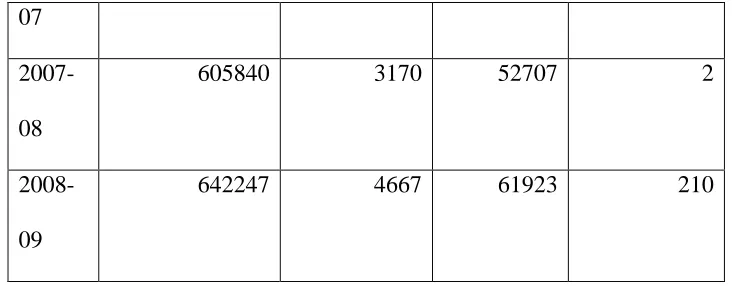
and the remaining 2,600 were under private sector. Thus, it is revealed from Table no. 1, that the
number of job seeker is incomparably exceeding the number of persons working in the organized
sectors in the state. During the year 2004-05 to 2008-09, out of 15140 vacancy notified, only
1058 appointment were made. The state government could not accommodate to employ all the
job seeker in its public sector organization. Therefore the importance of providing job through
private sector has become an essential step.
Table No. 1: Unemployment and Placement through Employment Exchange in Manipur
Year No. of
Unemployed
Persons
No. of
Vacancy
Notified
No. of Job
Applied
No. of
Persons
Appointed
2004-05
491476 1019 20984 -
2005-06
548704 3273 105882 489
07
2007-08
605840 3170 52707 2
2008-09
642247 4667 61923 210
Sources: Directorate of Employment, Govt. of Manipur
While Table no. 2 reflects that, in the year 2005-06, the employment generated through
registered industrial units is 53,719, which is again cannot be considered as a substantial measure
for unemployment problems in the state. On the other hand participation of shop and other
commercial establishment in employment generation is also less efficient with a total
employment of 2,475 in the year 2002-03 (Statistical Survey 2010-11).
Table No. 2 Registered Industrial Units in Manipur
Year
No. of
Units
No. of
Employment
Investment
(Rs. In
Crores)
Average
Investment
per Unit
(Rs. In
thousand)
Production
(Rs. In
Crores)
Average
per unit
Production
(Rs. In
lakh)
2001-02 9744 50364 36.07 37.02 162.30 1.67
2003-04 9993 51842 39.37 39.39 173.08 1.73
2004-05 10151 52857 41.38 40.76 177.79 1.75
2005-06 10264 53719 43.27 42.16 183.72 1.79
Sources: Directorate of Economics & Statistics, Govt. of Manipur
Thus the problems of unemployment has been a challenge to the economic planners of the state,
and the gap in the employment has been made through unorganized sector, either in agriculture,
its allied activities, tiny and village industry. The nonfarm and village industry has been taking a
very important role in mitigating the problems of unemployment in the state. Hence it is found
very significant to study the approach of village industries in the state.
Prime Minister Employment Generation Programme (PMEGP) is a new credit linked subsidy
programme implemented by Khadi and Village Industries Commission (KVIC) in the National
level. It was introduced on 31st March 2008, by merging two schemes namely Prime Minister’s
Rojgar Yojana (PMRY) and Rural Employment Generation Programme (REGP), for generation
of employment opportunities through establishment of micro enterprises in both rural and urban
areas. This scheme is implemented by state KVIC, Khadi and Village Industries Board (KVIB)
and District Industries Centre (DICs). The objectives of PMEGP are highlighted as;
1. Generation of employment opportunities in rural and urban areas by setting up new
ventures or micro enterprises.
3. To provide continuous and sustainable employment to a large segment of traditional and
prospective artisans to prevent from migration of rural artisan to urban artisans.
OBJECTIVES AND METHODOLOGY OF THE STUDY
The objectives of the study are to review the performance of Khadi and Village Industry (KVI)
under PMEGP in Manipur. Grossly the study is based on both primary and secondary data.
Primary data include interviews, comments, observations, opinion, questionnaire of the persons
concerned with the Khadi and Village Industry. And secondary data includes publication,
journal, annual reports, economic survey etc. The total sample size is 150 units who are
registered in the Directorate of Industries, Government of Manipur as Khadi and Village
Industries (KVI) units. Attempts were made to cover 30 percent of sample as ST, 10 percent as
SC and the remaining as OBC/General in the nine districts of Manipur.
PERFORMANCE OF PMEGP
To become a KVI artisans or an entrepreneur is a final option for employment of many educated
youth. Inability to get a government job or lack of proper financing in other venture may be the
main driving force for adopting KVI. The participation of women in the last three year is 28.39
percent in 2009-10, 37.02 percent in 2010-11 and 27.05 in 2011-12. Textiles industries are
mainly dominated by women while other industries by men, 77.42 percent in 2009-10, 84.73
percent in 2010-11 and 45.66 percent respectively of the total employment in textiles industries
are women. 42.46 percent of employment was increased during the year 2010-11 and 85.81
percent during the year 2011-12.
Table No. 3 EMPLOYMENT THROUGH KVI IN MANIPUR
Industries Women Men Total Women Men Total Women Men Total
Agro based 47 179 226 19 146 165 69 267 336
Forest
Based 43 86 129 63 57 120 86 239 325
HMP &
Fibre 0 0 0 0 0 0 0 0 0
Mineral
Based 65 154 219 50 220 270 82 495 577
Polymer &
Chemical 0 0 0 0 11 11 10 64 74
RE & BT 0 238 238 6 451 457 42 383 425
Service 14 144 158 22 96 118 119 318 437
Textile 168 49 217 466 84 550 442 526 968
Total 337 850 1187 626 1065 1691 850 2292 3142
Sources: Annual Progress Report, KVIC Manipur
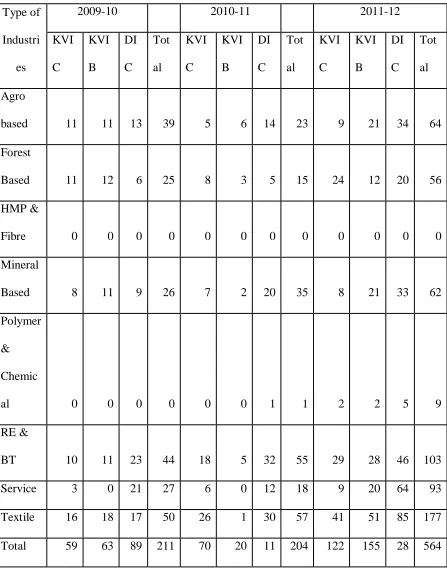
DIC sponsored 490 projects out of 979 projects during the year 2009-12, followed by KVIB with
251 projects and state KVIC with 238 projects. During these three years, no projects were
sanction for Handmade Paper and Fibre while polymer and chemical industries accounts for only
10 projects as the lowest. Maximum numbers of Projects were sanction in Textile industries
Table No. 4 NUMBER OF KVI PROJECT IN MANIPUR
Type of
Industri
es
2009-10 2010-11 2011-12
KVI C KVI B DI C Tot al KVI C KVI B DI C Tot al KVI C KVI B DI C Tot al Agro
based 11 11 13 39 5 6 14 23 9 21 34 64
Forest
Based 11 12 6 25 8 3 5 15 24 12 20 56
HMP &
Fibre 0 0 0 0 0 0 0 0 0 0 0 0
Mineral
Based 8 11 9 26 7 2 20 35 8 21 33 62
Polymer
&
Chemic
al 0 0 0 0 0 0 1 1 2 2 5 9
RE &
BT 10 11 23 44 18 5 32 55 29 28 46 103
Service 3 0 21 27 6 0 12 18 9 20 64 93
Textile 16 18 17 50 26 1 30 57 41 51 85 177
4 7
Sources: Annual Progress Report, KVIC Manipur
The application of machineries in the KVI are revealed as per the field survey as, 57.3 percent of
the respondent are semi mechanized, 28.2 percent were not mechanized, 7.3 percent are fully
mechanized and 7.3 percent are using outdated and risky tools and machineries.
26.67 percent of the respondent has lack of technical support, 19.67 percent have inadequate
working area, 10.67 percent found the high cost of technology, 20 percent cannot meet the
demand and 22.99 percent found some other difficulty in production like interrupted power
supply, law and order situation, seasonal raw materials etc.
30.67 percent of the respondent sold the product through sales representative on commission
basis. 10.67 percent have opened their own sales outlet, 16.67 percent through Khadi
Gramodyog, 20 percent sold through retailer, and another 21.99 percent used to participate in
Fair and Exhibition at national and international level.
FINDINGS
1. Manipuri women have been playing an important role in the promotion of KVI,
particularly in textile industries. They have some unique and artistic quality in hand
woven and embroidery which make handloom industry an internationally renowned.
2. The growth rate of employment generation through PMEGP has tremendous inclination
as compared to the last two previous years.
3. In spite of having adequate raw materials for handmade paper, the number of projects
under this industry is nil. Therefore, training and awareness is required for promotion of
4. KVIC has been involved with providing margin money in getting loan but it is also
necessary to take initiative for acquiring the right machineries and development of skills
through technical support etc.
5. Irregular power supply and law and order situation has been a common interrupting
factor for the establishment of any ventures in the state.
CONCLUSION
KVI product in the state has good demand but their supplies are not adequate. It is also necessary
to diversify the KVI projects into industries like Handmade Paper & Fibre and Polymer &
Chemical industries with innovation. It is also necessary to make maximum effort to utilize the
raw materials available in the state to its full extent and attract the educated youth to initiate such
industries to prevent them from migration of rural artisans to metropolitan city for job.
References:
Arunkumar A.V. (1997): Rural Industrialization In India: Aspects of Policy, Technology and
Employment With Reference to Kerala, MD Publication, New Delhi
Economic Survey Manipur (2010-11): Directorate of Economics & Statistics, Govt. of Manipur
Mehta G.S. (2002): Non Farm Economy and Development, Giri Institute of Development
Studies, Lucknow
Mathur, A and Pani, P. K. (1993): The Character of Rural Industrialization and Its Impact in
India, Indian Journal of Labour Economics, Vol. 36, No. 3
Papola (1992): Rural Non Farm Employment: An Assessment of Recent Trends, Indian Journal