Propulsion System Design and Sizing of an
Electric Vehicle
Amir Ahmed
Sikkim Manipal Institute of Technology/Department of Electrical and Electronics Engineering, Sikkim, India Email: [email protected]
Dikki D. Bhutia
Sikkim Manipal Institute of Technology/Department and Electronics and Communication Engineering, Sikkim, India Email:[email protected]
Abstract—Here sizing and designing of propulsion system of an electric vehicle has been done by first studying the vehicle dynamics and rated values of power, torque and speed is calculated from the Torque-Speed and Power-Speed profile of traction motor. This is followed by detail design parameters computation and adjusting the equivalent circuit parameters to increase the range of constant power region to attain higher drive efficiency. Once the motor is designed, its performance is evaluated using matlab simulink and modeling with different types of traction motor.
Index Terms—propulsion system, electric vehicle, vehicle dynamics, traction motor, constant power region
I. INTRODUCTION
To reduce the severe problem of Air Pollution in this century caused by fuel emission from Automobiles, one answer has been developed called Zero Emission Vehicles (Electric Vehicles) which are powered by onboard batteries and does not cause harmful tailpipe emissions. Fuel cell electric Vehicle has long term potential to be the vehicle of future [1].
A design methodology is presented based on vehicle dynamics and is aimed at finding the optimal torque-speed profile to meet the operational constraints with minimum power requirement. The more the motor can operate in constant power, the less the acceleration power requirement will be.
Here, the components are designed in such a way that the motors are imparted maximum torque-speed characteristics. Simulation of electric vehicle propulsion system is done using drive cycle input and the performance is evaluated.
II. ELECTRIC VEHICLE STRUCTURE
An Electric Vehicle contains 3 main parts [2]. (1) Energy Source.
(2) Power Converter. (3) Traction Motor.
Manuscript received September 9, 2013; revised December 29, 2013.
Figure 1. Electric vehicle power train block diagram
The energy sources consist of Rechargeable batteries, ultra capacitors and fuel cell. The electronic controller controls the flow of power from energy source to traction motors. The power converter adjusts the voltage according to the load demand. Li-Ion battery is better preferred as energy source because of long life and high energy density but it is not economically feasible [3].
The vehicle dynamics are studied first and the values of tractive force, Motor Torque and Motor angular speed is found out with the help of equations given below.
Follow the type sizes specified in Table I. As an aid in gauging type size, 1 point is about 0.35 mm. The size of the lowercase letter “j” will give the point size. Times New Roman has to be the font for main text. Paper should be single spaced.
III. VEHICLE DYNAMICS
Tractive force required for propelling the vehicle is given by:
f t =fmg + (0.5ρc xsv 2) + (mg sin(α ))+m(dv / dt )
(1)
The motor torque is given by:
The motor Angular speed is given by:
w = G × v / r (3)
Tractive Force (f t ) :
The term tractive force is the pulling or pushing force exerted by a vehicle on another vehicle or object.
Gear Ratio (G) :
The gear ratio of a gear train is the ratio of the angular velocity of the input gear to the angular velocity of the output gear, also known as the speed ratio of the gear train.
Drag Coefficient (
c
x ) :In fluid dynamics, the drag coefficient is a dimensionless quantity that is used to quantify the drag or resistance of an object in a fluid environment such as air or water.
Grade (α
)
:The grade (also called slope, incline, gradient, pitch or rise) of a physical feature, topographic landform or constructed element, refers to the amount of inclination of that surface to the horizontal.
We have taken City bus as a source vehicle whose vehicle parameters are shown below:
TABLE I. VEHICLE PARAMETER DYNAMICS
Parameter Symbol Value
Coefficient of rolling
friction f 0.01
Vehicle mass m 5123 Kg
Air density ρ 1.3 Kg/m3
Grade angle α 0
Frontal area s 5.65m2
Aerodynamic drag
coefficient cx 0.5
Gear ratio G 20
Tyre radius r 0.4m
Gravitational
acceleration g 9.81m/s2
In above table, the parameters of a source vehicle (City bus) are chosen. The mass of the vehic1e is taken as 5123Kg with inclination of 0 degree angle.
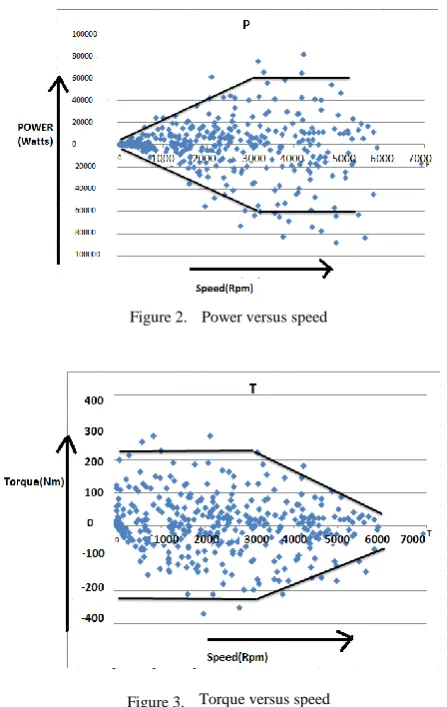
The parameters of city bus shown in above table are put in all above three equations and the following plots are obtained.
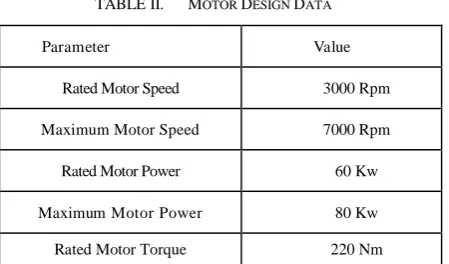
In the above plot of Power versus speed, at speed of 3000Rpm the power is becoming constant. So, at rated speed of 3000 Rpm, the rated power will be 60Kw and maximum motor power will be 80Kw respectively.
Figure 2. Power versus speed
Figure 3. Torque versus speed
Similarly, In Torque versus Speed plot, at rated speed of 3000 Rpm the rated torque will be 220 Nm.
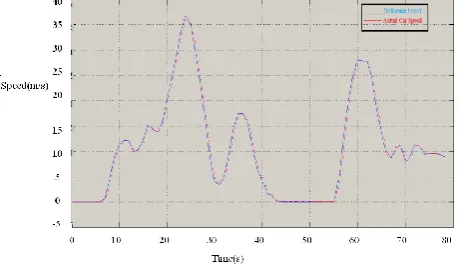
Figure 4. Speed (rpm) versus time (seconds).
From the vehicle dynamics, the following above plots are done and the rated values of Power, Torque and speed is obtained whose values are used as an input for traction motor sizing. Rated speed, Rated motor Power and Rated motor torque will be used as an input for designing the parameters of Induction motor.
IV. TRACTION MOTOR SIZING
TABLE II. MOTOR DESIGN DATA
Parameter Value
Rated Motor Speed 3000 Rpm
Maximum Motor Speed 7000 Rpm
Rated Motor Power 60 Kw
Maximum Motor Power 80 Kw
Rated Motor Torque 220 Nm
Based on the certain equations of electrical machine design, the following optimal designing of induction motor done is shown below.
TABLE III. OPTIMAL DESIGN OFINDUCTION MOTOR
Parameter Value
Output Power 35 KW
No. of Poles 2
Stator Diameter(Minimum cost) 0.196 m
Stator length (Minimum cost) 0.221 m
Flux per pole 0.0238 Weber
Total conductors 300.49 2
Stator current per phase 79.456 Ampere
Stator area 22.70 mm 2
Stator diameter(good power factor) 0.165 m
Stator Length(good power factor) 0.124 m
Flux per pole 0.0383 Weber
Total Conductors 186.72
Stator diameter(Good efficiency) 0.153 m
Stator length(Good efficiency) 0.36 m
Flux per pole 0.0346 Weber
Total conductors. 206.7
Stator diameter(good overall design) 0.385 m
Stator length(good overall design) 0.604 m
Flux per pole 0.146 Weber
Total conductors 48.98
No. of Rotor slots 61
Rotor bar current 54.21 A
Total rotor copper loss 232.68 W
Slip 0.00 6 5
Stator Leakage Reactance 1.0812 Ω
Magnetizing current 6.085 A
Magnetizing reactance 41.72 Ω
Stator resistance per phase 0.048 Ω
Total resistance per phase 0.0043 Ω
The stator and Rotor designing of Induction motor is done in C++ language using the rated values of motor obtained in Table II and using the designing procedure of
Electrical machine designing, the stator and rotor parameters are obtained.
The equivalent circuit parameters obtained is thus adjusted to increase the range of constant power region. On increasing the value of Rotor resistance, the range of constant power region increases which is shown below.
Figure 5. Torque versus speed showing constant power region for 2 graphs
For Graph 1, the input parameters are adjusted to the following values Rotor resistance=0.258Ω, Rotor reactance=0.507Ω Stator resistance=0.461Ω, Stator reactance=0.309Ω
Magnetizing reactance=30.74Ω
For Graph 2, the input parameters are adjusted to the following values Rotor resistance=0.982Ω, Rotor reactance=0.507Ω Stator resistance=0.461Ω, Stator reactance=0.309Ω
Magnetizing reactance=30.74Ω
V. MATLAB SIMULINK MODEL
After the analytical approach, the final results are obtained from Matlab Simulink modeling to assess the performance and range of the proposed Electric Vehicle design.
The simulation model consists of the following blocks: (1) Electrical Subsystem.
(2) Vehicle Dynamics.
(3) Energy management System.
The traction motor used is the Permanent Magnet Synchronous motor (PMSM) and three phase Induction motor (IM). The power converter used is the DC-DC bidirectional class C chopper. The battery used is Ni-Mh (Nickel Metal hydride). The gain is changed for Different values and the output is recorded.
The model used for simulation is a fuel cell electric vehicle which is shown in Fig. 6.
Graph 1
Graph 2
Figure 6. Fuel cell electric vehicle model.
Drive Cycle:
A drive cycle is a standardized driving pattern. This pattern is described by means of a velocity–time table.
Now putting the New York City drive cycle as an input. Above model is run again and the output graph between reference and actual speed is plotted under considerable time period.
Further simulation for PMSM with accelerator and later with Induction motor is done for 15 seconds for better understanding of the motor power, Fuel cell power and battery power which is shown in Fig. 7.
Figure 7. Fuel cell electric vehicle simulation output graph.
Later simulation of the same model is done with New York City drive cycle for 540 seconds to compare the efficiency and working of both PMSM and Induction motor.
Figure 8. Drive cycle output of PMSM electric vehicle for 78 seconds
The drive cycle in Fig. 8 shows that the actual car speed does not attend the reference speed which is due to machine inefficiency. The drive cycle shows the clear difference however, the validation is not there. The simulation result of the proposed model was satisfactory and shows correct performance of the system.
Figure 9. Drive cycle output of induction motor electric vehicle for 50 seconds.
From the above two simulation outputs, it is clear that PMSM gives better simulation results than Induction Motor. Their advantages are [4].
(1) Since, the magnetic field is excited by high energy of magnetic fields; it results in high efficiency and easy speed control.
(2) They have longer operating lives and an increased reliability and Brushless DC motor has been recommended for high performance electric vehicle [5].
Recent research has indicated that the permanent magnet synchronous motor and brushless dc motor (BLDC) can compete with Induction motor for electric vehicle propulsion [6].
Eventually, the simulation results for Rotor speed, Rotor and Stator current responses and Time response of Torque of 3 phase Induction motor is obtained.
Figure 10.Rotor speed curve of 3phase induction motor
Figure 11.Rotor and stator current responses of 3phase induction motor
The rotor and stator current responses of the three-phase induction motor are shown in Fig. 11. The rotor current fluctuates between 0 and 0.7 second. The stator current is drawn about 10 A at 0.8 second as shown in the figure
.
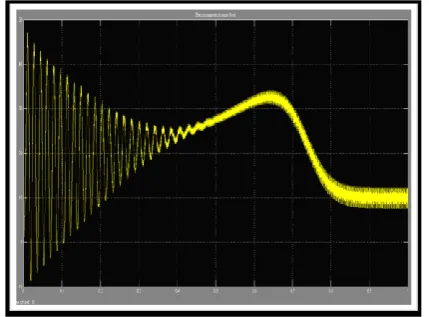
In Fig. 12, the time response of electromagnetic torque in the three-phase induction motor is expressed. The electromagnetic torque of three-phase induction motor is firstly variable in 0 to 0.4 second. Then the rated torque is reached at 0.8 second. The rated torque can be seen 10 Nm as shown in the figure below.
Figure 12.Time response of electromagnetic torque in 3phase induction motor
VI. CONCLUSION
Both PMSM and Induction Motor shows good characteristics for application in Electric Vehicles but PMSM are more preferred because of higher efficiency, higher power density and low cost [7]. But the only disadvantage with PMSM is that they are not self-starting motors .The range of Constant power region of Traction motor can be increased by increasing the value of rotor resistance. The vehicle’s operational constraints can be met with minimum power if the vehicle is operated mostly in constant power region[8]. Drive cycle can be prepared to evaluate the performance of electric vehicle through simulation and this reduces the time of testing the road and the fatigue engineers has to take in order to test the road.
REFERENCES
[1] E. Mehrdadehsani, K. M. Rahman, and H. A. Toliyat, “Propulsion system design of electric and hybrid vehicles,” IEEE Transactions on Industrial Electronics, vol. 44, no. 1, pp. 19-27, February 1997. [2] C. C Chan and Y. S Wong, “Electric vehicles charge forward,”
IEEE Power and Energy Magazine, pp. 2-12, November/December 2004.
[3] I. Alcala, A. Claudio, and G. V. Guerrero, “Analysis of propulsion system in electric vehicles,” in Proc. CIE 2005, September 7-9, 2005, pp. 312-313.
[4] P. Lindahl, E. Moog, and S. R. S. Haw, “Simulation design and validation of an uav sofc propulsion system,” IEEE Transactions on Aerospace and Electronic Systems, vol. 48, no. 3,pp. 2583-2592, July 2012.
[5] A. Tashakori and M. Ektesabi, “Direct torque controlled drive train for electric vehicle,” in Proc. the World Congress on Engineering.
[6] K. Buhr and P. Vozenilek, “Analysis of an electric vehicle with a BLDC pm motor in the wheel body,” Transactions on Transport Sciences, vol. 5, no. 1, pp. 1-10, 2012.
[7] J. D. S. Ochoa, “FEM analysis applied to electric machines for electric vehicles,” Digital Comprehensive Summariesof Uppsala Dissertations from the Faculty of Science and Technology, vol. 845.
[8] R. Singh, V. C. D. Roy, and C. K. Dwivedi, IJEEE, vol. 1, no. 3, pp. 2931-5284, 2012.
Amir Ahmed was born in 04.10.1989, Chungthang, Sikkim, India. Hegraduated in Electrical and Electronics Engineering in 2012 from Sikkim Manipal Institute of Technology, Sikkim, India and currently working as Assistant Professor Grade II in Sikkim Manipal Institute of Technology. His research interests are power electronics, electric vehicles, intelligent system and robotics.