ISSN 0975-928X
Research Article
Combining ability and gene action study for grain yield and its attributing
traits in bread wheat
N. D. Dholariya1, V. R. Akabari2, J. V. Patel3 And V. P. Chovatia3
1
Anand Agricultural University,Anand-388110,Gujarat, India.
2
Regional Research Station, Anand Agricultural University,Anand-388110,Gujarat, India.
3
Main Wheat Research Station,Junagadh Agricultural University, Junagadh – 362 001(Gujarat), India.
E-mail: [email protected]
(Received: 22 Apr 2014; Accepted:18 Jun 2014)
Abstract
Combining ability and nature of gene interactions that contribute to grain yield and its attributing traits of wheat were investigated using 28 bread wheat hybrids developed by crossing 8 commercial varieties in a diallel mating design. The results revealed that mean squares due to GCA and SCA were highly significant for all the characters studied and indicatethe occurrence of both additive and non-additive type of gene interactions. The GCA and SCA ratio (2GCA/2SCA) was less than unity for all the traits except for days to 50 % flowering, number of spikelets per main spike, days to maturity and biological yield per plant. This indicated that non-additive components played relatively greater role in the inheritance of these traits. The estimate of GCA effects indicated that the parents GW-366, GW-411, K-583, KRL-213 and LOK-1, were identified as good general combiners revealing their ability in transmitting additive genes in the desirable direction to their progenies. The hybrids viz., GW-366 x HD-2687, GW-366 x LOK-1 and LOK-1 x KRL-213 were found to be the best specific crosses for grain yield per plant in which GW-366 x HD-2687 was found to be the best specific combiner for number of effective tillers per plant, length of main spike, number of spikelets per main spike, number of grains per main spike, 100 grain weight, biological yield per plant and harvest index (%), therefore, can be further exploited for selection of transgressive segregants.
Key words: Wheat , combining ability, Grain yield, hybrid, yield Components. Introduction:
India is one of the wheat producing countries of the world. It produced 94.88 million tonnes wheat on an area of 29.90 million hectare (3173.24 kg/ha) (Anonymous, 2013) but geometrical increase in India’s population has been a challenge for agricultural scientists. To feed the ever-increasing population of India, there is a dire need of improving genotypes for better wheat yield potential per unit area basis. This could be achieved by exploring the maximum genetic potential from the available germplasm of wheat. Breeders should concentrate on development of productive wheat varieties by crossing good general combining lines for grain yield and selecting transgressive segregants from the resulting hybrids. Information regarding general and specific combining ability of wheat genotypes is a prerequisite to launch a successful wheat-breeding program. Diallel mating design has been extensively used to analyze the combining ability effects of wheat genotypes and also to provide information regarding genetic mechanisms controlling grain yield and other traits.
The present study was designed to find out the good general combining genotypes for sound breeding program and to select high yielding combiners for the development of productive wheat varieties and good specific combiners for selection of transgressive segregants.
Material and methods
Eight commercial varieties of bread wheat (Triticum aestivum), viz. 366, Lok-1, GW-173, HD-2687, KRL-213, RAJ-4037, GW-411 and K-583 were crossed in all possible combinations excluding reciprocals. The 10 parents and their resulting 28 F1’s were planted in a Randomized
Complete Block Design, with three replications at Main Wheat Research Station, Junagadh Agricultural University, Junagadh, during Rabi - 2011. Each entry was planted in two rows of 3 m length, with a plant-to-plant and row-to-row distance of 10 and 22.5 cm, respectively. Standard agronomic practices were followed from sowing till harvest.
For recording observations, 5 competitive plants were randomly selected and tagged from each treatment in each replication and the average value per plant was computed for various yield and its attributing traits viz., days to 50% flowering, plant height, no. of effective tillers per plant, length of main spike, no. of spikelets per main spike, peduncle length of main spike, days to maturity, no. of grains per main spike, 100 grains weight, grain weight per main spike, grain yield per plant and harvest index. The combining ability analysis was carried out according to Model-I (Fixed effect), Method-2 (Parents and one set of F1’s
ISSN 0975-928X Results and Discussion
The analysis of variance for combining ability for different characters has been presented in Table 1. The results revealed that mean squares due to general combining ability (GCA) and specific combining ability (SCA) were highly significant for all the characters studied. This indicated that both additive and non-additive type of gene effects imparting a vital role in the inheritance of all the traits.
The magnitude of GCA and SCA variances revealed that the SCA variances were higher than their respective GCA variances for all the characters except for days to 50% flowering, number of spikelets per main spike, days to maturity and biological yield per plant. The GCA and SCA ratio (2GCA/2SCA) was less than unity for all the traits except for days to 50% flowering, number of spikelets per main spike, days to maturity and biological yield per plant. This indicated that non-additive components played relatively greater role in the inheritance of these traits.
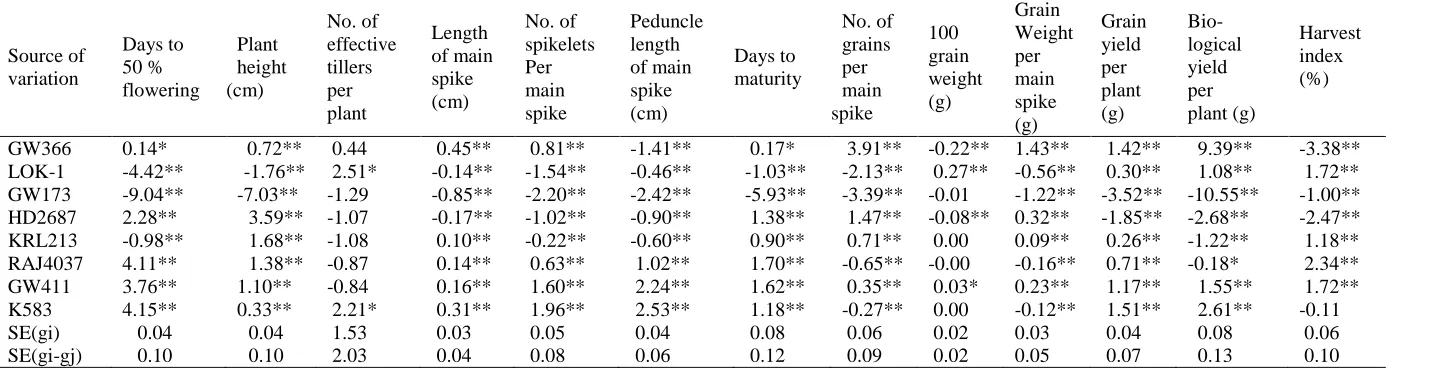
General combining ability effects of the parents (Table 2) revealed that none of the parents was found to be good general combiner for all the characters. An overall appraisal of GCA effects revealed that parents GW-366, GW-411, K-583, and LOK-1 were good general combiners for grain yield per plant and some of its components. K-583 ranked first in GCA effects for grain yield per plant and number of spikelets per main spike and stood second in respect of GCA effects for no. of effective tillers per plant, length of main spike and biological yield per plant. GW-366 and GW-411 showed significant GCA effects in desirable direction for length of main spike, no. of spikelets per main spike, no of grains per main spike, grain wt. per main spike, and biological yield per plant. LOK-1 showed significant GCA effects in desirable direction for days to 50% flowering, no. effective tillers per plant, penducle length of main spike, days to maturity, 100 grain weight, biological yield per plant and harvest index, which may be utilized in crossing programme to generate the genetic variability for effective selection to develop high yielding varieties as well as earliness in wheat. High gca effects are related to additive gene effects or additive × additive effects
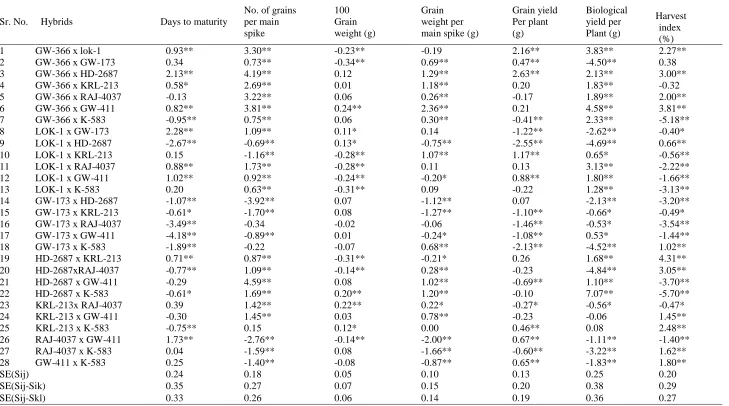
pollinated crops except where exploitation of heterosis is feasible. However, in the production of homozygous lines, breeder’s interest usually rests upon transgressive segregation shown by the crosses. The SCA effect of 28 crosses are presented in table 3. The crosses viz., GW-366 x HD-2687, GW-366 x LOK-1 and LOK-1 x KRL-213 were found to be the best specific crosses for grain yield per plant. The cross GW-366 x HD-2687 was also found to be the best specific combiner in desirable direction for no. of effective tillers per plant, length of main spike, no. of spikelets per main spike, no. of grains per main spike, 100 grain weight, biological yield per plant and harvest index (%). Among crosses, the hybrids GW-173 x HD-2687 exhibited significant sca effects in desirable direction for days to 50 per cent flowering, plant height and days to maturity.
Genetic variance component indicated that both additive and non-additive type of gene effects imparting a vital role in the inheritance of all the traits. The GCA and SCA ratio (2GCA/2SCA) was more than unity for days to 50 % flowering, no. of spikelets per main spike, days to maturity and biological yield per plant. This indicated that additive components played relatively greater role in the inheritance of these traits. Therefore, mass selection or pedigree selection might be fruitful in early segregating generations for the improvement of the traits controlled by additive genes action. The GCA and SCA ratio (2GCA/2SCA) was less than unity for viz., plant height, number of effective tillers per plant, length of main spike, penduncle length of main spike, number of grains per main spike, 100-grain weight, grain weight per main spike, grain yield per plant and harvest index. Therefore, selection must be delayed to late segregating generations (F6) as in bulk method for
these traits if necessary as discussed by Ahmadi et al. (2003) and Khaliq et al. (2006).
The results are in conformity with those obtained earlier by Mavi et al. (2003), Siddique et al.
(2004), Dhayal and Sastry (2003), Desai et al.
(2005), Chowdhary et al. (2007), Sami et al.
(2010) and Zahid et al. (2011)
ISSN 0975-928X
Wiley & sons Inc., New York. pp. 270-274. Chowdhary, M. A., Muhammad, S. and Ashraf, M. I.
2007. Analysis on combining ability of metric traits in bread wheat (Triticum aestivum). J.
Agric. Res., 45:11-17.
Desai, S. A., Lohithaswa, H. C., Hanchinal, R. R., Kalappanavar, I. K. and Math, K. K. 2005. Combining ability for quantitative traits in bread wheat (Triticun aestivum L.). Indian J.
Genet., 65:311-312.
Dhayal, L. S. and Sastry, E. V. D. 2003. Combining ability in bread wheat under salinity and normal conditions. Indian J. Genet., 63:69-70. Griffing, B. 1956. Concept of general and specific
combining ability in relation to diallel crossing systems. Aust. J. Biol. Sci., 9:463-493. Khaliq, I., Zahid, N., Chaudhry, M. A. and Kashif, M.
2006. Combining ability studies in yield related attributes in· Wheat. International Symposium on sustainable crop improvement and integrated management. September 14-16, Pp 53.
Mavi, G. S., Nanda, G. S., Sou, V. S., Sharma, S. and Kaur, S. 2003. Combining ability analysis for yield and its components in bread wheat
(Triticum aestivum L.) in two nitrogen
regimes. Crop Improv.,30:50-57.
Sami Ul Allah, Abdus Salam Khan, Ali, R. and Sajiad, S. 2010. Gene action analysis of yield and yield related traits in spring wheat (Triticum
aestivum). Intl. J. Agric. Biology, 12
(1):125-128.
Siddique, M.; Shiraz, A.; Malik, M. F. A. and Awan, S. I. (2004). Combining ability estimates for yield and yield components in spring wheat.
Sarhad J. Agric., 20:485-487.
Zahid Akram, Saif Ullah Ajmal, Khalid Saifullah Khan, Rahmatullah Qureshi and Muhammad Zubair 2011. Combining ability estimates of some yield and quality related traits in spring wheat
(Triticum aestivum L.). Pak. J. Bot.,
ISSN 0975-928X
Table 1. Analysis of variance for combining ability for various characters in wheat.
Source of variation df
Days to 50 % flowering Plant height (cm) No. of effective tillers per plant Length of main spike (cm) No. of spikelets per main spike Peduncle length of main spike (cm) Days To maturity No. of grains per main spike 100 Grain weight (g) Grain weight per main spike (g) Grain yield per plant (g) Bio- logical yield per plant (g)
Harvest index (%)
GCA 7 22.35** 10.74** 4.40** 1.60** 22.55** 31.05** 65.55** 49.49** 0.19** 5.79** 3.17** 31.24** 44.75** SCA 28 7.36** 3.78** 2.82** 0.28** 2.20** 4.44** 3.27** 8.81** 0.04** 1.36** 1.74** 12.25** 8.00**
ERROR 70 0.05 0.05 0.72 0.05 0.03 0.02 0.07 0.04 0.00 0.01 0.02 0.08 0.05
σ2 GCA 22.2 1.03 0.44 0.16 2.25 3.10 6.55 4.94 0.02 0.58 0.32 31.2 4.47
σ2 SCA 7.59 3.73 1.52 0.27 2.17 4.42 3.20 8.77 0.04 1.35 1.71 12.16 7.95
G.P.R. = σ2 GCA
/σ2SCA
2.93 0.28 0.29 0.59 1.04 0.70 2.05 0.56 0.50 0.43 0.19 2.60 0.56
*,** significant at 5% and 1% levels, respectively.
Table 2. Estimates of general combining ability effects for different characters in wheat.
Source of variation Days to 50 % flowering Plant height (cm) No. of effective tillers per plant Length of main spike (cm) No. of spikelets Per main spike Peduncle length of main spike (cm) Days to maturity No. of grains per main spike 100 grain weight (g) Grain Weight per main spike (g) Grain yield per plant (g) Bio- logical yield per plant (g) Harvest index (%)
ISSN 0975-928X
Table 3. Estimates of specific combining ability effects for different characters in wheat.
Sr. No. Hybrids
Days to 50 % flowering
Plant height (cm)
No. of effective tillers per plant
Length of main spike (cm)
No. of Spikelets per main spike
Peduncle length of main spike (cm)
1 GW-366 x lok-1 -0.36 -0.63** 0.88 -0.25** -0.72** 1.98**
2 GW-366 x GW-173 0.12 2.50** 0.44 -0.11 -2.13** -0.16
3 GW-366 x HD-2687 1.03** 2.45** 0.53 1.22** 1.46** 3.25**
4 GW-366 x KRL-213 0.50* -2.21** 0.03 0.87** 2.36** 2.18**
5 GW-366 x RAJ-4037 -3.29** -0.64** 0.82 -0.68** 1.30** -0.34*
6 GW-366 x GW-411 0.12 1.21** 0.13 0.58** 1.67** -0.86
7 GW-366 x K-583 -0.61** -0.57** -3.59** -0.47** 1.27** -2.30**
8 LOK-1 x GW-173 2.08** -1.74** -2.06** -0.48** -1.18** 1.61**
9 LOK-1 x HD-2687 -3.20** 2.59** -3.09** 0.60** 2.80** 2.27**
10 LOK-1 x KRL-213 0.13 3.57** -2.07** 0.63** 2.15** 1.06**
11 LOK-1 x RAJ-4037 -3.86** -1.61** -2.79** 0.23** 0.32* -0.47**
12 LOK-1 x GW-411 -0.64** 3.56** -2.37** 0.87** 0.32* -2.13**
13 LOK-1 x K-583 1.31** -1.65** 2.52** 0.05 0.91** -3.10**
14 GW-173 x HD-2687 -4.49** -3.01** -0.12 -0.28** -1.03** 2.96**
15 GW-173 x KRL-213 -0.13 0.94** 0.34 -0.04 1.74** 1.49**
16 GW-173 x RAJ-4037 -3.98** 1.53** 0.43 0.11 1.24** -1.09**
17 GW-173 x GW-411 -3.02** 0.18 0.52 0.05 1.06** -1.95**
18 GW-173 x K-583 -3.18** 0.51* -2.13** 0.28** -0.38* -1.70**
19 HD-2687 x KRL-213 4.02** 1.98** 1.54** -0.51** 0.62** -0.10
20 HD-2687xRAJ-4037 0.03 -0.15 1.07 -0.08 -0.20 -1.68**
21 HD-2687 x GW-411 -0.59** 0.79** 0.88 0.17* -0.90** -2.84**
22 HD-2687 x K-583 0.42* 1.06** -1.88** 0.19* -0.13 -2.49**
23 KRL-213x RAJ-4037 -2.53** -0.73** 0.71 -0.06 -1.10** -1.35**
24 KRL-213 x GW-411 -1.45** -0.95** 0.61 -0.30** -1.60** -1.54**
25 KRL-213 x K-583 -1.04** 1.14** -2.27** -0.23** -1.56** -1.00**
26 RAJ-4037 x GW-411 3.45** 0.76** 0.72 0.12 -1.16** 1.20**
27 RAJ-4037 x K-583 3.89** -0.43* -2.55** 0.29** -0.65** 1.52**
28 GW-411 x K-583 1.18** -0.96** -2.05** -0.43** 0.32* 3.02**
SE(Sij) 0.20 0.20 0.47 0.08 0.16 0.13
SE(Sij-Sik) 0.29 0.30 0.69 0.12 0.23 0.19
SE(Sij-Skl) 0.28 0.28 0.65 0.12 0.22 0.18
ISSN 0975-928X Table 3. Contd..
Sr. No. Hybrids Days to maturity
No. of grains per main spike
100 Grain weight (g)
Grain weight per main spike (g)
Grain yield Per plant (g)
Biological yield per Plant (g)
Harvest index (%)
1 GW-366 x lok-1 0.93** 3.30** -0.23** -0.19 2.16** 3.83** 2.27**
2 GW-366 x GW-173 0.34 0.73** -0.34** 0.69** 0.47** -4.50** 0.38
3 GW-366 x HD-2687 2.13** 4.19** 0.12 1.29** 2.63** 2.13** 3.00**
4 GW-366 x KRL-213 0.58* 2.69** 0.01 1.18** 0.20 1.83** -0.32
5 GW-366 x RAJ-4037 -0.13 3.22** 0.06 0.26** -0.17 1.89** 2.00**
6 GW-366 x GW-411 0.82** 3.81** 0.24** 2.36** 0.21 4.58** 3.81**
7 GW-366 x K-583 -0.95** 0.75** 0.06 0.30** -0.41** 2.33** -5.18**
8 LOK-1 x GW-173 2.28** 1.09** 0.11* 0.14 -1.22** -2.62** -0.40*
9 LOK-1 x HD-2687 -2.67** -0.69** 0.13* -0.75** -2.55** -4.69** 0.66**
10 LOK-1 x KRL-213 0.15 -1.16** -0.28** 1.07** 1.17** 0.65* -0.56**
11 LOK-1 x RAJ-4037 0.88** 1.73** -0.28** 0.11 0.13 3.13** -2.22**
12 LOK-1 x GW-411 1.02** 0.92** -0.24** -0.20* 0.88** 1.80** -1.66**
13 LOK-1 x K-583 0.20 0.63** -0.31** 0.09 -0.22 1.28** -3.13**
14 GW-173 x HD-2687 -1.07** -3.92** 0.07 -1.12** 0.07 -2.13** -3.20**
15 GW-173 x KRL-213 -0.61* -1.70** 0.08 -1.27** -1.10** -0.66* -0.49*
16 GW-173 x RAJ-4037 -3.49** -0.34 -0.02 -0.06 -1.46** -0.53* -3.54**
17 GW-173 x GW-411 -4.18** -0.89** 0.01 -0.24* -1.08** 0.53* -1.44**
18 GW-173 x K-583 -1.89** -0.22 -0.07 0.68** -2.13** -4.52** 1.02**
19 HD-2687 x KRL-213 0.71** 0.87** -0.31** -0.21* 0.26 1.68** 4.31**
20 HD-2687xRAJ-4037 -0.77** 1.09** -0.14** 0.28** -0.23 -4.84** 3.05**
21 HD-2687 x GW-411 -0.29 4.59** 0.08 1.02** -0.69** 1.10** -3.70**
22 HD-2687 x K-583 -0.61* 1.69** 0.20** 1.20** -0.10 7.07** -5.70**
23 KRL-213x RAJ-4037 0.39 1.42** 0.22** 0.22* -0.27* -0.56* -0.47*
24 KRL-213 x GW-411 -0.30 1.45** 0.03 0.78** -0.23 -0.06 1.45**