Naidu, S., & Cunnington, D. (2004). Showcasing faculty experiences with
technology enhanced teaching and learning.
AACE Journal
,
12
(2), 141-154.
Showcasing Faculty Experiences with Technology
Enhanced Teaching and Learning
SOM NAIDU AND DAVID CUNNINGTON
The University of Melbourne
Victoria, Australia
[email protected]
[email protected]
This article describes a research project that seeks to explore the experiences of faculty with technology-enhanced teaching and learning. A particular focus of this investigation is on how the use of information and communications technology is influencing teaching practices and students’ approaches to learning at the University of Melbourne. This is a naturalistic inquiry into the experience base of faculty who have been engaged in technology-enhanced teaching and learning. Our goal is to look beyond the existing, often rather superficial, data and closely examine how information and communica-tions technology is influencing the nature of the teaching and learning transactions. We are interested in the “untold” stories of academics. These stories and reflections of academics are archived on the following website. See <http://dozer.infodiv. unimelb.edu.au/tales/tales.php>.
AIMS AND OUTCOMES
research project that is seeking answers to some of these questions from the
perspective of faculty experiences. The goal of this study is to look beyond
survey data and into the experiences of academics to capture their “untold”
stories. We are hopeful that these stories would form the subject of further
study and exploration.
CONTEXT AND SCOPE
The use of information and communications technologies are enabling
campus-based providers to rethink and re-engineer the nature of their
teach-ing and learnteach-ing practices. The University of Melbourne, like many other
educational institutions, is currently involved in just such a process as part
of a strategy to position the University as a global player in higher
educa-tion. As a direct result of this and along with the adoption of ICT, innovative
approaches to teaching and learning such as problem-based learning and
collaborative learning are being encouraged. These initiatives have led to
the rise of new roles for teachers such as becoming “facilitators of
learn-ing” as opposed to being “deliverers of content” (de Verneil & Berge, 2000;
Evensen & Hmelo, 2000; Salmon, 2000). They have also exposed students
to new models and approaches to learning such as “computer supported
collaborative learning” (Koschmann, 1996), and “computer supported
problem-based learning” (Bernard, Rojo de Rubalcava, & St-Pierre, 2000;
Crook, 1994; Dillenbourg, 1999; Koschmann, Kelson, Feltovich, &
Bar-rows, 1996; O’Malley, 1995).
METHODOLOGY
The research described in this article comprises a naturalistic inquiry into
the operating mode of educators. Naturalistic inquiry is particularly suited
to questions such as these where the context is dependent on individual
interpretations and perceptions (Lincoln & Guba, 1985). Such a contextual
inquiry
demands
the active use of the inquirer’s tacit knowledge combined
with qualitative data gathering tools such as interviews, direct observations,
self-reporting and think-aloud, and document analysis. The inquiry takes
the form of successive iterations of these elements: purposive sampling,
inductive analysis of the data, development of grounded theory based on
the inductive analysis, and projection of next steps in a constantly
emer-gent design (Lincoln & Guba, 1985; p. 187). Throughout the inquiry, and
especially at the end, the data and interpretations are continuously checked
with respondents, and differences of interpretation are negotiated until the
outcomes are agreed upon or understood and reflected as such. This
infor-mation is then used to develop a case report or profile.
DATA GATHERING
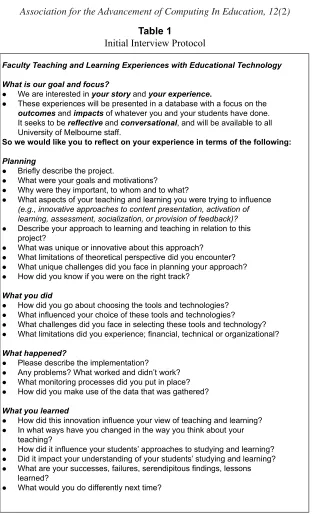
Table 1
Initial Interview Protocol
Faculty Teaching and Learning Experiences with Educational Technology
What is our goal and focus?
We are interested in your storyandyour experience.
These experiences will be presented in a database with a focus on the
outcomes and impacts of whatever you and your students have done. It seeks to be reflective and conversational, and will be available to all University of Melbourne staff.
So we would like you to reflect on your experience in terms of the following:
Planning
Briefly describe the project.
What were your goals and motivations? Why were they important, to whom and to what?
What aspects of your teaching and learning you were trying to influence
(e.g., innovative approaches to content presentation, activation of learning, assessment, socialization, or provision of feedback)?
Describe your approach to learning and teaching in relation to this
project?
What was unique or innovative about this approach? What limitations of theoretical perspective did you encounter? What unique challenges did you face in planning your approach? How did you know if you were on the right track?
What you did
How did you go about choosing the tools and technologies? What influenced your choice of these tools and technologies? What challenges did you face in selecting these tools and technology? What limitations did you experience; financial, technical or organizational?
What happened?
Please describe the implementation? Any problems? What worked and didn’t work? What monitoring processes did you put in place? How did you make use of the data that was gathered?
What you learned
How did this innovation influence your view of teaching and learning? In what ways have you changed in the way you think about your
teaching?
How did it influence your students’ approaches to studying and learning? Did it impact your understanding of your students’ studying and learning? What are your successes, failures, serendipitous findings, lessons
learned?
Interviews routinely begin with a discussion of this interview protocol. This
is to ensure that interviewees understand the questions, and are comfortable
with their motives. With the permission of the interviewees, all interviews
are audiotaped and subsequently transcribed. These transcripts comprise the
raw data for the development of profiles of practice. The interview protocol
follows the action research methodology.
DEVELOPMENT OF PROFILES OF PRACTICE
The interview transcripts comprise the raw data in this study. Researchers
examine these transcripts to develop individual profiles of practice along the
lines of the interview protocol. These are then presented to each interviewee
to allow the filling of gaps in the profiles, verification of existing
materi-als, and addition of any other thoughts on the matters raised during the
interview. This in itself is an iterative process and might involve further
interview and consultations with interviewees. The profiles are entered onto
the database only when complete agreement has been reached between the
interviewee and the researchers on the content of the profiles.
DEVELOPMENT OF THE DATABASE
Public access to this database is at
<http://dozer.infodiv.unimelb.edu.au/tales/tales.php>. Data is entered using
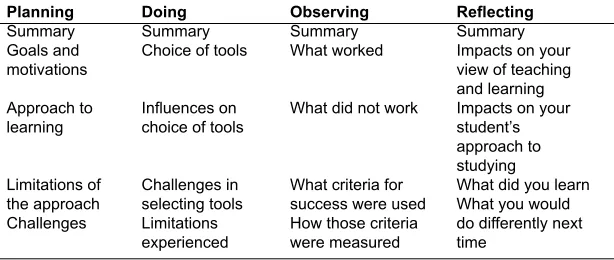
a simple web-based form to populate the fields (Table 2).
Table 2
Profiles of Practice Database Fields
Planning Doing Observing Reflecting
Summary Summary Summary Summary Goals and Choice of tools What worked Impacts on your motivations view of teaching
and learning
Approach to Influences on What did not work Impacts on your learning choice of tools student’s
approach to
studying
Data is also included for standard project details such as the names and
af-filiations of faculty members, project leaders, date of implementation, and
project type. Each profile also contains a brief summary of the project and
current issues in the discipline. Where appropriate, data can be provided in
formats other than text, such as images, audio files, or links to web sites.
The database is used to generate a showcase of academic practice. Users of
the site can display full details of individual projects (Table 3) or customize
the display of stories by focussing on a particular action research process,
group of questions, or faculty. Display options include a choice of
pre-defined categories, as well as browseable lists and individually constructed
searches.
Predefined categories enable the display of projects by person, faculty,
or department, as well as by each of the action research process. Search
functions provide for customised views of the data that enable investigation
based on specific interests. Keyword searching is also available across all
fields of the database.
A FULL SAMPLE PROFILE
Table 3
A Complete Profile on the Database
Project: Understanding Bile Salts and Bilirubin Metabolism
Faculty: Medicine, Dentistry and Health Sciences, The University of Mel-bourne
Summary of project
This project focuses on the study of the liver and hepatobiliary system in four mod-ules, integrating basic and clinical sciences across disciplines, such as anatomy, physiology, biochemistry, histology, pathology, pharmacology, and microbiology. The educational content of this project matches with the philosophy of problem-based learning (PBL). The project is set up as a formative assessment exercise that en-hances self-directed learning and the development of a wide range of domain spe-cific cognitive skills. Students using the program are required to submit their swers to progress to the next task. If they are unable to provide an adequate an-swer to a question, they might use the “consult” button, which provides users with some guidance that enables them to rethink their perspective on the task they are undertaking. Feedback is provided to the users at different stages of each task in the four modules.
Table 3 (continued)
A Complete Profile on the Database
Current issues in the discipline
I think there are a number of challenges that are forcing us to introduce changes to our curriculum. In the traditional curriculum, teaching was often focused around sin-gle discipline areas. In this way the traditional approach created an artificial division between basic sciences and clinical practice. Although traditional teaching of medi-cine has served well for almost a century, it seems that the traditional approach was designed for a different society and a different time. Over the last 30 years, several aspects in our community have changed enormously and our understanding of the role of science and psychosocial issues in relation to health and illness has raised the need for a rethinking of medical education strategies. Several problems were en-countered during the implementation of traditional curricula. For example, the appli-cation of knowledge acquired from basic sciences can be difficult and the acquisition and long-term retention of information that has no apparent relevance can be boring and of limited value.
Planning—Summary
As I was planning for the project with a number of goals in mind I thought that I would never be able to achieve these goals unless the project was designed in an innova-tive way that kept students engaged and motivated. I did not want to repeat what is already mentioned in text books or lectures and I did not want to encourage rote learning but rather, use and application of knowledge, interpretation of data and clini-cal findings, decision making strategies and deeper understanding of the scientific basis of mechanisms and underlying pathophysiological processes. These important educational issues have no place in textbooks or lectures. In this project, I have cre-ated a broad range of learning and formative assessment tools that reflect these edu-cational needs. I think I would not have been able to achieve these goals without the use of the technology, for example, the creation of a three dimensional model of the liver by the user, where students can clearly observe the complexity of the organ, the blood and bile flow and function of the different transporters (carrier proteins) which have been recently cloned. Deep understanding of these principles would not have been possible without the use of multimedia. The template, which encompasses the clinical cases, has been developed with these goals in mind and comprises an ex-ample of the effective use of technology in medical education.
Planning—Goals and motivations
The main goals of this project are to help students identify boundaries of their learn-ing; enable them to test their understanding of concepts and principles raised in the course; allow them to use and apply information learned; and provide them with de-tailed feedback to help them deepen their understanding of the issues. We have been encountering many problems with this conventional approach. The new approach: (1) reduces dependence on factual knowledge; (2) enhances self-directed learning and communication skills of the students; (3) encourages integration of basic and clinical sciences; (4) introduces community-related issues and small group learning; and (5) introduces changes to assessment to match with the philosophy of the curriculum. This approach emphasizes the need for formative assessment strategies, which this project addresses.
Table 3 (continued)
A Complete Profile on the Database
Planning—Approach to learning
I think there are several unique components of this project. When I thought about planning this CD-ROM, I had a number of educational objectives. I wanted to en-hance students’ cognitive skill. This is achieved through the clinical cases. We asked students, for example, to identify the problem(s) in the triggers they are presented with. Then we asked them what could possibly be the causes for each of these prob-lems? We thought that if we tried to build any project for formative assessment it should match the design and structure of the curriculum. I contributed to the writing of PBL cases used in the curriculum in Semesters 1 to 5, the first two years and a half, and this gave me the opportunity to see the overall curriculum and also identify areas of deficiency or areas that needed support and supplementation. In every phase of this program, a question provokes thought. We have an activity and then the “think” question that leads students to think ahead about what is going on. As the program progresses they might say, “Oh wow, now I understand that question.” Therefore, I give them challenges and motivation to think about what is going on. Whether stu-dents finally comprehend the question after one page or three pages does not matter. I also have a number of multiple-choice type questions at the end. I am also going to provide scenario-based MCQs at the end of each module, which will assess applica-tion of knowledge.
Planning—Challenges
It has been claimed, “assessment of cognitive skills of students is not only the most difficult but also the most neglected area in the assessment of medical students.” Formative assessment involves using assessment information to provide feedback into the teaching/learning process. These two statements reflect one of the major challenges that students and course planners usually face in a PBL curriculum. Stu-dents in a PBL course usually ask, “Am I doing enough? How do I know if I am doing enough?” In this project I am trying to create an innovative, formative assessment tool that motivates our students and keeps them engaged using a PBL approach. My aim is to transform learning into an enjoyable experience that suits students’ needs and keeps them engaged in the different educational challenges in the project. The aim is not to solve the problem but to drive the use of basic sciences in a clinical for-mat and enhance self-directed learning in an integrated way.
Doing—Summary
In the new medical curriculum, our students learn by using PBL cases on a weekly basis. Every case is discussed in two tutorials, each of which is two hours long. Dis-cussion of these cases is carried out in small groups of 10 students and the tutor of the group helps in facilitating the discussion. In my project, the educational philoso-phy of PBL has been maintained but one user rather than a group will complete the tasks. Students who used the program last year and contributed to a pilot study com-mented that they found it useful. They also comcom-mented that, “the PBL cases were useful to my learning and understanding of basic sciences related to the case. It re-flects what I really need…the interactive learning and the feedback after each task has increased my learning and kept me engaged in completing the
Table 3 (continued)
A Complete Profile on the Database
module. I did not realize how much time I spent on it. However, it was really a great experience I thought the PBL cases reflect what we need for the summative assess-ment. There are no resources for us that we could use. This program is useful and kept me learning.”
Doing—Choice of tools
What we decided upon is a CD-ROM designed for Mac and PC users. It took me about four to six months to design a template for the clinical cases and ensure that each part reflects specific educational objectives. The template allows students to type their answers in and submit them before proceeding to the next task. They can use the “consult” button, if they feel that they are unable to provide an adequate an-swer. They can also refine their hypotheses and their mechanisms on the basis of the new information available to them as they progress in studying a case. In all the four modules of the project, the use of technology was a means to comprehend deep learning rather than my main objective. My main goal was to ensure integration of basic and clinical sciences in an accessible, motivating, and challenging format that ensures deeper level learning.
Doing—Challenges in selecting tools
I wanted to come up with an effective tool that reflects the educational objectives of the project and could be used in formative assessment. However, turning the con-tents of the project into interactive tasks was not simple and required a lot of think-ing, testthink-ing, and investigating the best tools that could clearly reflect the project’s ob-jectives. The biggest challenge was the need to prepare all the drawings and the diagrams in the project, as our graphic designers were not trained to draw scien-tific diagrams and anatomical animations at the level of accuracy I needed. We had to ask them to repeat what they produced to reach the level of accuracy needed. It is fortunate that I have the skills to design and prepare these drawings but this required me to work hard during several weekends, to complete the drawings and type the content needed. Clinicians in general and many academics are always busy and they see what you might ask them to do as a service in which they do not have to put any commitment or effort. In the end I usually have to research the topic, col-lect the needed information, plan the interactivity or animation, write the contents and prepare the drawings. A third limitation was the limited resources and the need to use the project budget effectively. This at times forced me to limit some of the interactive exercises I wanted to introduce in the project.
Doing—Limitations experienced
We have been faced with three main challenges. The first challenge has been how to manage our budget and effectively use the project grant to create an integrated program that reflects the educational goals outlined in the application whilst keep-ing students engaged. The second challenge has been how to create a project that suits the needs of all students, both the graduate-entry students and year-12 school leavers. The third challenge has been how to maintain motivation and creativity in the four modules and ensure that there is a good flow of the material
Table 3 (continued)
A Complete Profile on the Database
presented, integration of basic and clinical sciences and unity across the whole proj-ect. Although I have a strong background in this area, it is worthy to note that the cre-ation of this project has been very demanding. The project manager has helped me a lot in this aspect, particularly in the early phases after we received the project grant. It was difficult to keep up with our plans because of other urgent tasks.
Observing—Summary
There are four modules in this set of exercises, and each module has specific objec-tives. The first module starts with clinical cases and is very interactive. It opens with a trigger text and the students try to find out what the problem is and then they can type in and submit their answers. If they don’t know the answer they can click on the “consult” button, which will provide them with more open-ended questions that try to make them rethink exploring the original questions in a proper and systematic way. We do not give them the answer—we give them a prompt. This encourages them to think and then use the question to comprehend the original question. In medicine there are many times when you deal with uncertainty. You might get a patient in a coma and you have no information about his or her condition. We need to prepare our students with strategies that enable them to deal with such uncertainty. The sec-ond module is about understanding the structure and the function of the liver in an integrated way. The third module is about bilirubin and liver function test. Bilirubin is a substance produced as a result of breakdown of red blood cells and the release of haemoglobin. Bilirubin is metabolized in the liver and if it is present in the blood in high levels it causes jaundice. It is an important issue for medical students to know about. Then we have the bile salts and the enterohepatic circulation in the last mod-ule. The clinical cases together with an understanding of the basic sciences and put-ting them together in one project like this, gives students the opportunity to study different disciplines about the liver in an integrated way, which is very similar to the philosophy of our curriculum. On the one hand, it complements the curriculum and on the other, it gives students a hands-on approach of thinking about these issues.
Observing—What did and did not work
Yesterday, I was running the project in the computer labs with a group of students. I was impressed with the level of the discussion and the way they looked at informa-tion and integrated it with related pieces of informainforma-tion from other disciplines. We were discussing the different zones of the liver and how the liver cells (hepatocytes) in each zone has specific functions. It was good to see how students were able to make the link between the locations of the cells, the presence of high oxygen con-centration, as it is the case with cells in zone 1, and the presence of a large number of mitochondria in these cells. I was very pleased with their approach and how they learned by discovering, integrating information, and expecting changes or outcomes. Obviously, the program was working very well. I stayed with the students from 2:15pm until 5:15pm and they were coming in and going out. However, I think some of them spent the whole three hours working with it, they did not move. They were very engaged and the way they asked the questions
Table 3 (continued)
A Complete Profile on the Database
was fantastic because it made me think hard. It was very good feedback for me. But it also gave me an opportunity to think about areas where, for example, there is a little jump that needs a screen inserted to facilitate an area and prevent them from asking these questions. But you can also see graduate students are not asking ques-tions. Some of them have a PhD, some of them have a Masters Degree. So even when I ask them, “How do you feel about the project? Do you need any help?” They say, No. This is fantastic. Some of them cover most of it in a short time, while others do struggle sometimes with a difficult words etc.
Observing—What criteria for success were used
Last year we ran a pilot study to evaluate the project. The students’ feedback on the project was tremendously positive and encouraging. I felt motivated to put more effort into it and keep working on the interactive tasks, the MCQs with feedback on each item and the clinical cases. These three areas were rated very highly by students who also commented that it was useful to their learning that the cases in the project were designed in a way that matches with the PBL philosophy. There were no edu-cational or technical criticisms from students except that some students commented that it would be much better if they could print out or download their answers to the clinical cases. Our team is currently reviewing this issue.
Observing—How those criteria were measured
I think evaluation is a very important thing. Last year I had a meeting with Gregor and this year with Mike Keppell, to design the questionnaire we will use in evaluation. Our survey comprises questions on the aims of every module, the design used, the animation and diagrams, flexibility, the flow of the content students’ understanding of the material. I also have a pretest and posttest to see whether students are using the program effectively for that amount of information. Students and staff also give me feedback on the project in person. They can go to one of the PBL rooms, work on the CD-ROM and then come for an interview. I might be there interviewing some students and also using the evaluation form, and comparing any differences in the responses between the Australian universities—Sydney, Queensland, Western Aus-tralia, and Flinders University.
Reflecting—Summary
I did not expect that some of the students would finish a module and do the second one in such a short time. I was expecting that it would take them much longer to do that. I was surprised when I saw some of them had finished the first and were moving into the second module and saying that tomorrow they will be doing the next module. They had done it well too. I think that our students are very able. We need to think about teaching and learning with new perspectives. I think if we present things dif-ferently and change the way we teach, we could succeed in keeping these students engaged. Learning should be fun as well. We need to introduce innovative ways in the design and delivery of the curriculum. We need to use new ways to motivate our students to learn and search for new information. I
Table 3 (continued)
A Complete Profile on the Database
think these issues are important components in the design of this project. I learned that designing computer-aided learning programs, although very demanding and challenging, was a great learning experience. I enjoyed every aspect of it.
Reflecting—Impact on your view of teaching and learning
I think one of the things that I learned is that you need to listen to the students be-cause the students are best placed to give you feedback. I think students, bebe-cause they have no background in the area discussed, have views, which usually reflect their needs. However, when I ask a consultant he or she usually focuses on the sci-entific content rather than student perceptions and better ways for facilitation and presentation of information. One of the things I would like to say in this regard is when I write a PBL case I usually go to one of our PBL rooms and spend some time on the case reviewing it from a student’s point of view. I think this is important in the development of the content of the project. It is important to be innovative and creative in what you present. Socrates once said, “A teacher is a midwife to a student preg-nant with ideas.” This is exactly what we mean by facilitation. I think teachers need to move away from spoon-feeding students with information. You cannot feed them with every piece of information. The huge explosion of information will not allow you to do this. Instead, we need to encourage self-directed learning and help students use and apply information in different situations. We need to challenge our students to move away from rote learning. I think we need to introduce innovative learning and assessment strategies that enhance their cognitive skills development. We also need to evaluate the value of such computer-aided learning programs in enhancing student learning. I think it is very important to teach people in a way in which they do not feel offended. The rule we have is nobody can teach problem-based learning until they complete the required training workshops, so that we ensure consistency in the delivery of the curriculum and that the method used in the tutorial is facilitation rather than traditional teaching.
Reflecting—Impact on your student’s studying and learning
Around 50 students used the program in Semester 2 of Year 1. Usually they use it during weeks nine, ten and eleven. They will also use it in Semester 5, in the third year of the course. Most students use it between lectures, during their free time. I think students in our PBL course are trained to think, to deal with uncertainty, to apply information, to identify their learning needs, to learn in small groups in a collaborative way and ask good questions. They are different in this regard from the students we used to teach in the traditional curriculum. I think in the traditional curriculum stu-dents focused on learning pieces of information while now their aim is better use of information and reflecting on what they are learning, exactly what we want them to be able to do.
Reflecting—What you learned
In this new approach to teaching and learning students are challenged to think, and we should continue to challenge them and enhance their abilities to link information, look for supportive evidence, make decisions and try to use information in solving problems. I think that this way of teaching is much better. Even when they go to
Table 3 (continued)
A Complete Profile on the Database
search for their “learning issues” they will not go and read a chapter in a textbook, but rather search for answers to questions they have already identified in Tutorial 1 of each week. It is interesting to see that they use a wide range of resources as they prepare for the second tutorial. Students in the new curriculum are using the library in an efficient way. It is not any more “just a quite place for me to study between lec-tures,” it has become a place for enhancing self-directed learning.
Reflecting—What you would do differently next time
I think there are a number of developments I would have liked to include in my pro-gram. One of these is to enable students to review the answers provided by other students and learn not just through the feedback provided in the program but also through peer learning. We will need to find a grant to support us to carry out this ad-dition. The other thing, which I am after in the future, is the reuse of the templates of the clinical cases, which we have created in new projects. It took me about six months to design the template and it took the graphic designer about two months to complete it. So we should be able to ruse it in other projects.
CONCLUDING REMARKS
regard at the University of Melbourne and elsewhere. A larger collection of
profiles in the database would enable the examination of models of behavior
among academics that could become the subject of further study. Questions
that might seem relevant would include: what are the reasons for particular
approaches to teaching, and what are the prominent approaches to student
study behavior? We hope that further exploration of these questions will
help explain how the use of technology is influencing teaching and learning
transactions.
References
Bernard, R.M., Rojo de Rubalcava, B., & St-Pierre, D. (2000). Instructional de-sign for collaborative distance learning: The state of practice and research.
Distance Education, 21(2), 260-277.
Crook, C. (1994). Computers and the collaborative experience of learning. Lon-don: Routledge.
de Verneil, M., & Berge, Z.L (2000). Going online: Guidelines for the faculty in higher education. Educational Technology Review: International Forum on Educational Technology Issues and Applications, Spring/Summer, 13, 13-18.
Dillenbourg, P. (Ed.) (1999). Collaborative learning: Cognitive and computa-tional approaches. New York: Pergamon.
Evensen, D. H., & Hmelo, C. E. (Eds.). (2000). Problem-based learning A re-search perspective on learning interactions. Mahwah, NJ: Lawrence Erl-baum.
Koschmann, T.D. (Ed.). (1996). CSCL: Theory and practice of an emerging par-adigm. Mahwah, NJ: Lawrence Erlbaum.
Koschmann, T.D., Kelson, A.C., Feltovich, P.J., & Barrows, H.S. (1996). Com-puter-supported problem-based learning: A principled approach to the use of computers in collaborative learning. In T. D. Koschmann (Ed.), CSCL: Theory and practice of an emerging paradigm (pp. 83–124). Mahwah, NJ: Lawrence Erlbaum.
Lincoln, Y.S., & Guba, E.G. (1985). Naturalistic inquiry. Beverly Hills, CA: Sage.
O’Malley, C. (Ed.). (1995). Computer supported collaborative learning. Berlin: Springer-Verlag.
Rumble, G. (2000). Student support in distance education in the 21st Century: Learning from service management. Distance Education, 21(2), 216-235. Salmon, G. (2000). E-moderating: The key to teaching and learning online.