Lehrsch, G.A., D.C. Kincaid, and R.D. Lentz. soil surfaces can stabilize soil aggregates. technology - bringing it home. Proc. of Conf 1996. Int. Erosion Control Assoc., Steamboat
1996. Polyacrylamide sprayed on p. 533-538. In Erosion control . 27, Seattle, WA. 27 Feb. - 1 Mar.
Springs, CO.
OSTER COPY
POLYACRYLAMIDE SPRAYED ON SOIL SURFACES
CAN STABILIZE SOIL AGGREGATES
Gary A. Lehrsch, Dennis C. Kincaid,
andHedrick D. Lentz
USDA-ARS
Northwest Irrigation and Soils Research Laboratory 3793 N 3600 E
Kimberly, ID 83341-5076
ABSTRACT
Vegetative cover protects soil surfaces and aggregates from erosion caused by the impact of raindrops or sprinkler drops. On bare surfaces, drop impact and wetting causes soil aggregates to slake, releasing aggregate fragments and/or primary particles that can obstruct pores at the soil surface and form a depositional seal. The seal reduces infiltration which, in turn, increases runoff and soil erosion. Polyacrylamide
(PAM)
applications, known to stabilize surface soil in irrigated furrows, may effectively stabilize soil aggregates as well. This field experiment evaluated the effects of spray-appliedPAM
and sprinkler droplet energy on surface soil aggregate stability, measured before and after 31 mm of irrigation. A moderate charge-density, anionic PAM at two nominal rates, 10 and 25 kg he, was applied as a sprayed solution to replicated plots of a Portneuf silt loam (coarse silty, mixed, mesicDurixerollic Calciorthid)
near Kimberly, Idaho, on 25 July, 1995. A linear-move irrigation system, designed to deliver water to the soil surface at two droplet energy levels, 5 and 15 J kg'', applied a total of 31 mm of water to the plots7
and 10 days after treatment. Soil samples (0 to 5 mm depth) were taken before and 72 hours after this water was applied. Gravimetric water content and aggregate stability by wet sieving were measured on these samples. Initially, PAM-treated aggregates visually appeared to resist breakdown under sprinkler/drop impact better than non-treated aggregates. PAM applications at economic rates increased aggregate stability when droplet energy was 5 J kg -1 but had no effect when droplet energy was 15 J kg-1 .INTRODUCTION
Raindrop impact alters soil surfaces on both a large (landscape) scale and also a small scale. Droplet energy-induced modifications on a small scale influ-ence hydrologic processes such as erosion, infiltration, surface sealing, and soil surface depressional storage.
Raindrop impact generally decreases aggregate stability (Glanville and Smith, 1988; Truman et al., 1990). An aggregate's resistance to drop-impact-induced breakdown is positively correlated with the soil's final infiltration rate and negatively correlated with its surface sealing rate. Knowing the response of soil aggregates to droplet energy will enable researchers to better design and manage irrigation systems to minimize surface sealing, maximize infiltration, and control erosion.
When applied to the soil surface, polyacrylamide (PAM) may increase an aggregate's resistance to breakdown by drop impact. All PAM molecules have a backbone structure made by linking the simple organic compound acrylamide, C 3H5NO, into long chains. The term PAM is used to describe an entire class of com-pounds, each different in its chemical and physical properties due to different chain lengths and minor alterations in some of the acrylamide subunits (Sojka and Lentz, 1994). Water-soluble PAMs are effective flocculants, used as settling agents in food processing, water treatment, mineral processing, and paper production (Barvenik, 1994).
PAM has been used in agricufture for nearly half a century. Early on, relatively low molecular weight PAMs at high rates (> 500 kg ha-1 ) were often incorpo-rated into the plow layer, i.e., the uppermost = 15 cm of soil, to improve soil structure (Azzam, 1980; Sojka and Lentz, 1994). More recently, much higher molecu-lar weight, moderately anionic PAMs were added to irrigation water to control erosion, maintain infiltration rates, and strengthen soil structure (Lentz and Sojka, 1994; Trout et al., 1995).
There is no consensus in the literature regarding PAM's effectiveness in stabilizing aggregates, particu-larly under rain or sprinkler drop impact. Shainberg et al. (1992) found that PAM-treated aggregates were better able to resist breakdown caused by water drop impact than non-treated aggregates. Ben-Hur (1994) attributed decreases in runoff and erosion caused by 20 kg PAM ha' sprayed on soil surfaces to suspected increases in aggregate stability that prevented surface seal formation. Other studies, however, show less promise for PAM. Levy et al. (1995) found that PAM-treated surface aggregates were not sufficiently stable to withstand drop impact and, as a consequence, allowed a surface seal to form on soils with exchange-able sodium percentages from 13 to 30%. While the application of 20 kg PAM he did reduce runoff and erosion, Ben-Hur (1994) encountered problems with PAM because it dissolved slowly in water and was viscous when in solution.
PAM is effective in apparently stabilizing
aggre-gates
along the wetted perimeters of irrigated furrows. PAM may be less effective, however, in controlling surface aggregate breakdown and seal formation from overhead irrigation, due to the much higher energy input, up to 260 times more, from falling water drops than flowing water (Hudson, 1971). This study was part of a larger experiment examining the effects of PAM on sugarbeet(Beta vulgaris
L.) emergence. The long-termgoal of the research project is to increase sugarbeet emergence via the cost-effective application of an appropriate chemical anti-crusting agent and/or manip-ulation of the soil surface above planted rows of sugarbeet. The objective of the field study we report here was to determine PAM and sprinkler droplet energy effects on soil aggregate stability before and after 31 mm of irrigation.
METHODS AND MATERIALS
Supplies and Plot Details
The polyacrylamide used was Superfloc 836A, manufactured by CYTEC Industries, Wayne, New Jersey. It has a high molecular weight of 12-15 Mg mo1-1 and moderate anionic charge-density. It was anionic because OK replaced 18% of the
NH2
groups on the acrylamide subunits (i.e., 18% hydrolysis).The soil was a Portneuf silt loam, a coarse silty, mixed, mesic
Durixerollic Calciorthid.
A representative Portneuf Ap horizon commonly contains 660 g silt kg'' and 200 of clay. Its cation exchange capacity is 18.6 cmol, kg'', pH (in a saturated paste) is 7.7, and sodium adsorption ratio is 0.87. Its organic C content is ap-proximately 9.3 g kg' andits aggregate stability at the soil surface at the start of the study was approximately 84%.The experiment was performed 2.1 km southwest of Kimberly, Idaho, on a field cropped in 1994 to spring wheat,
Triticum aestivum
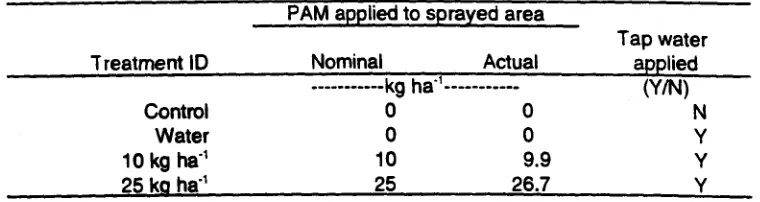
L. After being moldboard plowed on 11 April 1995, it was roller-harrowed to a depth of 80 mm, once on 17 April, 16 May and 18 May for an earlier study, and twice on 24 July in preparation for the current study.Table 1. Pam Treatments Studied.
PAM applied to sprayed area
Tap water applied
Treatment ID Nominal Actual
kg he (YIN)
Control 0 0 N
Water 0 0 Y
10 kg he 10 9.9 Y
25 ka he 25 26.7 Y
span of a linear-move irrigation system. The PAM treatments were randomly assigned to plots under each half span. Plots, each 25 mm wide, were perpen-dicular to the direction of travel of the irrigation system.
PAM Solutions and Spraying
Table 2 gives operational details of the equipment used to spray the PAM treatments on the soil surface. Tap water, used for the water treatment and to make up the two PAM solutions, had an electrical conductiv-ity of 0.9 dS rry1 and a sodium adsorption ratio of 1.5.
Each of the spray solutions was placed in a 19-L tank pressurized with regulated air to maintain the desired nozzle pressures, Table 2. Each solution flowed through approximately 2.3 m of 6 mm (I.D.)
hose before entering the fitting of a drop nozzle. Each spray nozzle was fixed in position immediately behind a Milton sugarbeet planter's rubber press wheels. To apply the PAM solutions to the soil surface, a tractor pulled the planter with the spray equipment across the plots at 4.12 km h-1 . The spraying of the plots on 25
July 1995 applied about 0.84 mm of tap water only to each of the water plots or 0.84 mm of PAM solution to each of the PAM plots, Table 2.
Irrigations
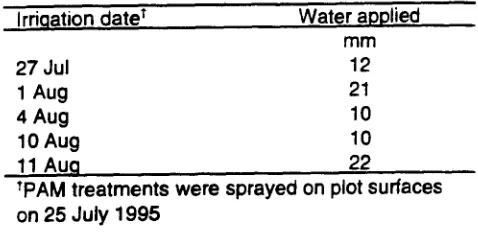
The linear-move system was used to irrigate the plots, Table 3. During the study, the only natural rainfall received was 0.5 mm on 30 August. We monitored aggregate stability response to only the irrigations on 1 and 4 August, considered a single irrigation for the purposes of this study. This relatively heavy irrigation of 31 mm was selected because it was comparable to one that might occur under a solid-set irrigation sys-tem. Such an irrigation was simulated by passing the linear system over the plots twice in a span of 72 h, from 1 to 4 August. Applying more than 21 mm of water at any one time was difficult because the soil's low infiltration rate caused ponding and runoff. Four catch cans, at the soil surface under each 19.8 m wide half span, were used to measure the amount of water applied.
Table 2. Operating Characteristics of the Spray Equipment.
Treatment PAM
ID conc.
mg L-1
Nozzle
pressure Flow rate
kPa L 'h-1
Nozzle height above soil
surface mm
Control 0
Water 0 169 85.4 76
10 kg he 1200 207 86.3 38
Table 3. Irrigation Summary. RESULTS AND DISCUSSION
Irrigation date/ Water applied mm
27 Jul 12
1 Aug 21
4 Aug 10
10 Aug 10
11 Aug 22
/PAM treatments were sprayed on plot surfaces on 25 July 1995
Soil Sampling and Analyses
Soil samples were taken prior to spraying, to establish baseline conditions, and before and after the monitored irrigation. To determine baseline aggregate stability, 10 samples were taken from the uppermost 5 mm of the profile throughout the study area on 25 July. This shallow depth increment was sampled per the recommendation of Lehrsch and Zobeck (1996) and because Mitchell (1986) found that PAM solutions sprayed on soil had no effect at depths greater than 50 mm. About 2 hours prior to the irrigation on 1 August, samples were taken to a depth of 5 mm from each plot. On these so-termed pre-irrigation soil samples, gravi-metric water content was measured and aggregate stability was determined using the procedure of Kemper and Rosenau (1986), as modified by Lehrsch and Jolley (1992). The principal modification was that field-moist 1 to 4 mm aggregates, rather than air-dry 1 to 2 mm aggregates, were vapor-wetted using a non-heating vaporizer (Humidifier Model No. 240, Hankscraft, Reedsburg, Wis.) prior to wet sieving. Aggregate stability was reported as the weight percent of aggregates that remained stable after sieving in distilled water for 3 min. A second set of soil samples, the post-irrigation samples, was taken 72 hours after the irrigation on 4 August, and analyzed as were the pre-irrigation samples.
Statistical Analyses
An analysis of variance was used to identify sources of variation that were statistically significant, here defined as those with F-ratios significant at probability levels on the order of 0.10 or less. Once a significant source was found, aggregate stability means were separated using paired t-tests and a 0.05 probability level. Additional, pre-planned single degree-of-freedom comparisons were also made.
The PAM solutions, due to their increased viscosity at high PAM concentrations (Ben-Hur, 1994), affected the spray patterns reaching the soil surface (Kincaid et al., 1996). The pattern of the 1200 mg L -1 -solution was fan-shaped about 35-40 mm below the nozzle but coalesced into a stream about 65 mm below the nozzle. Thus, to spray a 25 mm wide plot, we lowered the nozzle for this treatment to 38 mm above the soil surface, Table 2. The spray pattern of the 3000 mg L''-solution was never fan-shaped but resembled a dribbling stream. To apply this solution, we used two nozzles with one offset about 12 mm from the other so that the combination of both streams wet the soil in a 25 mm wide band.
PAM affected aggregate stability differently, depending upon droplet energy. Figure 1 illustrates the effects of this two-way interaction, significant at P = 0.064, on aggregate stability, averaged over the pre-and post-irrigation samples. At a droplet energy of 5 J kg-1 , aggregate stability increased almost linearly with each treatment. The difference between the highest PAM application and the control was significant at the P = 0.01 level.
At a droplet energy of 5 J kg'', the water treatment was as effective as either of the PAM treatments, Figure 1. As these three treatments were sprayed on the soil surface, they wet surface aggregates, albeit slightly, and may have provided a pathway through which slightly soluble bonding agents could have diffused to contact points between soil particles, there to precipitate as these aggregates subsequently dried (Kemper and Rosenau, 1984).
At this low droplet energy, single degree-of-free-dom comparisons indicated that the average aggre-gate stability of the two PAM treatments, 84.3%, was significantly greater (P = 0.024) than the control, 81.7%. Moreover, the aggregate stability of the PAM-treated soil was significantly greater (P= 0.03) than the non-PAM-treated soil, 82.3%. These statistical results confirm what was observed earlier, that PAM-treated aggregates initially resisted breakdown by sprinkler-drop impact.
r
a 85
a
F e
5 15
Droplet Energy (J kg'')
5 15
Droplet Energy (J kg'')
a
100
= Pre-Irrigation Samples
(223 Post-Irrigation Samples
95
90
85
80
75/
10
-0
a
100
Control
(E23 Water IESZ3 10 kg PAM hi'
EN 25 kg PAM hi'
Hi
rn
75/
10
0 95
90
Figure 1. PAM and droplet energy effects on aggregate stability averaged over the pre- and post-irrigation samples. Within each droplet energy, means without a common letter differ at the 0.05 probability level.
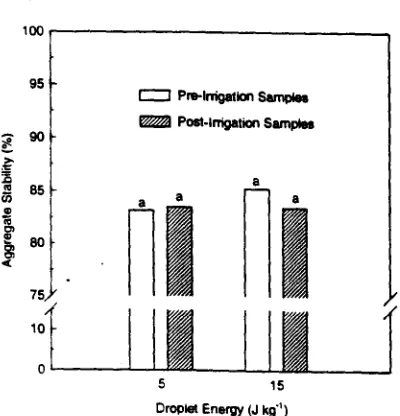
Figure 2. Sampling time and droplet energy ef-fects on aggregate stability averaged over four treatments. Within each droplet energy, means with a common letter do not differ at the 0.05 probability level.
energy input (i.e., early in the irrigation season) than more (late in the season).
The importance of the energy delivered to the soil surface by the sprinkler drops can be seen in Figure 2. It illustrates the significant interaction (P = 0.106) between sampling time and droplet energy on aggre-gate stability, averaged over the four treatments. At low droplet energy, there was little difference between the aggregate stability of the pre- and post-irrigation samples. At high droplet energy, in contrast, aggregate stability dropped from 85.3% to 83.5%, significant at P
= 0.058.
Figure 2 reveals that, for the pre-irrigation soil samples only, their aggregate stability was greater under the high energy level than under the low. In the
CONCLUSIONS
1. PAM sprayed on soil surfaces increased aggre-gate stability, provided the energy input from sprinkler drop impact was not too great.
2. The spray application of the PAM used in this study was not effective in preventing the physical deterioration of the soil surface when it was ex-posed to sprinkler droplet energy of 15 J kg 1 .
3. In this study, droplet energy appeared to be a more important factor causing change in aggre-gate stability than was the PAM we studied.
DISCLAIMER
Trade names are included for the benefit of the reader and do not imply endorsement of the product by the USDA.
REFERENCES
Azzam, R. A. I. 1980. "Agricultural Polymers, Poly-acrylamide Preparation, Application and Prospects in Soil Conditioning." Comm. Soil Sci. Plant Anal. 11: 767-834.
Barvenik, F. W. 1994. "Polyacrylamide Characteristics Related to Soil Applications." Soil Sci. 158: 235-243.
Ben-Hur, M. 1994. "Runoff, Erosion, and Polymer Application in Moving-Sprinkler Irrigation." Soil Sci. 158: 283-290.
Glanville, S. F., and G. D. Smith. 1988. "Aggregate Breakdown in Clay Soils under Simulated Rain and Effects on Infiltration." Aust. J. Soil Res. 26: 111-120.
Hudson, N. 1971. Soil Conservation. Cornell University Press, Ithaca, N.Y.
Kemper, W. D., and R. C. Rosenau. 1984. "Soil Cohe-sion as Affected by Time and Water Content." Soil Sc!. Soc. Am. J. 48: 1001-1006.
Kemper, W. D., and R. C. Rosenau. 1986. "Aggregate Stability and Size Distribution." p. 425-442. In A. Klute, (ed.) Methods of Soil Analysis, Part 1, 2nd Ed. Am. Soc. Agron., Madison, Wis.
Kincaid, D. C., R. D. Lentz, and G. A. Lehrsch. 1996. "Spray Patterns from Fan-Type Nozzles for Apply-ing PAM to Soil Surfaces." In Erosion Control Technology-Bringing It Home. Proceedings of the 27th Annual Conference and Trade Exposition, Seattle, Wash., 27 Feb.-1 Mar. 1996. International Erosion Control Association, Steamboat Springs, Colo., In Press.
Lehrsch, G. A., and P. M. Jolley. 1992. "Temporal Changes in Wet Aggregate Stability." Trans. Am. Soc. Agric. Eng. 35(2): 493-498.
Lehrsch, G. A., and T. M. Zobeck. 1996. "Sample Collection, Handling, and Preparation for Aggre-gate Stability and Size Distribution Analyses." In B. T. Warden, (ed.) Soil Sample Handling and Prepa-ration for Chemical and Physical Analysis. Marcel Dekker, Inc., New York. In Press.
Lentz, R. D., and R. E. Sojka. 1994. "Field Results Using Polyacrylamide to Manage Furrow Erosion and Infiltration." Soil Sci. 158(4): 274-282.
Levy, G. J., J. Levin, and I. Shainberg. 1995. "Polymer Effects on Runoff and Soil Erosion from Sodic Soils" Irrig. Sci. 16: 9-14.
Mitchell, A. R. 1986. "Polyacrylamide Application in Irrigation Water to Increase Infiltration." Soil Sc!. 141: 353-358.
Shainberg, I., G. J. Levy, P. Rengasamy, and H. Frenkel. 1992. "Aggregate Stability and Seal Formation as Affected by Drops' Impact Energy and Soil Amendments." Soil Sc!. 154: 113-119.
Sojka, R. E., and R. D. Lentz. 1994. "Polyacrylamide (PAM): A New Weapon in the Fight Against Irrigation-Induced Erosion." USDA-ARS Soil and Water Management Research Unit, Station Note #01-94.
Trout, T. J., R. E. Sojka, and R. D. Lentz. 1995. "Poly-acrylamide Effect on Furrow Erosion and Infiltra-tion." Trans. Am. Soc. Agric. Eng. 38(3): 761-765.