The Thirty-Third AAAI Conference on Artificial Intelligence (AAAI-19)
AutoZOOM: Autoencoder-Based Zeroth Order Optimization Method
for Attacking Black-Box Neural Networks
Chun-Chen Tu,
1∗Paishun Ting,
1∗Pin-Yu Chen,
2∗Sijia Liu,
2Huan Zhang
,
3Jinfeng Yi
,
4Cho-Jui Hsieh
,
3Shin-Ming Cheng
5,61University of Michigan, Ann Arbor, USA 2MIT-IBM Watson AI Lab, IBM Research 3University of California, Los Angeles, USA
4JD AI Research, Beijing, China
5National Taiwan University of Science and Technology, Taiwan 6Academia Sinica, Taiwan
Abstract
Recent studies have shown that adversarial examples in state-of-the-art image classifiers trained by deep neural networks (DNN) can be easily generated when the target model is trans-parent to an attacker, known as the white-box setting. However, when attacking a deployed machine learning service, one can only acquire the input-output correspondences of the target model; this is the so-called black-box attack setting. The major drawback of existing black-box attacks is the need for exces-sive model queries, which may give a false sense of model robustness due to inefficient query designs. To bridge this gap, we propose a generic framework for query-efficient black-box attacks. Our framework,AutoZOOM, which is short for
Autoencoder-basedZerothOrderOptimizationMethod, has two novel building blocks towards efficient black-box attacks: (i) an adaptive random gradient estimation strategy to balance query counts and distortion, and (ii) an autoencoder that is either trained offline with unlabeled data or a bilinear resizing operation for attack acceleration. Experimental results suggest that, by applying AutoZOOM to a state-of-the-art black-box attack (ZOO), a significant reduction in model queries can be achieved without sacrificing the attack success rate and the visual quality of the resulting adversarial examples. In particu-lar, when compared to the standard ZOO method, AutoZOOM can consistently reduce the mean query counts in finding suc-cessful adversarial examples (or reaching the same distortion level) by at least 93% on MNIST, CIFAR-10 and ImageNet datasets, leading to novel insights on adversarial robustness.
1
Introduction
In recent years, “machine learning as a service” has offered the world an effortless access to powerful machine learning tools for a wide variety of tasks. For example, commercially available services such as Google Cloud Vision API and Clar-ifai.com provide well-trained image classifiers to the public. One is able to upload and obtain the class prediction results for images at hand at a low price. However, the existing and emerging machine learning platforms and their low model-access costs raise ever-increasing security concerns, as they
∗
equal contribution
Copyright c2019, Association for the Advancement of Artificial Intelligence (www.aaai.org). All rights reserved.
Figure 1: AutoZOOM significantly reduces the number of queries required to generate a successful adversarial Bagel image from the black-box Inception-v3 model.
also offer an ideal environment for testing malicious attempts. Even worse, the risks can be amplified when these services are used to build derived products such that the inherent security vulnerability could be leveraged by attackers.
In many computer vision tasks, DNN models achieve the state-of-the-art prediction accuracy and hence are widely de-ployed in modern machine learning services. Nonetheless, recent studies have highlighted DNNs’ vulnerability to ad-versarial perturbations. In thewhite-boxsetting in which the target model is entirely transparent to an attacker, visually imperceptible adversarial images can be easily crafted to fool a target DNN model towards misclassification by lever-aging the input gradient information (Szegedy et al. 2014; Goodfellow, Shlens, and Szegedy 2015). However, in the
black-boxsetting in which the parameters of the deployed model are hidden and one can only observe the input-output correspondences of a queried example, crafting adversarial examples requires a gradient-free (zeroth order) optimization approach to gather necessary attack information. Figure 1 displays a prediction-evasive adversarial example crafted via iterative model queries from a black-box DNN (the Inception-v3 model (Szegedy et al. 2016)) trained on ImageNet.
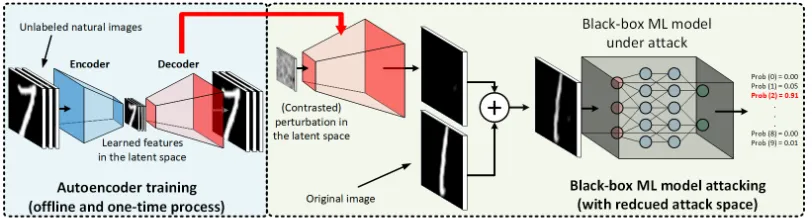
Figure 2: Illustration of attack dimension reduction through a “decoder” in AutoZOOM for improving query efficiency in black-box attacks. The decoder has two modes: (i) An autoencoder (AE) trained on unlabeled natural images that are different from the attacked images and training data; (ii) a simple bilinear image resizer (BiLIN) that is applied channel-wise to extrapolate low-dimensional feature to the original image dimension (width×height). In the latter mode, no additional training is required.
such as (Chen et al. 2017; Nitin Bhagoji et al. 2018), are not query-efficient since they exploit coordinate-wise gra-dient estimation and value update, which inevitably incurs an excessive number of model queries and may give a false sense of model robustness due to inefficient query designs. In this paper, we propose to tackle the preceding problem by usingAutoZOOM, anAutoencoder-basedZerothOrder
OptimizationMethod. AutoZOOM has two novel building blocks: (i) a new and adaptive random gradient estimation strategy to balance the query counts and distortion when crafting adversarial examples, and (ii) an autoencoder that is either trained offline on other unlabeled data, or based on a simple bilinear resizing operation, in order to accelerate black-box attacks. As illustrated in Figure 2, AutoZOOM utilizes a “decoder” to craft a high-dimensional adversarial perturbation from the (learned) low-dimensional latent-space representation, and its query efficiency can be well explained by the dimension-dependent convergence rate in gradient-free optimization.
Contributions.We summarize our main contributions and new insights on adversarial robustness as follows:
1. We propose AutoZOOM, a novel query-efficient black-box attack framework for generating adversarial examples. Au-toZOOM features an adaptive random gradient estimation strategy and dimension reduction techniques (either an offline trained autoencoder or a bilinear resizer) to reduce attack query counts while maintaining attack effectiveness and visual similarity. To the best of our knowledge, Au-toZOOM is the first black-box attack using random full gradient estimation and data-driven acceleration.
2. We use the convergence rate of zeroth-order optimiza-tion to motivate the query efficiency of AutoZOOM and provide an error analysis of the new gradient estimator in AutoZOOM to the true gradient for characterizing the trade-offs between estimation error and query counts.
3. When applied to a state-of-the-art black-box attack pro-posed in (Chen et al. 2017), AutoZOOM attains a similar attack success rate while achieving a significant reduction (at least 93%) in the mean query counts required to at-tack the DNN image classifiers for MNIST, CIFAR-10 and ImageNet. It can also fine-tune the distortion in the
post-success stage by performing finer gradient estimation.
4. In the experiments, we also find that AutoZOOM with a simple bilinear resizer as the decoder (AutoZOOM-BiLIN) can attain noticeable query efficiency, despite that it is still worse than AutoZOOM with an offline trained autoen-coder (AutoZOOM-AE). However, AutoZOOM-BiLIN is easier to be mounted as no additional training is required. The results also suggest an interesting finding that while learning effective low-dimensional representations of legit-imate images is still a challenging task, black-box attacks using significantly less degree of freedoms (i.e., reduced dimensions) are certainly plausible.
2
Related Work
Gradient-based adversarial attacks on DNNs fall within the white-box setting, since acquiring the gradient with respect to the input requires knowing the weights of the target DNN. As a first attempt towards black-box attacks, the authors in (Papernot et al. 2017) proposed to train a substitute model using iterative model queries, performing white-box attacks on the substitute model, and implementing transfer attacks to the target model (Papernot, McDaniel, and Goodfellow 2016; Liu et al. 2017). However, its attack performance can be severely degraded due to poor attack transferability (Su et al. 2018). Although ZOO achieves a similar attack success rate and comparable visual quality as many white-box at-tack methods (Chen et al. 2017), its coordinate-wise gradient estimation requires excessive target model evaluations and is hence not query-efficient. The same gradient estimation technique is also used in (Nitin Bhagoji et al. 2018).
factor of attack dimension reduction, which is the novelty in AutoZOOM as well as the main focus of this paper.
Under a more restricted attack setting, where only the de-cision (top-1 prediction class) is known to an attacker, the authors in (Brendel, Rauber, and Bethge 2018) proposed a random-walk based attack around the decision boundary. Such a black-box attack dispenses class prediction scores and hence requires additional model queries. Due to space limi-tation, we provide more background and a table comparing existing black-box attacks in the supplementary material.
3
AutoZOOM: Background and Methods
3.1
Black-box Attack Formulation and Zeroth
Order Optimization
Throughout this paper, we focus on improving the query ef-ficiency of gradient-estimation and gradient-descent based black-box attacks empowered by AutoZOOM, and we con-sider the threat model that the class prediction scores are known to an attacker. In this setting, it suffices to denote the target DNN as a classification functionF : [0,1]d 7→RK
that takes a d-dimensional scaled image as its input and yields a vector of prediction scores of allKimage classes, such as the prediction probabilities for each class. We further consider the case of applying an entry-wise monotonic trans-formationM(F)to the output ofF for black-box attacks, since monotonic transformation preserves the ranking of the class predictions and can alleviate the problem of large score variation inF (e.g., probability to log probability).
Here we formulate black-box targeted attacks. The formu-lation can be easily adapted to untargeted attacks. Let(x0, t0) denote a natural imagex0and its ground-truth class labelt0, and let (x, t) denote the adversarial example ofx0and the target attack class labelt6=t0. The problem of finding an adversarial example can be formulated as an optimization problem taking the generic form of
minx∈[0,1]dDist(x,x0) +λ·Loss(x, M(F(x)), t), (1)
where Dist(x,x0)measures the distortion betweenx and
x0, Loss(·)is an attack objective reflecting the likelihood of predictingt= arg maxk∈{1,...,K}[M(F(x))]k,λis a regu-larization coefficient, and the constraintx∈[0,1]dconfines the adversarial imagexto the valid image space. The distor-tion Dist(x,x0)is often evaluated by theLpnorm defined as Dist(x,x0) =kx−x0kp=kδkp=P
d
i=1|δi|1/pforp≥1, whereδ=x−x0is the adversarial perturbation tox0. The attack objective Loss(·)can be the training loss of DNNs (Goodfellow, Shlens, and Szegedy 2015) or some designed loss based on model predictions (Carlini and Wagner 2017). In the white-box setting, an adversarial example is gen-erated by using downstream optimizers such as ADAM (Kingma and Ba 2015) to solve (1); this requires the gra-dient∇f(x)of the objective functionf(x) =Dist(x,x0) + λ · Loss(x, M(F(x)), t) relative to the input of F via back-propagation in DNNs. However, in the black-box set-ting, acquiring∇f(·)is implausible, and one can only ob-tain the function evaluation F(·), which renders solving (1) a zeroth order optimization problem. Recently, zeroth order optimization approaches (Ghadimi and Lan 2013;
Nesterov and Spokoiny 2017; Liu et al. 2018) circumvent the preceding challenge by approximating the true gradient via function evaluations. Specifically, in black-box attacks, the gradient estimate is applied to both gradient computation and descent in the optimization process for solving (1).
3.2
Random Vector based Gradient Estimation
As a first attempt to enable gradient-free black-box attacks on DNNs, the authors in (Chen et al. 2017) use the symmetric difference quotient method (Lax and Terrell 2014) to evaluate the gradient ∂f∂x(x)i of thei-th component by
gi=
f(x+hei)−f(x−hei)
2h ≈
∂f(x)
∂xi
(2)
using a small h. Here ei denotes the i-th elementary ba-sis. Albeit contributing to powerful black-box attacks and applicable to large networks like ImageNet, the nature of coordinate-wise gradient estimation step in (2) must in-cur an enormous amount of model queries and is hence not query-efficient. For example, the ImageNet dataset has
d= 299×299×3≈270,000input dimensions, rendering
coordinate-wise zeroth order optimization based on gradient estimation query-inefficient.
To improve query efficiency, we dispense with coordinate-wise estimation and instead propose a scaled random full gradient estimator of∇f(x), defined as
g=b· f(x+βu)−f(x)
β ·u, (3)
whereβ >0is a smoothing parameter,uis a unit-length vec-tor that is uniformly drawn at random from a unit Euclidean sphere, andbis a tunable scaling parameter that balances the bias and variance trade-off of the gradient estimation error. Note that withb= 1, the gradient estimator in (3) becomes the one used in (Duchi et al. 2015). Withb=d, this estimator becomes the one adopted in (Gao, Jiang, and Zhang 2014). We will provide an optimal valueb∗ for balancing query efficiency and estimation error in the following analysis.
Averaged random gradient estimation.To effectively con-trol the error in gradient estimation, we consider a more general gradient estimator, in which the gradient estimate is averaged overqrandom directions{uj}qj=1. That is,
g= 1
q q
X
j=1
gj, (4)
wheregjis a gradient estimate defined in (3) withu=uj. The use of multiple random directions can reduce the variance of gin (4) for convex loss functions (Duchi et al. 2015; Liu et al. 2018).
Below we establish an error analysis of the averaged ran-dom gradient estimator in (4) for studying the influence of the parametersbandqon estimation error and query efficiency.
Theorem 1. Assumef : Rd 7→ R is differentiable and its gradient∇f(·)isL-Lipschitz1. Then the mean squared
1
estimation error ofgin (4) is upper bounded by
Ekg− ∇f(x)k22≤4( b2 d2 +
b2 dq +
(b−d)2
d2 )k∇f(x)k 2 2
+2q+ 1
q b
2β2L2. (5)
Proof. The proof is given in the supplementary file.
Here we highlight the important implications based on Theorem 1: (i) The error analysis holds whenfisnon-convex; (ii) In DNNs, the true gradient∇f can be viewed as the numerical gradient obtained via back-propagation; (iii) For any fixedb, selecting a small β (e.g., we setβ = 1/d in AutoZOOM) can effectively reduce the last error term in (5), and we therefore focus on optimizing the first error term; (iv) The first error term in (5) exhibits the influence ofb andqon the estimation error, and is independent ofβ. We further elaborate on (iv) as follows. Fixingqand letη(b) =
b2 d2 +
b2 dq+
(b−d)2
d2 to be the coefficient of the first error term
in (5), then the optimalbthat minimizesη(b)isb∗= 2qdq+d. For query efficiency, one would like to keepqsmall, which then implies b∗ ≈ qand η(b∗) ≈ 1 when the dimension dis large. On the other hand, when q → ∞, b∗ ≈ d/2
andη(b∗)≈1/2, which yields a smaller error upper bound but is query-inefficient. We also note that by settingb=q, the coefficientη(b) = bd22 +
b2 dq +
(b−d)2
d2 ≈ 1and thus is
independent of the dimensiondand the parameterq.
Adaptive random gradient estimation.Based on Theorem 1 and our error analysis, in AutoZOOM we setb = q in (3) and propose to use an adaptive strategy for selectingq. AutoZOOM usesq= 1(i.e., the fewest possible model eval-uation) to first obtain rough gradient estimates for solving (1) until a successful adversarial image is found. After the initial attack success, it switches to use more accurate gradi-ent estimates withq >1to fine-tune the image quality. The trade-off betweenq(which is proportional to query counts) and distortion reduction will be investigated in Section 4.
3.3
Attack Dimension Reduction via Autoencoder
Dimension-dependent convergence rate using gradient estimation.Different from the first order convergence results, the convergence rate of zeroth order gradient descent methods has an additional multiplicative dimension-dependent factor d. In the convex loss setting the rate isO(pd/T), whereT is the number of iterations (Nesterov and Spokoiny 2017; Liu et al. 2018; Gao, Jiang, and Zhang 2014; Wang et al. 2018). The same convergence rate has also been found in the nonconvex setting (Ghadimi and Lan 2013). The dimension-dependent convergence factordsuggests that vanilla black-box attacks using gradient estimations can be query ineffi-cient when the (vectorized) image dimensiondis large, due to the curse of dimensionality in convergence. This also moti-vates us to propose using an autoencoder to reduce the attack dimension and improve query efficiency in black-box attacks. In AutoZOOM, we propose to perform random gradient es-timation from a reduced dimensiond0< dto improve query efficiency. Specifically, as illustrated in Figure 2, the additive
Algorithm 1AutoZOOM for black-box attacks on DNNs
Input:Black-box DNN modelF, original examplex0, distortion measure Dist(·), attack objective Loss(·), mono-tonic transformationM(·), decoderD(·)∈ {AE,BiLIN}, initial coefficientλini, query budgetQ
whilequery count≤Qdo
1. Exploration:usex =x0+D(δ0)and apply the random gradient estimator in (4) withq= 1to the down-stream optimizer (e.g., ADAM) for solving (1) until an initial attack is found.
2. Exploitation (post-success stage):continue to fine-tune the adversarial perturbation D(δ0)for solving (1) while settingq≥1in (4).
end while
Output:Least distorted successful adversarial example
perturbation to an imagex0is actually implemented through a “decoder”D:Rd
0
7→Rdsuch thatx=x0+D(δ0), where δ0∈Rd0. In other words, the adversarial perturbationδ∈
Rd
tox0is in fact generated from a dimension-reduced space, with an aim of improving query efficiency due to the reduced dimension-dependent factor in the convergence analysis. Au-toZOOM provides two modes for such a decoderD: •An autoencoder (AE) trained on unlabeled data that are different from the training data to learn reconstruction from a dimension-reduced representation. The encoderE(·)in an AE compresses the data to a low-dimensional latent space and the decoderD(·)reconstructs an example from its latent representation. The weights of an AE are learned to minimize the averageL2reconstruction error. Note that training such an AE for black-box adversarial attacks is one-time and is entirely offline (i.e., no model queries needed).
•A simple channel-wise bilinear image resizer (BiLIN) that scales a small image to a large image via bilinear extrapola-tion2. Note that no additional training is required for BiLIN.
Why AE?Our proposal of AE is motivated by the insightful findings in (Goodfellow, Shlens, and Szegedy 2015) that a successful adversarial perturbation is highly relevant to some human-imperceptible noise pattern resembling the shape of the target class, known as the “shadow”. Since a decoder in AE learns to reconstruct data from latent representations, it can also provide distributional guidance for mapping adver-sarial perturbations to generate these shadows.
We also note that for any reduced dimensiond0, the setting b∗=qis optimal in terms of minimizing the corresponding estimation error from Theorem 1, despite the fact that the gradient estimation errors of different reduced dimensions cannot be directly compared. In Section 4 we will report the superior query efficiency in black-box attacks achieved with the use of AE or BiLIN as the decoder, and discuss the benefit of attack dimension reduction.
3.4
AutoZOOM Algorithm
Algorithm 1 summarizes the AutoZOOM framework towards query-efficient black-box attacks on DNNs. We also note that
2
AutoZOOM is a general acceleration tool that is compatible with any gradient-estimation based black-box adversarial at-tack obeying the atat-tack formulation in (1). It also has some theoretical estimation error guarantees and query-efficient pa-rameter selection based on Theorem 1. The details on adjust-ing the regularization coefficientλand the query parameterq based on run-time model evaluation results will be discussed in Section 4. Our source code is publicly available3.
4
Performance Evaluation
This section presents the experiments for assessing the per-formance of AutoZOOM in accelerating black-box attacks on DNNs in terms of the number of queries required for an initial attack success and for a specific distortion level.
4.1
Distortion Measure and Attack Objective
As described in Section 3, AutoZOOM is a query-efficient gradient-free optimization framework for solving the black-box attack formulation in (1). In the following experiments, we demonstrate the utility of AutoZOOM by using the same attack formulation proposed in ZOO (Chen et al. 2017), which uses the squaredL2norm as the distortion measure Dist(·)and adopts the attack objectiveLoss= max{max
j6=t log[F(x)]j−log[F(x)]t},0}, (6)
where this hinge function is designed for targeted black-box attacks on the DNN modelF, and the monotonic transforma-tionM(·) = log(·)is applied to the model output.
4.2
Comparative Black-box Attack Methods
We compareAutoZOOM-AE(D=AE) and AutoZOOM-BiLIN(D=BiLIN) with two different baselines: (i) Stan-dardZOOimplementation4with bilinear scaling (same asBiLIN) for dimension reduction; (ii)ZOO+AE, which is ZOO with AE. Note that all attacks indeed generate adversar-ial perturbations based on the same reduced attack dimension.
4.3
Experiment Setup, Evaluation, Datasets and
AutoZOOM Implementation
We assess the performance of different attack methods on several representative benchmark datasets, including MNIST (LeCun et al. 1998), CIFAR-10 (Krizhevsky 2009) and Im-ageNet (Russakovsky et al. 2015). For MNIST and CIFAR-10, we use the same DNN image classification models5as in (Carlini and Wagner 2017). For ImageNet, we use the Inception-v3 model (Szegedy et al. 2016). All experiments were conducted using TensorFlow Machine-Learning Library (Abadi et al. ) on machines equipped with an Intel Xeon E5-2690v3 CPU and an Nvidia Tesla K80 GPU.
All attacks used ADAM (Kingma and Ba 2015) for solving (1) with their estimated gradients and the same initial learning rate2×10−3. On MNIST and CIFAR-10, all methods adopt 1,000 ADAM iterations. On ImageNet, ZOO and ZOO+AE adopt 20,000 iterations, whereas AutoZOOM-BiLIN and
3https://github.com/IBM/Autozoom-Attack 4
https://github.com/huanzhang12/ZOO-Attack
5
https://github.com/carlini/nn robust attacks
AutoZOOM-AE adopt 100,000 iterations. Note that due to different gradient estimation methods, the query counts (i.e., the number of model evaluations) per iteration of a black-box attack may vary. ZOO and ZOO+AE use the parallel gradient update of (2) with a batch of128pixels, yielding 256 query counts per iteration. AutoZOOM-BiLIN and AutoZOOM-AE use the averaged random full gradient estimator in (4), result-ing inq+ 1query counts per iteration. For a fair comparison, the query counts are used for performance assessment.
Query reduction ratio.We use the mean query counts of ZOO with the smallestλinias the baseline for computing the
query reduction ratio of other methods and configurations.
TPR and initial success.We report the true positive rate (TPR), which measures the percentage of successful attacks fulfilling a pre-defined constraint`on the normalized (per-pixel) L2 distortion, as well as their query counts of first successes. We also report the per-pixel L2 distortions of initial successes, where an initial success refers to the first query count that finds a successful adversarial example.
Post-success fine-tuning.When implementing AutoZOOM in Algorithm 1, on MNIST and CIFAR-10 we find that Au-toZOOM without fine-tuning (i.e., q = 1) already yields similar distortion as ZOO. We note that ZOO can be viewed as coordinate-wise fine-tuning and is thus query-inefficient. On ImageNet, we will investigate the effect of post-success fine-tuning on reducing distortion.
Autoencoder Training.In AutoZOOM-AE, we use convo-lutional autoencoders for attack dimension reduction, which are trained on unlabeled datasets that are different from the training dataset and the attacked natural examples. The im-plementation details are given in the supplementary material.
Dynamic Switching onλ.To adjust the regularization coef-ficientλin (1), in all methods we set its initial valueλini∈
{0.1,1,10}on MNIST and CIFAR-10, and setλini= 10on
ImageNet. Furthermore, for balancing the distortion Dist and the attack objective Loss in (1), we use adynamic switching
strategy to updateλduring the optimization process. Per ev-erySiterations,λis multiplied by 10 times of the current value if the attack has never been successful. Otherwise, it divides its current value by 2. On MNIST and CIFAR-10, we setS = 100. On ImageNet, we setS = 1,000. At the instance of initial success, we also resetλ = λiniand the
ADAM parameters to the default values, as doing so can empirically reduce the distortion for all attack methods.
4.4
Black-box Attacks on MNIST and CIFAR-10
For both MNIST and CIFAR-10, we randomly select 50 correctly classified images from their test sets, and perform targeted attacks on these images. Since both datasets have 10 classes, each selected image is attacked 9 times, targeting at all but its true class. For all attacks, the ratio of reduced attack-space dimension to the original one (i.e.,d0/d) is 25% for MNIST and 6.25% for CIFAR-10.Table 1 shows the performance evaluation on MNIST with various values ofλini, the initial value of the
regulariza-tion coefficient λin (1). We use the performance of ZOO withλini = 0.1as a baseline for comparison. For example,
withλini = 0.1and10, the mean query counts required by
Table 1: Performance evaluation of black-box targeted attacks on MNIST
Method λini
Attack success rate (ASR)
Mean query count (initial success)
Mean query count reduction ratio (initial success)
Mean per-pixel L2distortion
(initial success)
True positive rate (TPR)
Mean query count with per-pixelL2
distortion≤0.004
0.1 99.44% 35,737.60 0.00% 3.50×10⁻³ 96.76% 47,342.85
ZOO 1 99.44% 16,533.30 53.74% 3.74×10⁻³ 97.09% 31,322.44
10 99.44% 13,324.60 62.72% 4.85×10⁻³ 96.31% 41,302.12
0.1 99.67% 34,093.95 4.60% 3.43×10⁻³ 97.66% 44,079.92
ZOO+AE 1 99.78% 15,065.52 57.84% 3.72×10⁻³ 98.00% 29,213.95
10 99.67% 12,102.20 66.14% 4.66×10⁻³ 97.66% 38,795.98
0.1 99.89% 2,465.95 93.10% 4.51×10⁻³ 96.55% 3,941.88
AutoZOOM-BiLIN 1 99.89% 879.98 97.54% 4.12×10⁻³ 97.89% 2,320.01
10 99.89% 612.34 98.29% 4.67×10⁻³ 97.11% 4,729.12
0.1 100.00% 2,428.24 93.21% 4.54×10⁻³
96.67% 3,861.30 AutoZOOM-AE 1 100.00% 729.65 97.96% 4.13×10⁻³ 96.89% 1,971.26
10 100.00% 510.38 98.57% 4.67×10⁻³ 97.22% 4,855.01
Table 2: Performance evaluation of black-box targeted attacks on CIFAR-10
Method λini
Attack success rate (ASR)
Mean query count (initial success)
Mean query count reduction ratio (initial success)
Mean per-pixel L2distortion
(initial success)
True positive rate (TPR)
Mean query count with per-pixelL2
distortion≤0.0015
0.1 97.00% 25,538.43 0.00% 5.42×10⁻⁴ 100.00% 25,568.33
ZOO 1 97.00% 11,662.80 54.33% 6.37×10⁻⁴ 100.00% 11,777.18
10 97.00% 10,015.08 60.78% 8.03×10⁻⁴ 100.00% 10,784.54
0.1 99.33% 19,670.96 22.98% 4.96×10⁻⁴ 100.00% 20,219.42
ZOO+AE 1 99.00% 5,793.25 77.32% 6.83×10⁻⁴ 99.89% 5,773.24
10 99.00% 4,892.80 80.84% 8.74×10⁻⁴ 99.78% 5,378.30
0.1 99.67% 2,049.28 91.98% 1.01×10⁻³ 98.77% 2,112.52
AutoZOOM-BiLIN 1 99.67% 813.01 96.82% 8.25×10⁻⁴ 99.22% 1,005.92
10 99.33% 623.96 97.56% 9.09×10⁻⁴
98.99% 835.27
0.1 100.00% 1,523.91 94.03% 1.20×10⁻³ 99.67% 1,752.45
AutoZOOM-AE 1 100.00% 332.43 98.70% 1.01×10⁻³
99.56% 345.62
10 100.00% 259.34 98.98% 1.15×10⁻³ 99.67% 990.61
93.21%and 98.57%, respectively. One can also observe that allowing largerλinigenerally leads to fewer mean query
counts at the price of slightly increased distortion for the ini-tial attack. The noticeable huge difference in the required at-tack query counts between AutoZOOM and ZOO/ZOO+AE validates the effectiveness of our proposed random full gradi-ent estimator in (3), which dispenses with the coordinate-wise gradient estimation in ZOO but still remains comparable true positive rates, thereby greatly improving query efficiency.
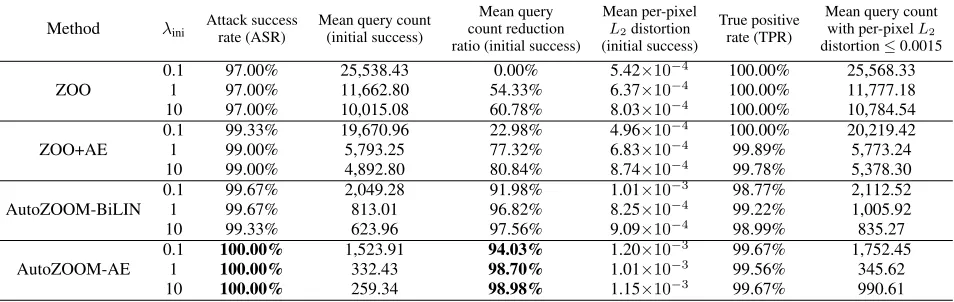
For CIFAR-10, we report similar query efficiency improve-ments as displayed in Table 2. In particular, comparing the two query-efficient black-box attack methods (AutoZOOM-BiLIN and AutoZOOM-AE), we find that AutoZOOM-AE is more query-efficient than AutoZOOM-BiLIN, but at the cost of an additional AE training step. AutoZOOM-AE achieves the highest attack success rates (ASRs) and mean query re-duction ratios for different values ofλini. In addition, their
true positive rates (TPRs) are similar but AutoZOOM-AE usually takes fewer query counts to reach the sameL2 dis-tortion. We note that whenλini= 10, AutoZOOM-AE has a
higher TPR but also needs slightly more mean query counts than AutoZOOM-BiLIN to reach the same L2 distortion. This suggests that there are some adversarial examples that are difficult for a bilinear resizer to reduce their post-success
distortions but can be handled by an AE.
4.5
Black-box Attacks on ImageNet
We selected 50 correctly classified images from the ImageNet test set to perform random targeted attacks and setλini= 10
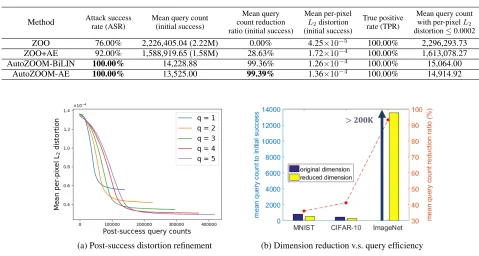
and the attack dimension reduction ratio to 1.15%. The re-sults are summarized in Table 3. Note that comparing to ZOO, AutoZOOM-AE can significantly reduce the query count re-quired to achieve an initial success by 99.39% (or 99.35% to reach the sameL2distortion), which is a remarkable im-provement since this means reducing more than2.2 million
model queries given the fact that the dimension of ImageNet (≈270K) is much larger than that of MNIST and CIFAR-10.
Table 3: Performance evaluation of black-box targeted attacks on ImageNet
Method Attack successrate (ASR) Mean query count(initial success)
Mean query count reduction ratio (initial success)
Mean per-pixel L2distortion
(initial success)
True positive rate (TPR)
Mean query count with per-pixelL2
distortion≤0.0002
ZOO 76.00% 2,226,405.04 (2.22M) 0.00% 4.25×10⁻⁵ 100.00% 2,296,293.73
ZOO+AE 92.00% 1,588,919.65 (1.58M) 28.63% 1.72×10⁻⁴ 100.00% 1,613,078.27
AutoZOOM-BiLIN 100.00% 14,228.88 99.36% 1.26×10⁻⁴
100.00% 15,064.00
AutoZOOM-AE 100.00% 13,525.00 99.39% 1.36×10⁻⁴ 100.00% 14,914.92
(a) Post-success distortion refinement (b) Dimension reduction v.s. query efficiency
Figure 3: (a) After initial success, AutoZOOM (hereD=AE) can further decrease the distortion by settingq >1in (4) to trade more query counts for smaller distortion in the converged stage, which saturates atq= 4. (b) Attack dimension reduction is crucial to query-efficient black-box attacks. When compared to black-box attacks on the original dimension, dimension reduction through AutoZOOM-AE reduces roughly 35-40% query counts on MNIST and CIFAR-10 and at least 95% on ImageNet.
suggest that setting some smallqbutq >1can further de-crease the distortion at the converged phase when compared with the case ofq= 1. Moreover, the refinement effect on distortion empirically saturates atq= 4, implying a marginal gain beyond this value. These findings also demonstrate that our proposed AutoZOOM indeed strikes a balance between distortion and query efficiency in black-box attacks.
4.6
Dimension Reduction and Query Efficiency
In addition to the motivation from the O(pd/T) conver-gence rate in zeroth-order optimization (Sec. 3.3), as a san-ity check, we corroborate the benefit of attack dimension reduction to query efficiency in black-box attacks by com-paring AutoZOOM (here we useD=AE) with its alterna-tive operated on the original (non-reduced) dimension (i.e., δ0 =D(δ0) =δ). Tested on all three datasets and aforemen-tioned settings, Figure 3 (b) shows the corresponding mean query count to initial success and the mean query reduction ratio whenλini = 10in all three datasets. When compared
to the attack results of the original dimension, attack dimen-sion reduction through AutoZOOM reduces roughly 35-40% query counts on MNIST and CIFAR-10 and at least 95% on ImageNet. This result highlights the importance of dimen-sion reduction towards query-efficient black-box attacks. For example, without dimension reduction, the attack on the orig-inal ImageNet dimension cannot even be successful within the query budge (Q= 200Kqueries).
4.7
Additional Remarks and Discussion
•In addition to benchmarking on initial attack success, the query reduction ratio when reaching the sameL2distortion can be directly computed from the last column in each table. • The attack gain in AE versus AutoZOOM-BiLIN could sometimes be marginal, while we also note that there is room for improving AutoZOOM-AE by exploring different AE models. However, we advocate AutoZOOM-BiLIN as a practically ideal candidate for query-efficient black-box attacks when testing model robustness, due to its easy-to-mount nature and it has no additional training cost. •While learning effective low-dimensional representations of legitimate images is still a challenging task, black-box at-tacks using significantly less degree of freedoms (i.e., reduced dimensions), as demonstrated in this paper, are certainly plau-sible, leading to new implications on model robustness.
5
Conclusion
DNN image classifiers for MNIST, CIFAT-10 and ImageNet, attaining at least93%query reduction in finding initial suc-cessful adversarial examples (or reaching the same distortion) while maintaining a similar attack success rate. It can also efficiently fine-tune the image distortion to maintain high visual similarity to the original image. Consequently, Auto-ZOOM provides novel and efficient means for assessing the robustness of deployed machine learning models.
Acknowledgements
Shin-Ming Cheng was supported in part by the Ministry of Science and Technology, Taiwan, under Grants MOST 107-2218-E-001-005 and MOST 107-2218-E-011-012. Cho-Jui Hsieh and Huan Zhang acknowledge the support by NSF IIS-1719097, Intel faculty award, Google Cloud and NVIDIA.
References
Abadi, M.; Barham, P.; Chen, J.; Chen, Z.; Davis, A.; Dean, J.; Devin, M.; Ghemawat, S.; Irving, G.; Isard, M.; et al. Tensorflow: A system for large-scale machine learning. Brendel, W.; Rauber, J.; and Bethge, M. 2018. Decision-based adversarial attacks: Reliable attacks against black-box machine learning models.ICLR.
Carlini, N., and Wagner, D. 2017. Towards evaluating the ro-bustness of neural networks. InIEEE Symposium on Security and Privacy, 39–57.
Chen, P.-Y.; Zhang, H.; Sharma, Y.; Yi, J.; and Hsieh, C.-J. 2017. ZOO: Zeroth order optimization based black-box attacks to deep neural networks without training substitute models. In ACM Workshop on Artificial Intelligence and Security, 15–26.
Duchi, J. C.; Jordan, M. I.; Wainwright, M. J.; and Wibisono, A. 2015. Optimal rates for zero-order convex optimization: The power of two function evaluations.IEEE Transactions on Information Theory61(5):2788–2806.
Gao, X.; Jiang, B.; and Zhang, S. 2014. On the information-adaptive variants of the admm: an iteration complexity per-spective.Optimization Online12.
Ghadimi, S., and Lan, G. 2013. Stochastic first-and zeroth-order methods for nonconvex stochastic programming.SIAM Journal on Optimization23(4):2341–2368.
Goodfellow, I. J.; Shlens, J.; and Szegedy, C. 2015. Explain-ing and harnessExplain-ing adversarial examples.ICLR.
Ilyas, A.; Engstrom, L.; Athalye, A.; and Lin, J. 2018. Black-box adversarial attacks with limited queries and information.
ICML.
Kingma, D., and Ba, J. 2015. Adam: A method for stochastic optimization. ICLR.
Krizhevsky, A. 2009. Learning multiple layers of features from tiny images.Technical report, University of Toronto. Lax, P. D., and Terrell, M. S. 2014.Calculus with applica-tions. Springer.
LeCun, Y.; Bottou, L.; Bengio, Y.; and Haffner, P. 1998. Gradient-based learning applied to document recognition.
Proceedings of the IEEE86(11):2278–2324.
Liu, Y.; Chen, X.; Liu, C.; and Song, D. 2017. Delving into transferable adversarial examples and black-box attacks.
ICLR.
Liu, S.; Chen, J.; Chen, P.-Y.; and Hero, A. O. 2018. Zeroth-order online alternating direction method of multipliers: Con-vergence analysis and applications. AISTATS.
Nesterov, Y., and Spokoiny, V. 2017. Random gradient-free minimization of convex functions. Foundations of Computa-tional Mathematics17(2):527–566.
Nitin Bhagoji, A.; He, W.; Li, B.; and Song, D. 2018. Practi-cal black-box attacks on deep neural networks using efficient query mechanisms. InECCV, 154–169.
Papernot, N.; McDaniel, P.; Goodfellow, I.; Jha, S.; Celik, Z. B.; and Swami, A. 2017. Practical black-box attacks against machine learning. InACM Asia Conference on Com-puter and Communications Security, 506–519.
Papernot, N.; McDaniel, P.; and Goodfellow, I. 2016. Transferability in machine learning: from phenomena to black-box attacks using adversarial samples.arXiv preprint arXiv:1605.07277.
Russakovsky, O.; Deng, J.; Su, H.; Krause, J.; Satheesh, S.; Ma, S.; Huang, Z.; Karpathy, A.; Khosla, A.; Bernstein, M.; et al. 2015. Imagenet large scale visual recognition challenge.
International Journal of Computer Vision115(3):211–252. Su, D.; Zhang, H.; Chen, H.; Yi, J.; Chen, P.-Y.; and Gao, Y. 2018. Is robustness the cost of accuracy?–a comprehen-sive study on the robustness of 18 deep image classification models. InECCV, 631–648.
Szegedy, C.; Zaremba, W.; Sutskever, I.; Bruna, J.; Erhan, D.; Goodfellow, I.; and Fergus, R. 2014. Intriguing properties of neural networks. ICLR.
Szegedy, C.; Vanhoucke, V.; Ioffe, S.; Shlens, J.; and Wojna, Z. 2016. Rethinking the inception architecture for computer vision. InCVPR, 2818–2826.