Hessam et al. World Journal of Pharmaceutical and Medical Research
COMPARING MOTHER-CHILD HEALTH INDICES IN RURAL REGIONS OF
LARESTAN CITY BEFORE AND AFTER IMPLEMENTATION OF FAMILY
PHYSICIAN PROGRAM
Roya Zamani1, Somayeh Hessam*2 and Abbas Yazdanpanah3
1
Department of Healthcare Management, Marvdasht Branch, Islamic Azad University, Marvdasht, Iran.
2
Assistant Professor, Department of Health Services Administration, South Tehran branch, Islamic Azad University, Tehran, Iran.
3
Assistant professor, Department of Healthcare Management, Marvdasht Branch, Islamic Azad University, Marvdasht, Iran.
Article Received on 19/04/2017 Article Revised on 10/05/2017 Article Accepted on 30/05/2017
INTRODUCTION
By affecting political, economic and cultural conditions, healthcare system of different countries is organized in various forms to offer healthcare services to public such as prevention, treatment and rehabilitation (Davoudi S, 2008). Health insurance in many advanced western countries, national medicine in most socialistic countries and public assistance or mixed approach in most developing countries are three dominant forms of healthcare system in the world. Our country belongs to the third category (Pileroudi S,1999- Asefzadeh S and Rezapour A,2006).
Improper coverage of healthcare services, supply of medical services based on demand rather than meeting requirements, supply of healthcare services and prevention via government without participation of private sector, a large number of centers without proper coordination between them, unnecessary referrals of
patients to different healthcare centers due to lack of proper system, an incomplete statistical system and improper registration of information, improper and unfair distribution of physicians, low income of most people especially in rural regions as well as poor urban regions, lack of health budget and credits, active market of private medicine based on advanced technology for rich urban people and lack of participation of people in planning and implementation of health program are among obvious problems and defects of the mixed method (Nekooei Moghadam, M and Beheshtifar, M 2005- Sadeghiani E, 2004). On the other hand, international studies show that many reforms in primary healthcare did not lead to favorable results. Access to qualitative staffs and expansion of teamwork between groups are important challenges for them (Talbot Y et al.,2009).
ISSN 2455-3301
WJPMR
AND MEDICAL RESEARCH
www.wjpmr.com
*Corresponding Author: Somayeh Hessam
Assistant Professor, Department of Health Services Administration, South Tehran branch, Islamic Azad University, Tehran, Iran.
ABSTRACT
Introduction: One of the most important tasks of healthcare team is to offer primary healthcare services based on family physician program. Therefore, it is not possible to use the term " family physician" without offering such services. The present study was designed to test the effect of family physician program on mother-child health indices in rural population of medical science & healthcare services university in Larestan from 2002 to 2004. The results were compared with those from 2006 to 2008. Method: To collect data, the researcher-conducted checklist has been used. Information related to mother-child health indices was collected from health records and indices extracted from vital horoscope and statistical information forms. Information were coded and analyzed by SPSS21. The effect size of family physician program on mother-child health indices has been measured before and after implementation of the program using paired T-test. Results: Results of the present research indicated that implementation of family physician program had a positive effect on health indices before pregnancy and postpartum healthcare for at least two times. However, no significant effect was seen on improvement of such indices. In addition, such program decreases number of cesarean sections in the first delivery. Conclusion: Generally, it can be said that implementation of family physician program improved not only rural access to healthcare services but also it promoted efficiency and effectiveness of healthcare services.
To cope with some aforementioned problems, national rural insurance & family physician program has been implemented based on article 91, act of the fourth development program with aims of 1) creating referral system 2- increasing response to health market 3- increasing public access to healthcare services 4- reducing unnecessary expenditures in health market and increasing services in rural regions and cities with less than 20000 populations (Family physician Instruction,2009- Family physician and referral system,2004). In this program, all residents in aforementioned regions could gain rural insurance booklet (Report of implicational assurance of rural and family physician program,2007). Family physician is mainly in charge of health team. One of the most important tasks of healthcare team is to offer primary healthcare services based on family physician. It is not possible to offer such services without family physician. All services should be offered actively (Ministry of health and medical education,2007).
Concerning the importance of mothers & children health, mother-child healthcare should be the core principle in primary healthcare programs. Most often, family physicians should offer health services to mother and child. Such services have been approved in healthcare service package of family physician program (The Executive Guideline of Rural Insurance & Family Physician Program,2007). In spite of many studies conducted on health of rural populations and mothers and children (Raeisi P etal.,2011, Demographic Health Survey in Iran,2001, Naghavi M et al.,2005), few studies have been conducted on performance of family physician program especially its effect on mother-child health indices (Raeisi P etal.,2011).
Although rural insurance & family physician program has been started for ten years in Fars province and Larestan city, the present study was conducted to compare mother-child qualitative and quantitative health indices in rural regions of the city before (2002-2004) and after (2006-2008) implementation of family physician program thus a proper ground has been provided to evaluate other components of family physician services to rural regions.
METHOD AND MATERIALS
The study has been conducted in all rural healthcare centers of Larestan medical science universities. The statistical population includes all mothers and children under coverage of rural healthcare centers in Larestan
and they were chosen by census during aforementioned years.
The information related to mother-child health indices was collected using information included in health records and indices extracted from vital horoscope and statistical information forms.
Rural primary healthcare workers (Behvarz) collected personal, social and vital data from rural families and their members based on standard forms. They are summarized by healthcare facilities in form of vital horoscope and they are updated monthly. Vital data were reported to rural healthcare centers where family physicians were present. In healthcare center, data are sent to the urban healthcare center via experts of evaluation centers. Information is examined, health indices are extracted in urban healthcare center. As a result, categorized information is sent to the healthcare center of the province. Then, information is coded and analyzed via SPSS 21. The effect size of family physician program on mother-child health indices was measured before and after implementation of the program. Significance level has been considered as 0.05 in all tests.
RESULTS
Table 1 shows frequency distribution of healthy information such as rural health center, number of healthcare facilities, number of female & male rural healthcare workers (behvarz) within years under study.
Table 1: Frequency distribution of healthcare centers within years under study.
Rural healthcare service centers Before implementation of family physician program
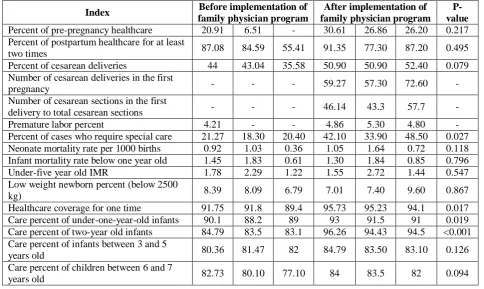
Table 2 Shows frequency distribution of health indices before and after implementation of family physician program.
Table 2: Frequency distribution of health indices before and after implementation of family physician program.
Index Before implementation of
family physician program
After implementation of family physician program
P-value Percent of pre-pregnancy healthcare 20.91 6.51 - 30.61 26.86 26.20 0.217 Percent of postpartum healthcare for at least
two times 87.08 84.59 55.41 91.35 77.30 87.20 0.495 Percent of cesarean deliveries 44 43.04 35.58 50.90 50.90 52.40 0.079 Number of cesarean deliveries in the first
pregnancy - - - 59.27 57.30 72.60 -
Number of cesarean sections in the first
delivery to total cesarean sections - - - 46.14 43.3 57.7 - Premature labor percent 4.21 - - 4.86 5.30 4.80 - Percent of cases who require special care 21.27 18.30 20.40 42.10 33.90 48.50 0.027 Neonate mortality rate per 1000 births 0.92 1.03 0.36 1.05 1.64 0.72 0.118 Infant mortality rate below one year old 1.45 1.83 0.61 1.30 1.84 0.85 0.796 Under-five year old IMR 1.78 2.29 1.22 1.55 2.72 1.44 0.547 Low weight newborn percent (below 2500
kg) 8.39 8.09 6.79 7.01 7.40 9.60 0.867 Healthcare coverage for one time 91.75 91.8 89.4 95.73 95.23 94.1 0.017 Care percent of under-one-year-old infants 90.1 88.2 89 93 91.5 91 0.019 Care percent of two-year old infants 84.79 83.5 83.1 96.26 94.43 94.5 <0.001 Care percent of infants between 3 and 5
years old 80.36 81.47 82 84.79 83.50 83.10 0.126 Care percent of children between 6 and 7
years old 82.73 80.10 77.10 84 83.5 82 0.094
Investigation of pre-pregnancy care index from 2003 to 2009 showed that implementation of family physician program had positive effect on such index. However, implementation of family physician program had no significant effect on improvement of pre-pregnancy care percent.
Regarding healthcare services for postpartum care, results of the study indicated that such services have been increased from 41.55% in 2002 (before implementation of family physician program) to 91.35% in 2008 (after implementation of family physician program). Premature delivery index has been added to the health program since 2004. We could not compare the index with previous years because it was not available. But information in the table shows fluctuation in premature labor percent after implementation of family physician program.
Regarding increase of special care index from 2002 to 2008, investigations show that special care percent has been increased such that the highest percent has been seen in 2006 (48.5). Some fluctuations have been observed in neonatal mortality index after implementation of family physician program such that the highest rate of mortality has been seen two years after implementation of family physician program.
Based on results of the present study, on average, 1.8 cases have been recorded for death of under-one-year-old infants per 1000 newborn neonates in rural regions.
Based on results of the present study, on average, 1.8 cases have been recorded for death of under-five-year-old children per 1000 newborn neonates in rural regions. Results indicate that some fluctuations have been seen in low weight newborn neonates such that the highest percent has been observed after implementation of family physician program.
Regarding indices of healthcare coverage at least for one time 30 days after birth, healthcare coverage of under-one-year-old children and two-year-old children care percent from 2003 to 2008, studies showed that implementation of family physician program had positive and significant effect on such indices. In conclusion, healthcare coverage of children between 3 and 5 years old and those between 6 and 7 years old has been increased after implementation of family physician program.
DISCUSSION
Unfortunately, percent of cesarean deliveries has been increased in rural regions of Larestan after implementation of family physician program such that the highest percent was seen in 2006 (52.4%). 10-30% of deliveries are done by cesarean section throughout the world whereas 50-60% of deliveries are done by cesarean section in Iran. 90 percent of cesarean sections are done in cities and private hospitals. It is while that according to WHO, maximum cesarean percent has been reported as 15% (World Health Organization,2009.).
The first cesarean delivery index has decreased after implementation of family physician program. Such achievements suggest rapid reduction of the first cesarean delivery in rural regions of Larestan. Although some regions are geographically remote and sporadic, rural access to health services has been improved and effectiveness of health services has been promoted.
Information in the table suggests fluctuations in premature labor percent after implementation of family physician program. Low socio-economic status and previous experience of premature labor are accounted as two important risk factors. Other factors such as cervix failure, polyhydramnois, infection, placental abruption, placenta previa, use of alcohol, cocaine and smoking, poverty, stress, physical-spiritual pressures can be effective on premature labor.
Regarding increase of special care index from 2002 to 2008, investigations show that special care percent has been increased such that the highest percent has been seen in 2006 (48.5). In this direction, family physician has played role in diagnosis and referral of those who required special care.
Health index of under-one-year-old infant mortality shows socio-economic status of Iran. Based on results of the present study, 1.8 cases have been recorded for death of under-one-year-old infants per 1000 newborn neonates in rural regions. Generally, infant mortality rate (IMR) per 1000 newborn neonates in rural regions of Iran has reduced from 37.2 in 1993 to 25.2 in 2002. Afterward, such rate reduced to one infant per 1000 neonates. Then, it reached 18.31 cases in 2006 (World Health Organization, 2012).
Based on results of present study, 1.8 cases have been recorded for death of under-five-year-old children per 1000 newborn neonates in rural regions. While, 17.4 cases have been reported for death of under-five-year-old children in Isfahan villages in 2011 (Khadivi et al, 2014).
Results show that some fluctuations have been seen in low weight newborns' index after implementation of family physician program. However, results of a study in Isfahan indicated that low weight newborns percent increased after implementation of family physician program ((Khadivi et al, 2014). Healthcare coverage of children has been increased after implementation of
family physician program. Unfortunately, no study has been conducted on healthcare coverage of children.
As a result, it seems that similar researches on heath indices of urban people especially in populations without insurance coverage can help more transparently authorities of health, treatment and medical education, ministry of cooperation, labor and social welfare in future policy making as well as development of urban family physician program.
REFERENCES
1. Davoudi S. Health and its determinants. 1st ed. Tehran – Iran: Asare Mouaser: Asefzadeh S, Rezapour A. Health management. 2006. 1st ed. Gazvin- Iran: Gazvin University of Medical Sciences, 2008; 140-142.
2. Sadeghiani E. Role of family physician in expenditure control and quality. Management improvement seminar. Babol University Medical Sciences. Iran, 2004.
3. Nekooei Moghadam M, Beheshtifar M. Health services planning. 1st ed. National Public Health Management Center (NPMC). Iran: Tabriz University of Medical Sciencs, 2005.
4. Family physician and referral system. Ministry of Health and Medical Education of Iran, Report of implicational assurance of rural and family physician program. 2007. Ministry of Health and Medical Education of Iran. Tehran – Iran: Assistant of health.Tehran – Iran. Health system reform of national unit, 2004.
5. Ministry of health and medical education, “Illustration of health team and family physician services”, first ed. Tehran, Arvij publishers, 1386: 1-2.
6. The Executive Guidline of Rural Insurance & Family Physician Program. 8th ed. Tehran: Ministry of Health and Medical Education Press. [Persian], 2007.
7. Raeisi P, Ebadi Fard Azar F, Roudbari M, Shabani Kia HR. The Impact of Family Physician Program on Mother and Child Health Indices in Rural Population Auspices of Mashhad University of Medical Sciences and Health Care Services, Iran; 2009. Journal of Health Administration, 2011; 13(43): 27-37.
8. World Health Organization. Rising caesarean deliveries in Latin America: how best to monitor rates and risks. WHO Policy brief. 2009; Available at: www.who.int/reproductive-health.
9. Chin-Shyan C, Herng-Ching L, Tsai- Ching L, Shiyng -Yu L, Stefani P. Urbanization and the likelihood of a cesarean section. European Journal of Obstetrics & Gynecology and Reproductive Biology, 2008; 141(2): 104-110.
11. Pallasmaa N, Ekblad U, Gissler M. Severe maternal morbidity and the mode of delivery.
12. Acta Obstet Gynecol Scand, 2008; 87(6): 662- 668. 13. Kahdivi, R, Kor, A, Forouzandeh, E, Comparing