UDC: 519.245:539.374
Computational Approaches to Inelastic Media with Uncertain Parameters
B. Rosić1,2, H. G. Matthies1
1 Institute of Scientific Computing, Technische Universität Braunschweig, Braunschweig,
Germany [email protected]
2 Faculty of Mechanical Engineering, Kragujevac, Serbia
Abstract
In this paper we will consider inelastic material described with uncertain parameters like bulk and shear modulus as well as yield stress, described as lognormal random fields. Uncertainty also can appear on the right hand side of the equilibrium equation. These uncertainties define stochastic inelastic problem, computationally treated by Karhunen-Loève expansion and polynomial chaos expansion. We observed just one material point, where the random fields become lognormal random variables. Here, we are introducing a stochastic radial return mapping for one material point based on the well-known deterministic radial return mapping,
assuming that the elastoplastic evaluation is independent of all other material points for the case of isotropic material. The reference solution is calculated using a Monte Carlo method and compared with the stochastic Galerkin method. The results show that both methods give almost the same results, while the Galerkin method is more effective than the Monte Carlo method.
Keywords: inelastic material, uncertain parametres, KL expansion, stochastic models
Introduction
Stochastic systems have recently become fast growing areas of scientific research. The increased interest in their simulation comes from the fact that systems are always subjected to random external influences, or are themselves uncertain or very often both of these.
In general the uncertainties are classified as epistemic or aleatory uncertainties (see e.g. Matthies, 2007b). Aleatory uncertainties are associated with the inherent randomness of nature (e.g. due to a random loading). Therefore, their influence cannot be reduced, but there is a highly developed mathematical theory dealing with this kind of problem. However, epistemic uncertainties arise due to our lack of knowledge. We can reduce their influence by collecting more data.
Material parameters describing both the elastic / reversible behaviour as well as those pertaining to the inelastic / irreversible behaviour are modelled as spatial random fields. The elastic as well as the inelastic behaviour has to be derived in terms of these random descriptors. In this paper we focus on the simplest such situation, which nonetheless is completely typical of irreversible material behaviour and easily extendible to any kind of inelastic description, namely linear elastic perfectly plastic material (Han and Reddy 1999, Matthies and Rosić 2008, Simo and Hughes 1998).
In general, there are several mathematical / numerical methods to deal with the time evolution of stochastic systems described by partial differential equations with random coefficients. They each involve very different views of the underlying randomness (Matthies et al. 1997, Schuëller 1997). Some of them are perturbation techniques (Markov 1987), theories of probability distributions (Master-Equation, Fokker-Planck equation according to Jeremić (2007)), methods based on direct integration such as the Monte Carlo method (Caflisch 1998) and the Smolyak method (Novak and Ritter 1999, Smolyak 1963), methods based on direct approximation such as traditional response surface methods, White Noise Analysis (Hida et al. 1993, Holden et al. 1996, Malliavin 1997), stochastic Galerkin, stochastic collocation (Babuška et al. 2004, Ghanem 1991, Keese 2003a, Keese 2003b, Matthies 2007a, Matthies 2007b, Matthies and Bucher 1999, Matthies and Keese 2005, Schwab and Todor 2003, Xiu and Karniadakis 2002), and approximate descriptions for plasticity by Anders and Hori (1999).
While the reversible behaviour has already been addressed in the stochastic setting many times, e.g. Matthies and Keese (2005), for the inelastic behaviour there are only few attempts based on perturbation methods (Markov 1987) or the theory of probability distribution (Jeremić 2007). The aim of this paper is to give stochastic evolution laws for the internal variables, complementing the stochastic description of the elastic behaviour. The computational treatment of stochastic inelastic material is based on the Karhunen-Loève expansion and sparse tensor product representations in order to employ as few random variables as possible (Matthies 2007b, Matthies and Keese 2005). Additionally, we use a polynomial chaos expansion à la Wiener, the truncation of which finally gives a completely discretized formulation which may be implemented on a computer.
In the numerical model we limit ourselves to the simplest situation, namely plane strain problems with isotropic plasticity and von Mises type of perfect plasticity. Isotropy is not a good assumption for heterogeneous materials, but it allows simple explanation of the main ideas, which can be equally applied in more complicated situations.
The result is a description of the evolution of the response variables and internal parameters in terms of those simpler random variables introduced before. This in turn then enables us to compute various quantities of interest, which are functionals of the solution.
In this paper we first give a short overview of the deterministic theory of plasticity, and then by describing random variables and random fields, we contrast it with the stochastic formulation of the plasticity. The computational treatment of the stochastic plasticity is given in Section 3, while the representation of the random input is given as modified lognormal random field and is explained in Section 4. Finally, in the conclusion we present the model results compared to the Monte Carlo simulation.
1. Model problem
1.1 The deterministic problem of elastoplastic flow
The object of our investigation is a quasistatic linear elastic material with perfect plasticity occupying a bounded Lipschitz domain G⊂\d (Duvaut and Lions 1976, Han and Reddy 1999, Kojić and Bathe 2005, Simo and Hughes 1998). Let T =[0, ]T be the interval of time and let us assume for the sake of simplicity homogeneous geometric boundary conditions for the displacement field and the following space of admissible displacements U, as well as the space of stresses defined by Σ and space of strains E. The stress and displacement evolution are then denoted by (σ,u) :T → Σ×U.
At all times stress lies in a closed, non-empty, connected convex set K∈ Σ, the boundary
∂K of which denotes the yield surface. A loading history ( ) :f t T →F is given in the time interval T, with F a space of forces in duality with U.
Introducing the bilinear form:
, ,D Σ: D : d , x , t
×Σ →\ 〈τ v〉 =
∫
v τ ∀ ∈v ∀ ∈Σ ∀ ∈τ T GU U, (1)
as well as the linear functional:
( ) : , ( ), : ( )· d , ,
l t →\ 〈l t v〉 =U
∫
f t v x ∀ ∈ ∀ ∈v t T GU U (2)
theequilibrium equation for each time t becomes:
: , ( ),
t D Σ l t
∀ ∈T 〈τ v〉 = 〈 v〉U ∀ ∈v U (3)
where D:U→E is a linear operator which maps displacements to strains:
D
= u∈
ε E (4)
and 〈 〉.,. denotes the duality paring.
In the case of small deformations the total deformation consists of two parts: the plastic deformationεp, which characterizes the irreversible part of the deformation, and the elastic deformationεe, due to the elastic behaviour of the material point i.e.:
p e
= +
ε ε ε (5)
The elastic and plastic strains, like the total strain itself, are symmetric second order tensors. The connection between space of stresses and space of strains is given by the elastic constitutive equation:
, e Σ , Σ,
〈ε εA 〉 =〈ε σ〉 ∀ε∈E (6)
defined by Hooke's law with elastic constants inA. The elasticity tensor ( , ( d d)) sym
L L ×
∞
∈ G \
A is
symmetric and uniformly positive definite i.e.:
2 c ( ) ,
( ),x ( )x x ∀ ∈ , ∀ ∈x
〈ε Aε 〉 > ⋅ ε ε E G (7)
with ε( )x 2 =ε( ) : ( )x ε x the usual norm of tensors, and it has a property of inversion, which defines a compliance tensor 1 ( , ( d d)).
sym
L L
− ×
∞
∈ G \
Purely elastic behaviour takes place when the stress is in the interior of K (σ∈int K)or when generalized stress moves from ∂K to the interior of K (elastic unloading). The plastic behaviour takes place only if σ lies on the yield surface and continues to do so. In the case of perfectly plastic behaviour the stress moves around the yield surface during plastic deformation and yield surface remains unchanged by this behaviour. The plastic evolution is described by inequality (Duvaut and Lions 1976, Han and Reddy 1999, Kojić and Bathe 2005, Simo and Hughes 1998):
, Σ 0
〈ε σ τ− 〉 ≤ ∀ ∈τ K (8)
i.e. normality law, which states that for a non-smooth yield-surface plastic strain rate εp lies in the normal cone at point σ . For the smooth yield surface this cone reduces to the usual normal in a point of the boundary. In the case of a smooth yield surface ( )ϕ σ , one can express the plastic flow as:
p
ϕ ρ∂
= ∂
ε
σ (9)
where ρ is a non-negative scalar, called plastic multiplier.
The yield function describing perfect plasticity ( )ϕ σ is a function of stress and in the case of isotropy it is a function of the stress invariants (Duvaut and Lions 1976, Han and Reddy 1999, Kojić and Bathe2005, Simo and Hughes 1998). Using the deviatoric part of stress σD:
1 : tr
3
D = − I
σ σ σ
(10) wheretrσ denotes trace of the stress tensor, one can introduce the von Mises yield function as:
3
: 0
2 D
y
ϕ = σ −σ ≤
(11) where σy is the yield stress.
1.2 Random variables
Let ( , , )ΩB P be a probability space with probability measure P and a σ -algebra of events
B.
Under the term random variable (RV) one considers a measurable map :Ω →V into a vector space V, which is often equal to \(Adler 1981, Krée and Soize 1986, Loève 1977). The random variableis completely specified by its distribution function (Doob 1990, Krée and Soize 1986, Loève 1977 and Papoulis 1991):
{ ( ) }
: ( ) Pr{ ( ) }: ( )
r
r r ω r ω dω
≤
∀ ∈\ Φ = ≤ =
∫
P(12) from which a measure for intervals ]a,b] and hence all sets in the Borel σ - algebra of \can be
given by the push-forward of the measure P with the measurable map as
*P(] , ])a b = Φ ( )b − Φ ( )a . In the case when this measure is absolutely continuous w.r.t. the
Lebesgue measure d on \, the random variable has a probability density function (pdf)
1
( ) dr ( ) / dr r L( )
The so-called second order information of a random variable involves the mean value,
(
)
: (·) : ( )
) (dω ω
Ω
=E =
∫
P(13) with the expectation (·)E and its auto-covariance,
:= ( ⊗ )
C E (14)
where ( )ω is split into the mean and the fluctuating part,
( )ω = ( )ω −
(15)
with ( ) 0E = .
The random variable whose expectation is equal to zero is called a centred random variable.
1.3 Random fields
If the vector space V where the RV takes its values is a space of functions, say ( , )C Γ \ , the space of continuous functions Γ, we call such a random variable a random process if Γ is interpreted as time, or a random field if Γis interpreted as space (Adler 1981, Krée and Soize 1986). Similarly to a ''simple'' random variable, we may define both the mean value of a random field ( , ) :κ xω
( ) :x ( ( , ))x
κ =Eκ ω (16)
and the fluctuating part ( , )κ xω =κ( , )xω κ− ( )x .
The covariance of the random field considers different positions x1 and x2:
1 2 1 2
( , ) :x x ( ( ,·)x ( ,·))x
κ = κ ⊗κ
C E (17)
This becomes important when the finite distribution of a random field is not available and only the second order information like the mean and covariance are known.
If ( )κ x ≡κ is a constant and the covariance is a function of the distance of two points:
1 2 1 2
( , ) :x x c x( x )
κ = κ −
C (18)
the process or random field is called stationary or homogeneous (Adler 1981, Papoulis 1991). The covariance function will be crucial later on in Subsection 2.1 for the dicretization of the input random fields.
1.4 Stochastic model problem
Heterogeneities at the micro-structural level are usually subject to a number of uncertainties. Material properties of a heterogeneous material usually are not known with certainty at every point. So the behaviour of these materials must be derived in terms of random descriptors, which are modelled as random fields.
fields, i.e. we have given a random loading history ( , )f tω = f( , , )x t ω a random field ( , )A xω of elastic coefficients, random elastic domain ( , )K xω , and the equilibrium equations required to hold for (almost) all ω(almost surely), which may be put in a variational statement:
: ,D Σ , : ( ( ),ω (ω) )
∀ ∈v U 〈〈τ v〉〉 = 〈〈f v〉〉 =U E〈f v 〉U (19)
The stochastic elastic constitutive model is defined using thestochastic Hooke's law
: (
, e Σ , Σ , Σ)
〈〈ε εA 〉〉 = 〈〈ε σ〉〉 =E 〈ε σ〉 ∀ ∈ε E (20)
The admissible stresses must be almost surely in the elastic domain ( , )σ tω ∈K( )ω , where the plastic flow rule is given by the stochastic Prandtl law:
0 ,
p Σ
〈〈ε σ − 〉〉 ≤τ ∀ ∈τ K (21)
We will consider isotropic material for the sake of demonstration and simplicity (Matthies and Rosić 2008), although this is an unrealistic representation of heterogeneous realisations. The yield function will be described by von Mises yield criterion, making this model the simplest case of an irreversible material behaviour. The properties of the material: bulk modulus
( , )
K xω , shear modulus ( , )G x ω and yield stress σy( , )xω are supposed to be random fields. Randomness will appear also in solutions like quantities ( , , )u x t ω , ( , , )εe x tω , and εp( , , )x tω . Properties of the material like bulk and shear modulus as well as yield stress must be positive, so they are assumed to be lognormal random fields (see Section 4.).
2. Computational approach
The goal of the stochastic analysis is to compute functionals of the solution in the form
( ) : ( ( )) : ( ( , ), , ) d ( )
u = 〈 〉 = Ψ =
∫ ∫
Ω Ψ xω xω x dωΨ Ψ u u u
G
E P
(22) In the simplest case this could be the mean value of displacement u=E( )u , or the variance of
the fluctuating part v ra ( )2
u=E u , where u u u = − , or the probability:
0 0 0
{u u≤ }= ({ω∈ Ω| ( )uω ≤u })= (χ(u u≤ ))
P P E (23)
All such desirables are usually expected values of some functional, to be computed via (high dimensional) integration over Ω. This integration is approximated by a sum defined by a number of evaluation points ωz. Depending on how many evaluation points we have in the sum and how expensive the evaluation of ( )uωz is, one can distinguish different calculation methods of this integral (see e.g. Matthies 2007a, Matthies 2007b, Matthies and Keese 2005).
2.1 Karhunen-Loève expansion
Given the covariance function Cκ( , )x y one considers the Fredholm eigenproblem on domain G(Courant and Hilbert 1989):
2
( , ) ( )x y g y dy g x( ) with g x g x( ) k( ) dx k
κ =λ =δ
∫
C∫
G j j j G j j (24)
As the covariance function is symmetric and positive semi-definite, (24) yields to positive decreasingly ordered eigenvalues λ2
j with the only possible accumulation point zero, and a complete orthonormal set of eigenfunctions gj, so that the spectral decomposition will have the form:
2
1
( , )x y j g x g y( ) ( )
κ λ
∞
=
=
∑
C j j
j (25)
This gives a possibility to synthesise the random field κ through its KLE (Loève 1977):
1 0
( , )x ( )x g x( ) ( ) : g x( ) ( )
κ ω κ ∞ λ ξ ω ∞ λ ξ ω
= =
= +
∑
j j j =∑
j j jj j (26)
where ( )ξ ωj are centred, normalised, uncorrelated random variables, i.e.
2( )
) )
(ξ =0 and (ξ ξk = 〈: ξ ξ, k L〉 Ω =δk
E j E j j j (27)
In actual computations the sum in (26) is truncated to a finite number of terms.
The RVs in the KLE (26) can be represented as functions of other simpler RVs i.e. Gaussian RVs (classical Wiener Chaos). Other possibilities also exist (Holden et al. 1996). If one additionally assumes that λ are independent, further developments can be found in Babuška et al. (2004), Xiu and Karniadakis (2002). It is best to use orthogonal polynomials in the underlying measure. In our case these are Hermite polynomials for Gaussian random variables.
2.2 Polynomial chaos expansion
Each random variable ( )ξ ωj from the KLE (26) may be expanded in the polynomial chaos expansion (PCE) (see e.g. Matthies 2007b, Matthies and Keese 2005):
( ) ( ) ( ( ) ( ))
( ) ( ( )), with
! H H α α α α α ξ ω ξ ω ξ ω ξ α ∈
=
∑
θ = θ jj j j
J
E
(28) with Hermite polynomials in Gaussian random variables (Holden et al. 1996, Malliavin 1997,
Matthies 2007b) { ( )}θ ωm m 1 : ( )ω
∞
= =θ such that:
1
( ( )) : ( ( ))
Hα ω hα θ ω
∞
=
=
∏
θ j j
j (29)
where ( )hA θ are the usual Hermite polynomials, and
1 0
1
: {α ( , , , ) : , α α α | |:α ∞ α }
=
= = … j … j∈` =
∑
j < ∞j
J
are multi-indices, where only finitely many are non-zero. The Hermite polynomials satisfy:
2( ) )
, L ( !
H Hα β Ω H Hα β α δαβ
〈 〉 =E =
(31)
where
1
!: ( !)
α ∞ α
=
=
∏
j j. Again, in a practical calculation, only finitely many RVs θmwill be
used, and the sum in (30) will be truncated to a finite number of terms.
2.3 Stochastic radial return mapping
Let quantities at the initial time t0 be denoted by [.]0, those at time t1 by [.]1 and increments
by Δ[.], where time t1:= + Δt0 t. Similarly, the increment of loading Δf can be defined and
1= (t+ Δ =t) ( )t + Δ = 0+ Δ
f f f f f f . A computation is based on a few steps which define the
equilibrium loop (Kojić and Bathe 2005, Simo and Hughes 1998). The first step is to find Δu,
so that equilibrium equation (22) is satisfied *
1 1
Dσ = f and σ1∈ K, where *
D is the dual operator toD. Then one needs to predict Δu by elasticity from the residual Δf , givingthe strain increment Δ = Δε D u. The next step is to compute the trial elastic stress σ1=σ0+ ΔA ε, and project it onto the convex elastic domain K , giving the trial stress 1∈
K
σ . Having the
trial stress, one can compute the trial elastic strain 1
1 ˆ1
e −
=
A σ
ε and the trial plastic strain
1 ( 0 ) ˆ1
ˆp = ε + Δ −ε εe
ε . The last step is to check the equilibrium and if it is not satisfied to repeat
the previous loop with the residuum *
1 ˆ1
: D
Δ =f f − σ .
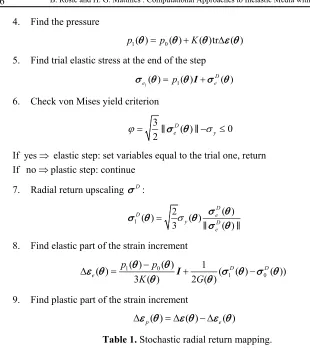
The algorithm of the stochastic radial return mapping given in Tab.1 is completely analogous to the case where we observe one material point, assuming that the elastoplastic evaluation is independent of all other material points. Considering one material point, the random fields become random variables, so that the bulk modulus K , shear modulus G, and yield stress σy become ordinary lognormal random variables. The algorithm will be used for calculating stresses when the inputs are random fields observed as random variables in each Gauss point (Matthies and Rosić 2008). In the deterministic case the radial return mapping operates on normal vectors and tensors, while in the stochastic case all computations must be performed for random variables. All operations used in the stochastic radial return mapping algorithm are polynomial chaos algebra operations explained in Appendix 6.2.
1. Given:
- Lognormal RVs ( ), ( ),Kθ Gθ σy( )θ
- Stress at beginning of the step σ θ0( ) and strain increment Δε θ( )
2. Calculate:
- Initial “pressure” : 0 1tr 0 3 p = σ
- Initial deviatoric part of the stress: 0 0 0
D = −pI
σ σ
3. Find trial deviatoric elastic stress
0
1
( ) ( ) 2 ( )( ( ) tr( ( )) ) 3
D D
e = + G Δ − Δ
4. Find the pressure
1( ) 0( ) ( )tr ( )
p θ = p θ +K θ Δε θ
5. Find trial elastic stress at the end of the step
1( ) 1( ) ( )
D
e θ = p θ + e
σ I σ θ
6. Check von Mises yield criterion
( ) 3
0 2
D
e y
ϕ= ‖σ θ ‖−σ ≤
If yes⇒ elastic step: set variables equal tothe trial one, return If no⇒plastic step: continue
7. Radial return upscaling σD:
1
( ) 2
( ) ( )
3 ( )
D
D e
y D
e
σ
= σ
θ
σ θ
σ θ
θ
‖ ‖
8. Find elastic part of the strain increment
1 0
1 0
( ) ( ) 1
( ) ( ( ) ( ))
3 ( ) 2 ( )
D D
e
p p
K G
−
Δ = θ θ + −
θ θ σ σ
θ θ θ
ε I
9. Find plastic part of the strain increment
( ) ( ) ( )
p e
Δε θ = Δε θ − Δε θ
Table 1. Stochastic radial return mapping.
3. Representation of a random input
In practice, it is often clearly inappropriate to use the Gaussian model due to its symmetry, its infinite domain, and the rate of decay of the tail of its density function. Some material properties like bulk modulus, shear modulus and yield stress are always positive, so we use lognormal random fields for their representation.
We will show this only for the bulk modulus K , as similar procedures can be used for both shear modulus and yield stress. A modified lognormal random field K is obtained as a nonlinear transformation of a centred Gaussian random field ( , )γ xθ by taking its exponential (Ghanem 1997, Sakamoto and Ghanem 2002):
( , ) exp( ( , ))
K xθ = μ σ γγ+ γ xθ (32)
where the second order statistics of the Gaussian random field (μ σγ, γ) are defined by
prescribing the second order statistics of the lognormal random field, i.e. the mean value K
2
2 ln 1 K
K γ σ σ μ ⎛ ⎞ = + ⎜ ⎟ ⎝ ⎛ ⎞ ⎜ ⎟ ⎜ ⎠ ⎟
⎝ ⎠ (32)
2
ln K 0.5
γ γ
μ = μ − σ
(33)
The shear modulus and yield stress are defined in a similar way.
3.1 Polynomial Chaos of a Lognormal Random Field
The random field ( , )κ xθ at a material point (Gauss point in FEM) x0is a simple random
variable =κ( , )x0 θ and has KLE / PCE approximation:
( )
0 0
( , ) ( ) ( ) ( ) ( )
M
M M
x g x g x αH
α α κ λ ξ λ ξ = = ∈ =
∑
=∑
∑
θ θ θ Jj j j j j j
j j (34)
where PCE of a random variable is givenas:
( ) ( )
0 0 0
0
, ( ) ( ) ( ( )) ( )
M M
M
x α x H α g x H
α α α α λ ξ ∈ ∈ = ∀ ∈ =
∑
θ =∑
∑
θ J Jj j j
j G
(35)
with the centred random variables ξ( )α
j , eigenfunctions g xj( )0 , eigenvalues λjand Hermite polynomials Hα( )θ .
A lognormal random variable can be represented by using univariate Hermite polynomials
m
h in the standard Gaussian random variable θ: = m 0 1 2( 2 1) ...
m m
h = + θ+ θ − +
∑
.Extending this idea to each point in the domain G, the random field is described as:
0 1 2 2
: (x) = m( ) ( ) ( ) ( ) ( 1) ...
m m
x x h x x xγ γ
∀ ∈G
∑
= + + − +(36) where γ denotes a Gaussian random field.
The KLE decomposition of a Gaussian random field ( , )γ xθ is given as:
1 0
ˆ ˆ
( , )x ( )x ˆ g x( ) :j ˆ g x( )
γ γ ∞ λ θ ∞ λ θ
= =
= +
∑
=∑
θ j j j j j
j j (37)
One can find the coefficients of the polynomial chaos expansion of a lognormal random field for one material point by using Sakamoto and Ghanem (2002) relation:
( ) ( ) ( ) 1 ˆ ( ! ˆ ( ) : ) ( )
! k j k j
p p
j
x p
x g x
α λ
α =
=
∏
(38)
where p( )x are given in (36), p is the order of H
α and ( ) ( )
1
ˆ ( )
ˆ m
k j k j
j
g x
λ
=
∏
is the product of4. Model results
The numerical example of a plane strain problem is given in the case when the random inputs , and y
K G σ are described by lognormal distributions. The strain tensor is given by three non-zero components, i.e. in vector notation ε θ( )= ⎣⎡εxx( ),θ εyy( ),θ εxy( ) ,θ ⎤⎦ while the stress is
given as σ θ( )= ⎣⎡σxx( ),θ σyy( ),θ σxy( ),θ σzz( )θ ⎤⎦, with:
2
( ) ( )( ( ) ( )) 3
zz K G xx yy
σ θ = − ε θ +ε θ
(39) The mean values of material parameters are given as K=1.75 10⋅ 11Pa, G=0.8077 10⋅ 11Pa,
6
450 10 y
σ = ⋅ Pa, while for standard deviations we take 5% of mean value.
The polynomial chaos expansions of random inputs of the fourth order are compared with the results of Monte Carlo simulations (MC) for 105samples, assuming that the later one is
exact. The calculation of coefficients of the polynomial chaos expansion given by equation (30) is done using a Gauss-Hermite quadrature rule.
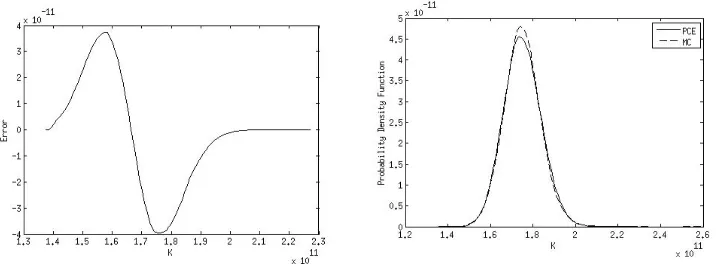
The obtained result forthe bulk modulus is shown in Fig.1.
Fig. 1. Comparison of PCE-MC and PDF of bulk modulus .K
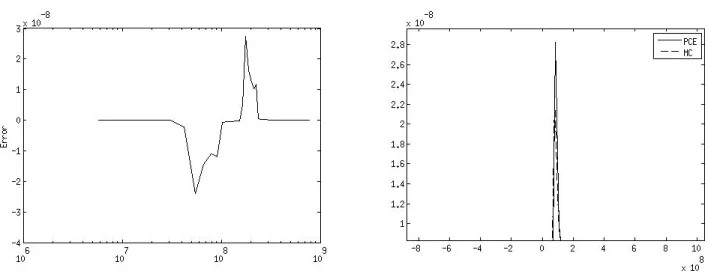
We givethe probability density functions for all output variables as “pressure”, given as
one third of trace of the stress tensor, i.e. 1tr 3
p= σ, as well as shear stress σxy and shear strain
xy
Fig. 2. Comparison of PCE-MC and PDF of pressure p.
Fig. 3. Comparison of PCE-MC and PDF of strain εxy.
Fig. 4. Comparison of PCE-MC and PDF of strain σxy.
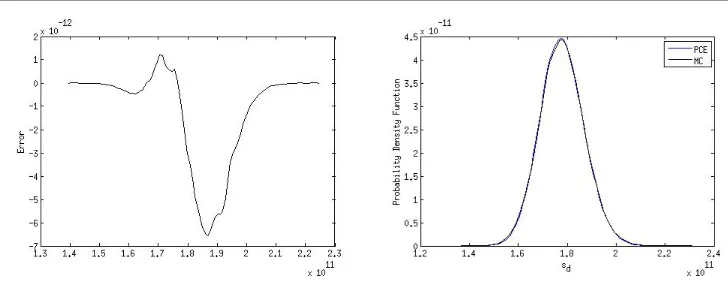
Another comparison for the stress defined as 1(2 )
4 zz xx yy δ
Fig. 5. Comparison of PCE-MC and PDF of stress σδ.
5. Conclusion
The objective of this article is to illuminate the white noise setting for a stochastic plasticity formulation. The idea of random variables as functions in an infinite dimensional space which have to be approximated by elements of finite dimensional spaces has brought a new view to the field. The stochastic Galerkin method (as well as the collocation method) is useful in the approximation of partial differential and integral equations, and it has been applied in the field of elasticity very successfully. Here, we also apply it to irreversible materials, e.g. in the case of plasticity. This new method is a contrast to traditional Monte Carlo methods. It remains yet to be seen which of these approaches is more effective.
6. Appendix
In the appendix we give a short explanation of Hermite polynomials in Section 6.1 and of polynomial chaos algebra in Section 6.2. The basic operations of polynomial chaos algebra are already introduced in Debusschere et al. (2005), Matthies (2007b). For non-linear operations we will use different methods described below.
6.1 Hermite algebra
The univariate Hermite polynomials are a linear basis for the polynomial algebra and their product may be written as follows (see e.g. Matthies 2007b):
( ) ( )
0
! ! ( ) ( ) ( ),
( )!( )!( )!
k
m m
k kl m k
m
k
h h c h c
g k g g m
θ θ + θ
=
= =
− − −
∑
AA A
A
A (40)
where the univariate coefficients (structure constants of the algebra) are nonzero only in the case when g=(k+ +A m) / 2 is integer and g≥k, ,A m. For the multivariate Hermite algebra, the analogous statement holds:
( )
( ) ( ) ( )
H H c Hγ
α β αβ γ
γ =
∑
θ θ θ
( ) ( )
j
cγ cγ
αβ = Π α βj jj
(42) defined in terms of the univariate coefficients (40) (see e.g. Debusschere et al. 2005, Matthies
2007b).
6.2 Polynomial chaos algebra
The most basic operations on PC variables are additions and subtractions, which are performed by adding/subtracting the corresponding PC coefficients of the variables being added/subtracted (Debusschere et al. 2005, Matthies 2007b). Multiplications of PC variables, however, are a little less straightforward. Let PC variables , and a b cbe given as polynomial chaos expansions:
( ) , , ( ) ( )
a a Hα α b b Hβ β c c Hγ γ
α β γ
=
∑
=∑
=∑
(43) Then their product is given as:
( ) ( ) ( ) ( ) ( ) ( ) ( )
a b c b c Hβ γ H b c cβ γ α
β γ βγ
β γ α β γ
θ θ
= ⋅ =
∑∑
=∑∑∑
(44) Hence,
( ) ( ) ( ) ( )
aα b c cβ γ βγα β γ
=
∑∑
(45) The division of two PC variables is based on the problem of multiplication where one of the
factors in the product is unknown, i.e. b a c= \ ⇔ = ⋅a b c (bis the unknown PC variable). The appropriate coefficient equation will be:
( ) ( ) ( ) ( ) ( ) ( ) ( )
:aα b c cβ γ βγα [ c cγ βγα ]bβ
β γ β γ
α
∀ =
∑∑
=∑ ∑
(46) and represents a system of linear equations which needs to be solved.
All basic PC variable operations are quite easy to obtain. The non-polynomial functions like exponential or square root convey difficulties. The non-polynomial function evaluations of PC variables make a challenge since the Galerkin projection method cannot be applied directly to determine the PC coefficients of the function result. Several approaches can be used like Taylor expansion method, then Monte Carlo method or the direct integration approach (Debusschere et al. 2005). The problems arising in this case are inaccuracy or cost-effectiveness of the method. The Newton method can be used for finding the square root by just replacing the algebraic operations of adding and dividing with the polynomial chaos algebraic operations of adding and dividing. The time for solving the system of equations in the division is computationally large. To overcome this, we instead use the process of finding the root of an inverse function. In that way we will have just one division per iteration, making the method more efficient. The tolerance ofthe converging method is defined by:
2
tol= μ +var (47)
Acknowledgments. The authors acknowledge the support of the Ministry of Science of Serbia Grant OI1144-208; and of the City of Kragujevac, Contract 1224/08.
References
Adler R J (1981). The Geometry of Random Fields, John Wiley & Sons, Chichester
Anders M, Hori M (1999). Stochastic finite element methods for elastoplastic body. Int. J. Num. Meth. Engnrng., 46:1897-1916.
Babuska I, Tempone R, and Zouraris GE (2004). Galerkin finite element approximations of stochastic elliptic partial differential equations. SIAM J. Numer. Anal., 42:800-825.
Calfisch RE (1998). Monte Carlo and Quasi-Monte-Carlo methods. Acta Numerica, 7:1-49. Courant R, Hilbert D (1989). Methods of Mathematical Physics. John Wiley & Sons, Chichester Debusschere BJ, Najm HN, Pebay PP, Knio OM, Ghanem RG, Le Maitre OP (2005).
Numerical challenges in the use of polynomial chaos representations for stochastic processes. SIAM Journal on Scientific Computing, 26:698-719.
Doob JL (1990). Stochastic Processes. John Wiley & Sons, Chichester
Duvaut G, Lions JL (1976). Inequalties in Mechanics and Physics. Springer Verlag, Berlin. Ghanem R (1999). The nonlinear Gaussian spectrum of lognormal stochastic processes and
variables. ASME Journal of Applied Mechanics, 66(4):964-973.
Ghanem R, Spanos P (1991). Stochastic Finite Elements - A Spectral Approach. Springer Verlag, Berlin.
Han W, Reddy BD (1999). Plasticity: Mathematical Theory and Numerical Analysis. Springer Verlag, Berlin.
Hida T, Kuo HH, Potthoff J, and Streit L (1993). White Noise - An Infinite Dimensional Calculus. Kluwer, Dordrecht.
Holden H, Øksendal B, Uboe J, Zhang T (1996). Stochastic Partial Differential Equations. A Modeling, White Noise, Functional Approach. Birkhüser, Basel
Jeremić B, Sett K, Levent Kavvas M (2007). Probabilistic elastoplasticity: Formulation in 1d. Acta Geotechnica, 2:197-210.
Keese A (2003a). Numerical Solution of Systems with Stochastic Uncertainties. A General Purpose Framework for Stochastic Finite Elements. PhD thesis, Technische Universität Braunschweig, Brunswick, Germany, 2003.
Keese A (2003b). A review of recent develpoments in the numerical solution of stochastic partial differential equations. Informatikbericht 2003-6, Institute of Scientific Computing, Department of Mathematics and Computer Science, Technische Universität Braunschweig, Brunswick, Germany.
Kojić M, Bathe KJ(2005). Inelastic Analysis of Solids and Structures. Springer Verlag, Berlin. Krée P, Soize C (1986) Mathematics of Random Phenomena-Random Vibrations of
Mechanical Structures. D. Reidel, Dordrecht
Loève M (1977). Probability Theory. Springer-Verlag, Berlin. Malliavin P (1997). Stochastic Analysis. Springer-Verlag, Berlin.
Markov KZ (1987). Application of Volterra - Wiener series for bounding the overall conductivity of heterogeneous media, I. general procedure. SIAM J. Appl.Math., 4:831-849.
Matthies HG (2007b). Uncertainty quantification with stochastic finite elements. In E. Stein, R. de Borst, and T. J. R. Hughes, editors, Encyclopedia of Computa tional Mechanics. John Wiley & Sons, Chichester.
Matthies HG, Brenner CE, Bucher CG, Guedes Soares C (1997). Uncertainties in probabilistic numerical analysis of structures and solids- stochastic finite elements. J. Stuctural Safety, 19:283-336.
Matthies HG, Bucher C (1999). Finite elements for stochastic media problems. Comp.Meth. Appl. Mech. Eng., 168:3-17.
Matthies HG, Keese A (2005). Galerkin methods for linear and nonlinear elliptic stochastic partial differential equations. Comp. Meth. Appl. Mech. Eng., 194:1295-1331.
Matthies HG, Rosić B (2008). Inelastic media under uncertainty: Stochastic models and computational approaches. IUTAM Symposium on Theoretical, Computational and Modelling Aspects of Inelastic Media, Proceedings of the IUTAM Symposium held at Cape Town, South Africa, 11: 185-194, Springer Netherlands.
Novak E, Ritter K (1999). Simple cubature formulas with high polynomial exactness. Constructive Approximation, 15:499-522.
Papoulis A (1991). Probability, Random Variables and Stochastic Processes. McGraw-Hill, New York, NY.
Sakamoto S, Ghanem R (2002). Simulation of multi-dimensional non-Gaussian non-stationary random fields. Probabilistic Engineering Mechanics, 17:167-176
Schüller G (1997). A state of the art report on computational stochastic mechanics. Prob. Engnrng. Mech., 12:197-321.
Schwab C, Todor RA (2003). Sparse finite elements for elliptic problems with stochastic loading. Numer. Math., 95:707-734.
Simo JC, Hughes TJR (1998). Computational Inelasticity. Springer Verlag, Berlin.
Smolyak SA (1963). Quadrature and interpolation formulas for tensor products of certain classes of functions. Dokl. Akad. Nauk SSSR (Soviet Math. Dokl.), 4:240- 243.