(UDC: 616.15:532.57 ; 616.13-004.6-092.18)
Role of oscillatory shear index in predicting the occurrence and
development of plaque
M. Blagojević1,*, A. Nikolić1, M. Živković1, M. Živković2, G. Stanković2, A. Pavlović3
1 Faculty of Engineering, University of Kragujevac, Sestre Janjić 6, 34000 Kragujevac, Serbia [email protected], [email protected], [email protected]
2 School of Medicine, Belgrade University, Belgrade, dr Subotića 8, 11000 Belgrade, Serbia [email protected], [email protected]
3 Department for Industrial Engineering-DIN, University of Bologna, via Risorgimento 2, 40136 Bologna, Italy
*Corresponding author
Abstract
The paper presents theoretical basis and results obtained by calculation of blood flow in coronary artery bifurcation, whereby the emphasis is placed on the plaque occurrence analysis based on oscillatory shear index (OSI). OSI is the temporal fluctuation of low and high average shear stress. The endothelial or wall shear stress is a major factor that affects the formation of plaque phenomenon. There are complex hemodynamic conditions in these areas where local fluid flow dictates the occurrence and development of plaque. Favorable conditions for the plaque development occurring in areas characterized by low shear stress, while areas with higher values of OSI index are not susceptible. Arterial bifurcations are the places in vascular tree where atherosclerosis mainly occurs. OSI index response to the appearance of plaques in the common coronary artery and branches are considered on three out of eight possible combinations of plaque locations. Algorithm for the calculation of OSI index are embedded in software PAK-F and the results are written in FEMAP neutral and Paraview VTK file format.
Keywords: Coronary artery, bifurcation, oscillatory shear index, wall shear stress, VTK
1. Introduction
30
PH. 2011). Non-invasive diagnostic procedures such as MRI are often used in this context, but do not provide information on time-dependent pressures and wall shear stresses - key quantities considered to be partially responsible for the formation and development of related pathologies.
Numerical methods, such as finite element analysis (FEA), allow sufficiently accurate determination of transient fields of pressures and wall shear stresses. Finite element models allow one to simulate experimental changes caused by variations of some parameters, and analyze the effects and influences of a single component within the phenomenon investigated (Mariunas M. 2011; De Beule M. 2009).
2. Oscillatory shear index (OSI)
Temporal oscillations of low and high average shear stress are measured across oscillatory shear index (OSI). Shear vector can be calculated from the stress tensor σ and the normal vector to the surfacen:
t σ n. (1)
Surface shear vector ts is defined as the tangential component of the shear stress:
s
t t t n n. (2)
The scalar value of the mean shear stress
mean is defined as the average intensity values of the shear vector:0
1T mean sdt
T
t . (3)while the scalar mag is defined as the average value of the intensity of the shear vector:
0
1T
mag s dt
T
t . (4)Oscillatory shear index (OSI) is defined by the expression:
1 1 2 mean mag OSI
. (5)
In case when meanmag, their ratio is mean 1 mag
, and OSI0. On the other hand, when
0 mean
, ratio is mean 0 mag , and
1 2
OSI . The value of OSI varies in the interval
0, 0.5
.3. Generation of Finite Element Models
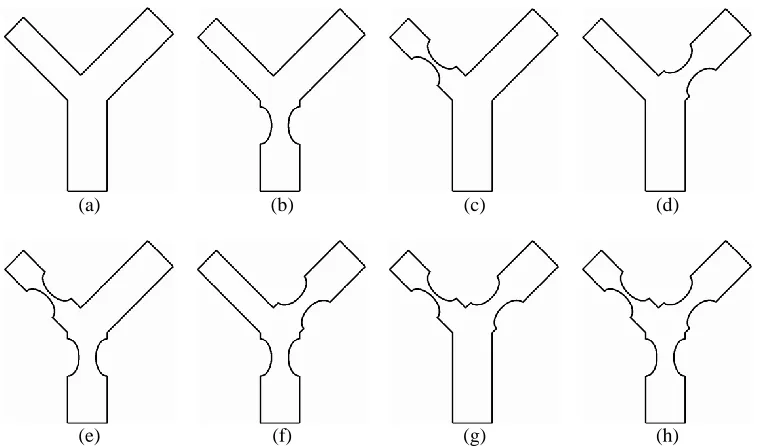
(LMCA) branching: (a) with no plaque, (b) with plaque on LMCA, (c) with plaque on left circumflex artery (LCX), (d) with plaque on left anterior descending artery (LAD), (e) with plaque on LMCA and LCX, (f) with plaque on LMCA and LAD, (g) with plaque on LCX and LAD, (h) with plaque on LMCA, LCX and LAD (Fig. 1).
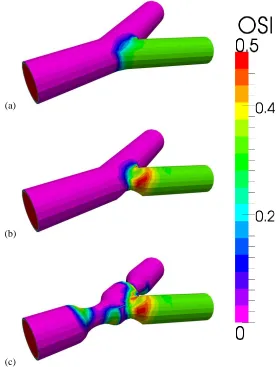
Among these cases, OSI index response to the appearance of plaques in the common coronary artery and branches are considered on three out of eight (23) possible combinations of plaque locations (Fig. 2). We observe the following cases of left main coronary artery bifurcation: (a) with no stenosis, (b) stenosis of the side branch, and (c) stenosis in all branches (Fig. 2).
(a) (b) (c) (d)
(e) (f) (g) (h)
Fig. 1. Theoretical cases of the appearance of plaques on the left main coronary artery branching.
CAD model of coronary bifurcation is generated in CATIA software (Fig. 2). Finite element models were generated using in-house software STL2FEM (Zivkovic M. 2012), thus the preparation of model also been made in software GOM Inspect (polygonization, setting borders of model). Multiblock approach embedded in in-house software STL2FEM is used for mesh generation (Blagojevic M. 2013a; Blagojevic M. 2013b). For complex geometries such as artery bifurcations multiblock method is the most adequate method to generate of finite element mesh with minimum errors of numerical solutions. Implemented approach dramatically speeds up the process of generating patient-specific finite element bifurcation models.
32
very short time required to generate the model allows the treatment of a large number of patients.
(a) (b)
(c) (d)
(e) (f)
(a) (b)
Fig. 3. Stereolitography and finite element model of patient-specific coronary artery bifurcation.
Finite element simulations of coronary flow are performed using software PAK-F (Kojić M. et al., 1998). Blood is approximated as an incompressible Newtonian fluid with a density of 1050 kg/m3 and a dynamic viscosity of 0.003675 Pas. One cardiac cycle (0.89 s) is simulated in 20 steps with time step size of 44.49 ms. Maximal diastolic flow velocity in the inlet is 33 cm/s. Velocity profile used for simulating is pulsatile flow. Velocities of nodes on the arterial wall are equal to zero. WSS, OSI index, velocity, and pressure are calculated throughout cardiac cycle.
4. Results and Discussion
WSS is one of the most essential factors influencing endothelial structure and function, and it is the main local flow related factor responsible for coronary atherosclerotic plaque formation and progression. According to several recent studies low WSS promote atherosclerosis with several mechanisms: through nitric oxide (NO)-dependent athero-protection, increased low-density lipoprotein cholesterol uptake, sustain increase in oxidative stress, inflammation and smooth muscle cell proliferation and migration.
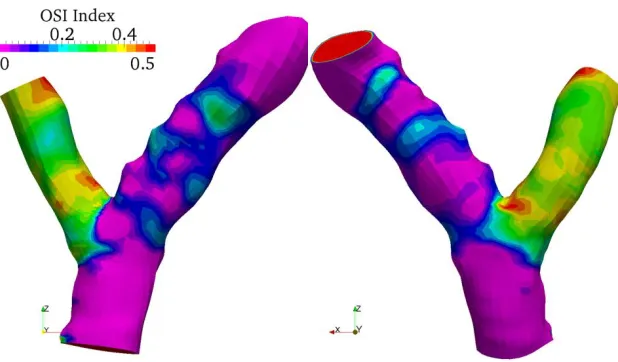
Analyses by 3D models that consider only the ideal geometry of arterial bifurcations are not suitable to draw conclusions that will come to develop the disease (Fig. 4). In cases where the pathology is modeled, one can predict how it will thrive. This adds to the importance of efforts to generate high-quality patient-specific models, and software STL2FEM contributes to these efforts. On example of real coronary bifurcation it is clearly visible areas where change in the direction of shear stress is negligible, so that the oscillatory shear index, with the field wall shear stress, modeling the distribution of LDL and other tools and techniques can be used to predict the occurrence and development of pathology (Fig. 5).
Better understanding of the complex dynamic interplay between local flow conditions and the plaque formation and progression in bifurcations may express areas of angiographic interest. Plaque distribution may provide useful information for appropriate technique selection in treatment of complex bifurcation lesions. It gives operator chance to consider to protect side branch with additional wire or to decide in advance between one and two stent technique. It is also valuable knowledge for future stent designs.
34
wall and other disorders are not included in the model because based on current knowledge it was not possible to predict extent of calcification deposition in relationship with fluid behavior. However, the presence of calcification is possible to simulate in future studies by changing characteristics of the arterial wall at calcification place.
CFD model of plaque free coronary bifurcation reveal that lateral walls of main branch, and lateral walls distal to carina are exposed with low WSS. Using this facts formation and progression of atherosclerotic plaque can be predicted. This low WSS specific bifurcation segments have higher probability for plaque development. In contrast WSS in carina region is higher and this area has less likely for plaque development.
Examining WSS in diseased coronary artery may enable identification of the initial stages of plaques that potentially evolve into a high-risk lesion.
(a)
(b)
(c)
Fig. 5. Oscillatory Shear Index (OSI) for observed patient-specific case.
4. Conclusions
The main findings of our study are: 1) CFD coronary artery model revealed that lateral walls of the main branch and lateral walls distal to carina are exposed to low WSS which is predilection site for development of atherosclerosis; 2) Simulations can be used in serial manner to investigate patient-specific hemodynamics conditions at the coronary artery bifurcation.
A very short time required to generate the model allows the treatment of large number of patients. This model offers the possibility for monitoring patients over time, which can become a part of their medical records. Thanks to rapid modeling, this methodology not only allows detailed characterization of arterial plaque at a given moment in time but, applied routinely, can give an insight how the plaques change over time and what antecedent features predict their future behavior. The previous considerations indicate that developed computational frame gives useful inputs to cardiologists. Thanks to the obtained results, cardiologists are set in the role of decision makers. They have clear view about insight of the blood flow through coronary artery bifurcation, so they can suggest optimal treatment strategies.
Thanks to rapid modeling, this methodology not only allows characterization of arterial plaque at a single point in time but, also allow prognostic insight into how plaques evolve over time. If it were possible to recognize in vivo plaques that were expected to develop features of rupture prone lesions, specific interventions could be performed to avoid adverse cardiac event.
Rapid modeling of patient-specific artery bifurcation opened new avenues in the investigation of the role of WSS in the natural history of atherosclerosis and in future we hope it will be powerful tool in every day medical practice in decision making process for single patient.
Acknowledgements
36
Извод
Улога осцилаторног смицајног индекса у предвиђању настанка и
развоја плака
M. Blagojević1,*, A. Nikolić1, M. Živković1, M. Živković2, G. Stanković2, A. Pavlović3
1 University of Kragujevac, Sestre Janjić 6, 34000 Kragujevac, Serbia [email protected], [email protected], [email protected]
2 School of Medicine, Belgrade University, Belgrade, dr Subotića 8, 11000 Belgrade, Serbia [email protected], [email protected]
3 Department for Industrial Engineering-DIN, University of Bologna, via Risorgimento 2, 40136 Bologna, Italy
*Corresponding author
Резиме
У раду су представљене теоријске основе и резултати добијени прорачуном струјања крви у коронарној бифуркацији, при чему је нагласак стављен на анализу појаве плака на основу осцилаторног смицајног индекса (ОСИ). ОСИ је временска флуктуација ниског и високог просечног смицајног напона. Ендотелни смицајни напон је главни фактор који утиче на феномен формирања плака. Постоје сложени хемодинамски услови у овим областима где локални проток крви утиче на појаву и развој плака. Повољни услови за развој плака јављају се у областима које карактеришу низак смицајни напон, док подручја са вишим вредностима ОСИ индекса нису подложна. Артеријске бифуркације су места у васкуларном стаблу где се атеросклероза углавном јавља. Појава ОСИ индекса у вези са настанком плака је разматрана у заједничкој коронарној артерији и огранцима на три од осам могућих комбинација настанка плака. Алгоритам за израчунавање ОСИ индекса је уграђен у софтвер ПАК-Ф и резултати су записани у FEMAP неутрал формату и Paraview VTK формату.
Кључне речи: Коронарна артерија, бифуркација, осцилаторни смицајни индекс, напон смицања на зиду
References
Blagojević M, Nikolić A, Ţivković M, Ţivković M, Stanković G (2013a) A Novel Framework for Fluid/Structure Interaction in Rapid Subject-Specific Simulations of Blood Flow in Coronary Artery Bifurcations, Vojnosanitetski pregled, 70, In press.
Blagojević M, Nikolić A, Ţivković M, Ţivković M, Stanković G (2013b) Influence of blocks‘ topologies on endothelial shear stress observed in CFD analysis of artery bifurcation, Acta of Bioengineering and Biomechanics, 15, 97-104.
De Beule M, Van Cauter S, Mortier P, Van Loo D, Van Impe R, Verdonck P, Verhegghe B. (2009) Virtual optimization of self-expandable braided wire stents, Medical Engineering & Physics, 31, 448-453.
Giannoglou G, Antoniadis A, Koskinas K, Chatziziz Y. (2010) Flow and atherosclerosis in coronary bifurcations, EuroIntervention, 6, J:J16-J23.
Giddens, DP, et al. Flow and atherogenesis in the human carotid bifurcation. In Schettler G, (ed). Fluid dynamics as a localizing factor for atherosclerosis. New York: Spinger-Verlag. Kojić, M., Filipović, N., Slavković, R., Ţivković, M., Grujović, N., (1998), PAKF: Program for
FE analysis of fluid flow with heat transfer, Faculty of Mechanical Engineering Kragujevac, University of Kragujevac.
Mariūnas M, Kuzborska Z. (2011) Influence of load magnitude and duration on the relationship between human arterial blood pressure and flow rate, Acta of Bioengineering and Biomechanics, 13, 67-72.
Na SH, et al. (2011) Evaluation of Local Flow Conditions in Jailed Side Branch Lesions Using Computational Fluid Dynamics, Korean Circulation Journal, 41, 91–96.
Stone PH, Feldman CL. 2011. In vivo assessment of the risk profile of evolving individual coronary plaques: A step closer, Circulation, 124, 763-765.