Journal of Arts & Social Sciences Vol 1, Issue 1, 30‐44 (2017)
30
Gender Differences in Cognitive Functioning Speed and Academic
Performance among Malaysian Undergraduates
Soh Ying Qing
Faculty of Education and Social Science, Raffles University Iskandar Johor Bahru, Malaysia. Email: [email protected]
Abstract
This research aims to prevent sexism that caused by the stereotyped belief against gender in cognitive functioning speed and academic performance. Furthermore, it also aimed to figure out the missing link in between cognitive functioning speed and academic performance. Hence, the research objectives were to investigate the gender differences in cognitive functioning speed, gender differences in academic performance, and the relationship between cognitive functioning speed and academic performance. The current research was a quantitative research with between-participants research design. It recruited the undergraduate students who study in a university in Johor, Malaysia, by purposive sampling method. The instruments used in the research were Trail Making Test (TMT) for cognitive functioning speed and Cumulative Grade Point Average (CGPA) for academic performance. The findings revealed that there were no significant gender difference in both cognitive functioning speed and academic performance. The relationship between cognitive functioning speed and academic performance was also not significant based on the findings of the research disclosed.
Keywords: gender, cognitive functioning speed, academic performance, TMT, CGPA
Introduction
Nowadays, academic performance is always be the main concern of every student. This could be due to the influence and expectations from family and lecturers towards students (Yuping, 2014; Grossman, Kuhn-McKearin, & Strein, 2011). Theoretically, academic performance involved learning to take place and it represented problem solving abilities of individuals as well. However, academic performance was frequently defined based on the performance in examination (Cambridge University Reporter, 2003). Thus, it was usually measured by the score or grade in the examination performance of students.
However, a lot of past researches had studied about the factors that would affect students’ academic performance such as gender, age, faculty of study, schooling, father or guardian social economic status, residential area, medium of schooling, tuition trend, daily study hours, accommodation trend, motivation, prior academic knowledge or background, and learning styles (Ali et al., 2013; Remali et al., 2013). Yet, there were only gender, motivation,
learning styles, father or guardian social economic status, and daily of study hours were significantly contributed to academic performance among all the factors above.
In Malaysia, a lot of people held the stereotyped belief of males were more intelligent than females in term of mathematical, emotional, and spatial intelligence (Szymanowicz & Furnham, 2013). This stereotyped belief led to sexism, a gender-based prejudice or discrimination, in school which it reduced the equity and justice among males and females and negatively impacted positive developmental outcomes (Brown & Stone, 2016). In addition, the stereotyped belief that against gender had affected both males and females in cognitive performance such as mental rotation, verbal fluency, and perceptual speed (Hirnstein, Andrews, & Hausmann, 2014).
31
the information was being processed in human brain. According to Neisser (1967), information processing also could be defined as the study of how people encode, structure, store, retrieve, use or otherwise learned knowledge as it was the psychological area of how humans being encode and retrieve information.
Nevertheless, there was a limitation on past studies which a lot of researches had only indicated either the relationship or gender differences in between cognitive functioning speed or/and academic performance. Yet, there were limited research done to investigate and indicate a significant relationship of cognitive functioning speed and academic performance among males and females.
Hence, relationship in between variables, including gender, cognitive functioning speed, and academic performance, was missing. It basically was assumed from findings of past researches about differences in cognitive functioning and academic performances, yet it has never been clearly stated in only one study previously.
Hence, this study aims to investigate gender differences and relationship between cognitive functioning speed and academic performance, whereas variables that under investigation were gender, cognitive functioning speed and academic performance. Consequently, research questions that were explored in this research are: Is there any significant difference or/and relationship in academic performance or/and cognitive functioning speed between males and females undergraduates?
Literature Review
Gender differences in academic performance was one of the famous topic that had been discussed by psychologists for decades. Vogel (1990) confirmed gender was one of the significant factors in influencing academic performance as his findings demonstrated females had outstanding ability on learning languages, yet males were superior to visual-spatial and mathematical abilities. Voyer and Voyer (2014) also reported females had advantages on both language and math, yet they showed greatest advantage in language and smallest advantage in maths.
The similar findings had been reported by Royer et al. (1999). They hypothesized that
males were faster at retrieving basic math facts than females based on higher achievement on standardized math tests in males. Males performed superior in retrieving math tasks and females performed faster at retrieving verbal-processing tasks. However, the more the students practice, the faster the speed of retrieval on math facts. Hence, practice was the best way to improve and strengthen ability of math facts retrieval for both males and females. Therefore, learning helped in reducing gender differences in academic performance.
Pierce (2014) discovered the conventional wisdom of gender differences in academic performance on math attributed to males had natural and innate ability to succeed in mathematics, whereas females were less confident and successful in learning styles. The stereotypes and attitudes were the main reason for causing the difference of mathematic performance in males and females. Females even might discriminate math and think of studying mathematics was not important for them because they believed math was only appropriate for males to study and they had no capability to succeed in math at all (Tocci & Engelhard, 1991).
However, Pierce (2014) distributed females were actually performed better on open-ended math questions, whereas males performed better on mathematics involved spatial and word problems. It might due to gender difference in pattern of thinking and reasoning. Females were concrete thinker as they were more likely to use inductive reasoning, while males think more abstractly and use deductive reasoning. Therefore, females would think from specific to general, so they would too focus and take unnecessary acts on solving complex problems and resulted on magnifying problem itself. Whereas males would think from general to specific, it aided to view problem directly and resulted in minimizing problem.
Journal of Arts & Social Sciences Vol 1, Issue 1, 30‐44 (2017)
32
in early childhood. Females performed better in time limited tasks and males better in visual discrimination tasks. Furthermore, gender differences of visual processing, favouring to boys, and processing speed, favouring to girls, was absent at the age of 2 to 3 but it emerged when they reached the age of 4 to 7.
Therefore, males started to develop visual processing and females developed processing speed when they reached the age of 4. Thus, gender differences in visual processing and processing speed started turning into significant. They also declared this differences might contribute to gender differences in later educational outcomes and cause gender differences in academic performance in the future.
Gualtieri (2010) also examined performance on some cognitive functioning between males and females. Result demonstrated males had better performance on tests of visual memory, executive function and psychomotor speed. While, females outperformed on tests of verbal memory, processing speed, and attention. Hence, females had better cognitive functioning in verbal memory, processing speed, and attention compared to males accordingly. In addition, female elderlies has poorer performance on the processing and psychomotor speed compared to female youths and male elderlies were inferior to male youths on memory in contrast (Gualtieri, 2010).
Similar findings could be found in Roivainen (2011), he indicated females performed better in rapid naming tasks and processing speed tasks involving digits and alphabets. They also had superior reading and writing skills compared to males. He concluded that it might due to the preference of engagement in language related activities at school and home. While, males were reported to have better performance on tasks that required fast reaction and finger tapping activities.
Markovits, Benenson, and White (2006) also highlighted that there was a gender differences in retention of information processing. Females processed latter information more rapidly, while males processed former information quicker. Hence, females had a better memory on recent information while males on earlier information. Furthermore, females responded more rapidly to items referring to dyads, while males responded to groups. There was no gender differences in responses on other’s perspective. Both gender responded rapidly to dyadic items when central character was female, while responded faster to group items when leading role was male. Hence, gender differences in retention of information processing existed in both responder’s and protagonist’s perspectives.
In addition, Debelak, Gittler, and Arendasy (2014) also found that males performed better than females on mental rotation tasks in terms of correct responses and reaction time, while females tended to work slower and more carefully. Although researcher was not able to explain gender differences in processing speed of mental rotation tasks was due to gender differences in mental rotation ability, they were still existed in the unidimensional construct.
Nevertheless, Weber et al. (2014) suggested gender differences in cognitive functioning
could be reduced by improving living conditions and balancing gender-restricted educational opportunities. These strategies could benefit females in boosting up their cognitive functioning of episodic memory, eliminating gender differences in category fluency, and decreasing gender differences in numeracy. However, males still have a better numeric skills compared to females even after benefits of educational opportunities had provided to females.
On the other hand, cognitive functioning was often discussed together with academic performance. Finn et al. (2014) reported cognitive skills were the significant predictor of
academic performance especially for math. Their findings revealed academic achievement on math had been improved regardless the pattern of learning. Hence, it could concluded that no matter what learning styles students adopted, learning would eventually benefit them by boosting up their academic performance.
Roebers et al. (2014) also claimed cognitive functioning of executive functioning, fine
33
Hence, executive functioning played an important role in predicting motor-cognitive performance.
Furthermore, Phan (2010) declared the mastery goals and deep cognitive functioning also had an impact on academic performance. Students who had a better academic performance were associated with having deeper cognitive functioning speed and mastery goals. He claimed that deep cognitive functioning was influenced by self-efficacy and self-esteem. In which, the esteem had a positive effect that exerted on efficacy so greater esteem and self-efficacy would benefit students to obtain better academic performance. For instance, females reported themselves with having higher self-esteem and they were having higher academic performance than males. Perhaps, Phan’s (2010) findings could provide an explanation on gender differences in academic performance.
Similar explanation of gender difference in academic performance could be found by Ardila et al. (2011). They reported there were three main differences in cognitive abilities
between males and females such as higher verbal abilities, favouring females; and, higher spatial abilities and arithmetical abilities, favouring males. They also believed that gender differences in cognitive functioning were the main reasons resulted in differences in academic performance as well.
Van Kesteren et al. (2014) proposed pre-existing schemas, place that stored prior
learned knowledge, brought advantages of facilitating learning and enhancing memory to individuals. Their findings declared that memory of prior knowledge was a predictor of academic performance. The more prior knowledge had been stored, individual would have better memory of prior knowledge and academic performance. While, it required a more speedily cognitive functioning to obtain the benefits as well (Fry & Hale, 2000).
According to Gray et al. (2015), cognitive functioning of attention was the predictor of
math performance. They reported that attention was an independent predictor of 1) arithmetic fluency, solving simple math facts; 2) arithmetic word problems; and 3) algorithmic computation such as adding, subtracting, multiplying or dividing whole numbers, decimals or factions using algorithms and arithmetic; as well as for 4) composites of arithmetic fluency and algorithmic computation. In which, students were required to put a lot of attention on these problems. Hence, their findings demonstrated that students who displayed better attention would have higher working memory scores in general. Furthermore, those who had higher working memory scores would associated with higher scores on math. Thus, it could conclude that attention and memory were the predictors of academic performance.
Therefore, a lot of past researches had supported that cognitive functioning was a reliable predictor of academic performance. Titz and Karbach (2014) also highlighted that students were able to improve their cognitive functioning speed in terms of working memory and executive functioning by cognitive training such as reading. Moreover, it benefited more towards low achieving students to gain greater improvement of cognitive functioning speed than those high achieving students.
Perveen (2010) mentioned that academic performance of mathematics was positively associated with problem-solving teaching approach. As the findings found that performance on math was similar for both control and treatment group, yet result of post-test showed that performance of math in treatment group had outscored than control group. Hence, it revealed that problem solving capability was associated with academic performance. The similar findings also had found in research of Pathak (2015). As he believed that ability of problem solving was strongly related to academic performance, better problem solving would beneficial to greater academic performance relatively.
As a result, several past researches had supported that learning was the variable that link cognitive functioning speed and academic performance together. As it could improve cognitive functioning speed by reducing reaction time for desired slow response and eliminate undesired fast response in the Stroop task (Kennedy & Bugajska, 2010). Moreover, learning also could help in enhancing problem solving skill according to Krawec et al. (2013). They mentioned that
Jo Vo pe pr an Fu stu gr ga
R
de (S pe pa co vi fu co re TM et co pe wh ca cr se co un fu ch pr pu be un (S (M re un (T m of 20 ournal of Arts ol 1, Issue 1, Thus, erformance t rocess in inte nd a set ofurthermore, udies (Perve reater academ ain a greater
Research M
The c esign. It em Salthouse, 2erformance ( Trail M arts, part A omplexity to isual search unctioning (A
onsistency re eliability was MT was reco
al., 2014). T
ontrast. Howe erformance t hich the ove alculated by t redit points)) emester and omputing CG On th ndergraduate unctioning sp hildren matu rocesses com ut attention a elonged to yo niversity stud StudyMalays
Furthe Morreale, Ru equired a mo ndergraduate Turkstra, Coe Moreo method or call f certain grou 007). s & Social Sc 30‐44 (2017 problem so theoretically ernal memor solution goa it also assoc een, 2010; P mic performa
academic pe
ethodology
current study mployed Tra 011) and C Zeek et al., 2Making Test and Part B, o high comp speed, speed Allen & Ha eliability was s 0.95 and 0 orded by rea The shorter t
ver, Cumul throughout a
erall perform the sum of m ) and then div previously. GPA was as s
he other ha e students in peed become ured (Fry & mpared to ad and limited re
oung adults, dents are mo ia.com, 2015 ermore, the ubin, & Jones ore superior c es to perform elho, & Ylvis over, particip led as purpos up of people
iences 7)
olving was a . It correlat ry space for als when a p ciated with a
athak, 2015) ance. Hence, erformance in
y
y was a qua ail Making Cumulative
2015) betwee t (TMT) was , of assessm plexity. It as d of process aderlie, 2010 s 0.89 and 0.9 0.94 for part action time th the reaction t
lative Grad ll semesters mance in eac multiplying e
viding total n It was calc shown below
and, particip n Johor, Mal e more rapi
Hale, 2000) olescent (Ka esearch aims not children ostly at the a 5).
competencie s, 1998) and cognitive fun m better and
saker, 2005) pants in curr sive sample, who had ful
34 also related ted to cogni seeking a re problem obj academic per ). As better , students w n school gen
antitative re Test (TMT Grade Poin en female an s a neuropsy ments for me ssessed abou sing, mental 0). It was a 92, test-retes t A and B re hat participan
time represe
de Point A that have stu ch semester each grade va
number of th culated to th w:
pants of the laysia. As a idly and dire ). According ail & Cavan s on individu n (Age of Ma
age of 19 or
es of underg critical think nctioning ab
attain a mor .
rent research which the sa lfilled resear
to both cog itive functio elationship b ject was ide rformance b problem sol ho have a be nerally.
search with T) to exami
nt Average nd male unde ychological a easuring pre ut cognitive
flexibility, c a highly rel st reliability w espectively (
nts required ented the fast
Average (CG udied, but no
(Jayanthi e
alue by unit c he unit credi hree decimal
e current st a lot of rese ectly lead to gly, young ad augh, 2015) uals who are ajority Act, 1 r 20 onwards
graduates we king (Paul &
ilities in ord re excellent a
h would be r ample was re ch requireme
nitive functi ning as it r between a se entified (Wan
ased on the lving skills w etter problem a between-ne cognitive (CGPA) to ergraduates. assessments frontal corte functioning complex atte iable instrum was 0.79 and (Mitrushina
to accompli ter cognitive
GPA) repre ot the grade
et al., 2014)
credit points t points that l points usu
tudy was on archers supp o incenseme
dults had m . Thus, curre over 18 year 1971; Child A
s, thus they
ere speaking Elder, 2007 der to bring t academic per
recruited by j ecruited base ents (Mugo F
ioning and a referred to s et of alternat ang & Chiew
findings of were associa m solving sk
-participants ve functionin o measure a
which consi ex activity f g of visual s ention, and e ment as the d 0.89, and i
et al., 2005)
ish it in seco e functioning
esented the point averag ). Hence, CG (∑ (grade v t have been t ually. The m
nly target ported that ent of intelli more mature ent study wo r-old because Act, 2001). I are young a
g and listeni 7). Both comp
the benefit o rformance ev
judgmental ed on total po Fridah, 2002 academic searching tive paths w, 2010). previous ated with kill would research ng speed academic
isted of 2 from less scanning, executive e internal nter-rater ). Hence, ond (Ising g speed in
35
As purposive sample only required a subgroup of sample from the larger population (Babbie, 1990). Therefore, it allowed researcher to recruit several students who were voluntary to participate in current research based on the population of students in a university in Johor, Malaysia, to represent the overall performance. Hence, there was 20 male and 20 female university students were recruited in this research. Since the number of sample group had fulfilled the minimum sample size to run the parametric test of t-test (n=5) (de Winter, 2013), Pearson’s r correlation (n=10) (Hertzog, 2008), and quantitative research (n= 40) (Fox, Hunn, & Mathers, 2007).
As a consequences, current study attempted to examine the difference in academic performance and cognitive functioning speed between male and female undergraduates and the relationship between academic performance and cognitive functioning speed. Hence, grouping or independent variable in current study was gender, which participants were categorized into females and males; whereas dependent variables were cognitive functioning speed and academic performance.
Procedures
First of all, the research ethical form was submitted to the authority for approval before execution of the research project. After that, the participants would be recruited in this study and provided with a set of consent form. It would mentioned about the important information of the current study such as the purpose of research and the confidentiality issues. The research would be continued only after the participants had put on their autograph on the consent form for representing they were accepted for being assessed. The participants would also be asked to clarify their gender in the consent form as well.
Initially, the participants would be required to take the TMT. They would be informed to finish the TMT as soon as possible before the test started. The rule of could not lifting the pen from the paper when doing both part A and part B of the TMT would be delivered to the participants previously as well.
The participants would be given the example of the part A of TMT which it was a shorter form for them to practice before the actual part A of TMT was given to them. Then, the researcher would inform the participants about the rule of connecting the numbers from the smallest to biggest (i.e., 1-2-3-4-5-6, etc.). After they had completed the example of part A, the actual part A of TMT, which the longer form, would be given to the participants subsequently.
After they had accomplished the part A, the researcher would distribute them the part B of TMT. Part B was similar to part A, which it also consisted of an example, shorter form, for the participants to practice before the actual part B had been given to them. While, the rule of conducting art B of TMT had changed into drawing a line for connecting both numbers and letters alternating in between (i.e., 1-A-2-B-3-C, etc.).
When an error was made while taking TMT, the researcher would inform the participant and they needed to return to the point where the error was made until the test was finished. The researcher also had to measure the time (in second) of the participants spent to conduct the actual, longer form, of part A and B for TMT and recorded it down for the further analysis.
After that, the researcher would ask the participants about their CGPA and requested them to show an evidence for certifying their academic performance. The evidence had to be a photo of their result in order to ensure that the researcher managed to record it electronically.
Once the assessment had been conducted on every participant, the researcher would collect all the data such as the reaction time of TMT for measuring cognitive functioning speed and score of CGPA for assessing academic performance for further analysing.
Results of the Study
Journal of Arts & Social Sciences Vol 1, Issue 1, 30‐44 (2017)
36
(t[40]=1.148; p>0.05). It was therefore concluded that there was no significant difference between male and female students on their academic performance.
Based on the result showed on Table 1, female students (x=22.45, SD=5.31) performed superior on cognitive functioning speed in part A of TMT to male students (x=21.21, SD=5.57). The mean difference between males and females was 1.24, which is a small effect size (d=0.23); the 95% confidence interval for the estimated population mean difference is between 2.16 and 4.63. An independent t-test revealed that, if null hypothesis were true, such a result would be highly unlikely to have arisen (t[40]=0.736; p>0.05). It was therefore concluded that there was no significant difference between male and female students on cognitive functioning speed in part A of TMT.
Table 1 also reported that male students (x= 41.72, SD=19.03) had a lower performance on cognitive functioning speed in part B of TMT than female students (x=42.04, SD=16.01). The mean difference between males and females was 0.32, which is a small effect size (d=0.02); the 95% confidence interval for the estimated population mean difference is between 10.64 and 11.29. An independent t-test revealed that, if null hypothesis were true, such a result would be highly unlikely to have arisen (t[40]=0.06; p>0.05). It was therefore concluded that there was no significant difference between male and female students on cognitive functioning speed in part B of TMT.
Table 1: Independent T-test on CGPA and TMT (df=40).
Variable
M F
Mean
difference t p
95% confidence interval of the difference
Effect size
SD SD Lower Upper
CGPA 3.12 0.45 3.27 0.36 0.15 1.148 0.26 -0.4 0.11 0.37 TMT
Part A 21.21 5.57 22.45 5.31 1.24 0.736 0.47 -4.63 2.16 0.23 Part B 41.72 19.03 42.04 16.01 0.32 -0.06 0.95 -11.29 10.64 0.02
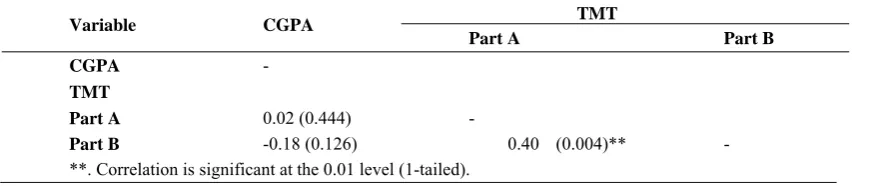
Table 2 showed the number of sample in this study was 42 and the correlation coefficients of the relationship between CGPA and part A of TMT was 0.02 which indicated that the correlation ship between these two variables was positive weakly correlated with each other. The significant value is 0.444 which means that the relationship between CGPA and part A of TMT was no significant with a value of p>0.05. The result in Table 2 also indicates that there was no significant relationship between CGPA and part A of TMT yet they were positive weakly correlated.
Nonetheless, the correlation coefficients of the relationship between CGPA and part B of TMT was -0.18 which indicated that the correlation ship between these two variables was negative weakly correlated with each other. The significant value is 0.126 which means that the relationship between CGPA and part B of TMT was no significant with a value of p>0.05. The result in Table 2 also indicates that there was no significant relationship between CGPA and part B of TMT yet they were negative weakly correlated.
37 Table 2: Correlation between CGPA and TMT (n=42).
Variable CGPA TMT
Part A Part B
CGPA
-TMT
Part A 0.02 (0.444) -
Part B -0.18 (0.126) 0.40 (0.004)** -
**. Correlation is significant at the 0.01 level (1-tailed).
Conclusion & Recommendations
There were three research questions and hypotheses had been formed to study the research objectives: 1) investigating the gender differences in academic performance, 2) discovering the gender differences in cognitive functioning speed, and 3) examining whether there was any relationship between academic performance and cognitive functioning speed in the current research.
Therefore, the research question of ‘Is there any difference in academic performance between male and female students?’ was drawn from the first research objective of investigating the differences between gender and academic performance. Nonetheless, result demonstrated that there was no significant difference between male and female students on their academic performance (t[40]=1.148, p=0.26, p>0.05) by assessing on their scores of CGPA.
Past researches had demonstrated that the gender difference was existed in the academic performance (Adigun et al., 2015; Amedu, 2015; Royer et al., 1999; Voyer & Voyer, 2014).
Yet, most of them were designed on primary or secondary school students, yet they were not targeted their sample group on undergraduates. Hence, the findings of those researches might not be suitable to discuss with the current research as the experiences and difficulties that faced in primary or secondary education might be differed from higher education (Kenayathulla, 2012).
Furthermore, every Malaysian were given the chance to choose whether or not they desired to continue their study after receiving at least 11 years of primary and secondary education from the government for free (Education system in Malaysia, 2014). During the primary and secondary education, they had to learn all the subjects in the schools. For instance, mathematics, linguistic subjects, science, and others. Hence, the gender difference was particularly obvious exposed during the years. Females revealed superior in learning languages (Vogel, 1990), while males performed better in math, science, and computer science (Vogel, 1990; Royer et al., 1999; Adigun et al., 2015; Amedu, 2015).
However, they also held the option to pick whether or not they wanted to do further study for tertiary education. Therefore, the students who were interested in pursuing their study would like to adhere to the courses based on their interest and ability (Proboyo & Soedarsono, 2015). Hence, gender difference in academic performance would be less obvious respectively compared to primary and secondary schools students. As undergraduates would be more passionate in their study due to the voluntary selection.
As a result, the findings of current research indicated that first hypothesis of there was significant difference in academic performance between male and female undergraduates was rejected. As the undergraduates were given an alternative on their study, so they were not being forced to study any subjects they were not interested or capable in. Hence, the gender difference was not revealed an obvious relationship in the academic performance among undergraduates.
Journal of Arts & Social Sciences Vol 1, Issue 1, 30‐44 (2017)
38
cognitive functioning speed by measuring their reaction time on TMT which comprised by part A (t[40]=0.736, p=0.47, p>0.05) and part B (t[40]=0.06, p=0.95, p>0.05).
Based on the review of literatures, gender difference happened in cognitive functioning speed (Gualtieri, 2010; Roivainen, 2011; Markovits, Benenson, & White, 2006). Yet, most of them only revealed gender prevalence in cognitive functioning. Females outperformed in verbal fluency, perceptual speed, accuracy and fine motor skills, whereas males showed advantages in spatial, working and mathematical abilities (Upadhayay & Guragain, 2014). Researchers mostly agreed with the findings of females were outperformed in the speed of information processing (Palejwala & Fine, 2015; Gualtieri, 2010; Roivainen, 2011), attention focused (Gualtieri, 2010), and verbal memory (Gualtieri, 2010). In contrast, males better in visual processing and memory (Palejwala & Fine, 2015; Gualtieri, 2010), spatial processing (Debelak, Gittler, & Arendasy, 2014), psychomotor speed (Gualtieri, 2010; Roivainen, 2011), and numeric skills (Weber et al.,
2014).While, they did not focus on studying the factors of differences in cognitive functioning speed mainly on gender.
Nevertheless, cognitive functioning speed was assessed by the TMT in the current research. As TMT was a neuropsychological assessment that able to measure about attention, visual search and scanning, working memory, and other fluid cognitive abilities (Salthouse, 2011). Hence, both males and females also demonstrated advantages on conducting this instrument based on their prevalence in different aspects of cognitive functioning that revealed from past researches.
Part A of TMT required participants to link numbers from smallest to largest (Allen & Haderlie, 2010). Males utilized their advantages on numeric skills (Weber et al., 2014) and
visual processing and memory (Palejwala & Fine, 2015; Gualtieri, 2010) through searching and scanning instrument, and psychomotor skills (Gualtieri, 2010; Roivainen, 2011) to agilely wield the pen to link those numbers accordingly. While, females also utilized their advantages on attention (Gualtieri, 2010), to put their focus on searching the numbers while taking the test. Although, females were not having advantage in visual processing, their prevalence in processing speed (Palejwala & Fine, 2015; Gualtieri, 2010; Roivainen, 2011) allowed them to process the information rapidly so they could catch up males on the speed of visual scanning and searching to reduce the difference in reaction time of conducting part A of TMT.
Moreover, part B of TMT required participants to connect numbers and alphabets alternatively from smallest to largest (Allen & Haderlie, 2010). Therefore, females utilized their advantage on verbal memory (Gualtieri, 2010) on recalling the subsequent alphabets more speedily. Therefore, gender difference in reaction time was able to be reduced more on conducting the part B of TMT. Hence, the difference of reaction time on part B of TMT (mean difference=0.32) was smaller than part A of TMT (mean difference=1.24) as it involved more complicated cognitive functioning that females mastered in and allowed them to catch up with males.
As a consequence, the findings of the current research illustrated that the second hypothesis of there was significant difference in cognitive functioning speed between male and female undergraduates was rejected. As gender difference in reaction time on conducting TMT was reduced by gender prevalence on different aspects of cognitive functioning. Additionally, visual processing and memory had aided males to take a lot of advantages on TMT. Even though the result showed no significant difference in gender as females prevalence in cognitive functioning had helped in reducing the difference in reaction time. Yet, males had better performance in reaction time on conducting both part A and B of TMT based on the findings of the current research.
On the other hand, the last research question of ‘Is there any relationship between cognitive functioning speed and academic performance?’ was designed to examine the third research question which to examine whether or not there was significant relationship between academic performance and cognitive functioning speed.
39
significantly correlated even at 0.01 level (l-tailed) based on the outcomes (p=0.004, p<0.05). Consequently, there was a significant correlation relationship between part A and B of TMT and they were positive moderately correlated to each other (r=0.40).
Researchers had focused their objective on learning about cognitive functioning and academic performance previously. Based on their findings, cognitive functioning was having some special relationship with academic performance such as cognitive functioning was strongly related to learning (Finn et al., 2014; Roebers et al., 2014; van Kesteren et al., 2014)
and problem solving (Krawec et al., 2013; Niarchou et al., 2013; Rebok et al., 2014).
As they believed, learning enhanced and accelerated cognitive functioning speed through repeatedly exposed to material, whereas cognitive functioning speed was beneficial to problem solving through speeding up speed of processing in order to shorten down reaction time for solving problem. Nonetheless, learning and creative thinking were extremely essential in education as it was problem solving approach where required students to learn and think out of the box for obtaining an outstanding academic performance in school (Perveen, 2010).
However, there were several types of cognitive functioning had influenced academic performance as well. For instance, executive functioning (Roebers et al., 2014; Titz & Karbach,
2014), fine motor skills (Roebers et al., 2014), non-verbal intelligence (Roebers et al., 2014),
mastery goal (Phan, 2010), self-esteem (Phan, 2010), verbal abilities (Ardila et al., 2011),
spatial abilities (Ardila et al., 2011), arithmetical abilities (Ardila et al., 2011), pre-existing
schemas (van Kesteren et al., 2014), attention (Gray et al., 2015), working memory (Titz &
Karbach, 2014), and others.
Furthermore, skills of study was another factor that would influence academic performance which consisted of time management and procrastination, concentration and memory, study aids and note taking, test strategies and test anxiety, organizing and processing information, motivation and attitude, and reading and selecting main idea (Hassanbeigi et al.,
2011). Students who mastered these skills had better academic performance as they could achieve higher score. Thus, the role of teacher was essentially importance as they had to actively mentor and encourage students to practice these skills in order to improve outstanding performance in academics.
Nevertheless, academic performance was mainly measured by scores of mathematics in past researches. Whereas, CGPA score was assessed in the current research. Hence, it should be a difference in measurement of academic performance as past researches only measured about one subject whereas the current research was assessed about the average score of overall performance throughout all the semesters (Jayanthi et al., 2014).
As a result, findings of the current research indicated that the third hypothesis of there was significant relationship between cognitive functioning speed and academic performance among Malaysian undergraduates was rejected. As academic performance was not only related to cognitive functioning speed, there were other cognitive functioning were also having the influences on academic performance. Hence, result demonstrated that CGPA and part A of TMT were positive weak correlated (r=0.02). While, CGPA and part B of TMT were negative weakly correlated (r=-0.18).
Thus, the outcomes of this research were not confirmed to the hypotheses drawn from review of literatures which all three hypotheses were being rejected. They indicated there were no significant differences between 1) gender and academic performance, 2) gender and cognitive functioning speed, and 3) there was no significant relationship between academic performances and cognitive functioning speed.
Consequently, current research was dedicated to Malaysia education system. Findings indicated there were no significant differences in academic performance and cognitive functioning speed between male and female undergraduates. So, teachers should alter their stereotyped belief against gender as they should treat both male and female students with equal attitude and attention paying while delivering lessons for reducing sexism in society.
Journal of Arts & Social Sciences Vol 1, Issue 1, 30‐44 (2017)
40
2014; Roebers et al., 2014; van Kesteren et al., 2014). Hence, students who have superior
cognitive functioning speed would be able to learn a new information more speedily and have an outstanding problem solving skills theoretically. Thus, syllabus of teaching should emphasize on cognitive functioning of students as it could improve learning and facilitate students in better academic performance.
However, there were some limitation in current study. First of all, the researcher issue in the research. The current research was not only involved one person in conducting the research, as the main researcher requested his friends to help in running the research together. Hence, it brought in a methodology error which some of the friends was not trained properly in conducting the research (Cohen, Swerdlik, & Sturman, 2013). Thus, they might not able to deliver the message clearly to the participants and it could result in the participants were not understand instrument clearly. Therefore, participants would make mistake on performing tests and the reliability of research would also be affected.
Second, environment of conducting research was one of the limitation in current research. Most of the participants did the research together with their friends at the same time. Hence, their performance was influenced by peers of giving hinds of test such as telling the sequences of following numbers or alphabets directly. Therefore, it had affected the result and reliability of the research precisely (Cohen, Swerdlik, & Sturman, 2013).
Furthermore, history of doing the test would also be limitation as well. For instance, psychology students might be having the experience on performing tests as they learnt about the instrument in class before. While, the current research did not target samples on certain course, thus they were selected from different programs such as psychology, business, interior design, multimedia design, fashion design, and others. Therefore, it would affect the validity and reliability of research (Hoffman & Hoffman, 1994).
In addition, most of the reviews of literature studies that conscripted in current research were not been studied and conducted in Malaysia context due to the limited past studies done. Although there were some literature reviews were conducted in Malaysia, they were also not in university context. Thus, the difference of nations or level of education might always result in cultural background differences (Shiraev & Levy, 2014). Hence, reliability of findings also would be affected due to cultural differences of studies.
Lastly, time of collecting data was not consistence as sometime the researchers would ask participants to take the research while they were in a rush. Hence, participants might not pay full attention and concentration on performing tests. As a consequence, it would affect reliability and result of the research. Therefore, it became another limitation for the study due to the researchers did not well control the time of collecting data.
In order to improve the quality of future study, there were some recommendations provided. First of all, sample group should be expanded and recruited from larger research areas. Therefore, findings could be precisely generalized to population. Furthermore, future research also could add more variables. Perhaps, a better explanation about relationship between academic performance and cognitive functioning speed could be obtained.
Future researcher also could narrow down measurement of academic performance as CGPA represented overall performance throughout all the semesters that have studied, it might not precise in studying detail of academic performance. Therefore, future research could assess gender difference in academic performance by specified subjects such as mathematics and linguistic subjects in order to obtain a better description of relationship between gender and academic performance.
41
References
Adigun, J., Onihunwa, J., Irunokhai, E., Sada, Y., & Adesina, O. (2015). Effect of Gender on Students' Academic Performance in Computer Studies in Secondary Schools in New Bussa, Borgu Local Government of Niger State. Journal of Education and Practice, 6(33), 1-7.
Age of Majority Act. (1971). R.S., c.4, s.1.
Ali, S., Haider, Z., Munir, F., Khan, H., & Ahmed, A. (2013). Factors contributing to the students academic performance: A case study of Islamia University Sub-Campus.
American Journal of Educational Research, 1(8), 283-289.
Allen, D. N., & Haderlie, M. M. (2010). Trail-making test. In The Corsini Encyclopedia of Psychology. Wiley.
Amedu, O. I. (2015). The Effect of Gender on the Achievement of Students in Biology Using the Jigsaw Method. Journal of Education and Practice, 6(17), 176-179.
Ardila, A., Rosselli, M., Matute, E., & Inozemtseva, O. (2011). Gender differences in cognitive development. Developmental psychology, 47(4), 984-990.
Babbie, E. (1990). Survey Research Methods (2nd ed.). Belmont, California: Wadsworth
Publishing Company.
Brown, C. S., & Stone, E. A. (2016). Chapter Four-Gender Stereotypes and Discrimination: How Sexism Impacts Development. Advances in child development and behavior, 50,
105-133.
Cambridge University Reporter. (2003). Indicators of academic performance. Retrieved from
http://www.admin.cam.ac.uk/reporter/2002-03/weekly/5915/
Child Act. (2001). Act 611, p.1, s.2.
Cohen, R. J., Swerdlik, M. E., & Sturman, E. D. (2013). Psychological testing and assessment: An introduction to tests and measurement (8th ed.). New York: McGraw-Hill
Companies.
de Winter, J. C. (2013). Using the Student’s t-test with extremely small sample sizes. Practical Assessment, Research & Evaluation, 18(10), 1-12.
Debelak, R., Gittler, G., & Arendasy, M. (2014). On gender differences in mental rotation processing speed. Learning and Individual Differences, 29, 8-17.
Education system in Malaysia. (2014). Retrieved from
http://www.etawau.com/edu/Department/EducationSystem.htm
Finn, A. S., Kraft, M. A., West, M. R., Leonard, J. A., Bish, C. E., Martin, R. E., . . . Gabrieli, J. D. (2014). Cognitive skills, student achievement tests, and schools. Psychological science, 25(3), 736-744.
Fox, N., Hunn, A., & Mathers, N. (2007). Sampling and sample size calculation. The NIHR
RDS for the East Midlands / Yorkshire & the Humber.
Fry, A. F., & Hale, S. (2000). Relationships among processing speed, working memory, and fluid intelligence in children. Biological psychology, 54(1), 1-34.
Gray, S. A., Rogers, M., Martinussen, R., & Tannock, R. (2015). Longitudinal relations among inattention, working memory, and academic achievement: testing mediation and the moderating role of gender. PeerJ, 3, e939.
Grossman, J. A., Kuhn-McKearin, M., & Strein, W. (2011). Parental expectations and academic achievement: Mediators and school effects. In Annual Convention of the American Psychological Association (Vol. 4, pp. 1-10). Washington, DC: American
Psychological Association.
Gualtieri, C. T. (2010). Gender differences in cognitive abilities form age 40 to 79. Gender Differences and Aging, 1-17.
Hassanbeigi, A., Askari, J., Nakhjavani, M., Shirkhoda, S., Barzegar, K., Mozayyan, M. R., & Fallahzadeh, H. (2011). The relationship between study skills and academic performance of university students. Procedia-Social and Behavioral Sciences, 30,
Journal of Arts & Social Sciences Vol 1, Issue 1, 30‐44 (2017)
42
Hertzog, M. A. (2008). Considerations in determining sample size for pilot studies. Research in nursing & health, 31(2), 180-191.
Hirnstein, M., Andrews, L. C., & Hausmann, M. (2014). Gender-stereotyping and cognitive sex differences in mixed-and same-sex groups. Archives of sexual behavior, 43(8),
1663-1673.
Hoffman, A. M., & Hoffman, H. S. (1994). Reliability and validity in oral history: The case for memory. Memory and history: Essays on recalling and interpreting experience,
107-135.
Ising, M., Mather, K. A., Zimmermann, P., Brückl, T., Höhne, N., Heck, A., . . . Reppermund, S. (2014). Genetic effects on information processing speed are moderated by age– converging results from three samples. Genes, Brain and Behavior, 13(5), 501-507.
Jayanthi, S. V., Balakrishnan, S., Ching, A. L., Latiff, N. A., & Nasirudeen, A. M. (2014). Factors contributing to academic performance of students in a Tertiary Institution in Singapore. American Journal of Educational Research, 2(9), 752-758.
Kail, R. V., & Cavanaugh, J. C. (2015). Human development: A life-span view (4th ed.).
Belmont, CA: Thomson Wadsworth.
Kenayathulla, H. B. (2012). Cost benefit analysis in Malaysian education. Jurnal Internasional Manajemen Pendidikan, 4(2), 1-18.
Kennedy, W. G., & Bugajska, M. (2010). Integrating fast and slow cognitive processes. 121-126. Krawec, J., Huang, J., Montague, M., Kressler, B., & De Alba, A. M. (2013). The effects of cognitive strategy instruction on knowledge of math problem-solving processes of middle school students with learning disabilities. Learning Disability Quarterly, 36(2),
80-92.
Markovits, H., Benenson, J., & White, S. (2006). Gender and priming differences in speed of processing of information relating to social structure. Journal of Experimental Social Psychology, 42(5), 662-667.
Mitrushina, M., Boone, K. B., Razani, J., & DElia, L. F. (2005). Handbook of normative data for neuropsychological assessment (2nd ed.). New York: Oxford University Press.
Morreale, S., Rubin, R. B., & Jones, E. (1998). Speaking and listening competencies for college students. Washington: National Communication Association.
Mugo Fridah, W. (2002). Sampling in research.
Neisser, E. (1967). Cognitive psychology. New York: Appleton-Century-Crofts.
Niarchou, M., Zammit, S., Walters, J., Lewis, G., Owen, M. J., & van den Bree, M. B. (2013). Defective processing speed and nonclinical psychotic experiences in children: longitudinal analyses in a large birth cohort. American Journal of Psychiatry, 170(5),
550-557.
Palejwala, M. H., & Fine, J. G. (2015). Gender differences in latent cognitive abilities in children aged 2 to 7. Intelligence, 48, 96-108.
Pathak, N. (2015). A study of problem solving ability in relation to academic achievement of pupil teachers. Voice of Research, 4(2), 7-9.
Paul, R., & Elder, L. (2007). A guide for educators to critical thinking competency standards: Standards, principles, performance indicators, and outcomes with a critical thinking master rubric. Foundation Critical Thinking.
Perveen, K. (2010). Effect of the problem-solving approach on academic achievement of students in mathematics at the secondary level. Contemporary Issues in Education Research, 3(3), 9-14.
Phan, H. P. (2010). Students’ academic performance and various cognitive processes of learning: An integrative framework and empirical analysis. Educational Psychology, 30(3),
297-322.
Pierce, S. (2014). The role of gender and learning modality in mathematical problem solving.
Georgia College and State University, 1-17.
43
Rebok, G. W., Ball, K., Guey, L. T., Jones, R. N., Kim, H. Y., King, J. W., . . . Willis, S. L. (2014). Ten‐year effects of the advanced cognitive training for independent and vital elderly cognitive training trial on cognition and everyday functioning in older adults.
Journal of the American Geriatrics Society, 62(1), 16-24.
Remali, A. M., Ghazali, M. A., Kamaruddin, M. K., & Kee, T. Y. (2013). Understanding academic performance based on demographic factors, motivation factors and learning styles. International Journal of Asian Social Science, 3(9), 1938-1951.
Roebers, C. M., Röthlisberger, M., Neuenschwander, R., Cimeli, P., Michel, E., & Jäger, K. (2014). The relation between cognitive and motor performance and their relevance for children’s transition to school: A latent variable approach. Human movement science, 33, 284-297.
Roivainen, E. (2011). Gender differences in processing speed: A review of recent research.
Learning and Individual differences, 21(2), 145-149.
Royer, J. M., Tronsky, L. N., Chan, Y., Jackson, S. J., & Marchant, H. (1999). Math-fact retrieval as the cognitive mechanism underlying gender differences in math test performance. Contemporary educational psychology, 24(3), 181-266.
Salthouse, T. A. (2011). What cognitive abilities are involved in trail-making performance?
Intelligence, 39(4), 222-232.
Shiraev, E. B., & Levy, D. A. (2014). Cross-Cultural Psychology (5th ed.). London: Pearson
Education Limited.
Sternberg, R. J., & Sternberg, K. (2010). Cognitive psychology (6th ed.). Belmont, CA:
Wadsworth Cengage Learning.
StudyMalaysia.com. (2015). Student info & guide: The Malaysian higher education system - An overview. Retrieved from
https://www.studymalaysia.com/education/higher-education-in-malaysia/the-malaysian-higher-education-system-an-overview
Szymanowicz, A., & Furnham, A. (2013). Gender and gender role differences in self-and other-estimates of multiple intelligences. The Journal of social psychology, 153(4), 399-423.
Titz, C., & Karbach, J. (2014). Working memory and executive functions: effects of training on academic achievement. Psychological research, 78(6), 852-868.
Tocci, C. M., & Engelhard, J. G. (1991). Achievement, parental support, and gender differences in attitudes toward mathematics. Journal of Educational Research, 84(5), 280-286.
Tongco, M. D. (2007). Purposive sampling as a tool for informant selection. Ethnobotany Research & Applications, 147-158.
Turkstra, L. S., Coelho, C., & Ylvisaker, M. (2005). The use of standardized tests for individuals with cognitive-communication disorders. Seminars in Speech and Language, 26(4), 215-222.
Upadhayay, N., & Guragain, S. (2014). Comparison of cognitive functions between male and female medical students: A pilot study. Journal of Clinical & Diagnostic Research, 8(6),
12-15.
van Kesteren, M. T., Rijpkema, M., Ruiter, D. J., Morris, R. G., & Fernández, G. (2014). Building on prior knowledge: schema-dependent encoding processes relate to academic performance. Journal of Cognitive Neuroscience, 26(10), 2250-2261.
Vogel, S. A. (1990). Gender Differences in Intelligence, Language, Visual-Motor Abilities, and Academic Achievement in Students with Learning Disabilities A Review of the Literature. Journal of Learning Disabilities, 23(1), 44-52.
Voyer, D., & Voyer, S. D. (2014). Gender differences in scholastic achievement: A meta-analysis. Psychological Bulletin, 140(4), 1174-1205.
Wang, Y., & Chiew, V. (2010). On the cognitive process of human problem solving. Cognitive Systems Research, 11(1), 81-92.
Weber, D., Skirbekk, V., Freund, I., & Herlitz, A. (2014). The changing face of cognitive gender differences in Europe. Proceedings of the National Academy of Sciences, 111(32), 11673-11678.
Journal of Arts & Social Sciences Vol 1, Issue 1, 30‐44 (2017)
44
Zeek, M. L., Savoie, M. J., Song, M., Kennemur, L. M., Qian, J., Jungnickel, P. W., & Westrick, S. C. (2015). Sleep duration and academic performance among student pharmacists.