A novel method to obtain initial basic solution and
optimal solution of pentagonal fuzzy transportation
problem
R. Helen
1* and G. Uma
2Abstract
In this paper, we apply the new method to solve the pentagonal fuzzy transportation model. We demonstrate that the special structure of the pentagonal fuzzy transportation model substantially reduces the computational burden. The pentagonal fuzzy solution, that we get by the proposed method are equivalent to the well- known existing methods and it is discussed with the comparison table.
Keywords
Pentagonal fuzzy transportation problem, Pentagonal fuzzy ranking, Pentagonal fuzzy optimal solution.
AMS Subject Classification: 03E72, 90B06
1Department of mathematics, Poompuhar College (autonomous)(Affiliated to Bharathidasan University,Trichy), Poompuhar, Nagai(Dt), Tamil Nadu, India.
2Research Scholar, (Affiliated to Bharathidasan University,Trichy), Tamil Nadu, India.
*Corresponding author:[email protected]; [email protected]
Article History: Received27July2019; Accepted10November2019 c2019 MJM.
Contents
1 Introduction. . . 676 2 Preliminaries. . . 677 3 Representation of the Fuzzy Transportation Model with
Nodes and Arcs. . . 678 4 The Proposed Algorithm. . . 678 4.1 Numerical Example of Proposed Method . . . . 678 4.2 Comparison of the Numerical Table. . . 679
5 Conclusion. . . 679
References. . . 679
1. Introduction
In modern era, rapid changing and competitive business and enterprise are facing a continuous pressure to find a bet-ter ways and minimum cost to deliver values to customers becomes stronger. How and when to send the products to the customers in the quantities, they want in a cost-effective manner, become more challenging. Transportation models have been developed to meet this challenge.. Hitchcock[16] developed the original basic transportation problem and also simplex algorithm were developed Primarily by Dentzig[13]
and Charnes & cooper[8] in 1947. Many of the researchers have provided many different methods to solve transporta-tion problem. Few of them are Modified Vogel’s Approx-imation Method for unbalance transportation problem by Balakrishnan.N[3]. An Improved Vogel’s Approximation Method by Serder Korukogu and Serkan balli[22]. A new approach for finding an optimal solution for transportation problems by Sudhakar V J et.al[24].
In our article we introduced a novel method to solve the pentagonal fuzzy transportation problem in which supplies, demands, capacities and costs are pentagonal fuzzy numbers. Section 4 deals with our pentagonal fuzzy transportation prob-lem briefly.
2. Preliminaries
Definition 2.1. Fuzzy Set:[17,18,26]
If x is a collection of objects denoted by x then a fuzzy setB in˜ x is a set of ordered pairs
˜
B={(x,µB(x))/x∈R}
µB(x)is called the membership function of grade of member-ship of x inB which maps X to the membership space M. The˜ range of the membership function is a subset of the nonnega-tive real numbers whose supremum is finite generally in the range [0,1].
Definition 2.2. Fuzzy Number: [17,18,26,27]
A fuzzy number g in the real line R is a fuzzy set g:R→[0,1]
that satisfies the following properties.
(i). g is piecewise continuous.
(ii). There exists an x∈R such that g(x) =1.
(iii). g is convex, (i.e), if x1,x2∈R andδ∈[0,1]then g(δx1+
(1−δx2)≥g(x1)∧g(x2).
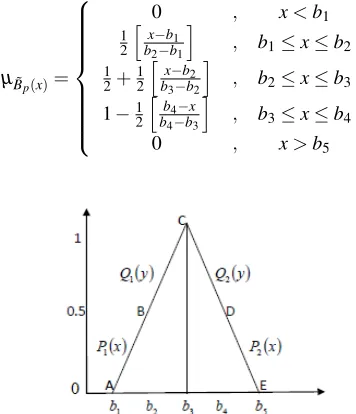
Definition 2.3. Pentagonal Fuzzy Numbers:[17,18] A pentagonal fuzzy numberB˜p= (b1,b2,b3,b4,b5)Where, b1,b2,b3,b4,b5are real numbers. The membership function of the pentagonal fuzzy number is given below.
µB˜p(x)=
0 , x<b1 1
2 hx−b
1
b2−b1
i
, b1≤x≤b2
1 2+
1 2
hx−b
2
b3−b2
i
, b2≤x≤b3
1−12hb4−x
b4−b3
i
, b3≤x≤b4
0 , x>b5
Figure 1.Representation of a Normal Pentagonal Fuzzy Number forx∈[0,1]
Definition 2.4. Canonical Pentagonal Fuzzy Numbers:[17, 18]
˜
Bpis called a Canonical pentagonal fuzzy number, if it is a closed and bounded pentagonal fuzzy number and its mem-bership function is strictly increasing on the interval[b2,b3] and strictly decreasing on the interval[b3,b4].
2.5 Operations of Pentagonal Fuzzy Numbers [17,18]
Following are the four operations that can be performed on pentagonal fuzzy numbers, suppose ˜Bp= (b1,b2,b3,b4,b5)
and ˜Cp= (c1,c2,c3,c4,c5)are the two pentagon fuzzy
num-bers then
Addition: ˜Bp(+)C˜p= (b1+c1,b2+c2,b3+c3b4+c4,b5+c5)
Subtraction: ˜Bp(−)C˜p= (b1−c5,b2−c4,b3−c3,b4−c2,b5−c1)
Multiplication: ˜Bp(∗)C˜p= (b1∗c1,b2∗c2,b3∗c3,b4∗c4,b5∗c5)
Division: ˜Bp(/)C˜p= (b1/c5,b2/c4,b3/c3,b4/c2,b5/c1)
2.6 Ranking of Pentagonal Fuzzy Numbers [11,17,18]
Figure 2.Normalized Pentagonal Fuzzy Number.
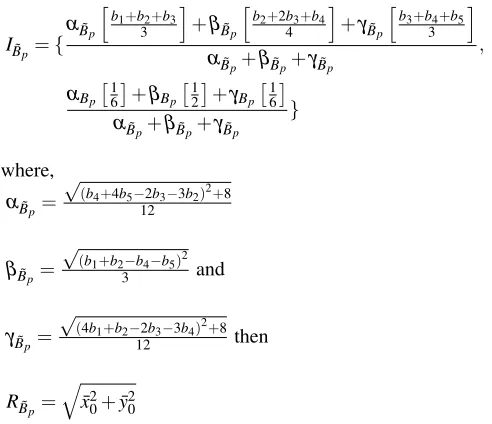
Divide the pentagonal into three fuzzy plane figures. In these three plane ,first figure is a fuzzy triangular AMQ, second figure is a fuzzy square QMNO and third is again a fuzzy triangle QOE. Let the fuzzy centroid of the three fuzzy planes figures beC1,C2,C3respectively. The pentagonal fuzzy in centre I of the fuzzy centroidC1,C2,C3is taken as the point of reference to define the ranking of normalized pentagonal fuzzy numbers. Consider a normalized pentagonal fuzzy num-ber ˜Bp= (b1,b2,b3,b4,b5)then fuzzy centroid of the three
fuzzy plane figures are
C1={[b1+b2+b3]/3,1/6}
C1={[b2+2b3+b4]/4,1/2}
C1={[b3+b4+b5]/3,1/6}
IB˜p ={
αB˜p h
b1+b2+b3
3 i
+βB˜p h
b2+2b3+b4
4 i
+γB˜p h
b3+b4+b5
3 i
αB˜p+βB˜p+γB˜p
,
αBp 1
6
+βBp 1
2
+γBp 1
6
αB˜p+βB˜p+γB˜p
}
where,
αB˜p=
√
(b4+4b5−2b3−3b2)2+8
12
βB˜p =
√
(b1+b2−b4−b5)2
3 and
γB˜p =
√
(4b1+b2−2b3−3b4)2+8
12 then
RB˜p = q
¯
x20+y¯20
Remark[17,18]:
If ˜Bp= (b1,b2,b3,b4,b5)and ˜Cp= (c1,c2,c3,c4,c5). Then,
we have the following comparison.
(i). ˜Bp≈C˜p⇔R B˜p=R C˜p
(ii). ˜Bp≥C˜p⇔R
e Bp
≥R C˜p
(iii). ˜Bp≤Cp⇔R
e Bp
≤RCep
3. Representation of the Fuzzy
Transportation Model with Nodes and
Arcs
Figure 3.Representation of Fuzzy Transportation Model
4. The Proposed Algorithm
The step by step procedure is given
Step 1: Examine the pentagonal fuzzy transportation is bal-anced. If so proceed step 2.
Step 2: Mark the pentagonal fuzzy cheapest cost ˜Ci jin every rows and column.
Step 3: Assign the lowest pentagonal fuzzy supply or pen-tagonal fuzzy demand to all marked penpen-tagonal fuzzy cheapest cost in every row and every column.
Step 4: Check for a pentagonal fuzzy cheapest cost for every fuzzy set ofm+n−1 routes that provides pentagonal fuzzy initial basic feasible solution.
Step 5: Test for the pentagonal fuzzy optimum. If the pen-tagonal fuzzy value is optimal, stop. Otherwise go to step 6.
Step 6: Now mark all the non-allocated pentagonal fuzzy cost. Now, find cheapest pentagonal fuzzy cost. Try to allocate the pentagonal fuzzy supply /pentagonal fuzzy demand in the constraint.
Step 7: Repeat the step 5.
4.1 Numerical Example of Proposed Method
A military equipment is to be transported from three ori-gins to four destination. The pentagonal fuzzy supply at the origins, the pentagonal fuzzy demand at the pentagonal fuzzy destinations and the pentagonal fuzzy cost of shipment is shown in the below table. we worked out a pentagonal fuzzy transportation plan so that the pentagonal fuzzy total cost re-quired for shipment is minimum.
˜
D1 D˜2 D˜3 D˜4 Supply(ai˜)
˜
S1 (0,1,2,3,4) (1,2,3,4,5) (7,9,11,13,15) (3,5,7,9,11) (2,4,6,8,10)
˜
S2 (-1,0,1,2,3) ˜0 (2,4,6,8,10) (-1,0,1,2,3) (1,1,1,1,1)
˜
S3 (3,4,5,6,7) (0,4,8,12,16) (5,10,15,20,25) (3,6,9,12,15) (0,5,10,15,20)
Demand(˜bj) (3,5,7,9,11) (1,3,5,7,9) (-1,1,3,5,7) (0,1,2,3,4) (3,10,17,24,31)
Table 1.Transportation Problem
Step1:∑(a˜i) =∑(b˜j) = (3,10,17,24,31)
The pentagonal fuzzy transportation problem is balanced.
Step2:
Finding the pentagonal fuzzy cheapest cost in every row and column
˜
D1 D˜2 D˜3 D˜4 Supply(ai˜)
˜
S1 (0,1,2,3,4) (1,2,3,4,5) (7,9,11,13,15) (3,5,7,9,11) (2,4,6,8,10)
˜
S2 (-1,0,1,2,3) ˜0 (2,4,6,8,10) (-1,0,1,2,3) (1,1,1,1,1)
˜
S3 (3,4,5,6,7) (0,4,8,12,16) (5,10,15,20,25) (3,6,9,12,15) (0,5,10,15,20)
Demand(˜bj) (3,5,7,9,11) (1,3,5,7,9) (-1,1,3,5,7) (0,1,2,3,4) (3,10,17,24,31)
Table 2.Fuzzy Cheapest Cost in Every Fuzzy Row/Fuzzy Column
Step3:
˜
D1 D˜2 D˜3 D˜4 supply(ai˜)
˜
S1
(0,1,2,3,4)
(2,4,6,8,10)
(1,2,3,4,5) (7,9,11,13,15) (3,5,7,9,11) (2,4,6,8,10)
˜
S2 (-1,0,1,2,3)
˜0
(1,1,1,1,1)
(2,4,6,8,10) (-1,0,1,2,3) (1,1,1,1,1)
˜ S3 (3,4,5,6,7) (1,1,1,1,1) (0,4,8,12,16) (0,2,4,6,8) (5,10,15,20,25) (-1,1,3,5,7) (3,6,9,12,15) (0,1,2,3,4) (0,5,10,15,20)
Demand(bj˜) (3,5,7,9,11) (1,3,5,7,9) (-1,1,3,5,7) (0,1,2,3,4) (3,10,17,24,31)
Table 3.Fuzzy Initial Basic Solution
Step4:
Checking for m+n-1= 4+3-1= Number of fuzzy allocations = 6
Total fuzzy initial basic feasible cost = (-2,33,112,239,391)
Step5:
Checking for an optimum. As we can see in the above tabular column it is not optimum. We can allocate some of the fuzzy supply /fuzzy demand to the next cheapest cost in the row 1 is (1,2). By assigning to (1,2) there will be a change in (1,3),(2,3),(3,1),(3,3),(3,4). The result shown in the below table 4.
˜
D1 D˜2 D˜3 D˜4 supply(ai˜)
˜
S1 (0,1,2,3,4)
(1,2,3,4,5) (1,3,5,7,9) (7,9,11,13,15) (-7,-3,1,5,9) (3,5,7,9,11) (2,4,6,8,10) ˜
S2 (-1,0,1,2,3) ˜0
(2,4,6,8,10) (1,1,1,1,1) (-1,0,1,2,3) (1,1,1,1,1) ˜ S3 (3,4,5,6,7) (3,5,7,9,11) (0,4,8,12,16) (5,10,15,20,25) (-1,-5,1,7,13) (3,6,9,12,15) (0,1,2,3,4) (0,5,10,15,20)
Demand(bj˜) (3,5,7,9,11) (1,3,5,7,9) (-1,1,3,5,7) (0,1,2,3,4) (3,10,17,24,31)
Table 4.Fuzzy Initial Basic Solution
No other routes are possible .The pentagonal value is opti-mum.
Pentagonal fuzzy total minimum cost = (-89,-38,100,331,643)
4.2 Comparison of the Numerical Table
Method Initial
Basic Solution
Optimal Solution North-West
Corner Rule (-2,31,111,235,390) —–
Least-Cost
Method (-1,29,110,236,384) —–
Vogel’s Approximation
Method (-2,33,112,239,391) —–
Proposed
Method (-2,33,112,239,391) (-89,-38,100,331,643)
MODI- Method —– (-89,-38,100,331,643)
5. Conclusion
The pentagonal fuzzy transportation problem, that we dis-cussed in the section 4 will definitely reduce the computational burden. The table 4.2 says that the pentagonal fuzzy value that we got is equal to the existing methods. This method will serve as a key for decision makers while handling various types of situations and in real life problems.
References
[1] Abdul kalam SM, Azad Md , Belle Hossain, A new
method fof solving transportation problem considering av-erage penalty,IOSR journal of Mathematics, 13(1)(2017), 40–43.
[2] Abbasbandy.s and Asady.B., Ranking of fuzzy numbers
by sign distance,Information sciences, 176(2006), 2405– 2416.
[3] Balakrishnan.N, Modified Vogel’s Approximation
method for Unbalanced transportation problem,Applied Mathematics Letters, 3(2)(1990), 9–11.
[4] Buckly J.J, Possiblistic linear programming with
tri-angular fuzzy numbers, Fuzzy Sets And Systems, 26(1)(1988),135–138.
[5] Bellman.R.R and Zadeh.L.A, Decision making in a fuzzy
environment,Management science, B17(1970), 203–218.
[6] Bit.A.K, Biswal.M.P, Alam.S.S, Fuzzy programming
ap-proach to multi criteria decision making transportation problem,Fuzzy Sets and Systems, (1992), 135–441.
[7] Bit.A.K, Biswal.M.P,Alam.S.S, An additive fuzzy
pro-gramming model for multi objective transportation prob-lem,Fuzzy Sets and Systems, 57(1993), 313-319.
[8] Charnes .A , Cooper W.W and Henderson.A, An
intro-duction to linear programming Wiley, New York, 1953.
[9] Chanas .S. Koloziejczyk.W and Machaj.A , A Fuzzy
approach to the transportation problem,Fuzzy Sets and Systems, 13(1984), 211–221.
[10] Chanas .S and Kuchta, A Concept of the optimal solution
of the transportation problem with fuzzy cost coefficients,
Fuzzy Sets and Systems, 82(1996), 299–305.
[11] ChengC.H, A New Approach for Ranking Fuzzy
Num-bers by Distance Method, Fuzzy Sets and Systems, 95(1998), 307–317.
[12] Chi-Jen Lin, Ve-Pyng Wen. A Labelling Algorithm For
The Fuzzy Assignment Problem,Fuzzy Sets and Systems, 142(2004), 373–391.
[13] Dantzig .G.B, Linear Programming and
Exten-sions,Princeton University Press, Priceton,NJ,1963.
[14] Dinagar .D.S ,Palanivel.K , The Transportation
Prob-lem in Fuzzy Environment,International Journal of Algo-rithms, ‘Computing And Algorithms, 2(3)(2009), 65–71.
[15] Gani.A , Razak .K.A, Two Stage Fuzzy Transportation
Problem,Journal of Physical Sciences, 10(2006), 63–69.
[16] Hitchcock.F.L, The distribution of a product from several
source to numerous localities,J. Math. Phys, 20(1941), 230–244.
[17] Helen.R and Uma.G , An innovative approach on
pen-tagon fuzzy numbers,Asia pacific journal of Research, 1(26)(2015), 190–196.
[18] Helen.R and Uma.G,Solving Parallel Moving Method
Using Pentagon Fuzzy Numbers, International jour-nal of mathematics and computer applications research, 5(4)(2015), 19–28.
[19] Jimenez.F, Verdegay.J.L, Uncertain solid transportation
[20] Kaufmann .A , Introduction to the Theory of Fuzzy Sets ,
Vol-I, Academic Press, New York, 1976.
[21] Kaur.A , Kumar.A , A New Method for Solving Fuzzy
Transportation Problems using Ranking Function, Ap-plied Mathematical Modeling, 35(12) (2011), 5652– 5661.
[22] Serder Korukoglu and Serkan Balli, An Improved Vogel’s
Approximation Method for the Transportation Problem,
Mathematical and Computational Applications, Article in Press, 2010.
[23] Shiang-Tai Liu and Chiang Kao, Solving fuzzy
transporta-tion problems based on the extension principle,European Journal of Operation Research, 153(2004), 661–674.
[24] Sudhakar VJ, Arun Sankar N, Karpagam T, A New
Ap-proach for Find an Optimal Solution For Transporta-tion Problems,European Journal of Scienticfic Research, 68(2)2012, 254–257.
[25] Preevanti singh,Saxena P.K, The multi-objective time
transportation problem with additional restrictions, Eu-ropean Journal of Operation Research, 146(2003), 460– 476.
[26] Zadeh.L.A., Fuzzy sets,Information and control, 8(1965),
338–353.
[27] Zadeh.L.A., The concept of a Linguistic variable
and applications to approximate reasoning- part-I,II and III,Information science .8(1975)199-249;8(1975)301-357;9(1976)43-80.
[28] Zadeh.L.A., Fuzzy sets as a basis for a theory of
possibil-ity,Fuzzy sets and systems, 1(1978), 3–28.
? ? ? ? ? ? ? ? ? ISSN(P):2319−3786 Malaya Journal of Matematik