THE EFFECTS OF PROCESS ORIENTED
GUIDED INQUIRY LEARNING
ENVIRONMENT ON STUDENTS’
SELF-REGULATED LEARNING SKILLS
Şenol Şen, Ayhan Yılmaz Hacettepe University, Ankara, Turkey E-mail: [email protected] , [email protected]
Ömer Geban Middle East Technical University, Ankara, Turkey E-mail: [email protected]
Abstract
Teaching and learning trend has shifted gradually from a teacher-centered approach to a student-centered approach. Many educational researchers have suggested that teachers must use student-centered learning approaches, such as Process Oriented Guided Inquiry Learning (POGIL). POGIL is an instructional approach combining guided inquiry and cooperative learning in which students are involved in the learning process. The purpose of this study was to investigate the effect of POGIL method compared to traditionally designed chemistry instruction (teacher-centered approach) method on 11th grade students’ Self-Regulated Learning Skills. The study was conducted during 2014-2015 spring semester. Participants were 115 students from one high school in Turkey. Non-equivalent control group design was used. Two experimental groups and two control groups were randomly selected. Experimental groups were instructed with POGIL, while control groups received traditionally designed chemistry instruction. Achievement Goal Questionnaire (AGQ) and Motivated Strategies for Learning Questionnaire (MSLQ) were administered to both groups as pre-test and post-test to determine students’ self-regulated learning skills. Multivariate Analysis of Variance (MANOVA) was used to investigate the effect of POGIL on the dependent variables. Results revealed that POGIL improved students’ mastery approach, task value,
control of learning beliefs, self-efficacy for learning and performance, critical thinking, help seeking,
peer learning, metacognitive self-regulation, effort regulation, time/study environmental management. The results showed that POGIL was superior to the traditionally designed chemistry instruction on students’ self-regulated learning skills. Thus, POGIL is helpful for development of students’ self-regulated learning skills.
Key words: achievement goals, motivation, learning strategies, POGIL, self-regulated learning skills.
Introduction
55
1998) because both students’ cognitive skills and their process skills influencing the process of
learning are very important in POGIL.
Individuals’ success in the process of learning, their developing learning abilities, finding
ways of solution to the problems they encounter and producing the solutions, teachers’ being able to design effective teaching environments in which meaningful learning can take place are
all dependent on determining the factors influential in learning. Factors affecting learning were studied in research into the field of education, and the relations of those factors with students’
achievement as well as their relations within themselves were also researched. Thus, efforts were made to determine the effects of those factors on students’ achievement. One of such frequently researched and analyzed concepts is self-regulation (Pintrich & De Groot, 1990;
Şenler, 2011; Zimmerman, 2000).
Self-regulated learners direct their own learning and they themselves assess their learning outcomes. Students, who take on the responsibility of their learning in this way, can inquire every stage of their learning and thus can attain the desired level of success. Self-regulated students are the students who are aware of the need for using different learning strategies for different learning occasions, and who use learning strategies effectively. Such students wish to control their own learning behaviors, motivations, feelings, and cognition (Polleys, 2002). Self-regulation is a complex process requiring a combination of metacognition, motivation and learning behaviors (Pintrich & De Groot, 1990). This research sets out to investigate the effects of the POGIL method on students’ self-regulated skills, and what is special about this study is that the issue of POGIL and the correlations between self-regulated skills is considered for
the first time in this study. POGIL develops the basic process skills such as critical thinking,
problem solving and communicating effectively on the basis of cooperative learning. Students learning by helping each other are the lifelong learning individuals, and they prepare for the competitive environment in the global market. According to self-regulation model- which
is based on Bandura’s Social cognitive theory, for the individuals to fail to attain sufficient
motivation means failing to effectively use cognitive and metacognitive strategies. Individuals’ motivational beliefs play important roles in those individuals’ setting their targets and planning their strategies. These motivational beliefs are in the form of learners’ control of their learning,
their task value perceptions, achievement goals, and test anxiety (Şenler 2011). Value attached
to learning- that is to say, the intrinsic value- and achievement goals determine the causes for
learners’ learning (Pintrich & DeGroot, 1990; VanderStoep, Pintrich, & Fagerlin, 1996, as cited in Şenler, 2011; Zimmerman, 2000). Setting out from this point, this current study aims to
investigate the effects of POGIL on self-regulated learning skills containing the motivational, cognitive and metacognitive processes. It is expected that students’ self-regulated learning skills
such as Mastery-approach goals (MAG), Task Value (TV), Control of learning beliefs (CLB), Self-efficacy for learning and performance (SELP), Critical thinking (CT), Help seeking (HS),
Peer learning (PL), Metacognitive self-regulation (MSR), Effort regulation (ER), Time/study environmental management (T/SEM) will develop at the end of this study; because developing the basic process skills as well as the content of the subjects is important in the philosophy of the POGIL. POGIL supports students’ acquisition of such basic process skills as information processing, critical thinking, problem solving, communication, teamwork, management and self-assessment (Hanson, 2004; Straumanis, 2010).
Problem of Study
IN THE 21 CENTURY Volume 66, 2015
56 were more successful than those in the control group (Farrell et al., 1999; Hanson, 2006; Lewis & Lewis, 2005). Accordingly, students had positive attitudes towards POGIL learning environments, and they demanded that those learning environments be used in the following learning processes (Elberlein et al., 2008; Farrell et al., 1999; Schroeder & Greenbowe, 2008). According to Johnson, Johnson and Smith (19991), students working in groups will acquire such basic process skills as communicating, teamwork, problem-solving, and analytical and critical thinking. Therefore, this study analyses the effects of the POGIL method on students’ self-regulated learning skills. Literature review also makes it clear that studies analyzing the effects of the POGIL method on self-regulated learning skills in comparison with traditionally designed instruction are not available in the literature. Therefore, the aim of this study is to investigate the effectiveness of POGIL over traditionally designed chemistry instruction on eleventh grade students’ self-regulated learning skills (including motivation and use of learning strategies). Therefore, this current study seeks answers to the following research questions:
1. Are there any significant differences between the experimental group and the control
group students’ scores in terms of motivation (mastery-approach goals, performance-approach goals, mastery-avoidance goals, performance-avoidance goals, task value, control of learning
beliefs, self-efficacy for learning and performance and test anxiety)?
2. Are there any significant differences between the experimental group and the control
group students’ scores in terms of learning strategies (rehearsal, organization, elaboration, critical thinking, metacognitive self-regulation, time/study environmental management, effort
regulation, peer learning and help seeking)?
Methodology of Study
General Background of Study
This study employs Nonequivalent Control Group Design. In this design, the experimental and the control groups are administered a pre-test, an application is performed with the experimental group, and then the post-test is administered to both the experimental and the control groups (Gay, Mills & Airasian, 2012). Two experimental groups and two control groups were randomly selected. Experimental groups were instructed with POGIL, while control groups received traditionally designed chemistry instruction. All of the groups received identical syllabus-prescribed learning content. The study was conducted during 2014-2015 spring semester over six weeks. The independent variable was instructional methods (POGIL and traditionally designed instruction). The dependent variables in this study were students’ self-regulated learning skills (the subscales of the Motivated Strategies for Learning Questionnaire and Achievement Goal Questionnaire). Achievement Goal Questionnaire (AGQ) and Motivated Strategies for Learning Questionnaire (MSLQ) were administered to both groups as pre-test and post-test to determine students’ self-regulated learning skills.
Sample of Study
In this study, 115 11th-grade students (61 boys and 54 girls) from four intact classes
of two teachers were involved in this study. The study was conducted in a large urban district
of Ankara, Turkey. Two of the classes were set as the experimental group (n= 56), and the
remaining two classes were set as the control group (n= 59) randomly. Students’ ages ranged
from 15 to 16 years old. The socioeconomic status (SES) of the students in experimental and
57 Instrument
1. Achievement Goal Questionnaire (AGQ) was developed by Elliot and McGregor
(2001), and was adapted into Turkish by Şen (2015). The scale was adapted through translation,
back translation and equivalence evaluation. The Turkish version was administered to a large
group of students (n=862) from five high schools in Ankara. Confirmatory factor analysis was used to evaluate the construct validity of the scale. The scale has four subscales: Items 1, 6 and 8 are on the scale of Mastery-approach goals (MAG), items 4, 10 and 16 are on the scale of
performance-approach goals (PAG), items 11, 14 and 17 are on the scale of Mastery-avoidance
goals (MAVG), and items 2, 7, 13, 19, 20 and 21 are on the scale of Performance-avoidance goals (PAVG) (Elliot & Mcgregor, 2001). The other items of the 21-item scale do not belong to
achievement goals. Despite this, the researchers developing the scale suggest that those items should be included in the scale and be applied even though they are not used. Thus, items 15 and 18 are included in the Competence and Expectancies (Elliot & Church, 1997) scale, and
items 3, 5, 9 and 12 are included in the Challenge and Threat Appraisals (Elliot & Reis, 2003) scale. The fit indices for the scale are: RMSEA= 0.07; CFI= 0.98; GFI=0.94; AGFI=0.91, NFI= 0.97; NNFI=0.97, and SRMR=0.042. Cronbach Alpha (α) was calculated as 0.85 for the scale of MAG, 0.79 for the scale of MAVG, 0.77 for the scale of PAG, and as 0.67 for the scale of PAVG.
2. Motivated Strategies for Learning Questionnaire (MSLQ) was developed by Pintrich, Smith, Garcia and McKeachie (1991) in order to assess university students’ motivational adjustment and their use of differing learning strategies for their university courses. The scale
was adapted into Turkish by Şen (2015). The scale was adapted through translation, back
translation and equivalence evaluation. The Turkish version was administered to a large group
of students (n=862) from five high schools in Ankara. Confirmatory factor analysis was used to
evaluate the construct validity of the scale. The MSLQ is a 7-pointed Likert type scale from 1 (not at all true of me) to 7 (very true of me). The MSLQ has two main components: motivation,
and learning strategies. The motivation component comprises 6 sub-dimensions; whereas the
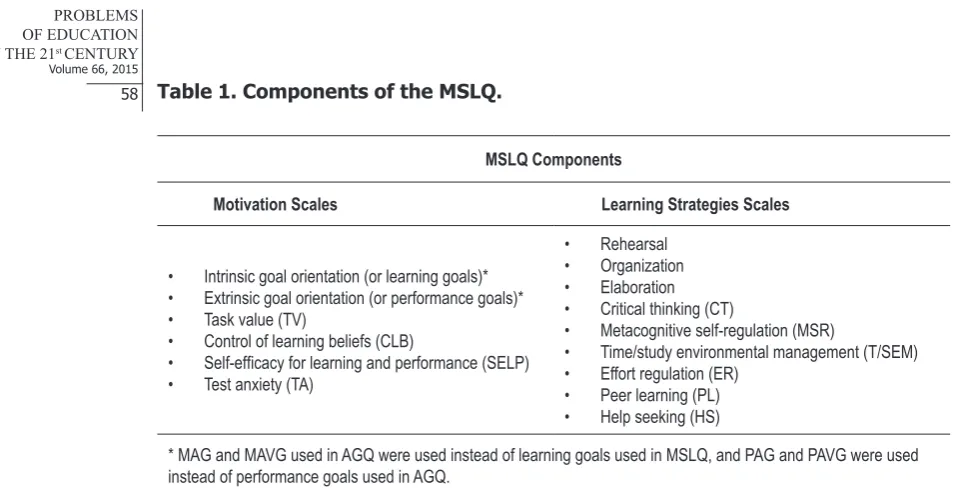
learning strategies component has 9 sub-dimensions (see Table 1). High scores received from any factor (each sub-scale in the scale) in the MSLQ indicate that students have the property
relevant to the factor at high levels (Pintrich et al., 1991). The fit indices for the motivation component of the scale are: RMSEA= 0.059, CFI= 0.95, GFI=0.83, AGFI=0.81, NFI= 0.94, NNFI=0.95, and SRMR=0.079. The Cronbach alpha calculated is 0.85 for the TV scale, 0.73 for the CLB scale, 0.87 for the SELP scale, and 0.61 for the TA scale. The fit indices found for the scale of learning strategies are: RMSEA= 0.059, CFI= 0.95, GFI=0.83, AGFI=0.81, NFI= 0.94, NNFI=0.95, and SRMR=0.079. The Cronbach alpha calculated is 0.76 for the rehearsal scale, 0.68 for the organization scale, 0.78 for the elaboration scale, 0.76 for the CT scale, 0.84 for the MSR scale, 0.75 for the T/SEM scale, 0.69 for the ER scale, 0.71 for the PL scale, and
IN THE 21 CENTURY Volume 66, 2015
58 Table 1. Components of the MSLQ.
MSLQ Components
Motivation Scales Learning Strategies Scales
• Intrinsic goal orientation (or learning goals)* • Extrinsic goal orientation (or performance goals)* • Task value (TV)
• Control of learning beliefs (CLB)
• Self-efficacy for learning and performance (SELP) • Test anxiety (TA)
• Rehearsal • Organization • Elaboration • Critical thinking (CT)
• Metacognitive self-regulation (MSR)
• Time/study environmental management (T/SEM) • Effort regulation (ER)
• Peer learning (PL) • Help seeking (HS)
* MAG and MAVG used in AGQ were used instead of learning goals used in MSLQ, and PAG and PAVG were used instead of performance goals used in AGQ.
Procedures
Experimental Process Steps
While the POGIL prepared by the researchers was used in the experimental group, the traditionally designed chemistry instruction was used in the control group.
Treatment in Experimental Group
Experimental group students were instructed by POGIL. POGIL is a learner-centered approach that focuses on small groups of students (4-5) engaging in inquiry-based POGIL activities. The students in the experimental group worked with POGIL activities designed on the basis of the three-phase (namely, exploration phase; concept invention phase; and application phase) structure of Learning Cycle.
a. Exploration Phase
• The activities were presented to the students in a fixed order in accordance with the
curriculum and the lesson plans.
• The activities include critical thinking questions guiding students according to the
learning goals and describing what they are to learn.
• The purpose in the two models given in the Appendix 1 is to make students structure
the oxidation number. Firstly, students were given the table showing the different compounds of the Mn element. The students examined the table, and found that the different compounds of the Mn element had different colors. They then noted their observations down, and had a discussion on the source of this. They asked questions and hypothesized on this.
• In addition to that, the experiment of Chemical Chameleon Color Changing Experiment
59 b. Concept Invention Phase
• As a result of the exploration phase, the oxidation number was explored, recognized,
and formed by the students.
• At this stage, students learn that the different colors of Mn stem from the fact that it has
different oxidation numbers.
• The students were guided with critical thinking questions so that they could associate
the changes in oxidation numbers with oxidation and reduction. The critical thinking questions help and guide them at the stage of exploration. Those questions also help them to describe their tasks and to direct them into knowledge, relations and results; and they ensure that learners structure the concepts.
• Here it is also demanded that students notice that oxidation and reduction happen at the
same time.
• Students work together in order to answer the critical thinking questions.
• While it is ensured that students explore new concepts, they are also supported to think
in a critical and analytical way.
c. Application Phase
• Following concept invention, the concepts need to be supported and expanded. At the
application phase, the exercises, problems and research cases included in the activities were used.
The POGIL Activities Used in the Study
Chemistry educators’ and chemistry teachers’ views were asked for while preparing
the POGIL activities used in this research. The modifications and corrections were made in
accordance with the views obtained. Nine activities in total were prepared related to reduction, oxidation, electrodes, electrochemical cells, galvanic cells, concentration cells, electrolysis, and Faraday’s Laws. Exercises and problems in addition to various numbers of models and critical thinking questions were prepared at the end of the activities. A sample activity is shown in Appendix 1.
Treatment in Control Group
Control group students were instructed by traditionally designed chemistry instruction (teacher-centered approach). Traditionally designed instruction is a teacher-directed strategy based on teaching strategies depended on teacher’s explanations, discussions, and textbooks. The management and responsibility for learning is teacher centered. The traditional instruction to teaching views students as passive recipients of information. Lessons were taught in the traditional chemistry teaching method in the form of lectures and questioning in the control group. A teacher-centered teaching approach was adopted in the process of learning the concepts related to reduction, oxidation, electrodes, electrochemical cells, galvanic cells, concentration cells, electrolysis, and Faraday’s Laws. Before coming to the classes, students studied the subjects in their course books. Classroom environment and the whole learning process were structured by teachers, teachers got students to take notes, they explained the concepts on the
blackboard, drew figures related to electrochemistry, prepared charts about galvanic cells and
concentration cells, and solved sample problems. The teachers asked students questions and made them participate in discussions which were always under teachers’ control. The examples,
IN THE 21 CENTURY Volume 66, 2015
60 Data Analysis
Multivariate analysis of variance (MANOVA) was employed for the solution of the first and second research problems of this study, which sets out to examine the effects of the POGIL method on students’ self-regulated learning skills. MANOVA is an extension of common analysis of variance (ANOVA) in which there is more than one dependent variable.
Results of Study
One-way MANOVA analysis was performed so as to find whether there were or there were not any significant differences between self-regulated learning skills of the students in
the experimental group and of the students in the control group. The students’ motivations and learning strategies were analyzed separately for this purpose. Firstly, an attempt was made
to check whether or not there were any significant differences between the motivation and
learning strategies pre-test scores of the experimental group and the control group students.
1. The MANOVA analysis results for students’ MAG, PAG, MAVG, PAVG, TV, CLB, SELP, TA pre-test scores revealed that there were no significant differences between the pre-test
scores of the students who were taught in POGIL method and the pre-test scores of the students
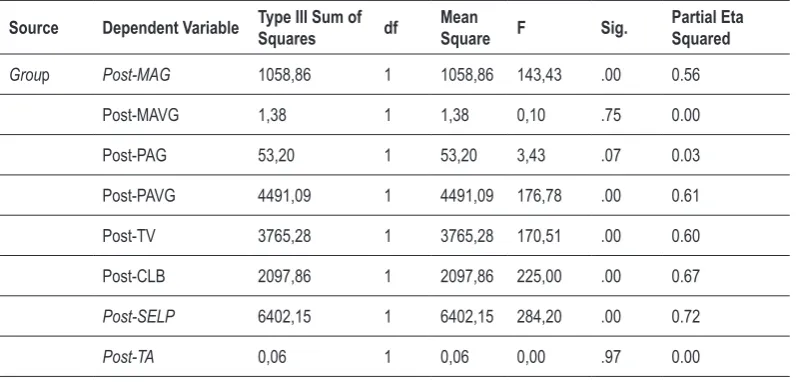
who were taught in the traditional method (Wilks’ Lambda (Ʌ)= .928, F(8,106)= 1.034, p>.05). The MANOVA analysis results for students’ MAG, PAG, MAVG, PAVG, TV, CLB, SELP, TA test scores revealed that there were significant differences between the post-test scores of the students in the experimental group (Wilks’ Lambda (Ʌ)= .105, F(8,106) = 106.00, p<.01). On examining the dependent variables one by one, it was found that there were significant differences between the MAG, PAVG, TV, CLB, and SELP post-test scores of the
students in the experimental group and the students in the control group according to the new
alpha level obtained with the Bonferroni adjustment (p<.006). An examination of students’ average made it clear that the MAG, TV, CLB and SELP scores of the experimental group students were higher. It was also found that the PAVG scores of the control group students were
higher than those of the experimental group students (see Table 2).
Table 2. Tests of between-subjects effects for motivation.
Source Dependent Variable Type III Sum of Squares df Mean Square F Sig. Partial Eta Squared
Group Post-MAG 1058,86 1 1058,86 143,43 .00 0.56
Post-MAVG 1,38 1 1,38 0,10 .75 0.00 Post-PAG 53,20 1 53,20 3,43 .07 0.03 Post-PAVG 4491,09 1 4491,09 176,78 .00 0.61 Post-TV 3765,28 1 3765,28 170,51 .00 0.60 Post-CLB 2097,86 1 2097,86 225,00 .00 0.67
Post-SELP 6402,15 1 6402,15 284,20 .00 0.72
Post-TA 0,06 1 0,06 0,00 .97 0.00
2. The MANOVA analysis results for students’ rehearsal, organization, elaboration, CT, HS, PL, MSR, ER, T/SEM pre-test scores demonstrated that there were significant differences
61
students who were taught in the traditional method (Wilks’ Lambda (Ʌ)= .831, F(9,105) = 2.368, p<.05). While there were significant differences between students’ pre-test scores according to multivariate statistics (Wilks’ Lambda (Ʌ) = .831, F (9,105) = 2.368, p<.05), there were no significant differences between their pre-test scores according to univariate statistics (p>.05). Discriminant function analysis, which was done following MANOVA analysis for students’
learning strategies, produced only one discriminant function. It accounts for only 17% of the
variance. Because of the fact that a portion of 83% is not accounted for and that the Wilks’
Lambda values are 1 or very close to 1 indicates that the effects of sub-tests are not very big
in discriminating the groups, it was regarded that there were not any significant differences
between students’ pre-test scores.
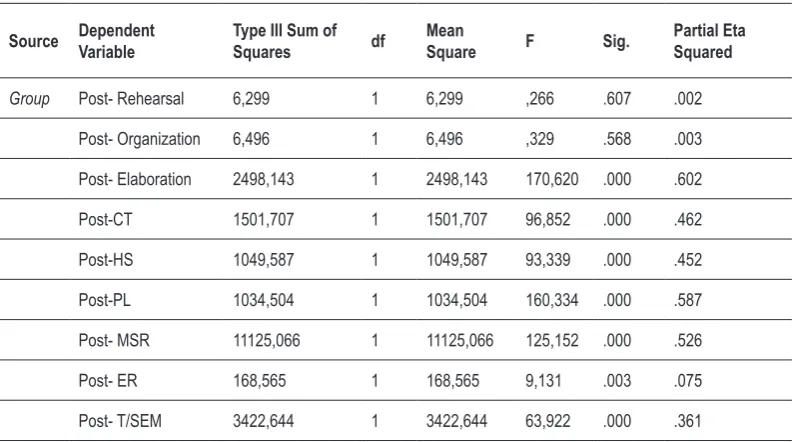
The MANOVA analysis results for students’ rehearsal, organization, elaboration, CT, HS, PL, MSR, ER, T/SEM post-test scores revealed that there were significant differences in
terms of post-test scores between the students who were taught in POGIL and the students who
were taught in the traditional method (Wilks’ Lambda (Ʌ)= .078, F(9,105) =138.042, p<.01). On examining the dependent variables one by one, it was found that there were significant
differences between the CT, HS, PL, MSR, ER, T/SEM post-test scores of the students in the experimental group and the students in the control group according to the new Alpha level
obtained with the Bonferroni adjustment (p<.006). An examination of students’ average made
it clear that the CT, HS, PL, MSR, ER, T/SEM scores of the students in the experimental group were higher. Yet, it was found that the elaboration scores of the control group students were
higher than those of the experimental group students (see Table 3).
Table 3. Tests of between-subjects effects for learning strategies.
Source Dependent Variable Type III Sum of Squares df Mean Square F Sig. Partial Eta Squared
Group Post- Rehearsal 6,299 1 6,299 ,266 .607 .002
Post- Organization 6,496 1 6,496 ,329 .568 .003 Post- Elaboration 2498,143 1 2498,143 170,620 .000 .602 Post-CT 1501,707 1 1501,707 96,852 .000 .462 Post-HS 1049,587 1 1049,587 93,339 .000 .452 Post-PL 1034,504 1 1034,504 160,334 .000 .587 Post- MSR 11125,066 1 11125,066 125,152 .000 .526 Post- ER 168,565 1 168,565 9,131 .003 .075 Post- T/SEM 3422,644 1 3422,644 63,922 .000 .361
Discussion
It was found in consequence that the averages for the MAG, TV, CLP, SELP, CT, HS,
IN THE 21 CENTURY Volume 66, 2015
62 more important than the grades received by students. Pintrich et al. (1991) pointed out that motivational attitudes, students’ use of strategies, students’ individual differences would stem from teachers’ characteristics and from the structure of a course. For this reason, it was found
in this study that the experimental group students’ MAG, TV, CLB and SELP scores were higher. No significant differences were found between the TA scores of the experimental group
students and the control group students.
It was observed in this study that the MAG scores of the experimental group students and
the PAVG scores of the control group students were higher. While PAV contained such targets as outpacing others and being the best, PAVG contained such targets as being ordinary and avoiding looking stupid. While MAG aimed to learn and understand in depth, MAVG stressed
not learning and misunderstanding (Elliot & Church, 1997; Elliot & McGregor, 2001; Pintrich
& Schunk, 2002, as cited in Şenler, 2011). At the end of this study, it was found that in-depth
learning was more important to the students in the experimental group.
It was another finding of this research that the CT, HS, PL, MSR, ER, and T/SEM scores of
the experimental group students were higher. While students’ metacognitive and source method
scores significantly different in favor of the control group students, significant differences
were found only in critical thinking strategies in terms of cognitive learning strategies. It may be said that, at the end of the study, the students in the experimental group developed such more complex learning strategies as employing analogies enabling them to set up connections between the current information and the new information rather than such simple analysis abilities as stating, learn by rote or underlining the main idea.
As Pintrich et al. (1991) point out, individual differences, teachers’ characteristics and
the structure of a course influence self-regulated learning skills. In this study it was found that
POGIL developed the targeted process skills. It was pointed out in Soltis et al. (2015) and in Soltis (2015) that students’ problem solving skills and critical thinking abilities developed when POGIL method was used. The reason for this is that POGIL’s basic goal is to create scientists who have collaborative communication skills and who are self-directed (Jaffe, Gibson, & D’Amico, 2015). It is suggested in studies in the literature that POGIL both develops students’ basic process skills and ensures meaningful learning (Hanson & Wolfskill, 2000; Lewis & Lewis, 2005; Straumanis & Simon, 2008). Besides, students’ perception of helping each other in understanding the concepts and ideas increases during peer cooperation (Brown, 2010). It
was also pointed out that students had less difficulty in lessons taught through POGIL (Farrell
et al., 1999; Hanson & Wolfskill, 2000; Straumanis & Simon, 2008). In the POGIL process of learning, students have to take on the responsibility of their learning actively. Teachers function as a guide in this process. The importance of metacognition becomes apparent in this process
too. Metacognition involves management, regulation, reflections on learning, and
self-assessment. In POGIL, students need to use metacognition in taking on the responsibility of their own learning, in monitoring their own learning (self-management and self-regulation), in
evaluating what they have learnt and what they have not understood (reflections on learning), and finally in thinking about and how to develop their performance (self-assessment) (Bransford
et al., 2000).
Conclusions
63 effectiveness of POGIL can be examined in different grade levels. Similar studies can be conducted in different types of high schools and with a larger sample size. Further studies can be conducted to investigate the effect of POGIL on students’ academic achievement. Also, the effectiveness of POGIL can also be tested with different chemistry topics.
Acknowledgements
The present study is a part of PhD Thesis entitled “Investigation of Students’ Conceptual Understanding of Electrochemistry and Self-Regulated Learning Skills in Process Oriented
Guided Inquiry Learning Environment” (Şen, 2015) completed within Hacettepe University
Graduate School of Educational Sciences. This study was supported by Research Fund of
Hacettepe University. Project Number: SDK-2015-5443.
References
Bransford, J. D., Brown, A. L., Cocking, R. R., Donovan, M. S., Bransford, J. D., & Pellegrino, J. W. (2000). How people learn: Brain, mind, experience, and school. Washington, D.C.: National Academy Press.
Brown, P. J. P. (2010). Process-oriented guided-inquiry learning in an introductory anatomy and physiology course with a diverse student population. Advances in Physiology Education, 34, 150-155. Cooper, M. M., Cox, Junior, C. T., Nammouz, M., Case, E., & Stevens, R. (2008). An assessment of the
effect of collaborative groups on students’ problem-solving strategies and abilities. Journal of Chemical Education, 85 (6), 866-872.
Eberlein, T., Kampmeier, J., Minderhout, V., Moog, R.S., Platt, T., Varma-Nelson, P., & White, H.B.
(2008). Pedagogies of engagement in science: A comparison of PBL, POGIL, and PLTL. Biochemistry and Molecular Biology Education, 36, 262-273.
Elliot, A. J., & Church, M. A. (1997). A hierarchical model of approach and avoidance achievement motivation. Journal of Personality and Social Psychology, 72, 218-232.
Elliot, A. J., & McGregor, H. A. (2001). A 2x2 achievement goal framework. Journal of Personality and Social Psychology, 80, 501-519.
Elliot, A. J., & Reis, H. T. (2003). Attachment and exploration in adulthood. Journal of Personality and
Social Psychology, 85, 317-331.
Farrell, J. J., Moog, R. S., & Spencer, J. N. (1999). A guided inquiry general chemistry course. Journal of Chemical Education, 76 (4), 570-574.
Gay, L. R., Mills, G. E., & Airasian, P. (2012). Educational research: Competencies for analysis and applications. Upper Saddle River, NJ: Pearson.
Hanson, D. (2004). Process-oriented guided inquiry learning Process-The missing element. What Works,
What Matters, What Lasts, 4, 1 - 13. [Available online at:
http://www.pkal.org/documents/hanson-apple_process--the-missing-element.pdf], Retrieved on 25.01.2014.
Hanson, D. (2006). Instructor’s guide to process-oriented guided-inquiry learning. Lisle, IL: Pacific
Crest.
Hanson, D., & Wolfskill, T. (1998). Improving the teaching/learning process in general chemistry: Report on the 1997 Stony Brook general chemistry teaching workshop. Journal of Chemical Education,
75 (2), 143-146.
Hanson, D., & Wolfskill, T. (2000). Process workshops: A new model for instruction. Journal of Chemical Education, 77, 120-130.
Jaffe, L., Gibson, R., & D’Amico, M. (2015). Process-Oriented Guided-Inquiry Learning: A natural fit for
occupational therapy education. Occupational Therapy in Health Care, 29 (2), 115-125.
Johnson, D. W., Johnson, R. T., & Smith, K. A. (1991). Active learning: Cooperation in the college classroom. Edina, MN: Interaction.
Johnson, D. W., Johnson, R. T., & Smith, K. A. (1998). Cooperative learning returns to college: What
evidence is there that it works? Change: The Magazine of Higher Learning, 30 (4), 26-35.
Lewis, S. E., & Lewis, J. E. (2005). Departing from lectures: An evaluation of a peer-led guided inquiry alternative. Journal of Chemistry Education, 82, 135 - 139.
IN THE 21 CENTURY Volume 66, 2015
64 Pintrich, P. R., & De Groot, E. V. (1990). Motivational and self-regulated learning components of
classroom academic performance. Journal of Educational Psychology, 82 (1), 33-40.
Pintrich, P. R., Smith, D. A. F., Garcia, T. & McKeachie, W. J. (1991) A manual for the use of the motivated strategies for learning questionnaire (MSLQ). National Center for Research to Improve
Postsecondary Teaching and Learning. Ann Arbor: Michigan. ED 338 122.
Polleys, M. S. (2002). A study of relationships between self-regulated learning, personality and achievement. Paper presented at the annual meeting of the mid-south educational research association (Chattanooga, TN, November 6-8, 2002).
Schroeder, C. M., Scott, T. P., Tolson, H., Huang, T.-Y., & Lee, Y.-H. (2007). A meta-analysis of national research: Effects of teaching strategies on student achievement in science in the United States. Journal of Research in Science Teaching, 44 (10), 1436-1460.
Schroeder, J.D. & Greenbowe, T.J. (2008). Implementing POGIL and the science writing heuristic jointly in undergraduate organic chemistry - student perceptions and performance. Chemistry Education Research and Practice, 9 (2), 149-156.
Soltis, R. (2015). The use of POGIL teaching strategy increases student learning of basic pharmacology concepts. The FASEB Journal, 29 (1 Supplement), 687-28.
Soltis, R., Verlinden, N., Kruger, N., Carroll, A., & Trumbo, T. (2015). Process-Oriented Guided Inquiry
Learning strategy enhances students’ higher level thinking skills in a pharmaceutical sciences course. American journal of pharmaceutical education, 79 (1), 1-8.
Straumanis, A. (2010). Classroom implementation of process oriented guided inquiry Learning. [Available
online at: http: //guidedinquiry.org/misc/IG_2e.pdf.]. Retrieved on 11.07.2014.
Straumanis, A., & Simons, E. A. (2008). A multi-institutional assessment of the use of POGIL in organic chemistry. In R. S. Moog, & J. N. Spencer (Eds.), ACS 173 Symposium Series 994: Process-Oriented Guided inquiry learning (pp. 226-239). Washington, DC: American Chemical Society.
Şen, Ş. (2015). Investigation of Students’ Conceptual Understanding of Electrochemistry and
Self-Regulated Learning Skills in Process Oriented Guided Inquiry Learning Environment. Unpublished Dissertation, Hacettepe University, Ankara, Turkey.
Şenler, B. (2011). Pre-service science teachers’self-efficacy in relation to personality traits and academic
self-regulation. Unpublished Dissertation, Middle East Technical University, Ankara, Turkey.
Zimmerman, B. J. (2000). Attaining Self-Regulation: A Social Cognitive Perspective. In M. Boekaerts, P.
Pintrich, & M. Zeidner (Eds.), Self-Regulation: Theory, Research, and Applications (13-39). San
Diego, CA: Academic Press.
APPENDIX 1
Activity 1: Determining Oxidation Numbers (What is an oxidation number?)
Model 1: Manganese Compounds
Table: Manganese Compounds
Chemical formula Name Color
MnCl2 Manganese (II) Chloride Pink
MnCl3 Manganese (III) Chloride Purple MnCl4 Manganese (IV) Chloride Green
MnO2 Manganese (IV) oxide Black
K2MnO4 Potassium Manganate Green
65 Critical Thinking Questions
1. Which atom is the source of differences in color in the MnCl2, MnCl3, and MnCl4
compounds?
2. What is the source of differences in each compound causing color changes? 3. Compare the ionic charge in the MnCl3, MnCl4, K2MnO4 and KMnO4 compounds. 4. What do the different ionic charges of the Mn2+ [Manganese (II)], Mn3+ [Manganese
(III)], Mn4+ [Manganese (IV)] and Mn6+ [Manganese (VI)] ions in compounds mean?
5. Is the charge of an ion equal to the oxidation number of an atom?
6. How many different oxidation numbers of manganese are there in the compounds
in the table?
Model 2: The Chemical Chameleon
Experiment: Chemical Chameleon Color Changing Experiment
Materials and Aids: * 6 mg Potassium permanganate (KMnO4) *750 ml Deionized water * 9 grams sucrose (sugar) *10 g Sodium Hydroxide (NaOH) * 1 L Beaker * Magnetic stirrer* Hotplate Magnetic Stirrer
Reactions:1. MnO4
-(aq) + e- → MnO42-(aq) 2. MnO4
2-(aq) + 2H2O + 2e- → MnO2 (aq) + 4OH-(aq) Procedure:
1. Magnetic stirrer is put into the beaker, and 750 ml of deionized water is added. 2. The beaker is placed on the hot plate. Yet, it will not be heated.
3. Mixing function of the hot plate is activated (this can also be done without a hot plate).
4. Then 9 g of sugar and 10 g of NaOH are added.
5. As soon as the sugar and the NaOH dissolve, KMnO4 is added into the beaker. Critical Thinking Questions
1. Which difference of atom is the source of color change?
2. How did the oxidation number of Mn change in the MnO4
-(aq) +e- →MnO42-(aq)
reaction?
3. Write down the oxidation numbers of Mn in the MnO42-(aq) + 2H2O + 2e- → MnO2 (aq) + 4OH-(aq) reaction.
4. How many different oxidation numbers of Mn did you observe in this experiment?
5. Did the MnO42- ion give out 2 electrons and thus cause oxidation?
6. If there had been no sugar in the reaction, would the reaction have happened?
7. What is the function of NaOH in this reaction?
IN THE 21 CENTURY Volume 66, 2015
66 Advised by Laima Railienė, Šiauliai University, Lithuania
Received: May 15, 2015 Accepted: July 18, 2015
Şenol Şen Dr., Hacettepe University, Faculty of Education, Beytepe-Ankara, Turkey. E-mail: [email protected]
Ayhan Yılmaz Prof. Dr., Hacettepe University, Faculty of Education, Beytepe-Ankara, Turkey. E-mail: [email protected]