Author for correspondence:
R. Shree Vidhya
Volume-6 Issue-2
International Journal of Intellectual Advancements
and Research in Engineering Computations
Experiment study of paver block using foundry waste sand
R. Shree Vidhya
1, Ms.S. Nandhini Devi
2 1M.E Project Student, Department of Civil Engineering, Tamilnadu College of Engineering,
Coimbatore
2
Assistant Professor, Department of Civil Engineering, Tamilnadu College of Engineering,
Coimbatore
ABSTRACT
Metal foundries use large amounts of sand as part of the metal casting process. Foundries successfully recycle and reuse the sand many times in casting process. When the sand can no longer be reused in the foundry, it is removed from the foundry and is termed as “foundry waste sand.” Like many waste products, foundry sand has beneficial applications to other industries. Foundry sand consists primarily of silica sand, coated with a thin film of burnt carbon, residual binder (bentonite, sea coal, resins) and dust. Foundry sand can be used in concrete to improve its strength and other durability factors. Foundry Sand can be used as a partial replacement of cement or as a partial replacement of fine aggregates or total replacement of fine aggregate and as supplementary addition to achieve different properties of concrete. In the present work, experimental Investigations were performed to evaluate the comparative study of the properties of fresh & hardened concrete containing ferrous & non-ferrous foundry waste sand as fine aggregate replacement. Fine aggregates were replaced with four percentages of foundry sand. The percentages of replacements were 0, 10, 20, & 30% by weight of fine aggregate & tests were performed for all replacement levels of foundry sand for M30 grade concrete at different curing periods (7 & 28 days).
Keyword:
Mixing, Curing, Compressive Test and Water Absorption Test.INTRODUCTION
Nations are considering restrictions on packaging and controls on products in order to reduce solid waste generation rates. Local and regional governments are requiring waste to be separated for recycling and some have even established mandatory recycling targets. However industrial and everyday activities continue discarding vast amounts of material, some of which contain toxic and environmentally harmful substances. Such substances are not always disposed of in a manner with the avoidance of environmental contamination. Despite the existence of environmental standards, and in spite of the ethical implication of such action, negligence,
Market potential cement concretes paving blocks find application in pavements, foot paths, gardens, passengers waiting sheets, bus stops, industry and other public places. Gurpreet Singh and Rafat Siddique [1] 2015 performed experimental investigations to evaluate the strength and durability properties of concrete mixtures, in which natural sand was partial replaced with (WFS). Test results obtained shown that, (a) Concrete mixtures made with WFS exhibited higher compressive strength than control concrete. From the results, it was found that 28days compressive strength. Khatib et al.[2] 2014 investigated some mechanical and fresh properties of concrete containing waste foundry sand (WFS). T.R. Naik etal. [3] 2013 conducted an investigation evaluate the performance of foundry by-products in concrete and masonry products. Based on the test results they concluded that, (a) The addition of foundry sand caused a decrease in concrete workability. (b) Compressive strength of concrete decreased slightly due to the replacement of regular coarse aggregate with foundry slag. Muhammad Amare et al. [4] 2013 were conducted a study to develop porous concrete with acceptable permeability and strength using recycled aggregate from waste crushed concrete. Alonso-Santurde et al. [5] 2012carried out a comparatively study to produce ceramic bricks with two types of foundry sand (green and core sand) fired, according to different firing cycles, corresponding to the manufacturing of different ceramic products at laboratory scale with the purpose of evaluating the influences of the firing cycle and the type and content of waste foundry sand in the physical and microstructural properties of the final product. Gurpreet Singh and Rafat Siddique [6] 2012 were evaluated the strength and durability properties of concrete mixtures, in which natural sand was partially replaced with (WFS). Gurpreet Singh and Rafat Siddique [7] 2012 evaluated the abrasion resistance and strength properties of concrete containing waste foundry sand(WFS). Properties examined where compressive strength, splitting tensile strength, modulus of elasticity and abrasion resistance expressed as depth of wear. Rafat Siddique et al. [8] 2011 carried out a research on the concrete mixes made with used- foundry (UFS)
produce concrete with sufficient strength and durability to replace normal concrete. Rafat Siddique and El- Hadjkadri [9] 2011 dealt with the effect of foundry sand (FS) and metakaolin (MK) on the near surface characteristics of concrete. Rafat Siddique et al. [10] 2009 evaluated the concrete mixtures containing fine aggregate (regular sand) partially replaced with used-foundry sand (UFS). Fine aggregate was replaced with three percentages (10%, 20%, and 30%) of UFS by weight. Tests were performed for the properties of fresh concrete.
MATERIAL PROPERTIES
They are various type of material are used. They are
Cement
To produce high performance concrete, the utilization of high strength cements is necessary. Different types of cement also will produce concrete have a different rates of strength development. The type of cement affects the rate of hydration, so that the strengths at early ages can be considerably influenced by the particular cement used. It is also important to ensure compatibility of the chemical and mineral admixtures with cement. Here Dalmia cement (OPC) of grade 43 is used.
Sand
Stone chip
A small piece of something removed in the course of chopping, cutting, or breaking a hard material such as wood or stone
Foundry sand
Foundry sand is high quality silica sand it is a by-product of ferrous and non-ferrous metal casting. Foundry sand consists primarily of silica sand, coated with a thin film of burnt carbon, residue and dust. Foundry sand can be used in concrete to improve its strength and other durability factors. Foundry use high quality size-specific silica sands for use in their molding and casting operation. The main component of the foundry sand used is a fine aggregate pure called "sand base." The sand base consists essentially of silica (silicon dioxide -SiO2). The bentonite is a hydrous silicate of alumina (in its composition contains silicon, aluminium, iron, calcium,
magnesium, potassium and sodium). In general, the sea coal dust consists of volatile material, fixed carbon, ash, sulphur and water. The water comes to the mixture to increase the cohesion by increasing its humidity.
Paver block
Paver block is also known as brick paving and commonly used for pavement or hardstanding. The main benefit of bricks over other materials is that individual bricks can later be lifted up and replaced. A concrete mix 1:2:4 (cement: sand: stone chips) by volume may be used for cement concrete paving blocks with water to cement ratio of 0.62. The size of stone chips should be 6mm. All the raw material are placed in a concrete mixer and the mixer is rotated for 15 minutes. The prepared mix is discharged from the mixer and consumed in the next 30 mintues. After moulding the paving units were kept in a humidity chamber for 24 hours and then it is not used to distributed.
Uses of paver block
M-30
• Building premises, landscapes, public garden, public parks, domestic drives, embankment slopes.
• It is used for non-traffic.
• Thickness should be minimum of 50mm.
M-35
• Shopping complex ramps,car park, office driveways, housing colonies rural roads with low volume ,farm houses ,residential roads.
• It is used for light traffic.
• Thickness should be minimum of 60mm.
M-40
• City streets, small and medium markets road, low volume roads.
• It is used for medium traffic.
• Thickness should be minimum of 80mm.
EXPERIMENT STUDIES
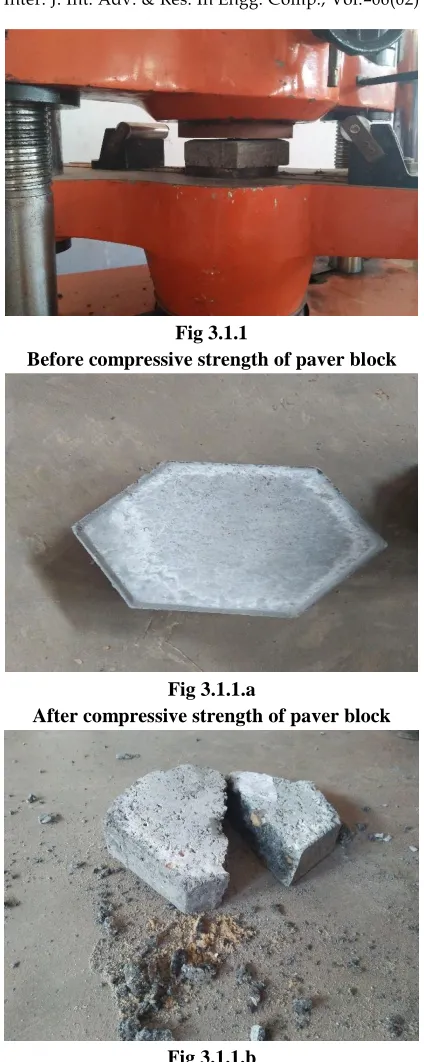
Compressive test
Compressive strength of paver blocks shall be determined as per the method given in Annex D. Paver block strength shall be specified in terms of 28 days compressive strength. In case the compressive strength of paver blocks is determined for ages other than 28 days, the actual age at testing
Fig 3.1.1
Before compressive strength of paver block
Fig 3.1.1.a
After compressive strength of paver block
Fig 3.1.1.b
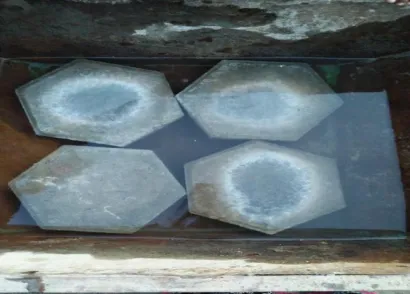
Water absorption test
The water absorption, being the average of three units, when determined in the manner described in Annex C, as per IS 15658:2006, shall not be more
Fig 3.2.1
RESULT
Results for compression strength of blocks PB1, PB2 and PB3 are shown in the graph. The compressive strength of paver block PB1 is greater than PB2 and PB3 in the form of strength. The graph shows the decrease in the variation of
strength of paver block PB1, PB2 and PB3. Here the PB1 have more efficient in using paver block. The graph shows the variation of water absorption in three grade of paver block PB1, PB2, and PB3. Graph 6.1 Compressive Strength of Paver Block
Graph 6.2 Water Absorption of Paver Block
0 5 10 15 20 25 30
PB1 PB2 PB3 PB4
Av
g
.s
tre
ss
N/m
m
2
% of paver block
0 0.5 1 1.5
PB1 PB2 PB3 PB4
%
o
f
w
a
ter
a
bs
o
rt
ed
% of water absorted
CONCLUSION
Replacement of fly ash to foundry reject sand in various percentages has been done in the paver block manufacture. Following are the conclusion of various tests that has been performed on these blocks. Water absorption percentage for all the samples are below 7% hence this can be accepted as per IS 15658:2006 With regard to compressive strength PB1 (25%) replacement of FRS shows the higher value comparatively and it can be suggested
as per IS 2185:2005. The abrasion test value is higher for 25% of replacement of FRS and this is within the limit as per for durability test (freeze and thaw) all the samples have shown the value between 0 to 1 and hence it can be accepted as per IS 15658:2006. From the above we conclude that at 25% replacement of foundry reject sand is the optimum one further research can be done for lower percentage of replacement.
REFERENCE
[1]. GURPREET SINGH AND RAFAT SIDDIQUE performed experimental investigations to evaluate the strength and durability properties of concrete mixtures, in which natural sand was partial replaced with (WFS) 2015. [2]. KHATIB ET AL. investigated some mechanical and fresh properties of concrete containing waste foundry sand
(WFS) 2014.
[3]. T.R. NAIK ET AL. Conducted an investigation evaluate the performance of foundry by-products in concrete & masonry products 2013.
[4]. MUHAMMAD AAMER RAFIQUE BHUTTAA ET AL. were conducted a study to develop porous concrete with acceptable permeability and strength using recycled aggregate from waste crushed concrete 2013.
[5]. ALONSO-SANTURDE ET AL. carried out a comparatively study to produce ceramic bricks with two types of foundry sand (green and core sand) fired, according to different firing cycles, corresponding to the manufacturing of different ceramic products at laboratory scale with the purpose of evaluating the influences of the firing cycle and the type and content of waste foundry sand in the physical and microstructural properties of the final product 2012.
[6]. GURPREET SINGH AND RAFAT SIDDIQUE were evaluated the strength and durability properties of concrete mixtures, in which natural sand was partially replaced with (WFS) 2012.
[7]. GURPREET SINGH AND RAFAT SIDDIQUE evaluated the abrasion resistance and strength properties of concrete containing waste foundry sand (WFS) 2012.
[8]. RAFAT SIDDIQUE ET AL. carried out a research on the concrete mixes made with used- foundry (UFS) sand as partial replacement of fine aggregates. Various mechanical properties are evaluated (compressive strength and split tensile strength) 2011.
[9]. RAFAT SIDDIQUE AND HADJKADRI dealt with the effect of foundry sand (FS) and metakaolin (MK) on the near surface characteristics of concrete 2011.