Licensed under Creative Common Page 1
http://ijecm.co.uk/
ISSN 2348 0386
EXPLORING THE VIABILITY OF E-PROCUREMENT SYSTEM
IN TAMALE POLYTECHNIC, GHANA
Gibrilla, Issah
Department of Computer Science, Tamale Polytechnic, Northern Region, Ghana [email protected]
Osman, Ibrahim
Department of Marketing, Tamale Polytechnic, Northern Region, Ghana [email protected]
Mohammed, Abdul-Basit Fuseini
Department of Marketing, Tamale Polytechnic, Northern Region, Ghana [email protected]
Issah, Eliasu
Dept of Secretaryship and Management Studies, Tamale Polytechnic, Northern Region, Ghana
Yahaya, Alhassan
Department of Languages and Liberal Studies, Tamale Polytechnic, Northern Region, Ghana [email protected]
Abstract
The adoption of e-procurement by government entities to optimise and economise
public procurements has been the buzzword of transparent governance. In fact e-procurement
has been touted as panacea for corruption and bureaucratic processes in the manual
procurement system. Literature is abound with studies which underline numerous benefits
of migration of procurement functions onto the Internet. A study case of Tamale Polytechnic
is done with the procurement unit and management as the main focus. The study examined the
viability of an e-procurement system in Tamale Polytechnic. Specifically it sought to investigate
e-Licensed under Creative Common Page 2
procurement and finally the challenges in implementing the system. The findings indicate that
Tamale Polytechnic was ready and willing for such a system. The study also revealed that
management support and policy strength in ICT by government are key to effective
implementation of e-procurement. This study has provided an insight into the important factors
affecting the implementation of e-procurement in Tamale Polytechnic.
Keywords: E-Procurement, Government, Viability, Ghana
INTRODUCTION
The proper management of procurement is highlighted by the fact that it accounts for substantial portion of an organisation’s resources. It is, therefore, necessary for every organisation to
maintain an efficient and effective procurement system to cut administration cost and to keep abreast of the market condition to procure material and services at the right price, quality and time. Traditionally, firms use paper based system to procure materials and services by searching for material from paper based catalogues provided by suppliers through telephone and fax. The traditional material procurement process involves generation, copying and transfer of many paper documents. The Public Procurement Act 2003 (Act 663) was enacted to provide the appropriate regulatory framework to the use of public funds in delivering government projects and purchases. Fundamentally, the Act is supposed to ensure that there is value for money in all acts of procurement for the government.
Manual tender processes in procurement can be long and cumbersome, often taking months or in some cases years, which is costly for both the buyer and the supplier. Waiting in long queues at various offices for different things and, in some cases, the same information can be a complicated endeavour to undertake. Unnecessary paper work and mundane activities such as continuously visiting the offices of the buyer for pertinent information can be very costly in terms of finance and time (E-Governance Document, 2009). It is against these reasons this study sought to address the following objectives:
i. To assess the state of the current procurement system in Tamale Polytechnic ii. To assess the viability of an e-procurement system in Tamale Polytechnic
Scope of the Study
Licensed under Creative Common Page 3 manpower of the nation and require the use of an effective and efficient procurement system in the delivery of its service.
Limitations of the Study
This study considered a small sample size which may not be generalised beyond a specific population from which the sample was drawn. Some of the sampled respondents may not have answered the questions with honesty and, therefore, the results of this study is based on the opinion of a sampled group which might not accurately reflect the opinion of all members within the population considered for the study.
LITERATURE REVIEW
Definition of Electronic Procurement
E- Procurement can be defined as a process which allows any designated user to requisition a product or service through a web interface, which then generates a purchase order to send to a supplier (Falk, 2005). According to the Chartered Institute of Purchasing & Supply, e-Procurement is about using the Internet to operate the transactional aspects of requisitioning, authorizing, ordering, receipting and payment processes for the required services or products (CIPS, 2009).
E-Procurement Tools
E-Procurement is viewed as an end to end solution that integrates and streamlines many procurement processes horizontally trough the organisation(CIPS,2009).
E-MRO: Electronic Maintenance Repair and Operations (e-MRO) focus on the process of creating and approving purchasing requisitions, placing the orders and receiving the goods or services ordered using a software system based on internet technology. Further on, the software system for e-MRO is generally available for all employees to put the purchase requisitions.
Web Based ERP: It’s similar to e-MRO. The difference between the two is that e-MRO deal with
MRO items whereas the web-based ERP deals with products related items.
E-Sourcing: E-sourcing is the process of finding new possible suppliers using the internet in general or more specific, a B2B marketplace. Identifying new sources of supply increases the competitive forces during the tendering process. This takes place in the expression of interest phase of the procurement process.
Licensed under Creative Common Page 4 comparison of responses is also supported by the solution (Boer et al., 2002). The data concerning tendering is focused on the product or service. Here, it is also possible to have an initial screening process where a selected number of suppliers qualify for the negotiation phase. This process phase does not include closing of the contract.
E-Reverse Auctioning: E-reverse auctions enables the purchasing company to buy goods and services from the supplier that has the lowest price or combination of lowest price and other conditions as well via internet technology. The auction is most often traded in real-time and ends in a closing bid between the buyer and the supplier.
E-Procurement Systems
Different solutions have been adopted to migrate from a transactional and offline purchasing function to a more strategic view. According Koorn et al. (2001), there are three types of e-Procurement systems: buyer e-Procurement systems, seller e-Procurement systems and online intermediaries. Kim and Shunky (2004) also consider e-Procurement systems as various internet B2B commerce systems, which are located at the supplier, third party or the buyer, with the following categorization: Supplier-centric Procurement systems; Neutral e-marketplaces and Buyer-centric e-Procurement systems:
E-Procurement Technology
The role of Information and Communications Technology (ICT) in e-procurement cannot be over emphasised. This allows automating the ordering process with the suppliers systems, and within customers systems to ease the operation of the supply chain. Such an effort is expensive not only in terms of money invested, but also in terms of time to implement those technologies. Their implementation on core business processes involves risks. Adopting a losing technology may mean not only losing the resources invested, but also higher operating costs and, at some point in the future, a further transition to the Appropriate technology (Davila et al., 2003).
Licensed under Creative Common Page 5
Procurement System in Ghana
Government procurement, also called public tendering, or public procurement, is the procurement of goods and services on behalf of a public authority, such as Government agency. To prevent corruption, fraud and waste, Government laws regulate Government procurement very closely. It usually requires the procuring departments of Municipal and District Assemblies (MDAs) to issue public tenders if the value of the bid exceeds a certain threshold. Even though this regulation exists, the procurement processes still have the following flaws: Time consuming: manual tender processes can be long and cumbersome, often taking months or in some cases years, which is costly for both the buyer and the supplier. Complicated: waiting in long queues at various offices for different things and in some cases the same information can be a complicated endeavour to undertake. Costly: unnecessary paper work and mundane activities such as continuously visiting the offices of the buyer for pertinent information can be very costly in terms of finance and time (e-Governance Document, 2009).
According to the e-Government document (2009), the Public Procurement Act 2003 (Act 663) was enacted to provide the appropriate regulatory framework to the use of public funds in delivering government projects and purchases. Fundamentally, the Act is supposed to ensure that there is value for money in all acts of procurement for the government.
The Purchasing Process
Over the years, the purchasing function has become more complex and involving many functions in the company which has evolved the purchasing process into issue of supply management. This development has consequently resulted in a more integrated supply chain management, where all steps should be taken into account (Trent & Monczka, 2003). Especially the purchasing function has increased in importance in this chain, since purchased materials consist of the majority of total cost spent in a manufacturing company (Dobler & Burt, 1996) Purchasing processes may vary to some extent between companies and within companies. For instance, they may vary depending on if the purchase concerns new- task situation, a modified rebuy or a straight rebuy (Van Weele, 2002). However, clear stages are still recognised and the purchasing process is described by many authors in a similar way. Below is an overview including a few authors description of a purchasing process, and the process is divided into seven steps that have been recognised among the authors. The discussion is set to manual operations in this process, but also includes the process can be transferred into E-procurement.
Step 1: Selection of Supplier
Licensed under Creative Common Page 6 be the case if the buyer favours one supplier and its products. An alternative is to invite suppliers to competitive biddings. The decision is made in this phase but the actual bidding starts first when the request for quotation (RFQ) is presented on the bidding site (Turban et al., 2000). Neef (2001), states that the selection of supplier could as well be done by using web-based catalogues.
Step 2: Request for Quotation (RFQ)
After deciding on what potential suppliers the company wants to work with, a request for quotation will be sent to the supplier or suppliers by post or email, describing the needs. This activity often requires much communication between the buyer and the concerned supplier or suppliers, since requests often include much information that has to be discussed and questioned (Neef, 2001). Giunipero & Sawchuk (2000), therefore, suggest voice communication with the computer in order to generate information. Turban et al. (2000) also suggest that this activity as well can take place by competitive biddings by placing the RFQ electronically and suppliers get to bid. Often the one with the lowest price will get to sign the contract.
Step 3: Signing of Contract
This activity includes getting an approval from the supplier. Both technical (availability) and financial (price) approvals are determined in this activity (Neef, 2001; Gadde & Håkansson, 1998). This results in negotiations between the buyer and supplier in order to establish an agreement and, thereby, a contract where both parties are satisfied (Van Weele, 2002). Giunipero and Sawchuk (2000) claim that instead of having paper contracts, one can manage the same activity by having on -line virtual contracts. However, the latter point out that to gain security with having electronic signatures, it requires that the electronic signature allows the receiver to verify the identity of the sender of the data.
Step 4: Placing and Dispatching the Order
Licensed under Creative Common Page 7 other forms such as receiving and inspection reports (Giunipero & Sawchuk, 2000; Dobler & Burt, 1996). Another method could be to go to a web site and enter the purchase order onto an electronic page. When having a paper based purchasing order, errors are some-times discovered too late and resulting in more paperwork that has to be done. But the on-line order form will be rejected if there are any errors, so the customer can correct it immediately (Giunipero & Sawchuk, 2000). The purchase order might concern only a purchase at that moment or the purchase order might be issued for a definite period, usually a year. If the purchase order and the placement of regular needs arrive electronically as described above, it makes it easier for the supplier to process and dispatch the order automatically (Giunipero & Sawchuk, 2000).
Step 5: Payment
This activity also includes many paper documents being compared. A typical procedure involves a simultaneous review of the purchase order, receiving report and the invoice. If everything is correct, payment is carried out (Dobler & Burt, 1996). Auditing invoices is a time-consuming task that should be handled as efficiently as possible. If the received material is not in accordance with the purchase order and what is said on the invoice, the purchasing department must make an adjustment with the supplier. This is a long process as well with many documents to be compared and a lot of communication between departments (Giunipero & Sawchuk, 2000).
The activities described above have according to Neef (2001) a good potential to be transferred into E-procurement. Giunipero and Sawchuk (2000) argue for integrated procurement systems when considering automation of a purchasing process. The authors suggest a system that allows posting of RFQ´s for supplier review and response on the internet, and which can handle web orders, and on-line supplier catalogues access.
RESEARCH METHODOLOGY Research Design
A case study design was used for the study. To do this, an exploratory research was carried out among procurement practitioners, both in the procurement unit and other entities in Tamale Polytechnic. Both structured and unstructured questionnaires and in-depth interviews were used to collect primary data by adopting the survey approach in collecting data.
Target Population
Licensed under Creative Common Page 8
Sampling Size Determination
The study used a convenience and purposive sampling technique in selecting the sample size of thirty (30). The purposive sampling was necessary because of the specific specialised responses desired.
Data Collection Instruments and Procedure
Questionnaires and interview guide were used as the data collection tools to solicit data from the respondents. The questionnaires were administered to the respondents whereas the interview guide was used in deriving information from key informants with respect to the research objectives.
Data Presentation and Analysis
Quantitative and qualitative methods were used to analyse the data. Computer data analyses software such as the use of Statistical Package for Social Sciences (SPSS) version 15, and Microsoft Excel were the main tools employed to analyse the data. The justification for the choices of these programmes was that, these techniques facilitated word processing and made data analysis very easy and accurate pictorial presentations.
FINDINGS & DISCUSSION Demographics of Respondents
The relevant demographic characteristics of respondents surveyed were position and work experience.
Position of Respondents
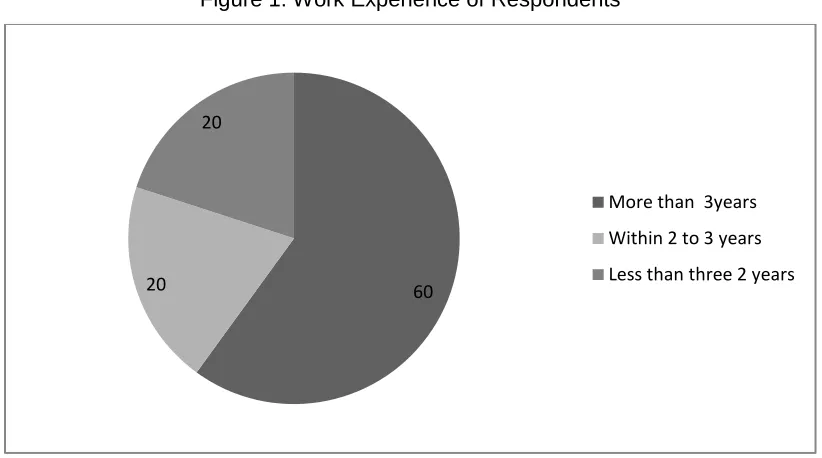
40% of the respondents were made of management staff and 60% were of non-managerial positions. The data shows that management which is the decision making group was less represented. Figure 1 below shows the distribution of positions held by respondents.
Working Experience of the Respondents
Licensed under Creative Common Page 9 Figure 1: Work Experience of Respondents
Assessment of Current Procurement System in Tamale Polytechnic
In assessing the current procurement practice in Tamale Polytechnic, responses revealed that the procurement process involved was selection of supplier, negotiation with supplier, issuance of purchase order (PO), material delivery tracking, and issuance of payment and arrangement of supplier correspondence. The results collected from the respondent are discussed below:
Selection of Supplier
From the survey results, all 14 respondents who were suppliers were selected from old records and updated registered suppliers of Tamale Polytechnic. However, the procurement officer mentioned two modes of selection;
“the price quotation and open tender. Price quotation method solicited bid prices from registered
suppliers of Tamale Polytechnic and open tender, which is open to the general public, required
advertising in the news papers. Open tender is used when the threshold of a procurement lot is more than GH₵ 20,000.00”
Negotiation with supplier
From the data, negotiation with suppliers was done mainly in three ways: through written documents, face to face and telephone. The procurement unit mainly communicated with suppliers through written documents and when the need be could communicate with suppliers on face to face basis. Communicating through the telephone was normally done by the finance
60 20
20
More than 3years
Within 2 to 3 years
Licensed under Creative Common Page 10 unit of the Polytechnic. Figure 2 below shows the data: written document (40%), face to face (30%) and telephone (30%).
Figure 2: Negotiation with suppliers
Issuance of Purchase Order
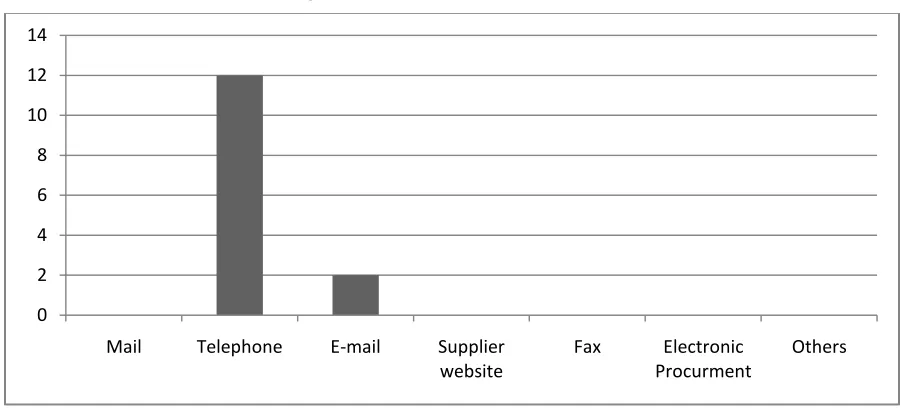
According to the procurement unit, suppliers were informed through telephone calls to pick the Purchase Orders (POs) after the documents were prepared. However, the Procurement Officer was of the view that
“the Polytechnic would have wished to at least send PO s to suppliers through e-mails but majority of suppliers still prefer to pick PO s from the procurement office.’’
Figure 3: Issuance of Purchase Order 0
1 2 3 4 5 6
Written Documents
Face to Face Telephone E-mail Supplier
Website
Electronic procurement
software
Otehrs
Negotiation with Suppliers
0 2 4 6 8 10 12 14
Mail Telephone E-mail Supplier
website
Fax Electronic
Procurment
Licensed under Creative Common Page 11
Purchase Delivery Tracking
From the survey results, almost all delivery tracking was done through the use of telephone. 83.3% of the respondents used telephone and 16.6% used e-mail to track the delivery. The data is presented on Figure 4 blow:
Figure 4: Purchase Delivery Tracking
Issuance of Purchasing Payment
From the survey results, it was found that payment was made always by cheque.
Figure 5: Issuance of Purchasing Payment 0
2 4 6 8 10 12 14
Mail Telephone E-mail Supplier
website
Fax Electronic
Procurment
Others
Purchase Delivery Tracking
0 2 4 6 8 10 12 14 16
Cash Electronic Funds
Tranfer(Cheque)
Electronic Procurement software
Others
Licensed under Creative Common Page 12
Arrangement of Supplier Correspondence
From the survey results, 10 respondents used only paper base (hardcopy) to organise the purchasing correspondence whilst 2 respondents say they used both paper base and electronic base.
Figure 6: Arrangement of Supplier Correspondent
Viability of an e-procurement System in Tamale Polytechnic
Important driver towards e-procurement adoption and implementation is the realisation of the potential benefits that may be achieved (Minahan, et al., 2003).There is a plethora of
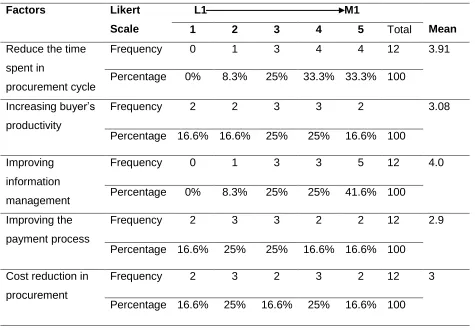
literature espousing the benefits of an e- procurement solution (Minahan, et al. 2003). The respondents were asked to rate the importance of factors from the view point of perceived value of implementing e-procurement. The data on Table 2 below indicate that improving information management was the most perceived value among the factors with a mean of 4.0. This was followed by reduced time spent in procurement cycle and increasing buyer’s productivity respectively with means of 3.91 and 3.08 respectively.
0 2 4 6 8 10 12
Paper base Electronic base (Soft Copy) Combination of paper and
electronic base
Licensed under Creative Common Page 13 Table 2: Survey Results on the Importance of Factors for Implementing e- Procurement
from the View Point of Perceived Value
Factors Likert Scale
L1 M1
Mean
1 2 3 4 5 Total
Reduce the time spent in
procurement cycle
Frequency 0 1 3 4 4 12 3.91
Percentage 0% 8.3% 25% 33.3% 33.3% 100
Increasing buyer’s
productivity
Frequency 2 2 3 3 2 3.08
Percentage 16.6% 16.6% 25% 25% 16.6% 100
Improving information management
Frequency 0 1 3 3 5 12 4.0
Percentage 0% 8.3% 25% 25% 41.6% 100
Improving the payment process
Frequency 2 3 3 2 2 12 2.9
Percentage 16.6% 25% 25% 16.6% 16.6% 100
Cost reduction in procurement
Frequency 2 3 2 3 2 12 3
Percentage 16.6% 25% 16.6% 25% 16.6% 100
CONCLUSION
Generally, the survey concludes that Tamale Polytechnic is using the traditional method of procurement and further provides an insight into the important factors affecting the implementation of e-procurement in Tamale Polytechnic. However, there could be other factors that needed to be identified. Hence, it is felt that, further research needs to be carried out in such areas as to identify the technologies used in E-procurement and the platform for the success of e- procurement.
Due to lack of vendors support and inadequate government policy to support the use of ICT in business, the study recommends that, government should provide various supportive measures to encourage the implementation of e-procurement, such as enacting electronic commerce regulation and laws.
Licensed under Creative Common Page 14
REFERENCES
Aboelmaged, M. G. (2010), “Predicting e-procurement adoption in a developing country: An empirical integration of technology acceptance model and theory of planned behaviour”, Industrial Management & Data Systems, Vol. 110 No. 3, pp. 392-414.
Angeles, R. & Nath, R. (2007), “Business-to-business e-procurement: success factors and to implementation”, Supply Chain Management: An International Journal, 342 Vol. 12, pp. 104-15. Auriol, E. & Picard, P.M. (2009), “Government outsourcing: public contracting with private monopoly”, The Economic Journal, Vol. 119, pp. 1464-93.
Croom, S. (2000), “The impact of web-based procurement on the management of operating resources supply”, Journal of Supply Chain Management , Vol. 36 No. 1, pp. 4- 13.
Croom, S. & Brandon-Jones, A. (2007), “Impact of e-procurement: experiences from the UK public sector”, Journal of Purchasing & Supply Management, Vol. 13, pp. 294-303.
Davila, A., Gupta, M. & Palmer, R. (2003), “Moving procurement systems to the internet: and use of e-procurement technology models”, European Management Journal , Vol. 21 No. 1, pp. 11-23.
Davis, F.D. (1989), “Perceived usefulness, perceived ease of use, and user acceptance information technology”, MIS Quarterly, Vol. 13 No. 3, pp. 319-40.
de Boer, L., Harink, J. & Heijboer, G. (2002), “A conceptual model for assessing the impact of electronic procurement”, European Journal of Purchasing & Supply Management, Vol. 8 No. 1, pp. 25-33. Hashim, R.(2007), “Issues in implementing e-procurement in local government”, Proceedings, eGov Asia, Putrajaya, Malaysia, 6-8 February.
H.-L., Wang, K. and Chiu, I. (2008), “Business-IT fit in e-procurement systems: evidence from high-technology firms in China”, Information Systems Journal, Vol. 18 No. 4,. 381-404.