5242
Analysis Of Export Import : Application Of
Simultaneous Equation Model Case Study In
Asean Countries
Syaparuddin, Faradina Zevaya
Abstract: This research aims to analyze (1) Export Import’s Development pattern in Asean Countries and Export Import Pattern according to Destiny and origin country, (2) Factors affecting Export Import in Asean Countries, (3) Simultaneous correlation amongst of Export Import in Asean Countries. Technic of Data Analysis is used by combining Descriptive Qualitative and Quanitative methods. Pattern of Export Import’s Development according to destiny and origin country utilizing descriptive analysis. Then, to analyze factors affecting export import in Asean Countries is used Simultaneous Equation Regression Model. And in analyzing simultaneous correlation amongst of export and import in Asean countries is used Hausman Test. This research results show pattern of export and import in Asean countries (Indonesia, Malaysia, Thailand, Fhilippina, Vietnam, Myanmar, and Cambodia) possess same (equal) relative pattern, whereby the enhancement or Decline of export followed by the enhancement and decline of import, vice versa. It means export and import value in Asean countries are increasing or decreasing occurred at the same time. By utilizing simultaneous equation model, import and exchange rate variables have significantly effect to export in Asean countries. Then, for import model is export variable only that has significant effect to import in Asean countries. There are no Asean countries whereby export and import have simultaneous correlation.
Index Terms: Export, Import, Simultaneous Equation Model.
—————————— ——————————
1.
INTRODUCTION
In open economy system, role of export import for a country is important. One of basically problems faced by numerous developing countries included in Asean Countries is relatively difficult in increasing export value. One of factors is caused by exported commodity for the most part primary commodity (raw commodity) from plantation and mining sector associated with various its weakness. In contrary, imported commodity is industrial products which processed in high technology with high value added and selling price. In the context of export import, theoretically export value will be illustrated as income, meanwhile import as expenditure. It means, when value export increases, it’s able to finance import. Research carried out by Syaparuddin (2017) about Indonesian export import Causality Granger Approach stated amongst of Indonesian export and import possess causality case. This condition was also seen in another Asean Countries. The magnitude of Asean countries’ export followed by the enhancement of import. Vice versa, In the context of theory and empirical some variables become determinant magnitude of export and import a country, for instance those exports and imports, foreign exchange reserves and exchange rate.
2.
STUDYLITERATUREAND HYPOTHESIS
DEVELOPMENT
International trade is business activity consist of 2 (two) sections, exporter and importer in 2 (two) different countries in purchasing and selling commodity agreement to whole term of selling, named Contract Sale.
International trade consist of export side that represent the demand of domestic currency and offering foreign currency. Even import side is a representative from domestic currency and the demand of foreign currency (Soufan, 2014).Export is commercial activity that involves domestic production exchange or importing goods or possess value added by considering values across national borders (Thowseaf, 2016) Economy fact, but very political. There are no countries technically can export more than imported. It is caused by money is base of trade. If USA imports car $1 million from Japan, Japan will be paid with US Dollar. Japan can replace that Dollar to Yen with higher value from bank or should use that currency in economy’s USA. Approximately 1/3 all USA Dollars that circulation in abroad, both as reserve currency a government or used by private society in economy’s USA although still shows USA wealth (Curry & Limona, 2001). Research entitled Analysis Correlationof Export and Import of Several Agricultural Sector Commodities with the Economy of North Sumatra which aims to analyze the correlation of the total exports value, total value of agricultural exports, and the export value of main commodities of agricultural sector with North Sumatra Gross Domestic Product per province; analyze the correlation of total imports value, total imports value of agricultural sector, and the import value of main commodities of agricultural sector with North Sumatra Gross Domestic Product per province. The results show there is a real and positive correlation between total exports value, the total exports value of agricultural commodities, and the FOB value of vegetable fats and oils, natural rubber latex, coffee, chocolate with North Sumatra Gross Domestic Product per province. Meanwhile, there is also a real and positive correlation between total imports value, the total value of agricultural commodity imports, the CIF value of seeds and fruit containing oil and wheat flour and meslin with North Sumatra Gross Domestic Product per province (Nadia Safitri, TaviSupriana and LuhutSihombing, 2017). Research entitled Analysis of Factors Affecting Indonesia's Export Performance. and Industry. The research method used is multiple regression analysis with the results of research show the development of ____________________________________
• Syaparuddin: Department of Economics Development University of Jambi, Indonesia [email protected]
5243 Indonesia's export performance historically dynamic which is
influenced by changes in turbulent world economic conditions. Furthermore, the model compiled is a dynamic linear model by looking at the supply and demand side of agricultural and industrial sectors, and the factors affecting exports in agricultural sector in supply approach, namely agricultural product prices, production capacity, exchange rates, auxiliary raw material imports and fuel price. In the meantime the supply of industrial exports is determined by the prices of industrial products, production capacity, exchange rates, imports of auxiliary raw materials and fuel price. In addition, the modeling of export projection from supply side is largely determined by the country’s condition (Lubis, 2013). Research entitled Analysis of Indonesian Imports with the aim of knowing the mastery of imports knowledge is a crucial requirement. Furthermore, import analysis is utilized to determine the prompt strategy in overcoming import problems. The research method is used data that provided by CEIC and analysis of four main components, such as the Degree of Import Openness, Degree of Commodity Concentration,Degree of Geographic Concentration, and the Magnitude of Autonomous and Marginal Prospensity to Import. The results of the calculation of DKK, DKI, DKG, Mo and m indicate that Indonesia is in import vulnerability level (Eko Atmadji, 2004). The results of this research revealed that low exports were caused by high inflation. Coupled with a statement showing that primary commodity exporters have more inflation than manufacturing exporters (Gylfason, 1997). According to research with the title Price and Non-Price Factors Affecting Imports In Pakistan, it shows that imports are influenced by exchange rates, economic growth, rural communities, urban communities, and the offering of real money significantly affected imports in Pakistan (Ahmad & Ahmad, 2018; Hassan, Wajid, Irfan, Tahir, & Arshed, 2014)Research entitled Import Demand ElasticitiesAnd Stability During Trade Liberalization: A Case Study of Kenya stated that relative short-term price, real income levels, and aggregate import demand affects on imports in Kenyav (Mwega, 1993). Research concerningof export-import’s correlation of Indonesian financial sector shows that export-import’s correlation have no significant effect. It is caused by several factors, such as loading of local goods as an export commodity, in so doinglinkages amongst of exports to imported goods is relatively small (Hakim, 2012).
3.
RESEARCH METHOD
Analysis methods used in this study are descriptive and quantitative analysis. In the meantime, the analysis’ tools are:
1. To analyze the patterns of export-import’s development in ASEAN countries and the patterns of exports and imports according to destiny and origin country, used a graphical approach
2. Factors affecting export and import in ASEAN countries
In this study, the model used is a simultaneous equation model.
EKSP = β10+β11lMP+ β12 Kurs + β13 Dummy + u1 ………….. 1
lMP = β20+ β21EKSP+ β21 Kurs + β23 ED+ β23 Dummy + u2 … 2
whereby :
EKSP :export value IMP :import value Kurs : Exchange Rate ED : External Debt Dummy :economic crisis
Identification test
This test is intended to find out whether the structural model is possible or not obtain parameter values in structural equation by estimating the reduce form equation. In addition, it is also necessary to find out what best approach for estimating the model. An identified structural equation as likeexactly/fully/just identified or over identified. Parameters both over identified and just identified can be estimated (Syafaruddin, 2013). Rules in identification tests can be formulated as follows: (Gujarati, 2003).
1. In a model of M simultaneous equation, in order to equation is identified, the equation must not include at least the M-1 variable both the endogenous variable and the predetermined variable (exogenous) that appears in the model. If the equation does not enter exactly M-1 variable, the equation is called exactly identified. If the equation does not include more than M-1 variables, the equation is over identified.
2. In a model of M simultaneous equation, in order to an equation is identified, number of predetermined variables issued from the equation must be no less than the number of endogenous variables entered in the equation less than one, namely:
K – k m – 1 * If K – k = m – 1, it isjust identified * If K – k > m – 1, it is over identified
The estimation method of simultaneous equation regression model used in this research is a limited information method. The limited information method is also known as the single equation method. In single equation method, each equation in simultaneous equation model is estimated individually by ignoring the limitations of another equations in model. Included in limited information method category viz. indirect least square (ILS) and two stage least square (2SLS). According to Klein in SrituaArief (1993; 82-83), in the practice of research method is more widely used on the practical consideration of load calculation and the insensitivity of the method to error specification of estimated regression model. The single equation method does not take into account the correlation between disturbance variables from different structural equations. This method is based on the assumption that the disturbance variables in various equations in model are free distributed, thus this method utilising basic assumptions of classical linear regression model with the consequence that the results of the estimates are consistent, but not efficient.
3. To analyze whether there is a simultaneous relationship between Export and Import in Asean countries, the Hausman Specification Test is used or Hausman Test (Gujarati, 2003 :) and Pyndick and Rubinfield, 1990). The formulations are:
EKSP = β30+β31lMP+ β32 Kurs+ β33Dummy + β34 Resid IMP ……… 3
5244 notification :
EKP :export value ER : Exchange Rate IMP :import value Dummy :economic crisis
ResidIMP :residual value from import equation Resid EKP: residual value from export equation
There are Hausman test procedures (Syafaruddin, 2013): 1. Regressing each reduced form equation in a system of
simultaneous equations for endogenous variables and the residual value is obtained
2. Regressing structural equations by takingobtained residual components from reduced form equations as explanatory variables (exogenous), it means that the initial structural equation is added as an exogenous variable.
The testing criteria are that if residual’s test is higher than t-table for a particular alpha, it means there is a simultaneous problem. In contrary, if residual’st-test is smaller than the value of the t-table at a particular alpha, it means there are no simultaneous problems. It means the system of equations are not a simultaneous equation
4 RESULTS AND DISCUSSION
4.1. Import Export Pattern
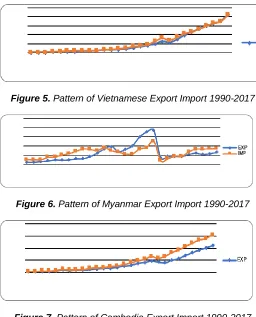
The pattern of export imports in the context of this study is to describe how changes in exports are followed by changes in imports or changes in imports followed by changes in exports. In this case, generally, the ability of a country to carry out imports depends on the ability of the country to export. This condition illustrates that the moreof export value, the more ofimport value. This condition also occured in several developing countries in Southeast AsiaThe illustration of export-import’s pattern in Southeast Asian countries is presented in Figure 1-7.
Figure 1. Pattern of Indonesian Export Import 1990-2017
Figure 2. Pattern of Malaysian Export Import 1990-2017
Figure 3. Pattern of Thailand Export Import 1990-2017
Figure 4. Pattern of Philippines Export Import 1990-2017
Figure 5. Pattern of Vietnamese Export Import 1990-2017
Figure 6. Pattern of Myanmar Export Import 1990-2017
Figure 7. Pattern of Cambodia Export Import 1990-2017
5245 obtained. The size of obtained foreign exchange reserves will
describe the ability of country to purchase goods and services from abroad (import). Thus it can be concluded that amongst of exports and imports of Southeast Asian countries have the same pattern.
4.2. Simultaneous Equation Model
This research utilising simultaneous equation model for two structural equations viz. export import in 7 (seven) Asean countries, such as Indonesia, Malaysia, Thailand, Philipiness, Vietnam, Myanmar, and Cambodia by using limited information method atau single equation method. Those seven countries are selected by considering the availability of data appropriate research variable, especially data 1990-2017. Based on data processed by using two stage least square method (TSLS) can be made simultaneous equation for each country as follow:
1. Indonesia
EKSP = 9744.621 + 0.849370 IMP + 2.274774 KURS + 51.01491 Dummy
(2.274792) (18.31972) (3.533586) (0.008989)
Adj R-squared = 0.971839
F test = 293.7544 dengan Probability 0.0000
IMP = -19687.14 + 0.872969EKSP -3.393301KURS + 0.257960ED - 8030.439DUMMY
(-4.505138) (11.96357) (-4.894477) (4.708983) (-1.540798)
Adj R-squared = 0.979654
F test = 302,2008 dengan Probability 0.0000
2. Malaysia
EKSP = -78886.89+1.132822IMP+27457.96KURS-4663.532DUMMY
2.191554) (32.61869) (2.101999) (-0.270545)
Adj R-squared = 0.987885
F test = 717.8912 dengan Probability 0.0000
IMP = -16895.84 + 0.557070EKSP + 19345.03KURS + 1.027687ED-12170.13DUMMY
(-0.532607) (8.077677) (1.496963) (4.789309) (-0.942054)
Adj R-squared = 0.991007
F test = 726.3990 dengan Probability 0.0000
3. Thailand
EKSP = -900.5453 + 1.137739IMP + 14.13987KURS + 325.1508DUMMY
(-2.189805) (29.78179) (1.076170) (1.380336)
Adj R-Squared = 0.977159
F test = 377.6903 dengan Probability 0.0000
IMP = 622.9908 + 0.858506EKSP -8.869399 KURS + 0.001667ED -368.1369DUMMY
(1.202908) (16.23432) (-0.625579) (0.465709) (-1.352582)
Adj R-Squared = 0.977073
F test = 273.5218 dengan Probability 0.0000
4. Philipinnes
EKSP = -11533.62 + 0.744372IMP + 360.0302KURS + 4265.526DUMMY
(-2.905240) (10.97526) (2.950356) (1.563733)
Adj R-squared = 0.919163
F test = 102.4821 dengan Probability 0.0000
IMP = 15489.39 + 1.343243EKSP -483.6633KURS + 0.000198ED-5731.027DUMMY
(0.322914) (0.826478) (-2.311986) (0.000106) (-0.794979)
Adj R-squared = 0.891574
F test = 53.59185 dengan Probability 0.0000
5. Vietnam
EKSP = 13783.59 + 1.124675IMP -1.631522KURS +4810.833DUMMY
(1.824791) (24.45716) (-2.563755) (1.538535)
Adj R-Squared = 0.992356
F test = 1149.073 dengan Probability 0.0000
IMP = 14102.36 + 1.182686EKSP 0.159435KURS -0.491493ED-2689.292DUMMY
(0.492407) (3.748000) 0.090311) (-0.923985) (-0.834216)
Adj R-squared = 0.993718
F test = 1044.104 dengan Probability 0.0000
6. Myanmar
EKSP = -12885.32 + 2.363608IMP -11.08274KURS-15299.90DUMMY
1.798104) (3.806449) 3.096170) (-3.585237)
Adj R-squared = 0.579111
F test = 5.662 dengan Probability 0.0047
IMP = 15177.01 + 0.610880EKSP + 5.373254KURS - 1.902105ED + 6056.037DUMMY
(3.395708) (3.520142) (4.650508) (-1.961902) (4.287404)
Adj R-squared = 0.779879
F test = 9.042733 dengan Probability 0.0002
7. Cambodia
EKSP = -11.57585 + 0.698366IMP + 0.002249KURS + 41.07625DUMMY
(-0.053397) (37.98880) (0.030120) (0.211565)
Adj R-squared = 0.989999
F test = 872.1981 dengan Probability 0.0000
IMP = -459.1197 + 1.251268EKSP + 0.130160KURS + 0.176140ED -281.9978DUMMY
(-0.739408) (6.033031) (0.707089) (0.881992) (-0.754073)
Adj R-squared = 0.990024
F test = 653.1702 dengan Probability 0.0000
To be noted : Alpha 0.05, t table 2.16037 (Numbers in brackets are t test)
5246 alpha (0.05) compared with probability (F-statistic). The same
condition is also occurred at Indonesian import, whereby export variable (EKSP), Exchange Rate, Foreign Debt, and Economy Crisis significantly affected to Indonesian import 1990-2017. Partially, import variable and exchange rate have positif significance effect to Indonesian export. In the meantime, dummy variable has no significant effect to Indonesian export. The magnitude of import, exchange rate, and economy crisis effect to Indonesian export is 0.971839. At the import equation, export variable, exchange rate, foreign debt, and economy crisis have significantly effect to Indonesian import. Meanwhile, dummy variable has no significant effect to Indonesian import 1990-2017. The magnitude of export (EKSP), exchange rate, foreign debt, and economy crisis have significant effect to Indonesian import 0.979654. Same condition occurred in another Asean countries, whereby simultaneously, the influence of import (IMP), exchange rate, dummy (Asean economy crisis) have significant effect to Malaysian, Thailand, Philipiness, Vietnamese, Myanmar, and Cambodia export 1990-2017, it is proven by the size of alpha value (0,05) compared with probability (F-statistic). The magnitude effect of import (IMP), exchange rate, and economy crisis (dummy) to Malaysian, Thailand, Philipiness, Vietnamese, Myanmar, and Cambodia export 1990-2017 respectively are 0.987885; 0.977159; 0.919163; 0.992356 ; 0.579111 dan 0.989999. In import equation, the magnitude influence of export, exchange rate, foreign debt, economy crisis (dummy) to Malaysian, Thailand, Philippiness, Vietnamese, Myanmar, and Cambodia import period 1990-2017 respectively are 0.979654; 0.977073; 0.891574; 0.993718; 0.779879 dan 0.990024. Thus, it can be concluded aside from Myanmar, the influence of IMP (import), exchange rate, economy crisis (dummy) to Indonesian, Malaysian, Thailand, Philippiness, Vietnamese, and Cambodia export are dominant. The same condition is also occurred in import equation. In export equation, partially import variable has positive significant to Asean countries’ export signed by t statistic compared with t α df, then the influence of exchange rate to Asean countries’ export is positive and significant to Indonesia, Philippiness, Vietnam, and Myanmar. In the meantime, Malaysia, Thailand, Cambodia have negative and not significant. Moreover, the influence of economy crisis (dummy) only positive and significant in Myanmar, even for Indonesia, Malaysia, Thailand, Philippiness, Vietnam, and Cambodia have negative effect and not significant. Next to in import equation, partially, export variable has positive effect and significant to import in all Asean countries signed by the size of t statistic value compared with t α df in respective country. Then, the influence of exchange rate to import in Asean countries is positive and significant in Indonesia, Philippines, Myanmar. Meanwhile in Malaysia, Thailand, Vietnam, and Cambodia have negative and not significant. The influence of foreign debt variable to import is only positive and significant in Indonesia and Malaysia. Moreover, for Thailand, Philippiness, Vietnam, Myanmar, and Cambodia have negative and not significant. Furthermore, the influence of economy crisis (dummy) to import is only positive and significant in Myanmar, even for Indonesia, Malaysia, Thailand, Philippiness, Vietnam, and Cambodia have negative effect and not significant. Based on simultaneous equation for each Asean country (aside from Philippiness), export variable has positive significant effect to import in those countries. In the contrary, import variable has
positive effect and significant to export in all Asean countries. This condition depicts that export and import support each other. The size of export subject to the size of import value. The same thing occurred whereby the size of import subject to the size of export. Import variable is dominant variable to encourage export compared with another variables. In other side, export variable is dominant to encourage import compared with another variables. This research in line with Syaparuddin’s research (2017) stated amongst of export and import in Indonesia possess causality. The influence of exchange rate to export is very responsive to Indonesian, Philippines, Vietnamese dan Myanmar’s export. Foreign Debt variable will encourage import obviously to Indonesia and Malaysia. Even in Vietnam and Myanmar, foreign debt will decrease import in those countries. Asean economy crisis (1990-2017) had an impact decreasing export and import value in Myanmar. Economy crisis has encouraged the enhancement of Indonesian, Thailand, Philippiness, Vietnamese, and Cambodia’s export, although not significant.
4.3. Simultaneity Test
Simultaneous test amongst of export and import in Asean countries viz. Indonesia, Malaysia, Thailand, Philipiness, Vietnam, Myanmar, and Cambodia are carried out by Hausman Test. This test is carried out by entering residual export qeuation’s value to import equation and entering import residual equation’s value into export equation in each simultaneous equation’s country. The test results show export and import model in Indonesia, Malaysia, Thailand, Fhilippina, Myanmar and Cambodia contain simultaneous case. Whereas in Vietnam, there is no simultaneous case during 1990-2017. This condition is proven by the significance of export residual value those countries’ import, conversely, import residual value has significant effect to those export’s countries, as follow :
1. Indonesia
EKSP = 9443.509 + 0.872335 IMP + 2.060319 KURS + 1191.203 DUMMY -0.671880 RESIDIMP
IMP = -11,472 + 1.177340 EKS -2.678140Kurs-2.678140 ED -59.81932-1.177324RESIDEKSP
2. Malaysia
EKSP=-75955.26+1.140165 IMP+25656.66 KURS-2994.122 DUMMY-0.579290 RESIDIMP
IMP=69637.48+0.882751 EKSP-24238.55 KURS-1.47E-11 ED+4116.737 DUMMY-0.882751 RESIDEKSP
3. THAILAND
EKSP=-900.8457+1.139005IMP+13.98901KURS+328.5690D UMMY-1.129896RESIDIMP
IMP =
791.5203+0.878936EKSP- 12.42806KURS+2.79E-08ED-285.7869DUMMY-0.878937RESIDEKSP
4. PHILIPINESS
EKSP =
-11533.57+0.744388IMP+360.0112KURS+4265.657D UMMY-0.744412RESIDIMP
5247 5. VIETNAM
EKSP =
3121.748+1.045304IMP-0.636462KURS+3274.135DUMMY+0.116131RESIDI MP
IMP = 9441.942+1.118212EKSP+0.055125KURS-
0.357045ED-2853.418DUMMY+0.123259RESIDEKSP
6. MYANMAR
EKSP = -5799.628 + 1.740942IMP -9.107223 KURS-12657.01DUMMY -1.593669RESIDIMP
IMP = 7503.569+0.448036EKSP+4.708208KURS-
0.382350ED+6404.548DUMMY-0.397591RESIDEKSP
7. CAMBODIA
EKSP =
1.639363+0.702535IMP- 0.008334KURS+59.76894DUMMY-0.685521RESIDIMP
IMP = 16.57564+1.431915EKSP-0.003221KURS-7.81E-12ED-58.81769DUMMY-1.431915RESIDEKSP
The simultaneous case of export import in Indonesia, Malaysia, Thailand, Fhilippina, Myanmarand Cambodia verify amongst of export import interdependent each other. It means the enhancement of export will encourage the enhancement of import and amount of import value will stimulate the enhancement of export value. This condition indicates for the most part Asean countries (Indonesia, Malaysia, Thailand, Fhilippina, Myanmar and Cambodia) still depend on the size of export value to increase its import. In other side, the simultaneous case will indicates the size of import affecting the size of Asean countries’ ability to increase their exports. This result reinforces the evidence of export import especially in Indonesia, Malaysia, Thailand, Fhilippina, Myanmar and Cambodia possess the same pattern whereby the enchancement or decline of export followed by the enhancement or decline of import. Conversely, the enhancement or decline of import are always followed by the enhancement or decline export. There are 2 (two) aspects will describe simultaneous case amongst of export and import in Indonesia, Malaysia, Thailand, Fhilippina, Myanmar and Cambodia. First, still relatively high dependency of export goods from another countries (import). Second, the ability in importing depends on the size of export value those Asean countries.
5
CONCLUSION,
LIMITATIONS,
AND
CONTRIBUTIONS
4.1. Conclusion
1. Pattern of export change in Asean during 1990-2017 is relatively same
2. Simultaneously, import (IMP), exchange rate, and Dummy (Asean Economy Crisis) have significant effect to Export in Asean countries (Indonesia, Malaysia, Thailand, Philippiness, Vietnam, Myanmar and Cambodia) during 1990-2017 and export, exchange rate, foreign debt and economy crisis have significant effect to Asean countries’ import (Indonesia, Malaysia, Thailand, Philippines,
Vietnam, Myanmar and Cambodia) during period 1990-2017.
3. There is simultaneous problem amongst of export and import in Indonesia, Malaysia, Thailand, Philippiness, Myanmar and Cambodia.
4.2. Limitation
The limitations of this research is in analysis tools aspect data or analysis model is only using Simultaneous Equation Model which should be analyzed by collecting simultaneous equation model and Data Panel Regression.
4.3. Contribution
1. Giving the description linkages export and import in Asean Countries
2. As a reference in taking government’s decision or other to compile policy especially associated with export import, in particular Asean countries.
6 REFERENCE
[1] Atmadji, Eko. (2004). Indonesian Import Analysis. Economics Study In Developing Countries, 10 (1), 33-46.
[2] Ahmad, I., & Ahmad, S. 2018. Multiple Skills and Medium Enterprises Performance in Punjab Pakistan: A Pilot Study. The Journal of Social Sciences Research: 44-49: 44.
[3] Green. Williarn H. l997. Econometic Analysis. Third Edition. New Jersey USA. Prentice-Hall.
[4] Gujarati. Damodar N, 2003. Basic Ecomometric. Fourth Edition. NewYork" McGraw-Hill Companies. [5] Gylfason. (1997). Exports, Inflation, and Growth. IMF
Working Papers. 97/119.
[6] Intriligator, Michael dkk, 1996, Econometric Models, Techniques and Aplication. Second Edition. New Jersey USA. Printice-Hall. Inc.
[7] HASSAN, M. S., WAJID, A., IRFAN, Q. M., TAHIR, M.
N., & ARSHED, N. (2014). Some Price And Non-Price Factors Affecting Imports In Pakistan. Pakistan Journal of Applied Economics, 24(2), 159-177. [8] Jefrey Edmund Curry, 2001. Understanding
International’s Economy. Edition 1. PPM Jakarta. [9] Lubis, D. Adrian. (2013). Analysis Factors Affecting
Performance of Indonesian Export. Research Center And Development of International Trade. Ministry of Trade. Jakarta
[10] Pavord, W.C. (1975). The Dynamics of The Decision To Export. Akron Business and Economics, 6-11 [11] Pyndick, RS dan D.L. Rubinfield, 1990. Econometric
Model and Econometric Forcasts. 4th edition. New York. McGraw-Hill
[12] Safitri, Nadia. Tavi Supriana, Luhut Sihombing. (2013). Correlation Analysis Export And Import Some Commodities Agricultural Sector With Economy of North . Research of Agribusiness Faculty of Agriculture North Sumatera University
[13] Soufan, Thikraiat. (2014). Factors Affecting Jordan’s Exports During Period 2003-2012. International Journal of Business and Social Sciences, 5(6). [14] Syamsurijal Tan, 2013. Economics International. Citra
5248 [15] Salvatore, 1997. Economics International. 5th Edition.
Erlangga Jakarta.
[16] Sritua Arief,l993.Economics Research Method. Jakarta.UI Press.
[17] Syaparuddin, 2005. Government’s Foreign Debt And An Affect To Indonesian Economic. Dissertation Unpad Bandung. Unpublished
[18] Thowseaf. (2016). Factors Influencing Exports: A Conseptual Analysis. Journal Impact Factors, 7(2), 150-158.
[19] Curry, J. E., & Limona, V. (2001). Elemente de marketing internaţional: Teora.
[20] Hakim, R. (2012). Hubungan ekspor, impor, dan Produk Domestik Bruto (PDB) sektor keuangan perbankan Indonesia periode tahun 2000: Q1–2011: Q4: suatu pendekatan dengan model analisis vector autoregression (VAR)[tesis]. Depok: Universitas Indonesia.
[21] HASSAN, M. S., WAJID, A., IRFAN, Q. M., TAHIR, M. N., & ARSHED, N. (2014). Some Price And Non-Price Factors Affecting Imports In Pakistan. Pakistan Journal of Applied Economics, 24(2), 159-177. [22] Lubis, A. (2013). Fasilitas Bebas Bea Masuk Bagi
Least Developed countries dan manfaatnya bagi Indonesia. Buletin Ilmiah Litbang Perdagangan, 7(2), 213-230.
[23] Mwega, F. M. (1993). Import demand elasticities and stability during trade liberalization: A case study of Kenya. Journal of African Economies, 2(3), 381-416. [24] Syafaruddin, S. (2013). Psikologi organisasi dan