Tunneling of Massive Vector Particles under the Influence of Quantum Gravity
Wajiha Javed,1,∗ Riasat Ali,2,†Rimsha Babar,1,‡and Ali ¨Ovg ¨un3, 4,§1Division of Science and Technology, University of Education, Township-Lahore, Pakistan
2Department of Mathematics, Government College, University Faisalabad Layyah Campus, Layyah-31200, Pakistan
3Instituto de F´ısica, Pontificia Universidad Cat´olica de Valpara´ıso, Casilla 4950, Valpara´ıso, Chile
4Physics Department, Faculty of Arts and Sciences, Eastern Mediterranean University, Famagusta, North Cyprus, via Mersin 10, Turkey
(Dated: July 11, 2019)
This paper is devoted to investigate charged vector particles tunneling via horizons of a pair of accelerating rotating charged NUT black hole under the influence of quantum gravitational effects. For this purpose, we use the modified Proca equation incorporating generalized uncertainty princi-ple. Using the WKB approximation to the field equation, we obtain a modified tunneling rate and the corresponding corrected Hawking temperature for this black hole. Moreover, we analyze the graph-ical behavior of corrected Hawking temperatureTH0 with respect to the event horizon for the given black hole. By considering quantum gravitational effects on Hawking temperatures, we discuss the stability analysis of this black hole. For a pair of black holes, the temperatureTH0 increases with the in-crease in rotation parametersaandω, correction parameterβ, black hole accelerationαand arbitrary parameterkand decreases with the increase in electriceand magnetic chargesg.
PACS numbers: 04.70.Dy; 04.70.Bw; 04.60.-m
Keywords: Massive boson particles; Wave equation; quantum gravity; Hawking radiation; Hawking radiation; Black hole thermodynamics
I. INTRODUCTION
A black hole (BH) is a physical object that has the ability to absorb all types of energy from the surrounding due to its strong gravitational pull. According to the theory of general relativity, a BH attracts all types of particles that interact with event horizon. Hawking(1974)described that, a BH acts as a black body and emit particles in form of radiation through its horizon by considering quantum effects in the background of curved spacetime, these radiation are known asHawking radiation[1] and possesses a particular temperature which is calledHawking temperature. In order to study the Hawking radiation phenomenon, thequantum tunnelingis one of the best technique [2]-[4]. This technique depends on electron-positron pair-creation, which needs an electric field. It could be a well-known fact that as particles overcome the horizon, the energy changes the sign, so that a pair created just inside/outside the horizon can materialize with zero total energy, while one member of the pair has ability to tunnel to the opposite side of horizon [5].
According to the tunneling phenomenon, particles are permitted to follow the classically forbidden trajectories, by starting from outside the horizon to infinity [6,7]. The BH evaporation can be studied with the discharge of quantum particles in form of Hawking radiation which enables BH to lose its mass. When a BH loses more matter instead of increasing through different means then it disseminate, shrink and eventually disappears. This phenomenon causes a change in thermodynamical characteristic of a BH, i.e., charge, mass and angular momentum. These particles follow the frame of outgoing/ingoing radial null geodesics. For the outgoing geodesics, the particles must be imag-inary although for ingoing geodesics, they are considered to be real. It is due to the fact that just a real particle that has a speed not exactly or equivalent to the speed of light can exist inside the horizon.
For calculating the imaginary part of the classical action there are two main approaches, i.e.,null geodesic technique andHamilton-Jacobi strategy. The first one proposed by Parikh and his colleagues [5] and second one introduced by Srinivasan and Padmanabhan [6]. To construct a relation between classical and quantum theory, an approximation is known asWKB approximationutilized by Wentzel, Kramers and Brillouin (WKB) [8]. Various authors studied tunnel-ing of vector particles, bosonic particles, spin-2, spin-3/2 and fermionic particles to obtain the Hawktunnel-ing temperature for different BHs and wormholes [9–59].
∗Electronic address:[email protected]; [email protected]
†Electronic address:[email protected] ‡Electronic address:[email protected]
§Electronic address:[email protected];https://www.aovgun.com
By incorporating generalized uncertainty principle (GUP) effects, it is conceivable to discuss quantum corrected thermodynamical properties of BH [60]. The GUP gives high-energy remedies to BH thermodynamics, which leads to the possibility of a minimal length in quantum gravity theory. The idea of GUP has been utilized for various BHs. The tunneling process for Kerr, Kerr-Newman and Reissner-Nordstr ¨om (RN) BHs [61] provides important contribu-tion towards the BH physics. Jiang [62] calculated the tunneling of Dirac particles and analyzed the Hawking radi-ation spectrum for black ring. Jian and Bing-Bing [63] studied the fermion particles tunneling from uncharged and charged BHs. Yale [64] studied the scalar, fermion and boson particles tunneling from BHs without back-reaction effects, they also analyzed the exact Hawking temperature for these particles. Sharif and Javed [65] studied the Hawking radiation through quantum tunneling process for various types of BHs and also derived the tunneling probabilities as well as their corresponding Hawking temperatures. The same authors [66] calculated the tunneling behavior of fermion particles from traversable wormholes. They also discussed the tunneling behavior of fermion particles for charged accelerating rotating BHs associated withNUTparameter [67].
¨
Ovg ¨un et al. [68] calculated the tunneling rate of charged massive bosons for various types of BHs surrounded by the perfect fluid in Rastall theory. Anacleto et al. [69] studied the finite quantum corrected entropy from non-commutative acoustic BHs. Li and Zu [70] analyzed the GUP effects by utilizing Klein-Gordon equation and also studied corrected temperature for Gibbon-Maeda-Dilation BH. Anacleto et al. [71] investigated the quantum cor-rected entropy by using tunneling method with GUP in self-dual BH. ¨Ovg ¨un and Jusufi [72] studied the spin-1 vec-tor particles tunneling for charged non-commutative BHs and its GUP-corrected thermodynamical properties. Singh et al. [73] analyzed particles radiation for Kerr-Newman BH by using quantum tunneling phenomenon. Sakalli et al. [74] investigated the scalar particles tunneling from acoustic BHs with a rotation parameter by applyingWKB approximation and Klein-Gordon equation with GUP to obtain Hawking temperature of massive particles.
Javed et al. [75] analyzed charged vector particles tunneling phenomenon for a pair of accelerating and rotat-ing as well as 5D gauged super-gravity BHs and investigated the correspondrotat-ing Hawkrotat-ing temperatures. In the continuation of their work, we study the Hawking radiation phenomenon by considering quantum corrections of boson particles through the event horizon of accelerating and rotating BH with NUTparameter. We also discuss the graphical behavior of corrected temperature with respect to horizon for given BH and analyzed the effects of different parameters on temperature and visualize the stable and unstable states of BH. The main motivation of this paper is to study the charged accelerating and rotating black hole withNUTparameters under the influence of quantum gravity effects and to check how the results reduce to the previous results when we neglect the quantum gravity effects as well as other parameters. The organization of this paper is as follows: In section2, we study the quantum corrected tunneling rate and corrected Hawking temperature for charged BH solution having acceleration, rotation and NUT parameter. Moreover, we analyze the graphical behavior of corrected temperature with respect to the event horizon of BH and also discuss the effects of different parameters on temperature. Section3is based on the conclusion and discussion of the mathematical results for these BHs.
II. PAIR OF CHARGED ACCELERATED BLACK HOLES INVOLVING ROTATION AND NUT PARAMETERS
Universally, theNUTparameter is associated with the twisting behavior of the surrounding spacetime or with the gravito-magnetic monopole parameter of the central mass. Moreover, its precise physical significance might not be investigated. Later, the higher dimensional origin of the Kerr-NUT-(anti) de-Sitter BH and its physical significance is studied [76,77]. For a BH, the apparent dominance of theNUTparameter on the rotation parameter takes off the metric free of curvature singularity and the corresponding result is known asNUT-like result. When the rotation parameter commands theNUT parameter, the solution is Kerr-like and a ring curvature singularity occurs. This type of singularity is independent from existence of the cosmological constant.
The exact understanding of the NUT parameter is conceivable when a static Schwarzschild mass is submerged in a stationary source-free electromagnetic universe [78]. Moreover, theNUTparameter is associated with the represen-tation of twisting behavior of the electromagnetic universe allowing off the Schwarzschild central mass. When elec-tric and magnetic fields vanish, the NUT parameter represents the twist of the vacuum spacetime [67]. Consequently, for creation ofNUTparameter, the bending of the environmental space couples with the mass of background field.
The line-element of this BH can be defined as follows [79]
ds2 = − 1
Ω2
h
− Q
ρ2
(4lsin2θ 2 +asin
2
θ)dφ−dt 2
−ρ
2 Qdr
2
+P˜ ρ2
((l+a)2+r2)dφ−adt 2
−sin2θρ
2 ˜ Pdθ
where
Ω = −(acosθ+l)α
ωr+1, ρ
2= (acos
θ+l)2+r2,
Q =
(e˜2+ω2k˜+g˜2)(1+2lαr
ω)−2rM−
ω2˜kr2
l2−a2
×
1−l−a
ω αr 1−
l+a
ω rα
,
˜
P = −sin2θ(a4cos2θ+a3cosθ−1) =sin2θP,
a3 =
αa
ω2M−4
α2al ω2 (g˜
2+e˜2+
ω2k˜),
a4 = −
α2a2 ω2 (g˜
2+e˜2+
ω2k˜),
whereM,ganderepresent mass, magnetic and electric charges, respectively. Whilel,ωandαareNUTparameter,
rotation and acceleration of source, respectively. Moreover,ais rotation parameter (parameter of Kerr-like) and ˜kis defined as
ω2
l2−a2−3α 2l2
˜ k=3α
2l2
ω2 (e˜
2+g˜2)−2αl
ωM−1.
We observe thatωdepends onaandl. The parameterαrepresents the bending behavior of BHs and relative to the
rotation parameter (ω). The parameters ˜e, ˜g, M,ω, ˜kand αare independent. Asα = 0, then the line-element (1)
implies to the Kerr-NewmanNUTresults. Forl =0, the line-element (1) gives the BHs with rotating and charged parameters. When ˜g and ˜eapproaches to zero then we get a Schwarzschild BH and ifaandlapproaches to zero, then it implies to the C-metric.
The line-element (1) can be rewritten in the following form
ds2=−Z(r,θ)dt2+ dr
2
B(r,θ)+C(r,θ)dθ
2+D(r,
θ)dφ2−2F(r,θ)dφdt, (2)
where the metric functionsZ,B,C,DandFare given as follows
Z(r,θ) = −Pa
2sin2
θ+Q
Ω2ρ2 , B(r,θ) = Ω2Q
ρ2 , C(r,θ) = ρ2
PΩ2,
D(r,θ) = 1 ρ2Ω2
sin2θQ((a+l)2+r2)2−Q(4lsin2θ
2+asin 2
θ)2
,
F(r,θ) = 1 ρ2Ω2
Pasin2θ((l+a)2+r2)−Q(4lsin2θ
2 +asin 2
θ)
.
The electromagnetic potential for these pair of BHs is defined as
A = 1
a((acosθ+l)2+r2) h
˜
g−l−acosθ
adt−r2+ (a+l)2dφ
+ re˜dφ((a+l)−adt+ (2alcosθ+a2cos2θ+l2)) i
.
The horizons are obtained fromB(r,θ) = Ω 2Q
ρ2 = 0, which implies thatΩ is not zero, thusQis zero, sorhas real
roots, i.e.,
rα1=
ω
α(l+a), rα2=− ω
(a−l)α, r±=
l2−a2
ω2k˜ h
(g˜2+e˜2+ω2k˜)αl ω
−M±
s
(g˜2+e˜2+ω2k˜)αl
ω −M
2
+ (g˜2+e˜2+ω2k˜) ω2k˜ l2−α2
i
. (3)
Here,rα1andrα2represent the acceleration horizons andr±denote the inner and outer horizons such that
(g˜2+e˜2+ω2k˜)αl
ω −M
2
−(g˜2+e˜2+ω2k˜) ω
The angular velocity of BH at outer horizon is given as follows
ΩH=
a (a+l)2+r2
+
. (4)
In order to study the corrected tunneling rate for boson particles through the pair of BH horizon, we consider La-grangian equation with quantum gravity effects. By considering a spacetime with potential due to both electric and magnetic field, the behavior of massive (spin-1) boson is described by the wave equation. The GUP modified Lagrangian equation with vector fieldψµfor bosons particles can be expressed as [80,81]
£GUP=−1
2(Dµψν−Dνψµ)(D
µψν−Dνψµ)− ι
¯ heF
νµψ µψν−
m2 ¯ h2ψµψ
ν. (5)
The modified wave equation for massive bosons can be defined as follows
∂µ( p
−gψνµ) +p−gm
2 ¯ h2ψ
ν+p −gι
¯ heAµψ
νµ+p −gι
¯ heF
νµψ
µ+β¯h2∂0∂0∂0
(p
−gg00ψ0ν)−β¯h2∂i∂i∂i(p−ggiiψiν) =0, (6)
where| g |,mandψµν are the matrix coefficients, mass of a particle and anti-symmetric tensor respectively. The
anti-symmetric tensor can be defined as
ψνµ = (1−β¯h
2
∂2ν)∂νψµ−(1−β¯h
2
∂2µ)∂µψν+ (1−β¯h
2
∂2ν)ι
¯ heAνψµ − (1−β¯h2∂2µ)ι
¯
heAµψν, and (7)
Fµν=∇µAν− ∇νAµ, where∇0= (1+βh¯2g00∇20)∇0, ∇0= (1−β¯h2gii∇2i)∇i,
whereβis the representation of the quantum gravity effect in terms of correction parameter, if β = 0 and A = 0,
then the above wave equation reduces to the expressions given in Ref.[75] and Ref.[68], respectively, if bothβand
Aare zero then this wave equation reduces to the wave equation given in Ref.[73]. While,Aµis considered as the
BH electromagnetic potential,edenotes the bosons particles charge and∇µis representing covariant derivative. In
the equation of wave motion the+iveand−ivebosons have alike behavior, the quantum tunneling phenomena for both type of particles is also similar. For+ivefield, the values ofψµandψνµare obtained as follows
ψ0= −Dψ0−Fψ3
ZD+F2 , ψ 1=B
ψ1, ψ2=C−1ψ2, ψ3= −Fψ0+Zψ3
ZD+F2 ,
ψ01= −BDψ01−BFψ13
ZD+F2 , ψ
02 = −Dψ02−Fψ23 C(ZD+F2) , ψ
03 = −ψ03 ZD+F2,
ψ12=BC−1ψ12, ψ13= B(Zψ13−Fψ01)
ZD+F2 , ψ
23 = Bψ23−Fψ02 C(ZD+F2).
Utilizing WKB approximation [82]
ψν=cνexp hι
¯
hI˜oαn+Σ¯h
nI˜ nαn
i
, (8)
the following set of equations
DB [c1(∂0I˜o)(∂1I˜o)−c1β(∂0I˜o)3(∂1I˜o) +c1β(∂1I˜o)(∂0I˜o)2eA0
− c0β(∂1I˜o)4+eA0c1(∂1I˜o)−c0(∂1I˜o)2] +BF[c3(∂1I˜o)2+c3β(∂1I˜o)3 − c1(∂1I˜o)(∂3I˜o)−c1β(∂3I˜o)3(∂1I˜o)−eA3c1β(∂3I˜o)2(∂1I˜o)] +DC−1 × [c2βeA0(∂0I˜o)2(∂2I˜o) +c2β(∂0I˜o)3(∂2I˜o)−c0β(∂2I˜o)2−c0β(∂2I˜o)4 + c2eA0(∂2I˜o) +c2(∂0I˜o)(∂2I˜o)] +F−1[c3(∂2I˜o)2+c3β(∂2I˜o)4 − c2(∂3I˜o)(∂2I˜o)−c2β(∂2I˜o)(∂3I˜o)3+c2eA3(∂2I˜o) +c2eA3β(∂3I˜o)2 × (∂2I˜o)] + [c3(∂3I˜o)(∂0I˜o)−c3β(∂0I˜o)3(∂3I˜o)−c0(∂3I˜o)2−c0β(∂3I˜o)4 − c0eA3(∂3I˜o)−c0eA3β(∂3I˜o)3+c3eA0(∂3I˜o) +c3eA0β(∂0I˜o)2(∂3I˜o)] + eA3[c3(∂0I˜o) +c3β(∂0I˜o)3−c0(∂3I˜o) +c0β(∂3I˜o)3−c3eA0
− c3β(∂0I˜o)2+c0eA3+c0eA3β(∂3I˜o)2]−Dm2c0−Fm2c3=0, (9) D [c1(∂0I˜o)2+c1β(∂0I˜o)4−c0(∂0I˜o)(∂1I˜o) +c0β(∂0I˜o)(∂1I˜o)3
− eA0c1(∂0I˜o) +c1β(∂0I˜o)3eA0] +F[c3(∂0I˜o)(∂1I˜o) +c3β(∂1I˜o)3(∂0I˜o) − c1(∂0I˜o)(∂3I˜o)−c1β(∂3I˜o)3(∂0I˜o)−c1eA3(∂0I˜o)−eA3c1β(∂3I˜o)2(∂0I˜o)] + (ZD+F2)C−1[c2(∂1I˜o)(∂2I˜o) +c2β(∂1I˜o)3(∂2I˜o)−c1β(∂2I˜o)2
+ eA3F[c1(∂0I˜o) +c1β(∂0I˜o)3−c0(∂1I˜o)−c0β(∂1I˜o)3+c1eA0
+ c1β(∂0I˜o)2eA0] =0, (10)
F [c3(∂0I˜o)(∂2I˜o) +c3β(∂0I˜o)(∂2I˜o)3−c2(∂0I˜o)(∂3I˜o)−c2β(∂0I˜o) × (∂3I˜o)3−eA3c2(∂0I˜o)−c2β(∂3I˜o)2(∂0I˜o)eA0] +D[c2(∂0I˜o)2 − c0(∂0I˜o)(∂2I˜o) +c2β(∂0I˜o)4−c0β(∂2I˜o)3(∂0I˜o) +c2eA0(∂0I˜o) + eA3c2β(∂2I˜o)2(∂0I˜o)]−B[c2(∂1I˜o)2+c2β(∂1I˜o)4−c1β(∂1I˜o)(∂2I˜o) − c1β(∂1I˜o)(∂2I˜o)3] +B[c3(∂3I˜o)(∂2I˜o) +c3β(∂3I˜o)(∂2I˜o)3−c2β(∂3I˜o)2 − c2β(∂3I˜o)4−eA3c2(∂3I˜o)−c2β(∂3I˜o)3eA3]−F[c2(∂0I˜o)(∂3I˜o) + c2β(∂3I˜o)(∂0I˜o)3−c0β(∂2I˜o)(∂3I˜o)−c0β(∂2I˜o)3(∂3I˜o) +eA0c2(∂3I˜o) + c2β(∂0I˜o)2(∂3I˜o)eA0]−(ZB+F2)m2c2+eA0F[c3(∂2I˜o) +c3β(∂2I˜o)3 − c2(∂3I˜o)−c2β(∂3I˜o)3−c2eA3−c2eA3β(∂3I˜o)2] +eA0D[c2(∂0I˜o) + c2β(∂0I˜o)3−c0(∂2I˜o)−c0β(∂2I˜o)3+c2eA0+c2eA0β(∂0I˜o)2] + eA3B[c3(∂2I˜o) +c3β(∂2I˜o)3−c2(∂3I˜o)−c2β(∂3I˜o)3−c2eA3
− c2βeA3(∂3I˜o)2] +eA3F[c2(∂0I˜o) +c2β(∂0I˜o)3−c0(∂2I˜o)−c0β(∂2I˜o)3
+ c2eA0+c2β(∂0I˜o)2eA0] =0, (11)
F [c2(∂0I˜o)(∂3I˜o) +c2β(∂3I˜o)(∂0I˜o)3−c0β(∂3I˜o)(∂2I˜o)−c0β(∂2I˜o)3 × (∂3I˜o) +eA0c2(∂3I˜o) +c2β(∂0I˜o)2(∂3I˜o)eA0][c3(∂0I˜o)2+c3β(∂0I˜o)4 − c0(∂0I˜o)(∂3I˜o)−c0β(∂0I˜o)(∂3I˜o)3−eA3c3(∂0I˜o) +c3β(∂0I˜o)3eA3
− c0(∂0I˜o)eA3−c0β(∂3I˜o)2(∂0I˜o)eA3] +BF[c1(∂0I˜o)(∂1I˜o) +c1eA0
× (∂1I˜o)−c0(∂1I˜o)2−c0β(∂2I˜o)4+c1β(∂0I˜o)3(∂1I˜o) +eA0c1β(∂0I˜o)2 × (∂1I˜o)]−ZB[c3(∂1I˜o)2+c3β(∂1I˜o)4−c1β(∂1I˜o)(∂3I˜o)−c1β(∂1I˜o) × (∂3I˜o)2−c1eA3(∂1I˜o) +c1βeA3(∂3I˜o)2(∂1I˜o)]−B[c3(∂2I˜o)2 − c2(∂3I˜o)(∂2I˜o) +c3β(∂2I˜o)4−c2β(∂3I˜o)3(∂2I˜o)−eA3c2(∂2I˜o) + c2β(∂3I˜o)2(∂2I˜o)eA3] +eA0[c3(∂0I˜o) +c3β(∂0I˜o)3−c0eA3+c3eA0
− c0(∂3I˜o)−c0β(∂3I˜o)3+c3eA0β(∂0I˜o)2+c0eA3β(∂3I˜o)2]
− Fm2c0−Zm2c3=0. (12)
Using the variables separation technique, the particle’s action is defined as follows
˜
Io=−(E−JΩH)t+R(r) +Nχ+Θ(θ), (13)
where JandEdenotes the angular momentum and particles energy, respectively and from the above Eqs.(9)-(12), we get a non-trivial matrix equation, i.e.,
whereVis a 4×4 matrix, whose elements are given as below
V00 = −R˙2BD−BDβ(E−JΩH)4−DC−1N2+DC−1βN4−Θ˙2 − βΘ˙2−eA3Θ˙ −βeA3Θ˙3+m2D−eA3Θ˙ +e2A23βΘ˙2+e2A23βΘ˙3, V01 = DB[(E−JΩH)R˙ −R˙β(E−JΩH)3+ReA˙ 0−R˙β(E−JΩH)2eA0]
+ BF[R˙Θ˙ +βR˙T˙3−eA3R˙+eA3Θ˙R˙],
V02 = DC−1[(E−JΩH)N+β(E−JΩH)3N−eA0N+βNeA0
× (E−JΩH)2] +FC−1[NT˙−βΘ˙3N−eA3N+βeA3Θ˙2N], V03 = βeA0N2Θ˙ −FC−1[N2−βΘ˙4] + (E−JΩH)Θ˙ −β(E−JΩH)3Θ˙
− eA0Θ˙ +eA3[(E−JΩH)−β(E−JΩH)3+eA0+β(E−JΩH)2] − BD[R˙2−βR˙3]−m2F,
V10 = D[(E−JΩH)R˙ +β(E−JΩH)R˙3] +eA0D[−R˙ +βR˙3] + eA3F[−R˙ +βR˙3],
V11 = D[(E−JΩH)2−β(E−JΩH)4+ (E−JΩH)eA0+βeA0
× (E−JΩH)3] +F[(E−JΩH)Θ˙ −β(E−JΩH)Θ˙3+ (E−JΩH)eA3
− βΘ˙2(E−JΩH)eA3] + (ZD+F2)C−1[−N2+βN4]−m2 + eA0D[−(E−JΩH) +β(E−JΩH)3+eA0−eA0β(E−JΩH)2] + eA0F[−Θ˙ +βΘ˙3−eA3+βΘ˙2eA3] +eA3A[−Θ˙ +βΘ˙3−eA3
− βΘ˙2eA3] +eA3F[−(E−JΩH) +β(E−JΩH)3+eA0
− β(E−JΩH)eA0],
V12 = (ZD+F2)C−1[RN˙ −βRN˙ ],
V13 = F[−(E−JΩH)R˙+β(E−JΩH)R˙3]−eA0F[R˙−βR˙3] + eA3Z[R˙ −βR˙3],
V20 = D[−(E−JΩH)N−β(E−JΩH)N3]−F[−NΘ˙ +βΘ˙N3] + eA0D[N−βN3] +eA3[−N+βN3],
V21 = B[RN˙ −βRN˙ 3],
V22 = F[(E−JΩH)Θ˙ −(E−ΩHJ)βΘ˙3+eA0(E−JΩH)−βeA3
× (E−JΩH)Θ˙2] +D[(E−JΩH)2−β(E−JΩH)4−eA0(E−JΩH) + β(E−JΩH)N2]−B[R˙2+βR˙4] +B[Θ˙2+βΘ˙4−eA3Θ˙ +βeA3S˙3]
− (ZD+F2)m2+FeA0[−Θ˙ +βΘ˙3−eA3−βΘ˙2eA3]
+ DeA0[−(E−JΩH) +β(E−JΩH)3+eA0+βeA0(E−JΩH)2] + BeA3[−S˙+βS˙3−eA3−βS˙2eA3] +eA3[−(E−JΩH)
+ β(E−JΩH)3+eA0+βeA0(E−JΩH)2],
V23 = F[(E−JΩH)N+β(E−JΩH)N3] + [Θ˙N−βN3Θ˙]B − eA0F[βN3−N] +eA3B[βN3−N],
V30 = [−Θ˙ −β(E−JΩH)Θ˙3+eA3(E−JΩH)−βeA3(E−JΩH)Θ˙2] − BF[R˙2−β(E−JΩH)3R˙+βR˙4] +F[−TN˙ +βN4] +m2F + eA0[−Θ˙ +βΘ˙3−eA3−βeA3Θ˙2],
V31 = BF[−(E−JΩH)R˙ +β(E−JΩH)3R˙+eA0Θ˙ −βeA0(E−JΩH)2Θ˙] − ZB[−R˙Θ˙ +βR˙Θ˙2−Θ˙eA
3−βΘ˙2ReA˙ 3],
V32 = F[−(E−JΩH)Θ˙ +β(E−JΩH)3Θ˙ +eA0Θ˙ −βΘ˙eA0(E−JΩH)2] + B[NΘ˙ −βNΘ˙3−NeA3+Θ˙2βNeA3],
V33 = [(E−JΩH)2−β(E−JΩH)4+eA3+β(E−JΩH)3eA3]
− ZB[R˙2−βR˙4]−B[N2+βN4]−m2Z+eA0[−(E−JΩH) + β(E−JΩH)3+eA0−βeA0(E−JΩH)2],
where ˙R=∂rI˜o, ˙Θ=∂θI˜oandN=∂χI˜o. For the non-trivial solution, we put det(V) =0and computing the radial
part for resultant components, the following integral can be obtained as follows
R±=±
Z
s
(E−JΩH−eA0)2+X2(1+XX12β)
B dr, (15)
whereR−andR+ denote the radial function of incoming and outgoing boson particles, respectively. Although the functionX1andX2can be determined as
X1 = eA3F
D[(E−JΩH)
3−(E−JΩ
H)eA0] + (ZD+F2)(CD)−1N4
+ β(E−JΩH)3eA0+eA0[(E−JΩH)3−eA0(E−JΩH)2]
− F
DΘ˙
2(E−JΩ
H)eA3+ F
D(E−JΩH)Θ˙
3−(E−JΩ
H)4+eA0F D
× [Θ˙3+Θ˙2eA3] +eA3Z[Θ˙3−Θ˙2eA3],
and
X2 = F
D[(E−JΩH)Θ˙ + (E−JΩH)eA3]−(ZD+F
2)(CD)−1N2−m2
+ eA0F
D[−Θ˙ −eA3]−eA3 Z
DΘ˙ −eA3+eA3 F
D[−(E−JΩH) +eA0].
After applying taylor’s series the functionsZ(r)andB(r)near the horizon can be obtained as
Z(r+)≈(r−r+)Z0(r+), B(r+)≈(r−r+)B0(r+). (16)
By using above relations in Eq.(15), we consider that the leading wave equation has two poles atr =r+. Utilizing Eqs.(15) and (16), by integrating around the pole, we get
ImR±=±iπE−ΩHJ−eA0
2κ(r+)(1+Ξβ), (17)
whereΞ=6 m2+
J2 θ+J
2 φcsc
2θ
r2
+ !
The surface gravityκ(r+)is given as follows [67]
κ(r+) =
lα ω(g˜
2+e˜2+
ω2k˜) + ω 2k˜
a2−l2r+−M r2++ (l+a)2
×
(a−l)α
ω r++1
×
1−(a+l)α
ω r+
.
The corrected tunneling probability(Γ)for boson particles can be obtained as
Γ = Prob[emission] Prob[absorption] =
exp[−2(ImR++ImΘ)]
exp[−2(ImR−−ImΘ)] =exp[−4ImR
+], = exp
−2π(E−JΩH−eA0)(1+βΞ) αl
ω(g˜2+e˜2+ω2˜k)−M+ ω2 ˜k a2−l2r+ r2
++(l+a)2
×1−α(l−a) ω r+
×1−α(l+a) ω r+
.
We calculate the corrected Hawking temperature by comparing the tunneling probability with Boltzmann factor, i.e., ΓB=e−(E−JΩH−eA0)/T
0
H
TH0 =
lα ω(g˜
2+e˜2+
ω2k˜) + ω 2k˜
a2−l2r+−M
1−(l−a)α ω r+
1−(l+a)α ω r+
2π
r2
++ (l+a)2
(1+Ξβ)
,
TH0 =
lα ω(g˜
2+e˜2+ω2k˜) + ω2k˜
a2−l2r+−M
1−(l−a)α ω r+
1−(l+a)α ω r+
2π
r2++ (l+a)2
× h1−βΞ+ (βΞ)2+... i
,
by considering only first order quantum corrections, we can write
TH0 =TH[1−βΞ], (18)
where the semi-classical Hawking temperatureTHis given as follows
TH =
lα ω(g˜
2+e˜2+ω2k˜) + ω2˜k
a2−l2r+−M
1−(l−a)α ω r+
1−(l+a)α ω r+
2π
r2
++ (l+a)2
.
The corrected tunneling probability depends on A0, E,`,ω, e,α, J and β, i.e., vector potential of BHs, energy of
particle,NUTparameter, kerr-like rotation parameter, charges of particles, acceleration of BHs, angular momentum of particle and correction parameter, respectively. We can observe that the corrected Hawking temperature does not only depend upon the BH properties but also depends upon the mass and angular momentum of the radiated particles and quantum correctionsβ. It is to be noted that the first order correction term is same as semi-classical
original Hawking termTH, while the next order correction term must be smaller than the preceding term satisfying
GUP.
It is to be noted that the corrected temperature of boson particles given in Eq.(18) reduced to the temperature of fermion particles in Eq.(4.20) for (β = 0)of Ref.[67]. So, the corrected temperature depends upon the correction
parameter. Also, for` = 0 and ˜k = 1, the above result reduces to the Hawking temperature of accelerating and rotating BHs with electric and magnetic charges [83]. Forα = 0, we recover the temperature for non-accelerating
BHs [84]. Moreover, forβ = 0,` = 0, ˜k = 1 &α = 0 in Eq.(18), the Hawking temperature of the Kerr-Newman
BH [85] is recovered and which is reduced fora = 0 to the temperature of ReissnerNordstr ¨om BH, forQ= 0, the temperature exactly reduces to the Hawking temperature of the Schwarzschild BH [86]. In order to calculate the residual mass of BH, the temperature can be expressed as
TH0 = 1 8πM
1−6β
m2+
J2θ+Jφ2csc2θ
r2+
where m2+
J2
θ+J 2 φcsc2θ
r2
+ !
denotes the kinetic energy component of radiated particles related with tangent plane
at horizon. For residual mass, we approximate the kinetic energy component asω2. Quantum corrections decelerate
the increase in temperature during the radiation process. These corrections cause the radiation ceased at some specific temperature, leaving the remnant mass. The temperature stops increasing when this condition holds [70]
(M−dM)(1+βΞ)'M.
FordM= ω,β= Mβ02
p andω ' MpwhereMpis the Planck mass andβ0is a dimensionless parameter representing
quantum gravity effects andβ0<1034, one can obtain the following constraints
MRes'
M2p
β0ω &
Mp
β0, TRes.
β0 8πMp.
It is important to mention here that the value of the corrected Hawking temperature is smaller than the original temperature and BH stops radiating, when the mass of the BH reaches to its minimal valueMRes.
A. Graphical Analysis ofTH0 versusr+
This subsection is devoted to study the graphical behavior of Hawking temperatureTH0 with respect to horizonr+ under quantum gravity effects. Furthermore, we study the physical significance of these graphs under the influence of correction parameterβ,NUTparameter`, rotation parametersaandω, BH accelerationα, electric and magnetic
chargeseand g, arbitrary parameterk, for fixed BH mass M = 1 and arbitrary parameterΞ = 0.01. We analyze stability and instability of accelerating and rotating BH associated withNUTparameter.
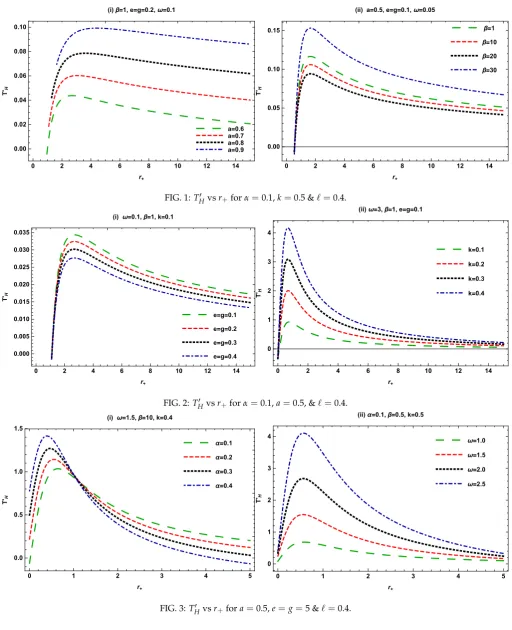
Figure 1indicates the behavior ofTH0 w.r.tr+for fixedα=0.1,k=0.5 and`=0.4.
(i)There can be seen an exponential increase in the temperatureTH0 and after attaining a height theTH0 slightly decreases with the increasing horizonr+ for varying values of rotation parametera. TheTH0 decreases as horizon increases, this physical behavior reflects the BH stability with positive temperature tillr+ → ∞. The temperature increases with the increase ofa.
(ii)We observe the behavior of temperature for varying values of correction parameterβwith fixed values of
dif-ferent parameters. TheTH0 decreases with increasing horizon in the domain 0≤r+≤15 after attaining a maximum height. The maximum temperature with non-zero horizon reflects the BH remnant. This physical behavior ofTH0 indicates the BH stability with positive range. It is also worthy to note that theTH0 increases with the increase of correction parameterβ.
Figure 2shows the behavior ofTH0 w.r.tr+for fixedα=0.1,a=0.5 &`=0.4.
(i)Figure shows that theTH0 exponentially increases and slowly falls down from a height for different values of electric and magnetic charges. The decrease inTH0 with the increasing horizon exhibits the stable state of BH in the domain 0 ≤r+ ≤ 15. It can be seen that theTH0 decreases with the increase of BH electric and magnetic chargese andg, respectively.
(ii)Figure indicates that the temperature eventually drops down from a height for different values of arbitrary parameterk. There is a significant change in temperature as it decreases exponentially and attains an asymptotically flat shape which indicates BH stability tillr+→+∞. TheTH0 increases with increase ofk.
Figure 3depicts the behavior of TH0 w.r.tr+ for fixeda = 0.5, e = g = 5 &` = 0.4 for varyingaandωin the
domain 0≤r+ ≤5.
(i)We can observe that initially the temperature increases with increasing horizon and after a maximum height it exponentially decreases with increasing which indicates the stable state of BH for different values of BH acceleration
α.
(ii)There can be seen thatTH0 exponentially increases and eventually falls down from a height and decreases as horizon increases tillr+ →+∞. This physical behavior identify the stability of BH with positive range for different values ofω. We can observe that with the increase in the value ofωtheTH0 increases.
III. CONCLUSION AND DISCUSSION
a=0.6
a=0.7
a=0.8
a=0.9
0 2 4 6 8 10 12 14
0.00 0.02 0.04 0.06 0.08 0.10
r+
T'H
(i)β=1, e=g=0.2,ω=0.1
β1
β10
β20
β30
0 2 4 6 8 10 12 14
0.00 0.05 0.10 0.15
r+ T'H
(ii) a=0.5, e=g=0.1,ω=0.05
FIG. 1:TH0 vsr+forα=0.1,k=0.5 &`=0.4.
e=g=0.1
e=g=0.2
e=g=0.3
e=g=0.4
0 2 4 6 8 10 12 14
0.000 0.005 0.010 0.015 0.020 0.025 0.030 0.035
r+ T'H
(i) ω=0.1,β=1, k=0.1
k=0.1
k=0.2
k=0.3
k=0.4
0 2 4 6 8 10 12 14
0 1 2 3 4
r+ T'H
(ii)ω=3,β=1, e=g=0.1
FIG. 2:TH0 vsr+forα=0.1,a=0.5, &`=0.4.
α0.1
α0.2
α0.3
α0.4
0 1 2 3 4 5
0.0 0.5 1.0 1.5
r+
T'H
(i) ω=1.5,β=10, k=0.4
ω 1.0
ω 1.5
ω 2.0
ω 2.5
0 1 2 3 4 5
0 1 2 3 4
r+ T'H
(ii) α=0.1,β=0.5, k=0.5
Hamilton-Jacobi technique, we have calculated the tunneling probabilities of boson particles. Moreover, we have analyzed the corrected Hawking temperatures of these BHs. We have concluded that the modified tunneling proba-bilities are not just depend upon the BHs properties but also depend on the properties of emitted boson particles, i.e., energy, potential, surface gravity, particles charge and total angular momentum. Moreover, it is important to note that the modified tunneling probabilities as well as Hawking temperature depend on the quantum particles which contributes gravitational radiation in form of massive particles (BH’s energy carrier) tunneling.
When the quantum gravity effects are neglected, i.e.,(β=0), then the corrected Hawking temperature Eq.(18) is
reduced to the absolute temperature obtained by quantum tunneling of boson (spin-1) particles [75]. If we ignore the potential effects(A=0), the modified Hawking temperature reduced to the temperature of vector (spin-1) particles provided in Refs.[66,87]. Also, for`=0 and ˜k=1, the above results are reduced to the Hawking temperature of the accelerating and rotating BHs with electric and magnetic charges [83]. Forα=0, we have recovered the temperature
of non-accelerating BHs from the Hawking temperature of the charged accelerating and rotating BHs [84]. Moreover, forβ =0,` = 0, ˜k= 1 andα =0 in Eq.(18), the Hawking temperature of the Kerr-Newman BH [85] is recovered,
which is reduced fora = 0 to the temperature of the RN BH. For Q = 0, the temperature exactly reduces to the Hawking temperature of the Schwarzschild BH at the residual mass of the BH [86].
In our analysis we have found that the quantum corrections decelerate the increase in temperature during the radiation process. This correction causes the radiation ceased at some specific temperature, leaving the remnant mass. The remnant will obtain at specific condition
MRes'
M2p
β0ω &
Mp
β0 .
It is important to mention here that the value of the corrected Hawking temperature is smaller than the original Hawking temperature and it stops radiating, when the mass of the BH reaches to its minimal valueMRes. However,
this result is still hold if background BH geometry is more generalized.
The results from the graphical analysis of corrected Hawking temperatures with respect to the horizon for the given BH is summarized as follows:
• For accelerating and rotating BH withNUTparameter, theTH0 decreases with the increasing horizon and BH reflects the stable state for varying values of rotation parameteraand correction parameterβ. The corrected
temperatureTH0 also increases with the increase inaandβ. The BH remnant can be obtained at nonzero horizon
with maximum temperature for different values ofβin the domain 0≤r+≤15.
• The corrected temperature TH0 decreases with the increase of e and g. For different values of electric and magnetic charges, the BH reflects stability in the domain 0≤r+ ≤15.
• TheTH0 increases with the increase in the value of arbitrary parameterk.
• TheTH0 increases with the increase in BH accelerationαand rotation parameterω.
• In our analysis, we have considered the valueΞ=0.01, then the condition of GUP must be satisfied for arbi-trary values of 0≤ β<100, the correction term is smaller than the usual term as well as positive temperature
is obtained. While, forβ>100 the first order correction term becomes greater than the usual term and the
con-dition of GUP do not satisfy and we observe the negative temperature which is non-physical. Furthermore, for
β=100, the semi-classical term cancel out with first order correction term and hence the temperature vanishes.
Acknowledgments
A. ¨O. acknowledges financial support provided under the Chilean FONDECYT Grant No. 3170035.
[1] Hawking, S.W.: Nature248(1974)30.
[2] R. Kerner, R.B. Mann, Class. Quant. Grav.25, 095014(2008). ibid; Phys. Rev.D 73, 104010(2006). [3] Q.Q. Jiang, S.Q. Wu, X. Cai, Phys. Rev.D 73, 064003(2006).
[7] R. Banerjee, B. R. Majhi, J. High Energy Phys.06, 095(2008).
[8] L. Brillouin, Comptes Rendus de lAcademie des Sciences183, 24(1926); [9] I. Sakalli and A. ¨Ovg ¨un, Gen. Rel. Grav.48, no. 1, 1 (2016).
[10] I. Sakalli and A. Ovgun, Eur. Phys. J. Plus130, no. 6, 110 (2015). [11] I. Sakalli and A. Ovgun, EPL110, no. 1, 10008 (2015).
[12] I. Sakalli and A. Ovgun, EPL118, no. 6, 60006 (2017).
[13] I. Sakalli and A. Ovgun, Astrophys. Space Sci.359, no. 1, 32 (2015). [14] I. Sakalli and A. Ovgun, J. Exp. Theor. Phys.121, no. 3, 404 (2015). [15] I. Sakalli and A. ¨Ovg ¨un, Eur. Phys. J. Plus131, no. 6, 184 (2016). [16] A. ¨Ovg ¨un, Int. J. Theor. Phys.55, no. 6, 2919 (2016).
[17] A. ¨Ovg ¨un and K. Jusufi, Eur. Phys. J. Plus132, no. 7, 298 (2017)
[18] K. Jusufi, A. Ovgun and G. Apostolovska, Adv. High Energy Phys.2017, 8798657 (2017) [19] X. M. Kuang, J. Saavedra and A. ¨Ovg ¨un, Eur. Phys. J. C77, no. 9, 613 (2017).
[20] X. M. Kuang, B. Liu and A. ¨Ovg ¨un, Eur. Phys. J. C78, no. 10, 840 (2018) [21] W. Javed, R. Babar and A. ¨Ovg ¨un, Mod. Phys. Lett. A34, no. 09, 1950057 (2019)
[22] P. A. Gonzalez, A. ¨Ovg ¨un, J. Saavedra and Y. Vasquez, Gen. Rel. Grav.50, no. 6, 62 (2018). [23] A. ¨Ovg ¨un, Adv. High Energy Phys.2017, 1573904 (2017).
[24] K. Jusufi and A. ¨Ovg ¨un,, Int. J. Theor. Phys.56, no. 6, 1725 (2017).
[25] Deyou Chen, Houwen Wu, Haitang Yang, Shuzheng Yang, Int. J. Mod. Phys.A 29(2014) 1430054. [26] Deyou Chen, Eur. Phys. J.C 74(2014) 2687.
[27] G. Gecim and Y. Sucu, Mod. Phys. Lett. A33, no. 28, 1850164 (2018). [28] G. Gecim and Y. Sucu, Phys. Lett. B773, 391 (2017).
[29] G. Gecim and Y. Sucu, Adv. High Energy Phys.2018, 8728564 (2018).
[30] W. Javed, R. Ali, R. Babar and A. ¨Ovg ¨un, Preprints 2019, 2019030194 (doi: 10.20944/preprints201903.0194.v3). [31] M. Hossain Ali and K. Sultana, Int.J.Theor.Phys.56, no.7, 2279-2292 (2017).
[32] M. Hossain Ali, Class.Quant.Grav.24, 5849-5860 (2007). [33] M. Hossain Ali, Int.J.Theor.Phys.47, 2203-2217 (2008). [34] M. Hossain Ali, Gen.Rel.Grav.36, 1171-1181 (2004).
[35] H. Pasaoglu and I. Sakalli, Int. J. Theor. Phys.48, 3517 (2009).
[36] E. T. Akhmedov, V. Akhmedova and D. Singleton, Phys. Lett. B642, 124 (2006).
[37] V. E. Akhmedova, T. Pilling, A. de Gill and D. Singleton, Theor. Math. Phys.163, 774 (2010). [38] A. de Gill, D. Singleton, V. Akhmedova and T. Pilling, Am. J. Phys.78, 685 (2010)
[39] T. Zhu, J. R. Ren and D. Singleton, Int. J. Mod. Phys. D19, 159 (2010)
[40] V. Akhmedova, T. Pilling, A. de Gill and D. Singleton, Phys. Lett. B666, 269 (2008) [41] V. Akhmedova, T. Pilling, A. de Gill and D. Singleton, Phys. Lett. B673, 227 (2009)
[42] E. T. Akhmedov, V. Akhmedova, T. Pilling and D. Singleton, Int. J. Mod. Phys. A22, 1705 (2007) [43] S. Kanzi and I. Sakalli, arXiv:1905.00477 [hep-th].
[44] M. Rizwan, M. Z. Ali and A. ¨Ovg ¨un, doi:10.1142/S0217732319501840, arXiv:1812.01983 [physics.gen-ph]. [45] G. Gecim and Y. Sucu, Gen. Rel. Grav.50, no. 12, 152 (2018)
[46] I. A. Meitei, T. I. Singh, S. G. Devi, N. P. Devi and K. Y. Singh, Int. J. Mod. Phys. A33, no. 12, 1850070 (2018). [47] G. R. Chen, S. Zhou and Y. C. Huang, Int. J. Mod. Phys. D24, no. 01, 1550005 (2014)
[48] X. X. Zeng and S. Z. Yang, Chin. Phys. B18, 462 (2009). [49] S. K. Modak, Phys. Lett. B671, 167 (2009)
[50] R. Li and J. R. Ren, Phys. Lett. B661, 370 (2008) [51] H. L. Li and S. Z. Yang, EPL79, no. 2, 20001 (2007).
[52] Q. Q. Jiang, S. Q. Wu and X. Cai, Phys. Lett. B651, 58 (2007) [53] X. He and W. Liu, Phys. Lett. B653, 330 (2007).
[54] T. M. He and J. Y. Zhang, Chin. Phys. Lett.24, 3336 (2007).
[55] H. L. Li, S. Z. Yang, Q. Q. Jiang and D. J. Qi, Phys. Lett. B641, 139 (2006). [56] X. Q. Li, G.R. Chen, Phys. Lett. B751, 34(2015).
[57] G. R. Chen, Y.C. Huang, Int. J. Mod. Phys. Rev. A30, 1550083(2015). [58] Z. Feng, Y. Chen, X. Zu, Astrophys. space Sci.48, 359(2015). [59] K. Jusufi, Ali ¨Ovg ¨un, Astrophys. Space Sci.361, 207(2016).
[60] J. M. Bardeen, in Conference Proceedings of GR5 (Tbilisi, URSS, 1968), p. 174. [61] A.D. Vries, T.S. Kaler, Phys. Rev. D65, 104022(2002).
[62] Q.Q. Jiang, Phys. Rev. D78, 044009(2008).
[63] T. Jian, C. Bing-Bing, Acta Physica Polonica,40, 241(2009). [64] A. Yale, Phys. Lett. B697, 398(2011).
[65] M. Sharif, W. Javed, Can. J. Phys. 90, 903(2012); ibid. Gen. Relativ. Gravit.45, 1051(2013); ibid. J. Exp. Theor. Phys. 115, 782(2012);ibid. Proceedings of the 3rd GalileoXu Guangqi Meeting, Int. J. Mod. Phys.: Conference Series,23, 271(2013);ibid. Proceedings of the 13th Marcel Grossmann Meeting (Stockholm, 2012), World Scientific,3, 1950(2015);ibid. J. Korean. Phys. Soc.57, 217(2010).
[68] A. ¨Ovg ¨un, W. Javed, R. Ali, Advances in High Energy Physics,3131620, 11(2018). [69] M.A Anacleto, F.A. Brito, G.C Luna, E. Passos, Annals of Phys.362, 436(2015). [70] G. Li, X. Zu, Journal of Applied Mathematics and Physics3, 134(2015). [71] M.A. Anacleto, F.A Brito, E. Passos, Phys. Lett. B749, 81(2015). [72] A. ¨Ovg ¨un, K. Jusufi, Eur. Phys. J. Plus131, 177(2016).
[73] T.I. Singh, I.A. Meitei, K.Y. Singh, Astrophys Space Sci103, 361(2016). [74] I. Sakalli, A. ¨Ovg ¨un, K. Jusufi, Astrophys Space Sci361, 330(2016). [75] W. Javed, G. Abbas, R. Ali, Eur. Phys. J. C77, 296(2017).
[76] W. Chen, H. L ¨u, C. N. Pope, Class. Quantum Gravity23, 5323(2006); ibid. Nucl. Phys. B762, 38(2007). [77] J.B. Griffiths, J. Padolsky, Class. Quant. Gravity24, 1687(2007).
[78] A.A. Badawi, M. Halilsoy, Gen. Relativ. Gravity38, 1729(2006). [79] J. B. Griffiths, J. Padolsky, Class. Quant. Gravity22, 3467(2005). [80] X.Q. Li, G.R. Chen, Phys. Lett. B751, 34(2015).
[81] X.Q. Li, Phys. Lett. B763, 80(2016).
[82] T. Shivalingaswamy, B.A. Kagali, Eur. J. Phys. Education2, 1309(2011).
[83] U.A. Gillani, K. Saifullah, Phys. Lett.B699, 15(2011); U.A. Gillani, M. Rehman, and K. Saifullah, JCAP06, 016(2011); M. Rehman, and K. Saifullah, JCAP03, 001(2011).
[84] M. Bilal, K. Saifullah, arXiv:1010.5575.
[85] R. Kerner, R.B. Mann, Phys. Lett.B665, 277(2008).