Type of the Paper (Article, Review, Communication, and so on)
Exploration on the Behavior Patterns of Public Bicycle Users
in Kaohsiung City from the Perspective of Theory of
Planned Behavior and Structural Equation Model
Huang Long-Sheng 1,* Su Wan-Ru2
1 Department of Distribution Management, SHU-TE, Kaohsiung City 82445, Taiwan (R.O.C.);
* Correspondence: [email protected]; Tel.: +886-7-6158000 ext 2203
2 Department of Distribution Management, SHU-TE, Kaohsiung City 82445, Taiwan (R.O.C.);
Abstract: Recently, the awareness of energy conservation, carbon emission reduction, and environmental protection in Taiwan has begun to gradually improve, and bicycles have become an important vehicle for residents. In 2009, Kaohsiung began promoting public bicycle sharing. The number of users in that year amounted to 140,000. By 2015, the accumulated number of users reached nine million. This study adopted the Theory of Planned Behavior (TPB) to explore the factors influencing the behavioral intentions of public bicycle users, including the three dimensions of attitude, subjective norm, and perceived behavioral control, and probed into the relationship between the factors influencing the behavioral intentions of public bicycle users in Kaohsiung City and the dimensions. This study used a questionnaire to collect data and SPSS & AMOS for statistical analysis. The empirical results demonstrated that the most prominent factors influencing the behavioral intentions of public bicycle users in Kaohsiung City included perceived behavioral control, attitude, and subjective norm, in order. Among the influencing factors in the three dimensions, personal interests, main groups, and self-competence had a positive and significant correlation. Administrators should provide more incentives related to the three influencing factors to encourage the public in Kaohsiung City to use public bicycles more frequently as their short-distance travel mode, so as to achieve the purposes of saving energy, reducing carbon emissions, and protecting the urban environment.
Keywords: Theory of Planned Behavior (TPB); Public bicycles; Structural Equation Model (SEM)
.
1. Introduction
The rapid popularization of private vehicles has also brought about environmental problems such as pollution, global warming, and climate change, as well as traffic jams. The 2015 data of the Taiwan Environmental Protection
Administration indicate that the amount of carbon dioxide discharged by vehicles accounted for 14.60% of the total emissions in Taiwan, only second to industrial emissions, which accounted for 47.84%. Jäppinen et al. 2013 [1] pointed out that it is efficient to take public transport or ride a bicycle in many cities in Europe, as that such actions can reduce air pollution, traffic jams, and carbon emissions. Karel 2007 [2] argued that riding a bicycle is faster than walking. Compared with private cars, bicycles can reduce energy consumption, air and noise pollution, and traffic jams. Furthermore, a bicycle sharing system can help achieve the goal of sustainable transportation, as well as reduce traffic jams, air pollution and carbon dioxide emissions in cities [3]. As a substitute for walking, public bicycles can reduce cost and pollution, and they promote health [4].
The public bicycle system of Kaohsiung City was officially put into use in March 2009. At present, there are 400 leasing stations, and the maximum turnover rate in one month is 6.54 times/bicycle/day. In 2016, the number of users was reached 12million. Apparently, the public bicycle sharing system of Kaohsiung City has been well received by users. The bicycles are widely used and contribute to the creation of a low-pollution environment in Kaohsiung City. Nevertheless, few studies have been conducted on the behavioral intentions behind the use of public bicycles in Kaohsiung City. This study aimed to explore the use of public bicycles in Kaohsiung City, investigate the behavioral attitude and perceived behavior of the users, and analyze the behavior patterns of public bicycle users in Kaohsiung City.
The Theory of Planned Behavior (TPB) was proposed by Ajzen in 1985. TPB utilizes the three main variables of attitude, subjective norm, and perceived behavioral control to predict the behavioral intention and behavior of individuals to participate in a specific activity. TPB asserts that the behavior of use is guided by behavioral beliefs, normative beliefs, and control beliefs [5]. Moore and Benbasat 1991 [6] proved that beliefs are decomposed into multidimensional forms, the relationship between beliefs and behavioral intentions, as well as the factors influencing behavioral intentions. Taylor and Todd 1995 [7] decomposed attitude into perceived usefulness, perceived ease of use, and compatibility, divided subjective norm into main groups and sub-groups, and separated perceived behavioral control into self-efficacy, perceived facilitation of resources, and perceived facilitation of technologies.
On the basis of TPB, this study analyzed the attitude, subjective norm, and perceived behavioral control of public bicycle users in Kaohsiung City, as well as the key factors influencing behavioral intention and actual behavior. In addition, structure equation modeling (SEM) coupled with the verification function of multiple regression and factor analysis, was also used to analyze the relationship among correlation coefficients. This study then applied (SEM) to verify the strategies to enhance the policy implementation, operation, and management of public bicycles in Kaohsiung City.
2.1 Study Framework
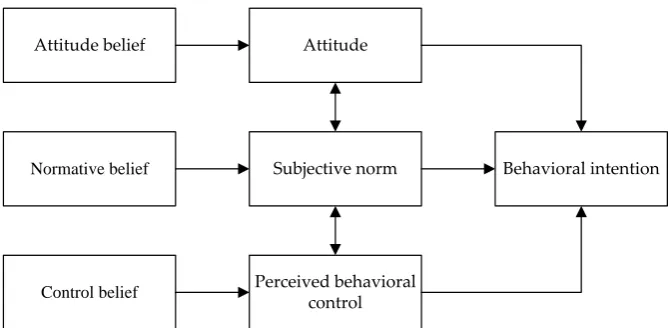
The main factors influencing behavioral attitude are behavior belief and outcome evaluation. Subjective norm is affected by normative belief and motivation to comply, and perceived behavioral control is mainly influenced by control belief and perceived facilitation [8]. Based on this, the structure of this study included attitude, subjective norm, perceived behavioral control, behavioral intention, and actual behavior. Variables were structuralized to improve the explanatory power of the model. In addition, the factors affecting attitude were classified into perceived ease of use, perceived usefulness, and environmental awareness. The factors influencing subjective norm were classified into family members, friends, colleagues, and media policies, and the factors affecting perceived behavioral control were classified into self-ability and perceived facilitation. This study proposed a research framework to explore the behavior patterns of public bicycle users in Kaohsiung City, as shown in Figure 1:
Attitude belief
Normative belief
Control belief
Attitude
Subjective norm
Perceived behavioral control
Behavioral intention
Figure 1. Research framework to explore the behavior patterns of public bicycle users in Kaohsiung City1
2.2 Study Hypotheses
This study proposed behavioral attitude, subjective norm, and perceived behavioral control as the three main variables determining behavioral intention. The more active the attitude is greater for the persons on whom it has an important influence. The perceived behavioral control is strong effect the behavioral intention. Based on the above, this study proposed three hypotheses as listed the following:
H1: The users' attitude will positively and significantly affect their behavioral intentions.
H2: The users' subjective norms will positively and significantly affect their behavioral intentions.
H3: The users' perceived behavioral control will positively and significantly affect their behavioral intentions.
attitudes.
H5: The users' environmental awareness will positively and significantly affect their attitudes.
H6: Main groups will positively and significantly affect their subjective norm. H7: Sub-groups will positively and significantly affect their subjective norm. H8: The users' self-ability will positively and significantly affect their perceived
behavioral control.
H9: The facilitating conditions will positively and significantly affect users' perceived behavioral control.
2.3. Operational Definition
This study explored the causality between the intention to use public bicycles and the use of public bicycles from the perspectives of the attitude, subjective norms, and perceived behavioral control of residents in Kaohsiung City. The operational definitions of the variables involved was listed in Table 1.
Table 1. Definition of variables1
Variable Operational definition
Attitude The users' positive or negative comments on the public bicycle system of Kaohsiung City.
Subjective norms
The degree of influence of their family members, friends, or those who support and encourage the users’ use of the public bicycle system of Kaohsiung City.
Perceived behavioral control
The degree of influence of self-ability on the use of public bicycles in Kaohsiung City.
Behavioral intention
The possibility and willingness of users to reuse or recommend Kaohsiung's public bicycle system in the future.
Personal interests
The benefits that users can obtain after using Kaohsiung's public bicycle system.
Environmental awareness
The degree of influence of awareness of environmental protection on the users of Kaohsiung's public bicycle system.
Main groups
The degree of influence of main groups (e.g. family members, friends, classmates, and colleagues) on the use of Kaohsiung's public bicycle system.
Sub-groups
The degree of influence of sub-groups (e.g. newspapers, magazines, TV channels, and ads on the MRT) on the use of Kaohsiung's public bicycle system.
Self-ability The self-assessment of users to successfully lease a public bicycle in Kaohsiung City.
Facilitating conditions
2.4 Questionnaire Design
The questionnaire of this study contained six parts, including attitude, subjective norm, perceived behavioral control, behavioral intention, actual behavior, and basic data on the respondents. A Likert six-point scale was adopted for scoring. Based on their feelings, experiences, or opinions after using public bicycles, the respondents filled in different scores. Each question had six options for scoring, including strongly disagree, disagree, somewhat disagree, somewhat agree, agree, and strongly agree.
The questionnaire was formally conducted from March 12 to April 12, 2017. A total of 420 copies of the questionnaire were sent out, all of which were collected. There were 412 valid copies and eight invalid ones, with a recovery rate of 98%.
2.5 Statistical Analysis
This study used SPSS for statistical analysis and SEM for data analysis, including descriptive statistical analysis, item analysis, reliability analysis, and SEM analysis. Descriptive statistical analysis refers to the frequency distribution and statistical analysis of the basic information collected and research dimensions so as to obtain the average, standard deviation, maximum value, and minimum value of each variable and understand the distribution of samples in each dimension, including gender, age, occupation, and educational level.
Reliability analysis aims to see if the data collected is internally consistent, and it is tested by Cronbach's α, which is often used in Likert's Attitude Scale. If Cronbach's α is above 0.7, it indicates reliability; if it is between 0.35 and 0.7, it implies that the reliability is acceptable; if it is below 0.35, it means low reliability [9].
SEM includes two basic forms: manifest variables, which can be identified through observation or investigation, and latent variables, which cannot be accurately or directly obtained via observation or investigation, but instead must be inferred through the manifest variables. The measurement model analysis used in this study included verification factor analysis, the univariate and multivariate normal test, the convergence validity and discriminant validity test, and fit analysis.
3 Test Results and Discussion
3.1 Results of Descriptive Statistical Analysis
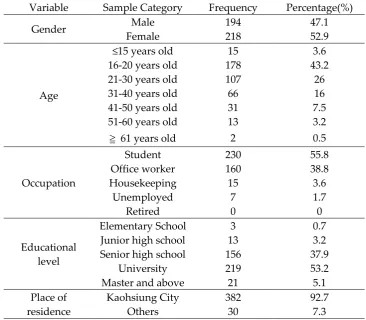
stable financial capacity, as residents above 40 years old tended to use private cars rather than public bicycles for commuting or shopping. Hence, their utilization rate of public bicycles was low.
In terms of occupation, most of the users of public bicycle were students, accounting for 55.8%, followed by office workers, accounting for 38.8%. It could be seen that most of the public bicycle users in Kaohsiung were students aged between 16 and 20 years old. In regard to place of residence, most of the respondents lived in Kaohsiung City, accounting for 92.7%, implying a regional trend of public bicycle users. The frequency of visitors riding a public bicycle was low.
Table 2. Frequency of using public bicycles by the respondents
Variable Sample Category Frequency Percentage(%)
Gender Male 194 47.1
Female 218 52.9
Age
≤15 years old 15 3.6
16-20 years old 178 43.2
21-30 years old 107 26
31-40 years old 66 16
41-50 years old 31 7.5
51-60 years old 13 3.2
≧ 61 years old 2 0.5
Occupation
Student 230 55.8
Office worker 160 38.8
Housekeeping 15 3.6
Unemployed 7 1.7
Retired 0 0
Educational level
Elementary School 3 0.7
Junior high school 13 3.2
Senior high school 156 37.9
University 219 53.2
Master and above 21 5.1
Place of residence
Kaohsiung City 382 92.7
Others 30 7.3
3.2 Factor Analysis and Reliability Analysis
The structure of the questionnaire in this study covered the three dimensions of attitude, subjective norm, and perceived behavioral control. It explored the correlation between the factors influencing the behavioral intentions of public bicycle users in Kaohsiung City and the dimensions. This study conducted Kaiser-Meyer-Olkin (KMO) analysis, and then used principal component analysis to extract the factors with an eigenvalue greater than 1.
interests, and awareness of environmental protection of users; (2) the subjective norm of use of Kaohsiung's public bicycle system, including 10 items that were adopted to understand the degree of influence on the use of public bicycles; (3) the perceived behavioral control of use of Kaohsiung's public bicycle system, including 11 items such as self-ability assessment and external support capacity; and (4) the intention to use Kaohsiung's public bicycle system and the usage behavior of the bicycles, including eight items that were adopted to understand the possibility and willingness to use the bicycles.
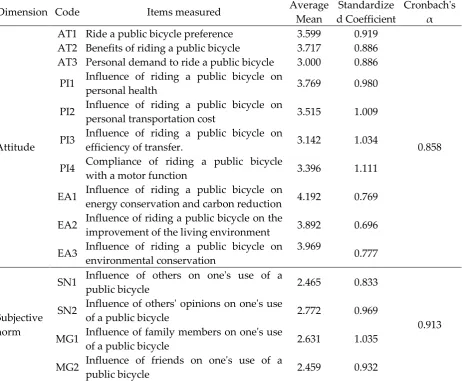
As shown in Table 3, this study verified the component reliability of the four dimensions of the use of Kaohsiung's public bicycle system, that is, attitude, subjective norm, perceived behavioral control, and behavioral intention. The Cronbach's α value of all dimensions were greater than 0.7. Bagozzi & Yi (1988) [10] stated that average variation extraction aims to observe latent variables. The standard value must be greater than 0.5. It could be seen that all the latent variables for the dimensions of attitude, subjective norm, perceived behavioral control, and behavioral intention could applied the willingness to use public bicycles in Kaohsiung City.
Table 3 Reliability analysis of the behavior to use public bicycles in Kaohsiung City
Dimension Code Items measured Average
Mean
Standardize d Coefficient
Cronbach's α
Attitude
AT1 Ride a public bicycle preference 3.599 0.919
0.858
AT2 Benefits of riding a public bicycle 3.717 0.886
AT3 Personal demand to ride a public bicycle 3.000 0.886
PI1 Influence of riding a public bicycle on
personal health 3.769 0.980
PI2 Influence of riding a public bicycle on
personal transportation cost 3.515 1.009
PI3 Influence of riding a public bicycle on
efficiency of transfer. 3.142 1.034
PI4 Compliance of riding a public bicycle
with a motor function 3.396 1.111
EA1 Influence of riding a public bicycle on
energy conservation and carbon reduction 4.192 0.769
EA2 Influence of riding a public bicycle on the
improvement of the living environment 3.892 0.696
EA3 Influence of riding a public bicycle on environmental conservation
3.969
0.777
Subjective norm
SN1 Influence of others on one's use of a
public bicycle 2.465 0.833
0.913 SN2 Influence of others' opinions on one's use
of a public bicycle 2.772 0.969
MG1 Influence of family members on one's use
of a public bicycle 2.631 1.035
MG2 Influence of friends on one's use of a
Dimension Code Items measured Average Mean
Standardize d Coefficient
Cronbach's α
MG3 Influence of colleagues on one's use of a
public bicycle 2.225 0.941
MG4 Influence of classmates on one's use of a
public bicycle 2.414 0.958
SG1 Influence of relevant reports on one's use
of a public bicycle 2.235 0.790
SG2 Influence of relevant medium reports on
one's use of a public bicycle 2.197 0.786
SG2 Influence of advertising on one's use of a
public bicycle 2.432 0.959
Perceived behavioral
PBC1 Self-assessment on the opportunities to
use a public bicycle 3.576 1.294
0.709 PBC2 Perceived behavior of use of Kaohsiung
City's public bicycles 2.224 0.918
PBC3 Time available to use a public bicycle 1.824 0.774
SA1 Personal ability to successfully lease a
public bicycle 3.661 1.041
SA2 Personal proficiency in leasing a public
bicycle 3.402 0.848
SA3
Personal proficiency in checking the public bicycle leasing system via the Internet
3.472 0.933
FC1 Satisfaction with special offers for renting
a public bicycle 2.766 1.169
FC2 Satisfaction with the information on
renting a public bicycle 2.565 1.149
FC3 Satisfaction with the after-sales service of
public bicycles 2.169 1.018
FC4 Satisfaction with the design of public
bicycles 2.161 0.887
Behavioral intention
BI1 Possibility to recommend others to use a
public bicycle 2.063 0.250
0.912 BI2 Willingness to continue to use a public
bicycle 1.938 0.250
This study applied SPSS 17.0 and AMOS (analysis of Moment Structure) 17.0 conducted to reveal the causal relationship among variables, test the fit of the model, and verify the hypotheses on perceived behavioral control and behavioral intention of public bicycle users in Kaohsiung City. Furthermore, it adopted the maximum likelihood model (MLM) to estimate the parameters. If the indicators related to the fit were not favorable, SEM was used for modification to meet the criteria of the fit indicators. For modification, this study referred to the modification index (MI) provided by Amos 17.0. Modification was conducted on the premise of having no influence on integrity.
hypothesis of multivariate normality. Therefore, the Mardia coefficient was used to test if the sample structure could meet the basic requirements of multivariate normality. This study quoted the parameter fit assessment standards of SEM, which are summarized in Table 4. The absolute values of the skewness coefficient were between -0.940 and -0.063, all of which were less than 3. The absolute values of the kurtosis coefficient were between -1.008 and 1.230, all of which were less than 10. Hence, the samples of this study could be regarded as normal and compliant with the univariate normal distribution. The observation item p = 32, p (p + 2) = 1088. The Mardia coefficient was 64.687 and less than 1088, indicating that the Mardia coefficient of each dimension in this study met the standard. Thus, MLM in SEM could be used to estimate the parameters.
Table 4. Distribution of skewness and kurtosis coefficients
Variable skew
composite reliability
(CR)
kurtosis
composite reliability
(CR)
Attitude
AT1 -0.816 -6.765 1.100 4.558
AT2 -0.801 -6.637 1.065 4.411
AT3 -0.290 -2.406 -0.197 -0.815
Personal interests
PI1 -0.894 -7.405 1.230 5.094
PI2 -0.819 -6.783 0.530 2.196
PI3 -0.390 -3.229 -0.240 -0.993
PI4 -0.739 -6.126 0.321 1.331
Environmental awareness
EA1 -0.847 -7.021 0.401 1.661
EA2 -0.812 -6.728 0.307 1.272
EA3 -0.790 -6.544 0.264 1.094
Subjective norms SN1 -0.486 -4.031 -0.169 -0.698
SN2 -0.659 -5.457 0.181 0.751
Main groups
MG1 -0.614 -5.085 -0.060 -0.25
MG2 -0.604 -5.004 -0.076 -0.316
MG3 -0.500 -4.140 -0.540 -2.236
MG4 -0.530 -4.391 -0.369 -1.529
Sub-groups
SG1 -0.228 -1.885 -0.622 -2.576
SG2 -0.240 -1.992 -0.712 -2.949
SG3 -0.308 -2.555 -0.467 -1.935
Perceived behavioral control
PBC1 -0.940 -7.793 0.911 3.776
PBC2 -0.298 -2.467 -0.662 -2.743
PBC3 0.063 0.521 -0.808 -3.346
Self-ability
SA1 -0.793 -6.574 0.425 1.761
SA2 -0.598 -4.953 0.542 2.245
SA3 -0.684 -5.669 0.548 2.271
SA4 -0.588 -4.871 0.212 0.878
Facilitating conditions
FC1 -0.122 -1.01 -0.706 -2.923
FC2 -0.213 -1.769 -0.786 -3.256
FC3 -0.083 -0.684 -1.008 -4.175
FC4 0.052 0.427 -0.851 -3.528
Behavioral intention
BI1 -0.499 -4.131 -0.108 -0.447
Variable skew
composite reliability
(CR)
kurtosis
composite reliability
(CR)
Multivariate 297.32 64.687
3.3 Confirmatory Factor Analysis (CFA)
Measurement model analysis is used to find the internal structural model fit and learn the relationship between manifest and latent variables, and CFA is used to verify the reliability, convergence, and validity of each dimension [12]. During measurement model analysis, latent variables cannot be used directly for measurement and estimation, which must be inferred through the manifest variables [13]. Bagozzi & Yi (1988) [10] suggested three commonly used measurement indicators, including factor load, composite reliability, and average variance extracted (AVE). Hair et al. 2010 [14] regarded a composite reliability (CR) of 0.7 as an acceptable threshold, while Fornell & Larcker (1981) [15] suggested the CR value should be above 0.6. Moreover, suggesting that the Average Variance Extracted (AVE) must be greater than 0.5.
Base on, this study classified the behavior patterns of the users of public bicycles in Kaohsiung City into a first-order and six-factor measurement model to conduct first order confirmatory factor analysis.
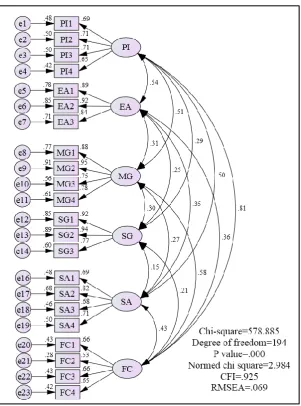
As shown in Figure 2, the first-order & six-factor measurement model included six dimensions: personal interests (PI), environmental awareness (EA), main groups (MG), sub-groups (SG), self-ability (SA), and facilitating conditions (FC). Table 5 shows the reliability and validity analysis of the first-order & six-factor measurement model. In the analysis of the first-order & six-factor measurement model, the AVE of PI and FC was below 0.5. As a result, in line with the principle of MI < 3.84, the variable relationship of the measurement model was modified. After PI1 and PI4 were deleted, CR became 0.67, which was above 0.6, and AVE became 0.504, which was above 0.5. After FC1, FC2, FC3, and FC4 were deleted, the AVE still failed to go above 0.5.
Figure 2. Confirmatory factor analysis of first-order & six-factor measurement model
Table 5. Reliability and validity of first-order & six-factor measurement model
Variable Code Factor load
> 0.5
C.R. t-value
SMC > 0.20
CR
≧0.70
AVE > 0.50
Personal interests
PI1 0.69 7.46*** 0.48
0.784 0.477
PI2 0.71 11.15*** 0.50
PI3 0.71 11.11*** 0.50
PI4 0.65 11.9*** 0.42
Environmenta l awareness
EA1 0.89 7.35*** 0.78
0.915 0.781
EA2 0.92 6.73*** 0.85
EA3 0.84 11.78*** 0.71
Main groups
MG1 0.88 11.57*** 0.77
0.907 0.712
MG2 0.95 11.58*** 0.91
MG3 0.75 12.34*** 0.56
MG4 0.78 9.31*** 0.61
Sub-groups
SG1 0.92 6.97*** 0.85
0.911 0.774
SG2 0.94 11.11*** 0.89
Variable Code Factor load > 0.5
C.R. t-value
SMC > 0.20
CR
≧0.70
AVE > 0.50
Self-ability
SA1 0.69 5.31*** 0.48
0.817 0.529
SA2 0.82 13.1*** 0.68
SA3 0.68 12.81*** 0.46
SA4 0.71 6.77*** 0.50
Facilitating conditions
FC1 0.66 5.31*** 0.43
0.720 0.394
FC2 0.53 12.85*** 0.28
FC3 0.66 11.66*** 0.43
FC4 0.65 8.25*** 0.42
Table 6. Coefficient estimation after modification of first-order & six-factor measurement model
Path Coefficient
estimation
Standardized
coefficient p value
PI2 <--- PI 1 0.69 —
PI3 <--- PI 1.142 0.725 ***
EA1 <--- EA 1 0.885 —
EA2 <--- EA 1.141 0.923 ***
EA3 <--- EA 1.033 0.843 ***
MG1 <--- MG 1 0.877 —
MG2 <--- MG 1.1 0.953 ***
MG3 <--- MG 0.961 0.748 ***
MG4 <--- MG 0.974 0.784 ***
SG1 <--- SG 1 0.923 —
SG2 <--- SG 1.034 0.941 ***
SG3 <--- SG 0.828 0.773 ***
SA1 <--- SA 1 0.684 —
SA2 <--- SA 1.17 0.834 ***
SA3 <--- SA 0.955 0.68 ***
SA4 <--- SA 0.986 0.697 ***
Note: *** means p < 0.001.
Table 7. Fit assessment and analysis of first-order & six-factor measurement model (after modification)
Indicator Judgment value Actual measured value Fit
χ2 The smaller, the better 181.604 Fit
χ2/df ≦3 1.932 Fit
CFI ≧0.9 0.978 Fit
RMSEA ≦0.08 0.048 Fit
Note: *** means P < 0.001.
3.4 Fit Assessment of the Overall Model
AT to EA, from SN to SG, from AT to EA, and from SN to SG, after which the model reached a significant level and met the standard. Figure 10 presents the final model.
Table 8. Overall SEM (after modification) fit assessment and analysis (results of the second modification)
Indicator Judgment value Actual measured value Fit
χ2 The smaller, the better 319.838 Fit
χ2/df ≦3 2.908 Fit
CFI ≧0.9 0.952 Fit
RMSEA ≦0.08 0.068 Fit
Figure 3. Analysis of overall SEM (after modification) path fit
3.5 Verification of Research Hypotheses
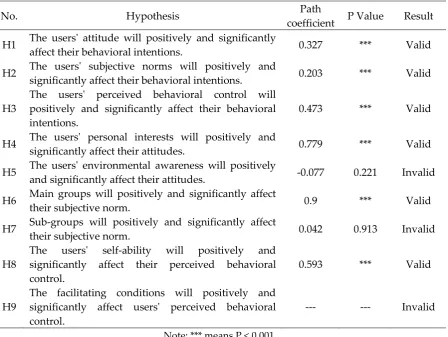
shown in Table 9. Personal interest was the most significant influencing factor in the dimension of attitude. Therefore, this study suggested increasing the benefits of users for handling performance, riding comfort, safety response, low prices, and transfer preferences, as well as setting up more channels to interact with users, so that public bicycle users in Kaohsiung City can access information on the benefits more easily and enhance their behavioral intention to use public bicycles.
Main group was the most prominent influencing factor in the dimension of subjective norm. The opinions and degree of support of family members and friends of public bicycle users had the most significant influences on users. This study suggested enhancing the support to use public bicycles from family members and friends so as to increase users' willingness to further use public bicycles. Self-ability was the most significant influencing factor in the dimension of perceived behavioral control. Via the interface of the public bicycle leasing system, users can successfully lease a public bicycle, which can best increase the willingness of users to ride public bicycles. Hence, the leasing devices, such as the leasing system interface, the network inquiry system, and the information presentation, which are operated by the users, should be simple and concise so as to raise the self-ability of users to rent a bicycle and improve their intention to use.
Table 9. Summary of the verification results of the hypotheses
No. Hypothesis Path
coefficient P Value Result
H1 The users' attitude will positively and significantly
affect their behavioral intentions. 0.327 *** Valid
H2 The users' subjective norms will positively and
significantly affect their behavioral intentions. 0.203 *** Valid
H3
The users' perceived behavioral control will positively and significantly affect their behavioral intentions.
0.473 *** Valid
H4 The users' personal interests will positively and
significantly affect their attitudes. 0.779 *** Valid
H5 The users' environmental awareness will positively
and significantly affect their attitudes. -0.077 0.221 Invalid
H6 Main groups will positively and significantly affect
their subjective norm. 0.9 *** Valid
H7 Sub-groups will positively and significantly affect
their subjective norm. 0.042 0.913 Invalid
H8
The users' self-ability will positively and significantly affect their perceived behavioral control.
0.593 *** Valid
H9
The facilitating conditions will positively and significantly affect users' perceived behavioral control.
--- --- Invalid
Note: *** means P < 0.001.
4. Conclusion
following conclusions can be drawn:
1. This study found that most of the users of public bicycles in Kaohsiung City are females, mostly between 16 and 20 years old, and students. The top purpose to ride a public bicycle is for sightseeing in the city. After riding a public bicycle, most of the users transfer to the mass rapid transit.
2. In terms of the overall model verification of the behavior patterns of public bicycle users in Kaohsiung City, the explanatory power of attitude, subjective norm, and perceived behavioral control was above 57%. They have significant and positive influences on behavioral intentions. The results indicated that the motivation of use and attitude of public bicycle users in Kaohsiung City significantly increase their behavioral intention to use public bicycles.
3. Individuals with an influence on public bicycle users in Kaohsiung City, as well as the opinions of those who support and encourage the respondents to use a public bicycle, could influence the behavioral intention of the users. The users have a higher self-ability to use the public bicycle leasing system in Kaohsiung City, their behavioral intention will be higher.
4. The verification results of the manifest variables of the behavior patterns of public bicycle users in Kaohsiung City implied that personal interest is the most significant factor influencing attitude. “Main group” is the most prominent influencing factor in the dimension of the subjective norm. The degree of influence of family members on of public bicycle users is the greatest, followed by that of friends. Self-ability is the most significant influencing factor in the dimension of perceived behavioral control.
5. The leasing devices, including the information presentation, of public bicycles influence the degree of difficulty in understanding how to use public bicycles. When users can use the public bicycle leasing system more smoothly, their perceived behavioral control of public bicycles will become stronger, and their behavioral intentions to use public bicycles will rise as well.
Acknowledgments: This study is endorsed by the 104-year special research program of the Ministry of Science and Technology (MOST 106-2221-E-366-002), Taiwan (ROC).
References
1. Jäppinen, S., Toivonen, T. and Salonen, M. Modelling the potential effect of shared bicycles on public transport travel times in Greater Helsinki. An open data approach. Applied Geography. 2013, 43(8), 13–24.
2. Karel, M. Promoting bike-and-ride: The Duetch experience. Transportation Research Part A. 2007, 41(4), 326-338.
3. Tight, M., Timms, P., Banister, D., Bowmaker, J., Copas, J., Day, A. and Macmillen, J. Visions for a walking and cycling focused urban transport system. Journal of Transport Geography. 2011, 19(6), 1580-1589.
967-985.
5. Ajzen, I. Perceived behavioral control, self-efficacy, locus of control, and the theory of planned behavior. Journal of Applied Social Psychology. 2002, 32(4), 665-683.
6. Moore, G. C., and Benbasat, I. Development of an instrument to measure the perceptions of adopting an information technology innovation. Information Systems Research, 1991, 2 (3), 192-222.
7. Taylor, S. E., and Todd, P. A. Decomposition and crossover effects in the theory of planned behavior: A study of consumer adoption intentions.
International Journal of Research in Marketing, 1995, 12 (2), 137-155.
8. Ajzen, I. The theory of planned behavior. Organizational Behavior and Human Decision Processes, 1991, 50, 179-211.
9. Cortina, J. M. What is Coefficient Alpha? An Examination of Theory and Application. Journal of Applied Psychology, 1993, 78(1), 98–104.
10. Bagozzi, R. P., and Yi, Y. On the evaluation of structural equation models.
Academic of Marketing Science, 1988, 16 (1), 76-94.
11. Ding, L., Velicer, W., and Harlow, L. Effects of estimation methods, number of indicators per factor and improper solutions on structural equation modeling fit indices. In Structural Equation Modeling, 1995, 2, 119-143.
12. Bagozzi, R. P. Assessing Construct Validity in Personality Research: Applications to Measure Self-Esteem. Journal of Research in Personality, 1993, 27(1), 49-87.
13. Diamantopoulos, A., and Siguaw, J. A. Introducing LISREL. London: Sage Publications, 2000.
14. Hair, F, J., Black, W. C., Babin, B. J., and Anderson, R. E. Multivariate Data Analysis (7th ed.). Upper Saddle River, NJ: Pearson, 2010.