A Trustworthy and Energy-Aware Routing Protocol in
Software-Defined Wireless Mesh Networks
Hui Lin1, Jia Hu2*, Li Xu1, YouLiang Tian3, Lei Liu4, Stewart Blakeway5
1Fujian Provincial Key Laboratory of Network Security and Cryptology, School of Mathematics and Computer
Science, Fujian Normal University, Fuzhou, 350007 China
2Department of Mathematics and Computer Science, University of Exeter, Exeter, EX4 4QF, UK
3College of Science, Guizhou University, Guiyang 550025, China
4School of Computer Science and Technology, Shandong University, Jinan 250100, China 5Department of Mathematics and Computer Science, Liverpool Hope University, L16 9JD, UK
Abstract- Hybrid Wireless Mesh Networks (HWMNs) were proposed to address the challenges in wireless
communications to support mobile applications across different domains. Due to the multi-hop and decentralized
network architecture, HWMNs are naturally susceptible to various security threats, especially internal attacks.
Therefore, HWMNs must be able to detect anomalies, provide secure routing and protect user privacy through the
cooperation among nodes. However, the existing routing protocols for HWMNs cannot ensure the security to protect
the users privacy effectively. Moreover, traditional HWMNs are vertically integrated where the control and data
planes of mesh routers are bundled together, which makes it complex and difficult to configure the network
according to predefined security policies, and to adaptively respond to various dynamic security threats.
Software-Defined Wireless Mesh Networks decouple the control plane and data plane of routers and thus enable a
more flexible and efficient configuration of security policies. Taking up this opportunity to address the
aforementioned challenges, this paper proposes a privacy-aware, secure and energy-aware green routing (PSGR)
protocol that can defend against internal attacks, achieve stronger privacy protection and reduce energy consumption
in Software-Defined HWMNs. The elaborate theoretical analysis verify that the PSGR protocol can implement the
security and privacy protection against internal attacks effectively and efficiently. Simulation results demonstrate a
superior performance of PSGR in terms of packet delivery ratio, network throughput and energy efficiency
compared to the existing PA-SHWMP, PASER, and HWMP protocols in the presence of Blackhole/Grayhole
Keywords- hybrid wireless mesh networks, privacy protection, energy efficiency, secure routing, software defined
networks
1. INTRODUCTION
The hybrid wireless mesh networks (HWMNs) integrate both ad hoc and backbone WMNs [1, 2]. Due to the
multi-hop decentralized architecture and special characteristics of the communication mode, HWMNs are exposed
to various attacks, especially internal attacks launched by the internal legitimate nodes [2, 3]. As a result, HWMNs
face multiple threats that could launch various internal attacks to obtain private data. Moreover, as the
popularization and application scope of HWMNs expand unceasingly, more and more private information is stored
in HWMNs. The leakage of such private information could bring disaster to individuals and the society.
Consequently, internal attacks have become one of the most notable security problems in HWMNs [3].
As a fundamental and critical security aspect of HWMNs, the routing protocol has always been the main target
of internal attacks. Various routing attacks launched from inside can damage the integrity, confidentiality and
usability of private information [4]. Therefore, in order to achieve the protection of privacy and offer support for
real-time applications and smooth delivery of broadband services, HWMNs must be equipped with a secure,
privacy-aware and efficient routing protocol. Traditional HWMNs are vertically integrated where the control and
data planes are bundled together, which makes the development and deployment of new routing algorithms very
hard since it would imply a modification of the control plane of all network devices – through the installation of new
firmware and, in some cases, hardware upgrades. However, Software-Defined Mesh Networks [5, 6] decouple the
control plane and data plane of mesh routers, thus enable a more flexible and efficient configuration of security
policies in the secure routing protocols.
The implementation of a privacy aware secure routing protocol in Software Defined HWMNs is very
8] are dependent on the cooperation of nodes and based on the assumption that the participating nodes are honest
and well-behaved with no malicious or dishonest intentions. However, in practice nodes in a HWMN may be
compromised by malicious users and are subject to various attacks from inside due to the intrinsically open and
distributed nature of HWMNs [7]. (2) The mesh clients in the HWMNs could be mobile and thus are normally
power constrained [8]. Therefore it is natural and imperative to consider the energy consumption of the mesh clients
in routing so as to improve energy efficiency and thus prolong the battery life of the mesh clients.
To address the aforementioned issues, we propose a privacy-aware, secure and green routing protocol (PSGR)
in HWMNs. In addition to achieving strong security and privacy protection, the PSGR can also maintain a good
balance between security and performance. The major contributions of this work include:
(1) The proposed PSGR protocol integrates a novel dynamic reputation mechanism, a security level (SL)
classified scheme and a hierarchical key management protocol in order to dynamically identify and manage the
malicious nodes as well as defend against internal attacks in the routing process for HWMNs.
(2) The PSGR can further enhance privacy and security by preventing malicious nodes from modifying and
interpreting packets. The energy consumption in PSGR is taken into account in the process of routing through the
presented energy consumption analysis model which makes the PSGR satisfy the requirements of both security and
energy-efficiency.
(3) Verified by the elaborate theoretical analyses, the PSGR protocol can implement the security and privacy
protection against internal attacks effectively and efficiently. Extensive OPNET simulation experiments demonstrate
that the PSGR protocol outperforms the existing routing protocols in terms of packet delivery ratio, network
throughput and energy efficiency in the presence of Blackhole/Grayhole attacks and wormhole attacks.
The rest of the paper is organized as follows Section 2 presents a brief review of the related work; Section 3
mechanism and the hierarchical key management protocol; Section 6 details the implementation of PSGR; Section 7
discusses the security and the analysis performance of PSGR. Finally in Section 8 concluding remarks are drawn.
2. RELATED WORK
The multi-hop decentralized architecture of HWMNs makes it difficult to design a privacy aware secure routing
protocol. The early studies were devoted to applying ad hoc routing protocols for WMNs. However, due to the
significant differences in the characteristics between ad hoc networks and WMNs such efforts were not fruitful [9].
Afterwards, tremendous research has focused on specific secure routing protocols in the backbone WMNs with
the aim of applying them in HWMNs later on. Several cross-layer secure routing protocols with the combination of
routing performance and security were proposed in [7, 10] for the backbone WMNs. These protocols combine in a
cross-layered approach the different parameters from various layers across the protocol suite. For example
routing-layer observations of forwarding behaviour and MAC layer to measure the quality of the wireless link in
order to select the most reliable path with the highest performance. However, these routing protocols are not suitable
for HWMNs due to the ad hoc nature of nodes and their ineffective privacy protection in HWMNs. Khan et al. [7]
proposed the Secure Routing Protocol SRPM which is an improved AODV protocol for a backbone WMN.
However, SRPM is vulnerable to the attacks launched by legitimate internal mesh nodes and thus cannot provide
privacy protection effectively. Islam et al. [11] proposed a secure hybrid wireless mesh protocol (SHWMP) which is
a secure extension of HWMP. However, SHWMP is also vulnerable to the attacks launched by legitimate internal
mesh routers; an active attacker can compromise and control mesh routers to obtain private user information.
The infrastructure of HWMNs is highly adaptable as opposed to other networks such as the Internet, Wi-Fi,
WiMAX, cellular networks or sensor networks. HWMNs are thus considered to be the most applicable architecture
backbone WMNs are not well suited for HWMNs, thus a variety of approaches have been recently proposed for
designing secure routing protocols for HWMNs. For instance, Ren et al. [12] proposed PEACE, a novel
privacy-enhanced yet accountable security framework for HWMNs. However, PEACE only secures the network
from external attacks and takes for granted that every internal node is cooperative and trustworthy. In [13], Khan et
al. presented a cross-layer secure and resource-aware on demand routing protocol (CSROR). Because the security
mechanism of CSROR is taken from the SRPM [7], it is vulnerable to the attacks launched by legitimate internal
mesh nodes and cannot provide efficient privacy protection.
The existing routing protocols for HWMNs cannot ensure security or protect user privacy effectively because
they are vulnerable to internal attacks. Moreover, few of the existing works have taken the energy consumption into
account when making a routing decision. To bridge this gap we propose a privacy-aware, secure and green routing
protocol (PSGR) in this paper. The PSGRcan defend against the internal attacks effectively and achieve stronger
security, privacy protection and also maintains a good balance between security and performance. Furthermore, as
the energy consumption is also taken into account in the process of routing, PSGR can satisfy the requirements of
both security and energy-efficiency.
Lin et al. [14] proposed a Privacy-Aware Secure Hybrid Wireless Mesh Protocol (PA-SHWMP) to defend against
inside attacks in WMNs, and later [15] proposed a role based secure routing protocol. Compared with these previous
work [14, 15], this paper offers original and important contributions by 1) taking into account energy consumption
in the routing process; 2) considering HWMNs that is more practical and exposed to attacks than WMNs; 3) optimal
route selection and route maintenance; 4) malicious node classification and management.
3. BACKGROUND
In this paper, we employ the holistic approach to implement the security and privacy preserving in HWMNs,
where two types of security mechanisms work together in a coordinated and adaptive way. One is the preventive
security mechanism that attempts to prevent attacks, e.g., cryptography techniques. The other is the reactive security
mechanism trying to detect and react against intrusions such as reputation mechanisms.
Every mesh node pre-loads an identity table which provides the information of peering mesh nodes in the
network. Each entry of the table describes the identity of a specific mesh node through binding the following
information together with the mesh node: MAC address, SL, and valid time period. The trusted identity manager in
HWMNs has to reflect the current bindings of mesh nodes in HWMNs and mesh nodes need to contact the identity
manager when the service is available to keep the freshness and correctness of the identity table. Every mesh node
also pre-loads a local reputation table storing the direct opinion on others and a certain SL based on its hierarchic
ranking or the role it plays in HWMNs. A hierarchical key distribution center is pre-loaded in HWMNs where each
mesh node pre-loads a key pool and an initial key according to its SL through using the proposed novel hierarchical
key management protocol. Each of these keys are hashed using a secure hash function dependent on the key size.
3.2. Adversary Model
HWMNs are vulnerable to both external and internal attacks. External attacks in HWMNs have been well
investigated. However, there is not much exploration on the internal attacks in HWMNs, particularly on the security
and privacy protection based routing protocol for HWMNs. We focus on two most common internal attacks that are
launched by an adversary appearing to be a legitimate participant in the network [16]:
1. Blackhole/Grayhole attack: Blackhole attack and its variant Grayhole attack are the attacks that lead to
Denial-of-Service (DoS) in HWMNs. In a Blackhole attack, the malicious node drops all the traffic that is
supposed to be forwarded; while in a Grayhole attack, the adversary avoids detection by dropping the
2. Wormhole attack: A wormhole attack aims to prevent discovering route between two legitimate nodes or
divert traffic to malicious nodes by establishing a tunnel within two or more malicious collusion nodes. As a
result, the malicious nodes are added in the path and then they either drop all the packets resulting in a
complete DoS attack, or drop the packets selectively to avoid detection.
The adversary may compromise certain nodes and gain full control of them. Once nodes are captured the
attacker can gain access to all stored information, including public keys, private keys. The adversary could also
reprogram the captured nodes to behave in a malicious manner. The purposes of the adversary include: 1) DoS
attacks (launched via dropping packets) against service availability, 2) illegal and unaccountable network access and
3) the privacy of legitimate network users [12].
3.3. Energy Model
With the aim of improving energy efficiency and prolonging battery life of the mesh client nodes energy
consumption is taken into account as an important factor when choosing the best path based on Eq.(5) in the routing
protocol design detailed in Section 6.
A multitude of research efforts have been devoted to modelling the energy consumption of wireless networks
[17]. Moreover, IEEE 802.11 Distributed Coordination Function (DCF) [18] based Medium Access Control (MAC)
protocols have been widely used in wireless ad hoc networks where the energy consumption is a critical issue. In
this section, we analyze the energy consumption per successful packet transmission of a client in a WMN using a
cost-efficient analytical model [17]. Without loss of generality we consider a scenario of N client nodes. The
transmission queue at each client node is modelled as an M/M/1/K queuing system where the traffic follows a
Poisson arrival process with rate
λ
(packets/second), whereKrepresents the buffer size at the client node.Let
e e
tx, ,
rxe
ovande
iddenote the power required for transmitting, receiving, overhearing and being idle,respectively. The overall energy consumed by a client node to successfully transmit a packet,
E
,
can besu co bf em
E
=
E
+
E
+
E
+
E
(1)where
E
su is the energy consumption for a successful packet transmission from the client node,E
cois the energywasted in collisions before the successful transmission,
E
bf is the energy spent in the backoff stages, andE
em isthe energy consumed when the client node has no pending packet between any two consecutive transmissions.
These components of the energy consumption model can be obtained from [17].
3.4. Subjective Logic
Subjective logic [19] represents a specific belief calculus that uses a belief metric called opinion to express
subjective reputation. Since it is necessary to develop mechanisms to detect and manage malicious nodes in WMNs
subjective logic with the ability to explicitly represent and manage a nodes uncertainty has emerged as an attractive
tool for handling trust relationships in WMNs.
In subjective logic each opinion is denoted by a 4-tuple
ω
x y:=
(
b
x y:,
d
x y:,
u
x y:,
a
x y:)
, where:
x y
b
,
dx y:,
ux y: designate node x’s belief, disbelief and uncertainty towards y respectively. The base rate: x y
a
designates x’s willingness to believe y which determines how uncertainty is viewed as belief when thereputation is used. The uncertainty reflects the confidence in node x’s knowledge of y; an uncertainty of 1.0
represents that a node has no basis for any conclusion. They satisfy the following conditions.
: : :
: : : :
1.0
,
,
,
[0.0,1.0]
x y x y x y
x y x y x y x y
b
d
u
b
d
u
a
+
+
=
⎧⎪
⎨
∈
⎪⎩
(2)
When an opinion is used in a decision, it is projected onto the belief/disbelief axis through its expectation,
(
x y:)
E
ω
, which is used to identify malicious nodes and can be computed as(
x y:)
x y: x y x y: :4. A SUBJECTIVE LOGIC BASED DYNAMIC REPUTATION MECHANISM
In this section, a subject logic based dynamic reputation mechanism (DRM) is presented to defend against the
internal attacks, to preserve the privacy of information and to promote a secure and reliable collaboration
relationship among participants.
4.1. Dynamic Reputation Mechanism (DRM)
Suppose x and y are two neighbouring nodes, the final opinion of x towards y at time t0, 0, :
final t x y
ω
, includes twocomponents. One is the direct opinion
0, :
dir t x y
ω
;; the other is the recommendation opinions 0, : rec t x yω
.4.1.1. Direct Opinion
The direct opinion
0, :
dir t x y
ω
, is stored in node x’s local reputation table and can be computed as0 0 0 0 0 0 0 0 : , : 1 : ( : ) : , : 1 : ( : )
((1 ) )
((1 ) )
s x y dir
t x y t
t s
x y l x y t
t f
x y dir
t x y t
t s
x y l x y t
t N b T N Q T N d T N Q T
α
α
α
α
− − ⎧ = ⎪ ⎪ × − × + × ⎪⎪ ⎨ ⎪ = ⎪ ⎪ × − × + × ⎪⎩ (4)whereNx y: is the total number of packets that have been transmitted by node x to node y for forwarding, s: x y N
denotes the number of packets that have been successfully forwarded by node y, f: x y
N is the number of packets that
node y has not forwarded. 0 1
( : )
t l x y
Q − is the evaluation value of the link quality between x and y during the
measurement period of the (t0-1)-th cycle [20]. α is the smoothed constant (0<α<1). Tst0 and
T
tt are thenumber of successful transmissions and the total number of transmissions during the measurement period of the t0-th
cycle, respectively.
For an entirely unknown node or a new node in DRM there is no basis for any conclusion about belief b and
disbelief d (which means full uncertainty), the default opinion assigned by its neighbours is (0.0,0.0 1.0,0.5), where
the willingness to believe a is set to be the mean between 0 and 1.
When there is not enough records of interaction history for node x to evaluate the direct opinion towards y or
the direct opinion is not enough for x to make a decision towards y, x will start a recommendation opinion query by
broadcasting a Reputation Query message to the neighbours and waits for a time interval T. Whenever one of node
x’s neighbours receives the Query message it checks its local reputation table to see whether there is a direct opinion
towards y with the uncertainty value of less than 1.0. If there exists a direct opinion, the neighbour sends a Reply
message to x containing its id, SL and subjective opinion on y, otherwise it simply ignores the query.
After receiving the replies x will execute the recommendation opinion evaluation phase. Let R represent the set
of recommenders ( R =n n, >1), then the recommendation opinion at time t0 can be calculated by Eqs. (5)-(7) in
[15]. After getting the direct opinion and the recommendation opinion, the final opinion at time t0, 0, : final t x y
ω
, can becalculated by Eqs. (8)-(10) in [15].
The multi-level security technology [20] is used to classify the malicious nodes and to decide whether and how
to punish or isolate the nodes in order to make the malicious nodes management more flexible and to improve the
fault-tolerant capability of DRM. Link security aims to authenticate a peer and to establish session keys between two
Mesh nodes (MDs) during the transmission process. A hierarchical key management protocol HKMP [15] is used to
improve the transmission security for the proposed routing protocol.
5. THE PRIVACY-AWARE, SECURE AND GREEN ROUTING PROTOCOL: PSGR
Fig. 1 illustrates an overview of the SDN-based HWMN. The logically centralized controller implements
routing control of the software-defined HWMN with three main modules. The controller interacts with various
applications in the upper layer through Northbound APIs, while communicating with data plane (i.e., mesh routers)
via Southbound API, e.g., OpenFlow. The main goal of the SDN control plane is to improve the utilization of shared
information. We briefly discuss the main control plane modules related to the PSGR routing protocol, which include
Reputation Computation, Energy Consumption Modelling, and Hierarchical Key Management, where Reputation
Computation module is responsible for computing the reputation of mesh routers; Energy Consumption Modelling
module calculates the energy consumption of selected routing path; and Hierarchical Key Management module is to
ensure the fine-grained and effective link security.
WiMAX Networks Wireless Router
With Gateway
Wireless Router With Gateway
Wireless Router With Gateway/Bridge
Wireless Router With Gateway/Bridge
Wireless Router With Gateway
Wireless Router With Gateway/Bridge
Wireless Router With Gateway/Bridge
AP
Wi-Fi Networks
Base Station Base Station
Celluar Networks Mesh Client: iMAC
Mesh Client: PDA
Mesh Client : Laptop Reputation
Compuation
Energy Consumption
Modelling
Hierarchical Key Management Northbound API
Southbound API (OpenFlow, SNMP)
S
D
N
C
ont
rol
P
la
ne
Fig.1. An overview of the SDN-based HWMN
Based on the ideas and methods presented in the previous sections, the privacy-aware, secure and green routing
protocol PSGR is detailed in this section as shown in Algorithm 1, which can defend against the internal attacks to
achieve stronger privacy protection and also to reduce the energy consumption for HWMNs.
_____________________________________________________________________________________
Algorithm 1: Privacy-Aware, Secure and Green Routing Protocol (PSGR)
_____________________________________________________________________________________ Input: Source address, destination address, secure and energy requirements,
Output: A meeting all requirements and the most reliable pathLfinal, route maintenance message
1. Begin
3. Route discovery phase:
4. The source node y broadcasts a PREQ message to its neighbours to trigger the route discovery phase described as follows:
5. If node x receives the PREQ successfully then 6. x retrieves its direct opinion :
dir x y
ω from its local reputation table and calculates the expectation ( : )
dir x y
E ω ;
7. If ( ( : ) 1 dir x y
Eω <γ ) then
8. x considers that y is a malicious node; 9. Else if ( ( : ) 2
dir x y
Eω >γ ) then
10. x considers that y is a trustworthy node; 11. Else
12. x broadcasts a reputation Query message to the common neighbours asking for their recommendation opinions on node y;
13. Do 14. If ( dir:
k y
u <1.0 (k is any node who receives the Query message)) then 15. k sends its direct opinion towards y, :
dir k y
ω , to x; 16. End if
17. While (time interval <T);
18. x weights each received recommendation opinions and integrates them into a recommendation opinion rec:
x y
ω ;
19. x computes the final opinion towards y final: x y
ω ;
20. If ( ( final: ) 2 x y
Eω >γ ) then
21. x considers that y is a trustworthy node; 22. Else
23. x considers that y is a malicious node; 24. End if
25. End if 26. End if
27. If y is considered trustworthy then
28. x sends an Accept message including its ID to y and records a positive interaction with y;
29. Else
30. x sends a Refuse message to y and records a negative interaction with y;
31. End if
32. x executes the malicious node classification and the management process to make the decision of whether and how to punish or isolate malicious node y.
33. If y receives the Accept message successfully then 34. y compares the security levels of x and y;
35. If (g>h) (Suppose that y is deployed at level g and node x is deployed at level h) then 36. y will reject x to be the next forwarding node;
37. Else
38. y will make a decision whether x is the malicious node; 39. If ((x is not the malicious node) && (g=h)) then
40. y computes their pair-wise keys and send a response message back to x; 41. Else if (1 ≤ g < h) then
42. y sends a response message back to x that computes their pair-wise keys; 43. End if
44. End if 45. End if
46. If there are many paths meeting the requirements then
47. The most reliable path denoted asLfinal is chosen by Eq. (5); 48. End if
49. EndRouting discovery
50. Routingreply phase:
51. The destination node sends a PREP message back to the node from which it received the PREQ totriggers the route reply phase;
___________________________________________________________________________
In PSGR, before starting a route setup process all the mesh nodes authenticate their neighbours to generate and
distribute keys. Afterwards, the source node triggers the route discovery phase by constructing a route discovery
message PREQ labelled with SL indicating the security requirements on the requested route and then broadcast
PREQ to its neighbours. Let
γ
1and
γ
2 (γ
1<
γ
2,
γ γ
1,
2∈
[0.0,1.0]
) be the minimum and maximum thresholdsrespectively. The details of the route discovery process are described as follows.
1. The source node y broadcasts a PREQ message to its neighbours.
2. When one of its neighbours x receives the PREQ successfully, x carries out the DRM to decide whether
node y is trustworthy by performing the following steps:
1) Node x retrieves its direct opinion dir: x y
ω
from its local reputation table and calculates the expectation:
( dir)
x y
E
ω
.2) If ( dir: ) 1
x y
Eω <γ , node y is perceived as malicious. If ( : ) 2
dir x y
Eω ≥γ , y is perceived as trustworthy. If : dir x y
ω
does not exist or 1 ( dir: ) 2
x y
E
γ
<ω
<γ
, node x invokes the following reputation query procedure:i) Node x broadcasts a reputation Query to the common neighbour nodes asking for their
recommendation opinions on node y and waits for a specified time interval T.
ii) Any node k whose uncertainty, dir: k y
u , of its direct opinion towards node y is less than 1.0 sends its
direct opinion towards y, dir: k y
ω
, to node x.iii) After the time interval T node x weights each received recommendation opinions and integrates them
into a recommendation opinion rec: x y
ω
, node x also combines the direct opinion dir: x yω
with therecommendation opinion rec: x y
ω
. Finally node x obtains the final opinion final: x yϖ
.iv) After obtaining the final opinion final: x y
ϖ
node x calculates its expectation ( : ) final x yE
ϖ
. If: 2 ( final)
x y
E
ϖ
≥γ
node y is perceived as trustworthy, otherwise y is perceived as malicious.interaction with x(y). Otherwise, if node y is malicious then x sends a Refuse message to y and records a
negative interaction with y. Furthermore, x executes the malicious node classification and the management
process is described in Section 4 to make the decision of whether and how to punish or isolate malicious
node y.
4. After node y receives the Accept message successfully, it compares the security levels of two nodes.
Suppose that y is deployed at level g and node x is deployed at level h. If g>h, y will reject x to be the next
forwarding node; otherwise y will execute Steps 2 and 3 to make a decision whether x is the malicious node.
If x is not the malicious node and g=h, y will compute their pair-wise keys and send a response message
back to x, if 1 ≤ g < h then y sends a response message back to x that will compute their pair-wise keys.
5. Repeated Steps 2, 3, and 4 until the satisfying terms of path are found.
6. If there are many paths meeting the requirements, the most reliable path denoted as Lfinal is chosen based
on the rules below.
(
1 ( ) 2 ( ))
1 2
1 ( ) 2
, 1
. .
1
final i L i i L i
i i
L i
L Max SL i n
s t
Th E Th
ϕ
ϖ
ϕ
ϕ
ϕ
= ∗ + ∗ = + = < < (4)where L( )s , (s=1 n), is the set of the paths meeting the minimum security needs. ϕi1 and
ϕ
i2 are theweight factors corresponding to the opinion and security level of path L( )i , respectively.
Th
1 andTh
2 arethe thresholds of EL i( ).
ϖ
L i( ) and SLL i( ) are the opinion and security level of path L( )i , respectively.( ) L i
E is the energy consumption of pathL( )i .
ϖ
L i( ), SLL i( ) and EL i( ) can be given by( )
( )1
( )
( ) 1
, min( )
( ,max( ))
m
i i
L i j j
j
i
L i j
i
m j i
L i j j
Min m
SL Min SL
E
E m Max m E
level of node i j
N , respectively. i j
E is the energy consumption of node i j
N .
When the destination node receives the route discovery message it triggers the route reply phase by sending a
PREP message back to the node from which it received the PREQ. The node then forwards the PREP packet along
the selected path until it reaches the source node.
6. SECURITY ANALYSIS AND EXPERIMENTAL EVALUATION
6.1. Security Analysis
In this paper the security and privacy protection are implemented through the dynamic reputation mechanism, a
reputation based node security rating scheme and a multi-level hierarchical key management protocol.
Firstly, the dynamic reputation mechanism is able to achieve efficient identification and management of
malicious nodes and to defend against internal attacks in the process of route selection by dynamically evaluating
the node’s reputation. The reputation is derived from the historical interactions as well as the neighbours'
recommendations.
Secondly, the privacy information and the nodes are divided into different levels according to the security
requirements and the node’s reputation. Then, with the reputation based node security rating scheme and the
multi-level hierarchical key management protocol, each node is assigned with a security level and a session key
accordingly. The node with the assigned security level and session key is only allowed to participate in the network
and access the privacy information according to its security level, which can further improve the capability of
internal attacks defence, especially those launched by the unidentified malicious nodes. Moreover, the data will be
delivered to the correct receiver without revealing any privacy information.
Thirdly, the multi-level hierarchical key management scheme is used to protect the non-mutable fields and
access to the resources. In what follows, we discuss the security features of PSGR considering Blackhole/Grayhole
attacks and wormhole attacks.
In the route selection process, the dynamic reputation mechanism coupled with the node security rating scheme
and the node’s security level can effectively identify and manage the malicious node, making sure that only those
nodes meeting the security requirement embedded in the packets can participate in the route discovery phase. Also,
by encrypting and authenticating certain fields, the malicious nodes with the lower security level can be prevented
from modifying and interpreting the packets without the higher-level key.
During the packet transmission process we consider that in the given routing path there are some unidentified
malicious nodes included or some normal nodes compromised. According to the features of the Blackhole/Grayhole
and wormhole attacks they will launch the attacks by dropping packets. Once they start dropping packets they will
be detected by the route maintenance phase through dynamically monitoring the relaying node forwarding behaviour
and the upstream/downstream traffic. Therefore the malicious nodes will be forced to cooperate or be isolated by the
proposed malicious node classification and management scheme.
Equipped with the aforementioned protection features the Blackhole/Grayhole and wormhole attacks can be
effectively prevented in both the route selection and the packet transmission process. The packets as well as the
privacy information are protected from insiders and can only be recognized by legitimate mesh nodes and opened by
the expected destination mesh node. Furthermore, PSGR can also improve route robustness and fault tolerance by
providing more route choices through multi-level route discovery and maintenance. For instance if a route at a
certain security level is broken the source node can still communicate with the destination node using another route
at other security levels.
6.2. Experimental Evaluation
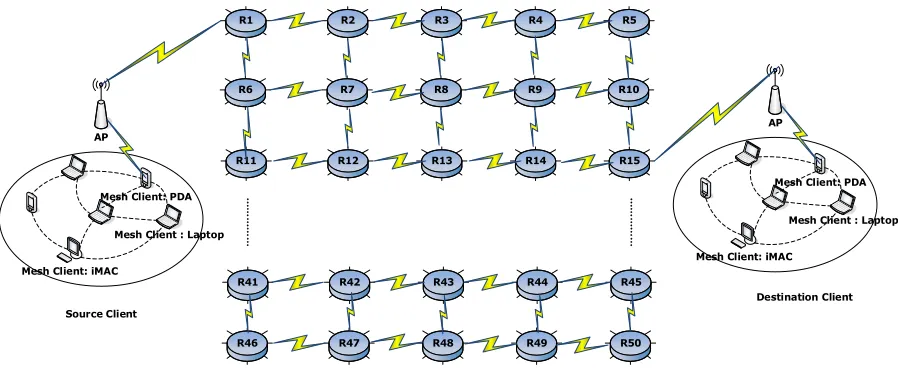
for transmission within each hop. The physical layer uses a fixed transmission range model where two nodes can
directly communicate with each other only if they are within a certain transmission range, i.e., within a hop. The
MAC layer protocol uses the IEEE 802.11 Distributed Coordination Function (DCF) [18]. The arrival traffic at each
MN has a Constant Bit Rate (CBR) with rate 1 Mbps and a packet size 1024 bytes. The channel data rate is 10 Mbps
and each MN has a buffer size of 25 packets. The other MAC and Physical layer parameters follow the existing
study [15]. The security parameters α
,
β,
γ γ
1,
2,
η1,
η2 are 0.5,0.5,0.3,0.6,0.3,0.7, which are empirical valuesobtained from multiple experiments. The experimental network topology graph is shown in Fig. 2. Each data point
depicted in Figs. 3-7 is the average of the results obtained from 20 runs of simulation experiments with a simulation
time of 100 s.
R11 R12 R13 R14 R15
R1 R2 R3 R4 R5
R6 R7 R8 R9 R10
R41 R42 R43 R44 R45
R46 R47 R48 R49 R50
Mesh Client: iMAC
Mesh Client: PDA
Mesh Client : Laptop AP
Mesh Client: iMAC
Mesh Client: PDA
Mesh Client : Laptop AP
Source Client
Destination Client
Fig. 2. Theexperimental network topology graph
6.2.1. Performance of the PSGR Routing Protocol
The performance of the PSGR is compared to the PA-SHWMP [14], PASER [22] and HWMP in terms of the
following performance metrics when Blackhole/Grayhole attacks and wormhole attacks are present [23].
l Average throughput: the ratio of the number of packets that successfully reach destinations to the number of
packets generated at sources.
l Packet delivery ratio (PDR): the ratio of the number of packets that are successfully received and accepted
l End-to-end delay (ED): the average time duration experienced by a packet transmitted from a source to a destination. 55 60 65 70 75 80 85 90
0 10 20 30 40 50
Av e r a g e T h r o u g h p u t ( % )
Percentage of Malicious Nodes (%) (a) HWMP PA-SHWMP PASER PSGR 55 60 65 70 75 80 85 90
0 10 20 30 40 50
Av e r a g e T h r o u g h p u t ( % )
Percentage of Malicious Nodes (%) (b)
HWMP PA-SHWMP PASER PSGR
Fig. 3. Average Throughput: (a) Blackhole/Grayhole Attacks (b) Wormhole Attacks
20 30 40 50 60 70 80 90 100
0 10 20 30 40 50
PD
R
(
%
)
Percentage of Malicious Nodes (%) (a) HWMP PA-SHWMP PASER PSGR 20 30 40 50 60 70 80 90 100
0 10 20 30 40 50
PD
R
(
%
)
Percentage of Malicious Nodes (%) (b)
HWMP PA-SHWMP PASER PSGR
Fig. 4. Average PDR: (a) Blackhole/Grayhole Attacks (b) Wormhole Attacks
20 40 60 80 100 120 140 160 180 200 220 240
2 3 4 5 6 7 8 9 10
Ti m e s ( m s )
Number of Hops (a) HWMP PA-SHWMP PASER PSGR 40 60 80 100 120 140 160 180 200 220 240 260
2 3 4 5 6 7 8 9 10
Ti m e s ( m s )
Number of Hops (b) HWMP
PA-SHWMP PASER PSGR
As shown in Fig. 3 the average throughputs of all the three protocols are affected by the presence of malicious
nodes in both Blackhole/Grayhole and wormhole attacks. Since HWMP does not take into account the internal
attacks and internal malicious nodes its performance is degraded most. For PA-SHWMP, PSGR and PASER, since
they establish the route based on the reputation mechanism and hybrid cryptosystem, which can identify and avoid
the malicious nodes participating in the routing, their performance reductions are less than that of the HWMP. In
PASER, the routing communication security relies on the origin, neighbor authentication and dynamic key
management scheme. When the percentage of malicious nodes is less than 30 percent, most of the authenticated
nodes are normal and they actively engage in the routing and data forwarding, which makes the throughput of the
PASER better than that of the PA-SHWMP. For PSGR, the proposed dynamic reputation mechanism updates the
node status effectively and rapidly, which enables PSGR to identify and isolate more malicious nodes than the
PASER and thus achieves a better throughput. When the percentage of malicious nodes is greater than 30 percent,
more internal nodes have been captured. Because of the lack of the rapid identification of internal malicious nodes,
the management and node status update schemes, the PASER cannot exclude the malicious nodes from the routing
and data forwarding, so the throughput of the PASER is less than that of the PA-SHWMP and PSGR. Moreover,
since the dynamic reputation mechanism proposed in PSGR is more flexible and accurate than the static reputation
mechanism used in PA-SHWMP, the performance of PSGR in better than that of PA-SHWMP.
(2) Average Packet Delivery Ratio (PDR)
The results in Fig. 4 reveal that the PDR of the network decreases as the number of malicious nodes increases.
However, the PDR under PSGR is better than those under PA-SHWMP, PASER and HWMP. HWMP does not take
into account internal attacks and malicious nodes and therefore cannot avoid malicious nodes participating in the
routing, thus its PDR is the worst. In PA-SHWMP and PASER, the malicious nodes are excluded from the network
soon after they have been detected, which results in less nodes that can participate in the routing and thus the PDR
dynamic reputation mechanism identifies the malicious nodes more accurately than the PA-SHWMP and PASER.
Furthermore, when the malicious nodes have been detected the flexible malicious node classification and
management scheme is adopted to make the decision on whether and how to punish or isolate the node. This ensures
that only those malicious nodes with low security levels will be excluded from the network and others will be forced
to cooperate. Therefore, the more accurate identification of malicious nodes and the larger number of cooperating
nodes lead to the better PDR performance of PSGR than that of PA-SHWMP and PASER.
(3) Average End-to-End Delay (ED)
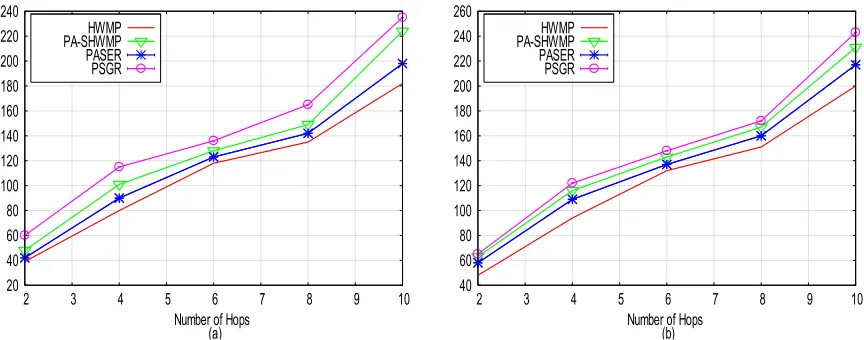
The simulation experiment was conducted using 5 to 10 source-destination pairs to compare the average ED of
the four protocols. As shown in Fig. 5, with light or medium traffic loads and less hops the delay is less than 200ms,
whereas under heavy traffic loads and more hops the delay reaches nearly 250ms. The average ED is slightly higher
in PSGR than those in PA-SHWMP, PASER and HWMP, because in addition to the routing operation of HWMP,
the PSGR, PASER and PA-SHWMP also require to execute the routing security mechanism to detect and isolate the
malicious nodes, which results in a higher delay. Moreover, the PSGR performs another two effective schemes to
provide privacy preservation and to reduce energy consumption, respectively. As a result, the average ED in PSGR
is slightly higher than those of PA-SHWMP, PASER and HWMP as a trade-off for the better throughput, PDR and
energy efficiency.
6.2.2. Energy Consumption
In this subsection, we evaluate and compare the energy consumption of the PSGR to those of PA-SHWMP,
PASER and HWMP.
(1) Average Energy Consumption
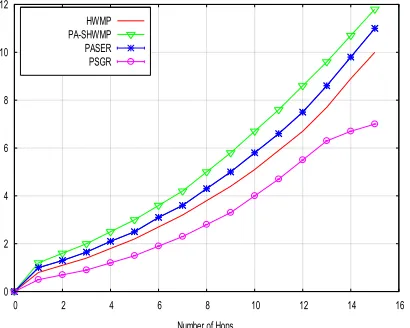
The results shown in Fig. 6 are obtained from simulation experiments with 2 to 15 source-destination pairs to
average energy consumption of all the four protocols increases. However, since the energy consumption is taken
into account in the process of routing, the PSGR is more energy-efficient than the PA-SHWMP, PASER and
HWMP. 0 2 4 6 8 10 12
0 2 4 6 8 10 12 14 16
Av e r a g e En e r g y C o n s u m p t io n ( jo u le )
Number of Hops HWMP
PA-SHWMP PASER PSGR
Fig. 6. Average Energy Consumption Fig. 7. Average SER
(2) Average SER
Let R, SL and E denote the set of the routes, the security level and the energy consumption level of the routes in
R, respectively. Then we classify SL and E into 5 levels to separately denote the corresponding security levels (SL)
and the energy consumption levels (E). Therefore, each route in set R can be denoted by a
2-tuple
R i
( ) (
=
SL
R i( ),
E
R i( )), (
SL
R i( ),
E
R i( )=
1 5)
, where SLR i( ) and ER i( ) denote the security level and theenergy consumption level of the route
R i
( )
, respectively. Based on the above definition, a new metric, SER, isproposed to evaluate the energy consumption of the PSGR,
( ) ( ) ( ) R i R i R i
SL
SER
E
=
(6)In Fig. 7, we depict the average SER against the number of routes, n, which satisfies the requirements of both
security and energy consumption. As shown in Fig. 7, the SER of the selected route in all cases is near 85% of the
highest SER. The results indicate that the proposed route discovery scheme can satisfy the requirements of both
7. CONCLUSIONS
In this paper, we have investigated the pressing problems such as privacy preserving, route security and energy
consumption in Software defined HWMNs and have proposed a privacy-aware, secure and green routing protocol,
PSGR. Based on the combination of the proposed dynamic reputation mechanism and a multi-level hierarchical key
management protocol, the PSGR protocol can effectively defend against the internal attacks to provide privacy
protection in HWMNs. Moreover, by taking the energy consumption into the process of routing, the PSGR protocol
can achieve good energy efficiency. The elaborated theoretical analyses have verified that the PSGR is secure,
privacy preserving and efficient. Furthermore, simulation experiments have demonstrated that in the presence of the
Blackhole/Grayhole attacks and wormhole attacks, the packet delivery ratio, network throughput and energy
consumption of the proposed PSGR are much better than those of the PA-SHWMP, PASER and HWMP routing
protocols.
Acknowledgements
This work is supported by the National Natural Science Foundation of China (61472083, 61402110, 61402262,
U1405255), the Fujian Normal University Innovative Research Team (IRTL1207), the UK EPSRC research grant
(EP/M013936/2), the Foundation of Science and Technology on Information Assurance Laboratory (KJ-14-109), the
Fujian Provincial Key Laboratory of Network Security and Cryptology Research Fund, and the Pilot Project of
Fujian Province (formal industry key project) (2016Y0031).
R
EFERENCES1. I. Ouveysi, K. C. Wong, S. Chan, K. T. Ko, “Interface assignment-based aodv routing protocol to improve
reliability in multi-interface multichannel wireless mesh networks”, Mobile Information Systems, vol.
no. 4, pp. 445-487, 2005.
3. J. Sen, “Security and Privacy Issues in Wireless Mesh Networks: A Survey”, Wireless Networks and
Security, Springer Berlin Heidelberg, pp. 189-272, 2013.
4. S. Paris, C. N. Rotaru, F. Martignon, A. Capone, “Cross-Layer Metrics for Reliable Routing in Wireless
Mesh Networks”, IEEE-ACM Transactions on Networking, vol. 21, no. 3, pp. 1003-1016, 2013.
5. G.Sato, N. Uchida, Y. Shibata, “Resilient Disaster Network Based on Software Defined Cognitive Wireless
Network Technology”, Mobile Information Systems, vol. 10,pp.1-11,2015.
6. H. Huang, P. Li, S. Guo, W. Zhuang, “Software-defined wireless mesh networks: architecture and traffic
orchestration”, IEEE Network, vol.29, no.4, pp.24-30, 2015.
7. S. Khan, N.A. Alrajeh, and K.K. Loo, “Secure Route Selection in Wireless Mesh Networks”, Computer
Networks, vol. 56, no. 2, pp. 491-503, 2012.
8. R. Riggio, T. Rasheed, S. Sicari, “Performance Evaluation of an Hybrid Mesh and Sensor Network”, Proc.
IEEE Globecom, 2011.
9. F. Nait-Abdesselam, B. Bensaou, and T. Taleb, “Detecting and Avoiding Wormhole Attacks in Wireless ad
hoc Networks”, IEEE Communication Magazine, vol. 46, no. 4, pp. 127–133, 2008.
10. S. Paris, C.N. Rotaru, F. Martignon and A. Capone, “EFW: A Cross-Layer Metric for Reliable Routing in
Wireless Mesh Networks with Selfish Participants”, Proc. IEEE INFOCOM, Shanghai, China, 2011.
11. M.S. Islam, M.A. Hamid and C.S. Hong, “SHWMP: A Secure Hybrid Wireless Mesh Protocol for IEEE
802.11s Wireless Mesh Networks”, IEEE Transactions on Computational Science VI, vol. 5730, pp. 95-114,
2009.
12. K. Ren, S. Yu, W. Lou, and Y. Zhang, “PEACE: A Novel Privacy-Enhanced Yet Accountable Security
Framework for Metropolitan Wireless Mesh Networks”, IEEE Transactions On Parallel And Distributed
13. S. Khan and J. Loo, “Cross Layer Secure and Resource-Aware On-Demand Routing Protocol for Hybrid
Wireless Mesh Networks”, Wireless Personal Communications, vol. 62, no. 1, pp. 201–214, 2012.
14. H. Lin, J. Ma, J. Hu and K. Yang, “PA-SHWMP: A Privacy-aware Secure Hybrid Wireless Mesh Protocol
for IEEE 802.11s Wireless Mesh Networks”, EURASIP Journal on Wireless Communications and
Networking, vol. 69, no. 1, pp. 1-16, 2012.
15. H. Lin, J. Hu, J. Ma, L. Xu, and A. Nagar, “A Role Based Privacy-Aware Secure Routing Protocol for
Wireless Mesh Networks”, Springer Wireless Personal Communications, vol. 75, no. 3, pp. 1611-1633,
2014.
16. S. Dietzel, J. Petit, G. Heijenk, F. Kargl, “Graph-Based Metrics for Insider Attack Detection in VANET
Multihop Data Dissemination Protocols”, IEEE Transactions on Vehicular Technology, vol. 62, no. 4, pp.
1505-1518, 2013.
17. Jia Hu, Geyong Min, and Mike E. Woodward, “Performance Analysis of the TXOP Burst Transmission
Scheme in Single-Hop Ad Hoc Networks with Unbalanced Stations”, Computer Communications, vol. 34,
no. 13, pp. 1593–1603,2011.
18. IEEE Standard for Wireless LAN Medium Access Control (MAC) and Physical Layer (PHY) specifications,
1999.
19. Yining Liu, Keqiu Li, Yingwei Jin, Yong Zhang, Wenyu Qu, “A Novel Reputation Computation Model
based on Subjective Logic for Mobile Ad Hoc Networks”, Future Generation Computer Systems, vol. 27,
no. 5, pp. 547-554, 2011.
20. W. P. Lu and MK Sundareshan, “A Model for Multilevel Security in Computer Networks”, IEEE
Transaction on Software Engineering, vol. 16, no. 6, pp. 647–659,1990.
22. M.Sbeiti, N.Goddemeier, D.Behnke, and C.Wietfeld, “ Paser: secure and efficient routing approach for
airborne mesh networks”, IEEE Transactions on Wireless Communications, vol. 15, no. 3, pp. 1950-1964.
2016.
23. M. Khabbazian, H. Mercier, and V. K. Bhargava, “Severity Analysis and Countermeasure for the Wormhole
Attack in Wireless Ad Hoc Networks”, IEEE Transactions on Wireless Communications, vol. 8, no. 2, pp.
Biography of Authors
Hui Lin received his Ph.D. degree from Xidian University, in 2013. He is currently an Associate Professor and master supervisor at Fujian Normal University. His research interests include wireless and mobile computing systems and network and information security, etc.
Jia Hu is a Lecturer in Computer Science at the University of Exeter. He has published over 40 research papers in prestigious international journals and at reputable international conferences. His research interests include performance evaluation, next generation networking, resource allocation and optimization, energy-efficiency, network security, smart city, and big data.
Li Xu received his Ph.D. degree from Nanjing University of Posts and Telecommunications in 2004. He is currently a Professor and Doctoral Supervisor at Fujian Normal University. His research interests include wireless and mobile computing systems, network and information security, complex networks and systems, intelligent information in communication networks, etc.
Youliang Tian received the PhD degree in cryptography from Xidian University in 2012. He is a professor and master supervisor in College of Computer Science & Technology at Guizhou University. His current research interests include algorithm game theory, cryptography and secure protocol.
Lei Liu an associate professor in Shandong University, China. He has published over 30 papers in conference proceedings and journals. He has served as program committee for more than 20 international conferences, and served as leading guest editor for 5 journal special issues. His current research interests include: software defined networking, 5G, traffic engineering and network big data.