Maxwell Demon’s and the Problem of Observers in
General Relativity
Luis Herrera1,†
Instituto Universitario de Física Fundamental y Matemáticas, Universidad de Salamanca, Salamanca 37007, Spain; [email protected]; Tel.: +34-923261426
Abstract: The fact that real dissipative (entropy producing) processes may be detected by non–comoving observers (tilted), in systems that appear to be isentropic for comoving observers, in general relativity, is explained in terms of the information theory, in analogy with the explanation of the Maxwell’s demon paradox.
Keywords:general relativity; theory of information; tilted spacetimes.
1. Introduction
Observers play an essential role in in quantum mechanics where the very concept of reality is tightly attached to the existence of the observer, as ingeniously illustrated by the well known Schrodinger’s cat paradox. In the quantum mechanics terminology, we say that the observer produces the collapse of the wave function.
However, it is generally assumed that observers do not play a similar role in classical (non quantum) theories. But is this assumption really justified? As we shall see here, the answer to such a question is negative. Indeed, the role of observers in General Relativity is a fundamental one, and reminds in some sense its role in quantum physics, namely: A complete understanding of some gravitational phenomena requires the inclusion of the observers in the definition of the physical system under consideration.
In order to make our case, let us first recall that in relativistic hydrodynamics different observers assign different four–velocities to a given fluid distribution. This simple fact is at the origin of an ambiguity in the description of the source of the gravitational field (whenever it is represented by a fluid distribution).
Thus one may face the situation when one of the congruences corresponds to comoving observers, whereas the other is obtained by applying a Lorentz boost to the comoving observer’s frame (this Lorentz boosted congruence is usually referred to as the tilted congruence).
The strange fact then appears, that systems that are isentropic for comoving observers, may become dissipative for tilted observers (see [1]–[10] and references therein).
We shall illustrate this situation with some examples, and shall provide an explanation based on the theory of information. More specifically, we shall see that an argument similar to the one put forward by Bennet [11] to solve the Maxwell’s demon paradox [12], may be used to explain the very different pictures of a given system, presented by different congruence of observers in general relativity.
As we shall see, the essential fact is that when we pass from comoving observers (which assign zero value to the three-velocity of any fluid element) to tilted observers, for whom the three-velocity represents another degree of freedom, the erasure of the information stored by comoving observers (vanishing three velocity), explains the presence of dissipative processes (gravitational radiation included) detected by tilted observers.
2. Comoving and tilted observers
In order to grasp the essence of the problem under consideration, is important to understand how the tilted (non–comoving) congruence may be obtained from the comoving one. In what follows we present the general scheme for doing that. Thus, let us consider a congruence of observers which are comoving with an arbitrary fluid distribution, then the four–velocity for that congruence, in some globally defined coordinate sytem, reads
Vµ= (V0, 0, 0, 0). (1)
In order to obtain the four–velocity corresponding to the tilted congruence (in the same globally defined coordinate system) one proceeds as follows.
We have first to perform a (locally defined) coordinate transformation to the Locally Minkowskian Frame (LMF). Denoting byLν
µthe local coordinate transformation matrix and by ¯Vαthe components
of the four velocity in such LMF, we have:
¯ Vµ=Lµ
νVν. (2)
Next, let us apply a Lorentz boost to the LMF associated to ¯Vα, to obtain the (tilted) LMF with
respect to which a fluid element is moving with some, non–vanishing, three–velocity. Then the four–velocity in the tilted LMF is defined by:
˜¯
Vβ=ΛαβV¯α, (3)
whereΛα
βdenotes the Lorentz matrix.
Finally, we have to perform a transformation from the tilted LMF, back to the (global) frame associated to the line element under consideration. Such a transformation, which obviously only exists locally, is defined by the inverse ofLν
µ, and produces the four–velocity of the tilted congruence in our
globally defined coordinate system, say ˜Vα.
In the following sections we shall present several examples of tilted space–times, that illustrate the sharp differences in their interpretations, with respect to the picture obtained by the comoving observers.
3. Tilting the Lemaitre–Tolman–Bondi congruence
The Lemaitre–Tolman–Bondi spacetimes (LTB) [13–15], as seen by a congruence of comoving observers, describe spherically symmetric distributions of geodesic, shearing, and vorticity free, inhomogeneous non–dissipative dust. The magnetic part of the Weyl tensor vanishes, whereas its electric part may be defined through a single scalar function. If we put the shear or the the Weyl tensor equal to zero, the LTB spacetime becomes the Friedman-Robertson-Walker spacetime.
The general form of LTB metric is defined by:
ds2=−dt2+B2dr2+R2(dθ2+sin2θdφ2), (4) whereB(r,t)andR(r,t)are functions of their arguments, and
B(t,r) = R
0
[1+k(r)]1/2, (5)
wherekis an arbitrary function ofrand prime denotes derivative with respect tor.
The energy momentum tensor describing a dust distribution with energy densityµin comoving coordinates takes the usual form:
Obviously for the comoving observer the fluid is geodesic .
However if we now tilt the comoving observer, then as it has been shown, the spacetime appears to be sourced by a dissipative anisotropic fluid distribution, and furthermore the fluid is no longer geodesic [5]. The important point to stress here is that the tilted observer detects a real dissipative process (entropy producing) as it follows from the discussion on the generalized Gibbs equation (see [5] for details).
Obviously, due to the spherical symmetry, the magnetic part of the Weyl tensor also vanishes for the tilted observer, implying that no gravitational radiation is detected by the latter.
4. Tilting the Szekeres congruence
In the example analyzed in the previous section the fluid distribution was spherically symmetric, thus it is interesting to wonder what happens when we consider fluid distributions non restricted by this symmetry. For doing so let us consider the Szekeres spacetime [16,17].
Indeed, Szekeres dust models have no Killing vectors and therefore represent an interesting generalization of LTB spacetimes. When analyzed from the point of view of comoving observers, the Szekeres spacetime is sourced by a geodesic non–dissipative dust, without vorticity. Also, as in the LTB case the magnetic part of the Weyl tensor vanishes, implying that there is no gravitational radiation.
In this case the line element is given by:
ds2=−dt2+ (R
0E−RE0)2 E2(e+ f) dr
2+R2 E2(dp
2+dq2) (7)
where a prime denotes derivative with respect tor,R= R(t,r),e=±1, 0 and f = f(r)>−eis an arbitrary function ofr. We number the coordinatesx0=t,x1=r,x2=p,x3=q.
The functionEis given by
E(r,p,q) = S
2
"
p−P S
2 +
q−Q S
2 +e
#
(8)
whereS=S(r),P=P(r)andQ=Q(r)are arbitrary functions. From Einstein equations it follows thatRsatisfies the equation
˙
R2= 2M
R + f, (9)
where a dot denotes derivative with respect tot, andM= M(r)is an arbitrary function. From the above equation it follows that
¨
R= −M
R2 , (10)
from where the meaning ofMas an effective gravitational mass becomes evident.
However the above picture drastically changes when the matter content is analyzed by a tilted congruence.
Indeed, as shown in [6], tilted observers detect a dissipative, anisotropic fluid which is no longer geodesic and furthermore is endowed with vorticity. As for the LTB case, the dissipation detected by tilted observers is “real” in the sense that there is an increasing of entropy. However, even in the tilted version, the magnetic part of the Weyl tensor vanishes, and so tilted observers do not detect gravitational radiation.
5. Tilted shear–free axially symmetric fluids
(r). We shall now consider a much more general situation, where the the boost is applied along two independent directions.
We shall consider axially symmetric fluids, which for the comoving observer are geodesic, shear–free non–dissipative, and vorticity free.
The line element reads [18]
ds2=−dt2+B2(t)hdr2+r2dθ2+R2(r,θ)dφ2
i
. (11)
whereB(t)andR(r,θ)are functions of their arguments satisfying the Einstein equations, and from regularity conditions at the origin we must requireR(0,θ) =0.
For the comoving observer the energy momentum–tensor in the “canonical” form reads:
Tαβ = (µ+P)VαVβ+Pgαβ+Παβ, (12)
where as usual,µ,P,Παβ,Vβdenote the energy density, the isotropic pressure, the anisotropic stress tensor and the four velocity, respectively.
For the comoving congruence the anisotropic tensor depends on a single scalar function, and the four–velocity vector reads:
Vα = (1, 0, 0, 0); V
α= (−1, 0, 0, 0), (13)
(see [18] for details).
Also, as shown in [18], the magnetic part of the Weyl tensor calculated by means of the four–velocity vector (13) vanishes and the electric part is defined through a unique scalar function.
The above picture is drastically changed when the system is analyzed by a tilted congruence of observers, as we shall now see (see [20] for details).
For doing so, we have to obtain first the tilted congruence and all the associated kinematical variables, applying the procedure sketched above, for the case when the boost is applied along ther and theθdirections.
Thus we obtain for the tilted four–velocity (see [20] for details):
˜
Vα= (−Γ,BΓv1,BrΓv2, 0); V˜α = (Γ, Γv1
B ,
Γv2
Br , 0). (14)
whereΓ≡ √1 1−v2,v
2=v2
1+v22, andv1,v2are the two non–vanishing components of the three–velocity of a fluid element as measured by the tilted observer.
We can now calculate all the kinematical variables for the tilted congruence. The result shows that now the four–acceleration, as well as the shear and the vorticity are non vanishing (see [20] for details). Also, for the tilted congruence the electric part of the Weyl tensor has three independent non-vanishing components and the magnetic part of the Weyl tensor is non–vanishing, and defined through two components. Thus we may write these two tensors in terms of five tetrad components ( ˜EI,
˜
EI I, ˜EKL, ˜H1, ˜H2) respectively.
For the tilted observers the fluid distribution is described by the energy momentum tensor:
˜
Tαβ= (µ˜+P˜)V˜αV˜β+Pg˜ αβ+Παβ˜ +q˜αV˜β+q˜βV˜α. (15)
It should be noticed that now the system appears to be dissipative, with the heat flux vector defined through two independent scalar functionsq(1),q(2)and the anisotropic tensor is defined by three independent scalars ˜ΠI, ˜ΠI I, ˜ΠKL
˜
P(1) = 2 ˜H2
3 2 ˜EI I+E˜I
+2 ˜H1E˜KL+32π2q˜(1)
˜ µ+P˜+
˜
ΠI 3
+ 32π2q˜(2)Π˜KL, (16)
˜
P(2) = −2 ˜H1
3 2 ˜EI+E˜I I
−2 ˜H2E˜KL+32π2q˜(2)
˜ µ+P˜+
˜
ΠI I 3
+ 32π2q˜(1)Π˜KL. (17)
In (16) and (17) we can identify two different types of contributions. On the one hand we have contributions from the heat transport process. These are independent on the magnetic part of the Weyl tensor, and appear in the tilted versions of LTB and Szekeres, as well as in the case analyzed in this section.
Next we have contributions related to the gravitational radiation. These require, both, the electric and the magnetic part of the Weyl tensor to be different from zero. Of course they vanish for LTB and Szekeres, but do not vanish in the present case.
The association of a state of gravitational radiation to a non–vanishing component of the super–Poynting vector, is enforced by the link between the super–Poynting vector and the news functions in the context of the Bondi–Sachs approach [21].
Thus, we have in the case analyzed in this section that for the comoving observer and the line element (11) the magnetic part of the Weyl tensor vanishes identically and the fluid is non–dissipative, implying at once thatP(1) = P(2) = 0. In other words, no gravitational radiation, or dissipative processes of any kind, are detected by the comoving observer .
However, for the tilted congruence calculations show that the magnetic part of the Weyl tensor is not vanishing and, more specifically, the sum of the first two terms in (16) and (17) does not vanish, except for the conformally flat case [20].
Thus, we face again the intriguing question: how it is possible that tilted observers may detect irreversible processes, whereas comoving observers describe an isentropic situation ?
As we shall see, the above quandary becomes intelligible if we appeal to the discussion on the Maxwell’s demon presented by Bennet.
6. The Maxwell’s demon and the observers in general relativity
The main moral emerging from the three cases analyzed here (and from many others included in the list of references) is that tilted observers may detect dissipation in systems that appear non–dissipative for comoving observers.
It is worth mentioning that in the case analyzed in the previous section the difference between the pictures described by both congruences of observers is still sharper since the tilted observer not only detects a dissipative process, but also gravitational radiation.
This last point is not alien to the fact that the tilted observer also detects vorticity, and as has been pointed out in [21], vorticity and gravitational radiation are tightly associated. At any rate, gravitational radiation is also a dissipative process, accordingly the basic explanation of its presence in the system analyzed by the tilted observer is basically the same as the one for any dissipative process.
As conjectured in [22], the basic fact that explains the above mentioned differences in the description of a given system, as provided by different congruences of observers, is that both congruences of observers store different amounts of information.
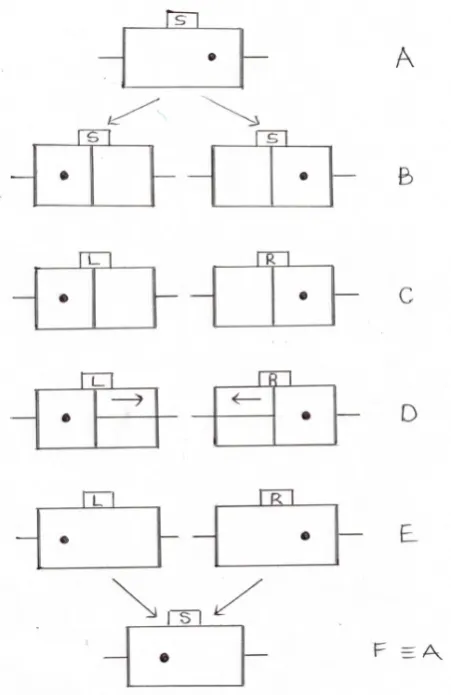
Here we shall delve deeper into this question, by resorting to the resolution of the well known paradox of the Maxwell’s demon [12].
Figure 1.The Bennet scheme.
Initially (stage A) we have a cylinder containing one molecule with two pistons at either side. At this point the demon does not know where in the cylinder is the molecule. We shall refer to this state of the demon’s mind asS. Next, at stage B, the demon inserts a partition wall in the middle of the cylinder, trapping the molecule in one side or the other. At this stage the demon still ignores on what side of the cylinder is the molecule, therefore the state of his mind is stillS.
At stage C, the demons performs a reversible measurement allowing him to know whether the molecule is on the left or the right side of the cylinder. En each case the state of the demon’s mind changes toLorRrespectively.
At D, depending on the result of the previous measurement, the demon moves the left piston to the right (if the molecule is in the right), or the right piston to the left (if the molecule is in the left), and removes the partition wall. Doing so he allows the molecule to freely expands against the piston, and thereby doing work.
At E, the pistons are at their original position and the molecule fill the whole cylinder. Thus, one is tempted to say that we have returned to the initial state A, but work has been done and therefore such a conclusion would imply the violation of the second law of thermodynamics.
The solution to the above, apparent, paradox, comes up when we realize that the demon’s mind state in A and E are different. Indeed, in E the demon knows where the molecule was before the expansion. In order to truly return to A, the information acquired by the demon has to be erased.
However, according to the Landauer principle [23], the erasure of one bit of information stored in a system requires the dissipation into the environment of a minimal amount of energy, whose lower bound is given by
wherekandTdenotes the Boltzman constant and the temperature of the environment, respectively. In other words, to get the demon’s mind back to its initial state (S), generates dissipation, after which the system is in F. Thus, all the work obtained by the expansion of the molecule in D is converted to heat in order to return the demon’s mind to the stateS, in F.
Therefore, Bennet solved the paradox by showing that the irreversible act which prevents the violation of the second law is not the reversible measurement allowing him to know where is the molecule, but the restauration of the measuring apparatus to the standard state previous to the state where the demon knows where is the molecule. Therefore, if we consider the whole system (demon + the gas in the cylinder), we must keep in mind that the information possesed by the demon before knowing where is the molecule, is smaller than the information after this process has been achieved. Accordingly, in order to return to the initial state of the demon, the acquired information has to be erased.
A somehow similar picture appears when we apply the operation transforming comoving observers, which assign zero value to the three-velocity of any fluid element, into tilted observers, for whom the three-velocity represents another degree of freedom. The erasure of the information stored by comoving observers (vanishing three velocity), when going to the frame of tilted observers, explains the presence of dissipative processes (included gravitational radiation) observed by the latter. Thus, we can say that the stateSof the demon, when he does not know where is the molecule, is analogous to tilted observers: for both, a piece of information is lacking. On the other hand, the stateL orRwhen the demon knows where is the molecule, is equivalent to comoving observers: in both cases additional information has been acquired
7. Discussion
With the three examples analyzed in the previous sections we have clearly illustrated the relevance of observers in the physical description of a given system.
To explain the detection of dissipation by the tilted congruence, in a system which appears isentropic for comoving observers, we have noticed that passing from comoving to tilted observers, or returning the demond’s mind to its initial state, requires the erasure of the acquired information, leading to the observed dissipative processes. This explains, on the one hand, why the second law of thermodynamics is not violated by the Maxwell’s demon, and on the other, why tilted observers detect dissipation there where comoving observers only see an isentropic system.
In other words, observers storing different ammounts of information, provide different pictures of the same phenomenon.
At the light of the comments above, the statement by Max Born [25]“Irreversibility is a consequence of the explicit introduction of ignorance into the fundamental laws”, becomes fully intelligible.
Acknowledgments:This work was partially supported by the Spanish Ministerio de Ciencia e Innovación under
Research Projects No. FIS2015-65140-P (MINECO/FEDER). No funds for covering the costs to publish in open access have been received.
Conflicts of Interest:“The founding sponsors had no role in the design of the study; in the collection, analyses, or interpretation of data; in the writing of the manuscript, and in the decision to publish the results”.
References
1. A. A. Coley and B. O. J. Tupper, “Zero-curvature Friedmann-Robertson-Walker models as exact viscous magnetohydrodynamic,Astrophys. J271, 1 (1983).
2. A. A. Coley and B. O. J. Tupper,“A new look at FRW cosmologies”,Gen. Rel. Grav.15, 977 (1983).
3. A. A. Coley and B. O. J. Tupper, “Exact viscous fluid FRW cosmologies: The case of general k”,Phy. Lett. A
100, 495 (1984).
4. A. A. Coley, “Observations and nonstandard FRW models”, Astrophys. J.318, 487 (1987).
6. L. Herrera, A. Di Prisco, J. Ibáñez and J. Carot, “Vorticity and entropy production in tilted Szekeres spacetimes”,Phys. Rev. D86, 044003 (2012).
7. M. Sharif and H. Tahir, “Dynamics of tilted spherical star and stability of non-tilted congruence”,Astrophys. Space Sci.351, 619 (2014).
8. J. Fernandez and J. Pascual–Sanchez, “Tilted Lemaître model and the dark flow”,Procc. Math. Stat.60, 361, (2014).
9. M. Sharif and M. Zaeem Ul Haq Bhatti, “Structure scalars and super-Poynting vector of tilted Szekeres geometry”,Int. J. Mod. Phys. D24, 1550014 (2015).
10. Z.Yousaf, K. Bamba and M. Zaeem Ul Haq Bhatti, “Role of tilted congruence and f(R)gravity on regular compact objects”,Phys. Rev. D95, 024024 (2017).
11. C. H. Bennet, “The Thermodynamics of Computation–a Review”,Int. J. Theor. Phys.21, 905 (1982). 12. J. C. Maxwell,Theory of heat, (D. Appleton and Co., New York) (1872).
13. G. Lemaître, “The Expanding Universe”,Ann. Soc. Sci. BruxellesA 53, 51 (1933) (Gen. Rel. Grav.29, 641 (1997)) .
14. R. C. Tolman, “Effect of Inhomogeneity on Cosmological Models”,Proc. Natl. Acad Sci20, 169 (1934) (Gen. Rel. Grav.29, 935 (1997)).
15. H. Bondi,“Spherically symmetrical models in general relativity”,Mon. Not. R. Astron. Soc.107, 410 (1947) (Gen. Rel. Grav.31, 1783 (1999)).
16. P. Szekeres, “Quasispherical gravitational collapse”,Phys. Rev. D12, 2941 (1975).
17. P. Szekeres, “A class of inhomogeneous cosmological models”,Commun. Math. Phys.41, 55 (1975). 18. L. Herrera, A. Di Prisco, and J. Ospino, “Shear-free axially symmetric dissipative fluids”,Phys. Rev. D89,
127502 (2014).
19. L. Herrera, A. Di Prisco, J. Ibáñez and J. Ospino, “Dissipative collapse of axially symmetric, general relativistic, sources: A general framework and some applications”,Phys. Rev. D89, 084034-15, (2014).
20. L. Herrera, A. Di Prisco and J. Carot, “Tilted shear-free axially symmetric fluids”Phys. Rev. D(2018). 21. L. Herrera, W. Barreto, J. Carot and A. Di Prisco, “Why does gravitational radiation produce vorticity?,Class.
Quantum.Grav.24, 2645 (2007).
22. L. Herrera, “The Gibbs paradox, the Landauer principle and the irreversibility associated with tilted observers”Entropy19, 110 (2017).
23. R. Landauer, “ Irreversibility and Heat Generation in the Computing Process”,IBM Res. Develop. 5, 183 (1961).