R E S E A R C H
Open Access
A prototype of knowledge-based patient
safety event reporting and learning system
Hong Kang, Sicheng Zhou, Bin Yao and Yang Gong
*From2018 Sino-US Conference on Health Informatics Guangzhou, China. 28 June - 01 July 2018
Abstract
Background:Patient falls, the most common safety events resulting in adverse patient outcomes, impose significant costs and have become a great burden to the healthcare community. Current patient fall reporting systems remain in the early stage that is far away from reaching the ultimate goal toward a safer healthcare. According to the Kirkpatrick model, the key challenge in reaction, learning, behavior and results is the realization of learning stage due to the lack of knowledge management, sharing and growing mechanism.
Methods:Based on the key contributing factors defined by AHRQ Common Formats 2.0, a hierarchical list of contributing factors for patient falls was established by expert review and discussion. Using the list as an infrastructure, we designed and developed a novel reporting system, where a strategy to identify contributing factors is intended to provide reporters knowledge support, in the form of similar cases and potential solutions. A survey containing two scenarios was conducted to evaluate the learning effect of our system.
Results:In both scenarios, potential solutions recommended by the system were annotated with correct
contributing factors, and presented only when the corresponding factors were identified from the query report or selected by the user. The five experts show substantial consistency (Fleiss’kappa > 0.6) and high agreement (ranging between fully agree and mostly agree) in the assessment of the three perspectives of the system, which verifies the effectiveness of the proposed knowledge support toward sharing and learning through the novel reporting system.
Conclusions:This study proposed a profile of contributing factors that could measure the similarity of patient safety events. Based on the profile, a knowledge-based reporting and learning system was developed to bridge the gap between surveillance, reporting, and retrospective analysis in the fall management circle. The system holds promise in improving event reporting toward better and safer healthcare.
Keywords:Patient safety, Knowledge base, Information storage and retrieval
Background
Patient safety events (PSE) are the most concerns in the
improvement of healthcare quality [1]. With more than
251,000 (9.5%) annual deaths, PSE is ranked the third leading cause of death in the U.S. following heart disease and cancer [2, 3]. Among the PSE, patient falls are the most common events resulting in adverse patient out-comes and imposing significant costs, a great burden to
the healthcare community. Patient Safety Organization (PSO) has listed patient falls as one of the top PSE [4]. The fall rate in acute-care hospitals is between 1.3 and 8.9, mainly ranging from 3 to 5 per 1000 occupied bed days [5]. A fall with injury adds in average 6.3 days to the hos-pital stay and costs around $14,000, which are a huge waste of time and money for both patients and healthcare facilities [6,7]. Different from diseases, which could be ef-fectively controlled in accordance with clinical procedures, patient falls and other PSE subtypes are difficult to control due to multiple inputs including healthcare providers, sys-tems, or even patients [8].
* Correspondence:[email protected]
School of Biomedical Informatics, The University of Texas Health Science Center at Houston, 7000 Fannin St, Houston, TX 77030, USA
About 92% in-hospital falls are preventable [9]. Pre-vention and assessment toolkits as well as reporting sys-tems would enable safety specialists to analyze events, identify underlying factors, and generate actionable knowledge to mitigate risks [10–12]. The toolkits pro-vide protocols for patient fall prevention in terms of leadership, evaluation of fall risks (vital status, medica-tion, environments, etc.), patient educamedica-tion, and event rate reduction. Commonly used fall prevention and
as-sessment toolkits include AHRQ WebM&M [13], AHRQ
Patient Falls Prevention Toolkit [14], Joint Commission Center for Transforming Healthcare Targeted Solutions Tool [15], Pennsylvania Patient Safety Authority Tools [16], etc. PSE reporting systems have been implemented for collecting PSE data and conducting root cause ana-lyses (RCA). Mandatory and voluntary reporting systems complement each other and serve different levels and
purposes in the PSE management [17]. The Institute of
Medicine (IOM) recommended patient safety reporting systems (PSRS) [18] for understanding why patients are
harmed by healthcare [19]. AHRQ created the Common
Formats (CF) [20] to standardize reporting formats and help healthcare providers uniformly report PSE. The CF fall-reporting form includes 13 structured questions cov-ering key contributing factors of fall event reporting and RCA, such as circumstances, outcome, fall risk assess-ment, preventions, medication, and assistant devices [20]. Since 2000, at least 30 PSE reporting systems have been established in the U.S., the initiatives to improve patient safety based on the common belief that data sup-ports learning from the events and creating actionable knowledge [21].
However, healthcare providers fail to receive timely feedback and customized knowledge support from current toolkits and systems [22,23]. The current toolk-its are isolated education manuals with no connections to reporting systems, which leads to a lack of effective and efficient interactions for shared learning among healthcare providers. In addition, most solutions pro-vided by the toolkits are comprehensive suggestions that are easy to follow but less tailored to fit into the
report-ing scenarios [24]. Current reporting systems do not
present any mechanism to guarantee reporting quality be-cause of its voluntary nature and clinicians' waning enthusi-asm due to no feedback. The systems will become redundant databases when low-quality reports dominate. As a result, the reports would not serve the sharing and learning purposes of event reporting recommended by IOM [25]. Despite PSO makes efforts to standardize report-ing formats by usreport-ing AHRQ CF, many reportreport-ing hospitals cannot upgrade or replace their own reporting mecha-nisms that have been in use for years, which poses a barrier for event data standardization. There has been no support for reporters to glean helpful information from previous
cases and learn from the tips suggested by the toolkits due to the lack of connection among different PSE resources [26].
To bridge the gap between surveillance, reporting, and retrospective analysis stages in the patient safety event management circle [22], developing a learning-oriented reporting system is an urgent need. The system is expected to automatically identify event contributing factors, con-tinually enrich and update the knowledge in the PSE do-main, and provide timely knowledge support such as similar cases and recommended solutions before, during or after event reporting. The Kirkpatrick model [27] provides the technique for appraisal of the evidence for any reported training program and can be used to evaluate whether a training program meets the expected outcomes of both or-ganizations and the staff [28]. The Kirkpatrick model has been discussed and proven as an effective tool guiding and evaluating the development of learning-oriented PSE reporting system [29]. The four-level Kirkpatrick model is organized from basic to advanced levels, i.e., reaction, learn-ing, behavior, and results, each of which addresses a sub-goal that is necessary to achieve. Current PSE reporting systems mainly focus on the reaction level that is far away from improving reporters’behavior toward safer healthcare. The key challenge resides in the realization of learning level due to the lack of knowledge management, sharing and growing mechanism. A well-organized contributing factor list could be an effective tool to build this mechanism. Un-fortunately, the prevailing contributing factors for patient safety are either too general (e.g., AHRQ CF [20]) or too specific (e.g., Castro’s list of contributing factors on Health IT exclusively [30]), because clear annotation criteria were unavailable for users to follow. As a result, no further knowledge supports could be provided based on these con-tributing factors. To identify the concon-tributing factors to-ward a knowledge base of patient safety events, a rule-based model could be applied since it shares the com-mon cognitive process with a human.
Methods
PSO fall reports
The AHRQ CF [20] is a set of standardized
questionnaire-based forms with nine subtypes defined by PSO, including blood or blood product, device or medical/ surgical supply including health information technology, fall, healthcare-associated infection, medication or other substance, perinatal, pressure ulcer, surgery or anesthesia, and venous thromboembolism. Statistics from PSO show that fall events hold the most number of reports than those of other event types. In this study, we employed 1836 de-identified fall reports collected by our collaborative PSO during year 2016. Each de-identified report includes the structured fields (4 general questions shared by all event types and 13 specific questions for fall event exclusively) and the unstructured fields (event description and re-sponses, such as other, in free texts in the structured fields).
Establish contributing factors and a rule-based annotation strategy
The AHRQ CF provides a document“Generic-National
Collection (core)”[31], which summarized the core data elements required for PSE reporting at the local level by healthcare providers to PSOs and the PSO Privacy Pro-tection Center (PSOPPC) for national aggregation and analysis. The elements include the type of patient safety concern, the circumstances of event of unsafe condition,
patient information, and reporter information. As a
sub-section of circumstances of events, the section of
contributing factors has nine factor categories including 42 factor terms, which were applied as the infrastructure of fall contributing factors. Three domain experts who are familiar with patient safety data and have event reporting experiences reviewed 1469 PSO fall reports, accounting for 80% of the total in year 2016. The expert review responsibilities included:
1) Extend the hierarchical list of contributing factors with new identified factors.
2) Annotate each report with contributing factors, i.e., factors identified from the structured fields and the unstructured fields were annotated separately. 3) Highlight keywords in the unstructured fields
contributing to the factor identification.
4) Label each option of the structured fields with one or more contributing factors.
The experts reviewed individually. Group discussions were held to resolve divergences and reach final decisions. New factors were added as follows:
1) Terms of diseases and symptoms were coded by the International Classification of Diseases, Tenth Revision, Clinical Modification (ICD-10-CM) [32].
2) Terms of surgeries were coded by Current Procedural Terminology (CPT) [33]. 3) Terms of medications were coded by the
Anatomical Therapeutic Chemical Classification System with Defined Daily Doses (ATC/DDD) [34].
Create identification rules for contributing factors
A super inspector, in addition to the three domain experts, reviewed the annotation results and assigned regular ex-pressions to each paired contributing factor and corre-sponding keywords. A regular expression is a sequence of characters typically used in rule-based models to define a search pattern. A regular expression was further labeled as either“true” or“false”as activation status of contributing factor when the expression is matched. For example, one expression of contributing factor“bed alarms”was coded as “\b (forgot)\b.+\b (alarm)\b.+\b (back on)\b” and la-beled as“true”because“bed alarms”could be a contribut-ing factor if a nurse forgot to reset the alarm. Another expression of factor “fatigue” was coded as “\b (denied fatigue)\b” and labeled as“false”because “fatigue” should not be a factor if a patient denied that. Each expression was called an identification rule for the corresponding contributing factor. Thus, each factor may have more than one identification rules. For the structured fields, the iden-tification rules were coded by listing all activation options of the questions to each contributing factor.
The remaining 367 (20%) reports were applied for evaluation, within which five high-quality reports with lit-tle factor overlaps were reserved for the evaluation of the knowledge support strategy, and the rest 362 reports were applied to evaluate the identification rules of fall event contributing factors. The rules were run on each report to identify the contributing factor(s), after which the experts reviewed and scored the factor(s) independently with four Likert scales [35], i.e., 1)fully agree, 2)mostly agree: lack-ing necessary factor(s), 3)mostly disagree: appearing some incorrect or inaccurate factor(s), and 4) fully disagree. Group discussions were held to generate final decisions when divergences appeared.
Develop identification rules for event solutions
Develop and evaluate a rule-based knowledge support strategy based on contributing factors
A knowledge support strategy was developed based on the identification rules of fall event contributing factors. As shown in Fig.1, the strategy includes three modules, i.e., query, analysis, and support. A learning session can be initialized by determining a query, either an event re-port (new rere-port or existing rere-port) or a group of cus-tomized contributing factors. A report query is screened by all identification rules and annotated with identified contributing factors, while the customized factors skip the screening process. Then the contributing factors of query are compared with the factors of all the other re-ports in the database.
As shown in Eq.1, a similarity scoreSqiis calculated be-tween the queryqand each of the other reportsiby com-pacting the annotations into binary vectors (QandVi) and measuring the cosine of two vectors (vector space [36]).
Sqi¼ Q∙Vi Q
k kk kVi ð
1Þ
If the query is a group of customized factors, the simi-larity score Sqi’ is Sqi plus the number of same factors
Nqibetween the query and reporti(Eq.2).
S0qi¼SqiþNqi ð2Þ
This similarity calculation method has been proven ef-fective on PSE reports in our previous study [37]. As a result, the knowledge support module provides 10 most similar reports based on the similarity scores, and poten-tial solutions determined by the identical contributing factors with the query. These materials are supposed to be a customized knowledge support to reporters toward a case-based learning mechanism.
We designed two scenarios to evaluate the learning effect of our strategy. The first one is applying the 5 reserved re-ports as query samples, which are not involved in the de-sign and evaluation of the identification rules. The other
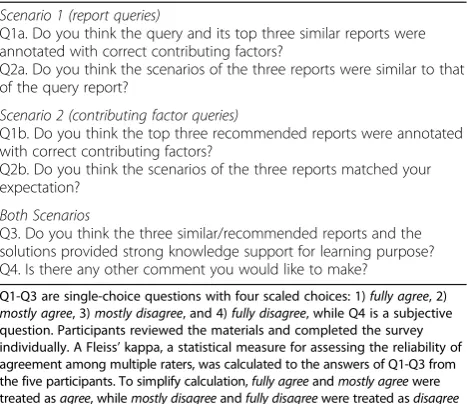
scenario is applying a group of user customized contribut-ing factors as the query. Five PSO experts participated in the evaluation. After reviewing the scenario-based learning materials (i.e., similar reports and recommended solutions), the participants were asked to complete a survey (Table1).
Apply user-centered design principles to a knowledge-based reporting and learning system
User-centered design (UCD) has been proven effective in improving reporting accuracy, completeness, and timeli-ness [38]. We applied UCD features such as input valida-tor, user-friendly layout, role-based operation, and user feedback, to the development of the knowledge-based reporting and learning system. The evaluation of UCD features were not included in this study.
Results
A hierarchical list of contributing factors for fall events
Based on the infrastructure (including 9 factor categories and 42 factor terms) derived from AHRQ CF, we extended
Fig. 1A rule-based knowledge support strategy for event reporting
Table 1Survey for learning effect evaluation
Scenario 1 (report queries)
Q1a. Do you think the query and its top three similar reports were annotated with correct contributing factors?
Q2a. Do you think the scenarios of the three reports were similar to that of the query report?
Scenario 2 (contributing factor queries)
Q1b. Do you think the top three recommended reports were annotated with correct contributing factors?
Q2b. Do you think the scenarios of the three reports matched your expectation?
Both Scenarios
Q3. Do you think the three similar/recommended reports and the solutions provided strong knowledge support for learning purpose? Q4. Is there any other comment you would like to make?
Q1-Q3 are single-choice questions with four scaled choices: 1)fully agree, 2)
mostly agree, 3)mostly disagree, and 4)fully disagree, while Q4 is a subjective
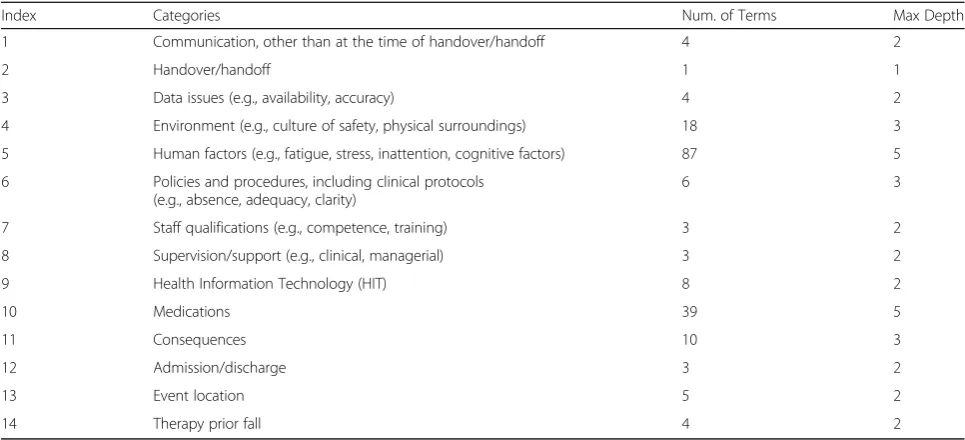
the contributing factor list for fall events to 14 categories and 195 terms by reviewing the 80% fall event reports. The maximum depth of the hierarchical structure is five. The categories are shown in Table2.
A rule-based strategy for annotating contributing factors
For the unstructured fields, a regular expression was la-beled as either “true” or “false” depending on the acti-vated or deactiacti-vated status of certain contributing factor when matching the expression. As a result, 939 rules were coded, including 862 activation rules and 77 deacti-vation rules. For the structured fields, 43 out of 195 con-tributing factors were coded with at least one answer option in the AHRQ CF fall reports. 362 reports out of the remaining 20% fall event reports were applied to evaluate the factor identification rules. As shown in Table 3, 349 (96.4%) reports were scored as fully agree
by the expert group, which indicates the 939 rules can effectively identify fall contributing factors from both structured and unstructured reports.
The fall solutions proposed in our previous study were further annotated with fall contributing factors by domain experts. 150 of 195 contributing factors were covered by a total of 122 solutions after coding experts’annotation re-sults (one solution may cover more than one factor).
A knowledge-based reporting and learning system
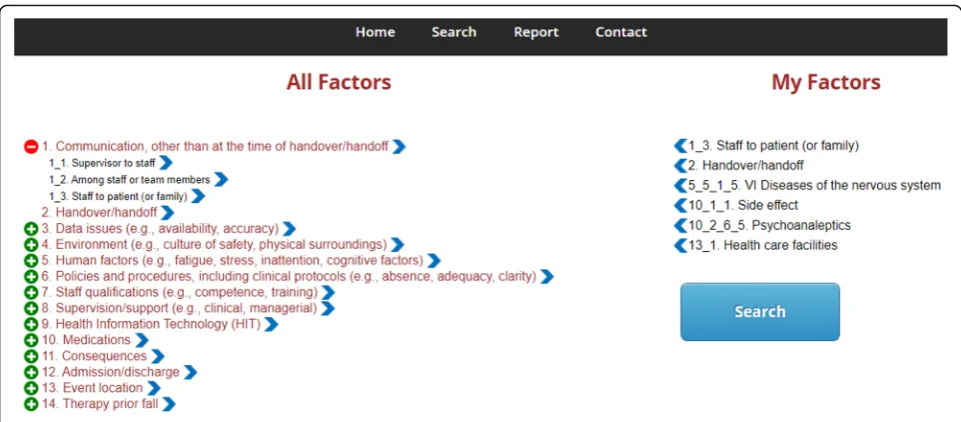
A knowledge-based reporting and learning system was de-veloped by applying the contributing factor identification rules and the corresponding similarity measurement strat-egy. The current version runs on a local webserver devel-oped by JSP and MySQL. UCD features such as input validator, user-friendly layout, role-based operation, and user feedback were incorporated into the system. To as-sess the knowledge support mechanism, we simulated two learning scenarios. Inscenario 1-learning after reporting or browsing, by applying the report submitted or selected by the user as a query (Fig. 2), while in scenario 2-active learning, the query was a group of contributing factors se-lected by the user (Fig.3).
Recommending solutions is an essential knowledge support for both scenarios. As shown in Fig.4, each so-lution was annotated with contributing factors, and was presented only when the corresponding factor(s) was/ were identified from the query report (scenario 1) or se-lected by the user (scenario 2). The ranking order of the factors were initialized randomly and would be opti-mized according to user preferences collected from the thumb up/down buttons. By clicking the download but-ton, the user could get more information about the iden-tified solutions, including solution category, source, link, and all related contributing factors.
Table 2A summary of the hierarchical contributing factor list for fall event reports
Index Categories Num. of Terms Max Depth
1 Communication, other than at the time of handover/handoff 4 2
2 Handover/handoff 1 1
3 Data issues (e.g., availability, accuracy) 4 2
4 Environment (e.g., culture of safety, physical surroundings) 18 3
5 Human factors (e.g., fatigue, stress, inattention, cognitive factors) 87 5
6 Policies and procedures, including clinical protocols (e.g., absence, adequacy, clarity)
6 3
7 Staff qualifications (e.g., competence, training) 3 2
8 Supervision/support (e.g., clinical, managerial) 3 2
9 Health Information Technology (HIT) 8 2
10 Medications 39 5
11 Consequences 10 3
12 Admission/discharge 3 2
13 Event location 5 2
14 Therapy prior fall 4 2
Table 3Distribution of the scaled scores -- Results of evaluating the identification rules
Scaled Scores 1: Fully Agree 2: Mostly Agree (lacking factor(s))
3: Mostly Disagree (appearing wrong factor(s))
4: Fully Disagree
To evaluate the knowledge support mechanism in both scenarios, a survey was conducted among five patient safety experts working with a PSO. Q1~Q3 were designed to assess contributing factor identification, similarity search, and learning effect respectively. The scaled scores
in Table 4 were calculated by averaging the scores from
the five experts, while Fleiss’Kappa [39,40] was calculated for the scores of each question to measure the consistency among experts. The five experts show substantial consistency (Fleiss’kappa > 0.6) in the assessment of the three perspectives of the system. Almost all mean scores are lower than 2, indicating a consensus of agreement of the effectiveness of the proposed func-tions toward learning. The only exception is the simi-larity assessment in scenario 2, where the mean score is
2.2. The reason was indicated in the experts’comments
that sometimes no report in current database covers all contributing factors selected by expert, which could lead to a bias in the similarity measurement. This bias is thought to be mitigated as the database grows.
Discussion
Bridging the gap between reporting and learning
The increasing number of PSE and needed solutions pose a challenge for exploring the potential connections among the events and presenting the events in an orga-nized view in a timely manner. Current reporting sys-tems do not have robust processes for analyzing and acting upon aggregated event reports. The expected knowledge support through event reporting is not mani-fest owing to many self-perceived barriers to voluntary reporting, such as no feedback, lengthy reporting forms competing with other priorities, and observed events that may seem “trivial”. A well-organized contributing factor list could be a reasonable start point that serves as an effective tool to manage knowledge. Nonetheless, none of the contributing factors relating to patient safety events has clear annotation criteria for reporters and re-searchers to follow. Focusing on fall events, we proposed a hierarchical list of contributing factors and annotation rules by reviewing PSO reports, and based on which we
developed a mechanism that integrates event reports and solutions toward case-based knowledge support. This learning-oriented mechanism bridges the gap between the reaction (reporting) and learning defined by the levels in the Kirkpatrick model, and paves the way for realizing the behavior and results at the higher levels.
Integrating and balancing unstructured and structured reports
Structured data refers to highly organized informa-tion, so that its inclusion in a relational database is seamless and readily searchable by simple, straightfor-ward search engine algorithms or other search opera-tions; unstructured data is the opposite. Further,
structured data is akin to computer language, which makes information easier to use with computers; while unstructured data is easier for human users, who do not interact with information in a strict
data-base format [41]. However, experts estimate that 80%
of the world’s data is unstructured, which means
re-searchers that do not access this data are losing much useful information [42]. In clinical settings, free-text reporting (unstructured) is preferred by healthcare providers over form-based reporting (structured) for PSE, because the providers are less acquainted with
the categories and fields pre-defined by the
form-based reporting. The lack of connection between structured and unstructured data could be overcome
Fig. 3A screenshot of customized contributing factor. Rather than applying an event report as a query, the user can also directly select the contributing factors and to launch the similarity search. The user is free to include/exclude any of the total 195 factors to/from“My Factors”and launch a similarity search. The calculation of similarity scores is based on Eq.2, and result display page is referred to Fig.2
by our rule-based strategy for identifying contributing factors since no pre-knowledge requirement about PSE taxonomy is needed for using our system. The timely knowledge support provided to targeted users can go beyond reporting format and holds promise in improving system interoperability and data sharing between sites, firms and industry sectors.
Minimizing the implementation cost
The hierarchical list of contributing factors for fall was established based on AHRQ CF and expert review, and could also support other PSE types through case-based
modification and extension. The knowledge-based
reporting and learning system in this study can be dir-ectly applied by PSO since it was developed based on AHRQ CF. PSO can provide an interface to local hospi-tals for reporting or learning. Therefore, the learning can occur at three levels. At the individual level, healthcare providers will have time to report and learn from what is being reported or has been reported. At the group level, for example, in a certain clinical department, the collective knowledge gleaned from the entire team could be shared through the system. The contributing factors in the events could be analyzed by an automatic process for patient safety experts to review and confirm as feed-back to the healthcare providers. At the organizational level, PSO can compare and analyze the reports across all reporting hospitals and provide tailored recommen-dations or solutions. Our system will not consume more time in reporting but add on learning features at the in-dividual level. Our system is expected to save time and effort at the group and organizational level in creating feedback and analyzing contributing factors. For the hos-pitals having their own reporting systems, the contribut-ing factor identification rules could be extracted as a natural language processing plug-in and embedded into the existing systems to minimize the implementation cost.
Detecting fall risks in EHR and CPOE systems
During the expert review, we found that the contributing factors to patient falls proposed in this study are suffi-cient to covere most fall scenarios in the PSO reports.
We also found that diseases, surgery histories, and medi-cations are essential contributing factors to patient falls. For example, the patients who were diagnosed as sei-zures, had neurosurgery, or took muscle relaxants, have higher fall risks than regular patients. Therefore, EHR and computerized physician order entry (CPOE) systems have great potential in detecting the fall cases and the corresponding contributing factors since a large amount of fall risks regarding to diseases, surgery histories, and medications are ignored. On the other hand, applying the factor identification tool in EHR and CPOE systems will facilitate the detection of fall risks at early stages, which could reduce unnecessary bed occupation days and save patient and healthcare facility’cost due to in-patient fall events.
Limitations
All evaluations in this project were processed through ex-pert review since there is no gold standard for PSE simi-larity measurement and solution recommendation. Each expert might bring a different perspective that may result in biases toward the learning effect assessment limited by the small sample size of survey (N= 5). The variety of the one-year data may be limited and insufficient to sub-stantiate the rules of contributing factors, which could im-pact the performance of similarity measurement.
Future work
The factor identification rules will be extended by increas-ing the sample sizes of fall reports and PSO experts in the evaluation survey. The effectiveness and efficiency of UCD features will be initially evaluated through usability inspec-tion and user evaluainspec-tion.
Conclusion
We developed a hierarchical list of contributing factors for patient falls and a rule-based factor identification model for both structured and unstructured reporting data. Based on the factors, a knowledge-based event reporting and learning system was developed to provide targeted knowledge sup-port and feedback. The knowledge supsup-port includes the similar reports sharing contributing factors to the query, and recommended solutions to prevent the
Table 4The result of survey-based evaluation for the knowledge support strategy
Mean Score (N= 5) Fleiss’
kappa
P-value
Scenario 1 Scenario
2 Report1 Report 2 Report3 Report4 Report5
Q1 (assess factors) 1.4 1.4 1.6 1.6 1.6 1.2 0.68 < 0.01
Q2 (assess similarity) 2.0 1.8 1.6 1.8 2.0 2.2 0.61 < 0.01
Q3 (assess learning) 1.4 1.4 1.8 1.4 1.8 1.6 0.66 < 0.01
*Please refer to method section for the content of each question
*Scaled scores: 1. fully agree; 2. mostly agree; 3. mostly disagree; and 4. fully disagree
recurrence and serious consequences. The evaluation result indicates that a profile of contributing factors could measure the similarity of patient safety events and organize patient safety knowledge for shared learn-ing. As a learning-oriented platform, our system is ex-pected to help healthcare professionals gain better understanding of PSE and actionable knowledge within their clinical workflows.
Abbreviations
AHRQ:Agency for Healthcare Research and Quality; CF: Common Formats; PSE: patient safety event; PSO: Patient safety organization; RCA: root cause analyses; UCD: user-centered design
Acknowledgements
We thank the experts for their expertise and participation in the survey.
Funding
This project is supported by UTHealth Innovation for Cancer Prevention Research Training Program Post-Doctoral Fellow-ship (Cancer Prevention and Research Institute of Texas grant #RP160015), The Agency for Healthcare Re-search and Quality (1R01HS022895), and The University of Texas System Grants Program (#156374). The content is solely the responsibility of the au-thors and does not necessarily represent the official views of the Agency for Healthcare Research and Quality.
Availability of data and materials Not applicable.
About this supplement
This article has been published as part ofBMC Medical Informatics and Decision Making Volume 18 Supplement 5, 2018: Proceedings from the 2018 Sino-US Conference on Health Informatics.The full contents of the supplement are available online athttps://
bmcmedinformdecismak.biomedcentral.com/articles/supplements/volume-18-supplement-5.
Authors’contributions
HK and YG designed the project and drafted the manuscript. HK collected the identification rules, coded rules to MySQL, and established the system interface. SZ and BY collected the solutions of patient falls and analyzed the survey results. All of the authors have read and approved the final manuscript.
Ethics approval and consent to participate
Protection of Human Subjects will be conducted according to the study protocol to be approved by the Institutional Review Board (IRB) of the University of Texas Health Science Center at Houston (UTHealth) (HSC-SBMI-12-0767) and in compliance with the National Institutes of Health human subject regulations.
Consent for publication Not applicable.
Competing interests
The authors declare that they have no competing interests.
Publisher’s Note
Springer Nature remains neutral with regard to jurisdictional claims in published maps and institutional affiliations.
Published: 7 December 2018
References
1. Runciman W, Hibbert P, Thomson R, Van Der Schaaf T, Sherman H, Lewalle P. Towards an international classification for patient safety: key concepts and terms. Int J Qual Health Care. 2009;21(1):18–26.
2. James JT. A new, evidence-based estimate of patient harms associated with hospital care. J Patient Saf. 2013;9(3):122–8.
3. Makary MA, Daniel M. Medical error-the third leading cause of death in the US. BMJ. 2016;353:i2139.
4. Healey F, Scobie S, Glampson B, Pryce A, Joule N, Willmott M. Slips, trips and falls in hospital. The third report from the patient safety observatory. In. London: National Patient Safety Agency; 2007.
5. Oliver D, Healey F, Haines TP. Preventing falls and fall-related injuries in hospitals. Clin Geriatr Med. 2010;26(4):645–92.
6. Wong CA, Recktenwald AJ, Jones ML, Waterman BM, Bollini ML, Dunagan WC. The cost of serious fall-related injuries at three Midwestern hospitals. Jt Comm J Qual Patient Saf. 2011;37(2):81–7.
7. Haines TP, Hill AM, Hill KD, Brauer SG, Hoffmann T, Etherton-Beer C, McPhail SM. Cost effectiveness of patient education for the prevention of falls in hospital: economic evaluation from a randomized controlled trial. BMC Med. 2013;11:135.
8. Nuckols TK, Bell DS, Paddock SM, Hilborne LH. Contributing factors identified by hospital incident report narratives. Qual Saf Health Care. 2008; 17(5):368–72.
9. Morse JM: Preventing patient falls. New York, NY 10036: Springer; 2008. 10. Murff HJ, Patel VL, Hripcsak G, Bates DW. Detecting adverse events for
patient safety research: a review of current methodologies. J Biomed Inform. 2003;36(1–2):131–43.
11. Gong Y. Data consistency in a voluntary medical incident reporting system. J Med Syst. 2011;35(4):609–15.
12. Shaw R, Drever F, Hughes H, Osborn S, Williams S. Adverse events and near miss reporting in the NHS. Qual Saf Health Care. 2005;14(4):279–83. 13. Morbidity & Mortality Rounds on the Web [https://psnet.ahrq.gov/webmm].
Date Accessed: Aug 31, 2018.
14. Preventing Falls in Hospitals: A toolkit for improving quality of care [https:// www.ahrq.gov/professionals/systems/hospital/fallpxtoolkit/index.html]. Date Accessed: Aug 31, 2018.
15. Targeted Solutions Tool [https://www.centerfortransforminghealthcare.org/ tst.aspx]. Date Accessed: Aug 31, 2018.
16. Pennsylvania Patient Safety Authority Tools [http://patientsafety.pa.gov/pst/ Pages/Falls/hm.aspx]. Date Accessed: Aug 31, 2018.
17. Donaldson MS, Corrigan JM, Kohn LT. To err is human: building a safer health system: National Academies Press; 2000.
18. Patient Safety Reporting System [https://psrs.arc.nasa.gov/]. Date Accessed: Aug 31, 2018.
19. Kivlahan C, Sangster W, Nelson K, Buddenbaum J, Lobenstein K. Developing a comprehensive electronic adverse event reporting system in an academic health center. Jt Comm J Qual Improv. 2002;28(11):583–94.
20. Common Formats for Event Reporting - Hospital Version 2.0 [https://www. psoppc.org/psoppc_web/publicpages/commonFormatsHV2.0]. Date Accessed: Aug 31, 2018.
21. Kang H, Gong Y. Design of a User-Centered Voluntary Reporting System for patient safety events. Stud Health Technol Inform. 2017;245:733–7. 22. Hua L, Gong Y. Information gaps in reporting patient falls: the challenges
and technical solutions. Stud Health Technol Inform. 2013;194:113–8. 23. Stavropoulou C, Doherty C, Tosey P. How effective are incident-reporting
Systems for Improving Patient Safety? A systematic literature review. Milbank Q. 2015;93(4):826–66.
24. Yao B, Kang H, Miao Q, Zhou S, Liang C, Gong Y. Leveraging event reporting through knowledge support: a knowledge-based approach to promoting patient fall prevention. Stud Health Technol Inform. 2017; 245:973–7.
25. Kang H, Gong Y. A novel Schema to enhance data quality of patient safety event reports. AMIA Annu Symp Proc. 2016;2016:1840–9.
26. Dechy N, Dien Y, Drupsteen L, Felicio A, Cunha C, Roed-Larsen S, Marsden E, Tulonen T, Stoop J, Strucic Met al: Barriers to learning from incidents and accidents. In.: European Safety Reliability and Data Association (ESReDa); 2015.
27. The New World Kirkpatrick Model [ https://www.kirkpatrickpartners.com/Our-Philosophy/The-New-World-Kirkpatrick-Model]. Date Accessed: Aug 31, 2018. 28. Smidt A, Balandin S, Sigafoos J, Reed VA. The Kirkpatrick model: a
useful tool for evaluating training outcomes. J Intellect Develop Disabil. 2009;34(3):266–74.
30. Castro GM, Buczkowski L, Hafner JM. The contribution of sociotechnical factors to health information technology-related sentinel events. Jt Comm J Qual Patient Saf. 2016;42(2):70–6.
31. Generic Event Description [https://www.psoppc.org/psoppc_web/ publicpages/commonFormatsHV2.0]. Date Accessed: Aug 31, 2018. 32. International Classification of Diseases, Tenth Revision. Clinical Modification
(ICD-10-CM) [https://www.cdc.gov/nchs/icd/icd10cm.htm]. Date Accessed: Aug. 2018:31.
33. Current Procedural Terminology (CPT) [https://www.ama-assn.org/ practice-management/cpt-current-procedural-terminology]. Date Accessed: Aug 31, 2018.
34. The Anatomical Therapeutic Chemical Classification System with Defined Daily Doses (ATC/DDD) [http://www.who.int/classifications/atcddd/en/]. Date Accessed: Aug 31, 2018.
35. Likert R. A technique for the measurement of attitudes. Archives of Psychology. 1932;140:1–55.
36. Vector space [https://en.wikipedia.org/wiki/Vector_space]. Date Accessed: Aug 31, 2018.
37. Kang H, Gong Y. Developing a similarity searching module for patient safety event reporting system using semantic similarity measures. BMC Med Inform Decis Mak. 2017;17(Suppl 2):75.
38. Gong Y, Kang H, Wu X, Hua L. Enhancing patient safety event reporting. A systematic review of system design features. Appl Clin Inform. 2017;8(3): 893–909.
39. Fleiss JL. Measuring nominal scale agreement among many raters. Psychol Bull. 1971;76(5):378–82.
40. Fleiss' kappa [https://en.wikipedia.org/wiki/Fleiss%27_kappa]. Date Accessed: Aug 31, 2018.
41. Structured vs. unstructured data [https://brightplanet.com/2012/06/ structured-vs-unstructured-data/]. Date Accessed: Aug 31, 2018. 42. Chakraborty G. Analysis of unstructured data: applications of text analytics