R E S E A R C H A R T I C L E
Open Access
“
Reducing unnecessary testing in a CPOE system
through implementation of a targeted CDS
intervention
”
Donald L Levick
1*, Glenn Stern
2, Chad D Meyerhoefer
3, Aaron Levick
4and David Pucklavage
5Abstract
Background:We describe and evaluate the development and use of a Clinical Decision Support (CDS) intervention; an alert, in response to an identified medical error of overuse of a diagnostic laboratory test in a Computerized Physician Order Entry (CPOE) system. CPOE with embedded CDS has been shown to improve quality of care and reduce medical errors. CPOE can also improve resource utilization through more appropriate use of laboratory tests and diagnostic studies. Observational studies are necessary in order to understand how these technologies can be successfully employed by healthcare providers.
Methods:The error was identified by the Test Utilization Committee (TUC) in September, 2008 when they noticed critical care patients were being tested daily, and sometimes twice daily, for B-Type Natriuretic Peptide (BNP). Repeat and/or serial BNP testing is inappropriate for guiding the management of heart failure and may be clinically misleading. The CDS intervention consists of an expert rule that searches the system for a BNP lab value on the patient. If there is a value and the value is within the current hospital stay, an advisory is displayed to the ordering clinician. In order to isolate the impact of this intervention on unnecessary BNP testing we applied multiple regression analysis to the sample of 41,306 patient admissions with at least one BNP test at LVHN between January, 2008 and September, 2011.
Results:Our regression results suggest the CDS intervention reduced BNP orders by 21% relative to the mean. The financial impact of the rule was also significant. Multiplying by the direct supply cost of $28.04 per test, the intervention saved approximately $92,000 per year.
Conclusions:The use of alerts has great positive potential to improve care, but should be used judiciously and in the appropriate environment. While these savings may not be generalizable to other interventions, the experience at LVHN suggests that appropriately designed and carefully implemented CDS interventions can have a substantial impact on the efficiency of care provision.
Keywords:Clinical decision support, Computerized physician order entry, Medical error, BNP testing, Alert fatigue, Sociotechnical, Unintended consequences, Appropriate testing
* Correspondence:[email protected] 1
Office of Chief Medical Information Officer, Lehigh Valley Health Network, PO Box 689, Cedar Crest and I-78, Allentown, PA 18105, USA
Full list of author information is available at the end of the article
Background
Computerized Physician Order Entry (CPOE) and embed-ded Clinical Decision Support (CDS) have been shown to improve quality of care and reduce medical errors [1-3]. CPOE and CDS can also improve resource utilization through more appropriate use of laboratory tests and diag-nostic studies. While a few Random-Controlled Trials (RCTs) have addressed CDS and CPOE efficacy [2,4,5], there are inherent limitations on the external validity of such studies. As a result, observational studies are also ne-cessary in order to understand how these technologies can be successfully employed by healthcare providers. How-ever, documentation of provider-initiated interventions is often limited, and as a result, more studies of implementa-tion at the point of care are needed to understand and measure CDS and CPOE effectiveness [6,7].
We describe the development and use of a CDS inter-vention in a CPOE system; an alert, in response to an ad-ministratively identified medical error of overuse of a diagnostic laboratory test. We discuss the complexity of effective CPOE implementation and demonstrate the ben-efits achieved by this quality improvement initiative through a reduction in inappropriate testing and lower medical care costs [2,7].
The medical error motivating this intervention was identified by the Test Utilization Committee (TUC) at the Lehigh Valley Health Network (LVHN), in Allentown, PA on September, 2008. The TUC noticed critical care pa-tients were being tested daily, and sometimes twice daily, for B-Type Natriuretic Peptide (BNP). BNP is secreted by the heart in response to changes in pressure that occur in patients with congestive heart failure (CHF). It is used as a marker to gauge the change in severity of CHF over time. Repeat and/or serial BNP testing is inappropriate for guid-ing the management of heart failure and may in fact be clinically misleading [8]. Given that additional BNP tests during an acute exacerbation of CHF provide no relevant clinical information, it was initially unclear why so many tests were being ordered. This overuse did not likely result in adverse clinical events [9], but it did significantly in-crease treatment costs.
All CDS interventions in response to identified errors involve critical success factors such as a culture of ac-ceptance of both technology and embedded ‘cognitive forcing strategies” (rules and alerts, standardized order sets, etc.) [10]. This report describes how one healthcare system designed a targeted CDS intervention to reduce unnecessary testing (and associated costs) in a CPOE system, and evaluates its effectiveness. This intervention was part of a larger initiative to create an “advanced” [11] CDS environment capacity at LVHN. Advanced CDS development moves beyond basic CPOE functions to respond to identified medical errors, evidence-based information changes, potential unintended consequences
and continuous quality improvement (CQI) over time, benefiting from a supportive socio-technical infrastruc-ture [11].
This study emerges from a growing body of literature that seeks to rigorously evaluate applications of Health IT in daily practice. A range of studies have focused on a sociotechnical approach in order to evaluate the multiple factors that contribute to effectiveness of these new tools [12-14]. Factors that have contributed the use and ability to evaluate decision support technologies include greater emphasis by providers on knowledge-management, and an increasing quantity of patient-specific data from genetic testing and electronic health records [15]. The enhanced ability of providers to analyze clinical practice patterns has also contributed to studies seeking to define what consti-tutes“appropriate testing”[16].
Among decision support tools, alerts and rules have received a great deal of attention in the literature due to the significant potential to improve care. CPOE systems have been shown to reduce medical errors and overall medical costs [1-3,17]. Several other studies and recent review articles [2,3] generally support the potential of CPOE and CDS to improve care, but note that most of the evidence related to effectiveness of these tools is from academic hospitals rather than community hospi-tals and or primary care facilities. Alerts and rules have also received a great deal of attention in the literature due to identified barriers to their acceptance and imple-mentation [14,18-21], and unintended consequences [14,22-25]. For example, this CDS intervention, and the development of the CPOE system in general, was designed to minimize“alert fatigue”that may occur when clinicians are overwhelmed by the number of alerts [21].
CPOE development and implementation
Lehigh Valley Health Network (LVHN) is the largest health care provider in the Lehigh Valley region of Pennsylvania with: three not-for-profit hospitals; nine health centers in four counties; primary and specialty care practices throughout the region; pharmacy, imaging and lab ser-vices; and preferred provider services. In fiscal year 2012, LVHN had over 54,000 acute admissions and 173,000 emergency department visits. The primary service area of Lehigh, Northampton and Carbon counties has a com-bined population of more than 800,000, making it Pennsylvania’s third most populated region. Minorities comprise more than 54% of all Allentown residents (the region’s largest city), almost 43% of whom are Hispanic or Latino.
through a socio-technical infrastructure that facilitates input from providers and includes an evaluative compo-nent pre and post implementation. Examples of this in-frastructure include the Test Utilization Council (TUC) that identified over-testing for BNP, and enterprise wide Clinical Decision Support Committee, safety commit-tees, and technology assessment groups. These groups and committees maintain an ongoing sensitivity to work flow issues in the implementation of CDS, including just-in-time evidence-based decision support (clinical knowledge) [15]. The discussion below demonstrates an adaptation to overcome a socio-technical barrier to effective usage of this technology—intrusion into the physician work flow.
LVHN began implementation of CPOE in 2001; by 2006, all beds were converted and CPOE use was mandatory. Concurrent with the implementation of CPOE was the installation of a closed loop medication admi-nistration system including embedded clinical decision support, automated pharmacy robot dispensing, online medication administration documentation and bar code medication administration. At LVHN, the implementation of this closed loop medication administration system is estimated to have reduced potential harmful medication errors by 80%.a
The initial approach to CDS at LVHN was very delib-erate. The implementation team was acutely aware of the impact that CPOE and CDS interventions had on physician workflow as well as their potential for generat-ing alert fatigue. Consequently, interventions that would
“add clicks” (such as alerts and rules) and standardized order sets were added judiciously during the early stages of the CPOE rollout—the“basic stage”[11]. As the phy-sicians acclimated to the system, they became more re-ceptive to an increasing number of CDS interventions. Moving physicians along this “continuum of intrusion” [26] was considered an important success factor by all stakeholders for this CDS intervention.
Identification of BNP over-testing as a medical error
In September 2008, the Senior Clinical Pathologist no-ticed critical care patients were being tested daily, and sometimes twice daily, for B-type natriuretic Peptide (BNP). The issue was brought to the TUC and priori-tized as a high volume (and high cost) test requiring fur-ther investigation and intervention. Research revealed that repeat BNP testing is usually not indicated during a hospital stay [8]. The TUC recommended modifying LVHN’s existing CPOE system to employ an expert rule to alert the ordering clinician that a BNP had been performed during the current admission and that repeat testing would add no value to the clinical decision mak-ing process.
Methods
CDS alert development
The CDS alert was implemented through an expert rule that searches the system for a BNP lab value on the patient. If there is a value and the value is within the current hospital stay, an advisory is displayed to the ordering clinician. (See Figure 1 for a screenshot of the alert.) If there is no BNP lab value on the patient within the current episode of care, the rule evaluates pending orders for an active order for a BNP within the current episode. If an active order is found, a different advisory is displayed. If no lab value and no pending active order exist in the current episode of care, then no advisory is displayed. The alerts are advisory only and considered a
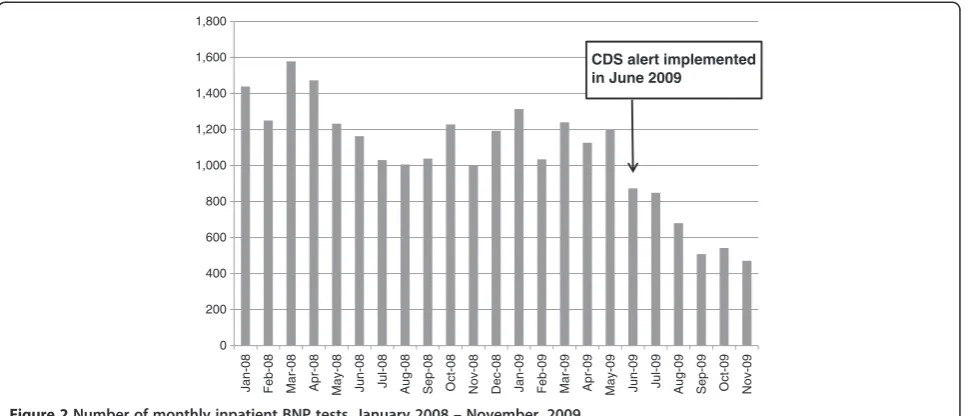
“soft stop”because the clinician still has the opportunity to place the order after having been presented with rele-vant information. The CDS intervention for repeat BNP testing was implemented in June, 2009 and BNP order-ing decreased by approximately 65% within six months of introduction of the alert. Comparing the three month period (January through March) before and after the intervention indicates that total BNP ordering on in-patient encounters decreased from 3,291 to 2,563, and the number of patients receiving two or more BNP tests during a single hospital stay decreased from 1,358 to 487 (p < .01). However, Figure 2 also reveals that there was a downward trend in BNP testing during the surrounding time period of the intervention. This trend could be the result of several factors, including behavioral change on the part of physicians or process changes caused by other aspects of the new medication administration sys-tem, as well as changes in the health and demographic characteristics of patients eligible for the BNP test.
Multivariate statistical analysis
In order to isolate the impact of the CPOE intervention on unnecessary BNP testing, we apply multiple regres-sion analysis to the sample of 41,306 patient admisregres-sions with at least one BNP test at LVHN between January, 2008 and September, 2011. Although the average num-ber of tests ordered was 1.8, the distribution of BNP or-ders is skewed to the right with a maximum value of 31 (see Table 1). Therefore, we model the number of BNP orders using a zero-truncated negative binomial (ZTNB) distribution to account for both the truncation of the dependent variable at 1, and the skewness of the distri-bution [27].
We include a variety of controls in our models to ac-count for changes over time in the characteristics of pa-tients that may influence the propensity of physicians to order additional tests. These include indicator variables for patient age (age ≤ 40; 40 < age≤ 60; 60 < age≤ 80; age > 80), gender, race (white; black; Hispanic; other race), admission type (emergency; elective; urgent), and insurance type (private traditional plan; Medicare; Me-dicaid; self-pay; private managed care plan; Medicare managed care; Medicaid managed care). In addition, we include indicators for quartile of the inpatient cost risk distribution, where risk is based on patients’ Diagnostic Cost Group/Hierarchical Condition Category (DCG/HCC) risk scores.b
Our intervention indicator is equal to 1 for all patient admissions during or after June, 2009, the month that the CPOE alert was put and place, and is equal to 0 be-fore that date. The mean, minimum, and maximum of the intervention indicator and all of the control variables are listed in Table 1.
0 200 400 600 800 1,000 1,200 1,400 1,600 1,800
Jan-08 Feb-08 Mar-08 Apr-08 May-08 Jun-08 Jul-08 Aug-08 Sep-08 Oct-08 Nov-08 Dec-08 Jan-09 Feb-09 Mar-09 Apr-09 May-09 Jun-09 Jul-09 Aug-09 Sep-09 Oct-09 Nov-09
CDS alert implemented in June 2009
Figure 2Number of monthly inpatient BNP tests, January 2008–November, 2009.
Table 1 Descriptive statistics for analysis variables (N = 41,306)
Mean Min Max
BNP Orders 1.787 1 31
(SD = 1.364)
Age≤40 0.022 0 1
40 < Age≤60 0.146 0 1
60 < Age≤80 0.432 0 1
Age > 80 0.399 0 1
Female 0.500 0 1
White 0.905 0 1
Black 0.023 0 1
Hispanic 0.024 0 1
Other race 0.048 0 1
Emergency admission 0.849 0 1
Elective admission 0.046 0 1
Urgent admission 0.103 0 1
DCG/HCC risk score 4.347 −0.875 17.779
(SD = 2.271)
Private insurance 0.132 0 1
Medicare 0.635 0 1
Medicaid 0.023 0 1
Self-pay 0.007 0 1
Private managed care 0.027 0 1
Medicare managed care 0.162 0 1
Medicaid managed care 0.014 0 1
Monthly time trend 21.659 1 45
(SD = 0.496)
Results
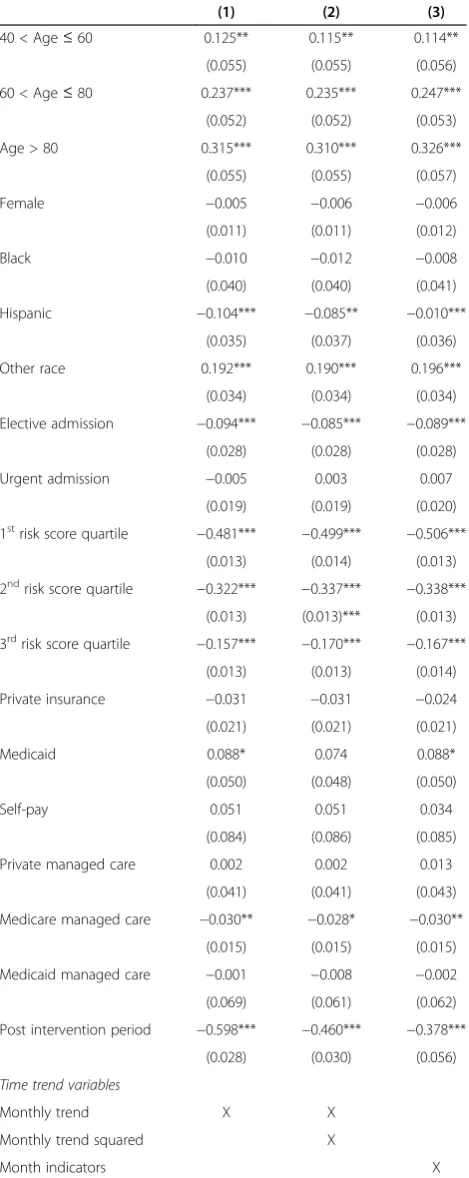
We estimate three ZTNB regression models in order to test the sensitivity of our results to different specifica-tions for capturing overall trends in BNP orders not due to the intervention during the sample period. These re-sults are reported in Table 2, which contains the mar-ginal effects of the control variables and the intervention indicator. The marginal effects are interpreted as the im-pact on the number of BNP orders corresponding to a one unit change in the given variable. The standard er-rors of the marginal effects in parenthesis are robust to heteroscedasticity.
In the first specification in column 1 we include a single monthly time trend variable to capture aggregate trends in BNP orders net of the CDS intervention. The estimates from this specification suggest that the intervention re-duced the number of BNP orders by 0.6 per inpatient ad-mission, on average. However, when we include additional variables to more flexibility control for aggregate trends over time, this estimate is reduced by over 20%. In addition to a linear monthly time trend, the specification in column 2 also contains the square of the time trend, while the specification in column 3 includes separate indi-cator variables for each month of the sample. Among these models, we prefer the third and most flexible specifi-cation, which indicates that the intervention reduced the number of BNP tests by 0.4 per admission. This effect is precisely estimated, and represents a reduction in BNP or-ders of 21% relative to the mean.
The financial impact of the rule was also significant. In the three quarters prior to the implementation of the intervention there were 11,209 BNP tests ordered at LVHN. Based on our statistical model, we project that the intervention reduced BNP orders by 21%, or 2,454 tests over three quarters. Multiplying by the direct sup-ply cost of $28.04 per test, this suggests the intervention saved approximately $92,000 per year. These savings are based on supply cost only, and do not account for the increased capacity for the laboratory to perform other tests. As a result, the full annual long run benefits of the intervention are greater than our estimate of supply cost savings, after the short term costs of implementing the intervention are recovered.
Discussion
While there are few observational studies that evaluate the effectiveness of similar CDS interventions, Bates et al [3]. found using a randomized controlled trial that computerized reminders about redundant laboratory tests significantly reduced the final number of ordered tests. There is also a paucity of research on the impact of CDS and CPOE on costs. A comprehensive 2010 re-search review of the impact of CDS on test ordering and appropriate utilization in the UK was not able to identify
Table 2 Change in BNP orders associated with one unit change in selected variables from ZTNB regression
(1) (2) (3)
40 < Age≤60 0.125** 0.115** 0.114**
(0.055) (0.055) (0.056)
60 < Age≤80 0.237*** 0.235*** 0.247***
(0.052) (0.052) (0.053)
Age > 80 0.315*** 0.310*** 0.326***
(0.055) (0.055) (0.057)
Female −0.005 −0.006 −0.006
(0.011) (0.011) (0.012)
Black −0.010 −0.012 −0.008
(0.040) (0.040) (0.041)
Hispanic −0.104*** −0.085** −0.010***
(0.035) (0.037) (0.036)
Other race 0.192*** 0.190*** 0.196***
(0.034) (0.034) (0.034)
Elective admission −0.094*** −0.085*** −0.089***
(0.028) (0.028) (0.028)
Urgent admission −0.005 0.003 0.007
(0.019) (0.019) (0.020)
1strisk score quartile −0.481*** −0.499*** −0.506***
(0.013) (0.014) (0.013)
2ndrisk score quartile −0.322*** −0.337*** −0.338***
(0.013) (0.013)*** (0.013)
3rdrisk score quartile −0.157*** −0.170*** −0.167***
(0.013) (0.013) (0.014)
Private insurance −0.031 −0.031 −0.024
(0.021) (0.021) (0.021)
Medicaid 0.088* 0.074 0.088*
(0.050) (0.048) (0.050)
Self-pay 0.051 0.051 0.034
(0.084) (0.086) (0.085)
Private managed care 0.002 0.002 0.013
(0.041) (0.041) (0.043)
Medicare managed care −0.030** −0.028* −0.030**
(0.015) (0.015) (0.015)
Medicaid managed care −0.001 −0.008 −0.002
(0.069) (0.061) (0.062)
Post intervention period −0.598*** −0.460*** −0.378***
(0.028) (0.030) (0.056)
Time trend variables
Monthly trend X X
Monthly trend squared X
Month indicators X
Notes: Standard errors in parenthesis; *** p<0.01, **p<0.05, *p<0.1. Base categories include: age≤40; white; emergency admission; 4th
any specific studies on reduced costs from interventions that reduced overuse of testing [4]. Nonetheless, the im-portance of studies that determine the impact of CDS and CPOE on cost is well recognized [2,4,7,11,28] A recent meta analysis of the relatively small number of studies cur-rently available that do address the cost consequences of CPOE and CDS, found a significant amount of variability in the level of cost savings; ranging from $6,000 to $84,194 [29].
Much of the previous literature on CPOE addresses the unintended consequences that result from the imple-mentation of new technologies, the most serious of which is e-iatrogenesis. Because there is no evidence that this over-testing error caused harm to patients, it is not an example of e-iatrogenesis. Furthermore, it is not clear whether over-testing for BNP was in fact an unintended consequence of CPOE. [22-25] In that case it may or may not be classified as a“new kind of error”[24] or an error made because of the existence of CPOE. LVHN front line staff concluded that the over-testing occurred because either the ordering physician did not understand the time-period of the reliability of the test, or the phys-ician was unable to find previous orders/ results in the electronic record (or did not take the time to search the system). If the former hypothesis is accurate then the ex-perience of LVHN demonstrates the benefit of CPOE in uncovering previously unrecognized instances of ineffi-cient care, and the ability of complementary CDS tech-nologies to increase the efficiency of care provision and lower costs. In contrast, if the latter hypothesis is cor-rect, LVHN’s experience demonstrates how CDS can be used to correct an unintended consequence of CPOE .In both cases the CDS intervention led to a positive out-come, but the two underlying reasons for the over-use error have very different implications for the efficacy of CPOE. This highlights the need for future research stud-ies that use a mix of qualitative and quantitative methods to fully characterize and evaluate the use of new tech-nologies [11-13,15]. Irrespective of the source of the over-use error, LVHN’s method of identifying and correcting the error can be replicated by other health care networks with similar IT systems and socio-technical infrastructures.
Conclusion
In the specific case of CDS, the use of alerts has great potential to improve care, but should be used judiciously and in the appropriate environment [11,14,20,26,30]. The intervention implemented at LVHN to reduce un-necessary testing was effective because: 1) It alerted phy-sicians that further BNP testing is potentially misleading; 2) It addressed an information failure associated with the EMR (previous episode of care results were not vis-ible once results were posted) and; 3) The intervention
was implemented and evaluated in the context of an ad-vanced [11] CPOE system facilitating this cycle of imple-mentation and evaluation. Although we cannot determine how each of these factors independently contributed to the success of the intervention, our statistical analysis indicates that they collectively resulted in the reduction of BNP test-ing by 21%; savtest-ing LVHN over $92,000 per year. While these savings may not be generalizable to other interven-tions, the experience at LVHN suggests that appropriately designed and carefully implemented CDS interventions can have a substantial impact on the efficiency of care provision.
Endnotes
a
Lehigh Valley Health Network, Internal Report, 2011
b
DCG/HCC risk scores are derived from data on pa-tient age, sex, and physician-reported diagnosis codes (ICD-9-CM). They have been validated as a proper measure of risk adjustment in the inpatient setting (Ash et al., 2003; Petersen, Pietz, Woodard & Byrne, 2005) and are also used by CMS to risk adjust Medicare pay-ments to private insurers under Part C (Pope et al., 2004; Pope et al., 2000).
Competing interest
The author(s) declare that they have no competing interests.
Authors’contributions
DL was involved in the development of the study, drafting and editing of the manuscript. DP participated in the development of the study and the initial draft of the document. AL performed the literature search and in the development of the manuscript. GS provided the theoretical frameworks and performed much of the editing of the manuscript. CM provided statistical analysis and contributed to the restructuring of the manuscript. All authors read and approved the final manuscript.
Acknowledgements
Bala Carver, M.D., Department of Pathology and Laboratory Services, Lehigh Valley Health Network; for providing support from Laboratory Services and ideas for initial design. Geoffrey Correll, BS, MT (ASCP). Department of Pathology and Laboratory Services, Lehigh Valley Health Network; for providing the data regarding test utilization. Lizhong Peng and Jeffrey McFetridge, Lehigh University, for valuable research assistance.
Author details
1Office of Chief Medical Information Officer, Lehigh Valley Health Network,
PO Box 689, Cedar Crest and I-78, Allentown, PA 18105, USA.2Chasm Crossing Consulting, 1470 Limeport Pike, Coopersburg, PA, USA.3Rauch Business Center, 621 Taylor Street, Bethlehem, PA 18015, USA.4Department of Physics, Cornell University, 109 Clark Hall, Ithaca, NY 14853, USA. 5
Information Services, Lehigh Valley Health Network, Cedar Crest and I-78, PO Box 689, Allentown, PA 18105, USA.
Received: 9 June 2012 Accepted: 13 March 2013 Published: 8 April 2013
References
1. Bates DW, Leape LL, Cullen DJ, Laird N, Petersen LA, Teich JM, Burdick E, Hickey M, Kleefield S, Shea B, Vander Vliet M, Seger DL:Effect of computerized physician order entry and a team intervention on prevention of serious medication errors.J Am Med Inform Assoc1998, 280:1311–316.
Loback D:Effect of Clinical Decision-Support Systems: A systematic Review.Ann Intern Med2012 [Epub ahead of print].
3. Bates DW, Kuperman GJ, Rittenburg E, Teich JM, Fiskio J, Ma’luf N, Onderdonk A, Wybenga D, Winkelman J, Brennan TA, Komaroff AL, Tanasijevic M:A randomized trial of a computer-based intervention to reduce utilization of redundant laboratory tests.Am J Med1999, 106:144–150.
4. Main C, Moxham T, Wyatt JC, Kay J, Anderson R, Stein K:Computerised decision support systems in order communication for diagnostic, screening or monitoring test ordering: systematic reviews of the effects and cost-effsets and cost-effectiveness of systems.Helth Technol Assess 2010,14(48):1–227.
5. Tamblyn R, Huang A, Taylor L, Kawasumi Y, Bartlett G, Grad R, Jacques A, Dawes M, Abrahamowicz M, Perreault R, Winslade N, Poissant L, Pinsonneault A:A Randomized Trial of the Effectiveness of On-demand versus Computer-triggered Drug Decision Support in Primary Care.J Am Med Inform Assoc2008,15:430–438.
6. Velasco F:Clinical Decision Support and Meaningful Use.Adv Health Inform Exec2010,20:15–20.
7. Lehmannm H, Ohno-Machado L:Evaluation of informatics systems: beyond RCTs and beyond the hospital.Am Heart J2006,152(5):828–34. 8. Wu AH:Serial testing of B-type natriuretic peptide and NTpro-BNP for monitoring therapy of heart failure: the role of biologic variation in the interpretation of results.Am Heart J2006,152(5):828–34.
9. Bates DW, Boyle DL, Vander Vliet MB, Schneider J, Leape L:Relationship between medication errors and adverse drug events.Gen Int Med1995, 10:199–205.
10. Croskerry P:Cognitive Forcing Strategies in Clinical Decisionmaking.Ann Emerg Med2003,41(1):110–120.
11. Kuperman GJ, Bobb A, Payne TH, Avery AJ, Ghandhi TK, Burns G, Classen DC, Bates DW:Medication-related clinical decision support in computerized provider order entry systems: a review.J Am Med Inform Assoc2007,14(1):29–40.
12. Westbrook JI, Braithwaite J, Georgiou A, Ampt A, Creswick N, Coiera E, Idema R:Multimethod evaluation of information and communication technologies in health in the context of wicket problems and sociotechnical theory.J Am Med Inform Assoc2007,14(6):746–755. 13. Georgiou A, Westbrook JI, Braithwaite J:An empirically-derived approach
for investigating Health Information Technology: the Elementally entangled Organisational Communication (EEOC) framework.BMC Med Inform Decis Mak2012,12:68.
14. Harrison MI, Koppel R, Bar-Lev S:Unintended Consequences of Information Technologies in Health Care–An Interactive Sociotechnical Analysis.JAMIA2007,14:542–549.
15. Wang XS, Nayda L, Dettinger R:Infrastructure for a clinical-decision -intelligence system.IBM Syst J2007,46(1):151–169.
16. van Walraven C, Naylor CD:Do we know what inappropriate laboratory utilization is? A systematic review of laboratory clinical audits.JAMA 1998,280(6):550–558.
17. Galanter WL, Didomenico RJ, Polikaitis A:A trial of automated decision support alerts for contraindicicated medications using computerized physician order entry.J Am Med Inform Assoc2005,12(3):269–274. 18. Weingart SN, Toth M, Sands DZ, Aronson MD, Davis RB, Phillips RS:
Physicians’Decisions to Override Computerized Drug Alerts in Primary Care.Arch Intern Med2003,163(21):2625–2631.
19. Payne TH, Nichol WP, Hoey P, Savarino J:Characteristics and Override Rates of Order Checks in a Practitioner Order Entry System.Proc AMIA Annu Fall Symp2002:602–606.
20. Wright A, Sittig DF, Ash JS, Bates DW, Feblowitz J, Fraser G, Maviglia SM, McMullen C, Nichol WP, Pang JE, Starmer J, Middleton B:Governance for clinical decision support: case studies and recommended practices from leading institutions.JAMIA2011,18:187–194.
21. Osheroff JA, Teich JM, Levick D, Saldana L, Velasco FT, Sittig DR, Rogers KM, Jenders RA:Improving Outcomes with Clinical Decision Support: An Implementer’s Guide.2nd edition. HIMSS Publishing; 2012.
22. Ash JS, Sittig DF, Dykstra R, Campbel E, Guappone K:The Unintended Consequences of Computerized Provider Order Entry: Finding from a Mixed Methods Exploration.Int J Med Inform2009,78(Suppl 1):S69–S76. 23. Ash JS, Sittig DF, Poon EG, Guappone D, Campbell E, Dykstra RH:The
Extent and Importance of Unintended Consequences Related to Computerized Provider Order Entry.JAMIA2007,14(4):415–423.
24. Campbell EM, Sittig DF, Ash JS, Guappone DP, Dykstra RH:Types of Unintended Consequences Related to Computerized Provider Order Entry.JAMIA2006,13:547–556.
25. Koppel R, Metlayy JP, Cohen A, Abaluck B, Localio AR, Kimmel SE, Strom BL: Role of Computerized Physician Order Entry Systems in Facilitating Medication Errors.JAMA2005,293(10):1197–1203.
26. Byers J:CMIO Summit: Levick says DCS must be clear for success. Health Imaging. in press.
27. Cameron A, Trivedi P:Microeconometrics: Methods and Applications.New York: Cambridge University Press; 2005.
28. Qaseem A, Alguire P, Dallas P, Feinberg L, Fitzgerald F, Horwitch C, Humphrey L, LeBlond R, Moyer D, Wiese J, Weinberger S:Appropriate Use of Screening and Diagnostic Tests to Foster High-Value, Cost-Conscious Care.Ann Intern Med2012,156(2):147–149.
29. Lobach D, Sanders GD, Bright TJ, Wong A, Dhurjati R, Bristow E, Bastian L, Coeytaux R, Samsa G, Hasselblad V, Williams JW, Wing L, Musty M, Kendrick AS:Enabling Health Care Decisionmaking Through Clinical Decision Support and Knowledge Management. Evidence Report No. 203. (Prepared by the Duke Evidence-based Practice Center under Contract No. 290-2007-10066-I.) AHRQ Publication No. 12-E001-EF.Rockville, MD: Agency for Healthcare Research and Quality; 2012.
30. Schedlebauer A, Prasad V, Mulvaney C, Phansalkar S, Stanton W, Bates DW, Avery AJ:What evidence supports the use of computerized alerts and prompts to improve clinicians’prescribing behavior?JAMIA2009, 16:531–538.
doi:10.1186/1472-6947-13-43
Cite this article as:Levicket al.: “Reducing unnecessary testing in a
CPOE system through implementation of a targeted CDS intervention”.
BMC Medical Informatics and Decision Making201313:43.
Submit your next manuscript to BioMed Central and take full advantage of:
• Convenient online submission
• Thorough peer review
• No space constraints or color figure charges
• Immediate publication on acceptance
• Inclusion in PubMed, CAS, Scopus and Google Scholar
• Research which is freely available for redistribution