R E S E A R C H
Open Access
Validation of the theoretical domains framework
for use in behaviour change and implementation
research
James Cane
1, Denise O
’
Connor
2and Susan Michie
3*Abstract
Background:An integrative theoretical framework, developed for cross-disciplinary implementation and other behaviour change research, has been applied across a wide range of clinical situations. This study tests the validity of this framework.
Methods:Validity was investigated by behavioural experts sorting 112 unique theoretical constructs using closed and open sort tasks. The extent of replication was tested by Discriminant Content Validation and Fuzzy Cluster Analysis.
Results:There was good support for a refinement of the framework comprising 14 domains of theoretical constructs (average silhouette value 0.29):‘Knowledge’, ‘Skills’,‘Social/Professional Role and Identity’,‘Beliefs about Capabilities’,‘Optimism’,‘Beliefs about Consequences’,‘Reinforcement’,‘Intentions’,‘Goals’,‘Memory, Attention and Decision Processes’,‘Environmental Context and Resources’,‘Social Influences’,‘Emotions’, and‘Behavioural Regulation’.
Conclusions:The refined Theoretical Domains Framework has a strengthened empirical base and provides a method for theoretically assessing implementation problems, as well as professional and other health-related behaviours as a basis for intervention development.
Keywords:Theoretical domains framework, Behaviour, Change, Implementation, Validation, Theory
Background
Behaviour change is key to improving healthcare and health outcomes. Behaviours may be those of healthcare workers, such as implementation of evidence-based prac-tice, of patients, such as medication adherence, or of the general population, such as smoking cessation and in-creasing physical activity. Despite high-level recommen-dations to improve implementation of evidence-based practice [1,2] and a rapidly developing field of implemen-tation science, implemenimplemen-tation remains variable, with nu-merous organisational and individual factors influencing healthcare workers’behaviour. These factors include the availability of evidence, its relevance to practice, the dissemination of evidence and guidelines, individual
motivation, the ability to keep up with current changes, clarity of roles and practice, and the culture of specific healthcare practices [3,4].
Improving implementation of evidence-based practice by healthcare workers depends on changing multiple behaviours of multiple types of people (e.g., health pro-fessionals, managers, administrators) [5]. Changing be-haviour is not easy, but is more effective if interventions are based on evidence-based principles of behaviour change [6]. These principles form part of many theories of behaviour change, but are seldom drawn on in designing and evaluating implementation interventions. There is some evidence that behaviour change interven-tions informed by theory are more effective than those that are not [7,8]. Designing interventions on the basis of practitioner or researcher intuition rather than theory precludes the possibility of understanding the behaviour change processes that underlie effective interventions * Correspondence:[email protected]
3Research Department of Clinical, Centre for Outcomes Research and
Effectiveness (CORE), Education and Health Psychology, University College London, 1-19 Torrington Place, London, WC1E 7HB, UK
Full list of author information is available at the end of the article
and of applying this knowledge to inform the design of future interventions. This is also the case where theory is cited but poorly applied to intervention development [9].
In a review of 235 guideline development and imple-mentation studies, only 22.5% were judged to have used theories of behaviour change, and 16.6% of stud-ies using a single theory [10]. A further 4.3% used only selected constructs from theories; across the majority of studies there was no clear rationale for theory use. While use of a single theory may be appropriate and lends itself to theory testing, in many cases the selec-tion has not been justified and the theory is not tested [9]. If theory selection is not informed by a compre-hensive theoretical assessment of the implementation or other behavioural problem, there is a risk of miss-ing relevant theoretical constructs or includmiss-ing irrele-vant ones. A second problem in applying theory to intervention design stems from basing interventions on several theories with overlapping theoretical constructs [11,12]. This makes it difficult to identify the specific processes underlying successful behaviour change.
To overcome such problems, an integrative frame-work of theories of behaviour change was developed by 18 psychological theorists in collaboration with 16 health service researchers and 30 health psychologists [13]. The aim of the Theoretical Domains Framework (TDF) was to simplify and integrate a plethora of be-haviour change theories and make theory more access-ible to, and usable by, other disciplines. The group identified 33 theories and 128 key theoretical con-structs related to behaviour change and synthesised them into a single framework to assess implementation and other behavioural problems and inform interven-tion design. They used a six stage consensus approach: identifying theories and theoretical constructs relevant to behaviour change, where a theoretical construct was defined as‘a concept specially devised to be part of a the-ory’[13]; simplifying these resulting constructs into over-arching theoretical domains, where a theoretical domain
was defined as ‘a group of related theoretical
con-structs’ [13]; evaluating the importance of the theoret-ical domains; conducting an interdisciplinary evaluation and synthesis of the domains and constructs; validating the domain list; and piloting interview questions rele-vant to the constructs and domains. This resulted in 12 theoretical domains and exemplar questions for each to use in interviews or focus groups to provide a comprehensive theoretical assessment of implementa-tion problems.
This framework has been used by research teams across several healthcare systems to explain implementa-tion problems and inform implementaimplementa-tion intervenimplementa-tions. For example, in Australia it has been used to identify the barriers and enablers to the implementation of
evidence-based guidelines for acute low back pain [14,15] and de-velop theory-informed behaviour change interventions [16]. In the UK, examples include studies of the barriers and levers related to hand hygiene [17]; the assessment of theoretical domains relevant to blood transfusion practice across different contexts including neonatal and adult intensive care units [18,19]; and identifying difficul-ties in implementing guidelines relating to schizophrenia [20]. In Denmark, it has been used to understand behav-iour in the implementation of tobacco use prevention and counselling guidelines amongst dental providers [21]. Most of this research has used interviews and focus groups that are resource intensive; a questionnaire meas-ure is currently being developed by the authors. This will facilitate research investigating prediction of implemen-tation and other types of behaviour change.
This article is one in a series of articles documenting the development and use of the TDF to advance the science of implementation research. To inform future use of the TDF, we conducted the current study to pro-vide a more thorough test of the validity of the frame-work than was carried out in the original research. The overall objective of the study was to examine the content validity of the TDF. Specifically, we wanted to confirm the optimal domain structure (number of domains), domain content (component constructs in each domain), and domain labels (most appropriate names that best reflected the content of the validated domain structure). Card sorting methodology was used to conduct the validation of the TDF in this study. By building on the validation process undertaken by Michie
et al. [13] the present study aimed to improve the em-pirical basis of this framework.
Method Design
The study used a cross-sectional design.
Participants
Psychological Society’s Division of Health Psychology. The contact details of all individuals identified as authors on papers identified through the electronic database searches were located via publically available sources (e.g., searches of university and other organisa-tion websites).
Of 101 individuals who asked for full information about the study, 61 expressed an interest in taking part and were sent links to one of the online tasks; 37 of these (61%) completed their assigned task. The majority were from the UK (16), with the remaining participants being from the Netherlands (8), USA (2), Ireland (2), Australia (2), Italy (2), Portugal (1), South Africa (1), Greece (1), Germany (1), and Switzerland (1). The 27 women and 10 men had a mean age of 36.54 years (range 22 to 62).
The sample size for the tasks was based on estimates of between six and 36 participants shown as sufficient for sort and cluster analysis tasks [22-28]. For content-validation tasks, such as those proposed in the closed sort task, two to 24 participants have been shown to be sufficient [29-32], with more than five participants redu-cing the influence of rater outliers [33].
Evaluating the framework
To evaluate the original framework, a three step method was used:
Step one: Identify the optimal number of domains by sort task methods.
Step two: Establish domain content by identifying the most suitable construct allocation to each of the domains. Step three: Finalise domain labels by identifying the most appropriate labels for new domains (labels for domains that replicated the original ones were retained).
Sort task methodology
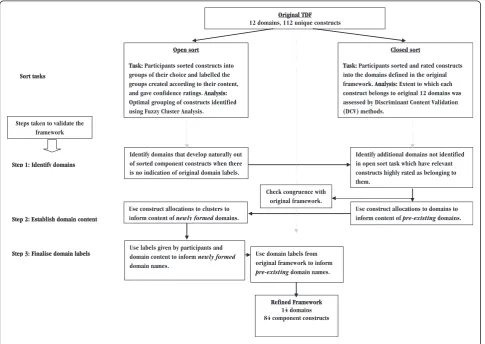
Two types of sort task were used: an open sort task and a closed sort task (see Figure 1). In the open sort task, participants were asked to sort constructs into groups of their choice and label these groups according to their content. The optimal grouping of constructs into domains was identified using Fuzzy Cluster Analysis [34], whereby sorting patterns across individual participants could be aggregated into clusters. This cluster technique has the benefit over the more commonly used k-means
and k-medoid cluster analysis, and other grouping meth-ods, in that it allocates a membership value (in the form of a probability value) for each possible construct-cluster pairing rather than simply assigning a construct to a single cluster, thereby the membership of items to more than one group could be assessed. The results obtained from the open sort task and Fuzzy Cluster Analysis were used to identify the optimal domain structure (step one), the content of new domains (step two), and the most appro-priate domain labels, based on the group names given by participants (step three). In the closed sort task, par-ticipants were asked to sort constructs into the domains defined in the original framework and rate their confi-dence in their allocation of each construct to a domain. The extent to which participants believed each con-struct belonged to the original 12 domains was assessed by Discriminant Content Validation (DCV) methods. DCV methods are able to examine the confidence of relationship between a single item and a particular domain [35]. The results from the closed sort task were used to identify any domains containing constructs with high confidence ratings and good agreement between participants (step one), and the constructs allocated to these domains (step two). Both types of sort task informed step one because it was considered important to include domains that developed naturally from the construct groupings (as informed by the open sort task), and to include domains to which there was good agree-ment across participants in the confidence of construct allocation to these domains (as informed by the closed sort task). To achieve this, the open sort task results were used to identify the domains based on the clusters formed in the open sort task; the closed sort results were then used to identify any additional domains for which there was good agreement and confidence in assigning constructs to these domains.
Materials
There were 112 unique constructs (see Additional file 1), after 12 duplicates from the original framework were removed (participants had the opportunity to sort each construct to multiple domains). Definitions for the domains and constructs were selected or constructed from dictionaries, (e.g., American Psychological Associa-tion DicAssocia-tionary of Psychology [36]), and internet sources (e.g., www.oed.com). Each definition was evaluated by the authors of the original framework and definitions were agreed by consensus. The sort tasks were delivered via an online computer program with constructs dis-played at the top of the computer screen. For the open sort task, 24 unlabelled boxes were displayed below the construct item window into which the participants could sort the constructs. Above each box a space was given so that labels and descriptions for each group created could
be given. For the closed sort task, 12 labeled boxes were displayed, each described by a single domain label from the original framework. In both tasks, individual con-structs could be assigned to multiple boxes and for every allocation a confidence rating was requested using a drop-down menu (from 1– ‘not at all confident’to 10–
‘extremely confident’). Constructs were presented in ran-dom order that was determined by the online program for each participant. Definitions for each construct (open and closed sort tasks) and domain (for closed sort task only) were available when the participant hovered over the word with their mouse. Participants were asked, through open-ended questions, to record the length of time they had been involved in using behaviour change theories, the context in which they used them (e.g., teach-ing, research, etc.) and their expertise in behaviour change theory and in using behaviour change interven-tions (1– ‘A great deal’, 2– ‘quite a lot’, 3– ’some’, 4– ‘a little’, 5– ’none’).
Procedure
allocate each construct to multiple groups. After assign-ing all constructs, participants were asked to review their construct allocations and to change any allocations if they wished to. On completion, participants were given further information about the project.
Data analysis
Data were collected using MySQL databases. For the open sort task, data were the construct-group alloca-tions, confidence ratings, and group labels allocated by the participant. For the closed sort task data were the construct-group allocations and confidence ratings.
Open sort
To examine the optimal clustering of constructs (step one: identify domains), the open sort data were first organised into a dissimilarity matrix for each participant. Construct pairs, consisting of all possible construct-by-construct combinations, were assigned 0 if they were placed in the same group and 1 if they were placed in a different group. Agreement across these individual matrices was assessed using Mantel Correlations and
Kendall's Coefficient of Concordance, W [37] using
CADM.global and CADM.post from the ‘ape’ package
[38] in the R statistics program [39]. Mantel Correlations determine the extent to which an individual participants’ matrix correlates with other participants’ matrices and were used to identify any potential outlying sort patterns that should be excluded from subsequent analysis. An individual’s matrix is considered to be an outlier when it negatively correlates with the other participants’ matri-ces [40]. Kendall’s Coefficient of Concordance provides an indication of the overall concordance across all parti-cipants’ sort patterns, Kendall’sW ranges from 1 to 0 [37], where 1 equals complete agreement in sorting pat-terns and 0 equals no agreement across sorting patpat-terns. To identify the clusters formed through these sorting patterns, means were calculated for each construct pairing across individual matrices to form a single, aggregated dissimilarity matrix. Fuzzy Cluster Analysis of this matrix, using the FANNY algorithm [34,41] in the R statistics program, led to a membership value assigned to each construct-cluster pairing. These membership values, converted into percentages, serve as an indica-tion of the extent to which a construct belongs to a particular cluster. Values near 100% indicate a high probability of association with a cluster and values near 0% indicate a low probability of association. Using these values, construct membership to multiple domains can be assessed (e.g., construct x might have 53% member-ship to cluster y and 47% membermember-ship to cluster z).
Constructs were then allocated to the cluster with which it has the highest membership value (known as a
‘hard’cluster solution and comparable to outputs of the
k-means and k-medoid cluster methods). The fit of con-structs within the clusters was calculated by silhouette values (s(i)) [42]. Silhouette values are calculated for each construct and range from +1, indicating strong as-sociation with a cluster and distance from neighboring clusters, through 0, indicating no distinct association with clusters, to −1, indicating that a construct is prob-ably assigned to the wrong cluster and should be consid-ered as belonging to the neighbouring cluster [42]. The average silhouette values (aves(i)) across construct items within a cluster indicates how well a cluster is defined, and the overall average of silhouette values across clus-ters can be used to compare cluster solutions of different sizes.
The optimal outcome of the cluster analysis is to achieve the highest average silhouette value with the fewest clusters. It has been argued that average cluster silhouette values greater than 0.70 indicate a strong structure, whilst average silhouette values below 0.50 in-dicate weak structures and silhouette values <0.25 indi-cate that there is little evidence for any reliable structure [34]. Informed by these cutoff values, we considered that a construct with a silhouette value<0.25 in relation to a cluster did not belong to that cluster.
In addition to identifying the optimal domain struc-ture, the open sort results were used to identify the ex-tent to which the clusters replicated the construct allocation in the original framework when domain labels were not provided (step two: establish domain content). Congruence was quantified as the percentage of con-structs from the original framework domain remaining in a cluster solution (e.g., if domain m contained con-structs x,y, and z and the cluster contained only xand
z, then congruence was 67%). If the structure of the
domains identified in the Fuzzy Cluster Analysis was considerably different from that of the original frame-work, confidence ratings would be used for secondary analysis to infer construct allocation to the new domains formed.
The group labels given by participants in the open sort task were organised according to their similarity and the frequency that they occurred across participants noted. Those labels that occurred frequently and were related to the content of the newly-formed domains were used to inform newly-formed domain labels (step three: final-ise domain labels).
Closed sort
ratings, were applied to a table. To examine the agree-ment of these construct x domain ratings and construct assignment across participants, two-way intraclass cor-relation coefficient (ICC) measures of consistency were used within each domain [43]. In line with previous re-search we classified ICC values<0.21 as indicating poor agreement, values between 0.21 to 0.40 as fair ment, values between 0.41 to 0.60 as moderate
agree-ment, and values of ≥0.61 as good to excellent
agreement [44]. ICC values were used as an indication of the agreement in assignments and ratings across partici-pants, but were not used to influence the final domain content.
To identify the strength of construct assignment to particular domains, DCV methods were used with one-sample t-tests on the participants’ confidence ratings against the value zero. A construct was considered as belonging to a domain if its mean confidence rating across participants was significantly greater than zero (p<0.05) following the adoption of Hochberg’s correc-tion [45] (see [29,35] for similar methods). Hochberg’s correction was used to control for the family-wise error rate given the number of tests used. Whilst this approach may not be considered a conventional use of one-sample t-tests, it provides a suitable criterion for inclusion and exclusion of constructs to a particular domain over and above the use of a subjective cut-off value. To ensure that domains with highly-rated, rele-vant constructs assigned to them were considered for inclusion in the framework, domains containing two or more constructs with ratings significantly greater than zero were considered. These constructs were also used to inform construct allocation to pre-existing domains (step two: establish domain content). The allocation of constructs to domains in the closed sort task was compared with construct allocation in the original framework to identify the extent of congruence be-tween assigned constructs when domain labels were available. Here congruence was quantified as the per-centage of constructs from the original framework do-main that were also in that dodo-main within this study.
Ethical approval
The study was approved by University College London’s Psychology Department Ethics Committee [STF/2007/ 003], and each participant gave full informed consent prior to participating.
Results
Eighteen participants completed the closed sort task and 19 the open sort task. All participants indicated that they had experience of behaviour change theory through ei-ther research, clinical practice, or teaching (or a combin-ation of these). Participants reported working with
behaviour change theory for a mean of 9.74 (SD = 9.14) years and rated both their expertise in behaviour change theory and in delivering behaviour change interventions as 1.97 (SD = 0.64) and 2.46 (SD = 0.90), respectively, as measured on five-point scales (lower score indicates more expertise).
Sample size suitability and open sort pattern concordance
Post-hoc power analysis for the closed sort task revealed that there was sufficient power (82%) with the final sam-ple size of 18 to detect a mean rating of 1.53 (SD = 2.42, d = 0.63) as significant within a one-tailed one-sample t-test with α= 0.05. The mean rating used in the power analysis was based on the mean of confidence ratings across all variables included in the closed sort analyses.
For the open sort task, Mantel Correlation analysis indicated that all participants’ matrices were positively correlated, with aggregated Mantel correlation values for each participant ranging from 0.14 to 0.25 (see Additional file 3). Therefore none of the participants’ sort patterns were considered as outliers, and matrices from all 19 participants were included in the final ana-lysis. The overall concordance of sorting patterns was
W= 0.22, p= 0.01, reflecting the unconstrained nature of this task and its high number of variables.
Step one: identify domains
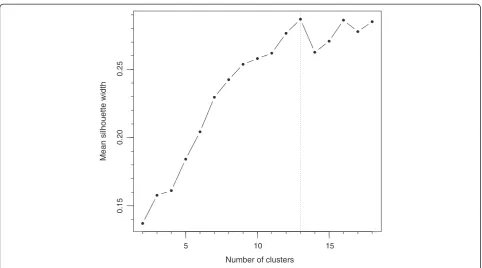
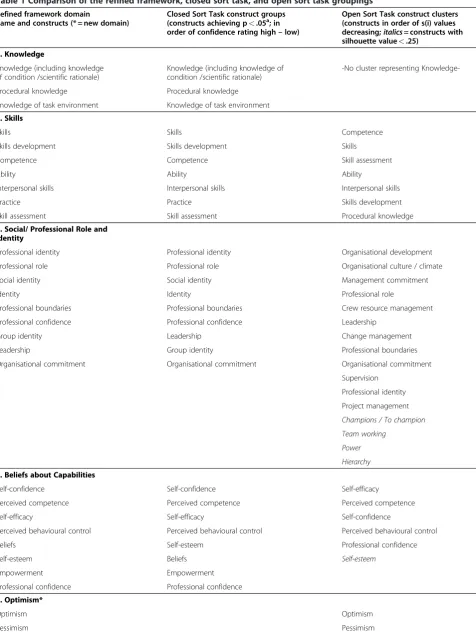
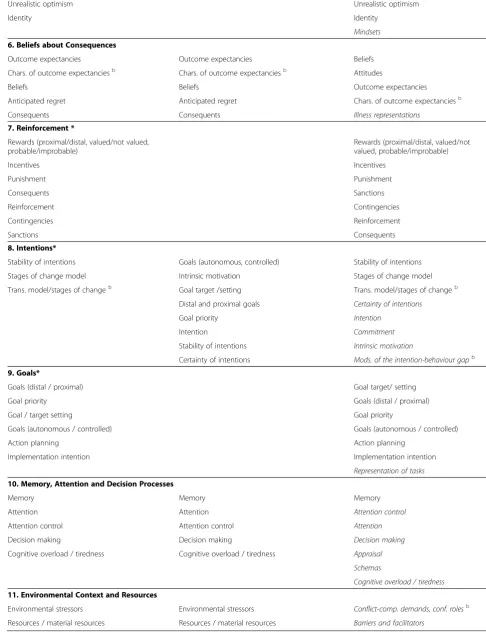
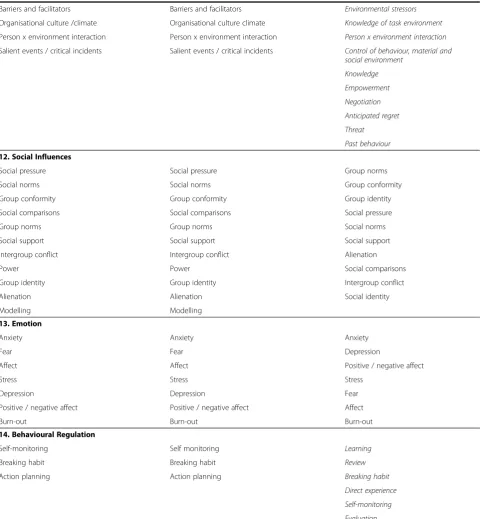
In the open sort task, participants created on average 13.59 (SD = 3.61) groups. To identify the optimal fit for the cluster patterns based on the groups created by the participants, silhouette values for solutions of minimum two and maximum 18 clusters were examined. Analysis revealed the 13-cluster solution to be the most appro-priate fit, achieving the highest overall average silhou-ette value of 0.29 (Figure 2 shows the relative overall silhouette values plotted for each cluster solution). The construct allocation within the ‘hard’ version of the 13-cluster solution, whereby each construct is allocated to only one domain, is presented in Table 1 next to
the domains they most closely represent (see ‘Open
sort task construct clusters’ and see Additional file 4 for related silhouette values).
Within the 13 cluster solution, three of the original domains,‘Beliefs about Capabilities’,‘Beliefs about Conse-quences’, and‘Motivation and Goals’, formed two clusters each. Four of the 13 clusters showed low average silhou-ette values (<0.25), one of the clusters arising from the
constructs within these clusters. To examine the impact of these low value constructs, they were removed and the average silhouette values of the clusters were recalcu-lated. After removal, 10 clusters had average silhouette values greater than 0.25 (see Additional file 4, column 7) with the average silhouette value across these 10 domains equal to 0.47 and the concordance across sorting pat-terns increasing to W= 0.34 (p= 0.01). Three clusters
remained with silhouettes below 0.25, ‘Environmental
Context and Resources’,‘Memory, Attention, and Deci-sion Processes’, and ‘Behavioural Regulation’. Whilst these clusters showed relatively weak cluster formations in the open sort, the confidence ratings in the closed sort indicated that when the domain labels were apparent the confidence ratings of allocated constructs were sufficient to form domains. Therefore, these three domains were considered important to retain in the framework. Also, there was no cluster indicative of the domain of ‘ Know-ledge’in the 13 cluster solution, with all constructs from the original ‘Knowledge’ domain allocated to alternative clusters; the constructs ‘Knowledge’ and ‘Knowledge of task environment’ were allocated to the ‘Environmental Context and Resources’cluster,‘Mindsets’ was allocated to one of the clusters arising from the ‘Beliefs about Capabilities’ domain, ‘Schemas’ was allocated to the
‘Memory, Attention and Decision Processes’cluster and
‘Procedural knowledge’ was allocated to the‘Skills’ clus-ter. However, within these construct reassignments only
‘Procedural Knowledge’attained a silhouette value equal to or greater than 0.25 (all other knowledge-related con-structs <0.23). In contrast, within the closed sort task the confidence ratings of three knowledge-related con-structs, ‘Knowledge’, ‘Knowledge of Task Environment’
and ‘Procedural Knowledge’ indicated that knowledge
might form a separate domain if the label ‘Knowledge’ was available (confidence ratings >6.32 across these three constructs). Therefore, it was considered that the
‘Knowledge’should be included when it was thought to be important in the specific context.
Based on the results across both tasks, 14 domains were specified through this first step. Eight domains were similar to the original framework domains: ‘Knowledge’,
‘Skills’, ‘Social/Professional Role and Identity’, ‘Memory, Attention and Decision Processes’,‘Environmental Con-text and Resources’,‘Social Influences’,‘Emotion’, and‘
Be-havioural Regulation’. The domains ‘Beliefs about
Capabilities’, ‘Beliefs about Consequences’, and ‘ Motiv-ation and Goals’were retained but were divided into six new clusters. The domain of ‘Nature of the Behaviours’ was removed because it was not represented in the open sort by any single cluster solution and only had one con-struct assigned to it in the closed sort task.
Step two: establish domain content
The mean confidence ratings and ICCs for the construct allocation to domains given in the closed sort task are
5 10 15
0.15
0.20
0.25
Number of clusters
Mean silhouette width
Table 1 Comparison of the refined framework, closed sort task, and open sort task groupings
Refined framework domain
name and constructs (* = new domain)
Closed Sort Task construct groups (constructs achieving p<.05a; in
order of confidence rating high–low)
Open Sort Task construct clusters (constructs in order of s(i) values decreasing;italics= constructs with silhouette value<.25)
1. Knowledge
Knowledge (including knowledge of condition /scientific rationale)
Knowledge (including knowledge of condition /scientific rationale)
-No cluster representing
Knowledge-Procedural knowledge Procedural knowledge
Knowledge of task environment Knowledge of task environment
2. Skills
Skills Skills Competence
Skills development Skills development Skills
Competence Competence Skill assessment
Ability Ability Ability
Interpersonal skills Interpersonal skills Interpersonal skills
Practice Practice Skills development
Skill assessment Skill assessment Procedural knowledge
3. Social/ Professional Role and Identity
Professional identity Professional identity Organisational development
Professional role Professional role Organisational culture / climate
Social identity Social identity Management commitment
Identity Identity Professional role
Professional boundaries Professional boundaries Crew resource management
Professional confidence Professional confidence Leadership
Group identity Leadership Change management
Leadership Group identity Professional boundaries
Organisational commitment Organisational commitment Organisational commitment
Supervision
Professional identity
Project management
Champions / To champion
Team working
Power
Hierarchy
4. Beliefs about Capabilities
Self-confidence Self-confidence Self-efficacy
Perceived competence Perceived competence Perceived competence
Self-efficacy Self-efficacy Self-confidence
Perceived behavioural control Perceived behavioural control Perceived behavioural control
Beliefs Self-esteem Professional confidence
Self-esteem Beliefs Self-esteem
Empowerment Empowerment
Professional confidence Professional confidence
5. Optimism*
Optimism Optimism
Table 1 Comparison of the refined framework, closed sort task, and open sort task groupings(Continued)
Unrealistic optimism Unrealistic optimism
Identity Identity
Mindsets
6. Beliefs about Consequences
Outcome expectancies Outcome expectancies Beliefs
Chars. of outcome expectanciesb Chars. of outcome expectanciesb Attitudes
Beliefs Beliefs Outcome expectancies
Anticipated regret Anticipated regret Chars. of outcome expectanciesb
Consequents Consequents Illness representations
7. Reinforcement *
Rewards (proximal/distal, valued/not valued, probable/improbable)
Rewards (proximal/distal, valued/not valued, probable/improbable)
Incentives Incentives
Punishment Punishment
Consequents Sanctions
Reinforcement Contingencies
Contingencies Reinforcement
Sanctions Consequents
8. Intentions*
Stability of intentions Goals (autonomous, controlled) Stability of intentions
Stages of change model Intrinsic motivation Stages of change model
Trans. model/stages of changeb Goal target /setting Trans. model/stages of changeb
Distal and proximal goals Certainty of intentions
Goal priority Intention
Intention Commitment
Stability of intentions Intrinsic motivation
Certainty of intentions Mods. of the intention-behaviour gapb
9. Goals*
Goals (distal / proximal) Goal target/ setting
Goal priority Goals (distal / proximal)
Goal / target setting Goal priority
Goals (autonomous / controlled) Goals (autonomous / controlled)
Action planning Action planning
Implementation intention Implementation intention
Representation of tasks
10. Memory, Attention and Decision Processes
Memory Memory Memory
Attention Attention Attention control
Attention control Attention control Attention
Decision making Decision making Decision making
Cognitive overload / tiredness Cognitive overload / tiredness Appraisal
Schemas
Cognitive overload / tiredness
11. Environmental Context and Resources
Environmental stressors Environmental stressors Conflict-comp. demands, conf. rolesb
shown in Additional file 4. In the closed sort task, the content of domains for‘Emotion’,‘Skills’,‘Motivation and Goals’, ‘Social/Professional Role and Identity’, ‘Beliefs about Capabilities’, and‘Memory, Attention and Decision
Processes’ all showed good congruence with the
constructs listed in the domains of the original frame-work (>69%) and fair ICCs (0.31 to 0.40). The domains of ‘Knowledge’,‘Environmental Context and Resources’ and ‘Social Influences’ showed lower congruence with the constructs listed in the original domains (27% to
Table 1 Comparison of the refined framework, closed sort task, and open sort task groupings(Continued)
Barriers and facilitators Barriers and facilitators Environmental stressors
Organisational culture /climate Organisational culture climate Knowledge of task environment
Person x environment interaction Person x environment interaction Person x environment interaction
Salient events / critical incidents Salient events / critical incidents Control of behaviour, material and
social environment
Knowledge
Empowerment
Negotiation
Anticipated regret
Threat
Past behaviour
12. Social Influences
Social pressure Social pressure Group norms
Social norms Social norms Group conformity
Group conformity Group conformity Group identity
Social comparisons Social comparisons Social pressure
Group norms Group norms Social norms
Social support Social support Social support
Intergroup conflict Intergroup conflict Alienation
Power Power Social comparisons
Group identity Group identity Intergroup conflict
Alienation Alienation Social identity
Modelling Modelling
13. Emotion
Anxiety Anxiety Anxiety
Fear Fear Depression
Affect Affect Positive / negative affect
Stress Stress Stress
Depression Depression Fear
Positive / negative affect Positive / negative affect Affect
Burn-out Burn-out Burn-out
14. Behavioural Regulation
Self-monitoring Self monitoring Learning
Breaking habit Breaking habit Review
Action planning Action planning Breaking habit
Direct experience
Self-monitoring
Evaluation
Key:a= after applying Hochberg’s correction for multiple comparisons within each domain,b- Chars. of outcome expect. = Characteristics of outcome
50%) and fair ICCs (0.26 to 0.39). The domains of ‘ Be-havioural Regulation’, ‘Nature of the Behaviours’, and
‘Beliefs about Consequences’ showed both low congru-ence between the original constructs and those assigned to these domains (<27%) and low ICCs (0.07 to 0.25). This was due in part to the low number of constructs assigned to these domains.‘Behavioural Regulation’only had two constructs out of the original ten (Self-monitor-ing, and Action planning) that were rated as belonging to the domain. ‘Nature of the Behaviours’only had one construct (Routine/automatic/habit) included from the original six constructs.‘Beliefs about Consequences’only had five of the constructs included from the original framework. Only constructs that achieved significance in the closed sort after Hochberg correction were allocated
to these pre-existing domains from the original
framework.
For the newly formed clusters arising from‘Motivation and Goals’(two clusters),‘Beliefs about Capabilities’(one cluster), and ‘Beliefs about Consequences’ (one cluster), construct allocation was informed by the constructs assigned to these clusters in the open sort task that achieved individual construct silhouette values greater than 0.25.
To identify if any constructs should be considered for multiple allocation to domains the membership values from the Fuzzy Cluster Analysis were examined. This revealed that the majority of constructs (74/112) were strongly associated with only one cluster (i.e., showed membership values over 80% to one specific cluster, see Additional file 5). A further 32 constructs showed mod-erately high associations with one cluster (memberships values between 28% to 79%), with the remaining propor-tion of memberships for these constructs spread over other clusters. Only eight constructs had the greatest proportion of their membership values split across at least two clusters, indicating possible multiple domain memberships, these were‘Knowledge’,‘Coping strategies’,
‘Empowerment’, ‘Anticipated regret’, ‘Negotiation’, ‘ Mod-erators of the intention-behaviour gap’, ‘ Routine/auto-matic/habit’, and ‘Past behaviour’. However, none of the multiple memberships indicated in the open sort results were replicated in the closed sort task where three dif-ferent constructs, ‘Professional confidence’, ‘Beliefs’, and
‘Group identity’, were allocated to multiple domains. Given lack of agreement across the two tasks, only the multiple allocations shown in the closed sort task or mul-tiple allocations that occurred through the construct se-lection process (i.e., using the closed sort for predefined domains and using the open sort for new domains) were used in the final framework. Using this approach, six constructs were allocated to more than one domain: (the domains that constructs are allocated to are shown in parenthesis) ‘Action planning’ (Goals and Behavioural
Regulation), ‘Beliefs’ (Beliefs about Consequences and Beliefs about Capabilities),‘Consequents’ (Beliefs about Consequences and Reinforcement),‘Group identity’ (So-cial/Professional Role and Identity and Social Influences),
‘Identity’(Social/Professional Role and Identity and Opti-mism), and‘Professional confidence’(Social/Professional Role and Identity and Beliefs about Capabilities).
Step three: finalise domain labels
Fifteen of the 19 open sort participants provided labels for the groups they created. The majority of labels were similar to those in the original framework: (number of participants giving that label shown in parenthesis): Knowledge (4), Skills (5), Intentions (7), Goals (6), Emo-tion (9), Cognitive-related (8), Beliefs (5), Beliefs about Capabilities (7), Outcomes (6), Environment-related (6), Organisational (7), Models / Theories (8), Learning / Reinforcement (7), Self-Regulation (3), Consequences (3), Social / Group (14), and Planning (2). Examples of other labels that could not be categorized (i.e., labels given by only one participant) included‘Techniques’,‘ Bar-riers’,‘Awareness’,‘Reviewing’, and‘Persistence’. Given the similarity between the labels provided in the open sort task and the labels used in the original framework, those domains that were retained with only minor modification were allocated their respective label used in the original framework. The labels for the newly developed domains were based on the frequency of labels and the domain content: these were Intentions, Goals, Reinforcement, and Optimism. The domain label of ‘Emotion’was plura-lised to‘Emotions’to bring in line with the other domain labels and to ensure that it clearly represented the range of emotions that were included as component constructs. Therefore, the final labels chosen to represent the 14 domains were: ‘Knowledge’, ‘Skills’, ‘Social/Professional Role and Identity’,‘Beliefs about Capabilities’,‘Optimism’,
‘Beliefs about Consequences’,‘Reinforcement’,‘Intentions’,
‘Goals’,‘Memory, Attention and Decision Processes’,‘ En-vironmental Context and Resources’,‘Social Influences’,
‘Emotions’, and‘Behavioural Regulation’.
The refined framework
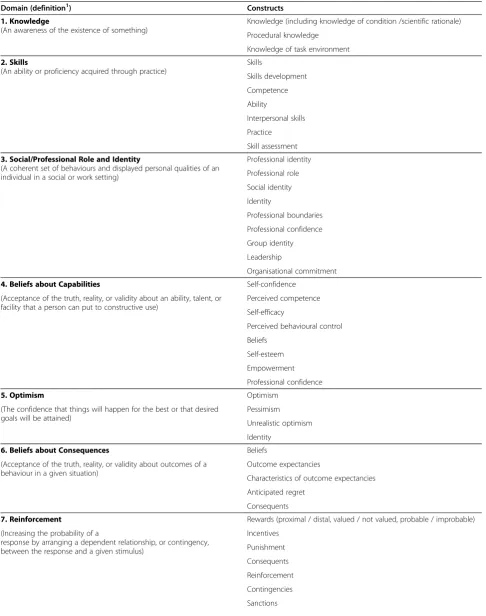
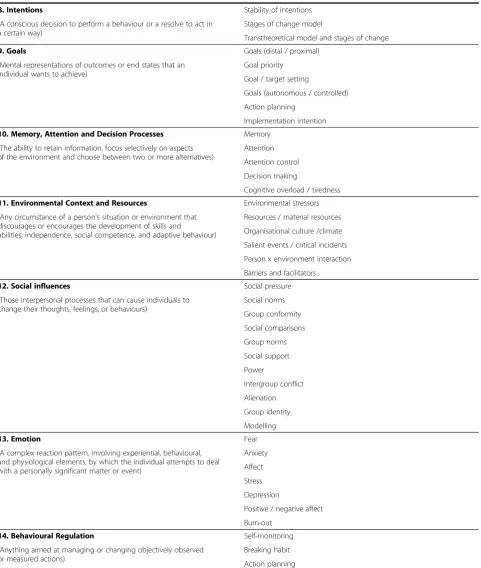
The refined framework contains 14 domains and 84 component constructs (the number of component con-structs in each domain is defined in brackets): ‘ Know-ledge’ (3), ‘Skills’ (7), ‘Social/Professional Role and Identity’ (9), ‘Beliefs about Capabilities’ (8),‘Optimism’ (4),‘Beliefs about Consequences’(5),‘Reinforcement’(7),
‘Intentions’(3),‘Goals’(6),‘Memory, Attention and
Deci-sion Processes’ (5), ‘Environmental Context and
Resources’(6),‘Social Influences’(11),‘Emotions’(7), and
Discussion
This validation study, using open and closed sort tasks, has shown good support for the basic structure of the TDF and led to refinements producing 14 domains:
‘Knowledge’,‘Skills’,‘Social/Professional Role and Identity’,
‘Beliefs about Capabilities’,‘Optimism’,‘Beliefs about Con-sequences’,‘Reinforcement’, ‘Intentions’,‘Goals’,‘Memory, Attention and Decision Processes’,‘Environmental Con-text and Resources’, ‘Social Influences’, ‘Emotions’, and
‘Behavioural Regulation’. There are three key advantages of this framework. First, there is comprehensive coverage of possible influences on behavior. Second, there is clar-ity about each kind of influence, as a result of each do-main being specified by component constructs. Third, the framework makes links between theories of behav-iour change and techniques of behavbehav-iour change to ad-dress implementation problems. The framework can be applied by gathering either qualitative data (interviews or focus groups) or quantitative data (e.g., by question-naires). The findings have strengthened the evidence for the structure and content of the domains, increasing confidence in the usefulness of the TDF as an approach to assessing implementation and other behaviour pro-blems, and laying the foundation for theoretically informed interventions.
To the authors’knowledge, Fuzzy Cluster Analysis and Discriminant Content Validity have not been used in combination to determine the validity of a framework structure. By combining these methods, we have investi-gated the validity of the original framework both when the original domain labels were, and were not, pre-sented. The results from both the open and closed sort tasks generally replicated the original framework, which
adds confidence to the validity of the framework’s
structure.
The study findings pointed to some changes in the framework, which had good face validity. First, there was a separation and clarification of a number of exist-ing domains. The separation of ‘Motivation and Goals’ into two domains of ‘Intentions’ and ‘Goals’ was indi-cated by both the closed and open sort task results and was particularly apparent in the labels provided by the participants, with labels relating to‘intentions’and‘goals’ amongst the most frequently used. The APA dictionary of psychology defines a goal as ‘the end state toward which a human or non-human animal is striving: the purpose of an activity or endeavour.’ [36] and defines intention as ‘a conscious decision to perform a behav-iour; a resolve to act in a certain way or an impulse for purposeful action. In experiments, intention is often equated with goals defined by the task instructions.’[36]. Therefore ‘Goals’tends to refer to an end state that can be seen as a preferred outcome, whereas ‘Intentions’ is concerned with the resolve to initiate or terminate a
behaviour. The separation of ‘Beliefs about
Conse-quences’ into two domains, one retaining the original
name and one termed ‘Reinforcement’, made
psycho-logical sense. The former refers to beliefs whereas the latter refers to constructs of associative learning. There was also a separation within the ‘Beliefs about Capabil-ities’ domain with a separate ‘Optimism’ domain being formed. This separation makes psychological sense in that the constructs in the optimism cluster concern gen-eral disposition rather than specific capabilities required to achieve an outcome. The domain‘Behavioural Regula-tion’ is clearer in the refined framework where it refers to self-regulatory processes rather than including a mix-ture of self-regulation and goal-related constructs, as was the case in the original TDF.
Second, the ‘Nature of the Behaviours’ domain was
dropped in the new framework, because its original component constructs were not assigned to the domain in the closed sort, and there was no cluster representing the ‘Nature of the Behaviours’ in the open sort. This strengthens the coherence of the new TDF because the domain did not sit easily in the original TDF. It was defined as the‘Essential characteristics of the behaviour’, had constructs relating to habit and experiences/past behaviours, and constituted an outcome, or dependent variable, rather than an independent variable. Whilst understanding the nature of behaviours is absolutely key to analyzing implementation and other behavioural pro-blems, analysing the nature of behaviour is a different task than analysing influences on behaviour. A comple-mentary theoretical approach to analyzing behaviour as a basis for intervention design has been recently devel-oped, as part of the‘Behaviour Change Wheel’[46]. Pre-vious studies that have adopted the TDF framework have seldom used the‘Nature of the Behaviours’domain [17]. Furthermore, where the domain has been used, in relation to changing transfusion practice, it was noted that when participants were asked questions relating to
the ‘Nature of the Behaviours’ domain they often
repeated answers that were previously given in response to questions relating to the ‘Behavioural Regulation’ do-main [19], therefore making responses in respect to
‘Nature of the Behaviours’ redundant. This along with empirical evidence shown in the present study shows a clear indication that the ‘Nature of the Behaviours’ do-main should be considered differently to the compo-nents of the TDF.
Table 2 The refined framework based on results of the open and closed sort tasks
Domain (definition1) Constructs
1. Knowledge
(An awareness of the existence of something)
Knowledge (including knowledge of condition /scientific rationale)
Procedural knowledge
Knowledge of task environment
2. Skills
(An ability or proficiency acquired through practice)
Skills
Skills development
Competence
Ability
Interpersonal skills
Practice
Skill assessment
3. Social/Professional Role and Identity
(A coherent set of behaviours and displayed personal qualities of an individual in a social or work setting)
Professional identity
Professional role
Social identity
Identity
Professional boundaries
Professional confidence
Group identity
Leadership
Organisational commitment
4. Beliefs about Capabilities Self-confidence
(Acceptance of the truth, reality, or validity about an ability, talent, or facility that a person can put to constructive use)
Perceived competence
Self-efficacy
Perceived behavioural control
Beliefs
Self-esteem
Empowerment
Professional confidence
5. Optimism Optimism
(The confidence that things will happen for the best or that desired goals will be attained)
Pessimism
Unrealistic optimism
Identity
6. Beliefs about Consequences Beliefs
(Acceptance of the truth, reality, or validity about outcomes of a behaviour in a given situation)
Outcome expectancies
Characteristics of outcome expectancies
Anticipated regret
Consequents
7. Reinforcement Rewards (proximal / distal, valued / not valued, probable / improbable)
(Increasing the probability of a
response by arranging a dependent relationship, or contingency, between the response and a given stimulus)
Incentives
Punishment
Consequents
Reinforcement
Contingencies
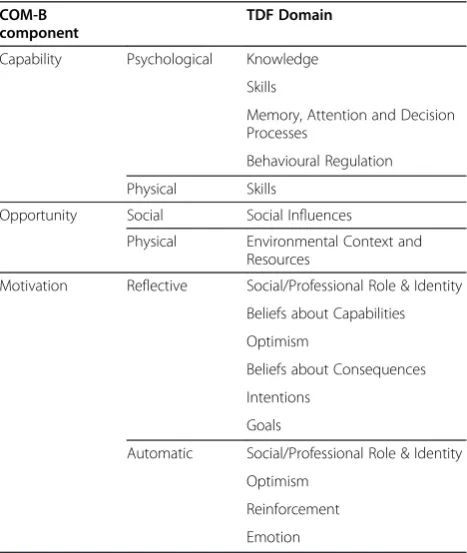
Motivation divided into reflective and automatic motiv-ation. The domains from the refined framework have been independently mapped onto the COM-B segments by three
experts in behavior change, with 100% agreement (Table 3). Use of the COM-B may help identify the TDF domains that are likely to be important in changing behaviour. By
Table 2 The refined framework based on results of the open and closed sort tasks(Continued)
8. Intentions Stability of intentions
(A conscious decision to perform a behaviour or a resolve to act in a certain way)
Stages of change model
Transtheoretical model and stages of change
9. Goals Goals (distal / proximal)
(Mental representations of outcomes or end states that an individual wants to achieve)
Goal priority
Goal / target setting
Goals (autonomous / controlled)
Action planning
Implementation intention
10. Memory, Attention and Decision Processes Memory
(The ability to retain information, focus selectively on aspects of the environment and choose between two or more alternatives)
Attention
Attention control
Decision making
Cognitive overload / tiredness
11. Environmental Context and Resources Environmental stressors
(Any circumstance of a person's situation or environment that discourages or encourages the development of skills and
abilities, independence, social competence, and adaptive behaviour)
Resources / material resources
Organisational culture /climate
Salient events / critical incidents
Person x environment interaction
Barriers and facilitators
12. Social influences Social pressure
(Those interpersonal processes that can cause individuals to change their thoughts, feelings, or behaviours)
Social norms
Group conformity
Social comparisons
Group norms
Social support
Power
Intergroup conflict
Alienation
Group identity
Modelling
13. Emotion Fear
(A complex reaction pattern, involving experiential, behavioural, and physiological elements, by which the individual attempts to deal with a personally significant matter or event)
Anxiety
Affect
Stress
Depression
Positive / negative affect
Burn-out
14. Behavioural Regulation Self-monitoring
(Anything aimed at managing or changing objectively observed or measured actions)
Breaking habit
Action planning
1
starting with a behavioural analysis such as this, interven-tion designers can be selective about the domains they in-vestigate to inform the nature of the intervention.
Research using the TDF has identified lack of know-ledge as a potential barrier to a number of professional health behaviours, including hand hygiene [17], changing transfusion practice [19], and the adoption of tobacco use cessation counseling in dental practices [21]. How-ever, for most health-related behaviours that are the target of theoretically-based behaviour change interven-tions (e.g., smoking, healthy eating, physical activity), knowledge is not an important source of variance [47-52]. This may be why participants did not identify a separate domain for knowledge, but that it has been identified as an important influence on some health pro-fessional behaviours. We therefore recommend that knowledge be assessed along with the other TDF domains.
Of the original 112 unique constructs in the TDF, 34 have been removed. They appear to be a mixture of rather vague constructs (e.g., Mindsets), very general constructs (e.g., Review), ambiguous constructs (e.g., Commitment), and infrequently used constructs in behaviour change theory (e.g., Generating alternatives). Because constructs that are‘poorly defined’,‘ undifferenti-ated’, and ‘imprecisely partitioned’ have previously been found to influence the content validity of assessment
instruments [53], their exclusion from the refined frame-work seems warranted. The remaining constructs stand as a more defined, focused set of constructs that are more relevant to behaviour change theory and more pre-cisely partitioned into domains. Within these remaining constructs, there are also a number of constructs that appear in more than one domain. Such allocations indi-cate the relevance of constructs across different domain contexts. For example,‘Action Planning’appears in both the‘Goals’domain and the ‘Behavioural Regulation’ do-main and can be considered as being influential in achieving a particular goal (e.g. I plan to achieve goal x through specific actions) and also in regulating be-haviour (e.g. in a certain situation I plan to behave in a particular way).
Two domains showed weak clustering:‘Environmental
Context and Resources’ and ‘Behavioural Regulation’. However, these domains, alongside the domain of
‘Knowledge’, were comprised of constructs consistently assigned to them when the original domain labels were presented in the closed sort task. This suggests that people are clear about the constructs within these domains when the domain labels are present. A second limitation is that the refined framework is limited to the constructs identified in the original framework. Whilst the current range of component constructs is quite ex-tensive, it does not cover all theories of behaviour change [54], and future research is likely to identify others that are important to behaviour change. Just as the current framework is an advance on the 2005 version, so future work is likely to improve it further. The issue of how to evaluate appropriateness and quality of theories in given contexts is an under-researched area, but one that is beginning to be addressed [54].
Conclusions
Through a three-step validation process, the present research has identified a refined version of the original TDF. This refined framework contains 14 domains and 84 component constructs. The strength of the frame-work validation stems from the methods used. Both the closed and open sort task methods alongside DCV and Fuzzy Cluster Analysis have provided complementary methods for examining the structure of the original framework. DCV methods assessed the confidence of allocation of constructs to the described domains, and the Fuzzy Cluster Analysis led to a refinement of the structure of the framework. The TDF has proved useful across a number of healthcare systems and this empiric-ally-based refinement lays the basis for stronger explana-tory and predictive power, and therefore increased usefulness in informing interventions to improve imple-mentation and bring about other behaviour change. Table 3 Mapping of the Behaviour Change Wheel’s
COM-B system to the TDF Domains COM-B
component
TDF Domain
Capability Psychological Knowledge
Skills
Memory, Attention and Decision Processes
Behavioural Regulation
Physical Skills
Opportunity Social Social Influences
Physical Environmental Context and
Resources
Motivation Reflective Social/Professional Role & Identity
Beliefs about Capabilities
Optimism
Beliefs about Consequences
Intentions
Goals
Automatic Social/Professional Role & Identity
Optimism
Reinforcement
Additional files
Additional file 1:Constructs from the original Theoretical Domains Framework and associated definitions [55-68].
Additional file 2:Instructions and additional questions given to participants. Instructions, consent information and additional questions given to participants.
Additional file 3:Mantel correlation values by participant. Mantel correlation coefficients for each participant.
Additional file 4:Comparison of the refined framework, closed sort task, and open sort task groupings with related mean confidence ratings, Intra-Class Correlation (ICC) values and silhouette values.
Additional file 5:Membership values (%) for each construct to each domain cluster defined in the cluster analysis.
Competing interests
SM and DOC are both Associate Editors of Implementation Science.
Acknowledgements
We would like to thank the MRC Population Health Sciences Research Network for funding this work, Daniel and Matthew West (www. britishwebsites.net) for website design, Henry Potts (University College London) for statistical advice and Jill Francis (University of Aberdeen) and Lou Atkins (Univerisity College London) for helpful comments on an earlier draft. DOC is supported by an Australian National Health and Medical Research Council Public Health Fellowship.
Author details
1School of Psychology, Keynes College, University of Kent, Canterbury, Kent
CT2 7NP, UK.2School of Public Health and Preventive Medicine, Faculty of Medicine, Nursing and Health Sciences, Monash University, The Alfred Centre, 99 Commercial Road, Melbourne, VIC 3004, Australia.3Research Department of Clinical, Centre for Outcomes Research and Effectiveness (CORE), Education and Health Psychology, University College London, 1-19 Torrington Place, London, WC1E 7HB, UK.
Authors’contributions
JC conducted preparation of materials, data collection, data analysis, and drafted the manuscript. DOC and SM commented on and aided in the drafting of the manuscript. All authors read and approved the final manuscript.
Received: 1 September 2011 Accepted: 24 April 2012 Published: 24 April 2012
References
1. Clinical Effectiveness Research Agenda Group (CERAG):An Implementation Research Agenda: A report prepared for the High Level Group on Clinical Effectiveness.London: CERAG; 2008.
2. World Health Authority (WHA):World Health Assembly Resolution 51.12: Health Promotion.2010, Accessed from [http://www.who.int/
healthpromotion/wha51-12/en/], 27th July 2010.
3. Newman M, Papadopoulous L, Sigsworth J (1998)Barriers to evidence-based practice. Clin Eff Nurs 2:11–18
4. McKenna H, Ashton S, Keeney S (2004)Barriers to evidence based practice in primary care: a review of the literature. Int J Nurs Stud 41:369–378 5. Grol R, Grimshaw J (2003)From evidence to best practice: effective
implementation of change in patients’care. Lancet 362:1225–1230 6. Abraham C, Kelly MP, West R, Michie S (2009)The UK national institute for
health and clinical excellence public health guidance on behavior change: a brief introduction. Psychology Health Med 14:1–8
7. Albarracin D, Gillette JG, Earl AN, Glasman LR, Durantini MR, Ho MH (2005)A test of major assumptions about behavior change: a comprehensive look at the effects of passive and active HIV-prevention interventions since the beginning of the epidemic. Psychol Bull 131:856–897 8. Noar SM, Zimmerman RS (2005)Health behavior theory and cumulative
knowledge regarding health behaviours: are we moving in the right direction?Health Ed Res: Theory Pract 20:275–290
9. Michie S, Prestwich A (2010)Are interventions theory-based? Development of a theory coding scheme. Heal Psychol 29:1–8 10. Davies P, Walker AE, Grimshaw J (2010)A systematic review of the use of
theory in the design and implementation strategies and interpretation of the results of rigorous evaluations. Implement Sci 5:1–6
11. Weinstein N (1993)Testing four competing theories of health-protective behaviour. Heal Psychol 12:324–333
12. Nigg CR, Allegrante JP, Ory M (2002)Theory-comparison and multiple-behaviour research: common themes advancing health multiple-behaviour research. Health Ed Res: Theory Prac 17:670–679
13. Michie S, Johnston M, Abraham C, Lawton R, Parker D, Walker A, on behalf of the‘Psychological Theory’Group (2005)Making psychological theory useful for implementing evidence based practice: a consensus approach. Qual Saf Health Care 14:26–33
14. McKenzie JE, French SD, O’Connor DA, Grimshaw J, Mortimer D, Michie S, Francis J, Spike N, Schattner P, Kent PM et al (2008)Implementing a clinical practice guideline for acute low back pain evidence-based management in general practice (IMPLEMENT): cluster randomised controlled trial study protocol. Implement Sci 3:11
15. McKenzie JE, O’Connor DA, Page MJ, Mortimer D, French SD, Walker BF, Keating JL, Grimshaw JM, Michie S, Francis JJ, Green SE (2010)Improving the care for people with acute low-back pain by allied health professionals (the ALIGN trial): a cluster randomised trial protocol. Implement Sci 5:86
16. French SD, Green SE, O’Connor D, McKenzie JE, Francis JJ, Michie S, Buchbinder R, Schattner P, Spike N, Grimshaw JM:Developing theory-informed behaviour change interventions to implement evidence into practice: a systematic approach using the Theoretical Domains Framework.For submission to Implementation Science in this series2011. 17. Dyson J, Lawton R, Jackson C, Cheater F (2010)Does the use of a
theoretical approach tell us more about hand hygiene behaviour? The barriers and levers to hand hygiene. J Infection Prev 12:17
18. Francis J, Stockton C, Eccles MP, Johnston M, Cuthbertson BH, Grimshaw JM, Hyde C, Tinmouth A, Stanworth SJ (2009)Evidence-based selection of theories for designing behaviour change interventions: Using methods based on theoretical construct domains to understand clinicians’blood transfusion behaviour. Br J Heal Psychol 14:625–646
19. Francis J, Tinmouth A, Stanworth SJ (2009)Using theories of behaviour change to understand transfusion prescribing three clinical contexts in two countries: development work for and implementation trial. Implement Sci 4:70
20. Michie S, Pilling S, Garety P, Whitty P, Eccles MP, Johnston M, Simmons J (2007)Difficulties implementing a mental health guideline: an exploratory investigation using psychological theory. Implement Sci 2:8 21. Amemori M, Korhonen T, Kinnunen T, Michie S, Murtomaa H (2011)
Enhancing implementation of tobacco use prevention and cessation counselling guideline among dental providers: a cluster randomised controlled trial. Implement Sci 6:13
22. Paul CL (2008)A modified approach to a new card sorting methodology. J Usability Stud 4:7–30
23. Whaley AL, Longoria RA (2009)Preparing card sort data for multidimensional scaling analysis in social psychological research: a methodological approach. J Soc Psychol 149:105–115
24. Trochim WMK, Cook JA, Setze RJ (1994)Using concept mapping to develop a conceptual framework of staff's views of a supported employment program for individuals with severe mental illness. J Consult Clin Psychol 62:766–775
25. Morrow D, Leirer V, Altieri P, Tanke E (1991)Elders’schema for taking medication: implications for instruction design. J Gerontol 46:378–385
26. Niven K, Totterdell P, Holman D (2009)A classification of controlled interpersonal affect regulation strategies. Emotion 9:498–509 27. Chollet S, Lelièvre M, Abdi H, Valentin D (2011)Sort and Beer: Everything
you wanted to know about the sorting task but did not dare to ask. Food Quality and Preference 22:507–520
28. Reed CL, McGoldrick JE, Shackelford R, Fidopiastis CM (2004)Are human bodies represented differently from other objects? Experience shapes object representations. Vis Cogn 11:523–550
29. Dixon D, Pollard B, Johnston M (2007)What does the chronic pain grade questionnaire measure?Pain 130:249–253
31. Waltz CW, Strickland OL, Lenz ER (1991)Measurement in nursing research. F. A. Davis Co, Philadelphia, PA
32. Dixon D, Johnston M, McQueen M, Court-Brown C (2008)The Disabilities of the Arm, Shoulder and Hand Questionnaire (DASH) can measure the impairment, activity limitations and participation restriction constructs from the International Classification of Functioning, Disability, and Health (ICF). BMC Musculoskelet Disord 9:114
33. Carmines EG, Zeller RA (1979)Reliability and Validity Assessment. Sage Publications, Newbury Park, CA
34. Kaufman L, Rousseeuw PJ (1990)Finding groups in data: an introduction to data analysis. Wiley, New York
35. Pollard B, Johnston M, Dieppe P (2006)What do osteoarthritis heath outcome instruments measure? Impairment, activity limitation or participation restriction?J Rheumatol 33:757–63
36. American Psychological Association (APA):APA Dictionary of Psychology. Washington, DC: American Psychological Association; 2007.
37. Kendall MG, Babington Smith B (2009)The Problem of m Rankings. Ann Math Stat 10:275–287
38. Paradis E, Bolker B, Claude J, Sien Cuong H, Desper R, Durand B, Dutheil J, Gascuel O, Heilbl C, Lawson D, Lefort V, Legrande, Lemon J, Noel Y, Nylander J, Opgen-Rhein R, Popescu A A, Schliep K, Strimmer K, de Vienne D:Package‘ape’: Analysis of Phylogenetics and Evolution. URL[http:// cran.r-project.org/web/packages/ape/ape.pdf]. 2011, 1–222.
39. R Development Core Team:R: A language and environment for statistical computing.Vienna, Austria: R Foundation for Statistical Computing; ISBN 3-900051-07-0; URL [http://www.R-project.org/]; 2011. 40. Legendre P:CADM.global: Congruence among distance matrices.In
Paradis E, Bolker B, Claude J, Sien Cuong H, Desper R, Durand B, Dutheil J, Gascuel O, Heilbl C, Lawson D, Lefort V, Legrande, Lemon J, Noel Y, Nylander J, Opgen-Rhein R, Popescu A A, Schliep K, Strimmer K, de Vienne D:Package‘ape’: Analysis of Phylogenetics and Evolution. URL[http:// cran.r-project.org/web/packages/ape/ape.pdf]. 2011, 1–222.
41. Maechler M:Package‘cluster’: Cluster Analysis Extended Rousseeuwet al. Version 1.14.0. URL[http://cran.r-project.org/web/packages/cluster/cluster. pdf]. 2011.
42. Rousseeuw PJ (1987)Silhouettes: a graphical aid to the interpretation and validation of cluster analysis. J Comput Appl Math 20:53–65 43. McGraw K, Wong SP (1996)Forming inferences about some intraclass
correlation coefficients. Psychological Methods 1:30–46
44. Landis JR, Koch GG (1977)The measurement of observer agreement for categorical data. Biometrics 33:159–174
45. Hochberg Y (1988)A sharper Bonferroni procedure for multiple tests of significance. Biometrika 75:800–802
46. Michie S, van Stralen M, West R (2011)The Behaviour Change Wheel: a new method for characterising and designing behaviour change interventions. Implement Sci 6:42
47. Kenkel DS (1991)Health behaviour, health knowledge, and schooling. J Polit Econ 99:287–305
48. Klesges RC, Somes G, Pascale RW, Klesges LM, Murphy M, Brown K, Williams E (1988)Knowledge and beliefs regarding the consequences of cigarette smoking and their relationships to smoking status in a biracial sample. Heal Psychol 7:387–401
49. Eckhardt L, Woodruff SI, Elder JP (1994)A longitudinal analysis of adolescent smoking and its correlates. J Sch Heal 64:67–72
50. Dishman RK, Sallis JF, Orenstein DR (1985)The determinants of physical activity and exercise. Public health reports 100:158–171
51. Baranowski T, Cullen KW, Baranowski J (1999)Psychosocial correlates of dietary intake: advancing dietary intervention. Annu Rev Nutr 19:17–40 52. Shapiro J, Radecki S, Charchian AS, Josephson V (1999)Sexual behavior
and AIDS-related knowledge among community college students in Orange County, California. J Community Health 24:29–43
53. Haynes SN, Richard DCS, Kubany ES (1995)Content validity in psychological assessment: a functional approach to concepts and methods. Psychol Assess 7:238–247
54. Hobbs L, Campbell R, Hildon Z and Michie S.Behaviour change theories across Psychology, Sociology, Anthropology and Economics: A Systematic Review.Psychology and Health2011,26:Supplement 1. 55. Taylor SE (2003) Health Psychology (5thEdition). MacGraw-Hill, Boston 56. Sutherland S (1995) The Macmillan Dictionary of Psychology (2ndEdition).
Palgrave Macmillan, London
57. WordNet[www.wordnet.princeton.edu/perl/webwn]
58. Oxford English Dictionary Online[www.oed.com] 59. Wikipedia[www.en.wikipedia.org/wiki]
60. Ajzen I (1991)The Theory of Planned Behavior. Organizational Behavior and Human Decision Processes 50:179–211
61. Ogden J (2000) Health Psychology: a textbook (2ndEdition). Open University Press, Buckingham
62. World Health Organization (WHO)[www.who.int/mental_health/ management/depression/definition/en/]
63. Dictionary.com[http://dictionary.reference.com/]
64. Forsyth DR (2006) Group Dynamics (5thEdition). Wadsworth, Cengage Learning
65. Alicke MD:Evaluating social comparison targets.In Handbook of Social Comparison: Theory and Research. Edited by Suls JM, Wheeler L. New York: Plenum Publishing; 2000: 271–293.
66. YourDictionary.com[www.yourdictionary.com/] 67. The Free Dictionary[www.thefreedictionary.com/]
68. Proschaska JO, DiClemente CC: The Transtheoretical Approach: Crossing Traditional Boundaries of Change. Homewood IL: J.Irwin.
doi:10.1186/1748-5908-7-37
Cite this article as:Caneet al.:Validation of the theoretical domains framework for use in behaviour change and implementation research.
Implementation Science20127:37.
Submit your next manuscript to BioMed Central and take full advantage of:
• Convenient online submission
• Thorough peer review
• No space constraints or color figure charges
• Immediate publication on acceptance
• Inclusion in PubMed, CAS, Scopus and Google Scholar
• Research which is freely available for redistribution