M E T H O D O L O G Y
Open Access
Figuring out fidelity: a worked example
of the methods used to identify, critique
and revise the essential elements of a
contextualised intervention in health policy
agencies
Abby Haynes
1,2*, Sue Brennan
3, Sally Redman
1, Anna Williamson
1, Gisselle Gallego
4,5, Phyllis Butow
6and The CIPHER team
Abstract
Background:In this paper, we identify and respond to the fidelity assessment challenges posed by novel contextualised interventions (i.e. interventions that are informed by composite social and psychological theories and which incorporate standardised and flexible components in order to maximise effectiveness in complex settings).
We (a) describe the difficulties of, and propose a method for, identifying the essential elements of a contextualised intervention; (b) provide a worked example of an approach for critiquing the validity of putative essential elements; and (c) demonstrate how essential elements can be refined during a trial without compromising the fidelity assessment. We used an exploratory test-and-refine process, drawing on empirical evidence from the process evaluation ofSupporting Policy In health with Research: an Intervention Trial(SPIRIT). Mixed methods data was triangulated to identify, critique and revise how the intervention’s essential elements should be articulated and scored.
Results:Over 50 provisional elements were refined to a final list of 20 and the scoring rationalised. Six (often overlapping) challenges to the validity of the essential elements were identified. They were (1)redundant—the element was not essential; (2)poorly articulated—unclear, too specific or not specific enough; (3)infeasible—it was not possible to implement the essential element as intended; (4)ineffective—the element did not effectively deliver the change principles; (5)paradoxical—counteracting vital goals or change principles; or (6)absent or suboptimal—additional or more effective ways of operationalising the theory were identified. We also identified potentially valuable‘prohibited’ elements that could be used to help reduce threats to validity.
Conclusions:We devised a method for critiquing the construct validity of our intervention’s essential elements and modifying how they were articulated and measured, while simultaneously using them as fidelity indicators. This process could be used or adapted for other contextualised interventions, taking evaluators closer to making theoretically and contextually sensitive decisions upon which to base fidelity assessments.
Keywords:Fidelity, Essential elements, Flexibility, Process evaluation, Intervention theory
* Correspondence:[email protected] 1
Sax Institute, Level 13 Building 10, 235 Jones Street, Ultimo, NSW 2007, Australia
2School of Public Health, University of Sydney, Edward Ford Building (A27), Fisher Road, Sydney, NSW 2006, Australia
Full list of author information is available at the end of the article
Background
The process evaluation literature frequently characterises interventions as a ‘black box’ meaning that little is known about how they function, including the hypoth-eses that underpin their design [1–3]. Process evaluation shines a light in this box by investigating‘how and why’ questions about the intervention’s implementation, change mechanisms and contextual interactions [4].
Fidelity assessment is a fundamental part of process evaluation. Its purpose is to ascertain ‘the degree to which an intervention or procedure is delivered as
intended’ ([5]: 407). This is achieved by operationalising
the intervention theory and monitoring the consistency and congruence with which it is implemented [6–9]. In order to determine if the delivery was ‘as intended’two areas of assessment should be considered: implementa-tion fidelity and theoretical fidelity. Implementation
fidelity tells us to what extent the
intervention-as-delivered matched the intervention-as-planned. The assessment focuses on measurable or codifiable dimen-sions such as how intervention providers were recruited and trained, what proportions of targeted people were reached, the amount of exposure participants had to intervention activities (intervention intensity) and the consistency with which the intervention components were delivered in each setting [10]. This is a comparative enquiry that identifies variation between desired and ac-tual activities, between participant sites and over the duration of the intervention. Implementation fidelity as-sessment is vital for understanding the intervention’s variation [9, 11], determining its feasibility [6, 12] and determining whether an ineffective intervention was due to poor implementation or flawed design [3, 12–15].
Theoretical fidelity tells us the extent to which the
intervention-as-delivered was congruent with the inter-vention theory (the logic and hypotheses that underpin the intervention design [16–18]). This intervention the-ory is operationalised in the form of ‘essential elements’: manifestations of the theory—the ‘active ingredients’— which must be implemented if the intervention is to be effective [2, 6]. The assessment uses the intervention’s essential elements as indicators for a formative enquiry that makes judgements about the validity of the inter-vention design in practice. This helps us determine how the intervention worked or why it did not [17–19]. As the new UK Medical Research Council guidance for process evaluation states,
It may never be possible to fully understand how variations in delivery affect outcomes, given that adaptations do not occur at random, and will be confounded by factors promoting or inhibiting intervention effects. A strong understanding of the theory of the intervention is a prerequisite for
meaningful assessment of implementation, focused not just on the mechanics of delivery, but whether [the] intervention remained consistent with its underlying theory([4]: 41).
Ensuring theoretical fidelity is vital for assessing the program theory [14], predicting outcomes [9, 20, 21], translating and adapting interventions for other contexts [12, 19, 22], further developing the intervention’s evi-dence base [9, 23] and enabling ‘streamlining’ that may reduce burden and cost [6, 24]. In trials of complex in-terventions, fidelity assessment supports interpretation of intervention outcomes ensuring that observed effects (or lack thereof ) can be linked to implementation of the intervention. More positive outcomes have been ob-served when interventions are delivered with high imple-mentation and theoretical fidelity [9, 12, 18], including in flexible interventions providing that adaptations are locally and culturally appropriate and are congruent with the program theory [11, 25–28].
The concept of assessing fidelity as part of interven-tion evaluainterven-tion originates from psychotherapeutic pro-grams. The aim of fidelity assessment in this context is to ensure prescribed treatments are delivered with min-imal variation [15, 21] and adhere to the behaviour-change theory that informed their design. This approach has proliferated within implementation science and is now used for a range of interventions designed to change professional practice in health care. There is in-creasing formalisation of the theory that underpins these interventions and their essential elements, leading to testable theoretical frameworks and taxonomies of stan-dardised techniques that support replicability and evi-dence synthesis across studies, e.g. [29, 30].
However, this approach cannot be used for all inter-vention trials. Indeed, its proponents do not suggest that methods designed to assess the fidelity of ‘clinical ac-tions performed by healthcare workers in the process of
delivering healthcare’ [30] should necessarily be more
widely applied [31]. Two aspects in particular pose prob-lems for translation: (i) the focus on individual behav-ioural change and (ii) the specificity with which the theory is operationalised. The former is problematic be-cause the best-developed methods of fidelity assessment identify essential elements from a taxonomy of tech-niques derived from individual behaviour-change theory [29, 32]. No equivalent exists for interventions informed by broader social science theories that target complex interactive, organisational and system level properties [10, 33, 34]. The latter is problematic because it is too restrictive for assessing the fidelity of flexible interven-tions designed to allow local adaptation in order to in-crease their relevance and applicability [35–37]. Nor does it capture how interventions respond reflexively to
unique characteristics and unpredictable reactions in their settings [38]. Thisfidelity/adaptation dilemma[22] is particularly pertinent for interventions based on com-posite theory that are designed for dynamic real world systems in which it is necessary to balance standardisa-tion of both form and content with responsivity to con-text. Indeed, resolving the fidelity/adaptation dilemma in these contextualised interventions is one of the most important challenges for evaluation [39]. (For clarity, we use the term contextualised intervention rather than
complex intervention in this paper as complex
interven-tions are most commonly defined in relation to struc-tural design rather than their theoretical or contextual characteristics [40].)
A growing body of literature documenting the evalu-ation of contextualised large-scale interventions at-tempts to tackle the challenges of composite theory, flexibility and responsivity to context. These interven-tions include those informed by ecological, complexity, empowerment and realist perspectives, and those tai-lored by local providers or developed participatively, e.g. [35, 41–48]. However, while many studies link their in-tervention’s essential elements to theory, they seldom re-port sufficient detail for others to see how that theory was translated into specific intervention techniques (ra-ther than o(ra-ther techniques or variants that might be equally well supported by the theory). Moreover, some assume prior knowledge of the form that the interven-tion and its underlying theory will ultimately take, failing to acknowledge that an intervention’s so-calledessential elements may function as conditional elements: contin-gent on the interaction between intervention techniques, heterogeneous participants and contextual characteris-tics [49–52]. Consequently, the intervention designers may be obliged to make countless incremental adjust-ments to the techniques and the theory that underpins them while the trial is in progress; thus,‘By the end of
the program, the designers’ operating theory may look
quite different from the theory with which they started’
[53]. Intervention studies targeted at community popula-tions such as cultural groups often highlight the contin-gent validity of program theory and why it should be critiqued, (re)operationalised and potentially rejected, depending on local needs and conditions, e.g. [27, 48, 54], but this is often lacking in organisational level studies [51]. So few trials conducted in policy organisations have been reported that, currently, our knowledge of how inter-vention strategies may interact with variations in these en-vironments is little more than speculative.
Despite widespread agreement that all intervention tri-als should document the extent to which their essential elements were delivered [6, 12, 36], no universal meth-odology exists for identifying or measuring essential ele-ments [8–10, 55] and, for interventions with composite
theory, there is sparse guidance for ensuring putative es-sential elements are valid indicators of the underpinning theory [9, 20, 38, 55]. So how should we determine which elements of an intervention are genuinely es-sential and which can be adapted without impairing effectiveness? Calls for greater attention to these ques-tions are widespread, coming from multiple sectors in health [5, 6, 13, 17, 23, 38, 56, 57], education [19, 55, 58] and community development [11, 20, 35, 59].
How are essential elements identified?
When based on previous studies, intervention designers can identify essential elements from analysis of earlier interventions or operationalise them using exemplary models that have established effectiveness [9, 10, 12]. Theoretically informed standardised behaviour-change techniques are in development, but these are currently limited to interventions founded on psychological theor-ies [30]. When designing and evaluating novel contex-tualised interventions, designers can either articulate the essential elements themselves or consult with expert col-leagues [8, 9, 19, 56]. Many evaluations tackle this post hoc, piecing together the essential elements via discus-sion with the designers and/or by reviewing intervention materials [12, 19, 55].
The design of interventions in trials is often founded on an amalgam of hypotheses that attempt to take ac-count of inter-related theoretical, contextual and prag-matic factors. These include formal and substantive theories; hunches based on professional experience; and considerations such as study resources, demands on par-ticipants, existing practice and infrastructure constraints. The intervention’s essential elements are representations of these composite working hypotheses [55]. Thus, es-sential elements are not extant change agents waiting to be discovered; rather, they are ways of putting working theories into practice in particular circumstances, chosen as the ‘best bet’from many potential candidates [7]. It is not surprising, therefore, that newly developed essential elements for all types of intervention need to be assessed in situ to determine the extent to which they capture and truly deliver the intervention theory in the context of messy real world delivery [17].
How specific should essential elements be?
resulting strategies align with the principles, goals and/ or functions (see [59] for examples) [33, 62]. Equal em-phasis should be placed on how discretionary elements were tailored and with what process effects [33, 59].
Where the intervention combines standardised and flexible components, an appropriate balance must be found. Essential elements that are too tightly specified oblige providers to adhere to prescriptive scripts and techniques which may be suboptimal or entirely in-appropriate in different contexts and circumstances [27, 35, 62], whereas minimally specified essential elements may not provide sufficient concrete guidance for devel-oping or monitoring the core intervention activities [21]. The specificity of essential elements is critical for defin-ing what the interventionisand what it is not, including which elements are genuinely essential and which can be adapted [13, 55]. To date, the literature does not provide the detail needed to identify, or determine the specificity of, essential elements for contextualised interventions.
Aims
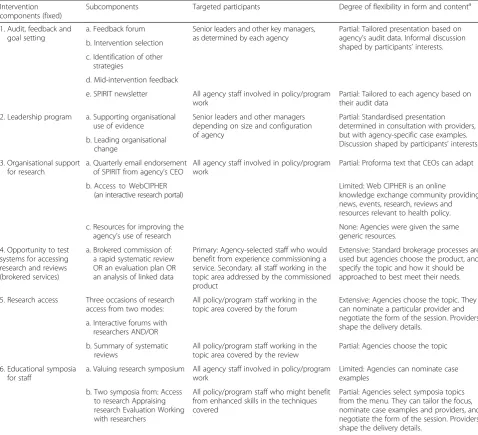
In this paper, we identify and respond to the challenges of fidelity assessment in contextualised interventions using the Supporting Policy In health with Research: an Intervention Trial (SPIRIT) study as an example. SPIRIT is testing the effects of a suite of strategies designed to increase the capacity of health policy agencies to use re-search. SPIRIT recognises that policymaking is a messy subjective social process that takes place in complex open systems with myriad influences [63]. How research is used in policymaking is not fully understood [64], but it appears that different structures, pressures, relation-ships, values and events interact to shape its relevance, applicability and use, and that this flux cannot be con-trolled during interventions [22, 43, 64, 65]. Conse-quently, SPIRIT draws on diverse theories from social and political science, targets individual and system level capacities and, as Table 1 shows, attempts to balance standardisation with responsivity to context in its imple-mentation and evaluation.
Specifically we (a) describe the challenges of, and propose a method for, identifying the essential elements of a contextualised intervention (a semi-flexible, theoret-ically eclectic intervention designed for complex set-tings); (b) provide a worked example of an approach for critiquing the validity of putative essential elements; and (c) demonstrate how essential elements can be refined during a trial without compromising the fidelity assess-ment. We consider how this approach might comple-ment current methods for identifying essential elecomple-ments.
Context for this study: SPIRIT
Our fidelity assessment was developed and conducted as part of the process evaluation of Supporting Policy In
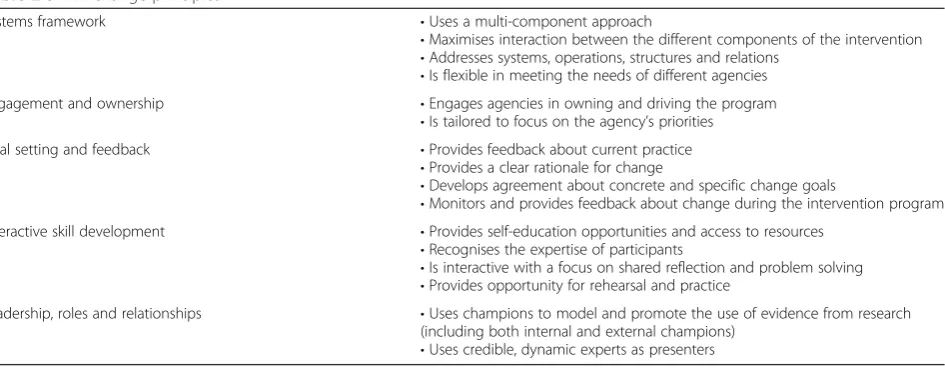
health with Research: an Intervention Trial (SPIRIT). In this trial, six health policy and program agencies based in Sydney, Australia, participated in an inter-vention designed to increase the capacity of policy-makers and program developers to use research in their work. SPIRIT was informed by cognitive behav-ioural theory, systems thinking, the literature on re-search utilisation, organisational change and adult learning theories. These were articulated in the form of the SPIRIT action framework (Fig. 1) and a list of change principles (Table 2) which, in turn, guided the intervention design and the goals and strategies of individual activities [63, 66].
The intervention comprised multiple components: (i) audit, feedback and goal setting; (ii) a leadership pro-gram; (iii) organisational support tools; (iv) the oppor-tunity to test systems for accessing research; (v) research access; and (vi) educational symposia. These compo-nents had varying degrees of flexibility as outlined in Table 1. Agency staff received approximately 11 face-to-face sessions over the 12-month intervention period, combined with periodic feedback and ongoing access to resources. Proximal and distal outcomes included (1) or-ganisational capacity to use research (staff knowledge, skills and perceptions of the value of research and organisational support for the use of research as demon-strated through leadership support, policies, tools and systems), (2) research engagement (accessing, appraising and generating research, and interacting with re-searchers), and (3) research use in policy or program work (demonstrated through the assessment of nomi-nated policy documents). Agencies could prioritise outcomes they wished to improve by tailoring the inter-vention, e.g. to target particular knowledge or skills.
High-profile policy and research experts were re-cruited to deliver the face-to-face intervention sessions. The outcome measures comprised an online survey and two structured interviews. Further details are provided in the study protocol [66].
The challenges
Several characteristics of SPIRIT presented challenges for fidelity assessment. Addressing these challenges drove the methods we used:
1. Composite theory. The intervention was built on cross-disciplinary composite theory that had not been operationalised in previous trials. This theory was articulated in the SPIRIT action framework and change principles (Fig.1 and Table 2), but these did not identify which intervention elements should be used as fidelity indicators, nor the level of specificity with which they should be
operationalised.
The manner in which the essential elements should be articulated was complicated by the paradigmatic tensions and different fidelity traditions in the composite theory. For example, cognitive behavioural theories lean towards positivism and experimental intervention approaches and fall within the
standardised approach to fidelity assessment outlined at the beginning of this paper in which essential elements are tightly specified. Systems thinking, on the other hand, proposes a complexity-orientated ecological worldview in which interventions are loosely specified for local adaptation and essential elements are articulated as principles rather than concrete techniques. SPIRIT, like many
contemporary interventions, was occupying a middle ground.
2. Flexibility.The expression of the essential elements needed to accommodate three levels of flexibility: (a) agencies were able to select different session options from a menu of components, (b) they could tailor the topics and goals of these options to address local priorities, and (c) expert providers determined the detail of delivery (see Table1). We could not foresee how these decisions would shape the content and form of the intervention. Given that meaningful comparison of the extent to which essential elements were delivered required that they be equally applicable across all intervention
Table 1The degree of flexibility in SPIRIT intervention components and subcomponents
Intervention components (fixed)
Subcomponents Targeted participants Degree of flexibility in form and contenta
1. Audit, feedback and goal setting
a. Feedback forum Senior leaders and other key managers, as determined by each agency
Partial: Tailored presentation based on agency’s audit data. Informal discussion shaped by participants’interests. b. Intervention selection
c. Identification of other strategies
d. Mid-intervention feedback
e. SPIRIT newsletter All agency staff involved in policy/program work
Partial: Tailored to each agency based on their audit data
2. Leadership program a. Supporting organisational use of evidence
Senior leaders and other managers depending on size and configuration of agency
Partial: Standardised presentation determined in consultation with providers, but with agency-specific case examples. Discussion shaped by participants’interests. b. Leading organisational
change
3. Organisational support for research
a. Quarterly email endorsement of SPIRIT from agency’s CEO
All agency staff involved in policy/program work
Partial: Proforma text that CEOs can adapt
b. Access to WebCIPHER (an interactive research portal)
Limited: Web CIPHER is an online
knowledge exchange community providing news, events, research, reviews and resources relevant to health policy.
c. Resources for improving the agency’s use of research
None: Agencies were given the same generic resources.
4. Opportunity to test systems for accessing research and reviews (brokered services)
a. Brokered commission of: a rapid systematic review OR an evaluation plan OR an analysis of linked data
Primary: Agency-selected staff who would benefit from experience commissioning a service. Secondary: all staff working in the topic area addressed by the commissioned product
Extensive: Standard brokerage processes are used but agencies choose the product, and specify the topic and how it should be approached to best meet their needs.
5. Research access Three occasions of research access from two modes:
All policy/program staff working in the topic area covered by the forum
Extensive: Agencies choose the topic. They can nominate a particular provider and negotiate the form of the session. Providers shape the delivery details.
a. Interactive forums with researchers AND/OR
b. Summary of systematic reviews
All policy/program staff working in the topic area covered by the review
Partial: Agencies choose the topic
6. Educational symposia for staff
a. Valuing research symposium All agency staff involved in policy/program work
Limited: Agencies can nominate case examples
b. Two symposia from: Access to research Appraising research Evaluation Working with researchers
All policy/program staff who might benefit from enhanced skills in the techniques covered
Partial: Agencies select symposia topics from the menu. They can tailor the focus, nominate case examples and providers, and negotiate the form of the session. Providers shape the delivery details.
a
sites, our fidelity criteria had to cover both standardised and locally adapted intervention components and reconcile potentially disparate adaptions.
3. Responsivity to context.The implementation plan was not fully developed when the trial commenced and was going to incorporate a degree of
responsivity to shifting agency priorities, so we needed capacity to adjust our fidelity criteria and data collection methods as the need arose. The complexity of the intervention and of the
participating organisations precluded any confident prediction about the essential elements’validity (would they accurately reflect the intervention theory? would they turn out to be essential?) or even their feasibility (could they be implemented as planned?).
Methods
As a result of these uncertainties, we were unable to pre-determine the content, scope and specificity of the es-sential elements. Consequently, we judged it necessary to identify provisional essential elements and observe
them in the field, using empirical evidence from the process evaluation to revise them as required. Our goal was to critique the construct validity of the essential ele-ments [9] and modify them while simultaneously using them as reliable fidelity indicators.
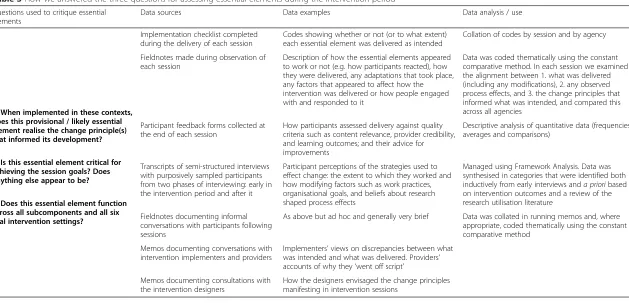
The mixed-method process evaluation focused on three domains: (a) how the intervention was imple-mented (fidelity assessment), (b) how people participated in and perceived the intervention, and (c) the contexts that mediated this relationship. As shown in Table 3, qualitative and quantitative data collection methods in-cluded purposively sampled semi-structured interviews; direct observation and coding of intervention activities; conversations with the intervention designers, imple-menters and providers; and participant feedback forms. These are described in detail in the SPIRIT process evaluation protocol [67].
The research group (which comprised the intervention designers, implementation team and process evaluation team working in parallel) used the relatively lengthy inter-vention period as an opportunity to identify, assess and re-fine hypothesised essential elements during the trial. This was aided by the multi-agency, stepped wedge design of the
Fig. 1The SPIRIT action framework. From: Redman, S., Turner, T., Davies, H., Williamson, A., Haynes, A., Brennan, S., Green, S. (2015). The SPIRIT Action Framework: A structured approach to selecting and testing strategies to increase the use of research in policy. Soc Sci Med, 136-137, 147-155. doi:10.1016/j.socscimed.2015.05.009
trial which allowed us to monitor the entire intervention in some agencies and still have scope to trial revisions in other agencies. A modified version of this approach could be ap-plied to other trial designs.
The provision of a dedicated process evaluation re-searcher as part of the wider group enabled the collec-tion of multiple forms of evaluative data from all sites, and iterative conversations with the intervention de-signers about their conceptualisation of the interven-tion’s causal pathways. This allowed us to assess the validity of the essential elements using a five-stage process. Stage 1: identify provisional essential elements; stage 2: test provisional essential elements in interven-tion contexts; stage 3: refine provisional essential ele-ments and develop likely essential eleele-ments; stage 4: test likely essential elements in intervention contexts; and stage 5: refine the likely essential elements and develop final essential elements. See Fig. 2 for a visual overview of this process. Each of these stages is now described.
Results
These results overlap with our methods in that we show how process evaluation data collection and analysis was used to critique essential elements. This detail is provided so that the procedure we devised is transparent and replicable.
Stage 1: identifying provisional essential elements
SPIRIT drew on diverse literature and expertise in its design. As shown in Fig. 2, this body of knowledge was distilled by the intervention designers into an action framework (Fig. 1) and a list of change principles (Table 2) [63, 66, 67] which formed the theoretical basis that we attempted to operationalise in response to each intervention session. These sessions were developed by the intervention designers in consultation with agency staff and expert providers.
We could not use SPIRIT’s change principles as our essen-tial elements. Doing so may have been appropriate for a very flexible intervention with minimally specified, non-standardised components [61]. In such a case, fidelity assess-ment could focus less on specific operationalisations of the change principles and more on if and how the change prin-ciples were realised [59]. However, this was not appropriate for SPIRIT which sought a balance of standardisation and flexibility within a menu of predefined components. The process evaluation aimed to report on variation in the deliv-ery and response to each of these components, consequently the change principles were too abstract to be used as indica-tors for fidelity reporting. Similarly, the action framework, which functioned as our logic model, outlined causal path-ways and relationships in relation to individual and organisa-tional capacity building but did not identify techniques. We needed a concrete and observable expression of what was at the heart of these strategies if we were to identify common-alities and differences in implementation that could help in-terpret the outcomes and inform further interventions.
The approach we devised was to identifypotential
essen-tial elements inductively. As each session outline became
available, the process evaluation team asked three questions. (a) What do the session goals and the planned characteristics of the session tell us about which change principles this ses-sion is attempting to utilise? (b) Which of these are likely to be essential to the effectiveness of the session? (c) What would these change principles look like in delivery (how can we operationalise them so that can be measured or fully de-scribed?)? This produced a list of draft essential elements that we further developed with the SPIRIT designers to ac-curately describe the elements they believed were essential for that session to be effective. These potential essential ele-ments included session content, key messages, provider characteristics, presentation techniques, activities, and par-ticular attendees and types of participation. At this stage, we consciously trialled many essential elements that we Table 2SPIRIT change principles
Systems framework •Uses a multi-component approach
•Maximises interaction between the different components of the intervention
•Addresses systems, operations, structures and relations
•Is flexible in meeting the needs of different agencies
Engagement and ownership •Engages agencies in owning and driving the program
•Is tailored to focus on the agency’s priorities
Goal setting and feedback •Provides feedback about current practice
•Provides a clear rationale for change
•Develops agreement about concrete and specific change goals
•Monitors and provides feedback about change during the intervention program
Interactive skill development •Provides self-education opportunities and access to resources
•Recognises the expertise of participants
•Is interactive with a focus on shared reflection and problem solving
•Provides opportunity for rehearsal and practice
Leadership, roles and relationships •Uses champions to model and promote the use of evidence from research
(including both internal and external champions)
Table 3How we answered the three questions for assessing essential elements during the intervention period
Questions used to critique essential elements
Data sources Data examples Data analysis / use
1. When implemented in these contexts, does this provisional / likely essential element realise the change principle(s) that informed its development?
2. Is this essential element critical for achieving the session goals? Does anything else appear to be?
3. Does this essential element function across all subcomponents and all six trial intervention settings?
Implementation checklist completed during the delivery of each session
Codes showing whether or not (or to what extent) each essential element was delivered as intended
Collation of codes by session and by agency
Fieldnotes made during observation of each session
Description of how the essential elements appeared to work or not (e.g. how participants reacted), how they were delivered, any adaptations that took place, any factors that appeared to affect how the intervention was delivered or how people engaged with and responded to it
Data was coded thematically using the constant comparative method. In each session we examined the alignment between 1. what was delivered (including any modifications), 2. any observed process effects, and 3. the change principles that informed what was intended, and compared this across all agencies
Participant feedback forms collected at the end of each session
How participants assessed delivery against quality criteria such as content relevance, provider credibility, and learning outcomes; and their advice for improvements
Descriptive analysis of quantitative data (frequencies, averages and comparisons)
Transcripts of semi-structured interviews with purposively sampled participants from two phases of interviewing: early in the intervention period and after it
Participant perceptions of the strategies used to effect change: the extent to which they worked and how modifying factors such as work practices, organisational goals, and beliefs about research shaped process effects
Managed using Framework Analysis. Data was synthesised in categories that were identified both inductively from early interviews anda prioribased on intervention outcomes and a review of the research utilisation literature
Fieldnotes documenting informal conversations with participants following sessions
As above but ad hoc and generally very brief Data was collated in running memos and, where appropriate, coded thematically using the constant comparative method
Memos documenting conversations with intervention implementers and providers
Implementers’views on discrepancies between what was intended and what was delivered. Providers’ accounts of why they‘went off script’
Memos documenting consultations with the intervention designers
How the designers envisaged the change principles manifesting in intervention sessions
Haynes
et
al.
Implementa
tion
Science
(2016) 11:23
Page
8
of
suspected would be collapsed or discarded later. See Add-itional file 1 for an example.
Devising potential essential elements also required the operationalisation of some relatively abstract overarching concepts. We describe the development of one of these—the concept of quality—in more detail. This is because it is par-ticularly important for ensuring that intervention objectives are achieved [10], yet is neglected in the literature [12, 68].
As per Dusenbury et al.’s definition of quality as‘the extent to which a provider approaches a theoretical ideal in terms of delivering program content’([10]: 244), we conceptualised quality as congruence between (a) the intervention-as-implemented and (b) the intervention theory—in particular, the change principles. The change principles were strongly informed by adult learning theory which provided quality constructs such as: the providers’content expertise and pres-entational skills; the extent to which participants found workshops to be interesting, engaging and respectful of their contributions; the relevance and potential usability of the in-formation and ideas provided; and if participants were facili-tated to explore how information and ideas might be applied in their work settings [69, 70].
We were able to operationalise some aspects of these qual-ity constructs and so include them as evaluator-coded essen-tial elements (e.g. by devising criteria for‘content expertise’ and using observations to determine the extent to which in-formation and ideas were discussed in relation to partici-pants’ work). However, because quality is highly situated [12], we considered many aspects would be best assessed by participants themselves. Therefore, items in the participant feedback forms were used to collect information about qual-ity constructs such as content relevance, provider suitabilqual-ity, how engaging the session was and the usefulness of informa-tion provided. Quality across the whole program was also considered as part of the semi-structured interviews that were conducted with participants after the intervention.
Interviews focused on capturing the breadth of quality cri-teria from participants’perspectives (we were mindful that our notion of quality might not align with theirs) and explor-ing reasons for their judgement rather than ratexplor-ings.
Stage 2: testing provisional essential elements in intervention contexts
During the first step of SPIRIT (in which the intervention was fully implemented in two agencies and partially imple-mented in a further two), the process evaluation team not only monitored adherence to the essential elements but also gathered qualitative and quantitative data that would help us better understand their real world functionality and validity. We conceptualised validity as (1) how well the essential ele-ments embodied and delivered the intervention’s theoret-ical foundations [6, 9, 71] and (2) the extent to which the essential elements were actually essential in each setting [17] (we were aware that elements which seemed essen-tial in one context might not be so in all contexts and circumstances [13]). Data was collected via observa-tional field notes, checklist coding, post-session memos, participant interviews, participant feedback form ratings and comments, and conversations with providers and implementation team members.
During the concurrent data collection and analysis process, we adopted a stance of ‘naïve curiosity’in rela-tion to the essential elements, asking‘What seems to be more or less successful in meeting the goals of each ses-sion, and why?’This enabled us to stay open to potential essential elements that we may have failed to consider prior to the evaluation. For example, we noted early on that participants appeared to engage more with session content and gave more favourable feedback when the provider explicitly recognised the challenges of their work, including having a realistic view of the (limited) role of research within it. When the reverse
Experiential wisdom Diverse literature
‘Action framework’
Individual session techniques & goals
Change principles
1. ‘Provisional EEs’ (session specific)
5. Refine: Final SPIRIT EEs
3. Refine: ‘Likely EEs’ (component level) 2. Test ‘provisional
EEs’ in sites 1-4
4. Test ‘likely EEs’ in sites 3-6
Questions for assessing essential elements:
1. Do they realise the change principles? 2. Are they critical for
achieving the session goals? (and what else appears to be?)
3. Do they function across all subcomponents and all intervention settings?
SPIRIT intervention designers
Process evaluation team (in consultation with SPIRIT intervention designers)
was observed (participants disengaging because the provider appeared insensitive to this issue), we con-cluded this concept was an essential element of the relevant components: ‘Provider demonstrated sensitivity
to the ‘real world’ of the agency’s policy/program
work’.
To address our concern about validity we also asked‘How well was the theory underpinning the intervention realised in the delivery of this session?’and‘Does each putative essential element appear to be critical for achieving the session goals?’ Data was synthesised in running memos that identified is-sues to explore in further sessions. Analysis focused on com-paring our data with the program logic and, primarily, with the change principles that had been identified as informing each session plan.
Six (often overlapping) challenges to the validity of the es-sential elements were identified through this inductive process. Essential elements could be (1) redundant—the element was not essential; (2)poorly articulated—unclear, too specific or not specific enough; (3) infeasible—it was not possible to implement the essential element as intended; (4)ineffective—the element did not effectively de-liver the change principles; (5)paradoxical—counteracting the goals of the session or the underpinning change princi-ples; or (6)absent or suboptimal—we identified additional or more effective ways of operationalising the change prin-ciples. See Table 4 for examples.
Detailed notes were made about the nature of the problem, what interactions affected it (where this was appropriate) and possible solutions that took account of our growing appreciation of contextual constraints and opportunities. Notes included suggestions about where session-specific essential elements could be collapsed and rephrased so that they could be applied across all agencies and intervention components.
Stage 3: refining the provisional essential elements and developing likely essential elements
The process evaluation team used these notes to amend, distil or reject the 50+ provisional essential elements initially used across the intervention into a list of 26 ‘likely’ essential elements. Following consult-ation with the intervention designers, these were fur-ther revised. The list represented a revised way of articulating and evaluating the fidelity of the interven-tion but did not affect its design or continuing imple-mentation (with the exception of providers who were sent a list of the essential elements and feedback form items prior to their sessions).
In the revision process, we sought to balance the need for more loosely specified essential elements (which the flexible aspects of the intervention design demanded) with the need to clearly describe what the intervention comprised: not only for the purposes of fidelity
assessment but also to provide detailed information that would aid transparent reporting of and potential replica-tion of the intervenreplica-tion. We were guided by Century, Rudnick and Freeman’s account of reducing the granu-larity with which their essential elements were defined and measured [55]. Consequently, essential elements that had been devised for topic specific sessions were ar-ticulated at a higher level of abstraction. For example,
‘The provider demonstrated the value of using systematic
reviews in policy/program decision-making’became ‘The
value of using research/evaluation in agency work was
conveyed’. This was necessary because agencies were
able to choose and tailor different sessions from within the same intervention component. So in order to moni-tor fidelity comparatively across all agencies, the essen-tial elements needed to be applicable to every session. Where agencies were able to choose the topic, content, form and goals of face-to-face sessions, the fidelity as-sessment no longer specified any of these attributes, only that they must reflect the relevant change principles for that component (e.g. those specifying interactivity, shared problem solving, and recognition of participants’ expertise).
Stage 4: testing‘likely’essential elements in intervention contexts
In this stage, we used the likely essential elements in our fidelity assessment data collection and continued using the methods described in stage 2 to collate information about the extent to which they were delivered and to ex-plore their functionality and congruence with the pro-gram theory.
Stage 5: developing final essential elements
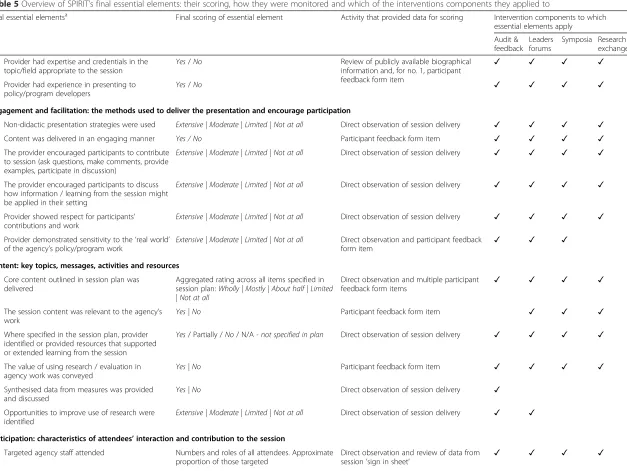
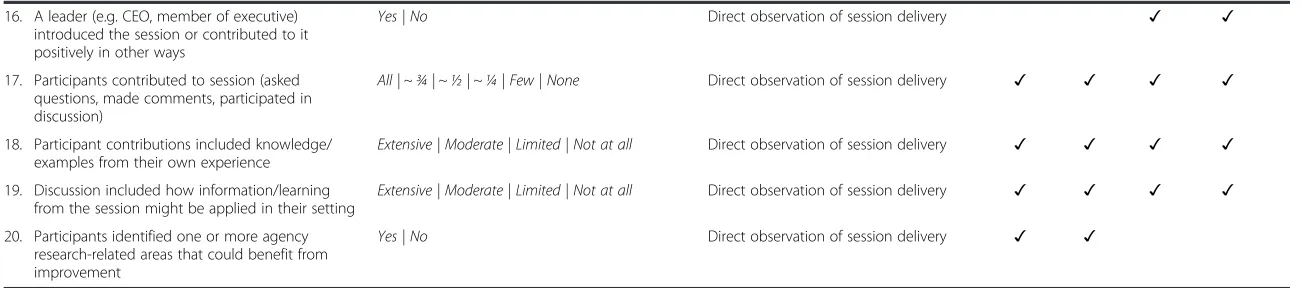
Several further changes were made in this stage but, with some exceptions, not as a result of additional infor-mation gathered in stage 4. Rather the iterative process of refinement allowed us to reflect on details that had been sidelined by more pressing concerns in the previ-ous stages. Having addressed those, we had capacity to focus on less critical amendments and fine tune some essential elements that might otherwise have been con-sidered‘good enough’. Our final list of essential elements was reduced to 20 items (Table 5). These included sev-eral that we considered collapsing but decided to retain separately. For example, is this provider-related element:
‘The provider encouraged participants to contribute to
session’ really essential when a participation-related
element: ‘Participants contributed to session’ addressed the same concept? Based on empirical evidence from the trial, we concluded it was important to differentiate be-tween (and learn from) what was delivered and how people responded. Our observational data showed that
element was not essential participants to ask questions’ based sessions where participants interacted as co-contributors
Poorly articulated The element description was unclear, too specific or not specific enough
‘The session was introduced by a leader (senior person in the agency
e.g.CEO, member of executive)’
This failed to capture the many times that less senior staff introduced sessions that were attended by leaders. This essential element was a proxy for visible endorsement/support (modelling) by organisational leaders which we concluded was also achieved when they attended and contributed enthusiastically to the session in other ways
Hone the description so that it accurately captures the essential element
Infeasible The essential element described a strategy that was not possible to implement as intended
‘Participants were facilitated to identify one or more change goals’
We found this was achievable only in agencies that had developed a research utilisation reform agenda prior to SPIRIT and felt able to use intervention sessions to discuss their goals openly. Other agencies needed more time and different processes to identify goals
Modify or develop alternative strategies. In some cases, the outcomes themselves may need be modified
Ineffective In practice, the strategy described by the essential element did not effectively deliver the change principles
‘The provider had experience presenting to policy/program developers’
This seemed intuitively reasonable as one of several criteria for securing providers with the expertise and credibility stipulated by our change principles, yet there was no correlation between this criterion and our evaluation of session quality or general participant satisfaction feedback
Consider whether this element can simply be removed or if the change principles require further operationalisation to capture an essential aspect of the intervention
Paradoxical When implemented, the strategy described by the essential element counteracted the session goals or the change principles
No examples of this were identified Interventions can have counterintuitive impacts. While the process evaluation identified examples of this in other aspects of the trial, none related specifically to the essential elements
Remove this element and consider possible implications for other parts of the intervention
Absent or suboptimal Additional or more effective ways of operationalising the change principles were identified
‘The provider persuasively articulated his/her commitment to using research’.
Despite being briefed to do so, many providers didnotarticulate their commitment to using research. However, some used case examples that powerfully illustrated the value of research, and facilitated discussion that enabled participants to express it themselves. This strategy was more sophisticated and a better fit with the adult learning orientated change principles that emphasise interactivity, shared reflection and harnessing participant expertise
Introduce absent elements and modify sub-optimally operationalised elements that the essential aspects of the intervention are captured
tion
Science
(2016) 11:23
Page
11
of
Table 5Overview of SPIRIT’s final essential elements: their scoring, how they were monitored and which of the interventions components they applied to
Final essential elementsa Final scoring of essential element Activity that provided data for scoring Intervention components to which
essential elements apply
Audit & feedback
Leaders forums
Symposia Research exchanges
1. Provider had expertise and credentials in the topic/field appropriate to the session
Yes/No Review of publicly available biographical information and, for no. 1, participant feedback form item
✓ ✓ ✓ ✓
2. Provider had experience in presenting to policy/program developers
Yes/No ✓ ✓ ✓ ✓
Engagement and facilitation: the methods used to deliver the presentation and encourage participation
3. Non-didactic presentation strategies were used Extensive | Moderate | Limited | Not at all Direct observation of session delivery ✓ ✓ ✓ ✓ 4. Content was delivered in an engaging manner Yes / No Participant feedback form item ✓ ✓ ✓ ✓ 5. The provider encouraged participants to contribute
to session (ask questions, make comments, provide examples, participate in discussion)
Extensive | Moderate | Limited | Not at all Direct observation of session delivery ✓ ✓ ✓ ✓
6. The provider encouraged participants to discuss how information / learning from the session might be applied in their setting
Extensive | Moderate | Limited | Not at all Direct observation of session delivery ✓ ✓ ✓ ✓
7. Provider showed respect for participants’ contributions and work
Extensive | Moderate | Limited | Not at all Direct observation of session delivery ✓ ✓ ✓ ✓
8. Provider demonstrated sensitivity to the‘real world’ of the agency’s policy/program work
Extensive | Moderate | Limited | Not at all Direct observation and participant feedback
form item ✓ ✓ ✓
Content: key topics, messages, activities and resources
9. Core content outlined in session plan was delivered
Aggregated rating across all items specified in session plan:Wholly | Mostly | About half | Limited | Not at all
Direct observation and multiple participant
feedback form items ✓ ✓ ✓ ✓
10. The session content was relevant to the agency’s work
Yes | No Participant feedback form item ✓ ✓ ✓
11. Where specified in the session plan, provider identified or provided resources that supported or extended learning from the session
Yes/ Partially /No/ N/A- not specified in plan Direct observation of session delivery ✓ ✓ ✓ ✓
12. The value of using research / evaluation in agency work was conveyed
Yes | No Participant feedback form item ✓ ✓ ✓ ✓
13. Synthesised data from measures was provided and discussed
Yes | No Direct observation of session delivery ✓
14. Opportunities to improve use of research were identified
Extensive | Moderate | Limited | Not at all Direct observation of session delivery ✓ ✓
Participation: characteristics of attendees’interaction and contribution to the session
15. Targeted agency staff attended Numbers and roles of all attendees. Approximate proportion of those targeted
Direct observation and review of data from
session‘sign in sheet’ ✓ ✓ ✓ ✓
Haynes
et
al.
Implementa
tion
Science
(2016) 11:23
Page
12
of
17. Participants contributed to session (asked questions, made comments, participated in discussion)
All | ~ ¾ | ~ ½ | ~ ¼ | Few | None Direct observation of session delivery ✓ ✓ ✓ ✓
18. Participant contributions included knowledge/ examples from their own experience
Extensive | Moderate | Limited | Not at all Direct observation of session delivery ✓ ✓ ✓ ✓
19. Discussion included how information/learning from the session might be applied in their setting
Extensive | Moderate | Limited | Not at all Direct observation of session delivery ✓ ✓ ✓ ✓
20. Participants identified one or more agency research-related areas that could benefit from improvement
Yes | No Direct observation of session delivery ✓ ✓
a
Essential elements are one type of fidelity criteria. Other fidelity measures concerning frequency, duration, coverage, etc., plus participants’perspectives, were collected for each session but are not shown on this table
tion
Science
(2016) 11:23
Page
13
of
in most sessions the providers’actions appeared to shape the levels and types of participation, but this was not al-ways the case. Also, because providers were given a loosely specified briefing regarding delivery techniques, as befitted the senior experts who were recruited, we felt it helpful to retain the item for instructional purposes.
Scoring the essential elements
Not all fidelity criteria can be assessed in the same man-ner [9]. Structural items such as participant attendance and the number, type and duration of sessions are easily observed and can usually be captured numerically. How-ever, process items (which may be more significant in terms of intervention effects [9]) such as presentation styles, types of participation and overall quality tend to be more descriptive and usually require context-sensitive qualitative assessment, especially direct observation [9, 19, 62]. Most of our essential elements were processual so we found that their inclusion in the fidelity assess-ment required that they be monitored not only in terms
of whether they were delivered, but the extent to which
they were delivered andhowthis was done. Our aim was to devise a pragmatic method of standardising observa-tions across sites that could accommodate local adapta-tion and extensive data collecadapta-tion.
We made three primary adjustments to the scoring as a result of the testing. First, we rejected dichotomised scoring on many items in favour of an ordinal scale. Not surprisingly, we found the yes/noformat we trialled too reductive for the complex processes we were observing. We also trialled several five-point scales (as recommended by Bond et al. [21]) but settled on a four-point descriptive scale ofextensive|moderate|limited|not at allas providing the necessary breadth and precision for our purposes. The definitions that specified the conditions under which each score was applicable were refined in consultation with the intervention designers and the scale was tested in each agency by two members of the team. All coding was sup-plemented with descriptive notes.
Second, we developed a scale that could be applied to each customised session (workshop, symposium, etc.) and would thereby enable us to compare sessioncontent scores across the whole trial. Content was considered to be the aspects of the session that the participating agency had specifically requested. Depending on the na-ture of the session and the level of detail each agency chose to specify, this content varied tremendously from concrete deliverables (e.g.an example of a systematic
re-view was provided) to relatively abstract processes and
concepts (e.g. ethical challenges were explored
inter-actively). The number of content items also varied from
between three to eight. We kept the yes/no score for each individual item and simply aggregated these using a scale of wholly|mostly|about half|limited|not at all for
each session. This allowed us to compare the delivery of varied content across all sessions and sites without the requirement for a consistent number of items.
Third, we concluded that we had been unsuccessful in finding semi-objective generalisable ways of scoring certain quality concepts (e.g. Was the presentation en-gaging? Was the content relevant?). We decided to rely entirely on participant feedback to score these essential elements. See Table 5 for an overview of the final scoring.
We had sufficient data (checklists, descriptive notes, memos and audio recordings) from the intervention implementation in stage 1 to apply these new codes retrospectively to the sessions that informed them.
‘Prohibited’elements
During the trial, we eschewed the concept of ‘prohibited’ [9] or ‘forbidden’elements [72], but when reviewing the data for stage 5 revisions, we concluded that they could have provided clearer guidance for our providers about the intervention’s underpinning principles. These pro-viders were experts in their field but newcomers to SPIRIT. Despite receiving the essential elements for their sessions in advance, many appeared to apply them se-lectively. Based on participant feedback and our observa-tions, the following guidance may have helped providers avoid the most common pitfalls:
To be avoided:
Talking down to participants. In particular, failure to recognise their expertise and the complexity of their work.
Talkingatparticipants. Didactic presentations should be interspersed with case examples, activities, discussion,etc.Invite questions, ask participants about their views and experiences, and encourage debate.
Reliance on data/cases from other fields. When information is highly relevant it is more applicable. Where possible, use case examples from the agency’s own work. We can provide assistance with this.
Squeezing out time for discussion. We conceptualise discussion as a primary mechanism for helping participants integrate new knowledge and think about how it might be applied in their contexts.
We did not trial this guidance partly because it would have radically changed the provider briefing protocol and partly because of the potential to alienate eminent highly skilled professionals with such censorious (and potentially patronising) guidance. However, we believe that our methods for assessing essential elements, com-bined with sensitive consultation with the providers, would
glean valuable information about the appropriateness and utility of such an approach. Although this paper concen-trates on critiquing and revising essential elements in situ as a means of improving validity in novel contextualised tri-als, where threats to validity can be identified in advance they should be addressed before the intervention is underway.
Discussion
Identifying an intervention’s essential elements and monitoring them via fidelity assessment is critical for understanding how the intervention worked or why it did not work. Yet, there is uncertainty about how to do this, particularly for novel contextualised interventions (i.e. interventions that blend theories pragmatically and which are designed to be flexible and at least partially re-sponsive to local conditions) [8–10, 20, 55]. How do we determine which elements of such interventions are genuinely essential to their effectiveness? And how do we ensure they are valid indicators of the intervention theory [6, 12, 14]? When attempting to answer these questions we found little practical guidance in the litera-ture and encountered paradigmatic differences and am-biguous terminology. For example, what we callessential
elements [10, 56] are also known as essential functions
[59],essential components[12],essential ingredients[62], active ingredients[6, 7, 11],critical ingredients[21],
crit-ical components[55] andcore components[23, 36]. More
importantly, they are not always referring to the same phenomenon and they differ greatly in terms of their re-lationship to the intervention’s theoretical underpin-nings. Some refer theoretically to intervention activities [12], others to theoretical functions [59]; some use the term to include the breadth of fidelity criteria (e.g. inten-sity and reach) [20], while others limit it to carefully mapped and validated indicators of theory-based models [73] or recommendations [17].
Meanwhile, the perceived value of assessing standar-dised interventions using universal fidelity criteria is de-clining. The growth of contextualised interventions mirrors increasing recognition of the complexity of the dynamic real world systems in which they are imple-mented, and the idiosyncratic and unintended ways that interventions and their context can change one another [41, 49, 59, 74]. The need to figure out what fidelity means in such interventions, and to devise methods for identifying and monitoring elements that are genuinely essential, is more pressing than ever.
In this paper, we describe a novel exploratory incre-mental test-and-refine process devised to strengthen the validity of a contextualised intervention’s essential ele-ments. This pragmatic approach enabled us to collect fi-delity data throughout the trial (despite uncertainty about what the intervention would look like when
implemented in each setting), while also assessing how well the intervention’s real world delivery aligned with the theoretical principles that underpinned its design. The literature provides advice for articulating factual, precise and targeted fidelity criteria prior to the inter-vention e.g. [21] but to ensure our essential elements were valid we needed to attend to the interplay of the intervention theory and design with the intervention set-tings, providers and participants. This was best done empirically in the context of the trial.
Although we monitored implementation fidelity, our methods focused on understanding the intervention’s theoretical fidelity because, as Hawe argues,‘Fidelity re-sides in the theory of the change process, rather than in any particular technology, component, or delivery chan-nel per se. Thus, the role and meaning behind a particu-lar component, rather than its face value, are what matter’([75]: 313).
Identifying the appropriate level of specificity was a critical aspect of determining the essential elements’ val-idity. Overarchingly, we moved from a tightly specified approach to one that was more loosely defined, better reflecting the intervention’s scope for expert providers to shape activities, and for tailoring to individual sites. We knew that session-specific essential elements would need to be distilled into higher order items that covered whole components of the intervention, but testing the func-tionality and theoretical congruence of a wide variety of provisional essential elements in multiple sessions and sites enabled us to explore a breadth of possibilities about what mattered and why, increase our understand-ing of which intervention elements genuinely appeared to be essential, and experiment with how best to articu-late and score them. One outcome of this was to in-crease the extent to which participant feedback was used to measure quality indicators. This approach accords with calls in fidelity assessment, and in research and evaluation more broadly, to use loosely specified evalu-ation methods that support local adaptevalu-ation and which recognise that change processes in complex systems are unpredictable and are often best assessed by those re-ceiving the intervention [7, 38, 58, 59]. While none of the process evaluation data, including the evolving fidel-ity assessment described in this paper, was fed back into the design or implementation of the intervention during this trial, our approach has potential to contribute for-matively to developmental evaluations that shape the intervention during its delivery [52].
results for individual sessions or components when analysing intervention outcomes as they are thought to function interdependently, but our data will tell us the extent to which the operational and theoretical aspects of the SPIRIT intervention were delivered in each agency. This, in turn, will help us interpret the ob-served effects of the overall intervention-as-delivered on outcomes.
The use of mixed data collection methods and sources (triangulation), including direct observation and partici-pant feedback, strengthened the rigour of this work [9, 19, 21, 62]. However, the final recursive loop (stages 4 and 5 as described in the‘Methods’section) could have been avoided if we had scrutinised all the essential ele-ments with equal emphasis in earlier steps rather than focusing on those with evident problems.
We note that this approach would not be appropriate for all interventions. Given that the modifications mostly either collapsed essential elements or articulated them at a less granular level, we were able to use the data gathered during earlier phases of implementation to apply the modified elements and codes to the sessions that informed them. However, where essential elements are revised to become more granular (as might be the case in standardised programs where highly specified techniques are being honed), our records would not have contained sufficient detail with which to apply codes retrospectively.
There are other limitations. Our lack of independ-ence as members of the wider study team may have affected our ability to observe the intervention imple-mentation dispassionately and, as is always the case, our theoretical and disciplinary allegiances may have skewed what we noticed and how we assessed it. Lastly, what we observed was situational: shaped by the complex interaction between the intervention the-ory and structure, delivery by multiple providers, di-verse participants and distinct organisational contexts, all at particular time points. So, while we believe we have identified elements that are at the heart of the intervention theory, we cannot claim that they will necessarily have equal functionality and validity in all settings and circumstances, particularly where they are expressed with greater specificity [65, 68]. We have, however, honed a list of essential elements that appear to be valid in the context of this trial, and which may provide a starting point for others for in-terventions similar to SPIRIT.
Conclusion
This paper describes the difficulties in identifying the es-sential elements of a contextualised intervention (i.e. an intervention that is informed by composite social and
psychological theories and which incorporates standar-dised and flexible components in order to maximise ef-fectiveness in complex settings). A worked example of an approach for critiquing the validity of essential elements is provided, including a demonstration of how they can be refined during a trial without compromising the fidelity as-sessment. This process takes intervention evaluators closer to making theoretically and contextually sensitive decisions upon which to base fidelity assessments in trials of contex-tualised interventions.
Additional file
Additional file 1:Example of how essential elements changed
during SPRIT.(DOCX 30 kb)
Competing interests
SPIRIT is funded as part of the Centre for Informing Policy in Health with Evidence from Research (CIPHER), an Australian National Health and Medical Research Council Centre for Research Excellence (APP1001436) and administered by the Sax Institute. The Sax Institute receives a grant from the NSW Ministry of Health. The Australasian Cochrane Centre is funded by the Australian Government through the National Health and Medical Research Council (NHMRC). AH is supported by an NHMRC Public Health and Health Services Postgraduate Research Scholarship (1093096).
Authors’contributions
AH led the design and conduct of the fidelity assessment and drafted the manuscript. SB and GG contributed to the design and ongoing oversight of this work as part of the SPIRIT process evaluation. AW supervised this work. SR and the CIPHER team investigators conceived of the SPIRIT study. PB helped draft the manuscript. All named authors contributed substantially to and approved the final manuscript.
Acknowledgements
We wish to thank the people and organisations participating in SPIRIT. SPIRIT is being conducted by the CIPHER Centre for Research Excellence. CIPHER is a joint project of the Sax Institute; Australasian Cochrane Centre, Monash University; University of Newcastle; University of New South Wales; Research Unit for Research Utilisation, University of St Andrews and University of Edinburgh; Australian National University; and University of South Australia. Thanks also to the members of the CIPHER team who provided valued support and feedback during the SPIRIT process evaluation, particularly: Stacy Carter, Denise O’Connor, Carmen Huckel Schneider and Tari Turner. Lastly, thanks to the reviewers whose comments improved our manuscript.
Author details
1Sax Institute, Level 13 Building 10, 235 Jones Street, Ultimo, NSW 2007, Australia.2School of Public Health, University of Sydney, Edward Ford Building (A27), Fisher Road, Sydney, NSW 2006, Australia.3Australasian Cochrane Centre, School of Public Health and Preventive Medicine, Monash University, The Alfred Centre, 99 Commercial Road, Melbourne, VIC 3004, Australia.4School of Medicine, University of Notre Dame, 160 Oxford Street, Darlinghurst, NSW 2010, Australia.5Faculty of Health Sciences, University of Sydney, 75 East Street, Lidcombe, NSW 2141, Australia.6Centre for Medical Psychology and Evidence-based Decision-making, Level 6, Chris O’Brien Lifehouse (C39Z), University of Sydney, Sydney, NSW 2006, Australia.
Received: 22 July 2015 Accepted: 29 January 2016
References
1. Grimshaw JM, Zwarenstein M, Tetroe JM, Godin G, Graham ID, Lemyre L, et al. Looking inside the black box: a theory-based process evaluation alongside a randomised controlled trial of printed educational materials (the Ontario printed educational message, OPEM) to improve referral and