LI-BR Water Absorption Systems Analysis using
Artificial Neural Network (ANN)
Dimple Patel Jitendra Jayant
M. Tech Scholar Assistant Professor
Department of Mechanical Engineering Department of Mechanical Engineering
LNCT, Indore. M.P. India LNCT, Indore. M.P. India
Abstract
As a result of projected world energy shortage, the use of solar energy for environmental control is receiving much attention in the engineering science literature. A simulation of the solar li-br zVAR system is carried out that predicts the performance of the system under given ambient condition. An optimization tool namely artificial neural networks (ANN) is used to find the optimized parameter at minimum entropy of the component.
Keywords: Absorption system, Li-Br, EGM, Optimization
_______________________________________________________________________________________________________
I. INTRODUCTION
The performance co-efficient of a VAR system can be calculated as a function of temperature entropy generation minimization(EGM) is a method of thermodynamic optimization of real systems that owe their thermodynamics imperfection to eat transfer, fluid flow and mass transfer irreversibility. The EGM method is also distinct from energy analysis. The following paper optimization strategies, artificial neural network and constrains of the system.
II. SYSTEM DESCRIPTION
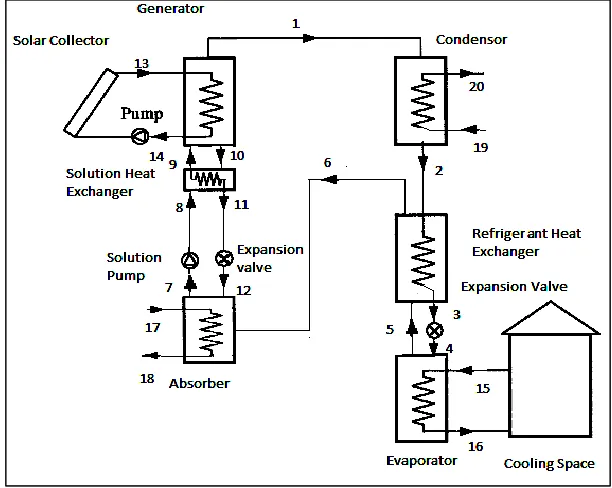
A schematic diagram of a solar driven lithium bromide VAR system is shown in fig. evacuated solar tube collector is used to supply the heat required to drive the entire system. The solar energy from the sun is received by the collectors. This energy is stored in the hot water tank in the form of the thermal energy of the water. The mass flow rate of the hot water is controlled and taken to the generator. In the generator pool type heat exchanger is used to utilize the energy of the hot water in nucleate boiling of the Li-Br water solution. The water vapor generated by the boiling passes through the condenser whereas the strong solution produced because of the evaporation of the water vapor returns to the absorber. The heat possessed by the strong solution is abstracted by the solution heat exchanger by transferring it to the weak solution entering in the generator. In condenser the water vapor is condensed with the help of ambient air.
The condensed water coming out of the condenser passes through expansion valve followed by the evaporator where the cooling effect is produced. The low pressure vapor is then absorbed by the absorbent in the absorber producing weak solution. The conventional VAR system with capacity of 10TR is considered.
Total entropy generation in the system can be obtained by summing up entropy generated in all components.
STotal= N
total j 1
S
=Scollector+SG +SC+SA +SE +SRHE+SSHE+SrevIII. ARTIFICIAL NEURAL NETWORKS (ANN)
ANN is originally developed to simulate the function of the human brain or neural system, resulting in systems that learn by experience. The use of ANNs has increased dramatically in recent years in the field of applied mechanics, logistics, manufacturing and etc. in order to model complex system behavior, the human brain consist of large number (approx. 1011) of highly connected neurons those have many desirable characteristics not present in modern sequential computers. Some of these characteristics are:
1) Massive parallelism
2) Distributed representation and computation 3) Learning ability
4) Generalization ability.
ANN involves processing elements or neurons and interconnection weights between neurons. These interconnection weight determine the nature and the strength of the connection between neurons. In ANN information processing occurs at many neurons and signals are passed between neurons over interconnection links.
Each interconnection link has its associated weight that multiplies the signals transmitted and each neurons applied and activation function to determine its output signal. A single neuron with R element input vector shown in fig.
Fig. 2: ANN structure
IV. PREDICTION OF COEFFICIENT OF PERFORMANCE
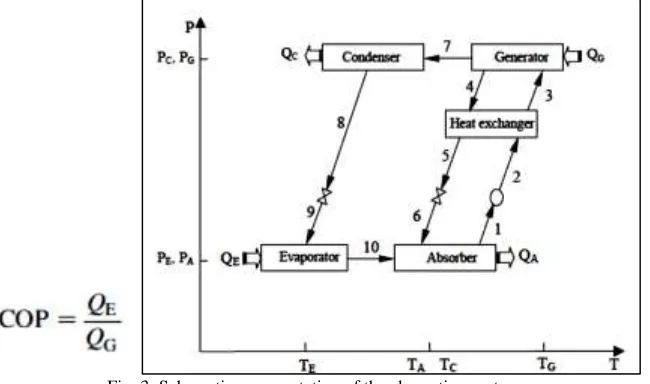
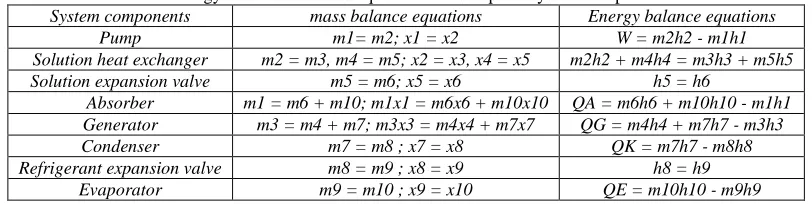
An absorption system consists of the evaporator, generator, condenser, absorber, solution pump, solution heat exchanger and expansion valve. A schematic representation of the absorption cycle is given in Fig. 3. The energy and mass balance equations of the various components of an absorption system are given in Table 1.
The cooling coefficient of performance (COP) of the absorption system is defined as the heat load in the evaporator per unit of heat load in the generator and can be written as:
Table - 1
The energy and mass balance equations of absorption system components
System components mass balance equations Energy balance equations
Pump m1= m2; x1 = x2 W = m2h2 - m1h1
Solution heat exchanger m2 = m3, m4 = m5; x2 = x3, x4 = x5 m2h2 + m4h4 = m3h3 + m5h5
Solution expansion valve m5 = m6; x5 = x6 h5 = h6
Absorber m1 = m6 + m10; m1x1 = m6x6 + m10x10 QA = m6h6 + m10h10 - m1h1 Generator m3 = m4 + m7; m3x3 = m4x4 + m7x7 QG = m4h4 + m7h7 - m3h3
Condenser m7 = m8 ; x7 = x8 QK = m7h7 - m8h8
Refrigerant expansion valve m8 = m9 ; x8 = x9 h8 = h9
Evaporator m9 = m10 ; x9 = x10 QE = m10h10 - m9h9
V. MODELING OF THE THERMODYNAMIC PROPERTIES WITH ANN
Determination of the thermodynamic properties of fluid pairs used in the absorption systems is one of the most difficult problems. Complex empirical expressions for entropy of Li Br–water solution in the temperature range of 0–190 8C and salt concentration of 0–75%. In order to develop a formulation procedure for entropy of Li Br–water solutions using ANNs, these data were used. The inputs of the network are temperature and concentration and the output is entropy of the fluid pairs.
In this study, the back-propagation learning algorithm is used in a feed-forward, single hidden layer network. Logistic sigmoid transfer function is used as the activation function for both the hidden layer and the output layer. The transfer function used is presented in Equation. The values of the training and test data were normalized to a range of 0–1. Levenberg–Marquardt (LM) Back-Propagation training was repeatedly applied until satisfactory training is achieved.
Where z is the weighted sum of the input. The computer program was performed under MATLAB environment using the neural network toolbox. The data set for the entropy of Li Br–water solution available included 100% data patterns. From these 70% data patterns were used for the training of the network and the remaining 30% patterns were randomly selected and used as test data set.
Fig. 4 shows the architecture of the ANN used for LiBr–water solution entropy prediction. In this, the temperature and concentration are the input data and Entropy of the solution is the actual output. The configuration 2-8-1 appeared to be the most optimal topology for this application.
VI. PROPOSED WORK
Artificial Neural Networks
Although the concept of artificial neural network (ANN) analysis was discovered nearly 50 years ago, it is only in the last two decades that application software has been developed to handle practical problems. ANNs are good for some tasks while lacking in some others. Specifically, they are good for tasks involving incomplete data sets, fuzzy or incomplete information and for highly complex and ill-defined problems, where humans usually make decisions on an intuitional basis.
ANNs have been applied successfully in various fields of mathematics, engineering, medicine, economics, meteorology, psychology, neurology and many others. They have also been used in weather and market trends forecasting, in the prediction of mineral exploration sites, in electrical and thermal load prediction, in adaptive and robotic control and many others.
Artificial neural networks are systems of weight vectors, whose component values are established through various machine learning algorithms, which take as input a linear set of pattern inputs and produce as output a numerical pattern representing the actual output. ANNs mimic somewhat the learning process of a human brain. Instead of complex rules and mathematical routines, ANNs are able to learn key information patterns within a multi-information domain. In addition, inherently noisy data do not seem to present a problem, as ANNs are tolerant to noise variations.
Artificial neural networks differ from the traditional modeling approaches in that they are trained to learn solutions rather than being programmed to model a specific problem in the normal way. They are usually used to address problems that are intractable or cumbersome to solve with traditional methods. They can learn from examples, are fault tolerant in the sense that they are able to handle noisy and incomplete data are able to deal with non-linear problems and, once trained, can perform predictions at very high speed. ANNs have been used in many engineering applications such as in control systems, in classification and in modeling complex process transformations.
making weight and bias changes based on an entire set (batch) of input vectors. Incremental training changes the weights and biases of a network as needed after presentation of each individual input vector. Incremental training is sometimes referred to as ‘‘on line’’ or ‘‘adaptive’’ training.
There are different learning algorithms that can be applied to train a neural network. The most popular of them is the back propagation algorithm, which has different variants. Standard back propagation is a gradient descent algorithm. It is very difficult to know which training algorithm will be the fastest for a given problem, and the best one is usually chosen by trial and error. An ANN with a back propagation algorithm learns by changing the connection weights, and these changes are stored as knowledge
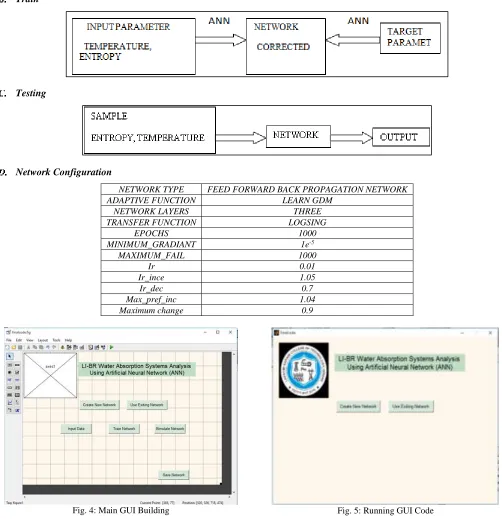
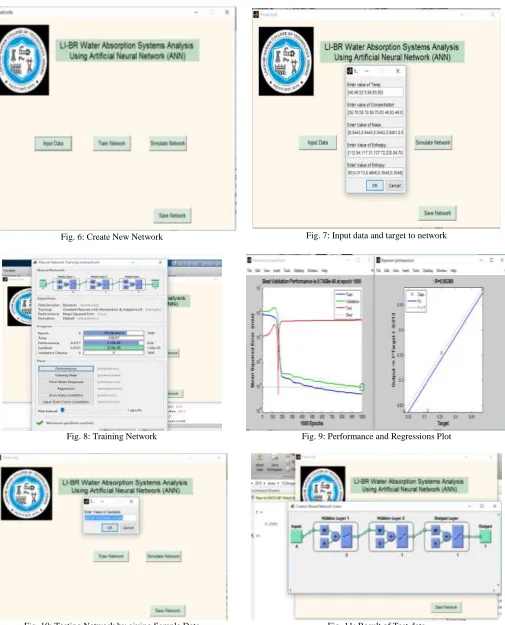
Train
Testing
Network Configuration
NETWORK TYPE FEED FORWARD BACK PROPAGATION NETWORK
ADAPTIVE FUNCTION LEARN GDM
NETWORK LAYERS THREE
TRANSFER FUNCTION LOGSING
EPOCHS 1000
MINIMUM_GRADIANT 1e-5
MAXIMUM_FAIL 1000
Ir 0.01
Ir_ince 1.05
Ir_dec 0.7
Max_pref_inc 1.04
Maximum change 0.9
Fig. 6: Create New Network Fig. 7: Input data and target to network
Fig. 8: Training Network Fig. 9: Performance and Regressions Plot
Fig. 12: Use Existing Network Fig. 13: Simulate Network
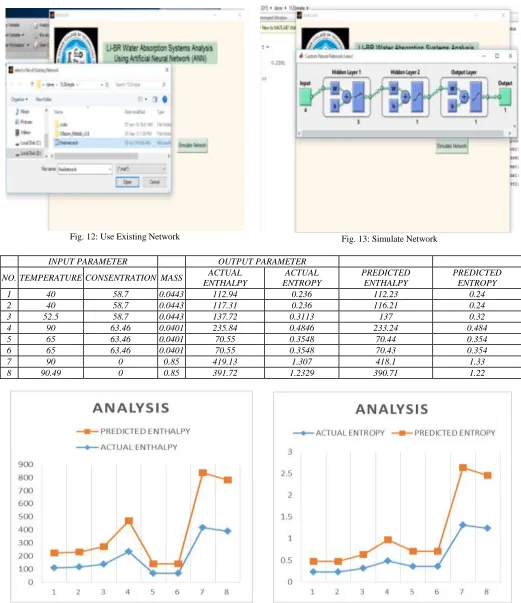
INPUT PARAMETER OUTPUT PARAMETER
NO. TEMPERATURE CONSENTRATION MASS ACTUAL ENTHALPY
ACTUAL ENTROPY
PREDICTED ENTHALPY
PREDICTED ENTROPY
1 40 58.7 0.0443 112.94 0.236 112.23 0.24
2 40 58.7 0.0443 117.31 0.236 116.21 0.24
3 52.5 58.7 0.0443 137.72 0.3113 137 0.32
4 90 63.46 0.0401 235.84 0.4846 233.24 0.484
5 65 63.46 0.0401 70.55 0.3548 70.44 0.354
6 65 63.46 0.0401 70.55 0.3548 70.43 0.354
7 90 0 0.85 419.13 1.307 418.1 1.33
8 90.49 0 0.85 391.72 1.2329 390.71 1.22
VII. CONCLUSION
As a result of the present work following conclusion can be made.
1) Generator has highest contribution in entropy generation of the system hence optimizing generator parameter with a view of reducing entropy is thermodynamically more important.
3) As from the analysis actual and predicted values small difference. So we can predict any level entropy for different inputs parameters.
REFERENCES
[1] Mohanraj M, J.a.2009 performance prediction of a direct expansion solar assisted eat pump using artificial neural networks. Applied energy, vol.86 pp. 1442-1449.
[2] Govindarajan L.a.2006.prediction of vapor liquid equilibrium data by using radial basis neural networks.Biochem.engg.vol.20 (3) pp.319-323. [3] Hykin, 1999 Neural networks:-A comprehensive foundation, 2nded.prentice-hall, englewoodcliffs,NJ,USA.
[4] Mittal, VK, 2005, modeling and simulation of solar absorption cooling system for India. Journal of energy in southern Africa, Vol17 no3pp.65-70. [5] Benardos, P.G.and vosniakos, G.C.2007,’optimizes feed forward artificial neural network architecture.” International journal of engineering applications of
artificial intelligence,vol 20, pp-365 -382.
[6] Siddharth Arora, Shobhit Chitkara, R. Udayakumar and Muhammad Ali., Thermal analysis of evacuated solar tube collectors. Journal of Petroleum and Gas Engineering Vol. 2(4), pp. 74-82, April 2011
[7] Bejan A.1982.Entropy Generation through Heat and Fluid Flow Wiley, New York.
[8] Kalogirou SA. Applications of artificial neural networks in energy systems: a review. Energy Convers Manage 1999; 40:1073–87. [9] Kalogirou SA. Artificial neural networks in renewable energy systems applications: a review. Renew Sust Energy Rev 2000; 5:373–401. [10] Kalogirou SA. Applications of artificial neural networks for energy systems. Appl Energy 2000; 67:17–35.
[11] Kalogirou SA. Long-term performance prediction of forced circulation solar domestic water heating systems using artificial neural networks. Appl Energy 2000; 66:63–74.
[12] Kalogirou SA. Optimization of solar systems using neural-networks and genetic algorithms. Appl Energy 2004; 77(4):383–405.
[13] Kalogirou SA, Panteliou S, Dentsoras A. Artificial neural networks used for the performance of a thermosyphon solar water-heater. Renew Energy 1999; 18:87–99.
[14] Kalogirou SA, Bojic M. Artificial neural networks for the prediction of the energy consumption of a passive-solar building. Energy 2000; 25:479–91. [15] Chouai A, Laugier S, Richon D. Modeling of thermodynamic properties using neural networks application to refrigerants. Fluid Phase Equilib 2002;
199:53–62.
[16] Pacheco-Vega A, Sen M, Yang KT, McClain RL. Neural-network analysis of fin-tube refrigerating heat exchanger with limited experimental data. Int J Heat Mass Transfer 2001; 44:763–70.
[17] Bechtler H, Browne MW, Bansal PK, Kecman V. New approach to dynamic modeling of vapor-compression liquid chillers: artificial neural networks. Applied Thermal Eng 2001; 21:941–53.
[18] Siddharth Arora,Shobhit chitkara R. Udaykumar and Muhammad Ali. Thermal analysis of evacuated solar tube collectors, Journal of petroleum and gas engineering vol.2 (4).pp 74-82 April-2011.