ISSN (Online): 2320-9364, ISSN (Print): 2320-9356
www.ijres.org Volume 3 Issue 6 ǁ June 2015 ǁ PP.10-14
The status of the development of Precision and ultra-precision
machine tool and key technology
LIULei, ZHOU Yu-feng* and MAO Jian
(College of Mechanical Engineering, Shanghai University of Engineering Science, Shanghai 201620, China)
ABSTRACT
: Precision and ultra-precision machine tool plays a decisive role in the precision machining technology. The increasing needs of the modern aerospace and laser technology reflect the prominent importance of precision machine tools which has led to extensive application to itself. In order to keep the steps with times, the accuracy of these precision machining of parts is demanded highly, and beyond the general precision machine. Ultra-precision machine tools are produced and evolved to meet these needs and continually evolving, and they are playing an increasingly important role in these areas of high technology. The paper focuses on precision and ultra-precision machine tool, elaborating the key technology of hardware which includes lathe bad and the precision spindle unit etc. and software which includes CNC. In the end it prospects the development trend of ultra-precision machine tool technology.Keywords
: Precision and ultra-precision machine tool, status, development tendency, key technologyI.
INTRODUCTION
With the rapid development of precision instruments and optics and laser technology, and satellite attitude control and telemetry devices, represented by a variety of high-precision planar, surface, and the machining of parts with complex shapes are demanded urgently. The application of ultra-precision machining is becoming broad. In order to keep the steps with times, the accuracy of these precision machining of parts is demanded highly, and beyond the general precision machine. Ultra-precision machine tools are produced and evolved to meet these needs and continually evolving, and they are playing an increasingly important role in these areas of high technology.
The definition of precision machining technology is walking forward with the steps of times, along with the development of times; the definition of precision machining of has been changed. Contemporary data on machining precision levels are shown in table 1[1]. Therefore, the definition of precise technology mostly thought to be that the dimensional accuracy and the form and position accuracy is better than sub-micron level and the processing technologies of the surface roughness (Ra) is Nano-scale.
Table 1 Levels of machining precision
Precision levels μm nm
General machining 10~100 ---
Precision machining 3~10 ---
High precision machining 0.1~3 100~3000 Ultra-precision machining 0.005~0.1 5~100
II.
T
HE DOMESTIC AND FOREIGN DEVELOPMENT STATUS2.1 The status of development of ultra-precision machine tool abroad
Generally, the development of precision and ultra-precision machine tool has gone three stages: (1) 50s to 80s 20 Century, Era of creating. (2) 80s to 90s 20 Century, the early periods of application to civil industry (3) 90s 20 Century to the present day, the mature era of folk industrial utilization.
Now, United States, Europe and Japan, and others countries have an advanced place in the ultra-precision machining technology.
research projects. For example, United States made a plan of developing ultra-precision machine tool-oriented research called POMAT (point one micrometer accuracy) [2] in the 20 century 80 years. In addition, Korea, and Russia and other countries in this area are also outstanding.
Expiration of ultra-precision machine tool first started in the United States, 1960s they made the development of single-pointed diamond turning techniques to cope with the processing of laser fusion mirrors, tactical missiles and manned spacecraft with large spherical, aspheric machining needs. And in 1966 the Union Carbide company in the United States pioneered the first ultra precision diamond tools. There are many institutions specializing in precision machine tools, the representative of Lawrence Livermore National Laboratory (Lawrence Livermore National laboratory, LLNL) and Moore Corporation, Focusing on the different points. Lawrence Livermore National Laboratory focused on the study of large-scale precision machine tools, the DTM-3 and LODTM are recognized worldwide as the highest machining precision level of large ultra-precision machine tools. The agency since the 20 century 60 started to develop ultra-precision turning machine, and in 1965 and 1970 respectively developed the DTM-1 and DTM-2 Ultra-precision diamond turning. In 1983 successfully developed DTM-3 and LODTM (Large optics diamond turning machine) large ultra-precision diamond turning machine [3].Moore Company focused on the research of commercialization. The series of Nanotechnology and Nano-form mainly represents the trend of technology and development of ultra-precision machine tool in Precitech Company on this field. Precitech Company improved the efficiency and flexibility in diamond turning, milling and grinding when processing optical lenses and mirrors, and released ultra-precision machine tools of Nano-form x and Nano-form L1000 in 2013[4]. The turning accuracy of Nano-form x machine tools can up to Ra<1nm, surface accuracy to PV <0.1μm, and the maximum machinable diameter to 440mm,The x and z to linear hydrostatic guide trip are all 220mm, The programmable linear resolutions can up to 0.01nm and angle resolution can up to 0.0000001°. As for Nano-form L1000 machine tools, the turning precision can up to Ra<1.25nm, PV<0.125μm and the maximum work piece diameter can up to 1m. The linear static pressure guide trips of X and Z are 500mm and 300mm respectively. The machine tool also has a z axis pallet of 606mm, which is able to accommodate a variety of tools / testing device and a milling spindle.
Europe, represented by United Kingdom and Germany, is the groups which closely followed by the United States to study the development of precision machine tools technology, The represented research institutions of UK is CranfieldUniversity, which developed a large diamond lathe for processing Rosat X ray space telescope optics in 1972 and successfully developed OAGM2500 large aspheric ultra-precision grinder in 1989. The OAGM2500, DTM-3 and LODTM, were recognized worldwide as the highest levels of machining precision of large ultra-precision machine tool in those years. Therefore, United Kingdom has reached the world advanced level in the aspect of precision machine tools. In order to process the extremely large telescope lenses, Cranfield University and Loxham Precision Company developed Big OptiX (BOX) which was recognized the new large ultra-precision grinding machines in 2006. The machine's linear motion resolution is 1nm, rotary motion resolution of 0.01″, can be used for processing free-form optical glass or ceramic materials surface with diameter of 1m-2m and processing surface accuracy up to 1 μm[5]. Besides, Cranfield University and the Loxham Precision developed Integ-μ4 Six-axis ultra precision machine tools for microstructure and micro parts manufacturing company with lower energy-consuming in 2012 [6]. The more well-known in this area in United Kingdom is United Kingdom Brunel University, and released a small ultra-precision milling machine, known as Ultramill, for micro parts machining. The linear axis motion accuracy of less than 1μm, and turntable rotation accuracy is less than 1″, another axis of motion accuracy less than 10″.The spindle and linear guides are all using air bearing technology [7-8]. Germany also attained great achievement. In the study of ultra precision machining and machine tools, the typical research institutions and companies are Fraunhofer Institute for Production Technology and the Aachen University of technology, Bremen University, Kugler Companies and so on.
2.2 The development status of domestic ultra-precision machine tool
In the early 80s 20 century, comparatively late nearly 30 years, China started the study on ultra-precision machining technology and machine. According to the help of the government and relevant institution’s work, they have achieved a lot of progress reached a higher position in some respects. For example, ultra-precision shafting has been successfully developed with rotary precision of 0.025um, and was equipped on ultra-precision lathes and milling machines to solve the blockade which was caused by foreign technology resistance [10].
Beijing machine tool Research Institute have developed a variety of different types of precision machine tools, components and related high-precision test equipment, such as JCS-027CNC precision lathe with Rotation accuracy of 0.025pm and maximum resolution is 0.01pm; JCS-031 Precision milling machine, JCS-035 Precision lathe, NAN-800 Nano CNC lathes, CNC system of ultra-precision lathe, copier drum machines, precision IR high-power laser mirror vibration displacement micrometer. These products have reached the international advanced level. A few years ago, Harbin Institute of technology developed HCM-1 Sub-micron precision machine tools. The maximum machining diameter can up to 320m, machining shape precision to 0.1pm, and surface roughness to 0.0042pm[11].
At present, the institution of the research and development of ultra-precision machine tool conclude Beijing machine tool Research Institute, Beijing Aviation precision machinery Research Institute, Harbin, Tianjin University. Beijing machine tool Research Institute has developed a variety of different types of ultra-precision machine, e.g. NAM-800 machine. Beijing Institute of aviation precision machinery in ultra precision spindles and other aspects of the study developed Nanosys-300 hybrid machine tools of aspheric surface ultra-precision.
2.3Comparison of latest technology in domestic and foreign
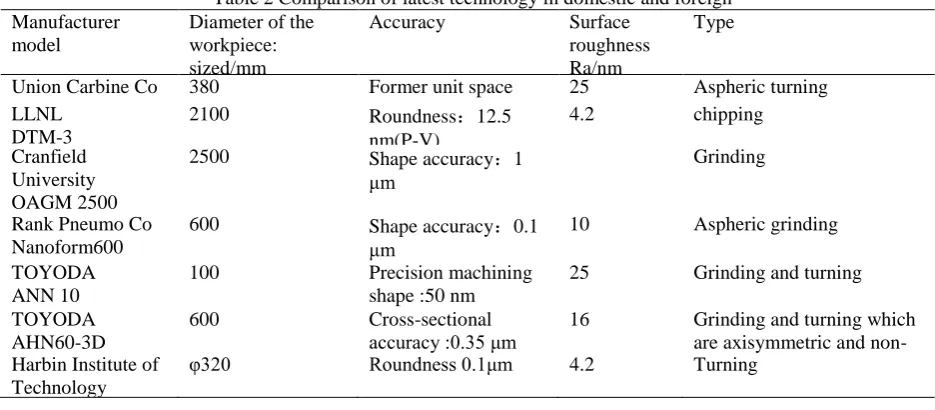
Each country invests a lot of manpower and material resources after realized the importance of ultra-precision machine tool. At present, the ultra- ultra-precision machine tool has reached a very high level. There are some typical and representative ultra-precision machine tools which come from foreign and HCM-1 machine tool development by Harbin Industrial University for comparison. The results are shown in Table 2.
Table 2 Comparison of latest technology in domestic and foreign Manufacturer
model
Diameter of the workpiece: sized/mm
Accuracy Surface
roughness Ra/nm
Type
Union Carbine Co 1 lathe
380 Former unit space
shape accuracy: ±0.63 μm
25 Aspheric turning
LLNL DTM-3
2100 Roundness:12.5
nm(P-V)
Flatness:12.5 nm(P-V);
Shape accuracy: 27.9 nm
4.2 chipping
Cranfield University OAGM 2500
2500 Shape accuracy:1
μm
Grinding
Rank Pneumo Co Nanoform600
600 Shape accuracy:0.1
μm
10 Aspheric grinding
TOYODA ANN 10
100 Precision machining
shape :50 nm
25 Grinding and turning
TOYODA AHN60-3D
600 Cross-sectional
accuracy :0.35 μm
16 Grinding and turning which
are axisymmetric and non-axisymmetric
Harbin Institute of Technology HCM-1
φ320 Roundness 0.1μm 4.2 Turning
III.
T
HE KEY TECHNOLOGY OF ULTRA-
PRECISION MACHINE TOOLSThere are many factors affect the accuracy of ultra-precision machine tool. In order to ensure its accuracy, ultra-precision machine tool should be made some special design. It introduced by hardware and software, the hardware include lathe bed, precision spindle, linear guide and ultra-precision feed driven system etc.; and the software include CNC etc..
3.1 Lathe Bed
basis for machine tool applications. Tong Ji University and the Beijing machine tool cooperation, developed China's first man-made stone precision cylindrical grinding machines [12-13].
3.2 The precision spindle unit
Precise spindle unit is the core of ultra-precision machine which can ensure accuracy. It needs a very high rotary precision spindle, turn smooth, vibration-free, and the key is precise bearings. Currently, the rolling bearing was rarely used in the ultra-precision machine tool, and most using aerostatic bearing. The biggest advantage is high rotation accuracy, which can up to 0.05~0.025μm. In order to improve the dynamic stiffness, few ultra-precision machine tools also use hydrostatic bearings. In the design of ultra precision air-bearing shafts, in order to improve the bearing capacity of floating shaft, the key criteria’s of design are static and dynamic rigidity and damping are. Kugler in Germany has developed a dome air bearing spindle with the stiffness as high as 350N/μm. Domestic air bearings mostly adopt orifice, but foreign countries use porous material in air bearing, such as Germany, University of Munich uses a micro copper ball-sintered porous materials to manufacture air flotation cushion.
3.3 Linear Guide
For ultra precision machine tool, aerostatic or hydrostatic guide way is generally used, and most of them are flat rail structure. The materials of guide are granite, steel and ceramics and so on. LLNL of US developed LODTM using high pressure hydrostatic guides with straightness error less than 0.025μm/1000mm. Currently the straightness of the rail can reach (0.1~0.2) Mum/250mm. The institute of 303 can also be done by 0.1μm/200mm in domestic. Hit developed sub micro ultra-precision machine tool using a linear air Guide, and the linearity can up to (0.1~0.2) Mum/250mm.
3.4 Ultra-precision feed driven system
In order to obtain a higher accuracy and resolution, the demands for drives of ultra-precision machine tool is very high. It requires characteristics of smooth ultra-low speed, and a good electromagnetic compatibility. Ultra-precision machine tools are driven by precision ball screw. But the install error of the ball screw, bent screw itself, the beat and manufacturing error of the ball and the degree of nut of preloaded will affect the movement precision of guide. Therefore, using the friction drive to instead of the ball screw drive is more common on large ultra-precision machine tools when it has a high accuracy of transmission, and this will, make the rail movement more smoothly, such as, the large ultra-precision machine tool of LODTM is used friction drive. Rank Tailor Hobson Company of United Kingdom developed a Nano-form 600 ultra-precision mirror surface machining machine and the feeding mechanism also used friction drive, It can get 1.25nm resolution and ±0.1μm accuracy in 300mm on the trip. Mizumoto and others, Tottori University of Japan, developed a twist-roller friction device resolution which can reached nanometer-scale degree. National University of Defense technology developed friction drive system consisting of a floating platform and a twist-roller friction driving device. The lead is less than 0.2mm, the motion resolution up to nm level in the range of 250mm, and position accuracy is better than 10nm.
3.5 Numerical control system of ultra-precision machine tool
Many countries have pay more attention to ultra-precision CNC Machine tools and lots of fund has been invested in it. Great achievements in this respect are attained. Moore (LLNL) national laboratory LODTM in United States, the large ultra-precision machine tools, using the precision digital servo control system made ultra-precision position control come true. China also did a lot of research in this area, and for different problems, proposing alternative solutions. For example, through displacement current to control magnetostrictive compensator repairing the error, comparing the amount of errors with error compensation amount, the researchers, coming from Inner Mongolia University of Science and Technology, achieve the feed system error bellow 1μm finally. Overall, they can achieve the error compensation above 90%. It has a good compensation effect.
3.6 Other important technology
IV.
T
HE TREND OF DEVELOPMENT OF ULTRA-
PRECISION MACHINE TOOLAbstractly, the direct of the development of ultra-precision machine tool is basically forward extremalization, intelligentialize, greenization, and service. Extremalization means that the search of machine toward higher precision and higher performance. Intelligentalization means in hardware or software has the function of perception, and performance forecast. greenization meets the needs of trend of modern international, super precision machine of design, usage, maintenance or scrap process of whole life cycle. Society must consider environment factors; service of main is refers to Super Precision machine of all manufacturers on after-sales service to increasingly attention. In particular, the development of ultra-precision machine tool can also be summed up to high precision, high reliability, high efficiency, small size, low cost, low power consumption, and so on.
V.
C
ONCLUSIONThe technology of Ultra-precision machine tool relates to national security and cutting-edge technology, and it is the core technologies of future industrial development. Countries attached great importance to development of ultra-precision machine tool technology. Although China has made great progress especially in terms of main factors of affecting accuracy of ultra-precision machine tool, there is still a big gap compared to developed countries. This paper focuses on the state of the art of precision and ultra-precision machine tool, elaborating the key technology of hardware and software, and prospecting the development trend of ultra-precision machine tool technology. To fully understand these, we can improve our deficiencies in this field.
R
EFERENCES[1] ZHANG Shu, and WEI Hanhua, TAN Huimin, et al. High Precision and Ultra-precision Machine Tool [J]. Aerospace Manufacturing Technology,2012(9) : 40-44.
[2] LI Shengyi . Ultra-precision machining technology achievements of modern national defense [J]. Defense Manufacturing Technology 2009(3) :16-21.
[3] YUAN Julong, ZHANG Feihu, DAI Yifan, et al . Development Research of Science and Technologies in Ultra-precision Machining Field [J]. Journal of mechanical engineering,2010,46 (15): 161-177
[4] LIANG Yingchun, CHEN Guoda, SUN Yazhou, et . Research status andoutlook of ultra-precision machine tool [J]. Journal of Harbin Institute of technology, 2014 , 46 ( 5 ): 28-39
[5] SHORE P,MORANTZ P,LUO X,et al. Big OptiX ultra precision grinding/measuring system [C]//Proc SPIE. Bellingham:The International Society for Optical Engineering,2005:1-8
[6] SHORE P,MORANTZ P,READ R,et al. Design overview of the μ4 Compact 6 axes ultra precision diamond machine centre [C]//10th Internationale Conference and Exhibition on Last Metrology,MachineTool,CMM& Robotic. Buckinghamshire, UK:European Society for Precision Engineering & Nanotechnology,2013
[7] HUO D, CHENG K.. A dynamics-driven approach to the design of precision machine tools for micro-manufacturing and its implementation perspectives [J]. Journal of Engineering Manufacture,2008,221(1):1-13.
[8] HUO D,CHENG K,WARDLE F. Design of a five-axis ultra-precision micro-milling machine-UltraMill. Part1:holistic design approach, design considerations and specifications [J].The International Journal of Advanced Manufacturing Technology ,2010,47(9):867-877.
[9] SHINNO H, YOSHIOK H, TANLGUCHI K. Anewly developed linear motor-driven aerostatic X-Y planar motion table system for nano-machining [J].CIRP Annals-Manufacturing Technology,2011,56(1):369-372.
[10] YU Yongkun.Research and Development on (Key Technologies of) Miniaturized High Accuracy Milling Machine[D].Shang Hai:DongHua University,2008
[11] WEN Xiulan. Ultra precision machining technology and equipment[M].Beijing: Chemical industry press.2006
[12] ZHANG Shun-guo,GUZhiqiang,LONGJian,et al. The Development of Ultra-precision Machining Technology[J]. Mechanical engineer,2006,11:19-22