ISSN (e): 2250-3021, ISSN (p): 2278-8719
Vol. 07, Issue 10 (October. 2017), ||V1|| PP 17-22
Energy Sensitive Energy Alert Hierarchical Protocol for
Clustered Heterogeneous Wireless Sensor Networks
Prachi Tiwari
#1, Dr. Mohit Gangwar
*2#M-Tech ,Bhabha Group of Institute Bhopal,*Principal,Bhabha Group of Institute Bhopal, (M.P.) India
Corresponding Author: Prachi Tiwari
Abstract
: In the current age the major issues in wireless sensors node for Generation is life time which is totally depend on supervision of the energy saving in each sensor Node. The lively research in this field for improving network lifetime with free mode in which is vital of (WSN) wireless sensor networks. Numerous algorithms have been developed but best is only one which is clustering base algorithms were increase lot of significance in increasing the network sensor lifetime of each sensor Nodes. In many studies have tried to increase clustering protocols, and all researchers tried to evade the weakness of randomly clustering of LEACH algorithm. In this research paper a new algorithm Energy Sensitive Energy Alert Hierarchical Protocol” (ESEAHP)is developing with using two different protocols advantage property with removing disadvantage of each node. Where Cluster Head nodes that have the maximum lifetime value in each round. In the more rounds, respectively node which has the peak value has the more chance of become cluster head. In This proposed algorithm, the nodes that have high energy solidity are suitable and yet have a good chance to be selected as a cluster-head. This paper proposed algorithm, in which work will be comparing with five different protocols namely The L-LEACH, DE-LEACH, LEACH-C, LEACH and W-LEACH. This work will be analysis and simulation the algorithm and observations made with all these protocols are presenting overtakes of regarding life time of sensing Nodes.Keywords
: Efficiency and Throughput, IEEE 802.11, unicast and broadcast packet, network, L-LEACH, Quality of Service, W-LEACH, routing protocol, LEACH-C, Energy Sensitive, DE-LEACH.--- --- Date of Submission: 27-09-2017 Date of acceptance: 18-10-2017
--- ---
I.
INTRODUCTION
The most main feature of a routing protocol, in order to be efficient for WSNs, is the energy consumption and the extension of the network’s lifetime. Many routing, power management, and data dissemination protocols have been specifically designed for WSNs where energy awareness is an essential design issue. Routing protocols in WSNs might differ depending on the application and network architecture.
In The sensor nodes non-rechargeable batteries help to run, so along with efficient routing the network should be energy effective with efficient use of the resources and hence this is an important research concern. Improvements in wireless technologies and evolution of low cost sensor nodes have headed to introduction of low power wireless sensor networks. Due to multiple functions and comfort of deployment of the sensor nodes it can be used in various applications such as target tracking, environment monitoring , health care, forest fire detection, inventory control, energy management, surveillance and reconnaissance, and so on [1]. The main responsibility of the sensor nodes in a network is to forward the collected information from the source to the sink for further operations, but the resource boundaries [2], unreliable links between the sensor nodes in combination with the various application demands of different applications make it a difficult task to design an efficient routing algorithm in wireless sensor networks.
In the past few years multi-path routing approach is widely used for different network management drives, such as providing a fault tolerant routing, refining broadcasting reliability, Quality of Service (QoS) and Congestion control support in the wired and wireless networks, but the unique features of the wireless sensor networks and the appearances of the short range radio communications introduce a new trials that should be spoke in designing the multi-path routing protocols.
Global Positioning System (GPS) devices or indirectly through swapping some information regarding to the signal strengths received at each node. Since the localization needs special hardware support and also imposes significant computation overhead, this approach cannot be easily used in resource forced wireless sensor networks. Geographic and Energy-Aware Routing (GEAR) and Geographic Adaptive Fidelity (GAF) can be referred as the geographic routing protocols.
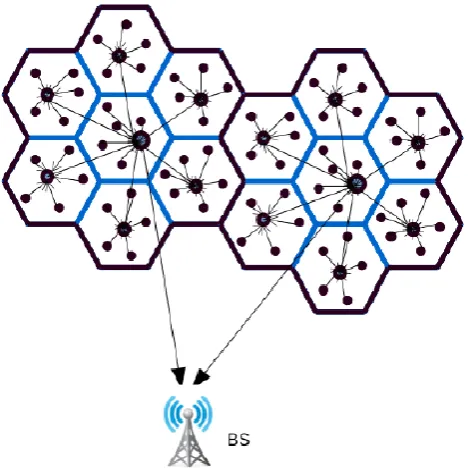
Fig 1. Data packets collected by the cell head are transmitted to the CH. The CH transmits these packets to the
BS.
Multipath Routing in Wireless Sensor Networks The limited capacity and transmission competence of multi hop path and high dynamics of wireless links single path method is not able to provide efficient data rate in broadcast in WSN. To overcome these issues now a day’s multi-path method is used widely. As mentioned before multi-path routing has established its efficiency to improve the performance of wireless sensor and ad-hoc networks.
II.
LITERATURE SURVEY
In This research paper [3] a Wireless sensor network (WSN), sensors are cable to collect the information, sensing, computing, transmitting and receiving data. Communication of the gathered data in the network from the nodes to the base station is a prominent activity and this communication consumes the maximum amount of energy. When there is a constant flow of information from the nodes to the base station in a wireless sensor network, the energy of the nodes gets drained .Lifetime of a network depends on the energy consumed by nodes. To improve the performance of system and to reduce the energy consumption various routing protocols are designed. Many routing protocols such as LEACH, LEACH-E, PEGESISetc are available which improve the lifetime of network. This paper suggested a Multi-hop-Gateway Energy Alert Routing protocol (M-GEAR protocol) for Wireless Sensor Networks (WSN) and also compares the performance of MGEAR protocol with LEACH protocol. Performance analysis and comparison shows that M-GAER is better than LEACH protocol in terms of throughput and energy consumption.
This research paper [4] Energy is one of the important factors in wireless sensor networks. For further usage and to increase the network lifetime, researchers are always looking for ways which tend to reduce energy consumption. Clustering of sensor nodes is one of the best ways that can significantly increase the network lifetime. In this paper, using nodes weighting based on the density and node’s energy that be used I algorithm, a new method is provided. In our method, the effects of weighting in the higher rounds have been decrease higher energy in the higher rounds do get a fair chance to become a cluster MATLAB simulation shows that the proposed method increases the network lifetime compared to W-LEACH and others protocols.
protocols namely, LEACH and EAMMH in Homogenous and Heterogeneous system supported by simulation scripts, and analysis of the results against known metrics with energy and network lifetime being major among them. author show simulation results using MATLAB, that is the proposed EAMMH in Homogenous and Heterogeneous system significantly reduces energy consumption and increases the total lifetime of the wireless sensor network.
In this research paper [6] Advancement in wireless sensor network (WSN) technology has provided the opportunity of small and minor-cost sensor nodes with potential of sensing various provisions of physical and environmental conditions, data processing, and wireless communication. The importance of diversity of sensing effectiveness is in the excess of application areas. However, the originality of wireless sensor networks requires extra effective approach for data forwarding and processing.
In WSN, the sensor nodes have a restricted transmission range, and their refining and storage potential as well as their energy systems are also restricted. Routing protocols for wireless sensor networks are accountable for maintaining the routes in the network and have to create reliable multi-hop communication under certain situations. In this research work, a survey of routing protocols for Wireless Sensor Network and compare their strengths. author also One of the prime design points for a sensor network is maintenance of the energy available in each sensor node. Expanding network lifetime is critical in wireless sensor networks. Many routing algorithms have been established in this regard. Out of all these, clustering algorithms have gained a lot of relevance in increasing the network lifetime thereby the efficiency of the nodes in it. Clustering provides an sufficient way for prolonging the lifetime of a wireless sensor network. In This work author put elaborately compares five renowned routing protocols namely, TEEN, SEP, LEACH and EAMMH, PEGASIS for several general scenarios, and brief analysis of the simulation results against known metrics with energy and network lifetime being major among them.
III.
PROPOSED TECHNIQUE
First explain Energy Alert Hierarchical Protocols where broken up into rounds where each round begins with a set-up phase, when the clusters are planned, tracked by a steady- state phase, when data transfers to the base station occur.
Neighbor Discovery phase:
In this phase every Nodes are broadcasting a control packet contains their Node ID, outstanding energy, location and wait for the neighbor discovery control packets from the Nodes of its range to find the neighbor Nodes. After the neighbor discovery phase each Node finds its neighbor Nodes.
Multi-Path Hierarchical:
After the Neighbor Discovery phase, each Node possesses their neighbor information and then the Energy Alert Hierarchical Protocols Structure phase starts. Here assume that the source Node location is known to the base and based on the location of the source the base starts the route request process. In this the main concept is that, there are two type of Nodes Leading and Modify. A Node is a Leading Node if it is in the Leading path from source to base else if it is the part of any Modify path then it is the Modify Node. As described in the Algorithm, the Leading Nodes find two paths to the source, the Leading path and the Modify path. The Leading path is built with the best possible neighbor (having the minimum Position Factor (PF)) and the Modify path is constructed with the next best neighbor (having the next minimum Position Factor (PF) after the Leading path Node). The Modify Nodes find one single path towards the source Node and searches its neighbor table for the Node with minimum Position Factor (PF) and will prefer a Leading Node if possible, this is done to converge the path else the path can diverge from its direction toward the source, Next hop is chosen by the following equations 1 and 2
𝑁𝐻𝑜𝑝𝑖 = min(𝑃𝐹𝑖) Equation-1
𝑃𝐹𝑖 = (𝑃𝑆𝑐𝑟− 𝑃𝑥)∀𝑥 ∈ 𝑁𝑒𝑔𝑏𝑖) Equation-2
Where, PFi is the set of distance of all the neighbors of Nodei from the source. Pscr is the location of the source
Node, Px is the location of the Nodex and Negbi is the neighbor set of Nodei. Here it is an incremental approach
from the base to the source. First the Base Node which is itself a Leading Node, selects two neighbors based on the equation 1.Out of these two neighbor Nodes one with the minimum Position Factor becomes the next Leading Node and the Node with the second minimum Position Factor becomes the Modify Node and with this step we initialize the multipath construction phase.
weight to the optimal probability Popt. This weight must be equal to the initial energy of each Node divided by
the initial energy of the Normal Nodes. Let us define as Pr the weighted election probability for Normal Nodes
and Ps the weighted election probability for the Leading Nodes.
Nearly there are n*(1+α*m) Nodes with energy equal to the initial energy of a Normal Nodes. The weighed probabilities for Normal and Leading Nodes are, respectively:
𝑃𝑟 = 𝑃𝑜𝑝𝑡
1+𝛼 ∗𝑚 +𝑙∗𝜇 Equation -3
𝑃𝑠=
𝑃𝑜𝑝𝑡∗(1+𝛼)
1+𝛼 ∗𝑚 +𝑙∗𝜇 Equation -4
Here replace Popt by the weighted probabilities to obtain the Energy Sensitive that is used to elect the cluster
head in each round.
𝐸𝑟 =
𝑃𝑟
1−𝑃𝑟∗(𝐶𝑟∗ 𝑚𝑜𝑑𝑒 1
𝑃𝑟)
𝑖𝑓 𝑛𝑟 ∈ 𝐾′
𝑜𝑡𝑒𝑟𝑤𝑖𝑠𝑒 0
Equation -5
𝐸𝑠=
𝑃𝑠
1−𝑃𝑠∗(𝐶𝑟∗ 𝑚𝑜𝑑𝑒 𝑃 𝑠1)
𝑖𝑓 𝑛𝑠 ∈ 𝐾′′
𝑜𝑡𝑒𝑟𝑤𝑖𝑠𝑒 0
Equation -6
K′ and K′′ are the set of Normal Nodes and set of Leading Nodes that has not become CHs in the last 1
𝑃𝑠
respectively, so ensuring that the equations 3 and 4 are working for rounds of the epoch, and Es is the Energy
Sensitive applied to a population of n*m Leading Nodes. This guarantees that each Leading Node will become a cluster head (CH) exactly once every 1
𝑃𝑜𝑝𝑡 ∗
1+𝛼∗𝑚
1+𝛼 rounds.
Here in this protocols all Nodes keep on detecting environment nonstop. As parameters from attribute set reaches active Energy Sensitive value, transmitter is turned on and data is transmitted to CH, however this is for the first time when this condition is met.
IV.
SIMULATION AND EXPERIMENTATION
Algorithm set-up phase
Energy Alert Hierarchical Protocols Algorithm-1 Input: Set of n sensor Nodes randomly distributed Output: One Leading and Multiple Modify Paths from Source to Base.
Repeat
if (Node == Base Node) then Find Leading Path(); Find Modify Path(); else if (Node == Leading) then
Find Leading Path(); Find Modify Path(); else if (Node == Modify ) then
Find Leading Path(); end if
until (Node≠ Source)
Function Find Leading Path() if (Node == Leading) then
Broadcast LEADING; Search for the best Node; Node ← Leading; end if
if (Node == Modify ) then Broadcast MODIFY ;
if (Node ≠ Leading) then Node ← Modify ; end if
end if end Function
Function Find Modify Path() if Node == Leading then
Search for the next best path Node accept Leading; if ((Node ≠ Leading) && (Node ≠ Modify )) then
Node ← Modify ; end if
end if
if (Node == Modify ) then Exit();
end if end Function
Algorithm steady- state phase
Energy Sensitive Energy Alert Hierarchical Protocol Base Cluster Head (CH) Selection Algorithm-2 Input: Set of n sensor Nodes, Energy Sensitive Energy Alert Hierarchical
Output: Node Generated Identified Value and Cluster Head (CH)
Run Algorithm 1 for Energy Sensitive Energy Alert Hierarchical Protocols Algorithm-1 and 2
Find Neighbor Discovery
Calculate Optimal Probability of Nodes Popt
Make clusters base on energy of Nodes (by equation 3,4), Pr, and Ps
Calculate Energy Sensitive Value (by equation 5, 6) Er, and Es
Every Node Generate value Ngv If Er>= Ngv
Normal Nodes Become CH (K’)
Else if Es>= Ngv Leading Nodes Become CH (K’’)
Else
Re-Calculate NgvUntil Node Energy <=0 End if
Calculate Average no. of CH per Round (Cr) by equation 7
Some of important features are described below:
Nodes keep on detecting nonstop but transmission is not done frequently, so energy consumption is much more less than that of proactive networks. At time of cluster change, values of de-active node, and (A) are transmitted afresh and so, user can decide how often to sense and what parameters to be detected according to the criticality of detected attribute and application.
V.
CONCLUSION
REFERENCE
[1]. O. Shagdar, K. Nakagawa and B. Zhang, “Achieving Per-Flow Fairness in Wireless Ad Hoc Networks”, Elec. Comm. in Japan, Part 1, vol. 89, no. 8, (2006), pp. 37–49.
[2]. Georgios Smaragdakis Ibrahim Matta Azer Bestavros, “SEP: A Stable Election Protocol for clustered heterogeneous wireless sensor networks”, Computer Science Department,Boston University Boston, MA 02215, USA
[3]. Kusum Lata, Kusum Dalal, “Performance Analysis of LEACH and M-GEAR Routing Protocols for WSN”, International Journal of Electronics, Electrical and Computational System, IJEECS, ISSN 2348-117X Volume 6, Issue 6, June 2017
[4]. Farhad Rad, Zahra Moghtaderinasab, and Hamid Parvin, “An Improved W-LEACH Routing Protocol in Wireless Sensor Network” Journal of Advances in Computer Research Quarterly pISSN: 2345-606x eISSN: 2345-6078, Sari Branch, Islamic Azad University, Sari, I.R.Iran (Vol. 8 No 2, Page 41-51, May 2017 www.jacr.iausari.ac.ir
[5]. Shaimaa S. Saleh Amr A. Al-Awamry Mahmoud F. M., “Energy- Efficient Communication Protocol for Wireless Sensor Networks”, International Journal of Engineering Research & Technology (IJERT) ISSN: 2278-0181, IJERTV4IS051108, Vol. 4 Issue 05, May-2015.
[6]. Neha Jain, Manasvi Mannan, “Comparative Performance Analysis Of Teen Sep Leach Eammh And Pegasis Routing Protocols”, International Research Journal of Engineering and Technology (IRJET) e-ISSN: 2395 -0056 Volume: 03 Issue: 01 Jan-2016.