Swift & Novel Algorithm for 2D to 3D
Conversion of HD Image using Energy
Reduction Approach
Anamika Patre Ravi Tiwari
M. Tech Scholar Assistant Professor
Department of Electronics & Communication Engineering Department of Electronics & Communication Engineering Dr. C.V. Raman University Bilaspur, Chattisgarh-India Dr. C.V. Raman University Bilaspur, Chattisgarh-India
Abstract
Video, audio and multimedia offer powerful means of communication. Moving pictures are excellent for showing how things change or how something is done, for establishing a context for information (such as a landscape or a working environment) to make it easier for an audience to relate to what you are saying. Three-dimension (3D) technology increases the visual quality as compared to (2D) technology. In present era every multimedia device needs 3D technology. The depth information needed for the generation of 3D form 2D content. Therefore, conversion of 2D video/image into 3D has become an important issue in emerging 3Dapplication. 2D to 3D conversion is basically based on accurate algorithm. This work presents Swift & Novel algorithm for 2D to 3D Conversion of HD Image/video. This approach will automatically convert 2D content into 3D content. In this work a novel approximate algorithm for 2D to 3D conversion. That algorithm include depth map generation unit and depth image based rendering (DIBR) process.
Keywords: SPAA, DIBR, Gaussian, 2D, 3D, Approximation, HD
________________________________________________________________________________________________________ I. INTRODUCTION
Overview:
WITH the recent advancement in 3-D displays, 3-D content visualization has become very popular in our daily life [1]. Recently, 3-D contents are being used in 3-D photography [2], 3-D broadcasting system [3], 3-D movie [4], etc. In contrast to the traditional 2-D content visualization, 3-D content provides an impressive visual experience and heightens a sense of realism with depth perception of the observed scene. 3D video is getting immense public attention recently because of vivid stereo visual experience over conventional 2D video. There are several methods to produce 3D content, such as active depth sensing, stereo camera recording, and 3Dgraphics rendering using of this approach 3D content is generated.
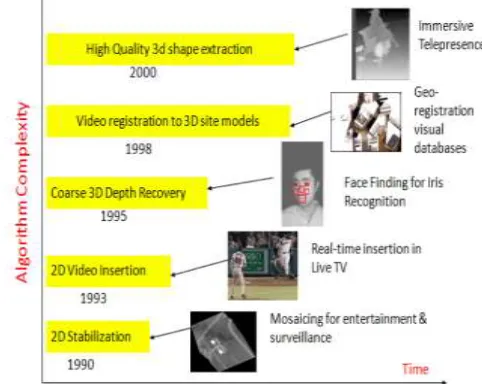
Fig. 1.1: Vision algorithm performance over time
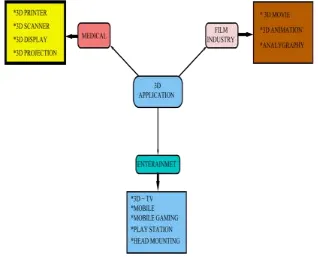
areas which require 2D to 3D conversion like medical, entertainment and lm industry. At present era film industry are mainly using 2D to 3D conversion technique.
Glass Work:
Why 3D glass is needed? 3D image is combination of two image i.e left & right image and by help of 3D glass we can feel 3D effect because these both image are mask with red and blue color and 3D glass project depth on out mind.
2D to 3D conversion is mostly based on accurate algorithm and accurate algorithm is faced with time complexity problem. So for reduction of this problem many researchers are working in this area.
Fig. 1.2.1: How 3D Glass Work
For reduction of time complexity issue we were apply approximation. It is a key for solution of time complexity related problem at algorithm
Fig. 1.2.2: Different area of 3D application
As we know approximation means we can apply some modification on design and based on that design we will get some output and error at particular output is neglect by human eye. Human eye accuracy level is up to 90% to 95% so why we design those logic which give 100% result.
Time complexity- In 2D to 3D conversion method at the algorithm level time complexity is the main issue. Previous approach requires a large time for generation of depth map, left and right view.
Visuality quality - In 2D to 3D conversion process 3D content is generated by 2D content. This conversion process affects the visual quality of generated 3D content.
Virtual depth- In the previous algorithm generated depth map is look like virtual depth.
Need of 2D to 3D conversion-
As we see that 3D technology is uses in much image/video application and at present image/movie are captured in the form of 2D.
If we are using 3D technology for capturing of image/video so it is an expensive process.
In every 3D application, inputs are taken in the form of 2D image/video and by using some conversion technique output is converted into 3D image/video.
Example: This phenomena are mainly using in 3DTV concept because our input image/video are captured in the form of 2D and by satellite we are receiving 2D data, then these 2D data are converted into 3D. With the help of 3D glass we can watch that 3D data.
III. METHODOLOGY
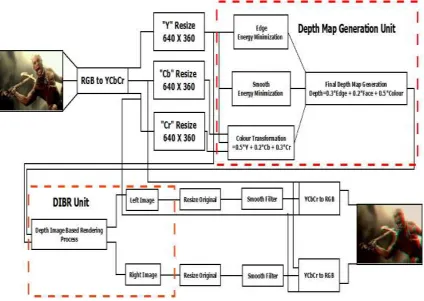
This flow (fig. 3.1a) shows how 2D content is converted into 3D content, so there is first step is find 3rd dimension which is known as Depth. After generation of depth map for 3D view left & right image is generated by depth image based rendering process (DIBR). Generated left and right image have some holes so for reduction of this problem hole Figure 3.1a: Flow of conversion process filling process is required. In a next step filtered left and right view are produced 3D output. This is a conversion process of 2D video/image to 3D video/image. Here 2D to 3D conversion process is based on single frame approach.
2D to 3D Conversion Unit:
Fig. 3.1.a: 2D to 3D Conversion Flow
In this depth map process basically there is three different type of depth is generated those are: Edge Based Depth Map
Smooth Based Depth Map
Fig. 3.1.b: 2D to 3D Conversion
IV. APPLICATIONS
As we know in present era every one need realistic view, and that view is only possible by using of 3D logic. We also know there is lots of approaches are there which will generate 3D image/video. So there is followings application where we are using 2D to 3D Conversion:
1) Medical Image Processing 2) Digital Image Processing 3) Video image Processing 4) Mobile Application 5) 3D TV Technology 6) 3D Printer Technology
V. RESULT & ANALYSIS
In this chapter result & analysis of algorithm is presented. Here at algorithm level subjective analysis is performed on Matlab. Standard image quality parameters are used for image quality measurement.
Algorithm level analysis:
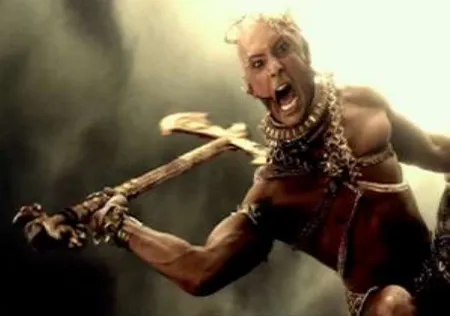
The algorithm 2D to 3D conversion of HD video is implemented by using of matlab and objective analysis is done for test image which is taken from one movie clip.
Test Image:
Fig. 5.1: Test image
Objective Analysis:
The algorithm is implemented on Matlab & subjective analysis on personal computer with Intel quad-core i3 CPU and 3 GB RAM is used to measure processing time test image (1280 X 720).
Here four parameter are taken and according to that results are generated. Memory complexity problem is reducing which results in improvement of 12%. Time complexity problem is reducing which results in improvement of 95%.
Here structural information, structural similarity (SSIM) parameter is used this is a new parameter. this parameter will check structure similarity between main image and reference image and according to that it will give score.
In terms of fast algorithm, approximate approach is applied which results in reduction of memory and time complexity. Table - 5.2
Comparative Subjective Analysis Result
PARAMETER EDGE[21] REAL[16] PROPOSED Memory(MByte) 9.352 8.279 7.201
Time(Sec) 12.88 2.338 0.679 PSNR(db) 18.505 15.57 19.5
VI. CONCLUSION AND FUTURE SCOPE
Algorithm of 2D to 3D conversion is a combination of depth map, DIBR and hole filling. For depth map generation edge detection, Gaussian filter, process is requiring all these parameters are used for image quality measurement. Overall 2D to 3D conversion approach is implemented on the algorithm and architecture level. At algorithm level all analysis is done in matlab. Generated3D content from algorithm is analyzed by subjective and objective analysis. At objective analysis the algorithm achieves reduction in time complexity. It requires 530 msec per frame. Image/video applications require large memory unit so this algorithm reduces the problem of the large memory unit. Approach requires only 7.201Mbyte. The approach achieves 12% reduction in memory complexity as compare edge based [21]. Similar generated 3Dcontent is passed from different image parameters, which results small degradation in image quality.
Algorithm and architecture of fast and approximate processing unit for 2d to 3d conversion for hd video used in 3DTV, movies etc. In future compression techniques can be merged with 2D to 3D technology. Compression techniques are like MPEG, JPEG, H.264 and HEVC etc. Here 2D Gaussian smooth filters and edge detection is also by using of approximation technique, which results reduction in hardware and time complexity. As we know edge detection, smooth filter are very important for many multimedia application. In future we can use, approximate smooth filter, edge detection in different multimedia applications.
VII. REFERENCES
[1] N. Holliman, N. Dodgson, G. Favalora, and L. Pockett, "Three dimensional displays: A review and applications analysis", IEEE Trans. Broadcasting, vol. 57, no. 2, pp. 362,371, Jun. 2011.
[2] Stereo Photography [Online]. Available: http://www.3dphoto.net
[3] C. Fehn, R. Barre, and S. Pastoor, "Interactive 3D-TV: Concepts and key technologies", Proc. IEEE, vol. 94, no. 3, pp. 524a€.538, Mar. 2006. [4] IMAX [Online]. Available: http://en.wikipedia.org/wiki/IMAX
[5] M. Kim, J. Nam, and W. Baek, "The adaptation of 3-D stereoscopic video in MPEG-21 DIA", Signal Proc. Image Commun., vol. 18, no. 8, pp. 685,697, 2003.
[6] Y. Taguchi, T. Koike, and K. Takahashi, TransCAIP: "A live 3DTV system using a camera array and an integral photography display with interactive control of viewing parameters", IEEE Trans. Vis. Comput. Graph., vol. 15, no. 5, pp. 841,852, Sep.a€.Oct. 2009.
[7] A. Woods, T. Docherty, and R. Koch, "Image distortions in stereoscopic video systems", in Proc. SPIE (Stereoscopic Displays Appl.), vol. 1915. 1993, pp. 36,48.
[8] H. Yamanoue, M. Okui, and F. Okano, "Geometrical analysis of puppettheater and cardboard e_ects in stereoscopic HDTV images", IEEE Trans. Circuits Syst. Video Technol., vol. 16, no. 6, pp. 744,752, Jun.2006.
[9] C. Fehn, "A 3D-TV system based on video-plus-depth information", in Proc. Asilomar Conf. Signals Syst. Comput., vol. 2. 2003, pp.1529,1533.
[10] L. Zhang and W. Tam, "Stereoscopic image generation based on depth images for 3D-TV", IEEE Trans. Broadcasting, vol. 51, no. 2, pp. 191,199, Jun. 2005. [11] D. Nagahara and S. Takahashi "Mobile robot control based on information of the scanning laser range sensor", in Proc. IEEE Int. Workshop Advanced Motion
Control, Mar. 2010, pp. 258,261.
[12] J. Zhu, L. Wang, R. Yang, and J. Davis, "Fusion of time-of-_Right depth and stereo for high accuracy depth maps", in Proc. IEEE Int. Conf. Comput. Vision Pattern Recognit., Jun. 2008, pp. 1,8.
[13] J. Zhu, L. Wang, J. Gao, and R. Yang, "Spatial-temporal fusion for high accuracy depth maps using dynamic MRFs", IEEE Trans. Pattern Anal. Mach. Intell., vol. 32, no. 5, pp. 899,909, May 2010.
[14] L. Zhang, C. Vazquez, and S. Knorr, "3D-TV content creation: Automatic 2D-to- 3D video conversion", IEEE Trans. Broadcasting, vol. 57, no. 2, pp. 372,383, Jun. 2011.75
[15] Stelmach, L.; Wa James Tam; Meegan, D.; Vincent, A., "Stereo image quality: e_ects of mixed spatio-temporal resolution," Circuits and Systems for Video Technology, IEEE Transactions on , vol.10, no.2, pp.188,193, Mar 2000
[16] Sung-Fang Tsai; Chao-Chung Cheng; Chung-Te Li; Liang-Gee Chen, "A real-time 1080p 2D-to-3D video conversion system," Consumer Electronics (ICCE), 2011 IEEE International Conference on , vol., no., pp.803,804, 9-12 Jan. 2011
[17] Jungwoo Park; Changick Kim; "Extracting focused object from low depth-of-_eld image sequences". Proc. SPIE 6077, Visual Communications and Image Processing 2006, 60771O (January 18, 2006); doi:10.1117/12.642319.
[18] Yi-Min Tsai; Chang, Yu-Lin; Liang-Gee Chen, "Block-based Vanishing Line and Vanishing Point Detection for 3D Scene Reconstruction," Intelligent Signal Processing and Communications, 2006. ISPACS '06. International Symposium on , vol., no., pp.586,589, Dec. 2006
[19] Sebastiano Battiato ; Salvatore Curti ; Marco La Cascia ; Marcello Tortora ; Emiliano Scordato; "Depth map generation by image classi_cation". Proc. SPIE 5302, Three-Dimensional Image Capture and Applications VI, 95 (April 16, 2004); doi:10.1117/12.526634.
[20] Yong Ju Jung ; Aron Baik ; Jiwon Kim ; Dusik Park; "A novel 2D-to-3D conversion technique based on relative height-depth cue". Proc. SPIE 7237, Stereoscopic Displays and Applications XX, 72371U (February 18, 2009); doi:10.1117/12.806058.
[21] Chao-Chung Cheng; Chung-Te Li; Liang-Gee Chen, "A novel 2Dd-to-3D conversion system using edge information," Consumer Electronics, IEEE Transactions on , vol.56, no.3, pp.1739,1745, Aug. 2010 doi: 10.1109/TCE.2010.5606320.
[22] H. Murata et al.: "Conversion of Two-Dimensional Images to Three dimensions", SID Digest of Technical Papers, vol. 26, pp859-862 (1995) [2] T. Okino et al.: a€.New Television
[23] Yukinori Matsumoto ; Hajime Terasaki ; Kazuhide Sugimoto ; Tsutomu Arakawa; "Conversion system of monocular image sequence to stereo using motion parallax". Proc. SPIE 3012, Stereoscopic Displays and Virtual Reality Systems IV, 108 (May 15, 1997); doi:10.1117/12.274446.
[24] Chan-Hee Han; Si-Woong Lee; Hyun-Soo Kang, "Low-complexity depth map generation for real-time 2D-to-3D video conversion," Consumer Electronics (ICCE), 2013 IEEE International Conference on , vol., no., pp.185,186, Jan. 2013
[25] Wan-Yu Chen; Chang, Yu-Lin; Shyh-Feng Lin; Li-Fu Ding; Liang-Gee Chen, "E_- cient Depth Image Based Rendering with Edge Dependent Depth Filter and Interpolation," Multimedia and Expo, 2005. ICME 2005. IEEE International Conference on , vol., no., pp.1314,1317, July 2005n
[29] Lin Zhang; Zhang, D.; Xuanqin Mou, "RFSIM: A feature based image quality assessment metric using Riesz transforms," Image Processing (ICIP), 2010 17th IEEE International Conference on , vol., no., pp.321,324, 26-29 Sept. 2010
[30] Lin Zhang; Zhang, D.; Xuanqin Mou; Zhang, D., "FSIM: A Feature Similarity Index for Image Quality Assessment," Image Processing, IEEE Transactions on , vol.20, no.8, pp.2378,2386, Aug. 2011
[31] Xue, W.; Zhang, L.; Mou, X.; Bovik, A., "Gradient Magnitude Similarity Deviation: A Highly E_cient Perceptual Image Quality Index," Image Processing, IEEE Transactions on , vol.PP, no.99, pp.1,1
[32] Rec. ITU-R BT.601-5, Studio Encoding Parameters of Digital Television for Standard 4:3 and Wide-screen 16:9 Aspect Ratios, (1982-1986-1990-1992-1994-1995), Section 3.5.
[33] Khorbotly, S.; Hassan, F., "A modi_ed approximation of 2D Gaussian smoothing_lters for _xed-point platforms," System Theory (SSST), 2011 IEEE 43rd Southeastern Symposium on , vol., no., pp.151,159, 14-16 March 2011
[34] Osman, Z.E.M.; Hussin, F.A.; Ali, N.B.Z., "Optimization of Processor Architecture for Image Edge Detection Filter," Computer Modelling and Simulation (UKSim), 2010 12th International Conference on, vol., no., pp.648,652, 24-26 March 2010.
[35] Fehn, Christoph. "A 3D-TV approach using depth-image-based rendering (DIBR)." Proc. of VIIP. Vol. 3. 2003.