A MEASUR and RUP Combined Business
Modeling Method
Hui Du
Beijing Philosophy and Social Science Research Center for Beijing Transportation Development, School of Economics and Management, Beijing Jiaotong University, Beijing, China
Email: [email protected]
Weiting Yu
School of Economics and Management, Beijing Jiaotong University, Beijing, China Email: [email protected]
Abstract—Business modeling is a primary task in the information systems development lifecycle. Although both MEASUR (Methods for Eliciting, Analyzing and Specifying User’s Requirement) and RUP (Rational Unified Process) provide their own Business Modeling Method (BMM), each has obvious merits and demerits. To keep the merits and avoid the demerits at the same time, in this paper, a MEASUR and RUP combined BMM is devised based on the comparison of the two BMMs respectively from the semantics, pragmatics and social world of the semiotic framework. The method proposed consists of three activities in sequence. Unified Modeling Language (UML) Use Case Diagrams (UCD) are employed in the first activity “UML UCD Modeling” to model business functions concerning with the social world since they are the only formal result modeling business functions in both BMMs. The extended UML Activity Diagrams (AD) are employed in the second activity “Extended UML AD Modeling” to model both norms and communications concerning with both the social world and the pragmatics since UML AD can model communications directly and obviously but norms cannot and therefore make the analysis of purposes in communications much easier. In addition, it is easy to extend UML AD with the deontic operators to express the same meaning as norms following the simple rules. The Ontology Charts (OC) are employed in the third activity “OC Modeling” to define meanings of terminology used in business models and concerning with the semantics since ontological dependencies are modeled directly and clearly in OC but not defined in UML Class Diagrams.
Index Terms—MEASUR, RUP, UML, business modeling, semiotic framework, information systems
I. INTRODUCTION
It has been widely accepted by current Information Systems (IS) researchers that IS are social-technological systems. That is to say, to develop an information system successfully, first of all, developers have to fully
understand the business in which the information system works. Therefore, business modeling has been a primary task in the IS development lifecycle.
As two kinds of IS development methods, although both MEASUR (Methods for Eliciting, Analyzing and Specifying User’s Requirement) and RUP (Rational Unified Process) provide their own Business Modeling Method (BMM), each has obvious merits and demerits. In order to keep the merits and avoid the demerits at the same time, some researchers have correlated the two BMMs. In [1], Zhiwu Xie et al. pointed out that Ontological Dependencies (OD) in Ontology Charts (OC) derived from MEASUR can be modeled as either nested classes or inheritances in Unified Modeling Language (UML) Class Diagrams (CD) and agents’ norms derived from MEASUR for actions on business terms can be modeled in UML Activity Diagrams (AD). In [2-3], continuing the effort in [1], Rodrigo Bonacin and Yasser Ades et al. provided rules for transferring OC into UML CD respectively. However, until now, no research has been done to compare the two BMMs respectively from the semantics, pragmatics and social world of the semiotic framework and devise a MEASUR and RUP combined BMM, which keeps the merits and avoids the demerits of the two BMMs at the same time.
This paper is organized as follows: in section 2, both the semiotic framework and the two BMMs are introduced. In section 3, the comparison of the two BMMs are presented. In section 4, the MEASUR and RUP combined BMM is devised. Finally, in section 5, conclusions are provieded.
II. THEORETICAL AND METHODOLOGICAL BACKGROUND
A. The Semiotic Framework
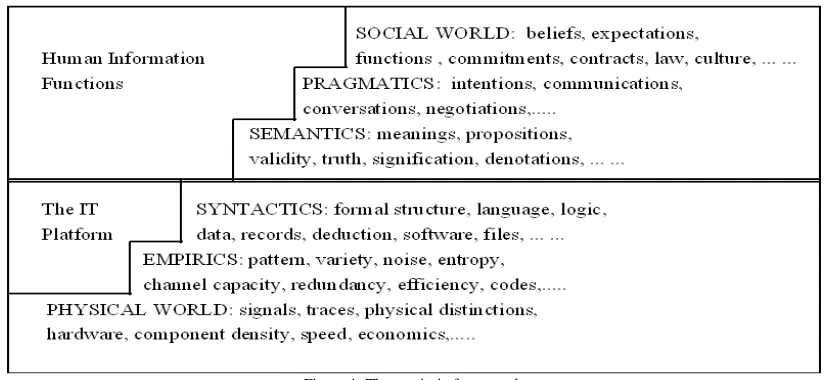
Figure 1. The semiotic framework
Semantics or Meaning of a sign is normally considered as a relationship between a sign and what it refers to. This is referential meaning and a logic function mapping words to reality. But in most social affairs, meaning is more appropriately seen as relationship between a sign and the response the sign elicits in a given social setting. This is what Stamper calls the behavior meaning. At the semantic level of use of language, what is firstly reflected in a sentence is the meaning which is accommodated by propositions. The sentence can be examined for its validity, signification and correspondence to the business world.[4]
When a sign has a meaning, it can be used intentionally for communications, conversations and negotiations. Pragmatics, in such a case of the purposeful use of signs, is a branch of semiotics concerned with the relationship between an intentional use of a sign and the resulting behavior of responsible agents in a social context. In a process of verbal communication, the purpose of the conversation is set up by the speaker and the speaker can conduct a series of speech acts to pursue the purpose which may be clearly stated by her/him or hidden.[4][5][6]
When a conversation takes place between two or more people, a change at social level will be caused. A conversation can be seen as a proper chain of speech acts. As soon as a speech act is addressed to the addressee, an obligation is usually built up for the addressee to respond. Otherwise, the addressee might not feel at ease. In a social setting, norms including beliefs, expectations, commitments, contracts, law and culture govern people’s behaviors and determine whether they are acceptable. In addition, if a technical information system is to serve the organization well, it is crucial to understand the organizational functions at the social level.[4]
B. The BMM provided by MEASUR
Proposed in the later 1970s, MEASUR is a radically set of norm oriented methods for IS development. To
model business, MEASUR provides two primary methods: Semantic Analysis Method (SAM) and Norm Analysis Method (NAM).[4][7][8]
OC are final result of SAM. Fundamental concepts employed by OC include agent, affordance, ontological dependency, determiner, role, generic-specific and whole-part.
An agent can be as simple as an individual person and complex as a cultural group, language community or society. An affordance is a behavior an agent can perform in its environment. OD are used to indicate that some agents or affordances (Dependants) can be possible only if certain other agents or affordances (Antecedents) are available. Properties of agents and affordances are labeled as determiners. When an agent is involved in a behavior, it may have a role to play. The generics represent patterns of behavior or mechanisms, whose particular realizations or instances are the specifics. A composite agent or affordance (the whole) can be partitioned into several parts (the part).
When modeling an ontology chart, a society is normally defined as the root agent, on which other agents and affordances are ontologically depended. Agents are placed in ovals. Affordances are put in rectangular boxes. Lines between agents and affordances indicate OD. Antecedents are placed on the left of dependants. Determiners are placed behind “#”. Role names are put in half-curves. The specific are placed under the generic. A line with a dot indicates the whole-part relationship. For example, figure 2 shows the ontological chart illustrating a project management business as follows:
Figure 2. The OC describing a project management business
Norms are final result of NAM. Wright explains the concept of a norm in this way: “‘Norm’ has several partial synonyms which are good English. ‘Pattern’, ‘standard’ and ‘type’ are such words. So are ‘regulation’, ‘rule’ and ‘law’”[9]. Norms are developed through the practical experiences of people in a culture and in turn have functions of directing, coordinating and controlling actions within the culture. In business, most rules and regulations fall into the category of behavioral norms. These norms prescribe what people must, may and must not do, which are equivalent to three deontic operators ‘permitted’, ‘prohibited’ and ‘obliged’. The following format is suitable for specification of behavioral norms:[4][7][8]
whenever<condition> if<state>
then<an agent>
is<“permitted”/“prohibited”/“obliged”> to do<action>
Following the format, a credit card company may state a norm governing interest charges as follows:[4]
wheneveran amount of outstanding credit ifmore than 25 days after posting
thenthe card holder isobliged
topay the interest
The norm says that after 25 days of posting the invoice, if there is still an amount of outstanding credit, the card holder will have to pay the interest.
C. The BMM provided by RUP
Proposed in the later 1990s, RUP, an object oriented software engineering process, has been gradually accepted by IS industry and is widely used by current IS developers. In RUP, a good business model consists of two major parts: a business use-case model and a business object model.[10][11][12]
A business use-case model includes UML Use Case Diagrams (UCD) containing business use cases, which describe business processes illustrated as sequences of actions that provide observable value (functions) to business actors. To fully understand the value of a business use case, developers must know whom the
business use case interacts with. Different types of “interactors” are represented as business actors.[10] For example, in figure 3, the business use case “Individual Check-in” interacts with the business actor “Passenger”.
Figure 3. The UML use case diagram
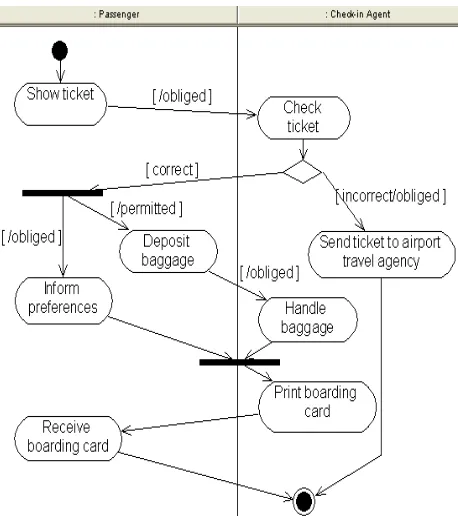
UML AD are recommended to illustrate sequences of actions involved in business use cases in detail. In UML AD, an activity state represents the performance of an activity within the process. A swim lane indicates who performs a given activity. A transition shows what one activity state follows another. A decision with a set of guard conditions are defined to control which transition follows once an activity is complete.[10] For example, figure 4 shows the UML activity diagram illustrating the general sequence of the actions involved in the business use case “Individual Check-in” in detail.
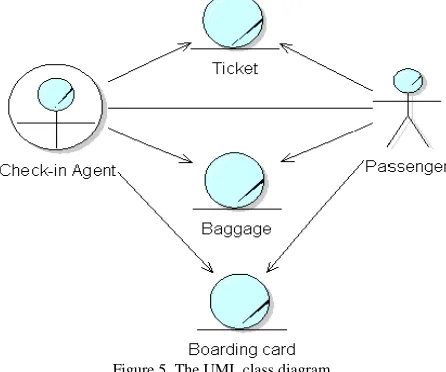
Whereas a business use-case model focuses on sequences of actions involved in business processes, a business object model focuses on business actors, business workers and business entities involved in business processes and their relationships. A business worker represents a role in a business, which interacts with business actors, other business workers and manipulates business entities. A business entity represents a significant and persistent piece of information that is manipulated by business actors and business workers.[10] For example, figure 5 shows the UML class diagram illustrating the business actor “Passenger”, the business worker “Check-in agent” and the business entity “Ticket”, “Baggage” and “Boarding card” involved in the business use case “individual Check-in” and their relationships.
Figure 5. The UML class diagram
To model UML UCD, UML AD and UML Class Diagrams (CD), corresponding methods can be found in [11-12], which are specified in detail.
Ⅲ. COMPARISON OF THE TWOBMMS
Prior to the comparison, the relationship of the two BMMs have to be firstly identified.
According to the previous introduction of OC and UML CD, it is quite apparent that both of them are used mainly to define meanings of terminology used in business models. Therefore, from view of the semiotics framework, both of them concern with the semantics of the framework.
Although purposes in communications are difficult to model by formal means, their underlying mechanisms can be understood by studying social and cultural norms at the social level.[4] Therefore, from view of the semiotics framework, norms are the formal results concerning with both the pragmatics and the social world of the framework. Likewise, purposes in communications are not modeled formally and obviously in UML AD either. However, communications between business actors and business workers are obviously and formally represented in them, which make the analysis of purposes much easier. Moreover, although norms are not
specified in UML AD, business rules,[13] which are similar to norms and generally state that if conditions are met, certain events will happen or actions will be taken, are hidden behind them. For example, following the structure employed in [13], in figure 4, the business rule hidden behind the transition pointing to the activity state “Deposit baggage” can be explicitly expressed as follows:
ifthe ticket iscorrect
thendeposit baggage
To sum up, from view of the semiotics framework, UML AD concern with both the pragmatics and the social world of the framework.
At last, since business use cases provide observable value (functions) to business actors, according to the previous introduction of the social world of the semiotics framework, UML UCD concern with the social world of the framework too.
Table 1 summarizes the relationship of the two BMMs from the semiotic framework view.
TABLE I.
THE RELATIONSHIP OF THE TWOBMMS
MEASUR RUP Formal results Methods used Formal results Methods used The semantics
OC SAM UML CD UML CD
modeling method The
pragmatics
UML AD UML AD
modeling method The social world Norms NAM UML AD and UML UCD
UML AD and
UML UCD
modeling method
Based on table 1, the two BMMs can then be compared. Here, the comparison focus is on the formal results of the two BMMs respectively in semantics, pragmatics and social world of the semiotic framework. The purpose of the comparison is to find obvious merits and demerits each of the formal results has. Table 2 shows the result of the comparison.
TABLE II.
THE RESULT OF THE COMPARISION
Formal results
Obvious merits Obvious demerits
OC Model OD directly and clearly Narrowly used The semantics UML CD
Widely used No OD are defined
Norms Three deontic operators are specified
(i) Purposes are not modeled formally and obviously; (ii) Communications are not modeled directly and obviously;
(iii) Narrowly used The pragmatics UML AD (i) Communications are modeled directly and obviously; (ii) Widely used
Norms Three deontic operators are specified
(i) Cannot model functions;
(ii) Narrowly used The social
world
UML AD and UML UCD
(i) Functions are modeled by UML UCD;
(ii) Widely used
In UML AD, business rules rather than norms are specified indirectly
As shown in table 2, for UML CD, UML AD and UML UCD, it is their obvious merits that they are all widely employed by current IS developers because UML has been approved by the Object Management Organization (OMG) as a standard since 1997. On the contrary, for both OC and norms, it is their obvious demerits that they are employed at present only by a small group of people and no commercial effort has been made to popularize them yet. Moreover, at the semantics level, as an important and indispensable relationship, OD are modeled directly and clearly in OC but not defined in UML CD.[1-3] At the pragmatics level, three deontic operators are specified in norms but not defined in UML AD, which make the presentations of communications and the analysis of purposes in communications more precise. On the other side, UML AD can model communications directly and obviously but norms cannot, which make the analysis of purposes in communications much easier. At last, it is their common demerit that purposes in communications cannot be modeled formally and obviously in both of them. At the social world level, similarly, three deontic operators are specified in norms. However, in UML AD, business rules rather than norms are specified indirectly. As stated in [13]: “with the help of the deontic operators, norms can handle both business rules and exceptions, which are situations difficult to anticipate and specify in advance and are situations, where decisions occur on an ad hoc basis and are made solely on human judgment”. In addition, business functions can be modeled by UML UCD but norms cannot.
Ⅳ. A MEASURANDRUPCOMBINEDBMM As discussed above, since both the two BMMs have obvious merits and demerits, it is supposed that a MEASUR and RUP combined BMM maybe devised in order to keep the merits and avoid the demerits at the same time.
Kecheng Liu states: “To model an information system is to represent, by formal means, an organization in which people use signs for business purposes. A sound modeling method must cover the issues in semantic, pragmatic and social aspects. Issues at the three semiotic levels are closely related. The social concern determines the intentions that the speaker needs to express and thus decide the words and expressions to be uttered.”[4].
Based on the statement above and the previous comparison, a MEASUR and RUP combined BMM is devised and shown in figure 6.
Figure 6. The MEASUR and RUP combined BMM
In figure 6, the formal result of the first activity “UML UCD Modeling” is UML UCD to model functions provided by a business, which concern with the social world. The formal result of the second activity “Extended UML AD Modeling” is extended UML AD to model both norms and communications, which therefore concern with both the social world and the pragmatics at the same time. The formal result of the third activity “OC Modeling” is OC to define meanings of terminology used in business models, which concern with the semantics.
The reason to choose UML UCD as the formal result of the first activity is that they are the only formal result modeling business functions as shown in table 2. Since the BMM provided by RUP is widely used by current IS developers, the UML UCD modeling method will not be presented here. People interested in it could find help in [11-12].
As pointed out previously, UML AD can model communications directly and obviously but norms cannot, which make the analysis of purposes in communications much easier. In addition, both UML UCD and UML AD are business models employed by the BMM provided by RUP, which has the similar modeling activities and sequence as the devised BMM and is much widely used than the BMM provided by MEASUR. At last, although business rules rather than norms are specified indirectly in UML AD, it is easy to extend UML AD with the deontic operators to express the same meanings as norms following the simple rules specified below:
Firstly, each transition pointing to an activity state should be extended with one of the three deontic operators.
Secondly, when the “permitted” or the “prohibited” is used, the text “permitted” or the text “prohibited” must appear at the end of the guard condition and separated with the guard condition by “/”.
Thirdly, when the “obliged” is used, the text “obliged” can be omitted. Otherwise, it should appear at the same place as the text “permitted” and the text “prohibited”.
Figure 7. The UML activity diagram extended
As shown in figure 7, all transitions pointing to an activity state have been extended with the “obliged” or the “permitted” except the two transitions pointing to the activities “Print boarding card” and “Receive boarding card” respectively. In fact, the two transitions are both extended with the “obliged”. However, according to the third rule, the text “obliged” has been omitted.
Moreover, following the format for specification of behavioral norms previously introduced, the norm hidden behind the transition pointing to the activity state “Inform preferences” can be explicitly expressed as follows:
wheneveran ticket has been checked ifthe ticket is correct
thenthe passenger isobliged
toinform preferences
In addition, the norm hidden behind the transition pointing to the activity state “Deposit baggage” can be explicitly expressed as follows:
wheneveran ticket has been checked ifthe ticket is correct
thenthe passenger ispermitted todeposit baggage
Furthermore, the usages of the “obliged” and the “permitted” respectively in two norms also validate the statement previously cited that: “with the help of the deontic operators, norms can handle both business rules and exceptions.”[13] Here, the first norm handles a
business rule, which can also be handled by UML AD without the “obliged” extension. However, the second norm handles an exception, which cannot be handled by UML AD without the “permitted” extension.
Because of the same reason as UML UCD, the UML AD modeling method will not be presented here. People interested in it could also find help in [11-12].
For the sakes above, the extended UML AD are chosen as the formal result of the second activity.
As shown in table 2, OD are modeled directly and clearly in OC but not defined in UML CD. Although efforts have been devoted into transferring OC into UML CD,[1-3]no simple and mature method has been proposed. In all of the efforts, the transformation of OD has always been the most difficult issue. Therefore, although OC are narrowly used, in order to keep the precise and completeness of business models at the semantics level, OC are chosen as the formal result of the third activity.
Reference [4] provides a detailed description of SAM, which includes four primary phases to produce OC. The first phase “problem definition” is for people involved to receive written documents to understand the business problem. The next phase, “candidate affordance generation”, is to produce a list of vocabulary of semantic units that may possibly be used in OC to describe agents and their patterns of behavior. In the following phase “candidate grouping”, the semantic units are categorized as agents, affordances, determiners, role names, and so on. Dependants are connected to their antecedents. Sketches of piecemeal ontological structures are conceived. Finally, there is “ontology charting”, where a complete ontology chart is produced by assembling the ontological structures.[4]
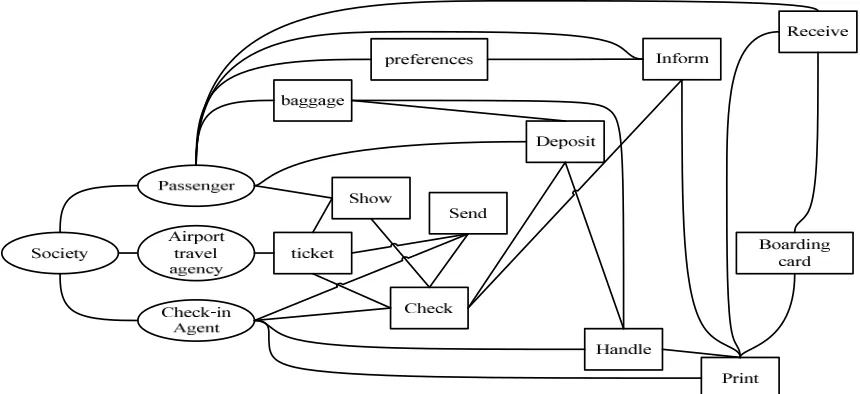
Following SAM to complete the third activity “OC Modeling”, extended UML AD derived from the second activity “Extended UML AD Modeling” should be taken as additional written documents in the first phase “problem definition”. In the second phase “candidate affordance generation”, nouns and verbs used to name swim lanes and activity states of the extended UML AD could be considered as semantic units. In the third phase “candidate grouping”, nouns used to name swim lanes could be categorized as agents. Nouns and verbs used to name activity states could be categorized as affordances. At last, the performance sequence of activity states could be used to determine OD.
Figure 8. The ontology chart derived
As shown in figure 8, “Passenger” and “Check-in Agent” as the names of the two swim lanes respectively are categorized as agents. Except “airport travel agency”, which is more appropriate to be categorized as an agent according to the previous definition of agent, all nouns and verbs used to name the activity states, such as “Show”, “ticket” and “Check” etc., are categorized as affordances. At last, all the OD are consistent with the performance sequence of the activity states, such as the one between the affordance “Show” and the affordance “Check”, which illustrates that the behavior “Check” can occur only if the behavior “Show” has occurred.
Ⅴ. CONCLUSIONS
Business modeling is a primary task in the IS development lifecycle. Although both MEASUR and RUP provide their own BMM, each has obvious merits and demerits. To keep the merits and avoid the demerits at the same time, in this paper, a MEASUR and RUP combined BMM is devised based on the comparison of the two BMMs respectively from the semantics, pragmatics and social world of the semiotic framework.
Just like any BMMs, the BMM devised in this paper has also demerits. Firstly, as the same with both norms and UML AD, purposes in communications are not modeled formally and obviously in the extended UML AD either. Secondly, since SAM is currently used by only a small group of IS developers, other IS developers have to study SAM before they adopt the BMM devised. At last, to validate the BMM devised, more practices are absolutely indispensable.
ACKNOWLEDGMENT
This work was sponsored by the Beijing Philosophy and Social Science Research Center for Beijing
Transportation Development and the Scientific Research Foundation for the Returned Overseas Chinese Scholars, State Education Ministry.
REFERENCES
[1] Z. Xie, K. Liu, and D. Emmitt, “Improving Business Modelling with Organisational Semiotics,” In Dynamics and Change in Organizations - Studies in Organizational Semiotics, H. W. M. Gazendam, R. J. Jorna, and R. S. Cijsonw, Eds. Kluwer Academic Publishers, 2003, pp. 85-102.
[2] R. Bonacin, M. C. Baranauskas, and K. Liu, “From Ontology Charts to Class Diagrams: Semantic Analysis Aiding Systems Design,” In Proceedings of the 6th International Conference on Enterprise Information Systems, Inst. for Syst. and Technol. of Inf., Control and Commun. (INSTICC), 2004, pp. 389-395.
[3] Y. Ades, I. Poernomo, and G. Tsaramirsis, “Mapping Ontology Charts to UML: an SNF Preserving Transformation,” InProceedings of the 10th International Conference on Organisational Semiotics, 2007, pp. 33-39. [4] K. Liu, Semiotics in Information Systems Engineering,
Cambridge: Cambridge University Press, 2000.
[5] R. Hou, “On Theories on Speech Act,” Journal of Chongqing Institute of Technology, vol. 21, no. 1, pp. 44-46, January 2007.
[6] Y. Rui, “Philosophical Reflection on Illocutionary Acts,” Journal of Northeastern University (Social Science), vol. 12, no. 1, pp. 75-78, January 2010.
[7] R. Stamper, K. Liu, M. Hafkamp, and Y. Ades, “Understanding the Roles of Signs and Norms in Organisations,” Journal of Behaviour & Information Technology, vol. 19(1), pp. 15-27, 2000.
[8] R. Stamper and K. Liu, “Organisational Dynamics, Social Norms and Information Systems,” InProceedings of the Twenty-Seventh Annual Hawaii International Conference on System Sciences, 1994, pp. 645-654.
[9] G. Wright,Norms and Action - a Logical Enquiry, New York: Routledge and Kegan Paul, 1963.
[10] J. Heumann, “Introduction to business modeling using the Unified Modeling Language,” http://www.ibm.com/developerworks/rational/library/360. html, accessed 11/08/2010.
[11] P. Kruchten, The Rational Unified Process: An introduction, 3rd ed., Addison Wesley, 2003.
[13] K. Liu and T. Ong, “A Modelling Approach for Handling Business Rules and Exceptions,”The Computer Journal, vol. 42, pp. 221-231, March 1999.
Hui DuHami, China, November 12th, 1975
Ph.D. in Information Systems, School of Management and Economics, Beijing Institute of Technology, Beijing, China, 2004
M.S. in Information Systems, School of Management and Economics, Beijing Institute of Technology, Beijing, China, 2001
B.S. in Information Systems, School of Management and Economics, Beijing Institute of Technology, Beijing, China, 1998
He has been a lecturer in Department of Information Management, School of Economics and Management, Beijing Jiaotong University since 2004. From 2007.2 to 2008.4, he did
postdoctoral research in the Informatics Research Center, University of Reading, UK. From 2002.4 to 2002.10, he did research as a visiting scholar in the Applied Computer Institute, Techniche Universitaet Berlin, Berlin, Germany. Until now, he has published nine papers in conference proceedings and journals as the first author and four books as the chief editor. His major field of study includes information systems engineering, petri nets simulation and organizational semiotics.
Weiting YuHohhot, China, October 12th, 1987
B.S. in Information Systems, School of Economics and Management, Beijing Jiaotong University, Beijing, China, 2010