C based Complex Event Processing Technique
using ADS algorithm
S. Palaniyappan I. Ilayaranimangammal
Assistant Professor Radio Jockey
Department of Electrical & Electronics Engineering Madurai FM Rainbow 103.3Mhz Dhanalakshmi Srinivasan Institute of Research &Technology
Tamil Nadu, India
All India Radio, Tamil Nadu, India
S. Anbuselvan
Department of Mechanical Engineering
M.A.R College of Engineering and Technology, Tamil Nadu, India
Abstract
This paper is proposed, an efficient complex event-processing framework, designed to process a large number of sequential events on field-programmable gate arrays (FPGAs). Unlike conventional structured query language based approaches, our approach features logic automation constructed with a new C-based event language that supports regular expressions on the basis of C functions, so that a wide variety of event-processing applications can be efficiently mapped to FPGAs. Evaluations on an FPGA-based network interface card show that we can achieve 12.3 times better event-processing performance than does a CPU software in a financial trading application. Advanced Encryption Standard algorithm was introduced to resist classical methods of cryptanalysis (i.e.) from linear or differential attacks. The cryptographic strength of the AES depends strongly on the choice of S-box. The result shows that the new nonlinear implementation of the AES S-Box by using C-Based Complex Event Processing provides enhanced security with good enough speed for encryption and decryption. Keywords: Event Processing, Advanced Encryption Standard algorithm, SQL, S-Box, Complex C
________________________________________________________________________________________________________
I.
INTRODUCTION
Complex event patterns involving Kleene closure are finding application in a variety of stream environments for tracking and monitoring purposes. In this paper, we propose a compact language, SASE+, that can be used to define a wide variety of Kleene closure patterns, analyze the expressive power of the language, and outline an automata-based implementation for efficient Kleene closure evaluation over event streams [1]. The need of finding patterns in a sequence of rows. We see this often in Com-plex Event Processing where business processes are driven from sequence of events, in Security applications where detection of unusual behavior definable with regular expressions is needed, in Financial applications where detecting stock patterns is critical, Fraud Detection applications, and for RFID processing where tracking of valid paths for RFID tags is needed. In the latter case, a win-dow size is defined using a pattern, and then standard processing on the window of rows can take place[2].Complex event detection is an advanced form of data stream processing where the stream(s) are scrutinized to identify given event patterns. To solve this problem, in this paper we present a hardware based complex event detection system\ implemented on field-programmable gate arrays (FPGAs). This is a significant improvement over CPU based systems and an architectural approach that opens up interesting opportunities for hybrid stream engines that combine the edibility of the CPU with the parallelism and processing power of FPGAs[5].An approach to the automatic generation of efficient Field Programmable Gate Arrays (FPGAs) circuits for the Regular Expression-based (RegEx) Pattern Matching problems is presented. Implementations of the algorithm for conventional FPGAs and the self-reconfigurable Gate Array (SRGA) are described. To evaluate performance, the NFA logic was mapped onto the Virtex XCV100 FPGA and the SRGA. Also, the performance of GNU grep for matching regular expressions was evaluated on an 800 MHz Pentium III machine. [8].
II.
COMPLEX EVENT PROCESSING
value. Analysts suggest that CEP will give organizations a new way to analyze patterns in real-time, and help the business side communicate better with IT and service departments. 7890The vast amount of information available about events is sometimes referred to as the event cloud.
Types: A.
Most CEP solutions and concepts can be classified into two main categories:
Aggregation-oriented CEP 1)
Detection-oriented CEP 2)
Aggregation-oriented CEPs
An aggregation-oriented CEP solution is focused on executing on-line algorithms as a response to event data entering the system. A simple example is to continuously calculate an average based in data on the inbound events.
Detection-oriented CEPs
Detection-oriented CEP is focused on detecting combinations of events called events patterns or situations. A simple example of detecting a situation is to look for a specific sequence of events. Currently many application use hybrid of the two approaches, and security monitoring.
III.
ADVANCED ENCRYPTION STANDARDS (AES)
The Advanced Encryption Standard (AES) is a specification for the encryption of electronic data established by the U.S. National Institute of Standards and Technology (NIST) in 2001. It is based on the Rijndael cipher developed by two Belgian cryptographers, Joan Daemen and Vincent Rjimen, submitted a proposal to NIST during the AES selection process. Rijndael is a family of ciphers with different key and block sizes. For AES, NIST selected three members of the Rijndael family, each with a block size of 128 bits, but three different key lengths 128, 192 and 256 bits. AES has been adopted by the U.S. government and is now used worldwide.
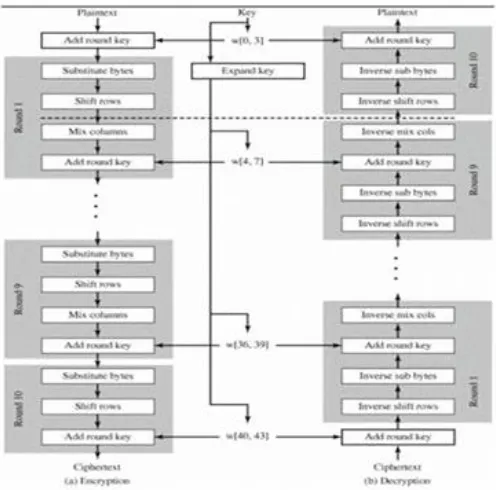
Block Diagram of Aes Algorithm: A.
Fig. 1: Block Diagram of AES Algorithm
Transformation: B.
Sub Bytes Transformation: 1)
Fig. 2: Sub Bytes Transformation
In the SubBytes step, each byte in the state is replaced with its entry in a fixed 8-bit lookup table, S; bij = S(aij). In the SubBytes step, each byte in the state matrix is replaced with a Sub Byte using an 8-bit substitution box, the Rijndael S-box. The S-box is also chosen to avoid any fixed points (and so is a derangement), and also any opposite fixed points.
Mix Columns Transformation: 2)
Each byte of a column IS mapped into a new value that is a function of all four bytes in that column.
Fig. 3: Mix Columns Transformation
In the Mix Columns step, each column of the state is multiplied with a fixed polynomial c(x)
In the Mix Columns step, the four bytes of each column of the state are combined using an invertible linear transformation. The Mix Columns function takes four bytes as input and outputs four bytes, where each input byte affects all four output bytes. Together with Shift Rows, Mix Columns provides diffusion in the cipher. During this operation, each column is multiplied by the known matrix that for the 128-bit key
The multiplication operation is defined as: multiplication by 1 means no change, multiplication by 2 means shifting to the left, and multiplication by 3 means shifting to the left and then performing XOR with the initial unshifted value. After shifting, a conditional XORwith 0x1B should be performed if the shifted value is larger than 0xFF.
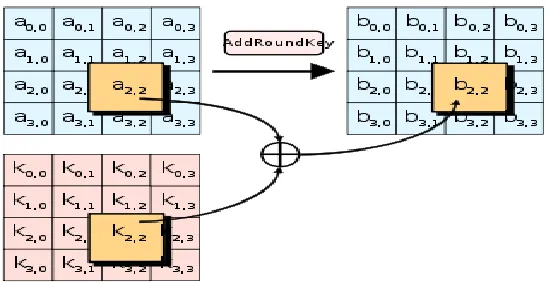
The 128 bits of State are bitwise XOR ed with the 128 bits of the of the round key.
In the Add Round Key step, each byte of the state is combined with a byte of the round sub key using the XOR operation.In the Add RoundKey step, the sub key is combined with the state. For each round, a sub key is derived from the main key using Rijndael's key schedule; each sub key is the same size as the state. The sub key is added by combining each byte of the state with the corresponding byte of the sub key using bitwise XOR.
IV.
RESULTS
Register: A.
Input:I = 00, 01, 10 and 11; Clock = clock pulse;Load = 1; Clear = 0 and 1;Signal: Q_tmp; Output:Q = Q_tmp ; [Q_tmp = I]
Fig. 5
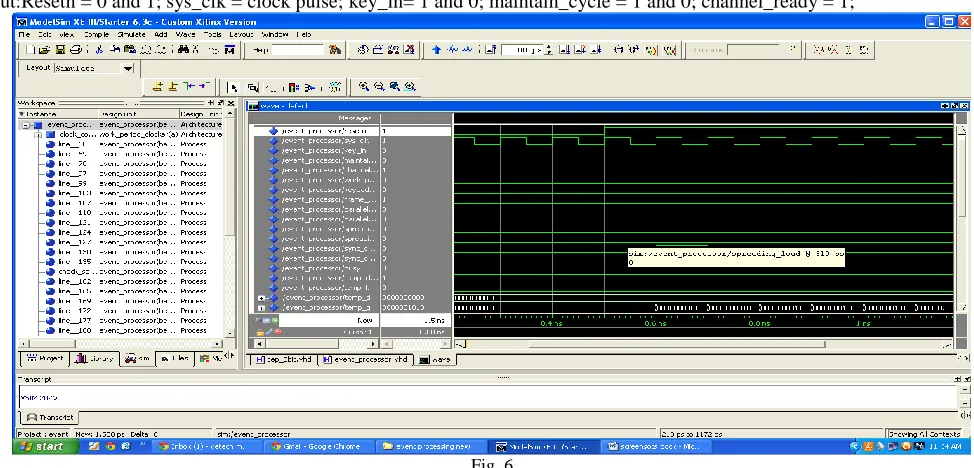
Event_Processor: B.
Input:Resetn = 0 and 1; sys_clk = clock pulse; key_in= 1 and 0; maintain_cycle = 1 and 0; channel_ready = 1;
Cep_8bit: C.
cep_rca_8_1:
Input: clock_config_c = 1; clock_main_c = clock pulse; i1 = 0 ,1; i2 = 00000000 to 11111111; i3 = 000000000000000000 to 111111111111111111; i4 = 00000000 to 11111111; i5 = 00000000 to 11111111; i6 = 00000000 to 11111111; i7 = 00000000 to 11111111;
Output: o1 = 00000000 to 11111111; o2 = 00000000 to 11111111; o3 = 00000000 to 11111111; o4 = 00000000 to 11111111;
Fig. 7
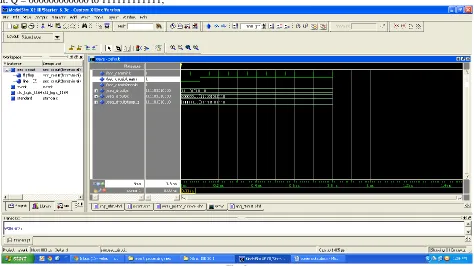
Seq_circuit: D.
Input: Clk = clock pulse; Clearn = 0, 1; Enable = 1; D = 000000000000 to 111111111111; Output: Q = 000000000000 to 111111111111;
V.
CONCLUSION
The requirements for fast CEP will necessitate hardware acceleration that uses reconfigurable devices. Key to the success of our work is logic automation generated with our C-based event language. Advanced Encryption Standard algorithm was introduced to resist classical methods of cryptanalysis (i.e.) from linear or differential attacks. The cryptographic strength of the AES depends strongly on the choice of S-box. The result shows that the new nonlinear implementation of the AES S-Box by using C-Based Complex Event Processing provides enhanced security with good enough speed for encryption and decryption With this language, we have achieved both higher event-processing performance and higher flexibility for application designs than those with SQL-based CEP systems. In a financial trading application, we have, in fact, achieved 12.3 times better event-processing performance on an FPGA-based NIC than does CPU software. In future work, we intend to implement complicated examples that require support for multiple streams.
REFERENCES
[1] D. Gyllstrom, J. Agrawal, Y. Diao, and N. Immerman, (Apr.2008)“ On supporting Kleene closure over event streams,” inProc. IEEE 24th Int.Conf.Data Eng..
[2] M. Cherniak, ,A. Witkowski, and F. Zemke(Mar.2007) “Pattern matching in sequences of rows,” American National Standards Institute, Washington, DC, Tech. Rep. ANSI NCITS H2-2006-nnn.
[3] S. Charkravarthy and Q. Jiang, Stream Data Processing(Apr.2009): A Quality Service Perspective. New York: Springer-Verlag.
[4] P. Bizarro, M. R. Mendes and P. Marques(2009),“A performance study of event processing systems,” inPerformance Evaluation and Benchmark-ing, vol. New York: Springer-Verlag, 2009, pp. 221–236.
[5] L. Woods, J. Teubner, and G. Alonso, “Complex event detection at wire speed with FPGAs,” inProc. Int. Conf. Very Large Data Bases,vol.3. Sep. 2010, pp. 660–669
[6] OPRA. (2011, Jan. 19). Updated Traffic Projections 2011 & 2012,Chicago, IL [Online]. Available:
http://www.opradata.com/specs/upd_traffic_proj_11_12.pdf
[7] L. Woods, J. Teubner, and G. Alonso(Sep.2010), “Complex event detection at wirespeed with FPGAs,” inProc. Int. Conf. Very Large Data Bases,vol.3. [8] R. Sidhu and V. Prasanna,“Fast regular expression matching using FPGAs,” Apr. 2001, pp. 227–238
[9] H. Inoue, T. Takenaka, and M. Motomura(Sep.2011), “20 Gb/s C-based complexevent processing,” inProc. IEEE Int. Conf. Field Program. Logic Appl., [10] R. Sidhu and V. Prasanna(Apr.2001), “Fast regular expression matching using FPGAs,” inProc. IEEE Symp. Field-Program. Custom Comput. Mach., [11] B. Johnson, Algorithmic Trading and DMA(Feb.2010): An Introduction to Direct Access Trading Strategies. Myeloma, U.K.: Myeloma Press, Feb.