Page 456 www.ijiras.com | Email: [email protected]
Towards Developing A Model For Distance Education: A Study Of
Two Universities In Kenya
Tabitha Rangara-Omol, D ED.
Senior Lecturer and Programs Coordinator,
Department of Rehabilitation, College of Health and Rehabilitation Sciences, Monash University / Princess Nora University
I. INTRODUCTION
The Analysis, Design, Development, Implementation and evaluation (ADDIE) model of instructional design has been the model of choice applicable to the planning, development and implementation of distance education programs (Durak and Ataizi, 2016). But for many institutions of higher learning in Africa, distance education comes into existence in an ad hoc manner without prior planning or empirically assessed needs (Juma 2012). The backdrop is that institutions providing distance education do not have a documented model even with numerous justifications for dual-mode universities to venture into distance education / e learning programs. These include the spontaneous response to the unquenched demand for education and the need to reach potential students at their geographical loci. Defined as “education anytime, anywhere” and combined with modern communication technologies,
distance education programs have proliferated to exponential levels (Njenga and Fourie 2010). A distance educational program can reach a wide population of students despite geographical, psychological, pedagogical, economic and social separation. It has the ability (within a proper design framework) to provide appropriate degrees of structure and support to maintain and enhance learning; it makes learning convenient for the student in environment and knowledge acquisition choices (Ma and Yuen 2011); the learner has the freedom of pace, technology and engagement (Chen, Lambert and Guidry 2010). Excited by the possible benefits from economies of scale, institutions have not been able to define the “cut off” number for distance education programs. For instance, riding on technology and its positive attributes, Njenga and Fourie (2010:200), explain the term “technopositives” to represent proponents who view distance education for its presumed economic value without
Abstract: There is no universal model for establishing distance education programmes. Yet, numerous distance education programs have been developed and exist within universities. These programs vary in size, models, contexts and styles of delivery. The implementation of distance education / e learning programs is often driven by the demand for higher education overlooking the need for structure. The Analysis, Design, Development, Implementation and evaluation (ADDIE) model used in instructional design has been floated as the best approach for implementing distance education programs. But with justifications, it is rarely used. This study purposed to explore the models used by existing distance education programs in two Universities in Kenya. A qualitative design was employed, involving i) semi-structured interviews of key implementers and ii) documentary analysis of documents of establishment. The results indicated that although models were not structurally documented, there existed a common pattern in both universities. This was outlined as i) instituting a department / directorate as the platform for all departments ii) hiring staff under directorship to liaise with university departments iii) benchmarking related universities iv) policy formulation v) training of faculty vi) continuous planning and implementation vii) model construction viii) model evaluation ix) model revision and development x) model implementation.
Page 457 www.ijiras.com | Email: [email protected] considerations of technology trade-offs. This makes the
programs demand-driven, often overlooking many factors that affect both development and implementation. In broader terms, they do not have a defined model of planning, development and implementation. These factors demonstrate the need to develop distance education models based on empirical studies to information revision of current programs and to guide implementation of future programs.
In Kenya, the increase in the demand for education has surpassed access (Boit and Kipkoech 2012). The Joint Admissions Board (JAB) for public universities recorded a rise of students from 3500 in 1986 to 41000 in 1991; a 91% increase over a period of 5 years (Boit and Kipkoech 2012). During this period, strapped by low budgetary allocations and support, the universities physical facilities could not expand fast enough to comfortably accommodate the rising number of students. In addition, there were huge numbers of students who had achieved the minimum university entry requirements but could not gain admission due to prohibitive physical facilities. This situation encouraged the development of three scenarios which were widely supported as sharing, cost-cutting and cost-recovery measures for public universities. Firstly, the four public universities available at the time expanded their infrastructure albeit at small scale but also co-opted diploma colleges and polytechnics as constituent colleges to benefit from existing infrastructure. Secondly, the growth and commissioning of private universities was driven by market demand for certain courses and a readily available student population. lastly, there was provision of a second stream of classes both in the public and private universities. These classes were provided either as evening, part time or distance.
The educational organisation should be responsible for the planning, preparation and dispatch of learning materials, ensuring the choice and functionality of communications media / technology, the provision and adequacy of all distance education systems. DE has many related concepts with names which are frequently interchanged (Moore, Dickson-Deane and Galyen 2011:129). Open and distance learning (ODL) is a term related to DE which is frequently used in modern educational circles. In many environments, it causes more confusion than clarity. The term „learning‟ in ODL is thought to be specific to learning and thereby exclude an all-rounded education. The term in focus, distance education, is a more comprehensive term, but unfortunately also excludes the all-important and current trend of openness to education. Operationally, universities offering education other than in the traditional physical classroom have interchangeably been referred to as Open Universities (OU) or distance education (DE) institutions or dual-mode universities (Daniel 2012; Gaskell 2010 and King 2012). Differences are mainly in the admission requirements and the mode of content delivery. Open universities have more flexibility and fewer restrictions in their admission criteria as well as in the courses offered (Daniel 2012). Many times, a student need not register for a full degree course but can choose units they deem relevant. Such students will not necessarily progress to the subsequent year or sit for certification examinations.
II. BACKGROUND AND HISTORICAL CONTEXT
Traditional formats of higher education are defined by physical space which also determine the size of the student cohort and vice versa (Lane and Van Dorp, 2011:3-4). However, the education environment is contextually fast changing. The new impetus and impact of distance education in the education scene coupled with revised forms of education practice has led to drastic changes in higher education in the last few decades. The changes have been orchestrated by numerous factors including: paradigm shifts, socio-cultural dynamics, new technological innovations, better learning models, economic fluctuations, changing work practices and steep population increases with a proportionate demand for education (Guri-Rosenblit, 2009:105). Education, employment and economic processes are so dynamic and challenges caused by this dynamism must continuously be addressed (Kucukan 2011:140-142). In addition, there is a constant environmental demand for knowledge and practical skills with two consequences: first, the unquenched need for both formal and informal education, and secondly, the concept of lifelong learning is now a reality which requires constant flow of information /education. Governments have therefore revised their policies and expanded the education sector to meet the foregoing challenges. This has contributed to the adoption of distance learning formats to increase access so that learning is not restricted to physical classrooms (Kucukan 2011:140-142). With the prevailing speed and demand, distance education institutions have developed and implemented programs in modes that lack scientific, economic and/or organisational structure.
This study purposed to explore the models used in establishing distance education programmes in two universities. The first university has the pseudonym of Western University (WU). It is a public, dual-mode university which grew out of a college of science and technology to become a full government accredited university in 2007. Distance education programs are provided under a directorate, commissioned in 2014 under the name of directorate for Open, Distance and E Learning (ODEL). Undergraduate distance education programmes had been in existence for the previous three years in the School of Nursing. The second university has the pseudonym of Northern University (NU). It is also a dual-mode public university founded in 2001. It is accredited and fully funded by the government. Its first E learning courses were rolled out in 2011, when a formal distance learning directorate was established under the name of E-campus as opposed to Open and Distance Learning (ODL). Previously in 2007, the university‟s senate had resolved to embrace ODL. A print-based DE was planned and implemented on small scale. The new directorate implemented DE programmes as web based/E learning delivery formats.
A. STUDY QUESTIONS
What are the undocumented procedures that comprise the framework of practice of distance education in Kenya? What are the processes of establishing and running
Page 458 www.ijiras.com | Email: [email protected] III. METHODS
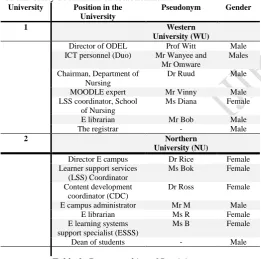
This was a phenomenological qualitative study using deductive methods from interviews and documents. The study was conducted in two universities to provide an understanding into the differences and similarities of procedures and processes used in establishing distance education / e learning units in universities. The study focused on institutions which had implemented distance learning programmes within the last twenty years. Purposive sampling was applied to identify the participating universities. Out of the sixty-six universities in Kenya (Commission for higher education (CUE) 2014), there are over twenty, practicing distance education in one form or the other. Application letters were sent to twenty-one universities. The first two out of four universities which responded within the study time-frame were taken as the sample. The modes of distance learning include e learning, online learning, mixed mode learning, blended learning or distributed learning included in the context of this study. Following the universities‟ approvals, emails and phone calls were made to set up interview appointments with key implementers as advised by the universities‟ research and ethic committees. Key informers / program implementers were interviewed (see Table 1) in addition to documentary analysis of university documents of establishment.
University Position in the University
Pseudonym Gender
1 Western
University (WU)
Director of ODEL Prof Witt Male
ICT personnel (Duo) Mr Wanyee and
Mr Omware
Males
Chairman, Department of Nursing
Dr Ruud Male
MOODLE expert Mr Vinny Male
LSS coordinator, School of Nursing
Ms Diana Female
E librarian Mr Bob Male
The registrar - Male
2 Northern
University (NU)
Director E campus Dr Rice Female
Learner support services (LSS) Coordinator
Ms Bok Female
Content development coordinator (CDC)
Dr Ross Female
E campus administrator Mr M Male
E librarian Ms R Female
E learning systems support specialist (ESSS)
Ms B Female
Dean of students - Male
Table 1: Demographics of Participants
A. INSTRUMENTATION
There were two instruments for data collection; a documentary analysis tool and a semi-structured interview schedule.
a. DOCUMENTARY ANALYSIS TOOL
This tool was used to gather qualitative data from the relevant documents of establishment. The documents included: The commission of university education (CUE) standards,
status reports, newsletters, distance education guidelines/policy, mission and vision statements, university charter, strategic plans, university websites and learning management system (LMS). The items on this tool included: the age of the document, characteristics, intended audience, intended message, its statement on the practice of distance education and the model used in establishing the distance education directorate/department. There was a total of forty documents including interview scripts from the two universities. At NU, upon the director of e learning‟s advice, the university‟s strategic plan which included the strategic plan for DE, the DE guidelines, the national guidelines for DE, and the evaluative/status report (e campus at one year) documents were also included. She explained that these documents were the guides for the establishment and were in continuous use as reference and guidelines for improvement. To access, the e learning portal at both universities, the researcher was granted limited access for three (3) months, based on temporary registration, a username and password.
b. SEMI - STRUCTURED INTERVIEWS
This tool, was used in combination with a voice recorder to gather data from key policy implementers and/or representatives; the director of distance learning, chairman of department, dean of students, registrar, administration, the ICT director, systems support specialists, content development coordinator, the librarian and learner support service coordinator. The list of persons snowballed to other concerned staff who were also interviewed (see Table 1). Appointments were made with the key concerned departments to identify representatives for interviews. At each interview, the respondent was requested to sign a consent form. Thereafter, the interview was conducted and recorded. Each interview took an average of forty-five minutes.
IV. FINDINGS AND DISCUSSION
Results are presented based on collected data. All documents comprising of interview scripts, university documents of distance education establishment, and documents compiled through documentary analysis of the university‟s websites were analysed. The documents were uploaded onto Atlas.ti7 qualitative analysis software and coded in two stages. In stage one, codes were assigned through each document. In stage two, the coded documents went through a second coding and some codes were merged into single codes. At the end, there were 189 codes, merged into three super codes with a code co-concurrence total of four hundred and eight. The three super codes were referred to as:
Establishing distance education programmes Distance education models
Guidelines and Policies
In answer to the research questions, the three super codes (Figures 1 and 2) were grouped into the following two (2) themes:
Theme one: Building the distance education experience Establishing DE programmes
Page 459 www.ijiras.com | Email: [email protected] Theme two: Formulas and frameworks
Guidelines and Policies
A. THEME ONE: BUILDING THE DISTANCE
EDUCATION EXPERIENCE
This theme had six parts presented as Justification for establishing DE programmes, Target population, Process of DE establishment at NU, Process of DE establishment at WU, Model at NU and Model at WU.
a. JUSTIFICATION FOR ESTABLISHING DISTANCE
EDUCATION PROGRAMMES
At WU, Ms. Diana, the LSS coordinator and the registrar explained that there was a two-sided justification for establishing DE programmes. One, the nursing council needed to establish degree-conversion programmes to help nurses with diploma qualifications to upgrade to degree without having to take leave from their places of work. Two, WU was strategically placed to attract students from the surrounding and from far places, who for various reasons; like family commitments, needed to acquire higher education through distance learning. However, according to Prof Witt, the target population had expanded leading to the establishment of the new ODEL directorate. Here, any student with minimum admission requirements who was not able, for any reasons, to study on-campus was eligible to register. He added that with the increased demand for education, numerous universities had tried solutions like hiring extra physical space but were still unable to cope with the number of applications. Thus, DE was established to augment on campus programs.
The strategic plan of NU outlined challenges that the main university had continued to experience due to substantial increase in student numbers against the available physical facilities. Furthermore, the projections in the same document indicated an unabated increase in the demand for higher education for years to come. It also quoted the national statistics which had an annual figure of over thirty thousand (30 000) high school graduates missing university admissions despite having met the minimum admission requirements. At NU, reasons for establishing DE were therefore, almost similar to those of WU; to augment participation and access.
b. TARGET POPULATION FOR DISTANCE
EDUCATION PROGRAMMES
At WU, the director and all the key informants reported that the target population from the onset, was specified as mature persons who for various reasons were not able to access the mainstream higher education. These included family people, disadvantaged women, people in employment and people on constant travel. Additionally, there was the special group of adults, over forty years of age, who needed education for self-actualisation. At the school of nursing, the DE programme targeted mature practicing nurses who wanted to upgrade to degree through BscN - degree conversion programme.
At NU, Ms. B, the e systems support specialist, explained that the programmes on e learning had attracted mature
students nationally and internationally with the same characteristics as those of WU. Ms. Bok, the learner support systems coordinator, added that the student age for those who had been admitted ranged between 20 years and 60 years with an average of 34 years. As an indicator for models, Ms. Bok further explained that because the target population involved a mature population which had many other competing pressures, there was a proposition in the yet to be ratified policy to allow them to take a minimum of two modules per semester translating to a maximum of eight years in an undergraduate programme. She further explained that this would not necessarily translate to eight calendar years because, it was possible to sandwich three semesters into one calendar year reducing eight to five calendar years.
c. PROCESS OF DISTANCE EDUCATION
ESTABLISHMENT AT NORTHERN UNIVERSITY (NU)
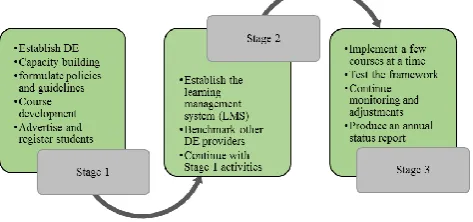
The process comprised of three stages (see Figure 1).
Stage 1 The Distance Education Idea
Ms. B, explained the historical background of establishment: 1) Ihe decision to go fully online was made in 2010 so a director was hired, 2) In 2010, capacity building began, and 23 lecturers were trained, who began e learning based content development for 5 courses, 3) Guidelines were developed simultaneously with course development, 4) The courses were advertised, and 5) Almost 300 students were admitted across the courses in 2011.
Figure 1: Process of DE Establishment at NU
Course development for new courses was still on-going even at the time of this study, three years later, at which time the number of registered students had reached over 800 students. There was also demand for e learning by on-campus programmes. As pilot, a HIV determinants and management course was established as an e learning module for the whole university community. Ms. B, contended that the LMS was designed to handle up to 20 000 students concurrently. Therefore, there was still opportunity for growth and commissioning of new programmes.
Stage 2 Benchmarking
Page 460 www.ijiras.com | Email: [email protected] that the E campus framework had been conceptualised and
adapted from those of other universities in the UK. She also noted that the framework continued to evolve with time.
Stage 3 Take Off
With the principle of starting small, the director explained that one certificate course was launched. Dr Rice reported that they started off with few courses to: 1) test the framework, 2) reduce start-up costs, and 3) distribute the cost of course development for other courses over time. She reported that once the guidelines were developed and used to implement programmes, the staff quickly adopted DE and contributed to its smooth running. It seemed that the initial framework was under continuous adjustments even after the first students were admitted and that the need to build support structures was realised only after implementation. She stated:
The e learning was conceptualized around a learning management system. Now we found that …. We needed support structures; we need a learner support structure, we need a system to support the lecturers, we need a cost management system. We now have a human resource. We have an e library….We have the infrastructure bit…So we felt that this is now good enough for an institution…And to institutionalise the whole framework, a year later we named it the E campus.
Dr Rice had envisioned a much bigger and better running e learning structure within three (3) years. This would have included a bigger physical space, but she also observed that given the previous experiences of expenditure on video conference facilities, the university was cautious with its investments.
d. PROCESS OF DISTANCE EDUCATION
ESTABLISHMENT AT WESTERN UNIVERSITY (WU)
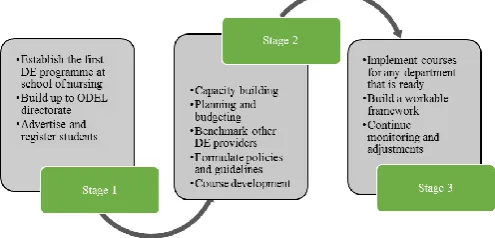
The process comprised of three stages (see Figure 2).
Stage 1: The Distance Education Idea
The first DE programme was established in WU at the school of nursing in 2011. In 2013, a centralised ODEL directorate was established to host the programmes for all departments in addition to that of the school of nursing. Many informants made claims to having originated the DE establishment. Mr Wanyee and Mr Omware of ICT reported that the idea of establishing DE programmes first originated from the ICT directorate. At the time, the imminent challenge was to sell the vision to the university's administration which lacked good will for the development of e programmes. But after a few years of persistence and the arrival of a new vice chancellor (VC), the goodwill improved and an ODEL directorate was established. At the school of nursing, Mr Vinny, the MOODLE expert, reported that part of the reason why he was hired was because of his extensive knowledge and skills concerning e learning. Upon his appointment and attachment to the school, he reported to have: 1) trained a few of the faculty on matters of DE and 2) sold the vision of starting a DE nursing programme to the faculty. He claimed
that the vision was hijacked by the nursing council or the university. In addition, the idea was on paper with the ICT but no one had bothered to initiate it.
Figure 2: Process of DE Establishment at WU
Stage 2: Benchmarking
The new vice chancellor came with diverse experiences having studied and worked in other universities, especially in South Africa. This influenced the decision to establish DE programmes through an ODEL directorate. The ICT duo reported that when the idea of establishing DE programmes was first mooted, they visited a newly established DE learning at Midrock University within the country where they learnt how to establish e-learning on learning management systems and the use of MOODLE. Thereafter, they returned to the WU, made a business plan and submitted a budget to the senate. But budget was not approved citing exorbitance. Thus, still using Midrock University as their benchmark, they went back to draw a new plan and budget.
Dr Ruud, the chairman, department of nursing, also talked about Midrock University as having a more superior organisation than the WU ODEL. He reported that they modelled ODEL and formulated policies, using it as the benchmark. He did not seem confident that the WU administration would prioritise the growth of ODEL to as high levels as that at Midrock University. He also had previous experiences from two other universities where he had worked but after visiting Midrock University, he believed that that was the best run model. He provided a document from the school of nursing named "BENCHMARKING REPORT FOR WU BSN DISTANCE LEARNING PROGRAMMEME REPORT". This document was compiled after a study by a task force appointed by the WU administration. In this, the terms for benchmarks included: institutional support, course development, teaching and learning, course structure, student support, faculty support, evaluation and assessments. In addition, there was differentiation between print media DE and e learning DE because the original modules developed by the Nursing Council of Kenya (NCK) were print-based while the WU was ready to deliver through e learning.
Stage 3: Take Off
Page 461 www.ijiras.com | Email: [email protected] A director was appointed and students admitted
immediately the director was appointed.
The director conducted press conferences and made advertisements in the mass media.
Members of management went for training in the University of South Africa (UNISA) and made a report for benchmarking. At the onset, there was little in framework, policies or guidelines. For instance, teachers were being recruited as students were being admitted. Prof Witt, the Director, reported that the formal
admissions system was manual and tedious, taking up to two (2) months for prospective students to be admitted. However, ODEL had since established a semi online system, which had improved the registration process. For faster payment of registration and tuition fees, he set up an account in a mobile telephone money transfer service. The director and his team developed guidelines and policy
which were undergoing readings before the senate at the time of this study. Meanwhile, the same were being used as standards for ODEL establishment. Prof Witt explained that while developing their own policy, they recognised the commission of university (CUE) policy and the national ODL policy.
e. DISTANCE EDUCATION MODEL AT NORTHERN
UNIVERSITY (NU)
Dr Rice, the director of E campus, explained that she and her team studied various other universities' models and built a generic DE model based on their context. She stated “we have what works for us”. Upon being hired, Dr Rice reported that the VC challenged her to find out the reason why it had been difficult to start e learning programmes at NU. She decided to make an audit report indicative of the status, a projected future and the way forward. She began by interviewing faculty and staff while in a needs assessment study. But then, one faculty member indicated that whatever she was doing had previously been done. This gave her more insight on the faculty's perceptions. Faculty seemed to believe that the main reason why distance education had not effectively taken off in the past was due to the absence of a remuneration policy for teaching faculty.
Dr Rice reported that she made headway through the audit study. One issue was to try and correlate policies. She reported that policy was lacking in the role of ICT in education in NU programmes. Additionally, ICT as a course in the curricula was not explicit even though it was mandatory for all students. She therefore proposed to create the first guidelines document for DE establishment. However, she complained that the budgeting votes were not yet explicit in the document. She often expressed throughout the interview that the budgetary allocations to DE were always insufficient.
It seemed that the director had to build a model based on the prevailing circumstances (see Figure 3). First, the university had incurred costs in acquiring video-conferencing equipment prior to her being hired. Establishing the video-conferencing was challenging yet she was expected to set up a functional DE unit in the shortest time possible. At the same time, faculty was already attuned to the possibility of setting up print-based DE programmes.
Figure 3: An Illustration of DE Model at Northern University
Meanwhile, the country's ICT sector improved the availability and accessibility of internet. She envisioned a web-based delivery system of DE, but had to construct her own model, unique to NU, borrowing from models from other universities (Figure 3). Her argument was that there were more challenges in putting up the video-conferencing system than there were for a web-based delivery system. She had established that there was enough bandwidth from most internet service providers, for individuals to use internet even through smart phones. She thus believed that e learning could be actualised.
f. DISTANCE EDUCATION MODEL AT WESTERN
UNIVERSITY (WU)
The WU modelled the DE framework and named it “the directorate of ODEL”. It was to run as one of the directorates of the university (See Figure 4). Although the school of nursing had been running undergraduate DE programmes for the preceding two years, ODEL was now a formal framework that would serve all departments that needed to adopt DE modes. The ODEL directorate co-opted the BScN programme into its model even though at the time of the study, the integration was still in progress. In this model, two members of the management were appointed by the council to visit University of South Africa (UNISA) for two weeks of training. By then, the current director had been appointed but was abroad on training. Later, following performance contracting, ODEL committed to train 10 members of faculty within the year, but within 6 months it had already trained over 15 lecturers prior to its launch in September 2013.
Figure 4: An Illustration of DE Model at WU
Page 462 www.ijiras.com | Email: [email protected] employed as interns, were hired for its administration. The
director gave the rationale for this as affordability and efficient distribution of work. He observed that it was more cost effective to hire and work with interns as their salaries was equivalent to that of one expert. After ODEL was established, the director began the development of guidelines and policy for ODEL. In 6 months the document had undergone the required readings and was awaiting ratification by the senate. Meanwhile, implementation and adjustments were made based on the new policy.
The intended model for budgeting was illustrated in the policy. The money made from DE would go into the university pool. Thereafter 6% would return to ODEL for its development. This was over and above the university's allocations and votes which the director did not specify. Unlike the E-campus model at NU, Prof Witt seemed happy with the budgetary arrangement. Except that he indicated that the amount was insufficient and that the percentage should be more than 6%. Prof Witt had observed that some systems worked in the first few months when the students were fewer but would need to be improved within revised budgets, with growing student populations. For example, orientation for students on how to use MOODLE was done during the first one week of on-campus orientation, but the training had proved inadequate and expensive. They would also require to hire experts to train the students online.
B. THEME TWO: FORMULAS AND FRAMEWORKS
The results in this theme are discussed under; the commission for university education (CUE) standards and guidelines, DE policies, admissions policy and quality assurance policies.
a. THE COMMISSION FOR UNIVERSITY
EDUCATION (CUE) STANDARDS AND
GUIDELINES
Both NU and WU referred to the Commission for University Education (CUE) standards and guidelines as the guide to the formulation of ODEL guidelines and policies in their universities. This was one of the documents analysed in this study. It described and outlined numerous schedules concerning the practice of higher education in Kenya. ODEL was discussed under; the scope, citation, interpretation, principles, scenarios and assumptions of ODEL and standards and guidelines for the education provider. There were 40 standards and guidelines. These included: a needs assessment, vision and mission statements, accreditation of the institution and programmes, institutional budget policies, provider's objectives and strategies, governance and administration, regional learning centres and collaborations, modes of delivery, learning management systems, technical and ICT support infrastructure, organisational structures and procedures, examination regulations and assessment procedures, course monitoring and evaluation procedures, staff appraisals and marketing of programmes.
b. DISTANCE EDUCATION POLICIES
At WU, Prof Witt explained that some of the framework used for establishing ODEL were guided by the national policy on ODL and the CUE policy document. This included the 6% budgetary allocations from the main university and the need to have a video conferencing facility. At NU, Dr Rice reported that there was a new national policy on DE in Kenya and that the NU is using this policy. The guidelines document at NU was also linked to the main university's policies. For example, admission requirements, assessments policy and course progression procedures. Following the implementation of DE programmes using the guidelines, e learning could position itself in NU. Dr Rice, the director reported that the university policies on ICT, on content development, on capacity building, on research and many others had adapted to provide e learning and recognised the goals for e learning in all these sectors.
c. ADMISSIONS POLICY
WU ODEL referred to CUE standards on admission requirements. The assumption was that the prospective student needed to meet the minimum university entry requirements as laid out for on-campus students even though ODEL was supposed to be open. Additionally, the proposed policy had a clause that allowed mature non-qualifying students to apply with preconditions. The document serving as the guidelines and policy document for DE programmes at NU indicated that conventional admission requirements would apply unless otherwise specified. This left ambiguity as to whether the DE programmes were open or not. The minimum and maximum completion time acceptable for each programme was also not explicit. It however, stated that individual modules would have a maximum validity period within which to be completed.
d. QUALITY ASSURANCE POLICIES
One of the analysed documents was the service charter; a mark of excellence usually displayed by organisations. It is a promissory statement to the commitment of quality service that the university would provide to its clientele and the society. It is intended for the university accountability to citizens as well as global users. The service charter for the universities were available through downloads from the main universities‟ websites.
In both WU and NU, the charter had polite and respectful language towards its audience. This was evidence that the universities valued their audience. As a quality assurance document, at NU, it promised to offer excellent service to its clients and the public. Every statement was designed to relay the message that the university is client-centred and customer-oriented. One example; We will set standards based on feedback, measure how well we meet them and publish the results.
V. SUMMARY AND CONCLUSIONS
Page 463 www.ijiras.com | Email: [email protected] indicate that in the absence of a universal model, each
university strives to build a model as it proceeds with implementation. The procedures and patterns that were common to both universities included; i) instituting a department /directorate as the platform for all departments with distance education programs ii) hiring staff under a directorship to liaise with university departments iii) benchmarking related universities iv) policy formulation v) training of faculty vi) continuous planning and implementation vii) Model construction viii) Model evaluation ix) Model revision and development x) Model implementation. While this is not a universal model, it seems like universities which are pressured temporally and budgetary may benefit from implementation (seemingly haphazard) in the absence of a structural model. They ride on the ambiguity associated with DE / e learning good will and the unquenched demand for higher education. In addition, future curricula and models will need to reflect the dynamism of the society. New trends in Open Education Resources (OERs) and Massively Open Online Courses (MOOCs), for example, have already distorted the concept of curriculum as it was previously known. These are indicators of the need for a supportive framework / model.
REFERENCES
[1] Boit, J. M,. & Kipkoech, L. C. (2012). Liberalization of Higher Education in Kenya: Challenges and Prospects. International Journal of Academic Research in Progressive Education and Development, 1(2):32-42. [2] Chen, P. S. D., Lambert, A. D., & Guidry, K. R. (2010).
Engaging online learners: The impact of Web-based learning technology on college student engagement. Computers and Education, 54(4):1222-1232.
[3] Daniel, J. (2012). Dual-mode universities in higher education: way station or final destination? Open Learning: The Journal of Open, Distance and e-Learning, 27(1):89-95.
[4] Durak, G., & Ataizi, M. (2016). The ABC's of Online Course Design According to Addie Model. Universal Journal of Educational Research, 4(9), pp.2084-2091. [5] Gaskell, A. (2010). "Openness, Access and e‐learning:
How can they be aligned?” Open Learning: The Journal of Open, Distance and e-Learning, 25(1): 1-4.
[6] Guri-Rosenblit, S. (2009). Distance education in the digital age: Common misconceptions and challenging tasks. The Journal of Distance Education, 23(2):105-122. [7] Juma M. N. (2012). The establishment of a higher
education open and distance learning knowledge base for decision makers in Kenya. Available: www.unesco.org/education/studyingabroad/highlights/odl /kenya.doc. [Accessed 20-07-2013]:35
[8] King, B. (2012). Distance education and dual-mode universities: an Australian perspective, Open Learning: The Journal of Open, Distance and e-Learning, 27(1):9-22.
[9] Küçükcan, P. D. (2011). A New TV Practice in Distance Education in Turkey. The Turkish Online Journal of Distance Education, 12(10):141-152.
[10]Lane, A., & Van Dorp, K. J. (2011). Open educational resources and widening participation in higher education: innovations and lessons from open universities. In: EDULEARN11, the 3rd annual International Conference on Education and New Learning Technologies, 04-05 July 2011, Barcelona. Available: http://oro.open.ac.uk/29201/ and: http://library.iated.org/view/LANE2011OPE [Accessed 20-07-2013]:1-11.
[11]Ma, W. W., & Yuen, A. H. (2011). Understanding online knowledge sharing: An interpersonal relationship perspective. Computers and Education, 56(1):210-219. [12]Moore, J. L., Dickson-Deane, C., & Galyen, K. (2011).
E-Learning, online learning and distance learning environments: Are they the same? The Internet and Higher Education, 14(2):129-135.