Page 158 www.ijiras.com | Email: [email protected]
Preparation And Evaluation Of Sustained Release Matrix Tablets
Of Repaglinide (Usp) Using Natural Polymers
Mahmooda
Dr. Syed abdul azeez
Deccan College of Pharmacy, Darussalam, Aghapura, Nampally, Telangana Hyderabad
I. INTRODUCTION
Matrix tablets composed of drug and polymer as release retarding material offer the simplest approach in developing a sustained-release drug delivery system. Recent trend in development of sustained-release drug delivery systems was the use of gums of plant origin to fulfill the aim of retarding the drug release. Natural gums are biodegradable and nontoxic, which hydrate and swell on contact with aqueous media, and these have been used for the preparation of dosage form2. Repaglinide is the first member of new class of oral hypoglycemic designed to normalize the meal time glucose excursions. Repaglinide induces rapid onset short lasting insulin release. It is administered before each major meal to control postprandial hyperglycemia the dose may be omitted if
a meal is missed. Because of short lasting action it may have a lower risk of serious hypoglycemia. Side effects are mild headache, dyspepsia, arthralgia, and weight gain. After oral administration, Repaglinide is rapidly and completely absorbed from the gastrointestinal tract. After single and multiple oral doses inn healthy subjects or in patients, peak plasma drug levels (Cmax) occurs within 1 hour (Tmax). The present study was designed to formulate matrix tablets using carrageenan, chitosan, gum karaya, bhara gum matrix polymers for controlling release of poorly water soluble drug Repaglinide.
Abstract: The objective of the present work is to develop and characterizes oral sustain release matrix tablets of Repaglinide. Repaglinide is practically insoluble in water so it is suitable to develop sustained release matrix tablet using hydrophilic polymers. Repaglinide is anti-diabetic drug used extensively in the treatment of diabetes type II. The natural polymers like carrageenan, chitosan, gum karaya, Bhara gum were utilized in the formulation of matrix tablets containing Repaglinide by wet granulation technique and evaluated for its drug release characteristics. Granules were prepared and evaluated for its physical properties and shows satisfactory results. Formulation was optimized on the basis of acceptable tablet properties (hardness, friability, drug content and weight variations), in vitro drug release and stability studies. All the formulations showed compliance with Pharmacopeial standards. The in vitro release study of matrix tablets were carried out in phosphate buffer pH 6.8 for 12 hr. Among all the formulations, F2 with shows 100% better controlled release at the end of 12 hrs when compared to other formulations. The release data was fitted to various mathematical models such as, Higuchi, Korsmeyer-Peppas, First-order, and Zero order to evaluate the kinetics and mechanism of the drug release. The drug release of optimized formulations F2 follows zero order kinetics and the mechanism was found to be diffusion coupled with erosion (non-Fickian diffusion). The stability studies were carried out according to ICH guideline which indicates that the selected formulations were stable.
Page 159 www.ijiras.com | Email: [email protected] II. AIM AND OBJECTIVE OF PRESENT STUDY
AIM
The main aim of the present investigation is to design, formulate and evaluate the sustained release dosage form of Repaglinide (USP) using natural polymers.
OBJECTIVES
Preformulation studies such as API characterization, solubility studies, determination of melting point.
To improve its oral bioavailability.
To develop the extended release system over a period of time.
Increased patient compliance by reducing the dose frequency.
Determination of λmax and development of calibration curve of Repaglinideusing UV spectrophotometer.
To perform various quality control evaluation parameters for the prepared tablets.
III. METHODOLOGY
A. FORMULATION OF EXTENDED RELEASE LAYER Matrix tablets of were prepared by Wet Granulation method. The active ingredient was passed through the sieve#40 followed by the other ingredients were passed the same sieve. Repaglinide, Carrageenan, Chitosan, Bhara gum, gum karaya, Ethyl cellulose, Micro crystalline cellulose were taken in a poly bag according to the formulation table and mixed for 5minutes to ensure uniform mixing of the ingredients with the drug. Weigh Starch accurately and it is mixed with water to form a paste is used as binder solution and kept separately. The binder solution was added slowly to the dry mixed ingredients with constant mixing till to get solid mass to form uniform and optimum granules. Then the wet granules were dried in trays and pass the air for drying .Samples were removed randomly at different time intervals from the total bulk of the granules and then checked out for moisture content. The dried materials were passed through the sieve#20. After sieving dry granules were lubricated using Magnesium .stearate and Talc. After lubrication granules were sent to compression. Repaglinide Matrix tablets was compressed using 12mm round punch.
Ingredients F1 F2 F3 F4 F5 F6 F7 F8
Repaglinide(USP) 4mg 4mg 4mg 4mg 4mg 4mg 4mg 4mg
Carrageenan 15% 30% - - - - - -
Chitosan - - 15% 30% - - - -
Bhara gum - - - - 15% 30% - -
Gum karaya - - - - - - 15% 30%
Starch 5
mg 5mg 5mg 5mg 5mg 5mg 5mg 5mg
Talc 12mg 12mg 12mg 12mg 12mg 12mg 12mg 12mg
Magnesium Stearate
12mg 12mg 12mg 12mg 12mg 12mg 12mg 12mg
MCC q.s q.s q.s q.s q.s q.s q.s q.s
Total wt(mg) 20
0 200 200 200 200 200 200 200
Table 1: Formulation Table For Extended Release Layer
IV. RESULTS AND DISCUSSION
A. PREFORMULATION STUDIES
a. ORGANOLEPTIC CHARACTERS FOR
REPAGLINIDE
DESCRIPTION OF REPAGLINIDE (API)
Test Description
Colour white to off-white powder
SOLUBILITY
Table showing the Solubility of Repaglinide (API) in various solvents.
Solvents Solubility
Water Practically insoluble pH6.8 Phosphate buffer Soluble
Methanol Soluble
Ethanol Soluble
MELTING POINT
Melting point of Repaglinide drug was determined by using melting point apparatus and was in the range of 131oC.
B. EVALUATION OF REPAGLINDE TABLETS a. PRECOMPESSION PARAMETERS
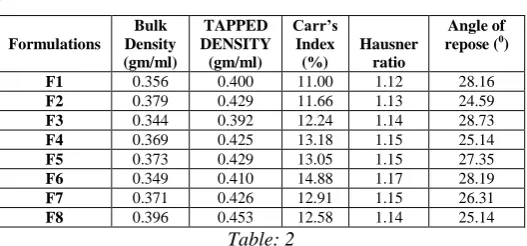
Formulations Bulk Density (gm/ml)
TAPPED DENSITY (gm/ml)
Carr’s Index
(%)
Hausner ratio
Angle of repose (0)
F1 0.356 0.400 11.00 1.12 28.16
F2 0.379 0.429 11.66 1.13 24.59
F3 0.344 0.392 12.24 1.14 28.73
F4 0.369 0.425 13.18 1.15 25.14
F5 0.373 0.429 13.05 1.15 27.35
F6 0.349 0.410 14.88 1.17 28.19
F7 0.371 0.426 12.91 1.15 26.31
F8 0.396 0.453 12.58 1.14 25.14
Table: 2
The blends for Matrix tablets were characterized with respect to angle of repose, bulk density, tapped density, Carr’s index, and Hausners ratio. Angle of repose was less than 30° and Carr’s index values were less than 15 for the blend of all the batches indicating excellent to good flowability and compressibility. Hausner’s ratio was less than 1.17 for all the batches indicating excellent flow properties.
b. POST COMPRESSION PARAMETERS
F.Code
F1
Hardness (kg/cm2)
Thickness (mm)
Weight (mg)
Friability (%)
5.4 ±0.44 2.08±0.17 199.8±1.48 0.36
F2 4.5±0.31 2.70±0.25 199.8±1.48 0.36
F3 5.5±0.40 2.81±0.80 200.4±0.54 0.39
F4 5.5±0.55 2.2±0.20 198.6±0.41 0.43
F5 4.6±0.57 2.08±0.66 200.8±1.64 0.12
F6 5.0±0.30 2.91±0.25 205.6±1.14 0.54
Page 160 www.ijiras.com | Email: [email protected]
F8 5.4±0.60 2.0±0.89 199.9±0.67 0.64
Table 3
The results of the uniformity of weight, hardness, thickness, friability, and drug content of the tablets are given in above Table 3
All the tablets of different batches complied with the official requirements of uniformity of weight as their weights varied between 198.6±0.41 and 200.8±1.64mg.
The hardness of the tablets ranged from 4.5±0.31 to 5.5±0.55 kg/cm2 and the friability values were less than 0.65% indicating that tablets were compact and hard. The thickness of the tablets ranged from 2.0 to 2.91 mm.
All the formulations satisfied the content of the drug as they contained 98 to 100 % of Repaglinide and good uniformity in drug content was observed. Thus all the physical attributes of the prepared tablets were found be practically within control.
c. INVITRO DISSOLUTION STUDIES FOR MATRIX TABLETS
DISSOLUTION STUDY (MATRIX TABLETS)
Acidic Stage:
Medium : 0.1N HCL
Type of apparatus : USP - II (paddle type) RPM : 50
Volume : 900ml
Temperature : 37ºC± 0.5 Time : 2hrs
Buffer Stage:
Medium : 6.8pH phosphate buffer
Type of apparatus : USP - II (paddle type)
RPM : 50
Volume : 900ml
Time : 12hrs
In vitro dissolution for matrix tablets were done initially in 0.1N HCL for 2hrs and next in 6.8 phosphate buffer for 12hrs.
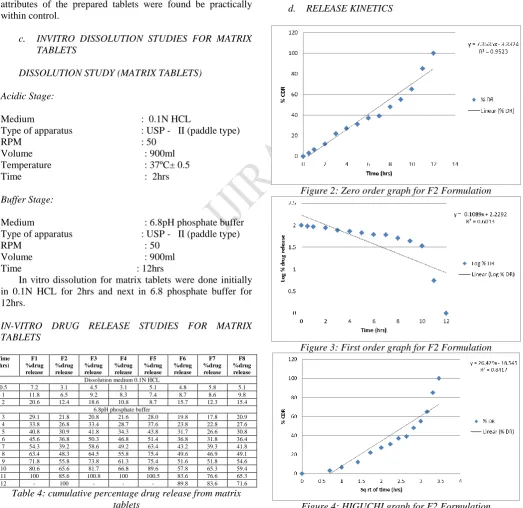
IN-VITRO DRUG RELEASE STUDIES FOR MATRIX TABLETS
Time (hrs)
F1 %drug release
F2 %drug release
F3 %drug release
F4 %drug release
F5 %drug release
F6 %drug release
F7 %drug release
F8 %drug release Dissolution medium 0.1N HCL
0.5 7.2 3.1 4.5 3.1 5.1 4.8 5.8 5.1
1 11.8 6.5 9.2 8.3 7.4 8.7 8.6 9.8
2 20.6 12.4 18.6 10.8 8.7 15.7 12.3 15.4
6.8pH phosphate buffer
3 29.1 21.8 20.8 21.6 28.0 19.8 17.8 20.9
4 33.8 26.8 33.4 28.7 37.6 23.8 22.8 27.6
5 40.8 30.9 41.8 34.3 43.8 31.7 26.6 30.8
6 45.6 36.8 50.3 46.8 51.4 36.8 31.8 36.4
7 54.3 39.2 58.6 49.2 63.4 43.2 39.3 41.8
8 63.4 48.3 64.5 55.8 75.4 49.6 46.9 49.1
9 71.8 55.8 73.8 61.3 75.4 51.6 51.8 54.6
10 80.6 65.6 81.7 66.8 89.6 57.8 65.3 59.4
11 100 85.6 100.8 100 100.5 83.6 76.6 65.3
12 - 100 - - - 89.8 83.6 71.6
Table 4: cumulative percentage drug release from matrix tablets
The Formulation F2 shows 100% drug release at 12 hrs.
Figure 1: In-Vitro Drug Release Studies for matrix tablets F1 – F8
d. RELEASE KINETICS
Figure 2: Zero order graph for F2 Formulation
Figure 3: First order graph for F2 Formulation
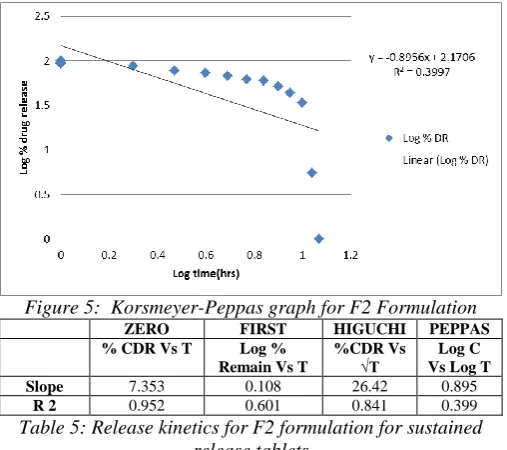
Page 161 www.ijiras.com | Email: [email protected] Figure 5: Korsmeyer-Peppas graph for F2 Formulation
ZERO FIRST HIGUCHI PEPPAS % CDR Vs T Log %
Remain Vs T
%CDR Vs √T
Log C Vs Log T Slope 7.353 0.108 26.42 0.895
R 2 0.952 0.601 0.841 0.399
Table 5: Release kinetics for F2 formulation for sustained release tablets
e. STABILITY STUDIES
Cumulative % d r u g r e l e a s e Sampling
interval
250C/60%RH 300C/65%RH 400C/75%RH
0 Days 100.1 99.8 99.9
15 Days 98.5 98.6 98.2
30 Days 97.82 97.75 97.70
90 Days 96.45 97.32 97.26
Table 6
Stability studies of the formulation F2 of Repaglinide (USP) matrix tablets were carried out to determine the effect of formulation additives on the stability of the drug and also to determine the physical stability of the formulation. The stability studies were carried out at 25ᴼ C/60%RH, 30 ºC/65% RH and 40 ºC/75% RH for 90 days. There was no significant change in the physical property and percent of drug release was within the limits ±4 during 8hour during the stability period.
V. DISCUSSION
The release profile of formulations F1, F2, F3, F4 F5,F6, F7 and F8 comprising various polymers like carrageenan, chitosan, bhara gum, gum karaya with varying concentrations. Formulations F1, F2, F3, F4 F5,F6, F7 and F8 exhibits release rates of 91%, 100% 94.2%, 91%, 97%, 89.8%, 83.6, 71.6% at various time intervals as shown in the table. Among all of these 8 formulations F2 contains carrageenan shows maximum drug release at the end of 12hrs. Hence it was optimized and decided to develop further formulations.
VI. CONCLUSION
In this study matrix tablet of Repaglinide was prepared by wet granulation technique, using carrageenan, chitosan, bhara gum, gum karaya Polymers used as release retardant. It was found that increase in the concentration of excipients in
polymeric ratio decreases the drug release. Carrageenan is non-carcinogenic, biocompatible and has high drug holding capacity. These led to its application as excipients in hydrophilic drug delivery system. The formulation F2 containing 30% carrageenan respectively showed good drug release with good matrix integrity. From the above result, it has been found that the optimized formula F2 containing 30% of carrageenan as drug retarding polymer shows better sustained effect for 12 hr when compared to other formulations. Different parameters like hardness, friability, weight variation, drug content uniformity, in-vitro drug release were evaluated for these formulations. Based on these results, formulation F2 was found to be the most promising formulations. The optimized formulation F8 follows zero order plot since the regression coefficient is 0.952 and plot was also found to be linear. The regression coefficient (R2) values of zero order in the optimized formulation F2 was greater than the R2 values of First order. Thus, the drug release follows zero order kinetics. The results suggest that the developed sustained release matrix tablets of Repaglinide could perform better than conventional dosage forms, leading to improve efficacy and better patient compliance. Thus, the aim of this study was achieved.
REFERENCES
[1] Barot Nikunj, Darshan Modi, “Formulation, Development
And Evaluation Of Sustained Release Matrix Tablets Of Repaglinide”. Nikunj Barot, 2014; Volume 3(2): 370-396. [2] Tapaswi Rani Dash, Pankaj Verma, “Matrix Tablets: An Approach Towards Oral Extended Release Drug Delivery”. International Journal Of Pharma Research & Review, Feb 2013; 2(2):12-24.
[3] Krushnakumar J Gandhi*, Subhash V Deshmane,
“Polymers In Pharmaceutical Drug Delivery System: A Review”. Int. J. Pharm. Sci. Rev. Res., 14(2), 2012; Nᵒ 10, 57‐66.
[4] Jitender Joshi, Lata Bhakuni, “Formulation And
Evaluation Of Solid Matrix Tablets Of Repaglinide”, ISSN: 0976-8688; Der Pharmacia Sinica, 2012, 3 (5):598-603.
[5] Prakash Pavan, Porwal Mayor, “Role Of Natural
Polymers In Sustained Release Drug Delivery
System”ISSN 2230 – 8407, 2011,(2) 9, 6 – 11.
[6] Balaji Venkataramanappa Kadri, “Mechanism Of Drug
Release From Matrix Tablets Involving Moving Boundaries” Department Of Pharmaceutical Sciences University Of Toronto; Master Of Science, 2001.
[7] Jaimini Manish*, Kothari Abhay, “Sustained Release Matrix Type Drug Delivery System: A Review”, Journal Of Drug Delivery & Therapeutics; 2012, 2(6), 142-148. [8] Baravaliya Smitaben H., Tandel Jyotika G. “Analytical
Method Development Of Repaglinide Formulation”, Mohite Mukesh T et al/ IJRAP (4) 1, Jan – Feb 2013.
[9] Gamal M El Maghraby1, Mohamed A Osman, “Self
Page 162 www.ijiras.com | Email: [email protected]
[10]Srinivas Mutalik, Krishnan Manoj, “Chitosan And Enteric Polymer Based Once Daily Sustained Release Tablets Of Aceclofenac” AAPS Pharmscitech. 2008 Jun; 9(2): 651– 659.
[11]Saptarshi D, Gupta MS. “Modified release dosage form
and drug delivery”. Journal of Pharmacy Research. 2009; 2(11):1728-29.
[12]Ansel HC, Allen LV, Popovich NC. “Pharmaceutical dosage forms and drug delivery systems”. Lippincott Williams and Wilkins; Baltimore 7th ed. 2000:p.231-75. [13]James S and James C, “Boylan encyclopedia of
Pharmaceutical technology”, 4th ed. Marcel Dekker; 1997:p. 304-07.
[14]Thomas WY, Joseph L,“Sustained and Controlled
release drug
delivery system”, Marcel Dekker; 1978(6):p.132- 34. [15]Luana Periloli, Valeria Ambrogi. Et al. “Mucoadhesive
Bilayered Tablets for Buccal Sustained Release of Flurbiprofen”. AAPS Pharm. Sci. Tech. 2007, Vol. 8, issue 3, Article 54.
[16]Juan Manuel Llabot, Ruben Hilario Manzo. Et al. “Double-Layered Mucoadhesive Tablets Containing Nystatin”. AAPS Pharm. Sci. Tech. 2002, Vol.3, issue 3, Article 22.
[17]Narendra. Et.al. “Optimization of Bilayer Floating Tablet Containing Metoprolol Tartrate as a Model Drug for Gastric Retention”. AAPS Pharm. Sci. Tech. 2006, Vol. 7, issue 2, Article 34.
[18]Vishnu M. Patel, Bhupendra G. Et al., “Mucoadhesive Bilayer Tablets of Propranolol Hydrochloride”. AAPS Pharm. Sci. Tech. 2007, Vol. 8, issue 3, Article 77.
[19]Chinam Niranjan Patra, Arethi Bharani Kumar. Et al. “Design and evaluation of sustained release bilayer tablets of Propranolol hydrochloride”. Acta Pharmaceutica. 2007, Vol. 57, Pages.479-489.
[20]Girish S. Sonara, Devendra K. Jaina. Et al. “Preparation
and in -vitro evaluation of bilayer and floating-bioadhesive tablets of Rosiglitazone maleate”. Asian Journal of Pharmaceutical Science. 2007, Vol. 2, issue 4, Pages.161-169.
[21]S Multak, A. Naha. Et al.“Preparation, in-vitro, Preclinical and Clinical Evaluations of Once Daily Sustained Release Tablets of Aceclofenac”. Arch Pharm Res., 2007, Vol.30, issue 2, Pages. 222-234.
[22]A. B. Rathnanad. Et al. “Design and Evaluation of Sustained release matrix tablet of Terbutaline Sulphate”. Indian drugs. 2007, Vol. 44, issue 3, Pages. 223-235. [23]Dhake A. S. Et al. “Formulation and Evaluation of
Sustained release of Ofloxacin tablet”. Indian drugs. 2005, Vol.42, issue. 5, Pages. 317-318.
[24]Hiremath S. N. Et al. “Formulation and Evaluation of sustained release matrix tablet of Metformin HCl”. Indian drugs. 2007, Vol. 44, issue 1, Pages. 52-53.
[25]Reddy K. R. Et al. “Once-Daily Sustained-Release Matrix Tablets of Nicorandil: Formulation and In-vitro Evaluation”. AAPS Pharmaceutical Science Technology. 2003, Vol. 4, issue 4, Article 61, Pages. 1-8.
[26]P.M. Dandagi. Et al. “Preparation and evaluation of Theophylline and Salbutamol Sulphate matrix tablet”.
Indian Journal of Pharmaceutical Sciences. 2005, Vol.67, issue 9, Pages. 598-602.
[27]Pandey H. Et al. “Preparation and evaluation of sustained release bilayer tablet of Domperidone”. Indian drugs. 2005, Vol. 42, issue 2, Pages. 84-86.
[28]Shirwaikar A. Et al. “Sustained release bi-layered tablets of Diltiazem hydrochloride using insoluble matrix system”. Indian Journal of Pharmaceutical Sciences. 2004, Vol.66, issue 4, Pages. 433-437.
[29]Hajare A. A. Et al. “Formulation and release characteristics of sustained release Diltiazem hydrochloride tablets”. Indian Journal of Pharmaceutical Sciences. 2003, Vol.65, issue 1, Pages. 44-48.
[30]Thilek kumar M. Et al. “Preparation of HPMC based matrix tablet of Atenolol and cisapride and its evaluation”. Indian Journal of Pharmaceutical Sciences. 2005, Vol.67, issue 4, Pages. 414-421.
[31]M A Abraham. Et al. “Formulation and Evaluation of Bilayered concept of Sustained release of Ephedrine HCl tablets”. Indian drugs. 2007, Vol. 44, issue 6, Pages. 312-315.
[32]M Rani. Et al. “Fabrication and Evaluation of Sustained release tablets of Diclofenac Sodium tablets”. Indian Journal of Pharmaceutical Sciences. 2001, Vol. 63, issue 3, Pages. 247-250.
[33]S. C. Basak Et al. “Controlled release HPMC matrix tablets of Propronalol hydrochloride”. Indian Journal Pharmaceutical Sciences. 2004, Vol. 66, issue 6, Pages.827-830.
[34]C Chebali. Et al. “Effect of substituted amylase as a matrix for sustained release”. International Journal of Pharmaceutics. 2000, Vol. 193, Pages. 167-173.
[35]M A Solinis. Et al. “Formulation and Evaluation of Sustained release of Ketoprofen enantiomers”. International Journal of Pharmaceutics. 2002, Vol.239, issue 1-3, Pages. 61-68.
[36]Rogelio Espinza, Enrique Hong, Leopoldo villafuerle, “Influence of admixed citric acid on the release profile of Pelaserin hydrochloride from HPMC matrix tablets”. International Journal of Pharmaceutics. 2000, Vol. 201, Pages. 165-173.
[37]Azarmi. Et al. “Thermal treating as a tool for sustained release of Indomethacin from Eudragit RS and RL matrices”. International Journal of Pharmaceutics. 2002, Vol.246, issue 1-2, Pages. 171-177.
[38]Koichiro Tahara. Et al. “Application of model-independent and model analysis for the investigation of effect of drug solubility on its release rate from hydroxypropyl methylcellulose sustained release tablets”. International Journal of Pharmaceutics. 1996, Vol.133, issue 1-2, Pages. 17-27.
[39]M. V. Velasco, A. Munog. “In-vitro evaluation of sustained release matrix tablets prepared with new modified polymeric carbohydrates”. International Journal of Pharmaceutics. 1996, Vol. 136, Pages. 107-115. [40]Aleksandra Krajacic. “Matrix formation in sustained