e- ISSN 0976-0342 Print ISSN 2229-7456
International Journal of Pharmacy & Therapeutics
Journal homepage:
www.ijptjournal.com
IJPT
ADULTERATION AND SUBSTITUTION IN ENDANGERED, COSTLY
HERBAL MEDICINAL PLANTS OF INDIA, INVESTIGATES THEIR
ACTIVE PHYTOCHEMICAL CONSTITUENTS
Sagar Pawan Kumar*
Research Officer (Chemistry), Scientist, Drug Research Standardization Unit, Quality Control of Pharmacy, Central Research Institute of Unani Medicines, (Under CCRUM, Dept. of AYUSH,M.H.& F.W., Govt. of India), Room N0.- 32, , Opp. ESI.
Hospital, A.G. Colony Road, Erragadda, Hyderabad-500038, A.P., India.
ABSTRACT
Indian herbal medicinal plants used from last several decade as a traditional and alternative medicine. In 21th and 22th centaury generation are becoming aware of the side effect and adverse reaction of synthetic drugs and so there is an increasing interest, Scope of innovate in herbal medicinal plants based branded, patent, Sashetra-oshadhi, proprietary Ayurvedic, Sidha, Unani (ASU.) herbal medicines for their natural effective standard quality medicated cure. But the adulteration and substitution in endangers and rare costly medicinal raw herbs are the burning problem in herbal pharmacy and modern pharmaceutical industry. It has caused a major treat in the research and development on commercial natural products. The deforestation of high altitude, interior forest areas and extinction for hill areas resort and hotel construction in interior forest. Resulted many high altitude endangered and rare costly original medicinal species such as are Vatsnabh, (Aconitum Chasmanthum stap fex. Haimes), Ativisha or Atis, (Aconitum heterophylum Wall.Ex.Royal), Kutki, (Picrorhiza kurroa royleex), Kuth or Kustha, (Saussurea lappa C.B.CL.), Puskarmool, (Inula racemosa Hook.F.), Riddhi, (Ho benariaintemedia D.Don), Vriddhi, (Habenaria edgeworthii Hook.f.ex.Collett ), Kakoli, (Roseea purpurrea Smith), Kshirakakoli, (Fritillaria roylei Hook) and (Lilium polyphyllum D.Don), Jeevak, (Crepipium acuminatum D.Don.)Szlach.), Meda, (Polygonatum verticillatum (Linn.) Allioni), Mahameda, (Polygonatum cirrhifolium (wall.) Royal) and (Polygonatum Verte cillatum Alloi), Rakta Chandana, Sandal Surkh, (Pterocarpus santalinus Linn.), Sveta Chandana, Sandal Safed, (Santalum album Linn.), Kesar, Keshar or KumKum, Zafran, (Crocus sativus Linn.) etc. completely endangered and incorrect identification intestinally or unintentionally of many endangered and costly, ASU. herbal medicinal plants of India has effectively adulterated and substituted in condition. In the present communication research review has investigates and reported with their active phytochemical constituents, taxonomical as well as extensive ethnobotanical authentication in selective several endangered and costly medicinal plants.
Key Words:- Adulteration, Substitution, intestinally or unintentionally endangered, costly, spurious, Ayurvedic, Sidha, Unani (ASU.).
INTRODUCTION
Natural sources of medicinal plants are after
Corresponding Author
Sagar Pawan Kumar
Email:- [email protected]
original crude drug partially or fully with other substances which is either free from or inferior in therapeutic and chemical properties or addition of low grade or spoiled or spurious drugs or entirely different drug similar to that of original drug substituted with an intention of enhancement of profits.A adulteration may also be defined as mixing or substituting the original drug material with other spurious, inferior, defective, spoiled, useless other parts of same or different plant or harmful substances or drug which do not confirm with the authenticated official standards. a drug shall be deemed to be adulterated if it consists, in whole or in part, of any filthy, putrid or decomposed substance. A treatise published two centuries ago (in 1820) on adulterations in food and culinary materials is a proof for this practice as an age-old one. Due to adulteration, faith in herbal drugs has declined. Adulteration in market samples is one of the greatest drawbacks in promotion of herbal products. Many researchers have contributed in checking adulterations and authenticating them. It is invariably found that the Adverse Event or side effects Reports are not due to the intended herb, but rather due to the presence of an unintended herb. Medicinal plant dealers have discovered the scientific methods in creating adulteration of such a high quality that without microscopic and phytochemical and physicochemical analysis, it is very difficult to trace these adulterations. Medicinal plants constitute an effective source of traditional (e.g., Ayurvedic, Chinese, Homeopathy and Unani) and modern medicine. Herbal medicine has been shown to have genuine utility. Germany and France, together represent 45% of the $23 billion global retail market as per current expect 2013 year. In India, about 80% of the rural population depend on medicinal herbs and/or indigenous systems of medicine. In fact today, approximately 70% of “synthetic” medicines are derived from plants. Popularity among the common people increased the usage of medicinal plants/herbal drugs. Herbal adulteration is one of the common malpractices in herbal raw material trade.
MATERIAL AND METHODS
Complete Information about the plant of Adulteration and Substitution in endangered, costly Ayurvedic Siddha Unani (ASU.) Indian medicinal plants (Actual confirmation of Plant Occurrence, Hearbesting, Cultivation, authenticated plant species and family, photographs etc, )‟were collected of source from standard, authenticated online world encyclopedia, High altitude medicinal plants Archie and flora online Google searching engine or authenticated text, Wealth of India 1948-1976 (CSIR.), Anonymous, 2000, Quality control methods for medicinal plant materials, World Health Organization,
Geneva, ( Anonymous The Ayurvedic Pharmacopeia of India, part-I, Volume I to VI, First Edition., Anonymous The Unani Pharmacopeia of India, part-I, Volume I to VI, First Edition.) and authenticated literature survey by the scientific help of botanical, taxonomists expertise researchers of Research council (ISM.,AYUSH.) and another‟s extensive, authenticated related literature survey has done from FRI., Deheradun, Uttarakand state, PLIM. (AYUSH.), Ghaziabad, Utterperdash state, NIPER., Mohali, Chandigarh, Punjab state, India. Adulteration and substitution in medicinal plants has also conformably reported by several related references mention as ; (Vasudevan, 1983; Uniyal, 1987; Tewari. 1991; Sunita. 1992; ,1993, 1997; Sarin, 1996; Pandeya, 1997; Afaq, 1999; Saraswathy, 2001; Mukhrjee, 2002; Mishra et al., 2002; Gupta, 2003; Dubcy, 2004; Chunekar, 2004; Shastri, 2005; Kokate et al., 2007; Poornima, 2010; Balkrishna et al., 2012; Roy et al., 2013) for identification and conformity of endangers, original Herbs adulteration and substitution appearance found in various plant, species naturally growing in Himachal and Nothen Himalayan higher altitude from 1200 to 4500 m asl. hill valleys and dense forest areas of Himachal and Uttarakhand state, various region of India. Selective and reported plant species were confirmed and identified with the help of standard flora, standard Ayurvedic and Unani pharmacopoeia Govt. of India, various reported volume in part fist-. Single drugs, Standard connected text books authenticated references, noted were prepared on their morphological attributes (Krishnamurthi et al., 1969; Zalkaw 1984; Soler et al., 1988; Paraschas, 1990; Wang et al., 1991; Okugawa et al., 1995; Angers et al., 1996; Divivedi et al., 1997; Rastogi et al., 1998; Chouhan, 1999; Sabinsa, 2000; Singh et al., 2004; Joshi et al., 2005; Chatterjee et al., 2005; Kant et al., 2005; Tahir et al., 2007; Robinson et al., 2008; Shah and Seth, 2010; Mohan et al., 2010; Rehman et al., 2011; Javed et al., 2012; Sarkar et al., 2012; Bohuguna et al.,2012&2013; Andola et al., 2013). As well as another authenticated reference has reported in research survey or references (Ved et al., 2003; Venkatachalam et al., 2006; Burdock et al., 2008; Warnke et al., 2009; Kareparamban et al., 2010; Nulu et al., 2010; Srivastava et al., 2010; Mandalar et al., 2010; Shah et al., 2013; Sharma et al., 2013;) for identification and conformity of extensive authenticated selective and reported plant species were confirmed and identified with the help of standard ethnobotanical flora, species, family as well as these reported active phytochemical constituents of rare and costly raw medicinal plants of India.
Drugs are generally adulterated or substituted with substandard, inferior or artificial drugs.
Using substandard commercial varieties
Adulterants resemble the original crude drug morphologically, chemically, therapeutically but are sub standard in nature and cheaper in cost. This is the most common type of adulteration.
Using superficially similar inferior drugs
Inferior drugs may or may not have any chemical or therapeutic value. They resemble only morphologically, so due to its resemblance they are used as adulterants.
Using artificially manufactured substance
The drug is adulterated with the substance which has been prepared artificially. The artificially manufactured substance resembles the original drug. This method is followed for the costlier drugs.
Using exhausted drug: The same drug is admixed but that drug is devoid of medicinally active substance as it has been extracted already. Mainly volatile oil containing drugs like clove, coriander, fennel, caraway are adulterated by this method. As it is devoid of colour and taste due to extraction, natural colour and taste is manipulated with additives.
Using of synthetic chemicals to enhance natural character: Synthetic chemicals are used to enhance natural character of the exhausted drug. Examples: citral is added to citrus oils like lemon and orange oils.
Presence of vegetative matter of same plant: Some miniature plants growing along with the medicinal plants are added due to their colour, odour, and constituents.
Harmful adulterants: Some are harmful materials as the adulterant, are collected from market waste materials and admixed with the drug. It is done for the liquid drugs.
Adulteration of powders: The drugs which are in the form of powders are frequently adulterated. Examples: dextrin is added in ipecacuanha, exhausted ginger in ginger, red and white sandal wood powders in red and white capsicum powders and powdered bark adulterated with brick powder.
Reason of adulteration of endangered and costly herbal raw drugs
Confusion in vernacular names
Lack of knowledge about authentic source: Nagakesar
is one of the important drugs in Ayurveda. The authentic source is Mesua ferrea. However, market samples are adulterated with flowers of Calophyllum inophyllum. Though the authentic plant is available in plenty throughout the Western Ghats and parts of Himachal or J&K State, Himalaya‟s valleys, suppliers are unaware of it. There may also be some restrictions in forest collection. Due to these reasons, C. inophyllum (which is in the plains) is sold as Nagakesar. Authentic flowers can be easily identified by the presence of two-celled ovary whereas in case of spurious flowers they are single celled.
Similarity in morphology
Mucuna pruriens is adulterated with other similar Papilionaceae seeds having similarity in morphology. M. utilis (sold as white variety) and M. deeringiana (sold as bigger variety) are popular adulterants. Apart from this M. cochinchinensis, Canavalia virosa an d C. ensiformis are also sold in Indian markets. Authentic seeds are up to 1 cm in length with shining mosaic pattern of black and brown color on their surface. M. deeringiana and M. utilis are bigger (1.5-2 cm) in size. While M. deeringiana is dull black and M. utilis is white or buff colored.
Lack of authentic plant
Hypericum perforatum is cultivated and sold in European markets. In India, availability of this species is very limited. However, the abundant Indo-Nepal species H. patulum, sold in the name of H. perforatum. Market sample is a whole plant with flowers and it is easy to identify them taxonomically. Anatomically, transverse section of H. perforatum stem has compressed thin phloem, hollow pith and absence of calcium oxalate crystals. Whereas H. patulum has broader phloem, partially hollow pith and presence of calcium oxalate crystals.
Similarity in color
It is well known that with course of time, drug materials get changed to or substituted with other plant species. „Ratanjot‟ is a recent day example. According to the suppliers and non-timer forest product (NTFP.) contractors, in the past, roots of Ventilago madraspatana were collected from Western Ghats, as the only source of „Ratanjot‟. However, that has not been practiced now. It is clearly known that Arnebia euchroma var euchroma is the present source. Similarity is in yielding a red dye, A.
Euchroma substitutes V. madraspatana. Recently V.
madraspatana is not found in market. Whatever is
Careless collections
Some of the herbal adulterations are due to the carelessness of herbal collectors and suppliers. Parmelia perlata is used in Ayurveda, Unani and Siddha. It is also used as grocery. Market samples showed it to be admixed with other species (P. perforata and P. cirrhata). Sometimes, Usnea sp. is also mixed with them. Authentic plants can be identified by their thallus nature.
Unknown reasons
„Vidari‟ is another example of unknown authentic plant. It is an important Ayurvedic plant used extensively. Its authentic source is Puerariatuberosa and its substitute is Ipomoea digitata. However, market samples are not derived from these two. It is interesting to know that an endangered gymnosperm Cycas circinalis is sold in plenty as Vidari. The adulterated materials originated from Kerala, India. Though both the authentic plant and its substitute are available in plenty throughout India, how C. circinalis became a major source for this drug is unknown. P. tuberosa can be easily identified by the presence of papery flake like tubers and I. digitata by the presence of its concentric rings of vascular bundles and their adulterant
C. circinalis by its leaf scars and absence of vessel elements.
Need for Substitution and Adulteration
Guggulu (Exudate), Commiphora wightii (Arn.)Bhand and Commiphora mukul is substituted and adulterated by Babul, Kikar (Exudate),Acacia
nilatica(L)willd and Myrrha gond or myrrh gum ,
(Exudate),Commiphora myrrha,Hing or Hingu (Exudate) (Ferula foetida regal ) and (Ferula narthex boiss) is substituted and adulterated by Kikar or Babul Gond, Hashab (Exudate), (Gum Accasia or Acacia senegal ), and Shittim Gond, Talha, Karaya (Exudate), (Acacia seyal . Uncertain identity of the drug: For the herb Lakshmana different species such as Arlia quinquefolia, Ipomea sepiaria etc are considered Cost of the drug: Rumi Mastagi(Exudate), (Pistacia lentisecus Linn) is substituted and adulterated by Salai guggul or Gum olibanum (Exudate),(Frankincense indica), Kumkuma or Keser, KumKum, Zafran,(Crocus sativus Linn.) Styles and Stigmas of arial parts of flowers is substituted and adulterated by Kusumbha or Kusum, (Carthamus tinctorius) Styles and Stigmas of aerial parts of flowers), Rakta Chandana, Sandal Surkh, (Hard wood powder),
(Pterocarpus santalinus Linn.) is substituted and
adulterated by Red Capsicum, Lal shimla mirch, (Friut powder), (Capsicum annuum Linn., Capsicum baccatum Linn. and Capsicum frutescens Linn.) as such Sveta
Chandana, Sandal Safed, (Hard wood powder), (Santalum album Linn.) is substituted and adulterated by White Capsicum, Safed shimla mirch, (Fruit powder),(Capsicum annuum Linn.,) largely used in Ayurvedic and Unani compound formulation being costly herb.Non-availability of the drug: Substitution and adulteration for Ashtvarga part (group of 8 crude drugs - Riddhi or Vriddhi, Kakoli, Kshirakakoli, Jibhaka, Rsabhaka, Meda and Meha meda).these endangers and rare drugs are found in high altitude reason 2000 to above 4500 meter height Himachal and Himalaya northan reason of high altitude dense valleys. Riddhi (Tubers), (Hobenaria intermedia D.Don) is substituted by Varahikand (Tubers), (Dioscorea
bulbifera) or Chiriya Musali (Tubers), (Asparagus
filicinus Buch. Ham.ex.D.Don), Vriddhi (Tubers),(
Habenaria edgeworthii Hook.f.ex.collett) is substituted by Varahikand (Tubers), (Dioscorea bulbifera) or Salam Panja (Tubers),(Dactylorhiza hatagirea (D.Don) Soo ) or Maha bala, (Sida acuta Burm.f.), Kakoli (Rhizomes and Buelbs), (Roseea purpurrea Smith) is substituted by Ashwagandha, Asrol, Asgandh Nagori (root), (Withania somnifera Dunal) or Kali Musali (root), (Corculigo
orchioids Gaerth), Kshirakakoli (Pseudobulbs),
disorder) drug, but due to its abortificiant activity its utility in pregnant women is limited, instead drugs such as Laksha, Ashoka etc.Above these reported and investigated research detail of endangered, costly, actives drugs are substituted. Mention with authenticated reported photos used parts pictures, authenticated species, family with their active Phytochemical constituents mention as respectively in Table-1 and Table-2.
Types of substitution presence in endangered and costly herbal raw drugs
Using totally different drug.
Substitution of the Species Belonging to Same Family.
And Using different species.,
Using different parts of the plant
Due to same in action.Table 1.Adulterated and substitute parts used in endangered, costly herbal drugs of India
S.No Original Endanger and costly Raw Drugs Substitute Used
1.
Vatsnabh (Dried Root),
( Aconitum Chasmanthum stapf ex.Haimes)
a- Mohri or Vatsnabh substitute,
(Aconitum ferox wall )
b- Mohri or Vatsnabh substitute, (Aconitum falconeri Stapf. )
2.
Ativisha, (root),(Aconitum heterophyllum)
a-
Mustaka(root),(Cyperus rotundus)3.
Kutki, (rhizome),
(Picrorhiza kurroa royle ex)
4.
Kuth or Kustha, (root), (Saussurea lappa)
a- Kuth or Kout (root), (Saussurea castus)
5.
Puskar mool, (root),
(Inula racemosa)
a-Kustha(root), (Saussrealappa)
b- Eranda (root), (Ricinus communis)
6.
Jatamansi (root),
( Nardostachys Jatamansi D C)
a-
Bhootkeshi (root), ( Selinum vaginatum )7.
Guggulu (Exudate),[7,21-22,26,46-50,83] Commiphora wightii(Arn.)Bhand
And Commiphora mukul
a-Babul, Kikar (Exudate), Acacia nilatica(L) willd
8.
Hing or Hingu (Exudate), (Ferula foetida regal ) And (Ferula narthex boiss)
a- a-Kikar or Babul Gond, Hashab (Exudate), (Gum Accasia or Acacia senegal )
b-Shittim Gond, Talha, Karaya (Exudate), (Acacia seyal )
9.
Rumi Mastagi, (Exudate), (Pistacia lentisecus Linn)
Salai guggul or Gum olibanum (Exudate), ( Frankincense indica )
10.
Riddhi, (Tubers),
(Hobenaria intermedia D.Don)
a-
Varahikand(Tubers), (Dioscorea bulbifera)b-
Chiriya Musali (Tubers),11.
Vriddhi, (Tubers),
( Habenaria edgeworthii Hook.f.ex.collett )
a-Varahikand(Tubers), (Dioscorea bulbifera)
b-
Salam Panja (Tubers),( Dactylorhiza hatagirea(D.Don) Soo )
c- Maha bala, (Sida acuta Burm.f.)
12.
Kakoli,(Rhizomes and Bulbs ( Roseea purpurrea Smith)
a- Ashwagandha, Asrol, Asgandh Nagori (root), (Withania somnifera Dunal)
b- Kali Musali (root),
13.
Kshirakakoli,(Pseudobulbs), ( Fritillaria roylei Hook) and
(Lilium polyphyllumD.Don
a- Ashwagandha, Asrol, Asgandh Nagori (root), (Withania somnifera Dunal)
b- Safed Musali (root),
(Chlorophytum arundinaceum Boker)
14.
Jeevak,(Pseudobulbs),
(Crepipium acuminatum(D.Don.) Szlach.)
a-
Varahikand(Tubers), (Dioscorea bulbifera)b-
Safed behman (Centaurea behen Linn.)15.
Rishbhak,(Pseudobulbs),
(Malaxis muscifera (Lindl.)Kuntze)
a-Varahikand(Tubers), (Dioscorea bulbifera)
b-c-
Lal behmen(Centaurium roxburghii(D.Don) Drue.)
16.
Meda,(Rhizomes and roots),
( Polygonatum verticillatum(Linn.)Allioni)
a- Satavari (root bulbs),
( Asparagus racemosus willd)Royle )
17.
Maha meda, (Rhizomes and roots),
( Polygonatum cirrhifolium(wall.)Royal) and( Polygonatum Vertecillatum Alloi)
a- Satavari (root bulbs),
( Asparagus racemosus willd)Royle )
b- Shakakul mishri (root bulbs),
( Polygontatum multiflorum(Linn.) All.)
c- Prasarani, (root bulbs), ( Paederia foetida Linn.)
18.
Rakta Chandana or Sandal Surkh, (Hard wood powder),
( Pterocarpus santalinus Linn.)
a- Red Capsicum, Lal shimla mirch, (Friut powder),
(Capsicum annuum Linn., Capsicum baccatum Linn. and
Capsicum frutescens Linn.)
19.
Sveta Chandana or Sandal Safed, (Hard wood powder),
(Santalum albumLinn.)
a-White Capsicum, Safed shimla mirch,
20.
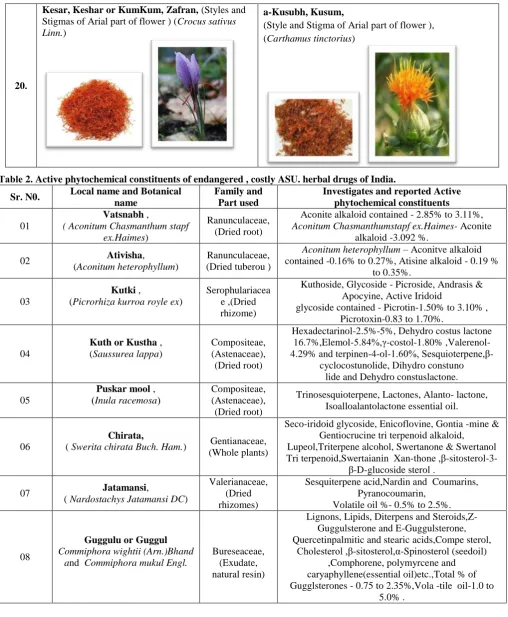
Kesar, Keshar or KumKum, Zafran, (Styles and Stigmas of Arial part of flower ) (Crocus sativus Linn.)
a-
a-Kusubh, Kusum,b-
(Style and Stigma of Arial part of flower ),c-
(Carthamus tinctorius)Table 2. Active phytochemical constituents of endangered , costly ASU. herbal drugs of India.
Sr. N0. Local name and Botanical name
Family and Part used
Investigates and reported Active phytochemical constituents
01
Vatsnabh ,
( Aconitum Chasmanthum stapf ex.Haimes)
Ranunculaceae, (Dried root)
Aconite alkaloid contained - 2.85% to 3.11%,
Aconitum Chasmanthumstapf ex.Haimes- Aconite
alkaloid -3.092 %.
02 Ativisha,
(Aconitum heterophyllum)
Ranunculaceae, (Dried tuberou )
Aconitum heterophyllum – Aconitve alkaloid
contained -0.16% to 0.27%, Atisine alkaloid - 0.19 % to 0.35%.
03
Kutki ,
(Picrorhiza kurroa royle ex)
Serophulariacea e ,(Dried rhizome)
Kuthoside, Glycoside - Picroside, Andrasis & Apocyine, Active Iridoid
glycoside contained - Picrotin-1.50% to 3.10% , Picrotoxin-0.83 to 1.70%.
04
Kuth or Kustha , (Saussurea lappa)
Compositeae, (Astenaceae), (Dried root)
Hexadectarinol-2.5%-5%, Dehydro costus lactone 16.7%,Elemol-5.84%,γ-costol-1.80% ,Valerenol-4.29% and terpinen-4-ol-1.60%, Sesquioterpene,β-
cyclocostunolide, Dihydro constuno lide and Dehydro constuslactone.
05
Puskar mool , (Inula racemosa)
Compositeae, (Astenaceae), (Dried root)
Trinosesquioterpene, Lactones, Alanto- lactone, Isoalloalantolactone essential oil.
06
Chirata,
( Swerita chirata Buch. Ham.) Gentianaceae,
(Whole plants)
Seco-iridoid glycoside, Enicoflovine, Gontia -mine & Gentiocrucine tri terpenoid alkaloid,
Lupeol,Triterpene alcohol, Swertanone & Swertanol Tri terpenoid,Swertaianin Xan-thone
,β-sitosterol-3-β-D-glucoside sterol .
07 Jatamansi,
( Nardostachys Jatamansi DC)
Valerianaceae, (Dried rhizomes)
Sesquiterpene acid,Nardin and Coumarins, Pyranocoumarin,
Volatile oil %- 0.5% to 2.5%.
08
Guggulu or Guggul
Commiphora wightii (Arn.)Bhand
and Commiphora mukul Engl.
Bureseaceae, (Exudate, natural resin)
Lignons, Lipids, Diterpens and Steroids,Z-Guggulsterone and E-Steroids,Z-Guggulsterone, Quercetinpalmitic and stearic acids,Compe sterol,
Cholesterol ,β-sitosterol,α-Spinosterol (seedoil) ,Comphorene, polymyrcene and caryaphyllene(essential oil)etc.,Total % of Gugglsterones - 0.75 to 2.35%,Vola -tile oil-1.0 to
09
Hing or Hingu,
(Ferula foetida regal ) And (Ferula narthex boiss)
Umbelliferae, (Exudate, natural resin)
Resin- 40 to 65%,Gum - 20 to 25%, Volatile oil - 4 to 20%,Sesquiterpene,
Assafoetidnol A & B, Umbellifeone, Feselol, Azulene,α -pinene, α-terpineol, α-Zulene, Vanillin, Ferulic acid, Dially ldisulfide,
Diallyl disulphfide,Luteolin.
10
Rumi Mastagi or Mastagi (Resin), (Exudate), (Pistacia lentisecus Linn)
Anacardiaceae, (Exudate, natural resin)
Resin, Volatile oil, α-bicyclicterpenoid, Triterpenic and Fatty acid compound- Oleanonic acid, Moronic acid,242-masicadienolic
acid, 242-iso-mastica dienolic acid, Triucallol,Dammarodie none,
28-naroleon-12-en-3-one, Oleonolic aldehyde.
11 Riddhi,
(Hobenaria intermedia D.Don)
Orchidaceae, (Tuber)
Dried Tuber contained Starch and Minerals with bitter Substances, Also reported Taxol compound.
12
Vriddhi,
( Habenaria edgeworthii Hook.f.ex.collett )
Orchidaceae, (Tuber)
Dried Tuber contained Starch and Minerals with bitter Substances, Also reported active Phenolic compounds.
13 Kakoli,
(Roseea purpurrea Smith)
Zingiberaceae, (Rhizome and Tuberous root)
Dried Rhizome and tuberous root cont ained Flavonoids, Alkaloids, Tannins, Saponin. Glycoside and
Active phenolic compounds.
14
Kshirakakoli, ( Fritillaria roylei) and
(Lilium polyphyllum D.Don)
Liliaceae, (Pseudobulb),
Dried pseudobulb contained Linalool and α-terpineol, β-sitosterol-3-glyceryl
-2-linoleiyl-3-linoleiate,Glyceryl-1-n-octadec-9-enoyl-2-n-decomoyl-3-n- decanoadte and Glyceryl-1-octadec-9 -enoyl-2-octadec-9,12-dienoyl-3-tetra cosanote and alkaloids Kashimirine
(imperialine), peimine, Peimisine, Propeimine, Peimiphine and Peimitidine.
15
Jeevak,
(Crepipium acuminatum (D.Don.)
Szlach.) Orchidaceae,
(Pseudobulb)
Dried pseudobulb contained alkaloid, glycoside, flavonoids, β-sitosterol, piperitone, O-methylbatatasin,1,8-cineole ,citoenoll, engenol, glucose,rhamnose, coline, limonene, p-cymene and
ceryla lcohol.
16
Rishbhak,
(Malaxis muscifera (Lindl.)Kuntze)
Orchidaceae, (Pseudobulb)
Dried pseudobulb contained bitter
substances alkaloid, glycoside, flavonoids with active derivate compounds.
17
Meda,
( Polygonatum verticillatum(Linn.)Allioni )
Liliaceae, (Rhizome and
root )
Dried Rhizome and root are contains Lysine, Serine,Aspartic acid,
Threonine,Diosgenin, β-sitosterol, Sucrose and Glucose.
18
Maha meda,
( Polygonatum cirrhifolium (wall.) Royal )
Liliaceae, (Rhizome and
root)
Dried Rhizome and root are contains Steroid terpenoide, Polysaccharides
phenol and stannin , α-L-rhamno- pyranosyl, β-D-glyco-pyranoside, Dauvosterol, β-sitosterol, Sucrose and Glucose,steroidal saponins -sibiricoside A and B, Di asgenin steroidal saponins,
19
Rakta Chandana or Sandal Surkh,
( Pterocarpus santalinus Linn.)
Papilionaceae, (Hard wood
powder)
Dried hard wood contained Santalol, Essential oil - 1.0 to 3.5%, Glycosides, colouring matter. As well as Dried seeds contained
50% fixed oil.
20
Sveta Chandana or Sandal Safed, , ( Santalum album Linn.)
Santalaceae , (Hard wood
powder)
Dried hard wood contained 80 to 93 % α- Santalol, and β- Santalol, Essential
oil- 3 to 6 %, Glycosides, colouring matter. As well as Dried seeds contained 50% fixed
oil.
21
Keshar or Kesar, KumKum, Zafran, (Crocus sativus Linn.)
Iridaceae, (Style and Stigma of arial part of flower )
Dried styles and stigmas of arial part of flowers contained active phyto -chemical constituents - Gums
- 10%, Pentosans-8.0% ,Polypeptieds-11-14%,Carotenoids-1%, Lipids -12 %, Starch-6%,Non
volatile oils -6.0 %,Volatileoils-12%,Water-10%,Fibers-(crude)-5.6%,α-Crocin-2.0%,Crocetin,
Crocin, Picrocrocine, Safranol.
22
Badam or Badam shireen,
(Prunus amygdalus Batsch.
var.dulces and Prunus cammunis fritch, Amygdalus communis
Linn.)
Rosaceae, (Seeds part)
Badam seeds parts or Almonds contained polyphenols, flavanols,
flavon-3-ols, hydroxylbenzoic acids and flavan -ones , protein, fat, sugar, glycoside, daucostrin, sito-sterol , Vitamin-E, Essential oil - 36% -60%.
23 Gulab or Gul-e-Surkh,
(Rosadamascena Mill.)
Rosaceae, (Dried flower)
Gulab flowers parts or Roses contained β-phenethyl-B-D-glycopyranoside,
Diglucoside, phenylethanol-2-hydroxy ursolic acid,β-amyrin, methyl ursalate, Geraniol,Cyanidin-3.5%, Essential oil - 0.02% -0.05% of Citranellol and Nerol
active chemical constituents .
RESULT AND DISCUSSION
It is find out focus point on the aspects of conclusive view or scientific observation that all adulterations are intentional malpractice as stated in many authenticated literatures. With our technical expertise experienced observation and investigation. It‟s communicated that the ASU. Herbal drugs are adulterated unintentionally also. Suppliers and cultivators, vendors are illiterate and not aware about their spurious as well as collection of substitute, adulterations supply. Major reasons are name confusion, non-availability and lack of knowledge about authentic plant. Even scientific community and traditional physicians (Hakeems and Vads from production ends) which has attached or deputed in production sites are unaware of it and consumed intestinally or unintentionally using as a oreganolaptic test (Panchiyainderiya parikshen) malpractice in large scale levels for achieve manufacturing target of Government and Private sector Herbal Pharmaceuticals and Pharmacies, organizations. Now today‟s demand herbal drug industries follow, high quality standards using modern techniques and instruments such as Auto-UPLC,HPTLC,GC-MS.,C13 and H1 NMR Chromatography
World Health Organization (WHO) authority for controlling adulteration, substitution, spurious drugs in ASU.
Herbal products
World Health Organization in its publication on quality standards for medicinal plant materials. recommends rejecting any batch of raw material, which has more than 5% of any other plant part of the same plant (eg. stem in leaf drugs), even though they derived from the authentic plant. Based on these standards, adulteration whether, intentional or unintentional, should be rejected. Also, suppliers and traders should be educated about the authentic sources. As the resulted conclusion and existing scientific observation, it‟s also must be need to considering high ethno botanical as well as industrial, commercial values and the endangered status of the species for conservation and sustainable utilization of critically endangered, rare costly species having preserve of high medicinal values of active phytochemical constituents., and defiantly very important should be need equally identified, climatically cultivated, officially protected for harvesting and conservation of high altitude region based growing endangered, rare species of northern region of Himachal Pradesh, Jammu & Kashmir and Uttarakhand state, northern Himalayas region. As the scientific ethnobotanical and innovated demand of protect critically endangered, costly medicinal plant species. It should be very important need to using cell culture techniques development, propagation and conservation ,cultivation, motivate forming and growing of these endangered, rare species. Also need to be tested and standardized, developed authenticated reference standard,
increase and protect for large scale forming, conservation, cultivation and sustainable utilization in climatically low temperature, high altitude growing endangered medicinal species that‟s a today needful demand for the aspect of preserve our cultural health care heritage and traditional, folk medicinal sashtra oshadhi therapy and developed, served as well as provide standard quality traditional and alternative original medicinal plant based standard quality ASU. Products to our stream nation.
ACKNOWLEDGEMENT
I grateful thanks to Prof. Dr. S.S. Jamil, Director General, Research Council (CCRUM., AYUSH., New Delhi, Govt. of India) and Dr. M.A. Waheed, Dy. Director In-Charge, CRIUM., Council research institute (CCRUM., AYUSH., M.H. & F.W., Govt. of India), Erragadda, Hyderabad-50038, A.P. State and also thankful to Mr. V.K. Sexena, Managing Director, Indian Medicines Pharmacutical Corp. Ltd.., Mohan, Almora U.K. State, (AYUSH., M.H.&F.W., Govt. of India) for providing all voluble support and necessary innovative research and extensive authenticated literature survey, data collection facility for research and documentation work background as well as I thanks to former Dean Prof. Dr. Ram Kumar paliwal, Dept. of Chemistry and Pharmacy, Gurukul Kangri University, Haridwar, Uttarakand. State, India and my research colic Dr. M.K. Hussain, SMPU., Medicinal plant survey and Botany Deptt., Research Officer (Botany), SMPU In-charge,CRIUM.,Hyderabd-38., A.P. state India for provide voluble suggestion and help ethnobotanical, taxonomical identical confirmation of endangered and rare costly species of selections and provide voluble research guidance time to time.
REFERENCES
Anonymous. Quality control methods for medicinal plant materials, World Health Organization, Geneva, 2000. Ananymous. The Unani pharmacopeia of India. 2007, Edition 1, Part-I, Vol. III. 31-32.
Anonymous, The Unani pharmacopeia of India. 2007, Edition-I, Part-I, Vol. I, 23-24.
Andola H C,Gwari G,Bhandari U, Lohani H and Chouhan N. Volatile constituents of Saussurea costus roots cultivated in Uttarakhand Himalayas. Indian Journal of Pharmacognocy Research, 2013; 5(3): 179-182.
Anonymous, The Unani pharmacopeia of India. 2007, Edition-I, Part-I, Vol. I, 85-86. Anonymous, The Unani pharmacopeia of India 2007, Edition-I, Part-I, Vol. I, 11-12. Anonymous, The Ayurvedic pharmacopeia of India 1999, Edition-I, Part-I, Vol. II, 180-182.
Afaq SH. A comparative introduction of the Unani and Tibetan medical traditions, Ayur Vijnana, 1999; 6.
Anonymous, the Drugs and Cosmetics Act and Rule, (The Drugs and Cosmetics Act 1940. The Drugs and Cosmetics Rule 1945):. Government of India, Ministry of Health and Family Welfare, 2003, chapter 2, 5.
Bisset WG, Herbal drugs & Phytopharmaceuticals, CRC Press, London1984.
Balkrishna A, Vashistha RK, Srivastva A, Mishra RK, et al. Astavarga plants-threatened medicinal herbs of the North-West Himalaya,. International Journal of Medicine and Aromatic plants, 2012; 2(4): 661-676.
Bahuguna R, Prakash V, Bisht H. Quantitative enhancement of active content and Biomass of two aconitum species through suitable cultivation technology. International Journal of Conservation Science, 2013; 4(1): 101-106.
Bahuguna R, Bisht H, Prakash V. Active content enhancement through different agrotechnological and post harvesting approaches in Picrorhiza Kurroa Royel ex benth, An endangered medicinal plant. International Journal of Biological chemistry, 6, 2012, 97-102,
Burdock GA and Carabin IG. Safety assessment of Sandal wood oil (Santalum album L.). Journal of food Chemistry Toxicology, 46, 2008, 421-432.
Chunekar KC, Bhavaprakasa Nighantu of Bhavamisra. Chaukhambha Bharati Academy, Varanasi. 2004. Chouhan NS, Medicinal and Aromatic plants of H.P, 1999, 373-374.
Chauhan RS, Noutiyal MC, Prasad P. Habenaria intermedia D.Don. An endangered medicinal orchid. The MeAllen International Orchied Society Journal, 8(10), 2007, 15-20.
Chatterjee A, Basak B, Dalla U, Baner ji J, Neuman A, Prange T. Studies on the chemical constituents of Nardostachys jatamansi DC.(Valerianaceae). Indian Journal of Chemistry, 44B, 2005, 430-433.
Dubey NK, Kumar R and Tripathi P. Global promotion of herbal medicine, India’s opportunity, Current Science, 86(1), 2004, 37-41.
De Smet PAGM, Keller K, Hansel R and Chandler RF. Adverse effects of herbal drugs. Vol.1. Springer-Verlag, Heidelberg. 1992.
Divivedi C, and Ghazaleh A Abu, Chemo preventive effects of Sandalwood oil on skin papilliomas in mice. European Journal of Cancer Prevent, 6(4), 1997, 399-401.
Gupta AK. Quality standards of Indian medicinal plants Vol. I. ICMR, New Delhi. 2003.
Javed Naqurikamran,Ansari Shahid Husain,Mohammad Ali, Iram Nazish, Phytoconstitu ents from the bulb of Lilium polyphyllum D.Don, International research Journal of Pharmacy, 2012; 3(2): 146-148.
Jamma Jabbar, Balakrish R, Ramakrishnan P Sarala, Samuel Jally CI. Comparative pharma cognostic study of Inula racemosa Hook. f. and its adulterant Coffea travanocorensis wight & Arn. Indian Journal of Natural Products and Resources, 3(3), 2012, 386-394.
Joshi P, Dhawan V, Swertia chirayita-An overview. Current Science, 89(4), 2005, 635-640.
Kokate C K, Purohit A P and Gokhele S B, Pharmacognosy. Chapter-6, Nirali Prakashan, 2007, 39th Ed, 97-98.
Kant T, Prajapati S and Parmar AK, Commiphora wightii (Guggul): An endangered Ayurvedic Divyaushidhi, 2005, 1-11. Kareparamban JA, Nikam PH, Jadhav AP and Kadam VJ. Ferula foetida “Hing”, A Review. Research Journal of
Pharmaceutical, Biological and Chemical Sciences, 3(2), 2012, 775-786. Labavitch J. Almond, United sates Dept. of Agriculture, 2001, 1-4.
Mitra SK and Kannan R. A Note on Unintentional Adulterations in Ayurvedic Herbs. Ethno botanical Leaflets, 11, 2007, 11- 15.
Mishra B, Shankar and Vaishya.R (editor): “Bhava Mishra‟s Bhavaprakasha Choukamba Sanskrit sansthan, Varanasi, UP, 10th edition, 2002.
Mukherjee PK, Quality Control of Herbal drugs, Business Horizons, New Delhi. 2002, 1st ed, 113-117.
Mohan JSS, Kalpesh B, Ishnava and Yogesh N. Mahida. In vitro assessments of antibacterial potential of Commiphora wightii (Arn.): Bhendari gum extract. Journal of Pharmacognosy and Phytotheraphy, 2(7), 2010, 91-96.
Nulu JR, Singh CU. Sandalwood oil and Santalols for treating cold sores and herpes, 2010.United State patent publication N0.US7858126B2.
Okugawa H, Ueda R, Mats umoto K et al. Effect of alpha-Santalol and beta-Santalol from sandalwood on the central nervous system in mice. Journal of Phyto medicines, 2, 1995, 119-126.
Paulpandi M, Kannan S, Thangam R, Kaveri K, Gunasekaran P and Rejeeth C. In vitro anti-viral effect of β-santalol against influenza viral replication. Journal of Phyto medicine, 19, 2012, 231-235.
Paraschas S, Magiatis P, Mitakou S et al. In vitro and vivo activities of chios mastic gum extracts and constituents against Helicobacter phlori, Antimicrobial Agents. Chemother Journal, 51(2), 1990, 551-559.
Pandeya G, Caraka Samhita of Agnivesa with Cakrapanidatta Tika. Chaukhambha Sanskrit Sansthan, Varanasi. 1997. Poornima B, Adulteration and substitution in herbal drugs a critical analysis. IJRAP, 1(1), 2010, 8-12.
Robinson A, Kumar V, Rao JM, Srinivas PV, Babu KS, et al. A new sesquiterpene lactone from the roots of Saussurea lappa, Structure - anticancer activity study. Bio organic and medicinal chemistry letters, 18, 2008, 4015-4017.
Roy Anirban Mallick Arindam Kaour Amrinder. Adulteration and substitution in Indian medicinal plants, IJPRBS, 2(1), 2013, 208-218.
Sharma K R, Sood S K, Singh V B. Effect of diurnal variability and storage conditions on essential oil content and quality of damask rose.(Rosa damascene Mill.): flowers in north weston Himalayas. Scientia Horticulture, 154, 2013, 102-108. Soler et al. Oil content and fatty acid composition of developing almond seeds. Journal of Agriculture food chemistry, 36(4),
1988, 695-697.
Srivastava R, Ahmed H, Dixit RK, Dharamveer and Saraf SA. Crocus sativus L, A Comprehensive review. Journal of
Pharmacognosy review, 4(8), 2010, 200-208.
Sharadini A,Dahanukar et al. Immunostimulants in Ayurvedic medicines, Immuno- modulatory agents from plants, edited by Wagner H, Switzerland, 1999, 316
Shah NC, Zare Amir. Asafoetde (Heeng): the well know medicinal condiment of India & Iraq. Herbal Tech Industry Journal, 10(41), 2013, 1-8
Sabinsa Corp, Commiphora mukul, The plant source of Gugulipid. 2000.
Sharma ML. Comparative chemical analysis of oleogum resin of Commiphora wightii Arnott. Bhandari. Currenet Science, 66(1), 1994, 9-10.
Sarkar PK, Prajapati PK, Pillai APG, Chauhan MG, Chuhan. Pharmacognosy of aconite sold under the name Vatsanabha in Indian market. Indain Journal of Traditional Knowledge, 11(4), 2012, 685-696.
Singh AP. Kuthins. A Review of Chemistry and Pharmacology, Ethnobotanical leaf lets. An International Journal of Ethnobotanical Research, 1(9), 2004, 1-5.
Shah Biren and Seth AK. Test book of pharmacognosy & phytochemistry , Drug Adulteration Chapter 10, 2010, 107-109 Sastry R, Bhaishajya Ratnavali of Govind Das Sen. Varanasi, Chaukhamba Sanskrit Bhavan, 2002.
Shastri Ambikadatta “Baishajya Ratnavali” Chaukambha Sanskrit Sansthan, Varanasi, U.P.18th Ed, 2005.
Sarin YK. Illustrated Manual of Herbal drugs used in Ayurveda and Unani, Joint Publication of C.S.I.R and I.C.M.R, New Delhi. 1996.
Saraswathy A. Adulterants and substitutes in Ayurveda. Sachitra Ayurved, 54(1), 2001, 63-66. Sunita G. Substitute and adulterant plants, Periodical Experts Book Agency, New Delhi, 1992.
Tewari NN. Some crude drugs, source, substitute and adulterant with special reference to KTM crude drug market. Sachitra Ayurved, 44(4), 1991, 284-290.
Uniyal MR and Joshi GC. Historical view of the basic principles of the identification of controversial drugs, problems and suggestions. Sachitra Ayurved, 45(7), 1993, 531-536.
Uniyal Mayaram. Astavarga Sandigdha Vanaushadhi,Dhanwantri Patrika,Shri Jwala Ayurvedic Bhavan Aligharh,1975. Uniyal Mayaram. Medicinal plants and minerals of Uttarakhand Himalaya, Baidyanath, Ayurved Shodh Sansthan, Patna,
1987, 168-233.
Uniyal Mayaram. Medicinal Flora of Garhwal Himalya shree Baidyanath Ayurvedic Bhavan, Nagpur, 1989.
Uniyal Mayaram. Medicinal plants and minerals of Uttarakhand Himalaya, Baidyanath, Ayurved Shodh Sansthan, Patna, 1997.
Venkatachalam M, Sathe SK. Chemical composition of selected edible nut seeds. Journal of Agriculture Food chemistry, 54(13), 2006, 4705-4714.
Vasudevan NairK,Yoganarasimhan KR, Kehava Murthy and Shantha TR. Studies on some south Indian market samples of Ayurvedic drugs II. Ancient Science of Life, 3(2), 1983, 60-66.
Wang Z, Hang X. Comparative GC analysis of essential oil in imported sandalwood. Zhagguo Zhong Yao Za Zhi, 16(64), 1991, 40-43.
Warnke PH. et al. The battle against multi resistant strains, renaissance of antimicrobial essential oils as a promising force to fight hospital acquired infection. Journal of Carnio Maxilliofacial Surgery, 37, 2009, 392-397.