INTERNATIONAL JOURNAL OF ENGINEERING SCIENCES &
MANAGEMENT
ENERGY EFFICIENT LOCATION BASED DREAM ROUTING PROTOCOL IN
MANET
Avinash Rai*, Dr. Tripti Arjariya
*MTech. Scholar in Dept. of CSE, Bhabha Engineering Research Institute, Bhopal, India
Dept. of CSE, Bhabha Engineering Research Institute, Bhopal, India
ABSTRACT
In Mobile Ad hoc Network (MANET) nodes are free to move in a surrounding area with random mobility speed, because of that the connection lost and re-establishment consumes more energy in routing. In this paper we proposed a new energy efficient location based DREAM routing for improving the routing performance and energy utilization in MANET. If a link is broken in the route due to lack of energy or move away from each other out of range, then the route information will become destroyed from the nodes, that are be the part of established link in network. The lifetime is described as the energy of nodes is remains up to able for communication in network. The only AODV routing protocol are not able to handle the connection stability in dynamic network because of On-demand routing procedure. In Proposed approach, a route consists of multiple links in series. Link is formed by two adjacent nodes which has the limited power and can move freely with itself mobility speed the DREAM has maintain the current location information with its mobility speed. The location DREAM protocol is play a vital role for maintaining the location of mobile nodes by that the flooding of packets are minimize and routing load decreases delay minimizes and throughput and PDF maximizes. The packets sending and receiving is also more in a given simulation time of proposed scheme that shows the more energy utilization and prolog the network life time.
Keywords: Energy, MANET, DREAM, Routing, Location, AODV.
INTRODUCTION
Mobile Ad Hoc Network (MANET) [1, 2] is a completely wireless connectivity through the nodes constructed by the actions of the network, which usually has a dynamic shape and a limited bandwidth and other features, network members may be inside the laptop, Personal Digital Assistant (PDA), mobile phones, MP3 players, and digital cameras and so on. In a MANET, the user's mobile devices are in the network, and they must cooperatively provide the functionality usually provided by the network infrastructure (e.g., routers, switches, servers). In a MANET, no infrastructure is required to enable information exchange among user's mobile devices. We can envisage these devices as an evolution of current mobile phones, and emerging PDA's equipped with wireless interfaces.
Mobile Ad hoc networks can be subdivided into two classes like static and mobile. In static ad hoc networks the position of a node may not change once it has become part of the network. In mobile ad hoc networks, systems may move arbitrarily. Examples where mobile ad hoc networks may be employed are the establishment of connectivity among handheld devices or between vehicles. Nodes in a MANET operate with batteries and can roam freely, and thus, a node may exhaust its energy or move away without giving any notice to its cooperative nodes. This will cause the changes in network topology. The development of an efficient routing protocol that can provide high-quality communications among mobile hosts, this is One of the important and challenging problems in the design of ad hoc networks.
Routing in MANETs has been an active area of research and in recent years numerous protocols have been introduced for routing in dynamic network [3]. A key issue is the necessity that the Routing Protocol must be able to respond rapidly to the topological changes in the network. In this dynamic network, each node must be capable of acting as a router. As a result of limited bandwidth of nodes, the source and destination may have to communicate via intermediate nodes [4]. Major problems in routing are Asymmetric links, Routing Overhead, Interference, Dynamic Topology and uncertain energy depletion
ENERGY EFFICIENT PROBLEM IN MANET
number of nodes used to establish connectivity, minimize the control overhead and so on) and at maximizing the life span should be considered. As a result of the energy constraints placed on the network’s nodes, designing energy efficient routing protocols is a crucial concern for MANETs, to maximize the lifetime of its nodes and thus of the network itself [5, 6]. Energy is consumed in Mobile Ad Hoc network during the transmission and reception of data, propagation of control packets, retransmission and eavesdropping. The location based DREAM [7] protocol is maintain the location information of mobile nodes to reduces the routing packets flooding. We concentrate in reducing the power consumption during the transmission and reception of data. Each node in Wireless Ad Hoc network transmits data with the maximum energy and also in transmission maximum energy is consumed Wireless Ad Hoc network. Also the mobile nodes expend some energy in transmission and reception of data. We have utilized the metrics received signal strength, link quality and the distance between the nodes to compute the energy required to transmit the data from a node to its neighboring node. The energy computed is involved in the selection of the optimal path which requires minimum energy to route the data from source to destination [8].
PREVIOUS WORK DONE IN FIELD OF ENERGY
Several energy-efficient techniques are proposed to reduce energy consumption in MANET. These techniques use energy aware metrics to establish a path in a network. Some of them are motioned here.
In this research [1] paper is presenting an Energy-Efficient Routing protocol that will improve the utilization of link by balancing the energy consumption between utilized and underutilized nodes to meet the above challenge. The protocol deals with various parameters as Residual Energy, Bandwidth, Load and Hop Count for route discovery. The failure of any node in the route when the transmission of data packet is in progress leads to the degradation of the QoS (Quality of Service). To overcome with this issue, the paper proposes two methods for maintenance of the route.
Wei Liu et. al has proposed “DELAR: A Device-Energy-Load Aware Relaying Framework for Heterogeneous Mobile Ad Hoc Networks” [9] and researcher focus work on the cross-layer designed Device-Energy-Load Aware Relaying framework, named DELAR, to achieve energy conservation from multiple facets, including energy-aware routing, transmission scheduling and energy control. In particular, they design a novel power-aware routing protocol that satisfactorily incorporates device heterogeneity, nodal remaining energy information and nodal load status to save energy. In addition, they develop a hybrid transmission scheduling mechanism, which is a mixture of reservation-based and contention-based medium access control schemes, to coordinate the data transmissions. Moreover, the novel notion of “mini-routing” is introduced into the data link layer and an Asymmetric MAC (A-MAC) scheme is proposed to support the MAC-layer acknowledgements over unidirectional links caused by asymmetric transmission power levels between powerful nodes and normal nodes.
Ying Zhu et. al has been proposed a “Energy-Efficient Topology Control in Cooperative Ad Hoc Networks” [10] in this work researcher introduce a new topology control problem: name is energy-efficient topology control problem with cooperative communication, and proposed two topology control algorithms to build cooperative energy spanners in which the energy efficiency of individual paths are guaranteed. both proposed algorithms can be performed in distributed and localized fashion while maintaining the globally efficient paths by proposed mechanism and control the topology change behaviour on the bases of energy efficient mechanism.
Vinay Rishiwal [11] in his work titled “Power Aware Routing in Ad Hoc Wireless Networks” they propose an efficient algorithm and maximize the network lifetime by minimizing the power consumption during the source to destination route establishment. As on thier case study proposed algorithm has been incorporated along with the route discovery procedure of AODV and by simulation it is observed that proposed algorithm’s performance is enhanced as compare to AODV and DSR in terms of various energy base parameters like total Energy Consumption, Average Energy Left Per Alive Node, Node Termination Rate, and Network Lifetime for different network scenarios.
of GPS. Location aided Energy-Efficient Routing protocol (LEER) protocol finds out the all-possible paths from source to destination and selects minimum energy path to route the packets. The selection of next hop node is based on whether it is situated near to destination than to source as well as transmit power of that node.
Natarajan Meghanathan in [13] proposed a new MANET routing protocol called “Location Prediction Based Routing” (LPBR) protocol that simultaneously minimizes the number of route discoveries as well as the hop count of paths used for a source-destination session. We assume all the nodes are position-aware using techniques like Global Positioning Systems (GPS) and the clocks across all nodes are synchronized. This indicates the effectiveness of the location prediction approach in LPBR. As there exist no single routing protocol that simultaneously minimizes the number of route discoveries as well as the hop count per path.
Niranjan Kumar Ray and Ashok Kumar Turuk have discussed different energy efficient techniques for wireless ad-hoc network [14]. One of the techniques is based on reduction of number of route request messages. In second Power control technique, next hop node is chosen depending on the power level of the node. Topology control technique is used to remove the energy-inefficient link from the network by examining the power level of the node. This technique helps network devices to take decision about their transmission range.
PROPOSED ENERGY EFFICIENT DREAM ROUTING
The Energy efficient DREAM Location based routing protocols that know the physical Location of the nodes have a feature to restrict the propagation of RREQ packets in surrounding range. However, the geographic knowledge is not available in many scenarios. Many routing protocols use historical information to restrict the RREQ flooding within a limited region of the network. The initial battery capacity of nodes is in joules and considered different initial energy of each node. This initial energy is progressively reduced by data transmission/reception. When it reaches zero units, the corresponding node cannot take part any more in the communication, and is regarded as died. The proposed simulation has done in two modules first is Energy based AODV routing (EAODV) and second is Energy efficient routing with DREAM location protocol (EAODV-DREAM). The proposed DREAM protocol is minimizes the routing flooding, that is the main cause of energy consumption and energy is only utilized for connection establishment as for it is utilized for data delivery in dynamic network.
Proposed Algorithm for proposed (Energy Efficient On demand Routing No. of Nodes = Nn //Total Mobile Nodes
Set Source nodes = Sn //Sn € Nn
Set Destination Nodes = Dn // Rn € Nn
Intermediate nodes = (Nn - (Sn + Dn ) ) = In
Nodes Energy = ENn
Routing Protocol =AODV Location Protocol=DREAM Start simulation time = t0
End Simulation Time= tn
Radio Range of Mobile Nodes = RRange; //Initialize radio range AODV Broadcast RREQ (S, R, RRange)
{
If ((RRange <=550) && (Next_hop information == True) && (ENn >0) // Next hop available
{
route_table->insert(rtable->next_hop informatiom); // Next_hop to RREQ by source route_table 1->insert(rtable1->next_hop); // Next_hop to RREQ to destination
route_tablen ->insert(route_tablen->next_hopn); // Next_hopn to RREQ destination
RREP In to S n || RREP In +1 to In
if (Destination==Found) {
Send Connection Confirmation with extra field of (Nodes Speed and Location coordinate value) with rtable1;
Data_Packet_Send (s_no, nexthop, type)
Sn, Dn , In Maintain Location through DREAM with respect to each other;
else {
destination not found; }
} else {
destination un-reachable ;
} }
In the absence of positioning service, we need a method to estimate the distance or direction to the destination. In the absence of it, for every transmission same source has again flooded the packets for connection establishment is all direction. Thus, we combine the DREAM position based routing features into On demand AODV routing protocols with DREAM and propose an location based routing protocol (EAODV_DREAM) to improve the route discovery.
SIMULATION TOOL DESCRIPTION
Network Simulator version 2 (NS-2) is an open source event driven simulator [15] designed specifically for research in computer communication networks. Since its inception in 1989, NS2 has continuously gained tremendous interest from industry, academia, and government. Having been under constant investigation and enhancement for years, NS2 now contains modules for numerous network components such as routing, transport layer protocol, application, etc. To investigate network performance, researchers can simply use an easy-to-use scripting language to configure a network, and observe results generated by NS-2
The standard NS-2 distribution runs on Linux. However, a package for running NS-2 on Cygwin (Linux Emulation for Windows) is available. In this mode, NS-2 runs in the Windows environment on top of Cygwin [16].
Simulation Parameters
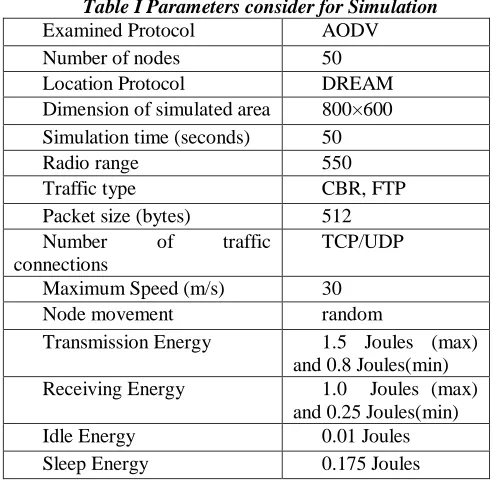
The traffic connection is of type TCP and UDP and the traffic type is of CBR and FTP. These are also mentioned in table 1 these simulation parameters are also varying according to the different
Table I Parameters consider for Simulation
Examined Protocol AODV
Number of nodes 50
Location Protocol DREAM
Dimension of simulated area 800×600
Simulation time (seconds) 50
Radio range 550
Traffic type CBR, FTP
Packet size (bytes) 512
Number of traffic
connections
TCP/UDP
Maximum Speed (m/s) 30
Node movement random
Transmission Energy 1.5 Joules (max)
and 0.8 Joules(min)
Receiving Energy 1.0 Joules (max)
and 0.25 Joules(min)
Idle Energy 0.01 Joules
Sleep Energy 0.175 Joules
Performance Metrics:
In our simulations we use several performance metrics to compare the proposed AODV protocol with the existing one. The following metrics were considered for the comparison is as follows:-
Packet delivery fraction (PDF): The ratio between the numbers of packets sends by source nodes to the number of packets correctly received by the corresponding destination nodes.
End to End delay:- Measure as the average end to end latency of data packets. The delay between the data transmission and receiving in network.
Normalized routing load: Measured as the number of routing packets transmitted for each data packet delivered at the destination.
SIMULATION RESULTS DESCRIPTION
The simulations are aimed to examine the performance of packet forwarding schemes. Because of this, the energy consumption in idle mode is ignored and set to zero, which means that a node will not consume any energy while listening for traffic on the wireless channel.
PDR Analysis of EAODV and Proposed EAODV-DREAM
The number of packets sends and received in network is represents the network routing performance. In dynamic network the possibility of link breakage is more due to that the loss of energy of intermediate nodes that be a part of connection in MANET. The percentage ratio of send data and received data is evaluated through the metrics PDR. The Packet Deliver Ratio (PDR) of normal EAODV and proposed EAODV-DREAM routing performance is illustrated in this graph. The PDR performance of proposed location based scheme is about more than 95% up to end of simulation but the normal energy efficient performance is no more than 85% and at the end of simulation PDR is about 77% in network. The proposed scheme utilized the energy consumption and provides better packets percentage performance in network.
Fig.1.1 PDR Analysis
Control Overhead Analysis of EAODV and Proposed EAODV-DREAM
Fig.1.2 Control overhead Analysis
Throughput Analysis of EAODV and Proposed EAODV-DREAM
The energy of mobile node in infrastructure less network is the limited resource for function. The each and every function has consumes the energy for completing. The number of packets in unit time is measured from the performance metrics throughput in MANET. Greater number packets receiving are showing the better energy efficient performance in network. The location based routing is reduces the overhead of flooding by maintaining the location information of nodes that are participate in routing. In this graph the performance of normal EAODV is about 900 packets in unit time at the end of simulation but the performance of proposed EAODV-DREAM location based protocol is about more than 1200 packets in a unit time. The location based routing is reduces the energy consumption and provides better energy efficient routing performance.
Fig.1.3 Throughput Analysis
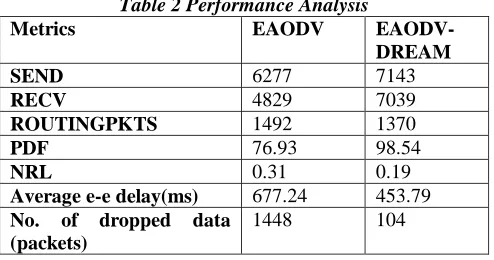
Summarized Performance Analysis of EAODV and EAODV-DREAM
improves by receiving more packets, that perk up the energy utilization and reduces unnecessary energy consumption due to packet drop in network
Table 2 Performance Analysis
Metrics EAODV
EAODV-DREAM
SEND 6277 7143
RECV 4829 7039
ROUTINGPKTS 1492 1370
PDF 76.93 98.54
NRL 0.31 0.19
Average e-e delay(ms) 677.24 453.79
No. of dropped data (packets)
1448 104
CONCLUSION & FUTURE WORK
In Mobile Ad hoc Network, energy efficient routing techniques are necessary to minimize the total power consumption of all the nodes in the network in order to maximize its life span. The mobiles nodes in MANET are consume power for communication and other activities like RREQ, RREP and Sensing. The energy cost is calculated using realistic energy consumption of mobile nodes at the time routing in network. The Proposed Location based DREAM with Energy AODV (EAODV) routing protocols can efficiently control the flooding of packets in every direction by that energy consumption utilizes in data delivery as compare to propagation routing packets. In addition, in the proposed approach the DREAM protocols need to maintain the position of the destination as respect to all other nodes that are interact or participating in routing. To maintain the location table accurately, each node needs to periodically broadcast its own coordinates to the network, which incurs additional overhead. Since conventional on demand routing protocols do not have any positioning service, it is difficult to exactly control the propagation of RREQ packets. The EAODV-DREAM is improves the network performance and utilizes energy consumption in MANET.
The MANET is easily influence from attackers due to that the network performance and resources like bandwidth and energy are wasted. In future, we try to do research efforts in field of security in MANET.
REFERENCES
[1] Supriya Srivastava, A.K. Daniel, R. Singh and J.P. Saini, "Energy-Efficient Position Based Routing Protocol for Mobile Ad Hoc Networks"2012 International Conference on Radar, Communication and Computing (ICRCC),SKP Engineering College, Tiruvannamalai, TN., India, pp.18-23, 21-22 December, 2012.
[2] C. E. Perkins "Ad hoc Networking" Addison-Wesley, Upper Saddle River, NJ, USA, 2001.
[3] Anuj K. Gupta, Harsh Sadawarti, & Anil k. Verma “Review of various Routing Protocols for MANETs,” International Journal of Information and Electrical Engineering, ISSN: 1109-2742, Vol. 1 No. 3, pp. – 251-259, 2011.
[4] Chai K Toh, "Ad Hoc Mobile Wireless Networks Protocols and Systems", Prentice Hall, 2002.
[5] G. Girling, J. Li Kam Wa, P. Osborn, R. Stefanova, “The Design and Implementation of a Low Power Ad Hoc Protocol Stack”, IEEE Personal Communications, 2000.
[6] Y. Hu, D. Johnson, A. Perrig, “SEAD: Secure Efficient Distance Vector Routing for Mobile Wireless Ad hoc Networks”, Vol. 1, No. 1, pp. 175-192, July 2003.
[7] S. Basagni et al., “A Distance Routing Effect Algorithm for Mobility (Dream),” Proc. 4th Annual ACM/IEEE International Conference on Mobile Computing and Networking, MOBICOM ’98, pp. 76–84,Dallas, TX, USA, 1998.
[8] K. Arulanandam, Dr. B. Parthasarathy, "A New Energy Level Efficiency Issues in MANET" International Journal of Reviews in Computing(IJRIC), pp. 104-109, 2009.
[9] Wei Liu, Chi Zhang et. al, DELAR: A Device-Energy-Load Aware Relaying Framework for Heterogeneous Mobile Ad Hoc Networks, IEEE journal on selected areas in communications, vol. 29, no. 8, September 2011. [10]Ying Zhu, Minsu Huang, Siyuan Chen, and Yu Wang, Energy-Efficient Topology Control in Cooperative Ad
[11]Vinay Rishiwal , Mano Yadav , S. Verma and S. K. Bajapai, Power Aware Routing in Ad Hoc Wireless Networks, JCS&T Vol. 9 No. 2, October 2009.
[12]Dahai Du & Huagang Xiong, “A Location aided Energy-Efficient Routing Protocol for Ad hoc Networks”, 19th Annual Wireless and Optical Communications Conference (WOCC), pp1-5,2010.
[13]Natarajan Meghanathan, "A Location Prediction Based Routing Protocol and its Extensions for Multicast and Multi-path Routing in Mobile Ad hoc Networks", Mobile Ad-Hoc Networks: Protocol Design, Prof. Xin Wang (Ed.), ISBN: 978-953-307-402-3, In Tech, Available from: http://www.intechopen.com/books/mobile-ad-hocnetworks protocol-design/a-location-prediction-based-routing-protocol and-its-extensions-for-multicast-andmulti-path-routing, 2011.
[14]Niranjan Kumar Ray & Ashok Kumar Turuk, “Energy Efficient Techniques for Wireless Ad Hoc Network”, International Joint Conference on Information and Communication Technology, pp.105-111, 2010
[15]The VINT Project. The network simulator - NS-2. http://www.isi.edu/nsnam/ns/. Page accessed on Feb 22th,
2015.