e
-ISSN: 2278-067X,
p
-ISSN : 2278-800X, www.ijerd.com
Volume 5, Issue 4 (December 2012), PP. 08-17
Optimized Controller Using LQG Approach for A
Nonlinear Process
Shijin C.S.
1, Manjith B.C.
21Department of Electronics and Communication Engineering, Lourdes Matha College of Science & Technology,
Trivandrum, Kerala, India
2
Department of Computer Science & Engineering, Lourdes Matha College of Science & Technology, Trivandrum, Kerala, India
Abstract:- This paper attempts to bring out a new PID control strategy to provide Optimized Control for a process. The proposed method has the advantage that it takes into account all the parameters variations associated with the process. The variations in the process parameters are modelled as a gaussian noise and an adaptive gaussian filter is placed in the feedback path. The adaptive gaussian filter in the feedback path adapts its filter coefficients based on a kalman estimation algorithm. This adaptive filter adapts so as to maintain the mean square error a minimum. The LQG (Linear Quadratic Gaussian) in Optimized Control is used in designing of the proposed strategy. The performance of the proposed controller is compared with existing adaptive control techniques also. The results validate the strength of the proposed strategy.
Keywords:- Optimized controller, Nonlinear Process, PID, Industrial Process, LQG, Kalman Estimation Algorithm, Adaptive control techniques.
I.
INTRODUCTION
PID controllers have dominated the process control industry over the decades owing to its associated simplicity and easiness in implementation. The needs for better control strategies for process control in order to achieve better performance have always motivated research interests. The design of PID controllers, tuning involves selecting the amounts of Proportional, Integral and Derivative components required at the output of the controller. The design of the optimum values for the PID controller parameters has always been challenging. Many new tuning techniques have been developed for the design of PID controllers, however then still exists a scope for better tuning method.
Alternatives for PID control have led to better-advanced control strategies. The fuzzy controllers and neural controllers are some of the results of this. However the combination of these different control strategies in process control is still to be explored.
In the present work a combination of the control strategies in the control of a heat exchanger is explored [33]. A comparative study of the PID control strategies to control a heat exchanger is made [32]. The different control strategies are studied individually and also in combination, in controlling the process. The optimized control of the heat exchanger process is explored in this work [34]. The PID controllers used in the control are tuned using the conventional tuning methods of Zeigler- Nichols tuning and Cohen- Coon tuning. A mathematical model of the heat exchanger is developed and this is used in the study of the control strategy of the process.
II.
LITERATURE
SURVEY
In real world process control problems, among the varieties of controllers the PID mode has proved its outstanding identity. This research work progress from the base knowledge [3], „PID control system analysis and design‟.
The transfer function of a PID controller is often expressed in the ideal form
(1.1)
)
T
T
1
(1
K
E(s)
U(s)
(s)
G
DS IS P
PID
Where U(s) is the control signal acting on the error signal E(s), KP is the proportional gain, TI is the
integral time constant, TD is the derivative time constant, and s is the argument of the Laplace transform. A PID
improves transient response and stability is often wrongly expounded. Practitioners have found that the derivative term can degrade stability when there exists a transport delay. Even though, for optimum performance KP, KI and KD have to be tuned jointly, knowledge about the impact of individual variation is a matter of interest.
Table 1. Effects of independent P, I & D tuning on closed-loop response
Rise Time Overshoo
t Settling Time
Steady-state
Error Stability
Increase KP Decrease Increase Small
Increase
Decrease Degrade
Increase KI Small Decrease Increase Increase Large
Decrease
Degrade
Increase KD Small Decrease Increase Decrease Minor
Change
Improve
While matters concerning commissioning and maintenance (such as pre- and post-processing as well as fault tolerance) also need to be considered in a complete PID design. Controller parameters are usually tuned so that the closed-loop system meets the following five objectives:
1. Stability and stability robustness, usually measured in the frequency domain 2. Transient response, including rise time, overshoot, and settling time 3. Steady-state accuracy
4. Disturbance attenuation and robustness against environmental uncertainty [8], [10], often at steady state
5. Robustness against plant modelling uncertainty [7], usually measured in the frequency domain. The methods adopted for tuning are heuristic method, frequency response method and analytical method.
In [1], the narration includes design of neural net controller for nonlinear plants, synthesis of nonlinear controller, training of neural network controller [30] etc. It is hard to obtain satisfactory control results only by simple PID algorithm for process with distinct characteristics of nonlinear and strong stochastic disturbance. A parameter adaptive self-tuning algorithm has certain requirements for the precision of system models, because its parameter adaptive of self-tuning are based on identification of controlled system model. If the model has distinct characteristics of nonlinear, it will lead to long span of calculation and heavy costs of hardware. Advanced Process Control (APC) algorithm designs a neural net controller for nonlinear plants, to resolve the above problems through the following stages.
Synthesis of linearized model of nonlinear plants around relevant operating points is followed by synthesis of linear optimal control law using Generalized Predictive Control (GPC) algorithm. The neural network controller training is done depending on the data samples thus obtained [31]. The neural network controller is trained by a series of training samples produced by time varying linear controller combining with input/output samples of the original nonlinear process [21].
The training algorithm is similar to back propagation algorithm used in modelling of neural network [35]. But the training algorithm uses the error between output of time varying linear controller and output of neural net controller to adjust the neural net weight factor in order to obtain the object of learning and training. [2], describes a scheme of performance-adaptive PID controllers. According to the proposed control scheme, the output prediction error is monitored regularly and system identification is initiated if this error exceeds a user-defined threshold.
Most over damped processes can be sufficiently well approximated by a first-order system with a time-lag element as follows:
(1.2)
e
Ts
+
1
K
=
G(s)
-LsWhere K, T and L denotes the system gain, the time-constant and the time-lag respectively. The controlled object is given by the following equation:
(1.3)
e
100s
+
1
0.5
=
G(s)
-45sThe discrete-time model corresponding to the above equation is considered, where the sampling interval is Ts = 10.0[s], and this system is disturbed by Gaussian white noise with mean and variance
0.001.
The combination of PID and fuzzy controller is expected to give better results. [4], focus on the experienced results of Simple Tuning Algorithm (STA) for fuzzy controllers. The fuzzy controllers have only one variable to be adjusted to achieve optimum performance, in contrary to PID controller, which has 3 parameters to be adjusted to achieve the same optimum performance. The real strength of PID controller is its simplicity to understand, explain and implement. But the fluctuations in environmental conditions and the disturbances add complexity to the controller design.
The tuning of fuzzy controller is a heuristic work and sometimes becomes overwhelming to find the optimal parameters. The tuning process of PID controllers using Ziegler-Nichols method is more complex than the above. But applying STA for tuning fuzzy controllers facilitates flexibility to the tuning process, since STA needs only the tuning factor to do it.
In conclusion, fuzzy controller tuned through STA is viable and effective, hence can replace PID controllers [25] in real world applications. [5] deals with fuzzy PID controller proposed by incorporating all the merits of both fuzzy and auto tuning PID controls. In recent years, the auto tuning methods for classical PID controller structures, were utilizing phase and gain margin, as they are important measures of closed loop system characteristics. The tuning method in [5] is also similarly based on phase and gain margin and these two are determining the parameters of a fuzzy-PID controller [24].
The proposed fuzzy PID controller is a fuzzy system that implements a multimode controller, where all the component controllers are of fuzzy self-adjusting PID kind. The practical running result of the proposed method in [5], possess characteristics of reasonable design, operating convenience, quick response, better stability, enhanced adaptability, robustness to process, small commissioning time and reduced debugging time. In [6], architecture of neuro fuzzy controller, its learning and decision making mechanism and practical implementation aspects are organized. Satisfactory control of industrial process sometimes fails due to lack of suitable process models or its inaccuracy or complexity. In [6], the proposed fuzzy controller building technique is particularly effective in dealing with or based on linguistic, qualitative and rule based control strategy.
The proposed technique formulates the knowledge combining artificial neural network with fuzzy logic resulting in neuro fuzzy structure. In other words, the proposed method utilizes artificial neural networks as tools in fuzzy models, yielding fuzzy neural network. In [6], industrial controller designed with neuro fuzzy model is based on Sugeno-type fuzzy inference. The fuzzy system employed as the controller can be tuned itself by the neural network mechanism based on gradient descent technique. The controller is implemented with M-file and Graphic User Interface (GUI) of Mat lab program. From the practical comparison results, the proposed controller performance is more robust than the PID systems.
III.
PROPOSED
METHOD
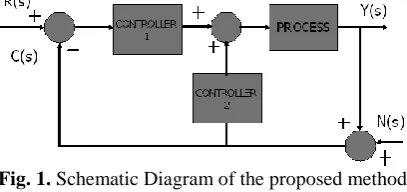
In usual process control strategies the set point of specific controller employed define the desired level of the process output variable. But in dealing with highly sophisticated process control, where much stability and accuracy are expected, probably perturbations may interfere and disturb the output variable. This disturbance is caused as the perturbations are getting fed back through the error detector to the controller. Generally extreme stability of the controller parameters is appreciable, as the parameter drift may also disturb the output variable. Hence the optimization of the controller is significant. It enhances stability over parameters and makes the system ultimately immune to perturbations. The resulting system can be viewed as a sort of adaptable control methodology. The goal is accomplished by employing an extra controller, obligated to nullify the external interferences and parameter drifts. It is obvious from the furnished schematic representation that the extra controller is in the feedback loop [29].
Fig. 1. Schematic Diagram of the proposed method
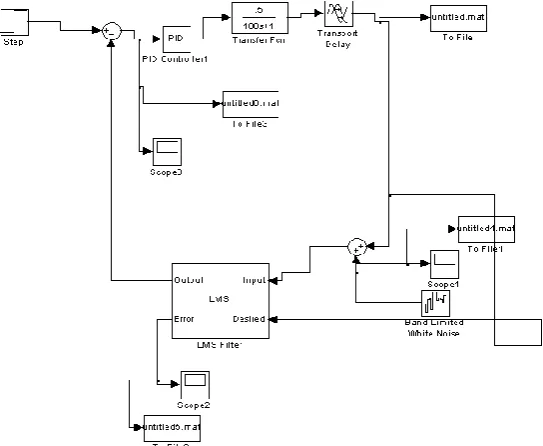
When moving towards the hypothesis testing, both the controllers are supposed to be PID controllers [26], [27], band limited white noise as the disturbance and the process as a first order lag plus delay (FOLPD) one [15], [23]. A first order lag plus delay process is appreciable because every industrial process can be easily approximated to an FOLPD process [22], [28]. Manipulative analysis of the response of the resultant makes it obvious that the perturbations cannot be suppressed beyond an extent. The SIMULINK block realization is as pictured below.
Fig. 2. Simulink Block Diagram of the Proposed Method
The above pointed intrications lead to think about other common strategies of robust control. They are 1. Linear Quadratic Regulator (LQR) and
2. Linear Quadratic Gaussian (LQG)
The linear quadratic regulator included in the feedback minimize mean square error e2(t), when its coefficients are designed appropriately. Mean square error is a derived variable of the error signal to the controller e(t). The response of LQR corresponding to heavy and fast variations in the process output is much poor and the same may not effectively serve the purpose of a totally robust controller [12].
But linear quadratic gaussian (LQG), a cascaded of linear quadratic regulator and a filter, quite effectively nullify variations in the form of gaussian noise. The filter is a Kalman filter with its coefficients adaptive. This adaptation is done so as to make the reference signal equal to the actual signal, making the error zero. More technically the robust controller like this includes a PID controller and a LQG. In order to validate the performance a band limited white noise has been probably applied. The implementation of the system is done using Kalman filter adapted using a Least Mean Square algorithm and the schematic of the same is furnished below.
Fig. 3. Optimal Controller which includes a PID and a LQG filter in the feedback path
without becoming significant, much below 2% or 5% of the peak over shoot. The SIMULINK block representation is as follows.
Fig. 4. Optimal Controller with a PID controller, a LQG filter and a Gaussian Noise
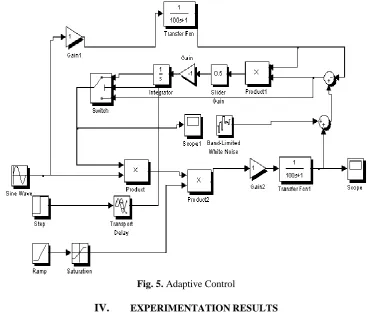
Adaptive control involves modifying the control law used by a controller to cope with the fact that the parameters of the system being controlled are slowly time varying or uncertain [11]. For example, as an aircraft flies, its mass will slowly decrease as a result of fuel consumption; we need a control law that adapts itself to such changing conditions. Adaptive control is different from robust control [9] in the sense that it does not need a priori information about the bounds on these uncertain or time-varying parameters; robust control guarantees that if the changes are within given bounds the control law need not be changed [13], while adaptive control is precisely concerned with control law changes. Such an adaptive control scheme, put forth, is as follows.
Fig. 5. Adaptive Control
IV.
EXPERIMENTATIONRESULTSWhen the process was conveniently approximated to first order lag plus delay one, band limited white noise effectively modelled the parameter variations. Apart to parameter drifts, band limited white noise is a symbolic of probable noise interference also.
Fig. 6. Noise modelled as a result of the parameter variations
Disturbance at the output end of process is usually caused, as the perturbations are getting feedback to. Means noise is overlapping the feedback signal [20]. The feedback signal thus obtained, with noise signal added, when examined, is as given in the diagram.
Fig. 7. Feedback signal with noise added
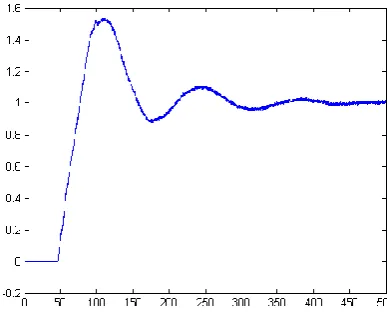
The integrated view of the above discussions and technical approaches end at simulated result of first order lag plus delay process with PID controller in the feedback path [17], [18]. It is lucid in close examination of response that noise is prevalent, dominating and cannot be suppressed at all.
In the spectral analysis of response with PID controller, it is noticeable that the ripples have acquired comparatively significant magnitudes and the attenuation fails beyond an extent. The spectral response is pictured like,
Fig. 9. Spectrum of output without LQG
The LQG, when introduced in the feedback signal proves its identity, nullifying variations in the form of gaussian noise. To validate the performance of this robust controller, hardwired with a PID and a LQG, a band-limited white noise, is probably employed. The robustness in all the sense is easy to be examined from the response shown,
Fig. 10. Simulated result of an FOLPD process with LQG filter in the feedback path
In contradictory to spectrum of output with PID, the reduction in harmonics is appreciable in spectrum of output with LQG. It may be noted that the ripples in the output end could effectively be suppressed making its magnitude comparatively minimal or attenuated. The facts above mentioned can be experienced from the diagram.
To enhance the efficacy of performance analysis, the band limited white noise can be substituted by a random noise signal. This is being done to make the system irritable to any characteristic noise. Even though the system is adapting itself, the noise is prevalent; however it is well below setting threshold. It is perspective in the figure below that the noise is only 2% or 5% of peak overshoot.
Fig. 12. Simulated result of an FOLPD process with LQG filter and random noise in the feedback path
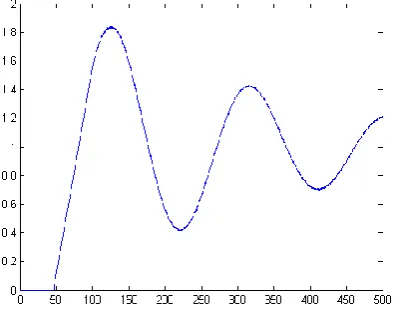
In order to verify whether an adaptive control can have the entire range of benefits of the proposed strategy, an adaptive control system based on MIT rule has to be simulated. The adaptation of adaptive control shown, can be commented like, after few cycles of the input the output tracks the input due to the adaptive action.
Fig. 13. Adaptation of the Adaptive Control
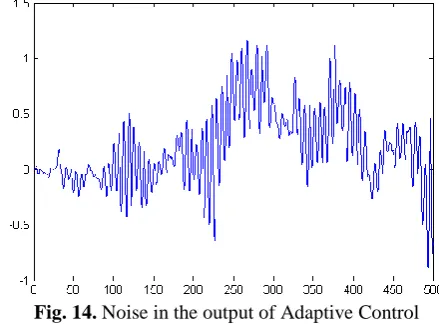
To get convinced with the fact that adaptive controller is quite inadequate to adjust to the parameter variations of the system, just a glance over the pictured representation of noise super imposed over the output of adaptive control, which is furnished below, is enough.
V.
CONCLUSION
This paper proposes an advanced control strategy is proposed which brings out a new method for optimized control. The proposed method has been studied using different schemes. Also the validity of the method determined. The proposed strategy has been implemented using a LQG filter in order to obtain better performance. A comparative study of the proposed strategy and MIT rule based adaptive control system is also carried out. The strategy has been simulated using SIMULINK for a first order lag plus delay process.
REFERENCES
[1]. Yun Li, Kiam Heong Ang & Gregory C.Y. Chong, (2006) “PID Control System Analysis and Design – Problems, Remedies, and Future Directions”, in IEEE control system magazine, pp. 32-41.Oscar Montiel, Roberto Sepulveda, Patricia Melin, Oscar Castillo, Miguel Angel Porta & Iliana Marlen Meza, (2007) “Performance of a Simple Tuned Fuzzy Controller and a PID controller on a DC motor”, IEEE Trans. Control., vol. 13, no. 4, pp. 59-76.
[1]. Xiao-Feng Li, Jian Sun, Hui-Yan Wu, Wei-Dong Zong, (2007) “Application of the fuzzy PID to the Power Plant,” IEEE Trans. Control., vol. 14, no. 5, pp. 926-936.
[2]. V.Tipsuwanporn, S.Intajag, K.Witheephanich, N.Koetsam-ang and S.Samiamag, (2004) “Neuro-Fuzzy Controller Design for Industrial Process Controls,” SICE.
[3]. Toru Yamamoto and Sirish L. Shah, (2007) “Design of a Performance-Adaptive PID Controller,” IEEE Trans. Auto., vol. 51, no. 5, pp. 745-759.
[4]. Zhao Yingkai, Lin Jinguo, Shu Zhibing, (1997) “The Design of Neural Network Controller for Nonlinear Plants,” IEEE Trans. Magn., vol. 12, no. 2, pp. 241–253.
[5]. Raymond A. de Callafon, Ryozo Nagamune, and Roberto Horowitz, (2006) “Robust dynamic modeling and control of dual-stage actuators,” IEEE Trans. Magn., vol. 42, no. 2, pp. 247–254.
[6]. Giuseppe C. Calafiore and Marco C. Campi, (2006) “The scenario approach to robust control design,” IEEE Trans. Auto., vol. 51, no. 5, pp. 742-752.
[7]. Dimitrios Karagiannis and Alessandro Astolfi, (2006) “A robustly stabilizing adaptive controller for systems in feedback form,” American Control Conf., pp. 3557-3562.
[8]. J.M.Nair, B.Bandyopadhyay and A.Lazar, (2006) “Robust control for uncertain singularly perturbed systems using periodic output feedback,” American Control Conf., pp. 4326-4331.
[9]. Kevin A. Wise, Eugene Lavretsky and Naira Hovakimyan, (2006) “Adaptive control of flight: theory, applications, and open problems,” American Control Conf., pp. 5966-5971, June 2006.
[10]. Xingang Zhao, Zhe Jiang, Jianda Han and Guangjun Liu, (2006) “Adaptive robust LQR control with the application to the yaw control of small-scale helicopter,” IEEE Trans. Mech., pp. 1002–1007. [11]. Baomin Feng, Guangcheng Ma, Qiyong Wen and Changhong Wang, (2006) “Adaptive robust control
of space robot in task space,” IEEE Trans. Mech., pp. 1571–1576, June 2006.
[12]. Kiam Heong Ang, Gregory Chong and Yun Li, (2005) “PID control system analysis, design, and technology,” IEEE Trans. Control., vol. 13, no. 4, pp. 559-576.
[13]. Paraskevas N. Paraskevopoulos, George D. Pasgianos, and Kostas G. Arvanitis, (2006) “PID-type controller tuning for unstable first order plus dead time processes based on gain and phase margin specifications,” IEEE Trans. Control., vol. 14, no. 5, pp. 926-936.
[14]. Alireza Karimi, Marc Kunze and Roland Longchamp, (2006) “Robust PID controller design by linear programming,” American Control Conf., pp. 3831-3836.
[15]. Masanobu Obika and Toru Yamamoto, (2005) “An evolutionary design of robust PID controllers,” IEEE Trans. Mech., pp. 101-106.
[16]. Ramon Vilanova, (2006) “PID controller tuning rules for robust step response of first-order-plus-dead-time models,” American Control Conf., pp. 256-261.
[17]. Nick J.Kinningsworth and Miroslav Krstic, (2006) “PID tuning using extremum seeking,” IEEE Control systems magazine, pp. 70-79.
[18]. Han-Xiong Li, Lei Zhang, Kai-Yuan Cai, and Guanrong Chen, (2005) “An improved robust fuzzy-PID controller with optimal fuzzy reasoning,” IEEE Trans. Syst., vol. 35, no. 6, pp. 1283-1294.
[19]. Jin Wang and Garth Thomas, (2006) “A model based predictive control scheme for nonlinear Process,” American Control Conf., pp. 4842-4847.
[20]. Jihong Li and Pingkang Li, (2006) “Stability regions analysis of PID controllers for time-delay systems,” Proceedings of the sixth world congress on Intelligent control and automation, pp.2219-2223. [21]. Alexander Leonessa, Wassim M. Haddad, and VijaySekhar Chellaboina, (1999) “Nonlinear robust
[22]. Baozhu Jia, Guang Ren and Gang Long, (2006) “Design and stability analysis of fuzzy switching PID controller,” Proceedings of the 6th world congress on Intelligent Control and Automation, pp. 3934-3938.
[23]. Ming-Guang Zhang, Xing-Gui wang and Wen-Hui Li, (2006) “The self-tuning PID decoupling control based on the diagonal recurrent neural network,” Proceedings of the Fifth International Conference on Machine Learning and Cybernetics, pp. 3016-3020.
[24]. Kiyong Kim, and Richard C. Schaefer, (2005) “Tuning a PID controller for a digital excitation control system,” IEEE Trans. Industry applications, vol. 41, no. 2, pp. 485-492.
[25]. Rodrigo R. Sumar, Antonio A. R. Coelho and Leandro dos Santos Coelho, (2005) “Assessing fuzzy and neural approaches for a PID controller using universal model,” Proc. of the fifth international conference on Hybrid intelligent systems.
[26]. Changchun Hua, Xinping Guan, and Peng Shi, (2007) “Robust output feedback tracking control for time-delay nonlinear systems using neural network,” IEEE Trans. Neural networks, vol. 18, no. 2, pp. 495-505.
[27]. N. Pappa and J. Shanmugam, (2004) “Neural network based predictor for control of cascaded thermal process” IEEE Trans. Icisip., pp.289-294.
[28]. D. R. Baughman, Y. A. Liu, (1995) “Neural Networks in Bio processing and Chemical Engineering,” Academic press, San Diego, pp. 247-256.
[29]. Chen S, Billings S.A., Grant P.M., (1990) “Non-linear system identification using neural networks,” International. J. Control, Vol. 51, No. 6, pp 3456-3459.
[30]. Alsop, A.W. and T. F. Edgar, (1989) “Non-linear heat exchanger control through the use of partially [31]. Chidambaram, M. and Malleswara rao, Y.S.N., (1992) “Nonlinear Controllers for a heat exchangers,” J.
Proc. Cont., Vol. 2, No 1, pp 17-21.
[32]. Gerardo Diaz, Mihir Sen, Yang K.T. and McClain, R.L., (2001) “Dynamic prediction and control of heat exchangers using artifical neural networks,” Int. J. Heat and Mass Transfer, Vol. 44, pp1671-1679. [33]. Allon Guez, James I, Eilbert, and Moshe Kam, (1988) “Neural network architecture for control, IEEE