ISSN (e): 2250-3021, ISSN (p): 2278-8719
Vol. 08, Issue 10 (October. 2018), ||V (IV) || PP 29-37
Model Early Warning System Based Android
Febrina Sari
1, Nurhadi
2, Herianto
3, Atma Hadiansa
4, Dewi Suranti
51Teknik Informatika, STT Dumai, Indonesia 2Teknik Informatika, STMIK Dumai, Indonesia 3
Sistem Informasi, STMIK Hang Tuah Pekanbaru, Indonesia
4
Manajemen Informatika, AMIK Dumai, Indonesia
5Fakultas Teknik Informatika, Universitas Dehasen Bengkulu, Indonesia
Abstract:
Early Warning System Model designed using Android-based mobile technology, with the aim of maintaining the continuity of injection contraceptive use. This system will provide an effective program for acceptors, so that they will periodically inject according to schedule. An early warning system will send text messages based Web Services via mobile devices such as smart phones. The use of contraceptives is one of the efforts made by the government to reduce the population growth rate, the use of contraception that is predominantly used by acceptors is injection contraception, therefore the use of contraceptives must be maintained, the results of this study are models of early warning systems designed to help acceptors in remembering their periodic injection schedule in the next period and provide various information about the implementation of family planning programs through text messages. Waterfall and in the development of system design using integrated modeling language namely Unified Modeling Language (UML).Keywords:
Web Service, Web Application, UML.--- --- Date of Submission: 16-10-2018 Date of acceptance: 31-10-2018 --- ---
I.
INTRODUCTION
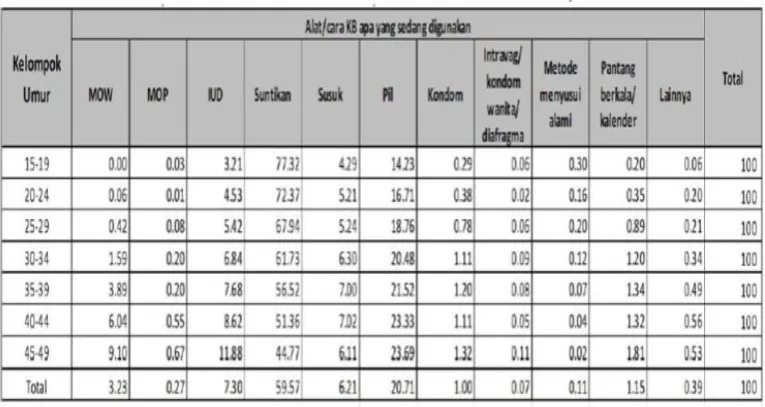
One of the efforts made by the government to reduce the population growth rate is the Family Planning Program. The contraceptives strategy of implementing family planning program, as stated in the midterm development plan (RPJM) 2004 – 2009, is to increase the use of contraceptives. Injectable hormonal contraceptives are one of the most commonly used contraceptive devices acceptor, Women who use the injectable contraceptive provided through the public sector as their main contraceptive, must visit a provider every three months for a new injection [1]. Today, nearly 16 million women worldwide use ingestion-only or combined injectable contraceptives [2]. in 2013 there were 8,500,247 couples of reproductive age (PUS) who were new Family Planning participants, and almost half (48.56%) used injectable hormonal contraceptive methods. Table 1 illustrates the number of acceptors with various contraceptives used.
The table above shows that the number of injector acceptors is more dominant, but the use of short-term contraceptive injections requires regular and ongoing guidance.
Based on data from the BKKBN there is still a 0.35 pregnancy failure rate per year. This can happen because the undisciplined acceptors with periodic injection schedules and periodic injecting acceptors do not match or can be delayed during the predetermined period. Quick access to contraception is very important for women [3], Generally, injecting contraceptive users usually record their injection schedule on a calendar or control card. In practice, the acceptor is not disciplined to adhere to an injection schedule or acceptors injects periodically not in accordance with a predetermined period, and many occur because acceptors forget the schedule for injecting birth control for the next period. Of course, this will affect the continuity of injecting contraceptive use. Based on these conditions, it is necessary to design a model of an Android-based early warning system.
The system was designed using SMS facilities (short message service) with text messages via mobile devices (smartphones). Currently the growth rate of smartphones are five times the rate at which personal computer devices were adopted in the 1980s. [4]. Text messaging has become an integral part of modern communications. First deployed in the late 1990s, the Short Messaging Service (SMS) now delivers upwards of 4.2 trillion messages around the world each year [5]. Divides mobile apps into groups, one of which is Short Message Service (SMS) and the simplest mobile app.
This research refers to several scientific journals that address similar issues and subsequently made the literature review. The first journal entitled “Mobile Application Reminder of SPP Payment Schedule's and School Activities Information Based SMS Gateway” [4]. This application is made to facilitate parents in getting SPP payment information, Arrears and provide various information related to school activities via mobile telephones based on SMS Gateway, using Gammu technology as a service of the recipient and sender of the message. This system has been successfully implemented by the Alfa Duta Dumai kindergarten school.
Research with similar topics has been carried out by other researchers, as was done by [6] design an Android-based academic information system, design the system, including designing the system in general to provide an overview to the user about the new information system developed and detailed system design to describe the physical form of the information system components to be built including UML, interface design and database scheme used.
Technological developments that are increasingly faster makes messaging using Gammu technology no longer useful, because building an SMS Gateway using Gammu requires an additional device in the form of a modem. We must plug the modem on a PC or Laptop for 24 hours full (or as long as the SMS will be used). Unlike the SMS Gateway that uses third party services (SMS Gateway based on Web Service). This method is fairly easy to use, we just send SMS programmatically to their server, the rest of the system and their device will send an SMS to the recipient.
Previous research and technological development became the basic capital of researchers in the design of the Early Warning System based on Android. The system is designed to use the latest technology such as the Application Programming Interface (API), Web Service that allows us to send and receive text messages or SMS, as well as various applications in the application, for example reminder, notification and confirmation.
II.
LITERATURE REVIEW
2.1 Andriod
The Android released in 2007 to date has been used as an operating system for devices mobile touch screen (smartphone) and users from this operating system continues to increase significant. number of Android-based smartphone users in the Area Asia Pacific in 2014 was 888 million continued has increased to an estimated year 2019 will touch the 1,483.4 million users Indonesia itself is an Andoird-based snortphone user 44.7 million continues to increase until 2019 estimated at 92 million users. Enhancement this can continue to happen with consider the number of smartphone products developed by good smartphone manufacturers domestic or foreign by viewing anemo community in using it.
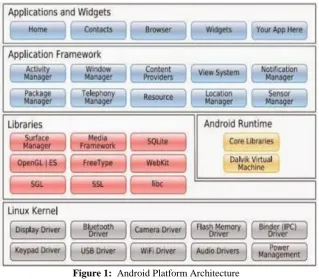
The Android architecture can be divided into four layers, Applications and Widgets, Application Framework, Libraries, Linux Kernel [8],[9], as shown in Figure 1.
Figure 1: Android Platform Architecture
2.2 Android SDK (Software Development Kit)
Android SDK is an API (Application Programming Interface) tool needed to develop applications on the Android platform using the Java programming language. Some of the most important android features are the Virtual Dalvik machine optimized for mobile devices, WebKit, Graphics optimized and supported by 2D graphics libraries, 3D graphics based on Open specifications ES 1.0 (Optional hardware acceleration), then SQLite data storage (database). Other android features include media that supports audio, video and images. There are also Bluetooth, camera, GPS and compass features. Furthermore, the features that are also provided are a complete and rich development environment including emulator devices, tools for debugging, memory profiles and performance, and plugins for the Eclipse IDE. Android also allows users to install third-party applications, both those obtained from application stores such as Google Play, the Amazon App Store or by downloading and installing APK files from third parties.
2.3 Web Services
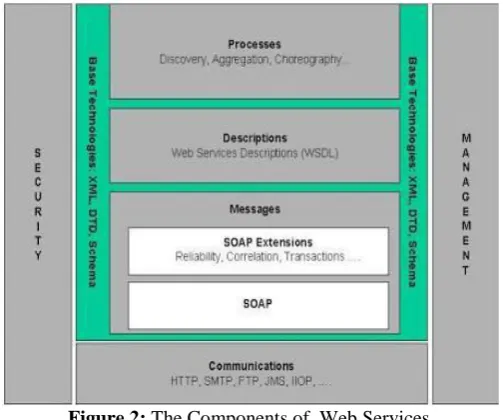
Web service is a computational entity that can be accessed through internet or intranet networks with certain protocol standards in platforms and independent programming language interfaces. The purpose of the development is to bridge communication between programs. This can happen, because the standard protocol is not bound to a platform or programming language. The protocol itself is built by Extensible Markup Language (XML) which in fact has been supported by many platforms, programming languages, and by developers around the world. The components of web services can be seen in Figure 2.
a. Extensible Markup Language (XML)
XML is an important basis for the formation of Web Services. Web Services can communicate with applications that call it using XML, because XML is in the form of text so that it is easy to transform using the HTTP protocol. In addition XML is also an independent platform so that the information in it can be read by different applications and from different platforms, as long as the application can translate XML tags.
b. Simple Object Access Protocol (SOAP)
c. Web Services Definition Language (WSDL)
Before accessing a web service, the things that need to be known are what methods are provided by the web services, to find out it requires a document called WSDL, in WSDL what methods are available in web services, what parameters are is required to call a method, and what results or data types are returned by the invoked method.
d. Universal description, Discovery and Integration (UDDI)
which is a directory location that contains services (services) and is platform free, is written based on XML and can be accessed by entities that are inside and outside the network. The existence of these standards makes web services easy to access through various interfaces and also provides opportunities for various systems to be built on different platforms and different languages to collaborate on a job. [10]
Figure 2: The Components of Web Services
Web services technology offers convenience in bridging islands of information without disputing the differences in technology used by each source. Suppose an information site is built using an Oracle database while other sites use MySQL while using your own Open Source software in building web services will overcome this difference. Web services are actually a collection of functions and methods found on a server that can be called by clients remotely, Web services are needed because in the present time hardware, operating systems, applications to more diverse types of programming languages, these conditions can cause problems in the process of exchanging data between devices using different applications and flatfrom.
2.4 Web Application
Web applications are computer software encoded in programming languages that support web-based software such as HTML, JavaScript, CSS, Ruby, Python, Php, Java and other programming languages. Web applications or commonly called Web App is is an application that can accessed through a web browser as its client [11]. Client is a word commonly used in the discussion of client server applications. Clients can be said to be applications that are used to enter information, while servers are applications that are used to store information [12].
There are two main parts in a web application that must be there first is the client side and the second is the server side, the client side in this case is the PC or it can also be a mobile device that is connected to the internet network, while the server is a computer with good specifications used to store web application along with a database server that is ready to be accessed by the client, The client is in charge of requesting the web server page through the Web Browser, the Web browser will forward it to the Server where the Web Application is located, the Server Computer will process the request from the client, when the requested web page found then the server computer will send it to the client computer and the requested web page will be displayed on the web browser on the client computer.
The web application consists of three main layers as follows:
a. Presentation layer, that is, the first layer is on the user's side and usually only consists of a web browser. b. The Application Layer, the second layer contains technologies that produce dynamic content, such as Java
servlets (JSP) or ActiveServerPages (ASP).
The way the Web Application works through these three main layers can be seen in Figure 3 below.
Figure 3: The Three Main Layers of Web Applications
The ability to update and maintain web applications without having to distribute and install software on the possibility of thousands of client computers being the hallmarks of this technology, besides the web application also for cross-platfrom compatibility.
III.
METHODOLOGY
Early Warning System Design Model refers to object-based design called Object Orianted Design (OOD) and is considered to be the most modern design strategy. Early Warning Design Methodology This system uses the System Development Life Cycle approach with the Waterfall model [13]. SDLC is a sequence of several processes in stages in designing and developing systems. starting from the requirements analysis stage, followed by system design, development, testing, and last system maintenance. Waterfall model has several stages from the start of the system is planned until the system is implemented, operated and maintained. When the system operation that has been developed still re-emerged problems that are critical and can not be overcome in the system maintenance phase, it is necessary to rebuild a system to overcome it and this process back to the first stage, that is the planning stage of the system. The waterfall model scheme is shown in figure 4. The main stages of the waterfall model map basic development activities.
This study uses interview methods and questionnaires with users (Doctors, Nurses and Acceptor) as respondents for data collection. System design development uses integrated modeling language namely Unified Modeling Language (UML) [13-15]. UML is the de-facto standard for object-oriented modeling [16-21]. The
Unified Modeling Language is a set of modeling conventions that are used to determine or describe a software system related to an object. UML is one of the most reliable tools in the world of object-oriented system development. UML provides a visual modeling language [15],[23-25] which makes it possible for system developers to create a blueprint for their vision and mission in a standard form, easy to understand and equipped with effective mechanisms to share and communicate their designs with others. UML is the work of a consortium of various organizations that are successfully used as standard standards in OOAD (Object Oriented Analysis and Design). UML also has graphic elements that can be combined into diagrams.
IV.
IMPLEMENTATION AND TESTING
Early Warning System Model is designed to help acceptors get information early about their regular injection schedule for the next period and provide various information about family planning activities through their smartphones. It is divided into three groups: feature design, system requirements design or requirements specifications and database design.
4.1 Design Feature
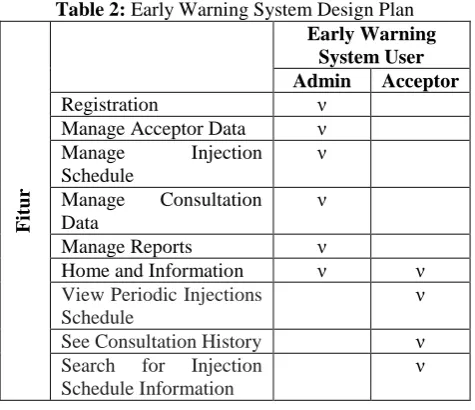
The feature design that is owned by the Early Warning System can be seen in table 2 below. Design features are intended to facilitate two types of users, namely administrator and acceptors. administrator is devoted to managing a number of data such as managing acceptor data, periodic injection schedules and managing various information related to family planning programs, as well as obtaining statistical information on the continuity of using injectable contraceptives.
The acceptor as the second type of user can see a variety of information on the different birth control methods and information on various other types of contraceptives that can be used, receive information early on periodic injection schedules for the next period and request information directly to the system about periodic injection schedules using the format determined by the system. This feature is very helpful for system users both administrator and acceptors. The administrator as an extension of the government to maintain the continuity of the use of injectable contraceptives can carry out its functions properly, while from the acceptor side this feature is very helpful in reducing the negligence of acceptors in their periodic injections for the next period.
Table 2: Early Warning System Design Plan
F
it
ur
Early Warning System User Admin Acceptor
Registration ν Manage Acceptor Data ν Manage Injection Schedule
ν
Manage Consultation Data
ν
Manage Reports ν
Home and Information ν ν
View Periodic Injections Schedule
ν
See Consultation History ν
Search for Injection Schedule Information
ν
4.2 System Needs Design
Figure 5: Use Case Diagram Early Warning System
4.3 Data Base Design
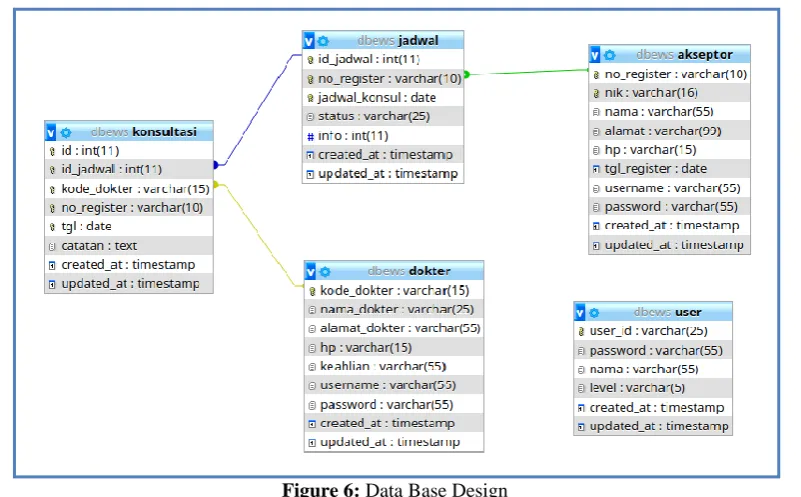
The database is used to design the Early Warning System is MySQL. The logic of the database is stored in the form of javascript files and sql. SQL databases can be accessed using applications that have been stored on the server. Database design is shown in Figure 6 which shows the relationship between one table and another table in the form of the relationship between the primary key of each table.
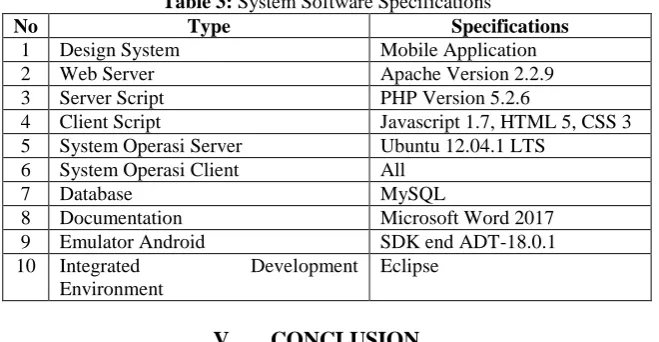
The technology used in designing the early warning system model is shown in Table 3 below
Table 3: System Software Specifications
No Type Specifications
1 Design System Mobile Application 2 Web Server Apache Version 2.2.9 3 Server Script PHP Version 5.2.6
4 Client Script Javascript 1.7, HTML 5, CSS 3 5 System Operasi Server Ubuntu 12.04.1 LTS
6 System Operasi Client All 7 Database MySQL
8 Documentation Microsoft Word 2017 9 Emulator Android SDK end ADT-18.0.1 10 Integrated Development
Environment
Eclipse
V.
CONCLUSION
The results of this study are the creation of an Early Warning System Design Model, the design that has been generated will then be used by researchers to proceed to the next stage which is to build an Early Warning System based on android, then implement. The purpose of this implementation phase is to prepare all activities for the implementation of the system so that it is in accordance with the jointly determined design, in this case the system built can help acceptors to get information early about their periodic injection schedule for the next period and provide various information about family planning activities through their smartphone.
ACKNOWLEDGMENT
This research paper is made possible through the help and support from Informatics Study Program of Sekolah TinggiTeknologi Dumai (STT Dumai) and funded from KEMENRISTEKDIKTI in 2018. The authors would like to convey their utmost appreciation to the anonymous reviewer and respective individuals for their involvement and invaluable feedbacks throughout conducting this research.
REFERENCES
[1]. Malawi National Statistical Office and MEASURE DHS, Malawi Demographic and Health Survey, 2010, Zomba: Malawi National Statistical Office and MEASURE DHS, 2010.
[2]. D„Arcangues C, Snow RC. ”Injectable contraceptives for women”. In: Rabe T, Runnebaum B, editors. Fertility Control-Update and Trends. Berlin: Springer-Verlag; 1999. pp. 121–49.
[3]. Westhoff C, Kems J, Morroni C, Cushman LF, Tiezzi L, Murphy PA. Quick start: novel oral contraceptive initiation method. Contraception. 2002 Sep;66 (3):141–5.
[4]. F. Sari and P. Lidya, “Mobile Application Reminder Of SPP Payment Schedule‟s And School Activities Information Based SMS Gateway”. Journal of Telecommunication, Electronic and Computer Engineering (JTEC), 2017.
[5]. The Open University. Text Messaging Usage Statistics. http://www.openuniversity.edu/news/news/2014-text-messagingusage- statistics, Dec. 2014.
[6]. N. Sulistianingsih, “Android-based Academic Information System: A Design”, in Conference on Information Technology, Information System and Electrical Engineering. Yogyakarta, 2016.
[7]. Developers A. What is Android[J]. 2011.
[8]. Brahler S. Analysis of the android architecture[J]. Karlsruhe institute for technology, 2010. [9]. Ehringer D. The dalvik virtual machine architecture[J]. Techn. Report (March 2010), 2010.
[10]. Silvestri, J.M., Lister, G., et al,., “Factors That Influence Use of a Home Cardiorespiratory Monitor for Infants”, Arch Pediatr Adolesc Med. 159:18 24, 2005.
[11]. Daniel, N., 2017, Web Applications url: http:// webtrends.about. com/od/ webapplications/a/ web_application.htm. Tanggal akses 15 June 2018.
[12]. Erlin, K. Andesta, and Agustin, “Standby Information System Model of Indonesian National Seminar”,
National Industry and Technology Seminar (SNIT), State Polytechnic Bengkalis, 2017. pp. 298-305. [13]. F. Sari, F. Damayanti, A. Hadiansa, and E. Hafrida, “Early Warning System For The Continuouse Use of
Injectable Contraception, Using SMS Gateway In The Success of Family Planning Programs”. IEEE International Conference on Smart Computing and Electronic Enterprise (ICSCEE), 2018.
[14]. F. Fernandes, and M. Song, “UML-checker: an approach for verifying UML behavioral diagrams”.
International organization of Scientific Research
37 | Page
[15]. L. Fuentes-Fern´andez and A. Vallecillo - Moreno, “An Introduction to UML Profiles,” European Journal for the Informatics Professional, 2004. vol. V, no. 2.
[16]. L.-Y. Pan, F. Liu, and F.-Y. Ma, "Mcta-modcling architecture based method for transforming UML class diagram into PVS spccification," shanghai JiaolOng Daxue Xuebao/Joumal of Shanghai Jiaotong University, 2004. vol . 38 , pp. 159-163
[17]. T. Ali, M. Nauman, and M. Alam, "An accessible formal specification of the UML and OCL meta-model in I sabelle/HOL," Lahore, Pakistan, 2007
[18]. H. Zhou, Z.-Q. Huang, L. Wang, and L. Chen, "Automated metrics for industrial applications software polymorphic interactions," Singapore, 2008, pp. 477-482
[19]. F. J. Lucas Martinez and A. Toval Alvarez, "A precise approach for the analysis of the UML models consistency," Klagenfurt, Austria, 2005, pp. 74-84
[20]. D. Berradi, D, Calvanese, and G. D. Giacomo, "Reasoning on UML Class Diagram," Artificial Intelligence, 2005, vol. 168, pp. 70-118
[21]. “Unified Modeling Language Specication 2.1.1 Infrastructure Specification,” Object Management Group, http://www.omg.org/cgibin/doc?formal/11-02-04, Tech. Rep., 2007.
[22]. Ruparelia, N.B., “Software Development Lifecycle Models”. ACMSIGSOFT Software Engineering
Notes. 2010. pp.8-13.
[23]. M. R. Chaudron, W. Heijstek, A. Nugroho, “How effective is uml modeling?”, Software & Systems Modeling, 2012. vol. 11, no. 4, pp. 571-580.
[24]. W. J. Dzidek, E. Arisholm, L. C. Briand, “A realistic empirical evaluation of the costs and benefits of uml in software maintenance”, Software Engineering IEEE Transactions on, 2008. vol. 34, no. 3, pp. 407-432.
[25]. L. Efrizoni, W.M.N. Wan-Kadir, and R. Mohamad, “Formalization of UML Classs Diagram Using Description Logics”, IEEE 2010 International Symposium on Information Technology, 2010. Vol. 3, pp. 1168-1173.