
Abstract—In reversible data hiding (RDH), the original cover can be losslessly restored after the embedded information is ex-tracted. Kalker and Willems established a rate–distortion model for RDH, in which they proved out the rate–distortion bound and proposed a recursive code construction. In our previous paper, we improved the recursive construction to approach the rate–distor-tion bound. In this paper, we generalize the method in our previous paper using a decompression algorithm as the coding scheme for embedding data and prove that the generalized codes can reach the rate–distortion bound as long as the compression algorithm reaches entropy. By the proposed binary codes, we improve three RDH schemes that use binary feature sequence as covers, i.e., an RS scheme for spatial images, one scheme for JPEG images, and a pattern substitution scheme for binary images. The experimental results show that the novel codes can significantly reduce the em-bedding distortion. Furthermore, by modifying the histogram shift (HS) manner, we also apply this coding method to one scheme that uses HS, showing that the proposed codes can be also exploited to improve integer-operation-based schemes.
Index Terms—Difference expansion (DE), histogram shift (HS), recursive code construction, reversible data hiding (RDH), water-marking.
I. INTRODUCTION
D
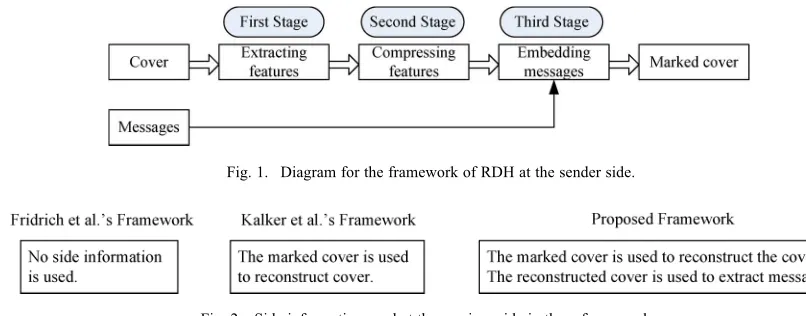
ATA HIDING is a technique for embedding information into covers such as image, audio, and videofiles, which can be used for media notation, copyright protection, integrity authentication, covert communication, etc. Most data hiding methods embed messages into the cover media to generate the marked media by only modifying the least significant part of the cover and, thus, ensure perceptual transparency. The em-bedding process will usually introduce permanent distortion to the cover, that is, the original cover can never be reconstructed from the marked cover. However, in some applications, such as medical imagery, military imagery, and law forensics, no degradation of the original cover is allowed. In these cases, we need a special kind of data hiding method, which is referred to as reversible data hiding (RDH) or lossless data hiding, by which the original cover can be losslessly restored after the embedded message is extracted.Many RDH methods have been proposed since it was intro-duced. Fridrich and Goljan [1] presented a universal framework for RDH, in which the embedding process is divided into three stages (See Fig. 1). The first stage losslessly extracts compressible features (or portions) from the original cover. The second stage compresses the features with a lossless compression method and, thus, saves space for the payloads (messages). The third stage embeds messages into the feature sequence and generates the marked cover. One direct reversible embedding method is to compress the feature sequence and append messages after it to form a modified feature sequence, by which replace the original features to generate the marked cover. Therefore, after extracting the message, the receiver can restore the original cover by decompressing the features. Fridrich and Goljan [1] suggested features obtained by ex-ploiting characteristics of certain image formats, e.g., texture complexity for spatial images and middle-frequency discrete cosine transform (DCT) coefficients for JPEG images. Celik et al.[2] extended Fridrich and Goljan’s scheme by predicting multiple least significant bit (LSB) planes. The same idea proposed in [1] can be also used for reversible data embedding into binary images [3], [4] or videos [5], [6].
Larger embedding capacity can be achieved by constructing a longer feature sequence that can be perfectly compressed. One of such constructions is difference expansion (DE), which was
first proposed by Tian [7], in which the features are the differ-ences between two neighboring pixels. The features are com-pressed by expansion, i.e., the differences are multiplied by 2, and thus, the LSBs of the differences can be used for embed-ding messages. Alattar [8] generalized Tian’s method by ap-plying DE to a vector of pixels. Kimet al.[9] improved the DE method by reducing the size of the location map used to com-municate position information of expandable difference values. The methods proposed in [10] and [11] can achieve better per-formance by applying DE to the prediction errors.
Another well-known strategy for RDH is histogram shift (HS), in which the histogram of the image is used as the com-pressible features because the distribution of the pixel values of an image is usually uneven. To compress the histogram,
Ni et al. [12] proposed to select a peak bin and a zero bin
and shift the bins between them toward the zero bin by one
KANTHI KIRAN KARASLA (M.Tech student),QCET,Nellore,[email protected]
SYED AKHTAR , M.Tech Assistant Professor ,QCET,Nellore, [email protected]
Enhancing Reversible Data hiding Schemes for Marked Covers
P.Babu, Associate professor, QCET,Nellore,[email protected]
INTERNATIONAL JOURNAL OF ENGINEERING SCIENCES
&Fig. 1. Diagram for the framework of RDH at the sender side.
Fig. 2. Side information used at the receiver side in three frameworks.
step. Therefore, the peak bin’s neighboring bin, which is now emptied out, and the peak bin can be used to represent “1” and “0,” respectively. It is easy to see that a steeper histogram implies larger capacity, and, usually, the histogram of residuals is quite steep. Thus, most state-of-the-art methods apply HS to residuals of the image [13], [14].
Both DE- and HS-based schemes use integer features and special methods to compress the features. As for DE, the fea-tures (differences) are compressed by expansion operation, and as for HS, the features (histogram) are compressed by shifting operation. There is a common character in both these schemes, that is, the distortion to the original cover is mainly introduced by the special compressing manners. By contrast, Fridrich and Goljan’s schemes [1] use a binary feature sequence and a generic compression algorithm, e.g., the arithmetic coder, and no distortion must be introduced by the compression. According to such differences, we divide RDH into two types as follows.
• Type I. The features can be formulated as a binary se-quence and can be compressed by using a generic com-pression algorithm. The methods in [1]–[6] belong to Type I.
• Type II. The features are nonbinary and compressed in some specific manners. Both DE-based [7]–[11] and HS-based methods [12]–[14] belong to Type II.
For Type-I RDH, the problem is formulated as how to re-versibly embed data into a compressible binary sequence with good performance. The performance is measured by embedding rate versus distortion, which is a special rate–distortion coding problem. A formal model for this problem has been established by Kalker and Willems [15]. In [15], the authors obtained the rate–distortion function, i.e., the upper bound of the embed-ding rate under a given distortion constraint, and, by diviembed-ding the cover into disjoint blocks, they proposed a recursive code construction, which consists of a nonreversible data embedding code and a conditional compression code. In fact, Kalker and Willems noted that the receiver can reconstruct the cover with the help of the marked cover, and thus, the sender can compress the cover under the condition of the marked cover. That is why the recursive construction is efficient.
In our previous paper [17], we improved the recursive con-struction by using not only conditional compression but also conditional embedding, which enables us to design an efficient
embedding algorithm and a perfect compressing method to approach the rate–distortion bound. In fact, we noted that the receiver could extract messages from the marked cover with the help of the reconstructed cover because of reversibility. In Fig. 2, the side information exploited at the receiver side in the proposed framework is compared with those used in two previous frameworks.
However, there are still limitations in three aspects in [17]. First, we construct embedding codes by improving the decom-pression algorithm of run-length coding, by which the recursive code construction is close to but cannot reach the rate–distortion bound. Second, the codes in [17] are restricted to some discrete embedding rates and cannot approach the maximum embedding rate at the least admissible distortion. Third, the codes are re-stricted to improve Type-I RDH for spatial images, and how to improve Type-II RDH by binary codes is still a problem.
In this paper, we generalize the code construction in [17] by using a general decompression algorithm as the embedding code and extend the applications to Type-II RDH. Compared with our preliminary paper [17], the new contributions of this paper are as follows.
• We prove that the recursive code construction can reach the rate–distortion bound when the decompression/com-pression algorithms used in the code are optimal, which establishes equivalence between source coding and RDH for binary covers.
• With the decompression of the adaptive arithmetic coder (AAC) as the embedding code, the proposed codes realize continuous embedding rates and reach the maximum em-bedding rate at the least admissible distortion.
II. CODINGMODEL ANDRECURSIVECONSTRUCTION
A. Coding Model
Throughout this paper, we denote matrices and vectors by boldface fonts and use the same notation for the random variable and its realization, for simplicity. We denote entropy by and conditional entropy by . Particularly, the binary
entropy function is denoted by for , and
the ternary entropy function is denoted by for
and .
To do RDH, a compressible feature sequence should befirst extracted from the original cover. For Type-I schemes, the fea-tures can be usually represented by a binary sequence. There-fore, we directly take the binary feature sequence as the cover to discuss the coding method and follow the notation established in [15].
Assume that there is a memoryless source producing binary
compressible cover sequence such that
with the probability and
. The assumption of being compressible implies that the ratios of “0’s” and “1’s” are biased. Without loss of generality, we assume that . We use Hamming distance to measure the embedding distortion on the cover . Because the message is usually compressed and encrypted before being embedded, we assume that the message is a binary random sequence. If we can reversibly embed an -bit message
into to get the marked cover with modifications on average, we define the
embedding rate as and the distortion as .
For any given distortion constraint, we desire the embedding rate as high as possible.
A direct construction for RDH was proposed by Fridrich and Goljan [1] as follows. First, compress the cover into a string Comp with a lossless compression algorithm Comp . The length of Comp is approximately equal to .
There-fore, we can averagely append bits of message
after Comp to obtain Comp . The recipient
can extract the message from and reconstruct by de-compressing Comp . As the bits of Comp are uncorrelated with those of , and the message is random, the expectation of distortion between and is 0.5. The embedding rate is equal to , which, in fact, is the maximum achievable em-bedding rate. If we only need to embed a shorter message with
length equal to for some , we can
exe-cute the aforementioned method on a fraction of the symbols
in . In this case, the embedding rate and
the distortion . Therefore, for the distortion constraint , this simple method can achieve a rate–distortion curve, i.e.,
(1)
Virtually, the simple method above is not optimal.
The maximum achievable embedding rate within the dis-tortion constraint is called the capacity under the distortion . The following theorem proved by Kalker and Willems [15] gives the expression of capacity.
Theorem 1: The reversible embedding capacity for a
memoryless binary source with is, for ,
given by [15]
(2)
Note that the above bound can be increased for nonmemory-less sequences, but we assume the binary cover is memorynonmemory-less throughout this paper, and this assumption, in fact, is suitable for most schemes.
B. Recursive Construction
To approach the rate–distortion curve, Kalker and Willems [15] proposed a recursive embedding method, which consists of a nonreversible embedding code and a conditional compression algorithm. First, select a nonreversible embedding code with distortion and embedding rate . Assume the binary cover
sequence is sufficiently long. The
se-quence is segmented into disjoint blocks of length , such that . Without loss of generality, we assume that is a sufficiently large integer. With the embedding code , bits of message can be embedded into thefirst host block , resulting in thefirst marked block . The recip-ient can reconstruct under the condition of known- after she receives . Therefore, the amount of information needed
to reconstruct is equal to , which means we can
compress into a sequence of length on average.
This compressed sequence is embedded into the second block
, averagely leaving room for bits of
auxil-iary message. Similarly, the information for reconstructing is embedded into . This process is recursively continued until
. For the last block , the simple method described in Section II-A is used to complete a full RDH method. When and are large enough, the distortion of this method is equal to the distortion of code , and the embedding rate is equal
to .
This recursive construction performs better than the simple method because of two key points: 1) The data is embedded by an efficient nonreversible embedding code, and 2) the cover block is compressed under the condition of the marked block. However, the above recursive construction cannot approach the upper bound (2).
III. IMPROVEDRECURSIVECONSTRUCTION
A. Motivations and Overall Framework
In this section, we will improve the recursive construction to approach the rate–distortion bound for any given distortion constraint. To do that, wefirst observe the rate–distortion func-tion (2), which shows that the maximum capacity is equal to
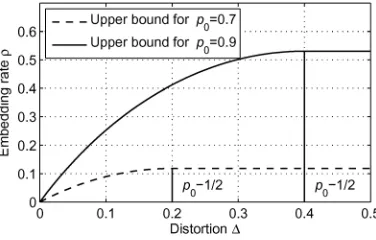
, and it can be achieved when distortion . In Fig. 3, we draw the rate–distortion curves for
and , which show that the capacity increases with distortion
for but keeps equal to for
. Therefore, we only need to consider how
to construct codes for . On the other hand, in
Fig. 3. Maximum capacity for and .
embedding manner for is that only the most
probable symbol, i.e., “0,” is allowed to be modified.
Inspired by the above observation, we improve the recursive construction as follows. We only embed messages into “0’s” of
the cover block to obtain the marked block
, and thus, only “0’s” in will be modified
for the th block such that . Therefore, for
the position such that , the corresponding must
be also equal to 0. This property can be used to compress under the condition of known- . In fact, we canfirst delete the
symbol in at position such that and obtain a
subsequence of , which is denoted by , and then compress by a lossless compression algorithm Comp . This method will greatly improve the compression rate because most sym-bols in have been compressed by deletion. The compressed , which is denoted by Comp , cascaded with an auxiliary message, is embedded into the next block to get the next marked block . To extract the message and reconstruct the cover, the extraction process must be performed in a backward manner. To extract message from , wefirst extract message
from and obtain by decompression. Combining and
, we can reconstruct andfind the positions of “0’s” in . According to the positions of “0’s” in , we can extract mes-sage from .
The detailed process and an example for embedding and ex-traction will be described in Section III-B.
B. Improved Recursive Construction
Wefirst need an embedding algorithm for embedding data only into zero symbols, which, in fact, is a special case of the coding model in Section II with taking . By (2), the capacity for is equal to , which implies that the optimal method for embedding data into only “0’s” is equivalent to decompression.
For example, assume is a lossless compression algorithm that has compression rate for a memoryless binary source with , and then, we can use the decompression algorithm of to embed data into zero symbols. In fact, into an -bit zero cover, we can embed bits of random messages, on av-erage, by decompressing the message into an -bit sequence by setting as the parameter of decompression. To extract the message, we only need to compress the -bit sequence back to the bits of messages. Obviously, the embedding rate is equal to , and the distortion is equal to because, on av-erage, “0’s” are changed to “1’s” in the embedding process.
Therefore, if the compression algorithm is optimal, i.e., the
compression rate , we just achieve the
embed-ding capacity.
To improve the recursive construction in [15] and [16], we use the decompression algorithm of as the embedding code and design a corresponding conditional compression algorithm for the cover based on .
Assume that the binary cover sequence is generated from a memoryless source satisfying
and . To embed messages into reversibly
with distortion constraint , we first divide into
dis-joint blocks of length , such that . In
each block, we only embed messages into zero symbols via the decompression algorithm of . Note that, when the distortion on the sequence is , the distortion on zero symbols is because only “0’s” will be modified. Therefore, we use as the parameter of the decompression algorithm of and, on average, decompress thefirst
(3)
bits of messages into a -bit sequence, which is denoted
by . The sequence will include
“1’s,” on average. By replacing the “0’s” in with , we just obtain thefirst marked block
, which introduces changes, on average.
Therefore, at the position , such that and , the corresponding must be also equal to “0” because no “1” in has beenflipped to “0.” We use this property to compress under the condition of known- by deleting all symbols in at position ’s, such that , resulting in a subsequence of . Denote this subsequence by , and thus, . Note that the proportion of “0’s” in is equal to the ratio of nonmodified “0’s” in , that is, , and thus, the ratio of “1’s” in is equal
to . Therefore, the average
length of is equal to . In other words, under
the condition of known- , the block is compressed to with compression rate , and we can reconstruct by replacing “1’s” in by the symbols of .
Furthermore, we compress with the lossless compression algorithm . Denote the proportion of “0’s” and “1’s” in by and , respectively, which can be easily computed as follows:
(4)
Therefore, can be compressed with the rate . Denote the compressed information by Comp . In summary, when is known, the amount of information needed to reconstruct , i.e., the length of Comp , is, on average, equal to
(5)
By using the decompression algorithm of , we embed Comp into the “0’s” of the next block , leaving room
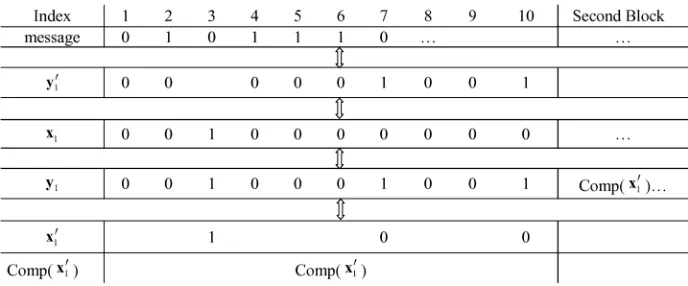
Fig. 4. Example on the improved recursive construction.
auxiliary messages, on average, and resulting in the second marked block . The information for reconstructing , which is denoted by Comp , is embedded into the third block . This process is recursively continued until the one but the last block . For the last block , we directly compress
the block and make room for bits, on average,
into which we embed Comp for reconstructing the
second last block . In addition, we also embed the overhead information, such as parameters , , and , into the last block.
To extract the message and reconstruct the cover, the extrac-tion process must be performed in a backward manner. To
ex-tract messages from the th block , for ,
we mustfirst extract messages from and obtain by de-compression. Combining and , we can reconstruct and
find the positions of “0’s” in , according to which we extract a subsequence from and compress this subsequence by with
as the parameter to obtain the message hidden in . When and are large enough, the distortion of the method above is just , and by (3) and (5), the corresponding
embedding rate can be calculated by
(6)
Now, we use an example with only two blocks to illustrate the embedding and extraction process of the method described above.
Example 1: As shown in Fig. 4, thefirst cover block
con-sists of nine “0’s” and one “1,” and thus, . Set the distortion constraint , and therefore, the distortion on
zero symbols is equal to . With 2/9 as the
pa-rameter of the decompression algorithm, assume that thefirst 7 bits of the message are decompressed into a 9-bit sequence . By replacing “0’s” in with , we generate thefirst marked block . Denote the index set of “1’s” in by Ind , and thus,
Ind , according to which we extract bits from
and get . The sequence is
com-pressed to Comp and then embedded into the second block.
To reconstruct the cover block and extract messages from the marked block , wefirst count the number of “1’s” in , that is, equal to 3. Second, we extract messages from the second
marked block and decompress the extracted messages succes-sively until we get a 3-bit decompressed sequence, which is just
. Thus, we can reconstruct by replacing the “1’s” in by . After that, wefind the index set of “0’s” in , such that
Ind , according to which we extract
bits from and get the sequence . Finally, we can extract the seven message bits by compressing .
C. Optimality
The next theorem shows that the proposed code construction is optimal as long as the compression algorithm is optimal.
Theorem 2: The proposed codes reach the embedding
ca-pacity [see eq. (2)] when the compression rate of is equal
to entropy, i.e., for .
Proof: As mentioned in Section III-A, the maximum
ca-pacity appears at , and thus,
we only need to consider the distortion range . When , (2) can be rewritten as
(7)
On the other hand, when the compression rate of is equal to entropy, the embedding rate [see eq. (6)] of the proposed codes can be rewritten as
(8) By the grouping property of entropy [18], on one hand, we have
(9)
and, on the other hand, we have
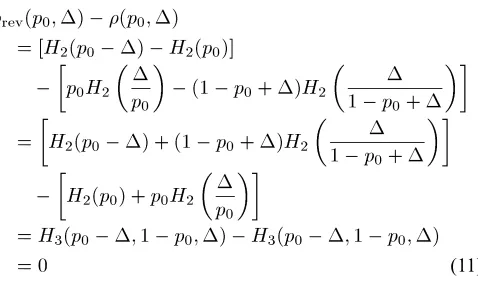
Subtracting (8) from (7), we have
(11)
and thus, we obtain the theorem. Herein, the third equality fol-lows from (9) and (10).
IV. IMPLEMENTATION ISSUES ANDPERFORMANCE COMPARISON
A. Overhead in the Last Block
In this paper, we propose the AAC [19] as the compression algorithm and the decompression algorithm of AAC as the em-bedding code, which can approximately reach the entropy.
In practice, we should set a proper length for the last block. Denote the estimated length of the last block by . After compression, the left room in the last block is about
bits, in which we will embed not only the informa-tion for reconstructing the second last block but also some over-head information. On one hand, to reconstruct the second last block, we need, at most, bits because the number of “1’s” in is not more than . On the other hand, the over-head consists of some parameters necessary to the recipient, the length of which is denoted by . Thus, the estimated length of the last block is enough, if
(12)
which implies that the lower bound of the length of the last block is
(13)
Therefore, for a cover sequence of length , the estimated number of -bit blocks, i.e., , is equal to
(14)
Thus, we get the estimated length of the last block as follows:
(15)
Note that the estimated length may be not enough in practice when the ratio of “0’s” in the last block is far from , that is, the overall ratio of “0’s.” Therefore, we should modify
Fig. 5. Structure of the last marked block.
the value of . First, take the last bits from the -bit cover and calculate the ratio of “0’s” in these bits, which is de-noted by . Second, by using , we modify the lower bound of the length of the last block as
(16)
and modify the number of -bit blocks as
(17)
Thus, the length of the last block is given by
(18)
To extract messages exactly, the recipient should know the length of previous blocks and the parameters , , and needed by the compression/decompression algorithm. Block length can befixed in advance by the sender and the recip-ient. Thus, the overhead consists of , , and . In practice, it is enough to take three decimal for each parameter, and thus, 30 bits are enough for the overhead, i.e., . We embed the overhead into the end of the last block. The structure of the last block is shown in Fig. 5.
When extracting messages from the -bit marked sequence, the recipientfirst reads the parameters , , and from the last 30 bits of the sequence and then computes by (4). Further-more, the recipient obtains by (13) (14) (15) (16) (17) (18) and determines the start point of the last block and then reads bits successively and decompresses them with as the param-eter. When the length of the decompressed sequence is equal to , stop the process of decompression because the last cover block has been obtained. Continue reading bits from the last marked block and decompress them with as the param-eter until the length of the decompressed sequence is equal to the number of “1’s” in the second last marked block . This decompressed sequence is just , which will be used to reconstruct the second last cover block . Next, with as the parameter, the extraction process, as described in Section III-B, will be continued until thefirst marked block.
B. Determining the Parameter
Fig. 6. Comparison of embedding rate versus distortion between the proposed codes and codes in [15]–[17]. (a) . (b) .
use the reverse function of (2) to estimate the needed parameter , that is
(19)
which will be embedded into the tail of the cover, as shown in Fig. 5. Note that the obtained by (19) is not distortion on the original -bit cover but on itsfirst bits.
C. Performance Comparison
In this paper, we propose the decompression algorithm of the AAC [19] as the embedding algorithm, whereas in our previous paper [17], we used the improved reverse zero-run length (RZL) coding [6] as the embedding algorithm. In fact, the improved RZL can be viewed as a modified version of the decompression algorithm of run-length coding. When we compare these two methods, the AAC is used as the compression algorithm in both cases.
We also compare these two methods with the codes proposed in [15] and [16]. In the original recursive construction [15], Kalker and Willems used Hamming matrix embedding [20] as the nonreversible data embedding code, by which they can embed bits of message into cover bits with, at most, one modification. The Hamming codes modify “0’s” and “1’s” with equal probability. Maaset al.[16] improved the original recursive construction by adjusting Hamming code to change more “0’s” than “1’s” for the case .
The simulation results of these coding methods are compared
for and . The simulation results are obtained by
embedding random messages into a -bit cover. In the ex-periments, we set the length of cover blocks for the proposed method and the RZL-based method in [17]. As shown in Fig. 6, the RZL-based method is only somewhat better than the proposed method at small embedding rates for , but it generates codes with only sparse embedding rates and cannot reach the maximum capacity for . The proposed method generates codes with continuous embedding rates and reaches the maximum capacity at distortion . Although
the codes proposed in [16] are close to the maximum capacity
for , they need larger distortion than .
V. APPLICATIONS INTYPE-I SCHEMES
The coding method above can be directly applied to data hiding schemes that belong to Type I, such as those in [1]–[6]. Next, we use the proposed codes to improve RDH schemes for spatial, JPEG, and binary images, respectively.
A. Improving the RS Scheme for Spatial Images
The RS method [1] is proposed for spatial images by con-structing compressible features based on texture complexity. Assume the covers are 8-bit gray scale images. The image isfirst divided into small groups, e.g., pixels per group. A permuta-tion is used toflip the gray values, the amplitude of which is controlled by a positive integer . For instance, when , theflipping function is as follows:
(20)
For a pixel group , the permutation on is
de-fined as . A distinguishing
func-tion is used to detect the changing direction of the variation of the group. Thus
(21)
By using the functions and , the pixel group can be defined as regular , singular , or unusable , such that
(22)
Fig. 7. Test images sized 512 512. (a) Lenna.pgm. (b) Baboom.pgm. (c) Boat.pgm. (d) Barbara.pgm. (e) Goldrill.pgm. (f) Peppers.pgm.
TABLE I
PATTERNSEXTRACTEDFROMTESTIMAGES
Flipping between “0” and “1” can be realized by applying to the corresponding pixel group.
Usually, larger amplitude implies larger capacity, but it also implies larger embedding distortion. In our experiments, we set from 1 to 4, and the group size . For each value of , we embed messages with the original RS method and the pro-posed codes into six 8-bit gray scale images sized 512 512 [21] (see Fig. 7). We observe that the ratio of “0’s” in the RS sequence varied from 0.54 to 0.87. In our coding method, we embed messages with the maximum embedding rate, i.e., taking as the parameter. As shown in Fig. 8, the pro-posed codes increase the peak signal-to-noise ratios (PSNRs) for various kinds of test images. Herein, the embedding rate is defined as bits carried by per pixel (bpp).
B. Improving the Scheme for JPEG Images
In this subsection, we apply the codes to the reversible em-bedding scheme for JPEG images proposed by Firdrich and Goljan [1]. In the method in [1], quantized DCT coefficients that are equal to 0 and 1 at middle or high frequency are selected to form a compressible binary sequence. In our experiments, the test images are generated by compressing test images in Fig. 7 into a JPEG format with quality factor 80. We construct the bi-nary cover by extract 0–1 coefficients from 11 positions, such as (3, 3), (2, 4), (4, 2), (1, 5), (5, 1), (3, 4), (4, 3), (2, 5), (5, 2), (1, 6), and (6, 1), from every 8 8 block of quantized DCT coefficients. Random messages are embedded into the binary cover by using Fridrich and Goljan’s method [1] and the pro-posed codes with several kinds of embedding rates. As shown in Fig. 9, the proposed codes can improve the method in [1] by increasing PSNRs from 1 to 4 dB.
C. Improving PS Scheme for Binary Images
As another example of applications, we use the proposed codes to improve the pattern substitution (PS) method for RDH in binary images [4]. Denote an binary image by , such
that . When using as
the cover image, the PS methodfirst computes the image differ-encing byEXCLUSIVE-ORoperation between neighbor pixels of , such that
if and
if and
otherwise.
(23)
TABLE II
NUMBER OFMODIFICATIONS FORDIFFERENTLENGTHS OFMESSAGES EMBEDDEDBY THEPS METHOD AND THEIMPROVEDPS METHOD
In the image differencing , the symbol “1’s” indicate the edges of the original image , around which modifications are usually insensible. Scan the image from left to right and from top to bottom, and divide it into disjoint blocks containing four pixels. Search all these 4-bit patterns tofind a pair of patterns, such that there is a large gap between their occurrence frequen-cies. Denote the pattern with large numbers by PM and the pat-tern with small numbers by PF. By assigning “0” to PM and “1” to PF, we just get a compressible binary cover. To keep vi-sual quality, neither PM nor PF can be all-zero vectors, and the number of modifications for PS should be as small as possible. In the PS method, a location map is used to record the positions of PFs, and then, the message bits combining with the location map are embedded into the PM–PF (0–1) sequence. Modifi ca-tions are realized by substitution between patterns PM and PF. Denote the number of PFs by , and the location map will cost bits of capacity. Therefore, the number of PFs must be very small.
We improve the PS method by applying the proposed codes to embed messages into the PM–PF sequence withfive kinds of message lengths, which does not need a location map. Be-cause the cover sequence is short, we take the length of the cover
blocks in the experiments. For each 256 256 test
rate under a given distortion constraint may be achieved by using joint encoding of feature compression and message em-bedding and, thus, proposed the recursive code construction. In this paper, we improve the recursive construction by using not only the joint encoding above but also a joint decoding of fea-ture decompression and message extraction. The proposed code construction significantly outperforms previous codes [15], [16] and is proved to be optimal when the compression algorithm reaches entropy.
The current codes are designed for binary covers and, thus, can significantly improve Type-I schemes based on binary fea-ture sequences. By slightly modifying the HS manner, we found that the proposed binary codes can be also partly applied to Type-II schemes and improve their performance, but the im-provement is not so significant as that for Type-I schemes. Note that we only use two simple methods to modify HS, and there-fore, one interesting problem is whether there exists other more effective modifying methods or not. Another problem is how to design recursive codes for gray scale covers. We will pay our attention to these problems in further works.
REFERENCES
[1] J. Fridrich and M. Goljan, “Lossless data embedding for all image for-mats,” inProc. EI SPIE, Security Watermarking Multimedia Contents IV, San Jose, CA, 2002, vol. 4675, pp. 572–583.
[2] M. U. Celik, G. Sharma, A. M. Tekalp, and E. Saber, “Lossless gen-eralized-LSB data embedding,”IEEE Trans. Image Process., vol. 14, no. 2, pp. 253–266, Feb. 2005.
[3] S. Li and A. C. Kot, “Privacy protection offingerprint database using lossless data hiding,” inProc. IEEE Int. Conf. Multimedia Expo., 2010, pp. 1293–1298.
[4] Y.-A. Ho, Y.-K. Chan, H.-C. Wu, and Y.-P. Chu, “High-capacity reversible data hiding in binary images using pattern substitution,” Comput. Standards Interfaces, vol. 31, no. 4, pp. 787–794, Jun. 2009. [5] R. Du and J. Fridrich, “Lossless authentication of MPEG-2 video,” in Proc. IEEE Int. Conf. Image Process., 2002, vol. 2, pp. II-893–II-896. [6] K. Wong, K. Tanaka, K. Takagi, and Y. Nakajima, “Complete video quality-preserving data hiding,” IEEE Trans. Circuits Syst. Video Technol., vol. 19, no. 10, pp. 1499–1512, Oct. 2009.
[7] J. Tian, “Reversible data embedding using a difference expansion,” IEEE Trans. Circuits Syst. Video Technol., vol. 13, no. 8, pp. 890–896, Aug. 2003.
[8] A. M. Alattar, “Reversible watermark using difference expansion of a generalized integer transform,”IEEE Trans. Image Process., vol. 13, no. 8, pp. 1147–1156, Aug. 2004.
[9] H.-J. Kim, V. Sachnev, Y. Q. Shi, J. Nam, and H.-G. Choo, “A novel difference expansion transform for reversible data embedding,”IEEE Trans. Inf. Forensic Security, vol. 3, no. 3, pp. 456–465, Sep. 2008.
[10] D. M. Thodi and J. J. Rodriguez, “Expansion embedding techniques for reversible watermarking,”IEEE Trans. Image Process, vol. 16, no. 3, pp. 721–730, Mar. 2007.
[11] Y. Hu, H.-K. Lee, and J. Li, “DE-based reversible data hiding with improved overflow location map,”IEEE Trans. Circuits Syst. Video Technol., vol. 19, no. 2, pp. 250–260, Feb. 2009.
[12] Z. Ni, Y. Q. Shi, N. Ansari, and S. Wei, “Reversible data hiding,”IEEE Trans. Circuits Syst. Video Technol., vol. 16, no. 3, pp. 354–362, Mar. 2006.
[13] P. Tsai, Y. C. Hu, and H. L. Yeh, “Reversible image hiding scheme using predictive coding and histogram shifting,”Signal Process., vol. 89, no. 6, pp. 1129–1143, Jun. 2009.
[14] L. X. Luo, Z. Y. Chen, M. Chen, X. Zeng, and Z. Xiong, “Reversible image watermarking using interpolation technique,”IEEE Trans. Inf. Forensics Security, vol. 5, no. 1, pp. 187–193, Mar. 2010.
[15] T. Kalker and F. M. Willems, “Capacity bounds and code constructions for reversible data-hiding,” inProc. 14th Int. Conf. DSP, 2002, pp. 71–76.
[16] D. Maas, T. Kalker, and F. M. Willems, “A code construction for recur-sive reversible data-hiding,” inProc. Multimedia Security Workshop ACM Multimedia, Juan-les-Pins, France, Dec. 6, 2002.
[17] W. Zhang, B. Chen, and N. Yu, “Capacity-approaching codes for re-versible data hiding,” inProc 13th IH, 2011, vol. 6958, LNCS, pp. 255–269, Springer-Verlag.
[18] T. M. Cover and J. A. Thomas, Elements of Information Theory. New York: Wiley, 1991.
[19] K. Sayood, Introduction to Data Compression. San Francisco, CA: Morgan Kaufmann, 1996, pp. 87–94.
[20] R. Crandall, Some Notes on Steganography 1998 [Online]. Available: http://os.inf.tu-dresden.de/westfeld/crandall.pdf, Posted on steganog-raphy mailing list
[21] Miscellaneous gray level images [Online]. Available: http://decsai. ugr.es/cvg/dbimagenes/g512.php
VII. CONCLUSION
![Fig. 6. Comparison of embedding rate versus distortion between the proposed codes and codes in [15]–[17]](https://thumb-us.123doks.com/thumbv2/123dok_us/7825471.1665931/7.592.84.515.63.238/fig-comparison-embedding-versus-distortion-proposed-codes-codes.webp)
