ISSN: 2251 - 6204
www.mjltm.com
Editor – in – Chief
Hamed Ghaemi, PhD, Islamic Azad University, Iran
Editorial Board
Abednia Arman
, PhD in TEFL, Allameh Tabataba’i University, Tehran, Iran
Azizi Masoud
, PhD in Applied Linguisitcs, University of Tehran, Iran
Basiroo Reza
, PhD in TEFL, University of Tehran, International Campus,
Iran
Elahi Shirvan Majid
, PhD in TEFL, Ferdowsi University of Mashhad, Iran
Fernández Miguel
, PhD, Chicago State University, USA
Ghaemi Hamide
, PhD in Speech and Language Pathology, Mashhad
University of Medical Sciences, Iran
Grim Frédérique
M. A., Associate Professor of French, Colorado State
University, USA
Izadi Dariush,
PhD candidate in Applied Linguistics, Macquarie University,
Sydney, Australia
Kargozari Hamid Reza
, PhD Candidate in TEFL, Payame Noor University
of Tehran, Iran
Kaviani Amir
, Assistant Professor at Zayed University, UAE
Kirkpatrick Robert
, Assistant Professor of Applied Linguistics, Shinawatra
International University, Thailand
Morady Moghaddam Mostafa,
PhD Candidate in TEFL, University of
Tabriz, Iran
Ndhlovu Finex,
PhD, Linguistics Programme, University of New England,
Australia
University of Wyoming in Laramie, USA
Rezaei Saeed
, PhD in TEFL, Sharif University of Technology, Tehran, Iran
Rolstad Kellie,
PhD, Associate Professor of Education, University of
Maryland, USA
Shahbazirad Mohammad
, PhD in English language and Literature, Yerevan
State University, Armenia
Weir George R. S.,
PhD in Philosophy of Psychology, University of
Strathclyde, Glasgow, UK
Zegarac Vladimir
, PhD, University of Bedfordshire, UK
Vol. 4, Issue 5, December 2015
Abstracting/Indexing
Index
Copernicus 2011
Linguistics Abstract
EBSCO Publication
Lulu Publication
Vol. 4, Issue 5, December 2015
Directory of Open Access Journals
ProQuest
Modern Language Association
Cabell's Directories
COPE
Vol. 4, Issue 5, December 2015
Directory of Research Journal Indexing (DRJI)
Indian Citation Index
International Society of Universal Research in Sciences
Vol. 4, Issue 5, December 2015
J-Gate
Ulrich's
Vol. 4, Issue 5, December 2015
TABLE OF CONTENTS
THE EFFECT OF DIRECT CORRECTIVE FEEDBACK ON STUDENTS' GRAMMATICAL ERRORS
Bahareh Por Nazari, Akbar Azizifar and Habib Gowhary
THE EFFECT OF USING MONOLINGUAL MOBILE DICTIONARY ON THE IRANIAN EFL LEARNERS’ ABILITY TO RECALL AND USE THE VOCABULARY
Rahmat Rabipour Pishevari, Reihaneh Sheikhi and Marjan Heydarpour
A COMPARISON BETWEEN THE NEW VERSION OF IRANIAN HIGH-SCHOOL ENGLISH TEXTBOOKS AND THE INTERNATIONALLY-PRODUCED TOP NOTCH SERIES:
A COMPARATIVE STUDY
Ali Pourahmad1, Kourosh Naderi2 , Soroush Heidarpoor3
CULTURE, INTERCULTURAL & CROSS-CULTURAL COMMUNICATIONS "A DESCRIPTIVE STUDY"
Akbar Afghari and Ali Asghar Pourakbari
THE ACCURACY ORDER OF ENGLISH GRAMMATICAL MORPHEMES OF IRANIAN EFL LEARNERS: AN EXAMINATION OF A UNIVERSAL ORDER
Azam Pourmohammadi Kharrati (Corresponding Author), Saeid Ahmadi, Mohammad Mohammaditabar and Firooz Sadighi
THE EFFECT OF SCHEMA ACTIVATION BY USING L1 IN THE CLASSROOM SITUATION ON IRANIAN EFL LEARNER'S LISTENING COMPREHENSION ABILITY
Homaera Rabiee pour and Houshang Azari
A STUDY ON THE EFFECTIVENESS OF FAVORITE- TEXT ON IRANIAN INTERMEDIATE EFL LEARNERS’ VOCABULARY DEVELOPMENT
Adineh Rahimi, Morteza khodabandehlou and Shahrokh Jahandar
INFANT'S PERCEPTION OF SUPRASEGMENTAL AND SEGMENTAL ASPECTS OF LANGUAGE
Nasser Ghafoori and Roya Ranjbar Mohammady
THE EFFECT OF REFLECTIVE TEACHING ON THE INTRINSIC MOTIVATION AND CRITICAL THINKING OF IRANIAN EFL LEARNERS ACROSS AGE GROUPS
Azam Abaslou and Jahanbakhsh Langroudi
THE STUDY OF THE RELATIONSHIP BETWEEN FEMALE EFL LEARNERS' SHYNESS, SELF-ESTEEM AND LEVEL OF EDUCATION
Farahnaz Abedini, Mehrdad Rezaeian and Firooz Sadighi
THE EFFECTIVENESS OF METACOGNITIVE STRATEGY USE ON EFL LEARNERS' READING COMPREHENSION AND MOTIVATION
Saeid Najafi Sarem and Fatemeh Adib
A STUDY ON THE EFFECTIVENESS OF DYNAMIC ASSESSMENT ON IRANIAN INTERMEDIATE EFL LEARNERS’ ORAL PROFICIENCY
Mohammad Mahdi Allahyari Hassanabad , Shahrokh Jahandar, Morteza Khodabandehlou
Vol. 4, Issue 5, December 2015
THE ROLE OF SCREEN CAPTURE TECHNOLOGY IN TRANSLATION: A CASE STUDY OF PROCESS-ORIENTED TRANSLATION FROM ENGLISH INTO PERSIAN
Reza Arta
COMPUTER ASSISTED LANGUGE LEARNING : THE COMPARISON OF TECHNOLOGICALLY CONTEXTUALIZED AND TRADITIONAL TEACHING OF VOCABUARY
Jafar Asadi
INVESTIGATING THE RELATIONSHIP BETWEEN EMOTIONAL INTELLIGENCE AND LISTENING COMPREHENSION OF UNIVERSITY STUDENTS
Somaye Badali and Alireza Bonyadi
INVESTIGATING THE PREPOSITIONAL ERRORS IN THE WRITINGS OF IRANIAN TEFL POSTGRADUATE STUDENTS
Samira Baghaei and Firooz Sadighi
ENGLISH PROFICIENCY AND IRANIAN EFL LEARNERS’ MOTIVATION IN LANGUAGE INSTITUTES
Anis Behzadi, Mohammad Golshan
BRIEF OVERVIEW 0F THE HISTORY OF GRAMMAR
Masoomeh Benshams and Firooz Sadighi
THE EFFECT OF GRAPHIC ORGANIZERS ON EFL LEARNERS’ WRITING SKILL
Maryam Borjalizadeh and Mansour Shabani
APPLYING THE BACKWARD DESIGN PLANNING PROCESS TO TEACH ENGLISH AS A FOREIGN LANGUAGE READING COMPREHENSION STRATEGIES INSTRUCTION
Cheng-Chang Tsai
SOCIOPRAGMATIC FAILURES IN EFL SETTINGS: THE THEORETICAL PERSPECTIVES AND EMPERICAL FINDINGS
Seyed Ali Ostovar Namaghi and Marzieh Davari Torshizi
A STUDY ON THE EFFECTIVENESS OF CONNECTED SPEECH INSTRUCTION ON IRANIAN INTERMEDIATE EFL LEARNERS’ LISTENING COMPREHENSION ABILITY
Hengameh Dehdast Lakmehsari, Shahrokh Jahandar, Morteza Khodabandehlou
THE EFFECT OF WRITTEN FEEDBACK ON IRANIAN EFL EXTROVERT STUDENTS’ WRITING
Amir Reza Nemat Tabrizi and Ali Dolati Yolghoun Aghaj
THE IMPACT OF USING OPEN TASKS VS. CLOSED TASKS ON IRANIAN INTERMEDIATE EFL LEARNERS’ WRITING PARAGRAPH
Sedigheh Esrafilian and Mohammadreza Khodareza
MORPHOLOGICAL AWARENESS AND VOCABULARY KNOWLEDGE: A CASE OF CORRELATION
Sima farhadi, Hanieh Davatgari Asl and Zahra Talebi
THE RELATIONSHIP BETWEEN IPA AND CORRECT PRONUNCIATION
Z. Ahmadi Foumani Shad1 and P. Farrokh2
INVESTIGATING THE RELATIONSHIP BETWEEN SELF ESTEEM AND READING PERFORMANCE OF IRANIAN EFL LEARNERS
Naser Ghafoori and Gholamreza Nourelahi
Vol. 4, Issue 5, December 2015
THE EFFECT OF APPLYING BACK TRANSLATION TASK (BTT) ON IRANIAN EFL LEARNERS’ GENERAL TRANSLATION ABILITY
Fereshteh Gholami, Mohammadreza Khodareza
IRANIAN PARENTS' PERSPECTIVES AND MOTIVATIONAL BELIEFS TOWARDS THEIR CHILDREN'S ENGLISH LANGUAGE ACQUISITION
Touran Ahour and Farideh Gholizadeh
ELABORATIVE DISCOURSE MARKERS IN COMPUTER ESP BOOKS DEVELOPED BY IRANIAN AND BRITISH AUTHORS
Ahmad Mohseny and Mohammad Golestani
THE USE OF SECOND LIFE IN EDUCATIONAL FORUMS
Ronnie Goodwin
THE EFFECT OF USING CARTOONS ON THE ACCURACY OF YOUNG ELEMENTARY IRANIAN EFL LEARNERS’ SPEAKING
Faranak Behaminfar and Nasrin Hadidi Tamjid
A STUDY ON THE EFFECTIVENESS OF THE DEGREE OF PERSONALITY TRAITS THROUGH
INTEGRATING LISTENING TASK ON IRANIAN INTERMEDIATE EFL LEARNERS’ IMPROVEMENT OF LISTENING COMPREHENSION ABILITY
Sara Hagh sheno and Morteza Khodabandehlou
THE EFFECT OF GROUP GAMES ON IRANIAN ELEMENTARY LEARNERS’ LETTER LEARNING KNOWLEDGE
Haghighat, and Shahrokh Jahandar,
A COMPARATIVE STUDY OF THE EFFECT OF GRAMMAR TRANSLATION METHOD AND
COMMUNICATIVE LANGUAGE TEACHING ON IRANIAN LOWER-INTERMEDIATE EFL LEARNERS' LANGUAGE PROFICIENCY
Masoomeh Hanafiyeh
A COMPARATIVE STUDY ON THE CURRENT STATE OF THE ART OF READING SKILL ACCOUNTS
S. Najafi Sarem and H. Hassankhani
THE RELATIONSHIP BETWEEN IRANIAN EFL LEARNERS’ READING COMPREHENSION AND THEIR PERSONALITY TRAITS: EXTROVERSION VS INTROVERSION
Saeed Najafi Sarem and Mahshid Hazrati
THE IMPACT OF DYNAMIC ASSESSMENT ON THE IMPROVEMENT OF IRANIAN INTERMEDIATE EFL LEARNERS' LISTENING COMPREHENSION ABILITY
Behnaz Hedayati, Shahrokh Jahandar and Morteza Khodabandehlou
RHETORICAL STRUCTURE OF BOOK REVIEWS: A CROSS-LINGUISTIC AND CROSS-DISCIPLINARY STUDY
Naser Rashidi , Mohammad Hamed Hoomanfard and Sara Ramezani
THE RELATIONSHIP BETWEEN ACADEMIC SELF-CONCEPT AND LEARNING ENGLISH IN HIGH SCHOOL STUDENTS
Maryam Meshkat, Seyed Mostafa Hosseini
ON THE EFFECT OF PEER AND TEACHER FEEDBACK ON IRANIAN UPPER-INTERMEDIATE EFL LEARNERS’ WRITING PERFORMANCE
Saeid Najafi Sarem and Shabnam Hosseiny
Vol. 4, Issue 5, December 2015
A STUDY ON THE EFFECTIVENESS OF THESAURUS ON IRANIAN UPPER INTERMEDIATE EFL LEARNERS' LISTENING COMPREHENSION ABILITY
Homeira Jafari Yaraki, Shahrokh Jahandar and Morteza Khodabandehlou
THE STUDY OF CORRELATION BETWEEN FLUENCY AND ACCURACY IN WRITING SKILL OF IRANIAN INTERMEDIATE AND ADVANCED EFL LEARNERS
Mojdeh Javidan, Fereydoon Vahdany and Nasrin Sabouri
THEORETICAL FRAMEWORKS OF LANGUAGE DEVELOPMENT "A LIBRARY RESEARCH" Ahmad Reza Lotfi and Bahar Joybar
LEARNING MANDARIN CHINESE AS A FOREIGN LANGUAGE:
EVIDENCE-BASED STRATEGIES FOR TEACHING STUDENTS WITH DISABILITIES
Kai Yung (Brian) Tam, Yuanyuan Rong, Lyndal M. Bullock and Ralph Gardner III
CULTURE-BOUND MATERIALS, LISTENING PERFORMANCE OF IRANIAN INTERMEDIATE EFL LEARNERS, AND THEIR EMOTIONAL INTELLIGENCE
Neshat Karamalian and Mohamadreza Talebinejad
THE EFFECT OF SCAFFOLDING ON EFL LEARNERS’ READING COMPREHENSION
Najmeh Kargar and Farhad Tayebipour
THE IMPACT OF CONTENT AND LANGUAEG INTEGRATED LEARNING (CLIL) ON EFL LEARNERS’ READING COMPREHENSION
Najmeh Kargar and Farhad Tayebipour
A COMPARATIVE INVESTIGATION INTO THE IMPACT OF INNOVATIVE AND NON- INNOVATIVE TEACHERS ON IRANIAN EFL LEARNERS’ SPEAKING ABILITY
Nasibeh Kazemi and Mohammad Abdollahi- Guilani
THE EFFECT OF DEEP ORTHOGRAPHY TASK ON IRANIAN INTERMEDIATE EFL LEARNERS' SPELLING AND PRONUNCIATION
Parisa Kazemian and Ramin Rahimy
THE EFFECT OF GI AND CIRT AS THE COOPERATIVE TECHNIQUES ON LEARNERS READING COMPREHENSION AT INTERMEDIATE LEVEL OF IRANIAN EFL CLASSROOMS
Ali Akbar Khansir and Sara Farajolahzadeh
THE STRUCTURAL AND TEXTUAL CHARACTERISTICS OF TRADITIONAL AND CONTEMPORARY IRANIAN WEDDING CARDS
Mohammad Bazdar and Mohammad Reza Khodashenas
A COMPARATIVE STUDY ON THE EFFECTIVENESS OF PEER-DIRECTED LEARNING STRATEGY VS. SELF-DIRECTED LEARNING STRATEGY ON IRANIAN INTERMEDIATE EFL LEARNERS’ WRITING IMPROVEMENT
Zeynab Khorram Vajargah and Morteza Khodabandehlou
THE EFFECT OF USING TIMED READING AND GENRE-BASED READING ON INTERMEDIATE EFL LANGUAGE LEARNERS’ READING COMPREHENSION
Molood Mahdizadeh, Mahsa Khoshchehreh and Hananeh Hemati
Vol. 4, Issue 5, December 2015
THE EFFECT OF TEST CONSTRUCTION ON IRANIAN ADVANCED EFL LEARNERS’ READING COMPREHENSION ABILITY
Ameneh Maghsoodi, Shahrokh Jahandar, Morteza Khodabandehlou
COMPARATIVE STUDY ON LEARNING CONVERSATION VIA THE USE OF METACOGNITIVE LEARNING STRATEGIES AMONG IRANIAN EFL LEARNERS AT INTERMEDIATE LEVEL CLASSES IN ENGLISH LANGUAGE INSTITUTES.
Majid Mehrabi
THE EFFECT OF THE IDEOLOGICAL BACKGROUND OF TRANSLATOR ON THE INFORMATION STRUCTURE OF TRANSLATED TEXT
Reza Mobashshernia and Bahareh Eskandari
THE EFFECT OF TEACHING CRITICAL THINKING ON IRANIAN UPPER-INTERMEDIATE EFL LEARNERS’ ESSAY WRITING ABILITY
Milad Moradpour, Shahrokh Jahandar and Morteza Khodabandehlou
CLASSROOM INTERACTION AND TEACHERS’ UPTAKE IN RESPONSE TO TEACHERS’ REFERENTIAL AND DISPLAY QUESTIONS IN EFL SETTING
Saleh Arizavi, Parisa Rezaee Kalhor, Namdar Namdari and Seyyed Ahmad Mousavi
A CONSTRATIVE STUDY OF LEXICAL COHESION USED IN SPORT TEXTS IN WASHINGTON AND TEHRAN TIMES NEWSPAPERS WRITTEN BY ENGLISH NATIVE AND IRANIAN AUTHORS
Nesa Nabifar and Gholamreza Rostami ,
DIFFERENCES BETWEEN L1 AND L2 ACQUISITION IN TERMS OF AFFECTIVE FACTORS AND MOTIVATION TO LEARN THE LANGUAGE
Saeid Najafi Sarem and Neda Toughiry
GRAMMATICALITY IN SYNTACTIC THEORIES
Mohammadreza Nasr, Sara Shahab and Firooz Sadighi
THE EFFECT OF USING L1 ON IRANIAN HIGH SCHOOL STUDENTS’ READING COMPREHENSION ABILITY
Khadijeh Nayeri
MOTIVATION AND ATTITUDE TOWARDS LEARNING ENGLISH: A CASE STUDY OF RASHT ISLAMIC AZAD UNIVERSITY
Atefeh Nazari and Mohammad Abdollahi-Guilani
AN INVESTIGATION INTO THE RELATIONSHIP BETWEEN GESTURES AND SPEAKING SKILL FOR IRANIAN EFL LEARNERS
Sayyed Esmail Mireghaffari Nouhadani and Mohammad Abdollahi-Guilani
INVESTIGATING THE RELATIONSHIP BETWEEN SELF ESTEEM AND READING PERFORMANCE OF IRANIAN EFL LEARNERS
Naser Ghafoori and Gholamreza Nourelahi
INVESTIGATING THE RELATIONSHIP BETWEEN PERSONALITY TYPE AND LISTENING PERFORMANCE OF IRANIAN EFL LEARNERS
Nasrin Hadidi and Gholamreza Nourelahi
THE RELATIONSHIP BETWEEN TEACHER AUTONOMY AND TEACHER EFFICACY
Atefeh Rahimi and Mohammad Javad Riasati
Vol. 4, Issue 5, December 2015
ESP VOCABULARY INSRUCTION: THE EFFECT OF USING GAME- ORIENTED TEACHING METHODS ON IRANIAN ESP LEARNERS MAJORING IN PSYCHOLOGY
Batoul Sabzalipour and Hossein Heidari Tabrizi
AN ANALYSIS OF EFL TEXTBOOKS IN IRAN FROM THE CULTURAL AWARENESS PROSPECTIVE
Batoul Sabzalipour and Mansour Koosha
EXTENSIVE READING AND ITS EFFECTS ON READING COMPREHENSION PERFORMANCE OF IRANIAN EFL STUDENTS ACCORDING TO BLOOM’S TAXONOMY
Ghafour Saeedi
THE EFFECT OF REFLECTIVE TEACHING ON DEVELOPMENT OF PRE-SERVICE TEACHERS’ TEACHING ABILITY IN AN EFL CONTEXT
Mohamad Javad Salehinia, Seyed Jalal Abdolmanafi-Rokni
THE EFFECT OF PARAGRAPH WRITING ON VOCABULARY LEARNING OF IRANIAN INTERMEDIATE EFL STUDENTS
Leila Salimi Dafsari and Houshang Azari
PRAGMATIC COMPETENCE DEVELOPMENT IN L2
Safieh Sayyar , Linda Samadi and Firooz Sadighi
ON THE EFFECTS OF PHATIC COMMUNION INSTRUCTION ON IRANIAN INTERMEDIATE AND ADVANCED EFL LEARNER’S ORAL PRODUCTION
Alireza Sedaghatnia, Shahrokh Jahandar and Morteza Khdabandehlou
A COMPARATIVE STUDY OF EXPRESSIVE SPEECH ACTS (APOLOGIES, COMPLAINTS AND COMPLIMENTS): A CASE STUDY OF PERSIAN NATIVE SPEAKERS AND EFL LEARNERS
Shahin Sheykh and Maral Sheykh Esmaeili
THE ANALYSIS OF IMPOLITENESS IN FAMILY DISCOURSE: VERBAL INTERACTIONS BETWEEN IRRECONCILABLE IRANIAN COUPLES
Nouroddin Yousofi, Fereshteh Shirzad and Gerannaz Zamani
THE RHETORICAL STRUCTURE OF M.A ABSTRACTS WRITTEN BY STUDENTS OF ENGLISH LANGUAGE TEACHING, ENGLISH TRANSLATION AND CHEMISTRY IN IAUSH
Seyyed Parsa Tabatabaei and Mohammad Reza Talebinejad
THE INFLUENCE OF TEACHING METACOGNITIVE READING STRATEGIES ON THE READING SELF-EFFICACY BELIEFS OF IRANIAN EFL LEARNERS: AN EXPERIMENTAL STUDY
Ali Taghinezhad, Razieh Dehbozorgi and Naghmeh Esmaili
DIFFERENT APPROACHES TO ENGLISH GRAMMAR FROM TRADITIONAL TO MINIMALIST AND THEIR PEDAGOGICAL EFFECTIVENESS
Hamideh Taheri and Firooz Sadighi
EFL TEACHERS’ POLITENESS STRATEGY USE IN CLASSROOMS: IRANIAN EFL TEACHERS IN FOCUS
Arezoo Mohammadi and Saeed Taki
THE EFFECT OF TASK-BASED LANGUAGE TEACHING (TBLT) AND TASK-SUPPORTED LANGUAGE TEACHING (TSLT) ON IRANIAN FEMALE INTERMEDIATE EFL LEARNERS' WRITING PROFICIENCY
Mina Tasouji Azari and AlirezaBonyadi
Vol. 4, Issue 5, December 2015
THE EFFECTIVENESS OF STRATEGY BASED INSTRUCTION OF SUMMARY WRITING(SBI) ON IRANIAN INTERMEDIATE EFL LEARNERS' READING COMPREHENSION ABILITY
Sedigheh Vafaeinejad
AN INVESTIGATION OF EFL LEARNERS LINGUISTICS 'INTRINSIC MOTIVATION TYPES AND SELF-IDENTITY CHANGES
Masoud Khalili Sabet, Amir Mahdavi Zafarghandi and Nushin Veisy
A COMPARATIVE STUDY ON THE EFFECT OF TASK-REPETITION STRATEGY VS. PEER COOPERATION STRATEGY ON IRANIAN INTERMEDIATE EFL LEARNERS’ VOCABULARY DEVELOPMENT
Mersedeh Zahmatkesh and Morteza Khodabandehlou
Vol. 4, Issue 5, December 2015
THE EFFECT OF DIRECT CORRECTIVE FEEDBACK ON
STUDENTS' GRAMMATICAL ERRORS
Bahareh Por Nazari
Department of English language Teaching, Islamic Azad University, Ilam Branch, Ilam, Iran [email protected]
Akbar Azizifar
Department of English language Teaching, Islamic Azad University, Ilam Branch, Ilam, Iran
Habib Gowhary
Department of English language Teaching, Islamic Azad University, Ilam Branch, Ilam, Iran
Abstract
Leaners grammar has proven to be an important variable in effective teaching and learning. One challenge in teacher education is to provide strategies and processes which equip teachers to improve grammatical level.A strategy that has received considerable attention in EFL leaning is direct corrective feedback. The objective of this study was to explore the impact of direct corrective feedback on leaners grammar. The participants were 40 intermediate EFL learners Iranian male and female teachers in two experimental and control groups. The particular treatment used in the experimental group was direct corrective feedback. At the beginning and the end of the semester, both groups completed a questionnaire regarding grammar level to investigate the possible effect of direct corrective feedback on learners’ grammar. TOEFL Grammar Test (TGT) was used as the measure of learners' grammar level. The findings suggest that learners' grammar improve as the effect of DCF.
Keywords: Corrective Feedback, Direct Corrective Feedback, , Grammatical Errors.
1.1Introduction
Grammatical error correction has been known as an interesting as well as commercially attractive problem in natural language processing in particular for EFL learners or ESL learners. Regardless of the growing interest, research has been hindered by the lack of a large annotated corpus of learner text that is available for research purposes. Consequently, the standard approach to grammatical error correction has been to train an off-the-shelf classifier to re-predict words in non-learner text. Learning grammatical error correction models directly from annotated learner corpora is not well explored as are methods that combine learner and non-learner text ( Dahl Meier and Ng; 2011).
Therefore one of the main challenges that educational system faced is how to help learners move toward becoming EFL leaner without any grammatical errors. There have been many studies on how to promote learner grammatical errors from 1940 till recent years. In Asian environment, EFL learners considered as passive student in classroom with a lot of grammatical errors, so educational system should change their strategies and teaching method for moving toward learning, and when it is possible that students become learners without any grammatical errors.
2. Review of the related literature 2.1 Corrective feedback
Discussion about the significance of providing corrective feedback on EFL learning has been prominent in recent years.Recently, there has been quite some disagreement in the academic field on the benefits of this
Vol. 4, Issue 5, December 2015
kind feedback on learners’ written output. According to Sheen (2004) there has been considerable interest in corrective feedback(CF) in SLA on both theoretical and pedagogical grounds. On the theoretical side, there has been an argument over whether CF, which is a type of ‘negative evidence, is necessary, or even beneficial, for language acquisition. Those who discuss against CF claim that positive evidence alone is sufficient for learners to acquire a second language (Krashen,1982,Schwartz, 1993) and that negative evidence has no use and may even have a harmful effect on interlanguage development)Truscott, 1996). On the other hand, those who supported CF, argue that negative evidence plays a facilitative and perhaps even crucial role in acquisition.
In recent years, there have been various research studies which have explored the role of CF on language learnig. In a study by Oliver (2000) who investigated two variables: age and participatory structure. The participants of the study were from 20 ESL classrooms (10 adult and 10 children classes) and 16 adults and 16 children NS-NNS dyads. She found that the pair-work context as opposed to a teacher-fronted context produced more negative feedback moves, whereas the actual use of CF by the learners was greater in teacher-fronted interaction. Also, children, as opposed to adults, were more likely to use such feedback. Her findings provide evidence for a clear role of pedagogical context as well as age in CF and learner responses to CF.
Ohta (2001) takes corrective feedback a step further by showing that if the correct form is provided, learners may have the chance to compare their own production with that of another. Accordingly, corrective feedback may stimulate hypothesis testing, giving the learner the opportunity to grapple with form-meaning relationships. Corrective feedback that does not provide the correct form, on the other hand, may force the learners to utilize their own resources in constructing a reformulation. In either case, corrective feedback may facilitate L2 development.
2.2 Direct corrective feedback
Two recent studies comparing different strategies on specific types of errors have provided more evidence in support of written corrective feedback. Ferris (2002) defined direct feedback as one “when an instructor provides the correct linguistic form for students (word, morpheme, phrase, rewritten sentence, deleted word[s] or morpheme[s]” (p.19).
Direct feedback may be done in various ways such as by striking out an incorrect or unnecessary word, phrase, or morpheme; inserting a missing or expected word, phrase, or morpheme; and by providing the correct linguistic form above or near the erroneous form (Ellis, 2008;Ferris, 2006, cited in Purnawarman, 2011; p.28) usually above it or in the margin.
In other words direct error correction (also referred to as explicit or overt error correction) is the type of feedback where the L2 teacher directly provides the correct forms or structures to explicitly show the error in the linguistic structure of the student’s written text (Ferris,2002;Ferris,2003),as shown in the above examples, in fact while indirect corrective feedback only consists of an indication of an error (i.e.by underlining the error or providing an error code), direct error correction identifies both the error and the target form. One common technique for correction of composition errors produced by native and foreign language learners is for teachers to simply provide the correct form of structure’s faulty sentences (Hendrickson, 1978).
Direct feedback is the strategy of providing feedback to students to help them correct their errors by providing the correct linguistic form (Ferris; 2003) or linguistic structure of target language. Direct feedback is usually given by the teachers, upon a noticing a grammatical mistake, by providing the correct answer or the expected response above or near the linguistic or grammar error (Ferris, 2003a). Direct correction is when the teacher corrects students’ errors on their scripts by writing the correct structural or lexical form (Lalande, 1982; Robb et al., 1986; Semk, 1984).
Bitchener et al (2005) compared two types of feedback groups (a combination of direct written feedback and oral conference feedback and direct written feedback only) with the control group (no corrective feedback) on three types of errors (prepositions, the past simple tense, and the definite article). The study found a significant effect of the combination of written and oral feedback in the use of the past simple tense and the definite article in new pieces of writing. However, no effect was found in the use of prepositions. The findings were confirmed by a recent study by Bitchener (2008) who compared three types of direct corrective feedback: a combination of direct feedback, written and oral linguistic explanation; direct feedback and written meta-linguistic explanation; and direct feedback only. It was found that the accuracy of students who received feedback in the immediate post-test outperformed those in the control group who received no corrective feedback in the use of the referential indefinite “a” and referential definite “the”. More importantly, this level of
Vol. 4, Issue 5, December 2015
performance was retained 2 months later. Results of the two studies indicate positive effects of written corrective feedback on particular linguistic features in student writing.
2.3 Grammatical errors
The role of grammar instruction and error correction in the EFL classroom has been an issue of considerable debate in language learning. According to Widdowson (1990), " . . . grammar is not a constraining imposition but a liberating force: it frees us from a dependency on context and a purely lexical categorization of reality."(p.86) Given that many learners – and teachers – tend to view grammar as a set of restrictions on what is allowed and disallowed in language use – ‘a linguistic straitjacket’ in Larsen-Freeman’s words (2002) the conception of grammar as something that liberates rather than represses is one that is worth investigating.
This discussion can be framed in terms of meaning-focused instruction versus form-focused instruction. Meaning focused instruction is based on the assumption that, like first language (L1) acquisition, L2 acquisition occurs unconsciously and implicitly. Only the availability of comprehensible input and a low affective filter in the learner are necessary for language learning. Any overt attention to linguistic form is unnecessary, and any corrective feedback is ineffective (Krashen, 1981)
According to Ellis (2001) Form-focused instruction is an umbrella term for “any planned or incidental instructional activity that is intended to induce language learners to pay attention to linguistic form” (p. 1). Long (1996) asserted that form-focused instruction has been seen as consisting of two broad types: focus on forms and focus on form.Based on Klapper and Rees (2003) focus on forms is characterized by "division of the language according to lexis, structure notions or functions, which are selected and sequenced for students to learn in a uniform and incremental way” ( p. 2). In contrast according to Ellis (2001) and Long (1996), focus on form constitutes attention to linguistic structures within the context of meaning-focused, communicative activities.
In the same vine Al-Mekhlafi and Nagaratnam (2011) argued that in grammar teaching, three areas have to be considered: grammar as rules, grammar as form, and grammar as resource. They also motioned that for many L2 learners, learning grammar often means learning the rules of grammar and having an intellectual knowledge of grammar. Teachers often believe that this will provide the generative basis on which learners can build their knowledge and will be able to use the language eventually. For them, prescribed rules give a kind of security.
Morelli (2003) exposed that, students perceived themselves as having a better attitude towards grammar instruction in context, while performing slightly better after having experienced the traditional grammar instruction. Elkilic and Akca (2008) stated generally positive attitudes of students studying English grammar at a private primary EFL classroom towards studying grammar. In particular, however, a little over 50% of their subjects claimed to enjoy grammar very much and only about 10% reported finding some difficulty in learning and remembering grammar.
3. Methodology 3.1 Design
The research design contained quantitative data collection procedures. The quantitative data collection procedure consisted of administration of the TOEFL Grammar Test (TGT) used as pretest and post-tests of the study. Thequestionnaire was distributed to the students of both control and experimental groups. In order to draw data from the TGT, pretest- posttest control group quasi-experimental design was used.
3.2 Participants
The subjects participating in the research were all Iranian students, both male and female studying English at Jihad Daneshgahi Institute in Kermanshah, Iran. This sample was chosen due to its availability because a large number of learners in this institute were intermediate ones. To do so, a total number of 70 EFL intermediate learners attended the study, but just 40 of those students whose proficiency levels seemed to be nearly the same were chosen as the main participants through the placement test. The role of direct corrective feedback in the experimental group was going to be focused on. Participants were randomly assigned into two groups of experimental and control, each consisting of 20 students (Table 3.1).
Vol. 4, Issue 5, December 2015
Table 3.1 Participants of the study
Groups N
Experimental 20
Control 20
3.3 Instruments
The current study has focused on Ferris's view for corrective feedback. Ferris (2002) defined and described direct feedback as one “when an instructor provides the correct linguistic form for students (word, morpheme, phrase, rewritten sentence, deleted word[s] or morpheme[s]” (p.19).
Two instruments were employed by the present researcher to conduct this study.
3.3.1 Oxford English Language Placement Test
To make sure that the participants were all the same level of proficiency, intermediate level, the Oxford English Language Placement Test (OELPT) was administrated. OELPT is a 50-item placement test developed by Oxford University Language Center. Those participants who have 21-30 correct answers out of 50 items were accepted to participate in this study as intermediate learners.
3.3.2 TOEFL Grammar Test (TGT)
To gather data, TOEFL Grammar Test (TGT) Chosen from RAHNAMA TOEFL book written by Nazari Teimoori(2009) was administered to investigate the extent to which learners grammar are correct .Students were supposed to answer the TOEFL Grammar Test (TGT). After piloting the TGT, to 20 students the Cronbach Alpha reliability of the questionnaire in this study was reported.91 using the SPSS. Since this study lasted 16 sessions within 8 weeks, the students' grammatical errors were corrected directly in the experimental group by the teacher.
3.4 Procedures
This study was an attempt to investigate the effectiveness of direct corrective feedback on Iranian EFL learners' grammatical errors. So a null hypothesis was formed:
"direct corrective feedback doesn’t improve Iranian EFL learners' grammatical errors ".
40 participants, both male and female, who were all in their intermediate levels, were selected. Out of them, one group was selected as a control group and the other as an experimental group, each group with 20 participates. TGT was administered to both experimental and control groups as a pre-test. The direct corrective feedback was used by the instructor to the participants in experimental group as the treatment.
Direct feedback provides learners with explicit guidance about how to correct their errors. This is clearly desirable if learners do not know what the correct form is (i.e. are not capable of self-correcting the error).As Ferris and Roberts (2001) asserted that direct CF is probably better than indirect CF with student writers of low levels of proficiency. Ellis (2005) also exposed that direct CF has the advantage that it provides learners with explicit guidance about how to correct their errors. Consequently the researcher of this study focused on direct corrective feedback.
In the direct CF the teacher provides the student with the correct form. As Ferris notes, this can take a number of different forms—crossing out an unnecessary word, phrase, or morpheme, inserting a missing word or morpheme, and writing the correct form above or near to the erroneous form. The teacher asked students write a text for each session and then explain it in English. When the students had errors either in their writing or their speaking (especially grammatical errors) the teachers immediately corrected them. When the treatment was carried out, and the experimental group has done their activities on English class, TGT was administered to both experimental group and control group as a post -test to investigate the impact of direct corrective feedback on grammatical errors.
4. Data Analysis
4.1 Analysis of Scores on Proficiency Test
Before administering the treatment of the study, all participants of main study (n =70) took the proficiency test i.e., Oxford English Language Placement Test (OELPT) to have their language proficiency pretested. The purpose of proficiency test was to manifest the learner's homogeneity or to show whether the learners' knowledge of English was at the same level. Every one of the participants was assigned a number that was fixed until the end of study.
Vol. 4, Issue 5, December 2015
The descriptive statistics of proficiency test is shown in Table 4.1. Regarding this table the minimum and maximum of the scores were 15 and 33 respectively. The mean of scores was 21.38 and standard deviation was 5.12. The far distancebetween the minimum and maximum of scores indicates that the distribution of scores is not normal.
Table 4.1 Descriptive Statistics of the Obtained Scores from OELPT
N Minimum Maximum Mean Std.
Deviation t Std. Error
OELPT Scores 70 15.00 33.00 21.38 5.12 -.213 .281
Valid N (listwise) 70
As it was mentioned in chapter 3, the participants with scores below 20 and above 30 were excluded from the study. Thus, forty of participants were excluded from the main analysis.
Table 4.2 Descriptive Statistics for Homogenized Scores
Table 4.2 shows that the most extreme differences between the scores are not significant. Regarding this table the minimum and maximum of the scores were 21 and 30 respectively, so it can be concluded that there was no significant difference between the observed distribution of selected scores of proficiency test and the scores are normally distributed.
4.2 Independent Sample t-test
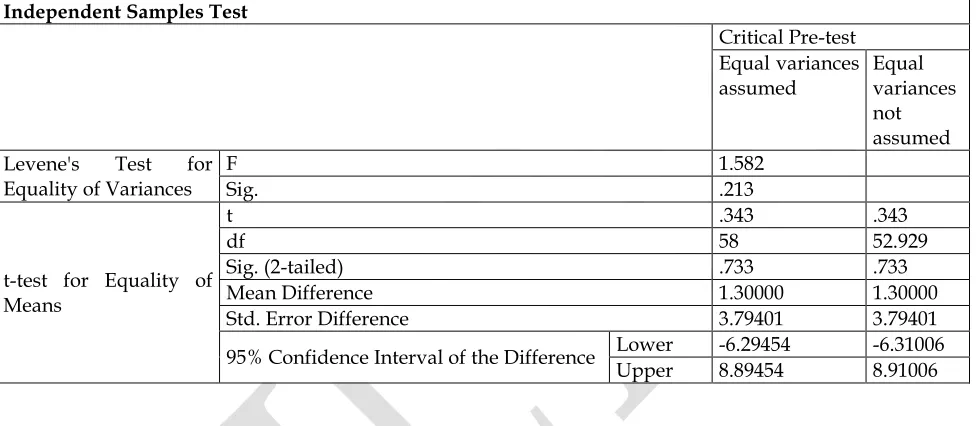
In the experimental and control groups the TOEFL Grammar Test (TGT) was given before and after the implementation period. Consequently, an independent sample t-test was conducted for the pretest scores of the both groups in order to investigate whether two mean values of the TGT results differ significantly prior to the treatment. Table 4.3 shows the paired sample independent test. In all of the TGT statistical data analyses, probability level was set to .05 (α<.05).
Table 4.3 Statistics for TOEFL test as a pretest
As indicated in table 4.3, there is no significant difference between the groups as pre-test. It also shows that since significant level is upper than the alpha level of 0.05 (P=.792), it can conclude that there is no significant difference between the experimental and control groups in their knowledge based on grammar as pre-test. After the treatment span, the TGT were examined respectively in order to see the differences between posttest scores of both groups.
N Minimum Maximum Mean Std.
Deviation t Sig(two tailed) OELPT
Scores 40 21 30 24.89 2.60 4.28 .67
Valid N (list
wise) 40
Group N Mean Std. Deviation Std. Error
Mean T df Sig(two tailed)
Control 20 13.25 1.209 .270 3.28 48 .792
Experimental 20 13.55 1.146 .216
Vol. 4, Issue 5, December 2015
Table 4.4 Statistics for TOEFL test as a posttest
As illustrated in Tables 4.4 comparing the mean scores, certainly was observed that the mean score for the posttest, in experimental group was 19.30 and this was 14.47 in control group.The sig which is .002 is less than p-value (.05>.002) so, it highly confirmed the superiority of participants in experimental group over the participants in control group.
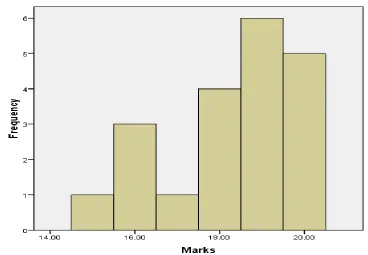
Figure 4.1Histogram of TOEFL test in the Experimental Group as post-test
As Figure 4.1 depicts in the post-test of the TGT in the Experimental group, all the students scored more than 15 points. So, it can be inferred from these results that the implementation period contributed to the students’ accuracy throughout the study.
5. Conclusion
In order to contribute to the need for further research on the value of providing corrective feedback to L2 writers (Ferris, 1999; Truscott, 1996), the present study investigated the extent to direct corrective feedback on EFL learners. It found that the combination of full, explicit written feedback and one-to-one conference feedback enabled them to use grammar with significantly greater accuracy. This finding adds to a growing body of research that has investigated the effect of different feedback strategies on accuracy performance. For instance, it has already been noted that direct feedback is more effective than indirect feedback in helping learners improve the accuracy of their grammar. Because little to no research has specifically investigated the effect of different direct feedback options on improved accuracy, the findings of the present study are noteworthy. Not only did the study find that direct oral feedback in combination with direct written feedback had a greater effect than direct written feedback alone on improved accuracy over time.
Consequently, the researcher would suggest that classroom EFL teachers provide their learners with both oral direct feedback as well as written feedback on the more‘treatable’’ types of grammatical errors. So that
Group N Mean Std. Deviation Std. Error
Mean T df Sig(two tailed)
Control 20 14.75 1.164 .656 6.65 48 .002
Experimental 20 19.30 1.559 .135
Vol. 4, Issue 5, December 2015
learners buy into this learning process, the researcher of this study also would suggest that teachers discuss with their learners which grammar errors should be focused on.
Because current research indicates that direct corrective feedback options have a great effect on accuracy grammatical performance, future research would do well to compare the effects of both direct oral and written feedback with various indirect options to see if the same differential effects are observed between ‘‘treatable’’ error categories (the past simple tense and the definite article) and the less ‘‘treatable’’ error category (prepositions). Although time comparisons have not been directly investigated in earlier error correction research, SLA research has consistently found that learners, in the process of acquiring mastery over the use of linguistic features, will accurately use a given feature on one occasion but fail to do so on other occasions even when the linguistic environment is the same. Consequently, in order to be able to observe patterns of consistent improvement, the researcher would suggests that there is a need for research to examine the effects of corrective feedback more longitudinally. Investigations over several semesters would be ideal. Finally, the researcher believe that the findings of this study have demonstrated that intermediate EFL learners can improve the accuracy of their use of rule-governed linguistic features if they are regularly exposed to oral and written corrective feedback.
References
Al-Mekhlafi, A. M., & Nagaratnam, R. P. (2011). Difficulties in Teaching and Learning Grammar in an EFL Context. Online Submission, 4(2), 69-92.
Bitchener, J. (2008). Evidence in Support of Written Corrective Feedback. Journal of Second Language Writing, doi: 10.1016/j.jslw.2007.11.004
Bitchener, J., & Knoch, U. (2008). The value of written corrective feedback for migrant and international students. Language Teaching Research, 12(3), 409-431.
Bitchener, J., Young, S. & Cameron, D. (2005). The Effect of Different Types of Corrective Feedback on ESL Student Writing. Journal of Second Language Writing, 14, 191-205.
Dahlmeier, D., & Ng, H. T. (2011, June). Grammatical error correction with alternating structure optimization. In
Proceedings of the 49th Annual Meeting of the Association for Computational Linguistics: Human Language Technologies-Volume 1 (pp. 915-923). Association for Computational Linguistics.
Ellis, R. (2001). Introduction: Investigating Form‐Focused instruction. Language learning, 51(s1), 1-46.
Ellis, N. C. (2005). At the interface: How explicit knowledge affects implicit language learning. Studies in Second Language Acquisition, 27, 305–352.
Elkilic, G. and Akca, C. (2008). Attitudes of the Students Studying at Kafkas University Private Primary EFL Classroom towards Storytelling and Motivation. Journal of Language and Linguistic Studies, 4(1): 1-22.
Ferris, D. (1999). The Case for Grammar Correction in L2 Writing Classes: A Response to Truscott (1996). Journal of Second Language Writing, 8(1), 1-11.
Ferris, D. (2002). Treatment of error in second language writing. Ann Arbor: The University of Michigan Press. Ferris, D. (2003). Responding to writing. In B. Kroll (Ed.), Exploring the dynamics of second language writing (pp. 119-140). New York: Cambridge University Press.
Ferris, D. R., & Roberts, B. (2001). Error feedback in L2 writing classes: How explicit does it need to be? Journal of Second Language Writing, 10, 161–184.
Haudron, C. (1988). Second language classrooms: Research on teaching and learning.Cambridge, UK: Cambridge University Press.
Klapper, J., & Rees, J. (2003). Reviewing the case for explicit grammar instruction in the university foreign language learning context. Language Teaching Research, 7(3), 285-314
Krashen, S. (1982). Principles and practice in second language acquisition. Oxford: Pergamon Press.
Lalande, J. F. (1982). Reducing composition errors: An experiment. Modern Language Journal, 66, 140–149.
Long, M. (1996). The role of linguistic environment in second language acquisition. In W. C Ritchie & B. K. Bahtia (Eds.), Handbook of second language acquisition (pp. 413-468. New York: Academic Press.
Morelli, J. A. (2003). Ninth Graders’ Attitudes toward Different Approaches to Grammar Instruction. Unpublished Dissertation. The Graduate School of Education, Fordham University, New York.
Krashen, S. (1981). Second language acquisition and second language learning. Oxford, England: Pergamon. Krashen, S. (1982). Principles and practice in second language acquisition. Oxford, England: Pergamon.
Vol. 4, Issue 5, December 2015
Ohta, A. S. (2001). Second language acquisition processes in the classroom: Learning Japanese. Mahwah, NJ: Lawrence Erlbaum.
Purnawarman, P. (2011). Impacts of teacher feedback on ESL/EFL students’ writing. Virginia: The faculty of the Virginia polytechnic Institute and State University
Robb, T., Ross, S., & Shortreed, I. (1986). Salience of feedback on error and its effect on EFL writing quality. TESOLQuarterly, 20, 83–93.
Schwartz, B. D. (1993). On explicit and negative data effecting and affecting competence and linguistic behavior.
Studies in Second Language Acquisition, 15(02), 147-163.
Semke, H. (1984). The effects of the red pen. Foreign Language Annals, 17, 195–202.
Sheen, Y. (2004). Corrective feedback and learner uptake in communicative classrooms across instructional settings. Language teaching research, 8(3), 263-300.
Sheppard, K. (1992). Two feedback types: Do they make a difference? RELC Journal, 23, 103–110.
Truscott, J. (1996). The case against grammar correction in L2 writing classes. Language Learning, 46, 327-369. Truscott, J. (2004). Evidence and Conjecture on the Effects of Correction: A Response to Chandler. Journal of Second Language Writing, 13, 337-343.
Truscott, J. (2007). The Effect of Error Correction on Learner’s ability to Write Accurately. . Journal of Second Language Writing, 16, 255-272.
Widdowson, H. G. (1990). Grammar and nonsense and learning. In H. G. Widdowson, Aspects of language teaching, pp. 79-98. Oxford: Oxford University Press.
Vol. 4, Issue 5, December 2015
THE EFFECT OF USING MONOLINGUAL MOBILE
DICTIONARY ON THE IRANIAN EFL LEARNERS’ ABILITY TO
RECALL AND USE THE VOCABULARY
Rahmat Rabipour Pishevari (MA in TEFL) [email protected]
Reihaneh Sheikhi (Ph.D in TEDL) [email protected]
Marjan Heydarpour (Ph.D in TEFL) [email protected]
Department of Language, Rasht Branch, Islamic Azad University, Rasht, Iran
ABSTRACT
Dictionary use is one of the potential vocabulary learning strategies in developing learning process and the types of learners’ dictionaries have been diversified with the development of digital technology in recent years. The present study aims at investigating the effect of using mobile dictionary on the Iranian EFL learners’ ability to recall and use the vocabulary. To ensure the homogeneity of the participants, an Oxford Placement Test was administered to 85 learners. Then 42 participants whose scores were between one above and below the standard deviation were selected as homogeneous and were randomly assigned to Mobile Dictionary (MD) as the experimental group and Paper Dictionary (PD) as the control groups. We administered a pretest to the groups before starting the treatment. During 15 sessions of treatment, 15 vocabulary categories were instructed to the both groups. The MD group received the words through a mobile dictionary to find the meaning and vocabulary use of newly taught words, while PD group followed the using a paper dictionary. The recall times of vocabularies were recorded at the end of each session to see the possible effect of mobile dictionary on the learners’ ability to recall the vocabulary. Then both groups took a posttest administered immediately after the treatment. The results of the inferential statistics revealed that the learners in MD group outperformed those in PD group. Hence, it is suggested that using mobile dictionary can improve learners’ ability to recall and use the vocabulary.
KEY WORDS: Mobile Dictionary, Paper Dictionary, Vocabulary Recall, Vocabulary Use
1. Introduction
Many authors believe that mobile and ubiquitous devices can play a key role in supporting educational communities and learning opportunities (Attewell & Savill-Smith, 2003). The use of mobile-wireless technology in education is expected to provide students with increased control of their learning experiences, as well as greater convenience and flexibility (Christina, 2005). It seems that among the devices that can be used for mobile learning, mobile phones have gained more attention due to their ubiquity among the youth at schools and universities and their applications in education (Rahimi & Miri, 2014).With the rapid development of mobile technologies, they are gaining an undeniable and active role at all educational levels nowadays, and are significant and indispensable dimensions of education, specifically in learning language. Learning with the help of mobile devices and their applications like dictionaries enables students to learn via mobile devices without being restricted by time and space thus they would feel a greater sense of freedom (Nyiri, 2002).
Vol. 4, Issue 5, December 2015
Dictionary use can be considered as a way for independent learning for learners. The first thing a foreign language learner purchases is a dictionary (Baxter, 1990). For a language learner the first and the most important tool which facilitate the process of learning efficiently and usefully is an appropriate and suitable dictionary. Most experts now agree that dictionaries should be compiled with the users’ needs foremost in mind. Dictionaries can be used as a last resort when guessing from context strategies fail. But they can also be used productively, both for generating text and as resources for vocabulary acquisition. Their usefulness depends on learners being able to access the information they contain both speedily and accurately. Training learners in effective dictionary use and selecting the appropriate dictionary is particularly important since many learners may not be familiar with dictionary conventions, even in their own language. Such training also provides them with the means to continue vocabulary acquisition long after their course of formal study has been completed. Therefore, it is as an essential source, if not the main source, of information on language for all literate people who have questions on form, meaning, and/ or use of a word(s) in their first language (L1) or in another language (Kirkness, 2004).
One of the key indicators of students’ success in school, on standardized tests, and indeed, in life, is their vocabulary. The reason for this is simply that the knowledge anyone has about a topic is based on the vocabulary of that information (Marzano & Pickering, 2005). Learning vocabulary as one of the sub-skills in language learning can play an important role in receptive (reading and listening) and productive (writing and speaking) skills. Learners consider vocabulary as the most important aspect of language, thus equating language learning with vocabulary learning. According to Singleton (2000, p.12), it can be said that “language is popularly conceived in terms of words”. We have to highlight the functional role of vocabulary as a crucial aspect in communication and language assessment, especially in productive skills like writing and speaking. If knowledge of vocabulary is at hand, then communication is possible even though no grammar knowledge exists (Liach, 2010).
Therefore, the present study has been intended to shed more light upon the use of mobile technology regarding mobile application in educational settings and classroom. Accordingly, the questions of this study have been formulated as below: 1. Does using monolingual mobile dictionary have any significant effect on the Iranian EFL learners’ ability to recall the vocabulary? 2. Does using monolingual mobile dictionary have any significant effect on the Iranian EFL learners’ ability to use the vocabulary?
2. Review of the Related Literature 2.1. Technology and Language Learning
Information and Communication Technology (ICT) have become the inevitable part of human life regarding social and personal life. It is now an integral part of us, so it can influence on our career, education, etc. This led teachers, syllabus and material designers to consider the possibility of integrating technology into the mainstream, curriculum development. ICT program provide so many novel experience for language learning (Golshan & Tafazoli, 2013). It has taken up the goal of modern approaches to language teaching, including communicative language teaching, tasked based learning, process approaches to writing and training in language learning strategies in enhancing student autonomy and control over the language learning process (Warschauer & Meskill, 2002).
Language organizations and institutes try to make language teaching and learning more flexible and make learners become more individual and more autonomous. In order to fulfill this goal, they are trying to use technologies such as computers, cell phones and etc. In this way they would break the time, space and condition constraints in learning. The implementation of technological resources is directly related to the way teachers perceive their use and functionality (Yunus, 2007). Yunus (2007) proposed that it is a necessity that teachers have positive attitudes towards a certain technology to adopt it efficiently in his or her working activity.
2.2. Mobile Learning
There are tremendous growing trends toward technology that mobile phones are one of the most prominent one in the educational context. This is the most dominant device in most students’ life and help learners in a foreign language. They are not just communication devices anymore, rather we ought to consider them useful computers that fit into students, pockets, are always with them and nearly always on, and can be used in any kind of learning (Prensky, 2005). Mobile learning is defined as the method in which materials are delivered using mobile technology, such as devices and wireless networks. Many define mobile learning as borderless, where learning can take place anywhere, anytime, as the learners will not be at a fixed, predetermined location
Vol. 4, Issue 5, December 2015
as long as there is network connection available. So we can claim that mobile learning is undergoing rapid evolution (Cortez, Nussbaum, Santelices, Rodriguez, Zurita and Correa, 2004).
Klopfer and Squire (2008) attempted to define mobile learning in 2008 when mobile smart phones were just in their infancy and handheld devices were gaining popularity. Their definition covering the fundamental concept of a mobile learning space in the following five areas:
(a) portability- can take the computer to different sites and move around within a location; (b) social interactivity- can exchange data and collaborative with other people face to face;
(c) context sensitivity- can gather data unique to the current location, environment, and time, including both real and simulated data;
(d) connectivity- can connect handhelds to data collection devices, other handhelds, and to a common network that creates a true shared environment;
(e) individuality- can provide unique scaffolding that is customized to the individual’s path of investigation.
2.3. Mobile and Electronic Dictionary
The learning and teaching environments of the twenty first century are changing very fast due to unprecedented opportunities advancement of information and communication technologies have created for education. Almost every language learner has a mobile device like smart phone, tablet and other wireless device. This enables learners to make a portable library and carry it wherever they like. Among the most popular mobile applications, dictionary applications are the most widespread ones. Because using mobile dictionaries is time efficient and help language learners acquire vocabulary and check verb conjugations (Steel, 2012).
Using mobile dictionaries in language classes can help students to hinder frustration of turning pages of paper dictionaries. They can also extend it to environment out of classroom, into everyday activities, and learning anywhere at any times is possible with the help of one mobile application (Joseph & Uther, 2009), that one of them can be dictionary of different types, including monolingual, bilingual and bilingualzed dictionary.
Many studies have shown that electronic and mobile dictionaries can have positive effect on learning. For instance, a study addressing children’s use of an electronic story book showed an effect on learning for a read-with-dictionary task over a read-only task (Koraft & Shamir 2006). The researcher found evidence that the ability of a student to understand the entry in a dictionary is related to the student’s academic performance. However, academically strong learners were more likely to skip entries unknown to them and not bother to take these up and hence, miss the opportunity to learn these terms.
3. Methods of Research 3.1. The Design of the Study
This study follows a quasi-experimental design with adopting quantitative approach to answer the research question. There are three main variables in this study: mobile dictionary as the independent variable, and ability to recall and use the vocabulary as the dependent variables. In order to gather data for answering the questions of research, different types of tests were used in this study. An OPT (Oxford Placement Test) which was included general tests of English for homogenizing learners, teacher-made pretest and posttest. Moreover, an oral test for recording the recall time of learners was included.
3.2. Participants
This study was conducted with 42 pre-intermediate Iranian EFL learners who enrolled in English classes at one private English institute. The participants were female and there was no age limit and discrimination in choosing them. In addition, the participants were aged from 15 to 25. They were also the native speaker of Farsi without any academic education on English and they had received prior English instruction in Iran. The target population was 85 out of which 42 learners were selected as samples to attend the research and the rest were excluded from the study. In order to homogenize the participants and make sure they were at the same English proficiency level, an Oxford Placement Test (OPT) was conducted on 85 learners. The papers were scored, and eventually the 42 learners whose scores were between one above and below the standard deviation were selected as the main sample. These 42 participants were randomly divided into two groups of experimental and control group (NE= 21 and NC= 21). Note that learners’ age and background were not considered as variable, they were explained only to describe the participants.
3.3. Instruments
The participants of the study went through four research instruments;
Vol. 4, Issue 5, December 2015
OPTSelecting Control and Experimental
Groups
Pretest Treatment Time
Recording Posttest
Data Analysis
1. An Oxford Placement Test (OPT). This test was administered in order to homogenize the participants and selecting the sample of the study.
2. A teacher-made pretest. This test was administered before the treatment in order to measure the initial vocabulary use knowledge of the learners in both groups of the study.
3. A teacher-made posttest. The teacher-made posttest was aimed to indicate the degree of progress from pretest to the posttest in the experimental group of the study in which teaching vocabulary recall and use by mobile dictionary being applied and in the control group in which teaching vocabulary by paper dictionary being applied.
The reliability of the pretest and posttest of the study was estimated using the inter-rater method as to be respectively 6.7 and 7.1. This estimation was made after the evaluation of pretest-posttest by three experts in teaching with a PHD in TEFL.
3.4. Procedure
The procedure of the study is shown in the following figure:
In the first phase an OPT was administered to 85 pre-intermediate Iranian EFL learners as the subjects of the study. Then, with the aim of selecting the homogeneous participants, the learners whose scores were between one above and below the standard deviation were selected as the main sample and were called for the next phase of the study. After that they were randomly divided in two groups of the study: one experimental group with 21 participants and one control group with 21 participants. The participants in both groups were given a teacher-made pretest of vocabulary use to measure the participants’ initial subject knowledge of the learners under investigation. Then the pretest data have been collected.
After the preliminary steps, the participants were informed about the procedure of the study. They had two sessions in a week and each session was 90 minutes. According the institute, the Headway Book 2 was taught for the participants in the pre-intermediate level. The total sessions were 15 sessions in three months. There were 15 vocabulary categories with 7 vocabularies in each category. It is worth mentioning that the categories were selected based on the Headway Book 2, because the learners could engage better in the subjects and categories that are familiar to them and related to their main course book. Although both groups had the same instructors, they attend two different classes in two different days. In addition, the experimental group received treatment and the vocabularies were taught by using the mobile dictionary. On the other hand, the control group did not receive any treatment and the vocabularies were taught by using the paper dictionary.
The treatment procedure was as follows: in the first 30 minutes of each session, one of the categories was written on the board. The learners had to check the 7 vocabularies items of the related category. In the experimental group the teacher and learners checked each vocabulary in their mobile dictionary and the instructor explained the vocabulary use for them. As explained earlier, the good indicator of ability to use vocabulary is using it appropriately in the sentence and correct usage of vocabularies requires different factors. In addition to the explanation of different factors of each vocabulary, the instructor emphasized on the part of speech of words as one of the indicator of correct vocabulary use, so the learners paid special attention to part of speech of words. On the other hand, in the control group this procedure has been done by using paper dictionary.
In the next phase of the study, after teaching the categories and the related vocabulary items, the recall time for vocabularies were recorded with the help of a simple stopwatch at the end of each session. In this part, the maximum of 70 seconds was dedicated for each category. It means that if each learner can recall more vocabulary of each category in less time, his performance in recalling ability will be better. Thus the total times of recalling each category and the number of vocabulary of the given category in each session were recorded. At
Vol. 4, Issue 5, December 2015
the final phase, after the treatment sessions all the participants in both groups of study took a teacher-made posttest.
4. Results and Discussion
In order to test the research hypothesis, independent samples t-test and Pearson correlation coefficient was proposed. Data obtained from the pre and post-test vocabulary use was used to determine the learners’ improvement in vocabulary use. In addition, the mean of obtained vocabulary recall statistics were used to determine the learners’ improvement in vocabulary recall.
Tables 1 and 2 indicate the number of participants in each group (N=21), the mean of pretest and posttest of the groups of the study, and standard deviations.
Table 3
Independent Samples T-test results of the study
As indicated in Table 3, the t-value (observed t) of the study was calculated between the posttests of the vocabulary use of participants in the experimental and control groups. The observed t value was calculated as to be 3.459 (tobs= 3.459) and the degree of freedom was 40 (df=n-1=40). Critical t for df=40 is 2.021 that is lower
than observed t. Finally, the level of significance was calculated to be 0.001 (p=0.001). Table 1
Descriptive analysis of the pretest of the groups of the study
Mobile Dictionary N Mean Std. Deviation Std. Error Mean
L2 Vocabulary Use
Mobile Dictionary 21 12.7619 3.94254 0.66754 Paper Dictionary 21 11.2381 3.12174 0.50665
Table 2
Descriptive analysis of the posttest of the groups of the study
Mobile Dictionary N Mean Std. Deviation Std. Error Mean
L2 Vocabulary Use
Mobile Dictionary 21 15.4762 3.57238 0.77956 Paper Dictionary 21 11.8571 3.19821 0.69791
t-test for Equality of Means
t df Sig. (2-tailed) L2VocabularyUse Equal variances assumed 3.459 40 0.001
Equal variances not assumed 3.459 39.520 0.001
Table 4
Pearson correlation results between the pretest and the posttest of the experimental group of the study
Pre EX Pos EX
Pre EX Pearson Correlation 1 0.453
Sig. (2-tailed) 0.039
N 21 21
Pos EX Pearson Correlation 0.453 1 Sig. (2-tailed) 0.039
N 21 21
Vol. 4, Issue 5, December 2015
According to Table 4, the Pearson correlation coefficient between the pretest and the posttest of the experimental group (Mobile Dictionary) has been calculated 0.453. This amount is smaller than 0.5 and shows that the scores of pretest and posttest do not have closeness and instead are far from each other. The level of significance based on the Table 4 is 0.039 that confirms the lack of closeness among the scores.
According to Table 5, the Pearson correlation coefficient between the pretest and the posttest of the control group (Paper Dictionary) has been calculated 0.866. This amount is higher than 0.5 and shows that the scores of pretest and posttest have closeness and are not far from each other. The level of significance based on the Table 4 is 0.000 that confirms the existence of closeness among the scores.
Table 6
Recall Statistics Results for groups of the study
Category Mobile Dictionary Paper Dictionary Recall Time
(seconds) Recalled Vocabulary Recall Time (seconds) Recalled Vocabulary
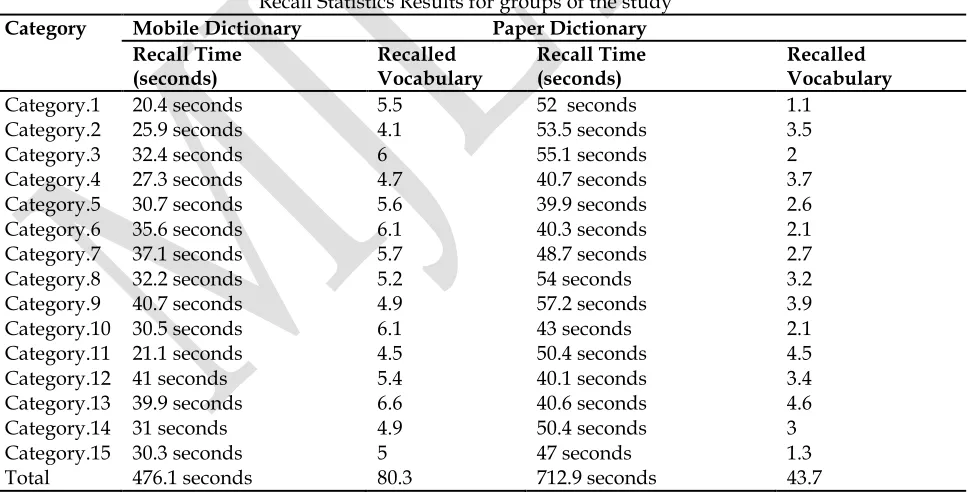
Category.1 20.4 seconds 5.5 52 seconds 1.1 Category.2 25.9 seconds 4.1 53.5 seconds 3.5 Category.3 32.4 seconds 6 55.1 seconds 2 Category.4 27.3 seconds 4.7 40.7 seconds 3.7 Category.5 30.7 seconds 5.6 39.9 seconds 2.6 Category.6 35.6 seconds 6.1 40.3 seconds 2.1 Category.7 37.1 seconds 5.7 48.7 seconds 2.7 Category.8 32.2 seconds 5.2 54 seconds 3.2 Category.9 40.7 seconds 4.9 57.2 seconds 3.9 Category.10 30.5 seconds 6.1 43 seconds 2.1 Category.11 21.1 seconds 4.5 50.4 seconds 4.5 Category.12 41 seconds 5.4 40.1 seconds 3.4 Category.13 39.9 seconds 6.6 40.6 seconds 4.6 Category.14 31 seconds 4.9 50.4 seconds 3 Category.15 30.3 seconds 5 47 seconds 1.3 Total 476.1 seconds 80.3 712.9 seconds 43.7
According to Table 6, the recall time and recalled vocabulary for each category is calculated. For example the time for recalling category one (discussed in previous chapter) in experimental group (Mobile Dictionary) is calculated 20.4 seconds and this time for control group (Paper Dictionary) is calculated 52 seconds. Moreover, as indicated in Table 6, the total recall time for experimental and control group are 476.1 seconds and 712.9 seconds respectively. In addition, the recalled vocabulary for category one in experimental group is 5.5 and this number
Table 5
Pearson correlation results between the pretest and the posttest of the control group of the study
Pre CON Pos CON
Pre CON Pearson Correlation 1 0.866
Sig. (2-tailed) 0.000
N 21 21
Pos CON Pearson Correlation 0.866 1 Sig. (2-tailed) 0.000
N 21 21
Vol. 4, Issue 5, December 2015
is 1.1 for the control group. The total recalled vocabulary for experimental and control groups are 80.3 and 43.7 respectively.
Figure 1. Recall Time Results
Figure 2. Recalled Vocabulary Results
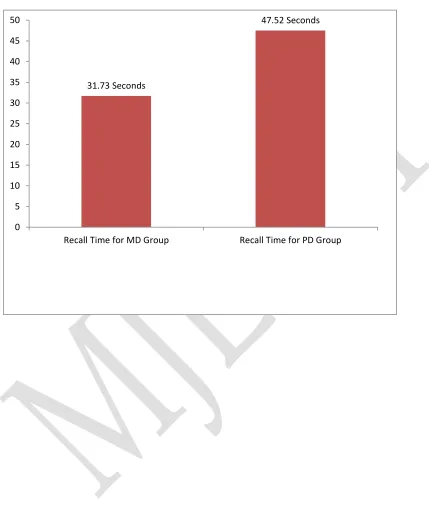
According to the recall statistics there is difference between the mean of recall time of the groups of the study and the first hypothesis is rejected. In addition, there is difference between the mean of recalled vocabulary items in both groups. As it is indicated in figure 1, the mean recall time for experimental group (Recall Time for
31.73 Seconds
47.52 Seconds
0 5 10 15 20 25 30 35 40 45 50
Recall Time for MD Group Recall Time for PD Group
Vol. 4, Issue 5, December 2015
MD) is 31.73 seconds and the mean recall time for control group (Recall Time for PD) is 47.52 seconds. On the other hand according to figure 2 the mean of recalled vocabulary for experimental group (Recalled Vocabulary for MD) is 5.3 and the mean of recalled vocabulary for control group (Recalled Vocabulary for PD) is 2.9. To sum up, the experimental group (MD) recalled 5.3 vocabulary items in 31.73 seconds, and the control group (PD) recalled 2.9 vocabulary items in 47.7 seconds. Therefore, it is concluded that the experimental group (MD) recalled more vocabulary items in less time and had better performance in comparison with control group. Using monolingual mobile dictionary has significant effect on the Iranian EFL learners’ ability to recall vocabulary. Therefore, the first null hypothesis (H1) is rejected according to the inferential data analysis.
The interpretation of the descriptive and inferential data analysis for the H2 is as below. Table 3 presents the results of independents samples T-test of the study. According to the null hypotheses of the present study, the level of significance for two tailed is considered to be 0.05 that its degree of freedom is shown to be 40 (df=40) in Table 3. As indicated in Table 3, observed-t is shown to be 3.459 that is higher than the critical-t of 2.021 (John Best, 2006, p. 483). Therefore, we conclude that the second hypothesis (H2) is rejected. Moreover, the degree of significance of the obtained observed-t is 0.001 according Table 3 that is much lower than the considered degree of significance for two tailed (sig=0.05) (John Best, 2006m p.483), this also confirms the rejection of the second hypothesis (H2). The rejection of the second null hypothesis indicated that using monolingual mobile dictionary effects on the Iranian EFL learners’ ability to use vocabulary.
Over the years, the integration of technology into language teaching was of great importance for many researchers and aroused them to investigate the effect of mobile technology on the four main skills of language teachi