4567
REVITALIZATION AS A CATALYST FOR
REMAKING CORE CITIES IN THE CHANGING
WORLD
Jariwala Pooja Bipinchandra, Sejal S. Bhagat
Abstract— Every city emerges from its core and the city development process begins from it. As city grows, its original city transforms into Core city. Cities are like living organisms and they require constant maintenance and development for their healthy growth without which city function fails and they resulted in urban decay. The core city is losing its characteristics and identity with time because of changing scales and functions are unable to create harmony between old city and newly developed planned city. Urban revitalization is emerged as a response to urban decay. The term Regeneration, Renewal, Redevelopment is interchangeably used to address the term Revitalization. This paper describes the general concept of urban decay and urban revitalization. It gives an overview about historical evaluation of revitalization, strategies, approaches, framework of methodology for successful implementation of urban renewal project and the financial models. It reveals urban revitalization as an essential tool to transform obsolesce into opportunities by enhancing vitality, productivity and standard of living to meet the needs of people.
Index Terms— Core city, Urban decay, Urban renewal, Urban revitalization
—————————— ——————————
1INTRODUCTION
Cities act as an engine of growth. If the city is considered as living organism then core city is its nucleus.The evolution of urban core is result of a consequential process where its characteristics emerge from traditional market centres and residential locality to commercial, retail, institutional and historic zones. Rapid urbanization leads to urban sprawl. Due to urban sprawl city grows and this original city remold into ‘inner city’, ’core city’ or ‘walled city’. Core cities are marked by key features, such as, narrow roads (gullies), dense built ‐up, often mixed use of land, small plot sizes occupying 100% ground for built-up, social homogeneity, limited public spaces, which are usually congested developments, in comparison to the modernized planned cities[1].The dynamics of an urban metropolis experience changes and fluctuations through time, this metamorphosis occurs in social, physical, cultural, economic and environmental dimensions. High density, degenerating, overused, obsolete and inadequate services, utilities, infrastructure, poor urban planning together with other governance challenges results into Urban decay. Growth of these declining areas are stagnant and neglected. They urge attention to be refurbished with contemporary urban planning techniques. The decaying core city is one of the most important planning challenges in 21 st century. Many old cities need public oriented area-based planning intervention for upgrading and preserving their physical, cultural and socio-economic identity. Thus, revitalization of inner city is an essential tool to provide opportunity for growth and economic development.2 URBAN DECAY
Urban decay is a process in which a city that previously worked, deteriorates and stops working. Urban decay is described as “the physical effects including facilities that are poorly monitored and in disrepair, deterioration of buildings and improvements, visual and aesthetic impacts, increase in property crime and increased demand for emergency services which result from increase in retail closures and long-term vacancies” [2]. In 1970s and 1980s urban decay programme were initiated by western cities, particularly in North America and Europe, as well as certain areas associated with the former Soviet Russia. Rapid urbanization, rural – urban migration, degrading economy, aging and inadequate urban infrastructure and inattentive urban housekeeping are key factors to lead a city in a state of decay. Like other living beings, Cities likewise go through a procedure of development- growth and decay. Lewis Mumford (1946) [3], explains the cycle of growth of cities and decay process in 6 phases:
Phase 1 Eopolis: Rise of town group; advancement of urban character
Phase 2 Polis: Evolution of a few urban groups that constitute city
Phase 3 Metropolis: Emergence of an overwhelming city among a few urban areas in a locale
Phase 4 Megapolis: Beginning of decay of city
Phase 5 Tyrannopolis: Extensive decay of financial structure, urban administration, and metropolitan administrations prompting to all around disorder
Phase 6 Nekropolis: Almost a dead city/ruins ————————————————
Er.Jariwala Pooja Bipinchandra, PG Student, Town and Country Planning, Sarvajanik College of Engineering and Technology, Surat, Gujarat, India.E-mail: [email protected]
Prof. Sejal S. Bhagat (Ph.D Pursuing), Assistant Professor, Faculty of Civil Engineering, Sarvajanik College of Engineering and Technology, Surat, Gujarat, India.Email: sejal.bhagat.ac.in
4568 (Source: Mumford, Lewis (1948), The Culture of Cities, Secker and
Warburg, London,[10])
A large number of cities in the world emerged more than a hundred years ago, and due to the aging process, many areas have seriously deteriorated. Excessive centralization and activities related to industry and commerce have caused tremendous growth in the urban population. Due to fortuitous urban development, many cities are losing their character and identity. Environmental quality is degrading and urban decay is reflected in terms of physical and social aspects.
(Source: By Author, Compilation from various research papers and case studies)
3
THE
CONCEPT
OF
REVITALIZATION
‘Bringing again into activity or prominence’ or ‘giving new life and vitality to’(a building, a community, a neighborhood, activities, business, etc.) is Revitalization. It is the tool of intervention to manage urban decay. According to a World Bank group-PPP Knowledge lab (2014),[4]“Urban Revitalization refers to a set of initiatives aimed at reorganizing an existing city structure, particularly in neighborhoods facing decline due to economic or social reasons”. Local policies and strategies designed to deal with urban decline or decay are termed as urban renewal. According to Roberts and Sykes (2000),[5] Urban renewal can be defined as an integral and integrated vision and action that leads to the resolution of urban problems and that seek to achieve a lasting improvement in the economic, physical, social and environmental conditions of an area which has been subject to change. Urban renewal called as urban regeneration in the United Kingdom and urban redevelopment in the United States,that is often used to address urban decay in cities. Aim
is to renew the economic and social life of a deteriorated part of a city to bring back a new vitality in a building or a community or a neighborhood by planning and urban design implications and specific measures such as mixed use, rehabilitation of slums, rehabilitation of the informal sector and heritage conservation. Holcomb and Beauregard (1981; cited in Ergenekon, 2003),[6] Revitalization defines the growth, progress and the infusion of new activities into stagnant or declining activities which has lost attractiveness to investors and middle-class residents.
The dimensions of urban renewal are described as below [7]:
(Source: Author, Inspired by Preeti Onkar ITPI journal,[7])
4
HISTORY
OF
URBAN
REVITALIZATION
Urban renewal is reached its peak between 1940 and 1970. The concept started off as renewal of blighted housing and slums in America and Europe during the 1850s. The nature of urban renewal schemes during the initial period primarily concentrated on total clearance of slums, without paying much attention to appropriate planning, relocation and conservation of historical elements and green areas. The concept of urban renewal is originally given by American authority. In England, this concept is used to uplift the increasingly cramped and unsanitary conditions of the urban poor in the rapidly industrializing cities of the 19th century for social reform. This process began in the later 19th Century in developed nations and entered an intensive phase in the post-World War II era brought and entered into being by the necessary reconstruction schemes were undertaken in many nations give birth to the preparation of comprehensive Development Plan/ Master Plan for urban areas. In India, With the growth of the bigger cities, improvement Trust were created during 1890 to 1915 at Mumbai, Mysore, Calcutta, Hyderabad, Nagpur etc. for developing housing, infrastructure, improvement of central area of the city etc. gradually they merged in municipal bodies [9].
Fig. 1 Cycle of Growth and Decay of Cities and Role of Urban Renewal
Fig. 2 Effects of Urban Decay
4569 Table- 1 Terminologies related to Urban revitalization in Historical Order
(Source: Roberts and Sykes (2000), Pelin Pınar Özden (2008), Peter Bosselman (2008) and Robert Cowan (2005)
Period 1850’s 1950’s 1960’s 1970’s 1980’s 1990’s 2000’s to date
Policy Type Urban Clearance Urban Reconstruction Urban Revitalization Urban Renewal Urban Redevelopment Urban Regeneration Urban Transformation
Vision Removal of the insufficient urban
fabric
Reproducing lost urban structures in
original form
Upgrading physical, social
and economic life in decayed urban quarters
Process focus on physical transformation of
cities
Replacing the existing structure
with a new one
Reproducing lost urban structures in
original form
Replacing the old and obsolesce urban structure by
considering sustainability, livability and vitality Major strategy and orientation Improvements in slum neighborhoods Reconstruction and extension of older areas of towns and cities often based on a
Master Plan, suburban growth Continuation with some early attempts of rehabilitation Focus on institutional and neighborhood schemes in continuation to development of peripheries Many major schemes of development and redevelopment projects Comprehensive form of policy and more emphasis on
integrated treatments
Focus on urban living quality
Key actors and Stakeholder
s
National and local government private
sector developers
National and local government private sector developers Maintain balance between public and private sectors
Growing role of private sector and decentralization of local government
Emphasis on private sector and
special agencies, growth
of partnership
Devolution of power to the local authorities. Community empowerment Public Private Partnership (PPP) Spatial activity level
Site level Local and site level Regional level Local emphasis Site level Strategic perspective, growth of regional
activity
City and regional level Economic focus Private sector investment with public sector involvement Public sector investment with some
private sector involvement Private investment Resource constraints in public sector and growth of private
investment Private sector dominant with selective public funds Greater balance public, private and voluntary funding Private sector taxation Social context
Improve the living conditions of slum
areas
Improvement in housing and living
standards
Social and welfare improvement
Community based action and greater empowerment Community self-help with very selective state support, High rise housing for displaced citizens
Emphasis on the role of community
Emergence of new social organization, community participation Physical context demolishing the existing urban structure and creating completely new urban characteristics
Replacement of inner areas and peripheral
development Gentrification in UK
Rehabilitation of existing areas
More extensive renewal of older urban areas
Major schemes or replacement and new development Heritage and retention Revitalization, comprehensive renewal Environmen tal approach Well-being improvement Landscaping and some greenery Selective improvements Environmental improvement with some innovation
Growth of concern for wider approach to environment
Introduction of broader idea of
4570
5 APPROACHES OF URBAN REVITALIZATION
Essential approaches of urban revitalization to make city attractive, progressive and productive.
Approach Description
Real Estate Approach
High rise multi storied approach to decongest the city making more space available for green and open space. It adopts the large-scale housing estate model
Participatory Approach
To improve the condition of the inner area by small scale participatory and cooperative approaches when large percentage of residents are not willing to relocate or pay to improve their housing conditions
Regional Approach
A macro level strategy for conserving the old city involves shifting of many economic activities to other surrounding areas thus decentralizing the development in the region.
Adaptive reuse and cost recovery Approach
Private entities and/or nongovernment institutions are allowed to lease historic facilities for commercially viable uses that respect their historical value and to earn a profit from the use to which the facilities are put.
Integrated area development Approach
Significant investment in infrastructure restoration of monuments and mass rehabilitation of entire housing areas, which requires a cooperative financing plan funded by individuals as well as commercial and public sector entities.
Full
commercializa tion Approach
Plots were sold to commercial organization for rehabilitation cum-redevelopment as shops, restaurants, hotels, or offices.
Singapore offers the best example.
Transfer of development right
Both Mumbai and Rio de Janeiro are experimenting with the North American method of transfer of development rights, which can be applied to privately hold or owned premises listed as monuments and located in areas considered mature for development
Placemaking Approach
Transform unused or underused areas into active spaces, to make the space interactive and ensure maximum citizen participation by providing variety of activities through thoughtful interventions and to create ecologically sustainable and adaptable sites for future use
Main Street Approach
Focus on the transformation. Strategies that focused on the deliberate path to revitalize or strengthen a commercial center or district. Vision is to design iconic streets of city centre.
(Source: Author, Inspired by Steinberg, Florian,[11])
6 FINANCIAL TOOLS FOR REVITALIZATION
Finance is the important aspect to revitalize, renew, regeneration or redevelopment. World Bank has given various tools for it [10].Capital Investment Planning: A capital plan provides a link between the strategic vision of local body its urban land use plan, and its annual budget.
Developer Exactions and Impact Fees: Development impact rates are contributions required by the private sector to cover the cost of additional public infrastructure and services. Tax Increment Financing (TIF): Tax Increment Financing (TIF) is the most widely used method for funding urban renewal in North America, and was introduced last year as a new means of funding urban regeneration programs in the UK. Cities have accessed capital markets to help fund urban regeneration in a variety of ways.
Up- zoning: This approach is used by cities in the United States to take advantage of regulatory powers is ascending zoning.
Transferable development rights: In addition to municipal land, municipalities may also have rights to participate in more intensive land development (a higher floor space index (FSI) or a higher FAR) as a form of "finance" and encourage Tax incentives: Selective and intelligently designed tax incentives can play an important role in the absorption of private sector capital for urban regeneration.
Public land as a payment "in kind" in exchange for the construction of public infrastructure: This financing approach is viable if a municipality has a plot of land that has a market value greater than the estimated infrastructure cost required.
Public land as a capital contribution to a joint venture: A variation of the in-kind payment approach is when a municipality uses the value of its land as a capital contribution to a joint venture with a developer.
Land readjustment: Land readjustment, with the exception that it occurs in existing urban areas and often implies a rezoning by the government of a given area.
Inclusive zoning: This approach is used in many cities to reduce gentrification and protect the rights of the most vulnerable population around the renewal site.
6 URBAN RENEWAL METHODOLOGY
4571 (Source: By Author)
7 RESULT AND DISCUSSION
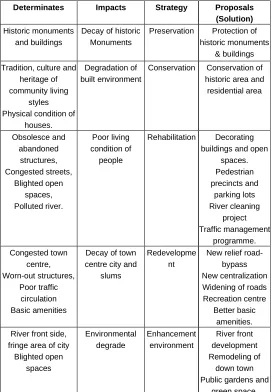
It requires a comprehensive programme with active involvement. Initiatives of a few people can make all the difference to the revival of a city. Depending upon the stage of decay, the strategy of urban renewal has to be decided.
Fig. 1 Scenario of Revitalization in Developed and Developing Nations
Problems are different, contexts differ, needs change, and therefore the policies and programme to deal with each city and town also differ. Different interpretations were made in different countries and in different periods to adapt to local requirements. The exact nature of the urban renewal strategy adopted depends on the nature of the problem and the local situation.
Table- 2 Method decision of Strategy based on character of area
(Source: By Author, Compilation from various Resources)
8 CONCLUSION
With the extension of limits, city not only expands physically but also consolidate over a period. At this stage with the aging of the city, redevelopment and renewal process is required for revitalization of the city. During recent times the rehabilitation and regeneration of historic centers and inner-city areas have been increasingly recognized as an efficient tool for sustainable urban development, synthesizing cultural values and economic opportunities and benefits for communities. Urban revitalization is people’s demand oriented comprehensive planning scheme. Comprehensive and integrated vision and action, participatory planning approach, use of advanced technologies, improvements in administrative and institutional systems should be useful for successful implementation of projects under urban renewal programs. The aim of urban renewal is less destructive and more on renovation. Core city is a major simulator for economic growth and have potential to generate revenue for local government Innovates ideas like TDR and exchange of FSI shall be evolved to reduce burden on local authority.
Determinates Impacts Strategy Proposals (Solution)
Historic monuments and buildings
Decay of historic Monuments
Preservation Protection of historic monuments
& buildings
Tradition, culture and heritage of community living
styles Physical condition of
houses.
Degradation of built environment
Conservation Conservation of historic area and residential area
Obsolesce and abandoned
structures, Congested streets,
Blighted open spaces, Polluted river.
Poor living condition of people
Rehabilitation Decorating buildings and open
spaces. Pedestrian precincts and
parking lots River cleaning
project Traffic management
programme. Congested town
centre, Worn-out structures,
Poor traffic circulation Basic amenities
Decay of town centre city and
slums
Redevelopme nt
New relief road-bypass New centralization Widening of roads Recreation centre
Better basic amenities. River front side,
fringe area of city Blighted open
spaces
Environmental degrade
Enhancement environment
River front development Remodeling of
down town Public gardens and
4572
REFERENCES
[1] Ministry of Urban Development. Urban and Regional Development Plans Formulation and Implementation Guidelines. Vol Volume 1.; 2015
[2] Gbadegesin, J.T. and Aluko, B.T., 2010. The programme of urban renewal for sustainable urban
development in Nigeria: issues and
challenges. Pakistan Journal of Social Sciences, 7(3), pp.244-253.
[3] Kulshrestha, S.K., 2018. Urban Renewal in India: Theory, Initiatives and Spatial Planning Strategies. SAGE Publishing India.
[4] https://pppknowledgelab.org/Urban regenration-PPP World Bank
[5] Roberts, P., and Sykes, H.(eds), 2000. “Urban Regeneration: A Handbook”, (Sage Publications, London-Thousand Oaks-New Delhi).
[6] Holcomb, H.B., Beauregard R.A., 1981. Revitalizing Cities, Pennsylvania
[7] K. D. and A. S. Preeti Onkar, “Exploring the Concept of Urban Renewal in the Indian Context,” Inst. T. Planners India, vol. 5, no. 2, pp. 42–46, 2008.
[8] 62nd National Town and Country Planners Congress, Redevelopment and Regeneration: Challenges & Options, January 2014
[9] https://urban-regeneration.worldbank.org/
[10]Mumford, Lewis (1948), The Culture of Cities, Secker and Warburg, London
![Fig. 1 Cycle of Growth and Decay of Cities and Role of Urban Renewal (Source: Mumford, Lewis (1948), Warburg, London,[10]) The Culture of Cities, Secker and](https://thumb-us.123doks.com/thumbv2/123dok_us/8640686.1430394/2.612.391.554.190.342/growth-cities-renewal-source-mumford-warburg-culture-secker.webp)