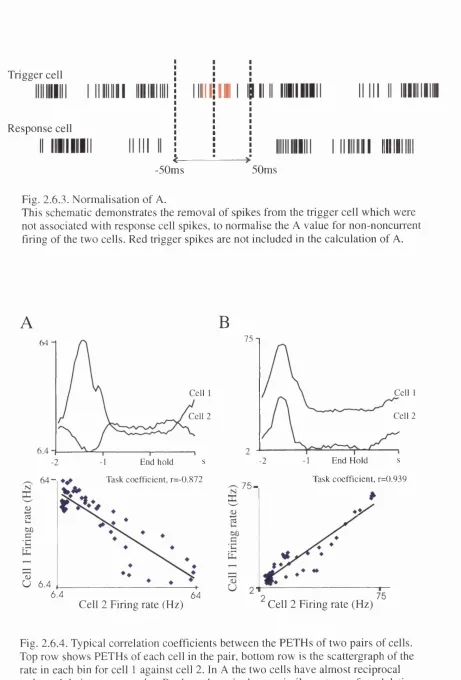
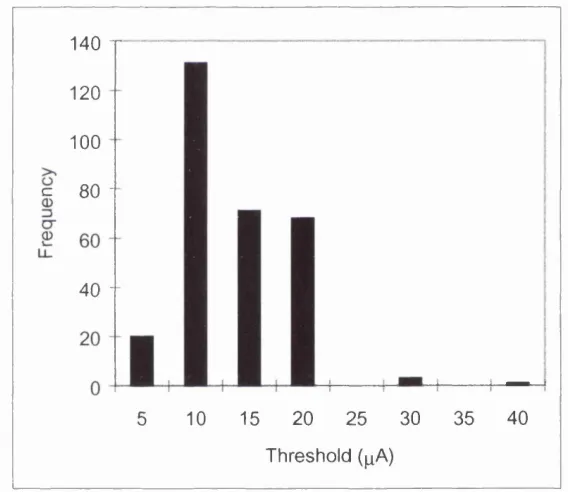
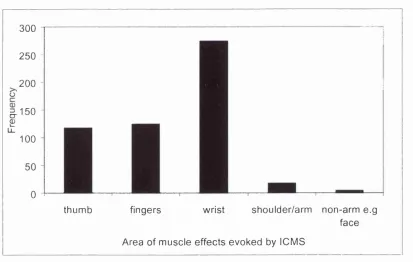
QUEEN SQUARE,
LONDON,
WC\N 3BGThe contribution of population activity in motor cortex to
the control of skilled hand movements in the primate.
Elizabeth Margery Pinches
Institute of Neurology University College, London
submitted for PhD (Neuroscience) August 1999
ProQuest Number: U145580
All rights reserved
INFORMATION TO ALL USERS
The quality of this reproduction is dependent upon the quality of the copy submitted. In the unlikely event that the author did not send a complete manuscript and there are missing pages, these will be noted. Also, if material had to be removed,
a note will indicate the deletion.
uest.
ProQuest U145580
Published by ProQuest LLC(2015). Copyright of the Dissertation is held by the Author. All rights reserved.
This work is protected against unauthorized copying under Title 17, United States Code. Microform Edition © ProQuest LLC.
ProQuest LLC
789 East Eisenhower Parkway P.O. Box 1346
Abstract
In recent years, our understanding of cortical function has been dominated by the view that neurons operate as part of larger assemblies, with each assembly responsible for an aspect of information processing. Advances in multiple neuron electrode
recording have enabled the activity of several cells to be sampled simultaneously in vivo
in the awake behaving monkey, thereby allowing, in theory at least, the function of assemblies to be monitored. This method can provide important insights into the role of single cells as potential members of a neuronal assembly.
The aim of this thesis is to review our current understanding of the cortical control of voluntary hand movements, and to describe experimental work which has explored the simultaneous activity of multiple cortical neurons, and the interaction between them as a basis for that control. The experimental paradigm used was the fine control of forearm and intrinsic hand muscles during performance of the precision grip task by the macaque monkey.
Multiple single electrode recordings were made in the motor cortex of two
investigated by regression-based analysis in the frequency domain. The resulting data were modelled using computer simulations of parts o f the motor system.
This thesis provides strong evidence for the existence of a cortical network which could be responsible for oscillatory activity across a population of neurons. Synchrony was observed between local field potentials in the cortex and hand muscle EMG. The results suggest a significant contribution of population synchrony to the cortical control of distal muscles during certain phases of movement. The proposed function for
synchrony between cortical output cells is in the efficient activation of motoneurons by temporal summation of their excitatory post-synaptic potentials in the target
Table of Contents
Title Page
Abstract 1
Table of Contents 3
List of Figures and Tables 6
Abbreviations 10
Declaration of conjoint work 12
Acknowledgements 13
Ch 1. Introduction 14
1.1 The motor system as an example of cortical function 14
1.2 Theoretical models of cortical function 17
1.3 Function of different cortical areas in control of hand movement 20
1A Cortical neuroanatomy 26
1.5 Inputs to the motor cortex 33
1.6 Descending motor pathways 35
1.7 Outputs from the motor cortex: the corticospinal tract 35 1.7.1 Filtering of cortical outflow at the motoneuronal synapse 42
1.7.2 Recruitment of motor units 44
1.8 The Study of cortical function 47
1.8.1 Insights at the single-cell level: Neural codes 47 1.8.2 Coding of force by single cortical cells 51 1.8.3 Insights at the population level: Ensemble coding 53
1.8.4 Ensemble codes in the motor system 62
1.9 Aims of the project 69
1.9.1 Assessment of cell sampling by multiple electrode system 69 1.9.2 The investigation of connectivity amongst the cortical 70
population
1.9.3 The contribution of synchrony within the motor system 70
Ch 2. Experimental methods 72
2.1 Animals 72
2.3 Surgical techniques 74
2.4 Surgical procedures prior to recording 75
2.5 Recording techniques 78
2.6 Analytical methods 83
Ch 3. Physiological characteristics of cell populations in M l and SMA 89
3.1 Total number of cells sampled 89
3.2 Antidromic latency (ADL) and thresholds 94
3.3 Relationship of spike shape to ADL 96
3.4 Distribution of ICMS effects in muscles. 99
3.5 Spike-triggered averaging o f EMG 101
3.6 Firing rates and interval histograms of sampled cells 109 3.7 Characterisation of firing patterns during the task 111 3.8 Changes in task relationship with cortical separation 118
Ch 4. Functional Connectivitv in the Motor Cortex 124
4.1 Cross-correlation effects between pairs of cells 124
4.2 Significance of cross-correlation peaks 130
4.3 Variation of strength of peak with distance between pairs of cells 135 4.4 Variation of strength of peak with cell type 139 4.5 Variation of strength of peak with task modulation 140 4.6 Effects of synchrony on the form of ST A of EMG by CM cells 143 4.7 Effects of s-ICMS on groups of cortical cells 150
Ch 5. Population svnchronv in the motor cortex 156
5.1 Time domain versus frequency domain analysis 159 5.2 Frequency domain analysis: analytical methods 168 5.3 Coherence between LFP recorded at different sites 173 5.4 Coherence between cortical cell discharge and LFP 176
5.5 Coherence between pairs of cortical cells 191
5.7 Simulation of cell phase locking 198
5.8 Dependence of coherence on cell firing rate 202
5.9 Modulation of cell-LFP coherence during the task 205
Ch 6. Svnchronv between cortex and muscle 212
6.1 Coherence between EMG and LFP 212
6.2 Coherence between LFP and pyramidal tract activity 218 6.3 Large-scale simulation of the LFP/EMG phase relationship 221
Ch 7. Discussion 230
Figures
Figure Title Page
1.2.1 The Wolpert model of sensorimotor integration. 19
1.3.1 Motor areas of the primate cortex. 20a
1.4.1 Intrinsic circuitry of the motor cortex. 25
1.7.1 Topographical distribution of motor columns at rostral C l and 37 caudal C8 segments.
1.7.2 A simplified diagram of the basic segmental organisation 38 influencing motoneuron function.
1.7.3 The use of spike-triggered averaging to detect post-spike 40 facilitation of EMG recorded from monkey hand muscles.
1.7.4 A model of motor cortex output organisation based on findings 41 from STA.
2.2.1 The precision grip task. 73
2.5.1 The Eckhom microdrive. 79
2.5.2 The collision test. 82
2.6.1 Spike discrimination by principal component analysis and 84 cluster cutting.
2.6.2 Measurement of PSF characteristics. 86
2.6.3 Normalisation of A. 88
2.6.4 Typical correlation coefficients between the PETHs of two 88 pairs of cells.
3.1.1 Map of chamber over right M l of monkey 33, showing where 90 penetrations 1-20 were made.
3.1.2 Distribution histograms of number of cells recorded in each 91 session for each monkey.
3.1.3 Number of cells sampled vs number of electrodes used per 92 penetration in M l (both hemispheres) for monkey 33.
3.1.4 Number of each cell type recorded in each area for both 93 monkeys.
3.1.5 Percentage occurrence of more than one cell on an electrode for 94 each monkey.
3.2.1 Distribution of ADLs of all PTNs sampled. 95
3.3.1 Spike shapes of the 10 fastest and 10 slowest PTNs. 97 3.4.1 Distribution histogram of ICMS effects at each stimulation
threshold.
99
3.4.2 Occurrence of ICMS-evoked muscle effects across all sessions. 100 3.5.1 Schematic classification of post-spike effects. 101 3.5.2 PT-evoked responses in hand and forearm muscles. 102 3.5.3 Examples of post-spike effects seen in ST As of rectified EMG. 104
3.6.1 Firing rates of cells during the task. 110
3.6.2 Examples of INTHs observed in each area. 112
3.7.1 Examples of PETHs observed in each area. 114
3.7.2 Distribution o f task modulation patterns for each cell type in M l.
116
3.7.3 PETHs for 5 fast and 5 slow PTNs recorded in M l and SMA. 117 3.8.1 Examples of task modulation across the recording array. 119 3.8.2 Four examples of pairs of cells with reciprocal task modulation. 120 3.8.3 Scattergraph of values of task correlation, r, against d
(separation between pairs of cells).
121
4.1.1 Examples of cross-correlation effects in each area. 126
4.1.2 Distribution of A values in each area. 128
4.2.1 Variation of A with length of recording. 132
4.3.1 Scattergraph of A value vs distance between two cells. 136 4.3.2 Spatial arrangement of cross-correlation peaks across cell pairs
in one session.
137
4.3.3 Spatial arrangement of cross-correlation peaks between pairs of cells recorded in 4 M l sessions.
138
4.5.1 Scattergraph of A value vs task correlation coefficient. 140 4.6.1 Three methods of spike selection to produce STAs v^th
synchronous spikes removed.
145
4.7.1 Comparison of sICMS and cross-correlation effects across a population.
152
5.0.1 15-30 Hz oscillations in EMG and LFP during performance of the precision grip task.
157
5.1.2 Relationship between extent of phase locking and amplitude of oscillation.
162
5.1.3 Comparison of two time domain methods for prediction of cross-correlation from phase locking of the individual cells to the LFP.
164
5.3.1 Raw data from one session showing coherence between LFP at different recording sites.
174
5.3.2 Representation of phases across an array o f LFP recordings. 175 5.4.1 Phase relationship of cell to LFP at each recording site. 178 5.4.2 Typical data demonstrating coherence between a CM cell and
the LFP.
179
5.4.3 Phase relationships between cortical cells and the LFP. 183 5.4.4 Schematic illustration of corticospinal conduction of the
population oscillation.
186
5.4.5 Lack of correlation between PTN conduction velocity and phase relationship with the LFP.
188
5.5.1 Typical data demonstrating coherence between a pair of PTNs. 192 5.5.2 Phase relationships for coherent cell pairs in M l. 193 5.6.1 Prediction of coherence and phase between a cell pair, using the
cell-LFP coherence.
195
5.7.1 Results of simulations of cell-LFP coherence. 199 5.8.1 Effect of cell firing rate on coherence between cell and LFP. 203 5.9.1 Changes in coherence and phase during the hold period of the
precision grip task.
206
5.9.2 Time section containing peak coherence for each frequency range.
208
Tables
Table Title Page
2.4.1 Co-ordinates of each chamber centre. 77
2.5.1 Types of electrodes used to record EMG in each monkey. 78 3.1.1 Number of sessions and total cells sampled in all areas for each
monkey.
89
3.5.1 Criteria used to classify post-spike effects in STAs of the hand and forearm muscles.
103
3.5.2 A summary of all the post-spike effects measured from PTNs in M l of each monkey.
105
3.6.1 Firing rates across the population during the task. 110 3.7.1 Distribution of task modulation patterns in each area. 113 4.1.1 Summary of cross-correlation effects across all areas. 125 4.4.1 Size of cross-correlation peak for each type of cell pair. 139 4.7.1 Comparison of sICMS effects and cross-correlation effects. 153 5.2.1 Database of cells used in the cell-LFP phase locking analysis. 168 5.4.1. Number of cells coherent in each frequency band. 181 5.4.2 Significance of differences in number of coherent cells across
frequency and cell type.
182
5.4.3 Phase relationships to LFP for CM cells with the same target muscle.
Abbreviations
|LAg micrograms
|im micrometres (microns)
IDI first dorsal interosseous
A anterior
AbDM abductor digiti minimi AbPB abductor pollicis brevis AbPL abductor pollicis longus
AdP adductor pollicis
AHP after-hyperpolarisation
APA arcuate premotor area
CM cortico-motoneuronal
CMAc caudal cingulate motor area CMAr rostral cingulate motor area
CS corticospinal
d distance between two cells
ECR extensor carpi radialis
EDO extensor digiti communis
EH end hold time of precision grip task
EMG electromyogram
EPSP excitatory post-synaptic potential
ECU flexor carpi ulnaris
FDP flexor digitorum profundis FDS flexor digitorum superficialis
Fig. figure
GABA gamma- amino butyric acid
GPi internal segment of the globus pallidus
HRP horseradish peroxidase
Hz Hertz
i.m. intra-muscular
kQ kiloOhms
kg kilograms
kHz kiloHerz
L lateral
LFP local field potential
M l primary motor cortex
mg milligrams
min minute
ml millilitre
MRI magnetic resonance image
P probability
P phasic
PCO2 partial pressure of carbon dioxide PET positron emission tomography
PM premotor cortex
PMv ventral premotor area
PSF post-spike facilitation
PSS post-spike suppression
PT pyramidal tract
P-T phasic-tonic
PTN pyramidal tract neuron
PWHM peak width at half-maximum
r correlation coefficient
s second
s.d. standard deviation
SEM standard error of the mean
sICMS single pulse intracortical microstimulation
SMA supplementary motor area
SPcS superior precentral sulcus STA spike- triggered average
SYN synchrony effect in STA o f EMG
T tonic
Acknowledgements
I would like to express my gratitude to those people, without whose continued help and support, the completion of this thesis would have been almost impossible.
Firstly, my sincerest thanks and admiration go to Professor Roger Lemon, whose expertise, time and energy given to my period of study at the Institute have been immeasurable. Additionally, Dr. Stuart Baker has provided guidance in analytical methods, and programming throughout, for which I am most grateful.
The commitment of the technical staff is particularly appreciated: Nora Philbin, Rachel Spinks, and Helen Lewis for help with training and recording sessions. Valuable assistance was also provided by Dr. Chris Seers, Mrs. Kully Sunner and Miss Julie Sawides.
The support of other members of the Sobell Department is also greatly appreciated, especially Dr. Susan Goodbody, James Kilner, Dr. Peter Kirkwood and Dr. Daniel Wolpert for useful discussions, and also Dr. Chris Harris for help with Fourier methods.
Chapter 1
Introduction
1.1 The motor system as an example of cortical function.
In our quest to understand brain function, evolutionary, neurophysiological, anatomical and developmental evidence has been accumulated that suggests that all areas of cortex may have a common processing function (Mountcastle, 1978). The similarity between different cortical areas is most pronounced at early stages of development, following which specialisation occurs according to function. However, there remain elements of cortical functional organisation which are common between areas, for example its six-laminar structure, and the grouping within it of particular sets of neurons having specific inputs and outputs.
Transplantation experiments in neonates have shown that areas o f prototypical cortex destined to become somatosensory cortex can be replaced by proto-visual cortex with no detrimental effects later in development (Schlagger and O’Leary, 1991). Normal connections are made from the thalamus with the ‘new’ cortex, suggesting that, for a critical period early in development, undifferentiated cortex is equipotent for different processing functions. It is only later that specialisation occurs in the form of organisation by its inputs and outputs. Evolutionary theorists have suggested that the complexity of the primate brain may have arisen by duplication of the undifferentiated processing units and subsequent functional allocation into specific areas (Jones, 1990).
and which participate in the generation of specific outputs. Consideration of the nature of processing required in each area leads to the notion of clear differences in the intrinsic connectivity that must exist between areas. Thus primary receiving areas, once fully developed, are likely to comprise relatively hard-wired connections, so as to optimise the reliability of signalling the presence of particular stimuli. In contrast, the flexibility of processing required by the motor system suggests that it should be organised differently, in order to maximise the repertoire of responses available to a given sensory input (Porter and Lemon, 1993). We therefore expect to see somewhat different intrinsic connectivity within the fully developed processing units of sensory and motor cortex. This has arisen due to their organisation during development, under the influence of their input connections from the thalamus and other areas.
Why is motor function a useful paradigm with which to explore the functions of the cerebral cortex? The primary reason derives from the relative ease of characterisation of its output: movement. Unlike other cortical areas, the output from cortical motor areas can be measured as the activity o f motoneurons and muscles and the movement itself.
The extent of the contribution of cortex to generation of voluntary movement has been revealed by lesion experiments. Both reversible (Matsumura et ah, 1991) and permanent (Brinkman, 1974) lesions of motor cortex result in complete disruption of movements requiring fine control of distal musculature with relative preservation o f postural control and reaching movements. Lesions to the pyramidal tract, which is the main descending motor pathway from motor cortex, result in permanent loss of relatively independent finger movements with recovery of other, whole limb movements, posture and locomotion (Lawrence and Kuypers, 1968a).
It is important to realise, however, that a large proportion of motor control derives from subcortical areas such as cerebellum, basal ganglia and pons, lesions o f which give rise to a variety of different motor disorders. Thus, disturbances such as persistent hypotonia and tremor follow cerebellectomy in primates, and Parkinsonian akinesia results from basal ganglia lesions (Rothwell, 1994). The major output o f both the basal ganglia and the lateral cerebellum is via the cortical motor areas, and it is probable that these connections are the means by which these structures make their important contribution to the control o f the body musculature.
1.2 Theoretical models of cortical function.
The study o f cortical motor function requires the development of a theoretical framework to formalise the issues in motor control. Control system models have recently been used to address problems such as motor planning, motor prediction, state estimation and motor learning (see Wolpert (1997) for review).
Theoretical approaches consider the motor system as being made up o f one or more ‘black box’ processors, which achieve a desired computational goal by physiologically unspecified means. This method is conceptually far removed from the bottom-up approach which is adopted in the main part of this thesis, yet its value in predicting the kinematic and dynamic parameters which the cortex might be processing is clear. To be successful a computational model for planning, controlling and executing movements with characteristics similar to real movements should generate predictions about the nature o f the information transfer taking place in the primate motor system.
From an engineering perspective, the arm can be considered as a dynamic system whose inputs are the motor commands issued by the controller. The controller has access to the output of the system, sensory feedback. The outputs are some function of the current state. The behaviour of the dynamic system is dependent on the inputs and a set of state variables which confer the initial conditions. For example a robotic model of an arm can generate a movement given the desired torques around the joints as a motor command, and the joint angles and angular velocities as state variables. The sensory feedback might be in the form of visual and proprioceptive signals about joint angles and position information.
paths, velocity profiles and muscle activations. He described motor planning as being the process by which a single solution from this selection is chosen. Within his proposed framework the path chosen was that of optimal control, i.e. to minimise the value o f a certain cost function. Both dynamic and kinematic cost functions were investigated, but more recently, the cost function has been described in terms of signalling integrity. Using both theoretical (Harris and Wolpert, 1998) and experimental (Sabes et al., 1998) approaches, the Wolpert group developed a model for motor planning in which the movement was selected so as to minimise the effects of signal-dependent neuronal noise on the variability o f the final arm position. This model is attractive because it can also predict planning o f saccadic eye movements using the same cost function.
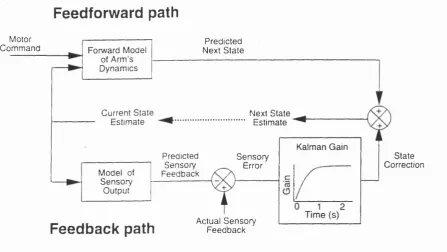
estimate resulting from the forward model. The relative contributions of the internal simulation and sensory correction processes to the final state estimate were regulated by the time-varying gain of a Kalman filter so as to provide optimal state estimates. The model was able to reproduce the characteristics of the measured variance in estimate of hand position during a movement. Wolpert concluded that this implicated a forward model in sensori-motor guidance.
Feedforward path
Motor
Com m and Forward Model Next S tatePredicted of Arm’s
D ynam ics
Current State Estimate
Next State Estimate
Kalman Gain
State Correction Predicted
Sensory F eedback
S en so ry Error Model of
S en sory Output
Time (s)
Actual S en so ry F eed b ack
Feedback path
Fig. 1.2.1 The Wolpert model of sensorimotor integration.
To summarise this work, computational models of various aspects of motor control have provided a framework in which some experimental studies can be designed and interpreted. To date, these models have gone some way to explaining results from human movement experiments, but some development is needed before models can predict the parameters coded by cells in the primate motor system.
1.3 Function of different cortical areas in control of hand movement.
The four main cortical areas known to be critically involved in control of voluntary movement are the precentral cortex (M l), corresponding to area 4 in Brodmann's classification, the supplementary motor area, (SMA, or mesial part of area 6), premotor cortex (PM, or lateral part of area 6) and cingulate motor cortex (CMA or areas 23 and 24; Fig. 1.3.1). Non-primary motor areas have since been further divided into 6 different areas: (Dum and Strick, 1991) the SMA on the medial wall of the hemisphere, pre-SMA, the arcuate premotor area (APA) in and around the caudal bank of the arcuate sulcus, the region adjacent to the superior precentral sulcus (SPcS) and the rostral and caudal cingulate motor areas (CMAr and CMAc). Dum and Strick (1991) used retrograde tracer injection into cervical spinal cord (C4 to T2 grey matter) to determine the location of the corticospinal (CS) neurons projecting to the cervical spinal cord: M l contributed about 50% of CS fibres, compared with 12-19% from SMA, 12-21% from premotor areas, and 17-21% from cingulate motor areas. M l therefore constitutes by far the largest of the descending influences on the cervical spinal cord.
The contribution of these areas to movement has long been studied, via a great many different methods. Initial findings used crude electrical stimulation of the cortical surface to evoke muscle responses, and thence methods have progressed to fine intra-cortical stimulation and recording techniques. More recently functional imaging has been used to identify areas of cortex which are active during movement. There follows a brief description of the postulated function of the different cortical motor areas.
C M Ad
10mm
thresholds for stimulation of all the motor areas, and produces the most focal activation of muscles, often evoking discrete movements of fingers or wrist (Asanuma and Rosen, 1972).
Passingham (1993) wrote in his book on the functional anatomy o f the frontal lobes: ‘[primary] Motor cortex provides a mechanism for the execution o f the fine behavioural variants which are selected in voluntary action. The ability to perform discrete movements depends on the direct connections from motor cortex to the motor neurons in the spinal cord.’
His conclusion was based on evidence from: (1) lesions in the pyramidal tract of humans and macaques resulting in loss of fine distal control; (2) correlation between the extent o f corticospinal termination and dexterity observed across mammalian species and (3) the evidence from spike-triggered averaging (or STA, see section 6.1) for direct CM connections to discrete muscle fields (Porter and Lemon, 1993). Functional imaging evidence also supports the function of M l in execution o f voluntary muscle activation (PET: Colebatch et al., 1991; fMRI: Rao et al., 1995).
single premotor cells while the animal was waiting for a cue to move. A separate study by Chen and Wise (1996) investigating the directional tuning o f discharge from cells in the supplementary eye fields indicated that these cells are involved in learning an association between a visual stimulus and an oculomotor response. Functional imaging data is consistent with this finding, in that PET scans show greater activation in lateral premotor cortex for tasks where subjects must select between movements rather than simply repeat the same movement (Deiber et al., 1991).
The hallmark of SMA function is probably its involvement in bilateral tasks. Brinkman (1984) showed deficits in tasks requiring bimanual co-ordination performed by macaques after unilateral SMA lesion. The performance returned to normal after subsequent callosal section. It was suggested that this could be explained by an imbalance o f control produced by the unilateral lesion, leaving one SMA to deal with the preparation for action by the motor executive apparatus bilaterally. However, Kazennikov et al., (1998) showed that monkeys with both unilateral and bilateral SMA lesions were able to perform a bimanual co-ordination task requiring one hand to grasp and pull out a drawer, while the other reached into it to pick out a piece of food. They concluded that SMA was involved in movement initiation rather than bimanual co-ordination, based on delays seen in initiating movements with the arm contralateral to the lesion.
and 7. This would allow transfer o f information about sensory context for movement planning. Thalamic input to SMA is from the VLo nucleus, which itself receives inputs from basal ganglia (Schell and Strick, 1984). Passingham (1993) emphasises deficits in self initiated tasks in monkeys with SMA lesions, with a relative preservation of extemally-cued performance. His interpretation is that SMA functions similarly to postarcuate premotor areas, but has a greater contribution in response selection for tasks with no external cues. This can be explained by its more substantial inputs from basal ganglia, which may be involved in initiation of willed movements (Rothwell, 1994). PET experiments in normal humans show activity in SMA both during execution of complex finger movements, and during mental rehearsal of the same movement sequence (Roland et al., 1980). Further work will no doubt help to tease out the contribution o f SMA to bimanual control, planning of complex sequences and selection of self-cued movements.
inactivation of CMAr by muscimol injection. There was no effect on the ability to select based on an external cue.
The final issue to be mentioned here is that of the organisation of the cortical system as a whole. Rouiller (1996) argued against a classical hierarchical organisation, with MI being responsible for appropriate muscle activations to perform movements, while non primary areas were responsible for attention, selection, preparation and programming of hand movements. This arrangement would, he proposed, be subserved by a dense convergence of projections from non-Ml areas onto M l, with no direct CS outputs from these areas. However, since non-Ml areas account for about half the CS fibres (Dum and Strick, 1991) the evidence seems instead to support parallel influences from the different areas onto spinal targets. Somewhat paradoxically, although non-primary motor areas contribute a large proportion of CS pathways, the direct CM connections to motoneurons originate largely in M l. Rouiller (1996) demonstrated close apposition o f CS projections from SMA onto cervical motoneurons using dual label light microscopy, suggesting the existence of CM connections from SMA, but this remains to be confirmed by electron microscopy. However, Maier et al., (1997), found weaker CM effects from SMA as compared to M l.
L ayer O utputs Inputs
Other cortical areas
spiny stellate
chandelier cell ^
cortico-cortical pyramidal
\ c e l l
basket cell
pyramidal collat erals
THALAM US R N
Pons
RF
Thai
TON
striatum
Flexor MNs Extensor MNs
Renshaw cell
•
0Fig. 1.4.1. Intrinsic circuitry o f the motor cortex.
M ajor input pathways are represented on the right hand side; outputs are on the left. Pyramidal cells are triangular; non-pyramidal cells are circular. Inhibitory synapses are represented by black circles, excitatory by white semi-circles. RN =red nucleus; RF =reticular formation; Thai =thalamus; TON ^trigem inal nuclei; M N= motoneuron.
1.4 Cortical neuroanatomv.
The classical evolutionary picture of cortical development from multiplication of processing modules has arisen from histological evidence which suggests that all areas of neocortex are organised in a similar 6-laminar structure from the same basic cellular components (Rockel et al., 1980). The inputs and outputs to the cortex are found within these laminae and can be identified by intra-neuronal labelling, such as retrograde HRP labelling.
All areas of cortex receive their main specific thalamic inputs in layer IV (Rockel et al., 1980). Their subcortical outputs are from layers V and VI. The motor cortex differs slightly in that it is often considered to be agranular, so that the cell morphology which would normally be used to delineate layer IV is largely absent. However, the motor cortical circuits seem to be based on the same neuroanatomical template despite this difference (Figl.4.1).
‘essentially the same structural units are present throughout the whole of the neocortex. The differences in function between cytoarchitectonie areas depend upon the differences in total pattern of connection of these modules... ’
There are several basic cell types within motor cortex, of which pyramidal cells are the most common (78%, Sloper et al., 1979) and the largest. Their axons project to other cortical or subcortical regions and their function is to carry the outputs from motor areas. Pyramidal cells are found in layers II to V, the majority being in layers III and V. Their morphology exhibits extensive dendritic branching, with dendritic spines receiving the majority of synaptic inputs. All the corticospinal output from motor cortex derives from lamina V. It is estimated that 10-20% of its pyramidal cells project their axons down the spinal cord (Porter and Lemon, 1993). Abeles (1991) states in his review of cortical organisation that, in all known cases, pyramidal cells make excitatory synapses onto their postsynaptic targets, while receiving mainly inhibitory synapses close to the soma, but excitatory synapses on dendrites.
Within the cortex, intracortical collaterals from cells in layer III project throughout the laminae, whereas those from cells in layer V terminate in deeper layers only and spread further horizontally.
Lamina V of motor cortex has the least dense cell packing of all the layers, (Sloper et al., 1979). Pyramidal cells within motor cortex are organised into clusters, the functional significance o f which has yet to be determined. Each cluster gives rise to a bundle of ascending apical dendrites, amongst which communication between pyramidal cells probably occurs (Feldman, 1984).
The other cells found in motor cortex, which are non-pyramidal cells, include basket cells, which are large inhibitory aspiny stellate cells found in layers III, IV and V. They project mainly to intrinsic pyramidal cells. Basket cells differ from other cells in several ways: they are inhibitory, probably releasing GAB A (Abeles, 1991); they receive their synapses diffusely over the cell body and dendrites, unlike spiny stellate and pyramidal cells, which both receive much of their input at dendritic spines. Also, basket cells mainly have horizontally oriented axons, unlike the predominantly radial connectivity throughout the motor cortex. Other horizontal intracortical fibre systems include pyramidal axon collaterals found at the border of layers II and III.
processing units combined with short-range horizontal connections between them may be an optimal arrangement across different cortical areas.
Perhaps the most compelling argument for radial organisation of processing units comes from studies in the sensory areas, where it appears to be involved in segregation of different modalities of incoming sensory information. In monkey primary visual cortex, the cells seem to be segregated into three types of processing modules. Some cells are distinguished by their ocular dominance, some by their orientation selectivity and some by their colour responsiveness. In the next stage of processing, V2, there seem to be three types of processing areas: two which stain for cytochrome oxidase in stripes, and one interstripe region (Livingstone and Hubei, 1984). Cells from the first area seem to be involved in further processing of information from the Y-type retinal ganglion cells, while the others seem to relate to X-type retinal ganglion cells.
multiple representation of identical ICMS-evoked movements over M l (Lemon, 1988; Sato and Tanji, 1989).
Data from the Lemon group showed that cortico-motoneuronal (CM) cells facilitating the same target muscle were distributed over a wide region o f the macaque motor cortex. The group of CM cells which activate a single motoneuron is called a colony (Phillips, 1969), and maybe distributed over as much as 6.5mm in the dorsoventral and 2mm in the mediolateral direction (Lemon, 1990). Porter and Lemon (1993) conclude that the output map contains multiple overlapping representations of different muscles.
It is perhaps surprising then that neighbouring CM cells have been shown to project to common output targets, reinforcing the argument for a somatotopic organisation of M l (Cheney and Fetz, 1985). This work involved the investigation of CM cell muscle fields by ICMS and STA during a simple wrist flexion-extension task. However, a contrasting conclusion was presented by Lemon et al., (1987) based on evidence from a study o f the activity of CM cells projecting to a wide range of muscles during the precision grip task. The latter study found neighbouring CM cells with more disparate muscle fields and a lower correspondence between CM effects and ICMS effects than did Cheney and Fetz (1985). They suggested that the cortical organisation of CM cells contributing to the two tasks might differ, in that the wrist movement involves alternate co-activation of select groups of synergistic muscles, whereas precision grip requires subtle fractionation o f muscle activity across larger groups of muscles.
adjacent cortical output neurons received similar afferent inputs and exhibited matching behaviour during movement. Rather than supporting the somatotopic motor map theory, Lemon (1981b, 1988) proposed that the output map in M l might be specialised for producing a certain muscle synergy, for use in some movements but not others. This is supported by the finding that CM cells are not active during all the movements in which their target muscles are used (Muir and Lemon, 1983).
The classical concept of a motor map proposed by Asanuma (1975) and Mountcastle (1978, 1997) also encompassed somatotopic organisation of inputs to the cortex. This was also investigated by Lemon (1981b) who recorded the response of single M l cells to passive sensory stimulation, and during active movements. He concluded that the topographic map o f afferent input to M l was also complex, with multiple representations o f input from a single zone (e.g. wrist, hand or digits). In addition, these distributed representations of each zone were overlapping, reinforcing the argument for a more complex input-output organisation than the strictly somatotopic columnar arrangement suggested by Asanuma (1975).
observed multiple representation of sites with similar input-output coupling led the authors to propose that specific sensory inputs could play a role in the sequencing of movement vectors to execute a movement. They postulated that each representation of a particular movement about a joint might be associated with a particular combination movement such as wrist and finger flexion.
In addition to radial organisation, another common theme in the functional connectivity o f cortical areas is inhibition across a network. The importance of inhibitory networks in the motor cortex was revealed by some elegant experiments involving the block of GABAergic transmission in local populations (Matsumura et al., 1991) and in single cells (Matsumura et al., 1992). Observations of macaque manual dexterity following local G ABA antagonist injections demonstrated deficits consistent with muscle weakness. The authors concluded that an intact inhibitory network was necessary for the skilled control of hand movements. Inhibitory block caused non-reciprocal activity of PTNs, resulting in an increase in total muscle activity with errors in timing of activity sequences. The effect of this was to abolish muscle fractionation, in favour of uncontrolled co-contraction of hand and forearm muscles.
pyramidal cell axons in layers II, III and V. They suggested that these terminals onto initial segments would be a powerful means of ‘on-off control over pyramidal cell output.
Perhaps more significantly, Matsumura et al. (1992) showed that iontophoresis o f a GABA agonist produced an increase in task-related cell activity, but not in the baseline activity, while excitatory agonists such as glutamate and acetylcholine had the opposite effect. This hints at the function of the inhibitory network, in refining the PTN outputs to the motoneurons, but only during the phases of task at which the PTN discharge is active. The existence o f inhibitory networks in primary visual cortex is well-documented (Lund, 1990) and it is proposed that they represent a ubiquitous feature of cortical processing.
In summary, different neocortical areas share several features, including their laminar structure, radial connectivity, and cell types, making it all the more likely that this arises due to duplication and subsequent specialisation during evolution. Therefore insights into general cortical function and connectivity may be gained from the study of motor control by the motor cortex.
1.5 Inputs to the motor cortex
Jones (1986) has summarised the afferent connections via the thalamus to somatic sensory cortex, motor cortex and supplementary motor area. Dorsal columnar, lemniscal and cerebellar afferents are segregated in their pathways to the cortex, via nuclei VPL and VL of the thalamus. VPL projects to somatic sensory cortex, which then supplies cortico- cortical afferents to M l. VPLo supplies some thalamocortical input directly to M l. VL is divided into VLc, projecting mainly to M l, and VLo, projecting mainly to SMA and premotor areas, but also to M l. More recently, however. Percheron et al. (1996) have argued for a new nomenclature for the thalamic motor nuclei, based on three-dimensional analysis of PET images of macaque thalamus. The authors documented a posteroanterior sequence across dorsal thalamus of the four topographically distinct areas receiving lemniscal, cerebellar, pallidal and nigral inputs.
1.6 Descending motor pathways.
There are six recognised descending systems that exert synaptic effects on motoneurons: corticospinal, rubrospinal, reticulospinal, vestibulospinal, tectospinal and interstitiospinal systems (Felix and Wiesendanger, 1971; Nathan et al., 1996). Excepting the reticulospinal system they are all somatotopically organised, and are highly modulated in relation to the kinematic features of movement (Cheney et al., 1987). The different descending systems offer different contributions to movement control, revealed by lesions within each system. The systems that allow distal muscle command, including relatively independent finger movement are referred to as the dorso-lateral system, which comprises corticospinal and rubrospinal. The other projections are referred to as the ventro-medial system, and are involved in proximal and axial muscle control, for posture and locomotion systems (Lawrence and Kuypers, 1968a, b). The current study focuses on the corticospinal system as it is the main means of transmission for descending motor commands in humans and non-human primates. It is, however, but one of many descending influences arising from the supraspinal neuraxis, and integration of descending information from the other systems probably occurs at both the motoneuronal and pre-motoneuronal levels (Kuypers, 1981; Baldissera et al., 1981; Pierrot-Deseilligny 1996).
1.7 Outputs from the motor cortex: the corticospinal tract.
The corticospinal component o f the peduncle is actually quite small, (18% by area in man, Lankamp, 1967, cited in Porter and Lemon, 1993) but nevertheless represents the means by which the cortical commands specifying voluntary movement can gain access to motor apparatus of the spinal cord. In the monkey, according to Humphrey and Corrie (1978), about 75% of fibres in the ipsilateral pyramidal tract descend into the spinal cord, the remainder terminating in the medulla. Below the medulla approximately 10-15% of axons remain uncrossed (Porter and Lemon, 1993), descending into the ipsilateral spinal cord within small lateral and medial tracts. The remainder descend in the dorsolateral funiculus. Although 10-15% of axons descend in the ipsilateral spinal cord, only about 7% of axons actually terminate ipsilaterally (Galea and Darian-Smith, 1994) because the remainder re-cross in the spinal cord, to terminate contralaterally.
The distribution of corticospinal termination within the spinal cord varies between mammalian species, such that Kuypers (1981) was able to classify species into four groups based on their pattern of corticospinal termination. The progression upwards in phytogeny corresponds to termination in dorsal horn, then intermediate zone and in higher primates, (such as chimpanzee and man), fibres which extend throughout the spinal cord terminating in dorsal horn, intermediate zone, and innervating motoneurons supplying both distal and proximal muscles. In these primates the specificity of connections indicates that some CM cells may exert localised actions on a limited population of functionally related motoneurons at a single target site (Porter and Lemon, 1993).
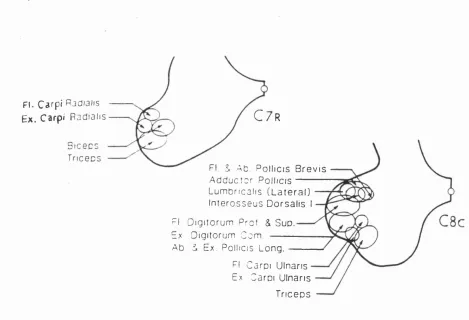
Somatic motoneurons are all located in the anterior horn (lamina IX of Rexed). The population of motor neurons that innervate a particular muscle are arranged with their somata within a longitudinal column, often spanning several segments of the spinal cord. These columns are arranged topographically within a segment, (fig. 1.7.1). The ventromedial part of the lamina IX contains motoneurons supplying axial and proximal limb muscles, while the dorsolateral part of lamina IX contains motoneurons supplying distal musculature, with flexors being found more dorsally than extensors. Proximal muscle control is provided by motoneurons in the central region of lamina IX (Porter and Lemon, 1993).
F I . Carpi R j d i a i i s
E x. C a r p i P a d i a h s
C 7
rFI & Ab P o l i i c i s B r e v i s A d d u c t o r P q IIic is
L u m b n c a i i s ( L a t e r a l ) I n t e r o s s e u s D o r s a l i s I FI D i g i t o r u m P r o f & S u p . Ex D i g i t o r u m C o m ---A b & Ex. P o l l i c i s L o n g .
FI C a r p i Ul nar i s Ex Car pi U l n a r i s
T r i c e p s
Fig. 1.7.1 Topographical distribution of motor columns at rostral C7 and caudal CS
segments. Schematic arrangement of HRP-labelled motoneurons of the anterior horn, taken from Jenny and Inukai, 1983.
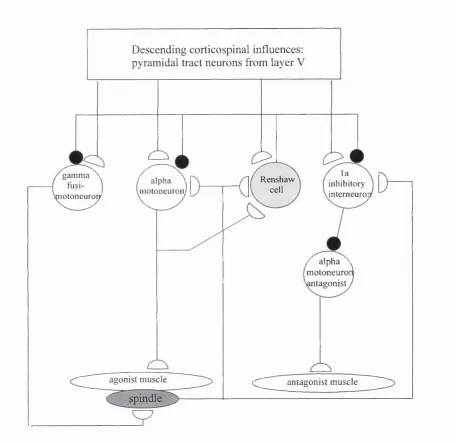
The processing components o f the spinal cord are organised into complex segmental
circuits, as represented in figure 1.7.2, the function o f which has been investigated in detail,
mainly in cat, but also in other animals and in man. In addition to these connections, many
other spinal interneurons probably exist, as do propriospinal connections between segments
which are not illustrated.
Descending corticospinal influences; pyramidal tract neurons from layer V
gamma \ fusi- j lotoneuroiy
Renshaw cell
' alpha '
motoneuron. inhibitoryinterneuroi
/ alpha ^ motoneuroi 'antagonist
agonist m uscle antagonist m uscle
Fig 1.7.2. A simplified diagram o f the basic segmental organisation influencing motoneuron function. Based on Fig. 1.13 Porter and Lemon (1993).
This circuit represents the general segmental organisation influencing the motoneuron. However, Illert et al., (1996) demonstrated that motoneurons projecting to distal muscles are not influenced by the recurrent inhibitory system. It was suggested that this arrangement allowed reciprocal muscle activation for control o f posture, but more flexible control, involving co-contraction and fractionation of groups muscles, for control of manipulative movements.
PTN
.lotoneurone
EMG
STA
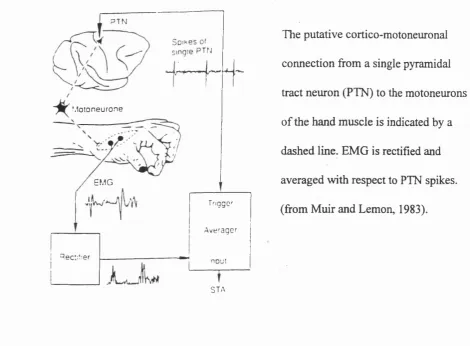
The putative cortico-motoneuronal connection from a single pyramidal tract neuron (PTN) to the motoneurons o f the hand muscle is indicated by a dashed line. EMG is rectified and averaged with respect to PTN spikes, (from Muir and Lemon, 1983).
Fig. 1.7.3 The use of spike-triggered averaging (STA) to detect post-spike facilitation (PSP) of EMG recorded from monkey hand muscles.
Divergence of single CM cells to more than one muscle has been shown by the STA method (Fetz and Cheney, 1980; Cheney and Fetz, 1985). The mean number of muscles to which a CM projected was 2.4, the maximum number o f target muscles being as many as 5 or 6. This has implications for the selection of an appropriate functional grouping of muscles required for a certain task (Lemon, 1988).
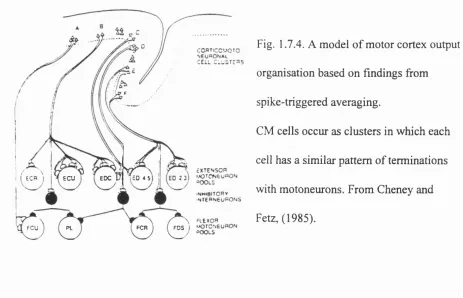
Cheney and Fetz, 1985 also demonstrated that neighbouring CM cells have very similar target muscle fields, although their patterns of spike discharge may be dissimilar. The organisation of corticospinal inputs to pools of agonist and antagonist motoneurons can facilitate the precise co-activation of muscles. Figure 1.7.4 shows the model postulated Cheney and Fetz in 1985 to explain motor output organisation, as investigated by STA.
They proposed that the basic output module of the motor cortex is a cluster of pyramidal cells, which may project to one or more than one motoneuron pool. The most common pattern of CM connection they measured was one of pure facilitation, in which single pyramidal cells from a cluster facilitate only agonist muscles (clusters A and C), another common pattern being reciprocal connection in which the cells of a cluster simultaneously facilitate agonist and suppress antagonist muscles, probably through inhibitory intemeurons
(B and E).
For movements requiring co-contraction of, for example, wrist extensors and flexors as in the power grip task a different arrangement of agonist and antagonist muscles must be activated, using a more complicated system of supraspinal activation of muscles.
50 4 5
EDC ECU
FCA
FCU P I FOS
Fig. 1.7.4. A model of motor cortex output organisation based on findings from spike-triggered averaging.
CM cells occur as clusters in which each cell has a similar pattern of terminations with motoneurons. From Cheney and Fetz, (1985).
Having established the connection pattern from the cortex to the motoneurons, it is important to understand the way in which the motor command is interpreted at this synapse, to achieve the movement goals.
1.7.1 Filtering of cortical outflow at the motoneuronal synapse
The above discussion has addressed the arrangements of spinal motoneuronal pools and the cortical projections to them. The next aspect of corticospinal function to be considered is filtering o f the corticospinal input at its target synapses.
Study of this synaptic transfer has led the motoneuron to be considered as a low-pass filter of descending command signals. For example, the typical rate of a CM input to a motoneuron is in the range 30-100 Hz, whereas the motoneuron’s output rate is invariably lower, in the range 10-20 Hz (Rothwell, 1994). The explanation for the low-pass filtering properties of the motoneuron lies in the intrinsic after-hyperpolarising (AHP) properties of its membrane (Kemell, 1986). Thus, the motoneuron firing rate is limited by the time it takes for the membrane potential to return to resting potential after the preceding spike. The duration of AHP is variable across the motoneuron pool, but is correlated with the type of muscle innervated. Motoneurons supplying slow-twitch muscle fibres generally have AHPs of longer duration, and slowly conducting axons, compared with those supplying fast-twitch muscle fibres (Kemell, 1986).
The input-output fimction of the CM synapse onto motoneurons has been investigated by two main methods: STA of intracellular recordings from target motoneurons and cross-correlation of afferent and motoneuronal discharge. There are considerable difficulties associated with the first method (Asanuma et al., 1979) and only two measurements of the amplitude of a unitary excitatory post-synaptic potential (EPSP) are published in the literature: 25 and 120 pV.
1982, Fetz and Gustafsson, 1983). Although there is still debate concerning the exact expression, Kirkwood (1979) showed that the shape of the cross-correlogram peak is approximated by the first derivative of the EPSP waveform. Although this method is technically easier than that of Asanuma et al., (1979) it has mainly been applied to assess size of EPSP at the la synapse, rather than at a CM synapse. From the data available, it appears that CM EPSP size is roughly consistent with unitary EPSPs produced by other segmental afferent and descending systems (Porter and Lemon, 1993).
1.7.2 Recruitment of motor units
The role o f muscle fibres and motor units is generally to produce controllable amounts o f force, generating torques around the joints and giving rise to planned movements. In reflex and voluntary movements the isometric force produced by a motor unit depends on the rate of its repetitive activation. Much work has been done to characterise the properties of both motoneurons and motor units, mostly in the cat hindlimb. I shall summarise the main features of this system which are responsible for converting cortical outflow into muscular contractions.
Properties of motor units are variable within a population: specifically the speed and force of contraction are variable, as is the endurance of the motor unit over time. These properties do not, however, vary independently but fall into three main groups, as reviewed by Kemell (1986). At one extreme are the slow, fatigue-resistant, weak units (S) while at the other are the fast, fatigue-sensitive and strong units (FF) and in between units are usually found to be fast, producing intermediate force with varying resistance to fatigue (FR). Optimum use of the muscle requires that the different groups be recmited in order, to produce smooth contraction of the muscle. This is achieved by two different mechanisms: rate gradation and recruitment gradation (Kemell, 1986).
Recruitment gradation implies that the apparent excitability of the motoneuron is matched to the contractile properties of the motor unit it innervates. Specifically the smallest, slowest and most fatigue-resistant motor units are recruited first, followed by units with gradually increasing speed, force and decreasing endurance properties. Therefore in a process of continuing recruitment the force steps are kept in proportion to the absolute level o f force output to ensure smooth build-up of force. The units to be recruited initially are those used most often in posture, leaving all the fast-twitch units to be recruited for dynamic limb movements (Kemell, 1986). This is also referred to as the ‘size principle’ (Mendell and Henneman (1971).
There has been much interest in how this kind of specifically matched motoneuron- to-fibre-type innervation arises. As shown in Fig 1.7.1, the motoneurons are topographically organised, and innervate different regions of a muscle dependent on their rostro-caudal position, unlike the motor units, which show no clear topographic organisation of their types.
recruitment gains, as produced by the differential distribution o f synaptic effects within a motoneuron pool.
The specialisation of this system has implications for the way in which a neural code from the cortex is used by the spinal apparatus. Kemell and Hultbom (1990) suggest that the motoneuron code should employ as much as possible of the working range o f firing rate, while scaling of the output force is carried out at the level of the motoneuron pool by adjustment of recmitment gain.
1.8 The study of cortical function
Two main approaches have been used with the aim o f investigating cortical function: the first is a top-down approach in which a theory of how the cortex computes is then tested experimentally by recording; the second is a bottom-up approach, where an hypothesis of cortical function is built from experimental data. The ideas reviewed here are a product of both approaches.
1.8.1 Insights at the single-cell level: Neural codes.
The classic method by which cortical function has been investigated is by single unit recording, both extracellularly and intracellularly in various areas of the brain. The interpretation of this data relies on the assumption that if enough units are sampled, one gains a representation of all there is to measure in a given functional unit of brain.
It is also assumed that the activity of one neuron is tuned to some information- bearing parameter. Coding in the visual system has been investigated in great detail using this method. Hubei and Wiesel, (1968) were able to record accurate tuning curves for single cells in primary visual cortex which showed that their firing rate was tightly coupled to aspects of simple visual stimuli, such as the orientation of a bar.
Conduction by neurons and their synaptic connections is an inherently noisy process, therefore a code is used which maximises the amount of information-carrying capacity for a system with a given signal-to-noise ratio.
Since Shannon's 1949 publication 'Communication in the presence o f noise', information theorists have been investigating codes which could be used by neurons to transmit information using a spike train. Analysis of the properties of spike trains recorded
in vivo has revealed that no single coding system seems to occur. Unsurprisingly, different areas of central nervous system may employ independently rate codes, spike interval codes, spike pattem codes or perhaps more complicated codes involving phase relative to a synchronous population oscillation.
A rate code is used by most peripheral sensory nerves to code stimulus intensity, whilst interval codes may be used in transmission from retinal ganglion cells to the lateral geniculate nucleus (LGN), since lateral inhibition in the LGN is able to extract information about visual stimuli without an increase in overall firing frequency (Eggermont, 1990). Pattem codes consist of favoured pattems within a spike train that occur more often than would be predicted by chance, for example Dayhoff and Gerstein (1983b) observed in the crayfish claw control system pattems of 3-7 spikes in 23 out of 30 spike trains investigated. If these pattems are common enough to provide adequate information capacity, they would prove suitable for coding, particularly given their robustness to noise cormption.
unknowns in the system. The origins of these unknowns are found in the Bayesian expression of the transfer function o f a neuron:
P[s(t)| {ti}] = P[{ti }|s(t)] X Pfsffll ,
P [{ ti} ]
Where P[s(t)| {tj}] is the probability of observing the stimulus given the spike train recorded, P[{tj }|s(t)] is the probability of observing the spike train given the stimulus applied, and P[s(t)] and P[{tj}] are the prior probabilities of observing the stimulus in the environment and the spike train from the neuron respectively. For any system it is impossible to obtain a value for these prior probabilities with a limited sample. So the values obtainable from this method are estimates of the limits on information transmission given the bounds of the conditional probabilities as stated above. Rieke et al (1997). state that rates o f 300 bits per second are possible in the invertebrate models studied. However, they point out that, given behavioural response limits which require temporal resolution in the millisecond range (e.g for fly photoreceptors) this translates to only 4 or 5 bits every 15ms or 2 bits per spike, which means that one spike can carry the information to decide between one of two alternatives. Unfortunately, most of their treatment of coding applies to the spike train observed from a single neuron, so it is hard to extrapolate this quantitatively to an ensemble code.
which a stimulus can be detected in a time span during which it is only possible for a single cell to fire one spike. Therefore, what might appear to be a rate code, because the cell produces stimulus-modulated changes in firing rate, could be a sparse temporal code.
One final consideration in the field of coding strategies employed by the nervous system is that of design versus evolution, which has been addressed by Reeke et al. (1990). If a code for information transmission within the nervous system exists then that code itself must be specified to the individual organism without the use of a code, otherwise an infinite regress of codes would occur. To avoid such a situation, the only possible assumption is that the most fundamental level of operation of the nervous system does not use symbols or codes. Equally, the algorithms necessary for manipulation of information within the cortical processing units must be genetically determined, or learned, or some combination o f the two. It is hard to imagine how the complexity of algorithm necessary to expand and deal with the vast selection of stimuli and cause/effect contingencies seen in life might be implemented in a genetic code.
we come to study could have evolved without the design process needed to make algorithms to interpret them today.
The problem o f coding within the motor system has long been an issue for discussion; specifically, what aspects of movement are coded for, and how much o f this is done by the motor cortex? The two main rival features of movement which could be specified by the cortex are dynamics (force, rate of change o f force, and torque) versus the kinematics (direction, velocity).
1.8.2 Coding of force bv single cortical cells.
Early experiments to address force coding were performed by Evarts in 1968, who concluded that PTN discharge rate was directly related to external load against which the limb worked. Since Evarts’ initial work in 1968, several studies have addressed the relation of cortical discharge and force exerted during movement (Evarts, 1969; Humphrey et al., 1970; Schmidt et al., 1975; Hepp-Reymond et al., 1978). The general conclusions firom this work are that single neurons in hand area may be divided into several populations, based on their force relationship. Hepp-Reymond et al., (1978) found two groups o f M l neurons, one with increasing, the other decreasing monotonie relationships to static force. Smith et al., (1975) also successfully demonstrated a group o f neurons related to rate o f change o f force.
The neurons recorded by Hepp-Reymond et al. (1978) were unidentified; one might predict that, for CM cells, a positive relationship between cell firing and the level of static force exerted would exist.
that all CM cells were active during the hold period with one of four patterns: phasic-tonic, tonic, phasic-ramp or ramp discharge. CM cells responded with the same pattern to isotonic as to auxotonic movements, and firing during the hold period showed a positive correlation with load. The steepest increase in firing rate with load was for extension-related cells.
Evarts et al., (1983), added to the evidence for force coding by PTNs using a larger sample of cells during a task involving wrist pronation and supination. They observed two distinct groups of PTNs: firstly, small slow PTNs which signalled torque over a wide range, and which were recruited during the smallest load conditions when relatively few motoneurons were active. Secondly, they found that fast PTNs exhibited graded frequency changes over a restricted range of forces, resulting in sets of sigmoidal force relationships. They suggested that a similar ordering of PTN recruitment with increased force may function as for motoneuron recruitment, allowing sensitive control o f small forces, and a smooth increase in contraction to generate larger forces. The authors also noted that 75% of neurons sampled were related to both direction and force. This, they ascribed to a relationship between cortical discharge and the activity of prime mover muscles, which held true for both isotonic and isometric movements. There is clearly an interdependence between force and direction which means that it is difficult to discriminate coding of one from the other.
allowing co-contraction of agonists and antagonists to occur. Alternatively, these cells could play a role in the controlled release of force, by increasing their activity while the majority o f cells (with a positive force relationship) decreased theirs.
Fu et al., (1993) showed that alternative variables which might be encoded are movement distance and direction. However, the authors acknowledge that the distance parameter may covary with force, so that the observed correlation between cell discharge and distance might actually be explained by a force relationship. These authors distinguished between coding in the pre-movement period, during which direction o f motion seemed to predominate, and the actual movement period, in which cells covaried either with direction or distance. They found cells that were broadly tuned to a preferred direction, which remained constant with changes in distance.
In summary, there is evidence that some groups of cells in primary motor cortex, including CM cells, code for static force in their discharge, while others may code its derivative over time. Still others may be related to direction of movement, particularly during the premovement period.
1.8.3 Insights at the population level: Ensemble coding.
A recent advance in the study of cortical function has been the use o f multiple electrode systems (McNaughton et al., 1983). I shall describe certain advantages conferred by multiple single cell recording, and then discuss current views surrounding the issue of ensemble coding.
to asking a production line worker how fast the finished car will go. Using a recording method which is able to simultaneously sample many cells from a population may give a more unambiguous view of how the population as a whole codes behavioural parameters.
Thus, many workers have moved towards an understanding o f the computational function of the brain in neural network terms. Instead o f investigating tuning o f single units, the spatiotemporal patterns o f firing activity can be used to investigate the network status: a population code. This approach, according to Eggermont (1990) redefines the assumptions inherent in the method as follows: Tt is ... assumed that there is collective decision-making without the need for commmand neurons, which were previously regarded as single-cell correlates of perceptual processes’.
Co-operative effects can be investigated by studying correlations in the firing behaviour of populations of cells. If a population code such as that proposed by Georgopoulos (see section 1.8.4) is being employed, one would expect to see a functional independence between neurons, that is a broad tuning o f single cells which is spatiotemporally averaged to obtain the fine tuning from the population.