2611
Salesperson Creative Performance: The Role Of
Performance Appraisal Systems
Dr. Abdullah Matar Al-Adamat, Dr. Hayel Falah Alserhan
Abstract: This paper explores the role of performance appraisal systems and how they affect the performance of salespersons in Jordan. This
industry-based research was conducted through questionnaires that were analysed statistically using multi -regression analysis through SPSS version 21. This analysis allowed for the hypothesis to be tested and also provided positive results in favor of the performance appraisal sys tem. The outcome of the study is to recommend a review of the system that would include adopting some changes to improve efficiency.
Index Terms: Salesperson, Creative Performance, Performance Appraisal System, Jordan.
—————————— ——————————
1
INTRODUCTION
Organizations are becoming increasingly aware that their employees are central to the success of the business and that the creative behavior of staff is vital to their success [1]. This is particularly important as many businesses operate in highly competitive areas where technological advances and ever-changing business environments can impact on the role of human resources. Creativity amongst employees is of particular importance in a sales area as employees need to be engaging, enthusiastic and able to think outside of the box. The evolution of markets and the advancement of technology has had an impact on how sales work is done and has shown that creative thinking is vital within any sales role [2]. This has resulted in an increased consideration towards creative performance of salespeople and how this can be developed and supported across their roles. One way of supporting staff is through a performance appraisal system (PAS) which has been seen by many as a tool that can contribute towards an employee‘s creative endeavors [3], [4], [5]. Such appraisal systems provide a basis for communication and feedback and as such can be used to instil trust between employees and employers [5]. The type of appraisal system is vital to how successful it is. A system based on fair criteria is more likely to be useful, transparent and able to engage with both sides of the appraisal process. If employees are more engaged with such initiatives, they are more likely to respond with positive creative behavior. However, there could be a situation where an excellent system is in place, but the supervisor or manager does not have the skills or experience to be able to carry out the appraisal with confidence and professionalism. This could result in poor information being recorded, the employee having a negative experience of the appraisal process or for there to be inconsistencies across how it is run within the business. In the situation where there are fair criteria within the appraisal system there may still be inconsistencies with how the system is used which could produce negative or unreliable results. By reviewing previous studies, we find that the topic of employee creativity has attracted increasing attention from both scholars and practitioners; e.g. [6], and [7].
However, salespeople‘s creativity has been identified as one of the most under-researched topics in the sales literature [8]. Little is known about whether certain conditions enhance salespersons‘ creative performance, and it is unclear whether a performance appraisal system demonstrates short-term or long-term effects on salesperson creative performance. This is what this research tries to prove by knowing the impact of the effectiveness of the evaluation system on the creative behavior of employees. Therefore, this research intends to answer the question: ―What is the impact of performance appraisal system on salesperson creative performance? We propose that when organizations adopt an effective appraisal system which reflecting real and accurate results, salespersons‘ creative performance would be positively affected.
2
THEORETICAL
BACKGROUND
AND
RESEARCH
HYPOTHESIS
2.1 Performance Appraisal System (PAS)
One of the practices that is most central to effective performance review and management of staff within human resources is the use of performance appraisal systems. This is because a PAS can identify the responsibilities and objectives of each employee and how this relates to the overall mission of the business [9] to assess how they are doing in their job. A performance appraisal system is usually a process that is set up between a manager or supervisor and an employee which reviews the actions and work of the latter where the former assesses said work [10]. Coates [11] outlined that performance appraisal is a formal process that provides a systematic review of an individual‘s performance and role and can also compare them to the standards set for that particular role or individual. Moreover, PAS can be seen as a method for gathering information on how an employee views a company and can be analysed to measure areas such as job satisfaction and engagement [12]. Appraisals and performance review are a vital component of successful human resource management processes [13[, [14]. McConkie [15] highlighted that ―where performance is measured, performance improves‖ which is a simple understanding of why PAS are so effective. Likewise, such processes can motivate employees as it gives them the opportunity for growth and being listened to [16], [17], [18]. There is a broad range of performance appraisal techniques that businesses can use. This will depend on the type of business and each will have their benefits. The systems include creating narratives; criteria-based reviews; management by objectives; work planning and review; 360
————————————————
• Dr. Abdullah Matar Al-Adamat: Assistant Professor at Department of Business Administration, Faculty of Economics & Administrative Sciences, Al al-Bayt University, E-mail: [email protected] • Dr. Hayel Falah Alserhan: Assistant Professor at Department of
2612
appraisals (i.e. not just one way to the employee); ratings; peer review; and trait scales. There are benefits and downfalls to all of the different methods which means that a lot of companies might use a range of the techniques within one overall performance appraisal system. Appraisals are also a common way for companies, departments or management to set and measure goals. Armstrong and Taylor [19] highlighted that businesses can use PAS to identify goals across the business and then use the system to identify what needs to be done, how and by who. Across any business, it is important that a consistent approach to appraisals and performance review must be taken. This will ensure the validity and reliability of the results by ensuring that everyone is conducting and similarly engaging with them.
2.2 Salesperson Creative Performance
―Creativity‖ and ―innovation‖ are often wrongly used interchangeably within research [20]. Whilst there can be overlap and similarities it is important to recognize the differences that both terms offer. Creativity can be defined within some research as a unique action or activity [21] or the formation of an original idea that has not taken place before [6], [22], [23]. A more detailed definition of creativity comes from Torrance [24] who saw it as a means of analyzing a current situation or task to identify where improvements or alternatives could be and then make modifications or create new ideas that will then present a new and unique solution. Another useful take on creativity is to consider Daft‘s [25] positioning which highlights the role of new behaviors within an organization or marketplace. Moving over to innovation, this can be viewed as working with an already existing product, service or process and implementing a new idea or improvement [23] which as Janssen et al. [26] point out, can be a more complex process than creativity which is a completely unique concept. Porter and Stern [27] highlighted that innovation can be a process that occurs through the adaptation of products and services to understand and meet the needs and preferences of customers. Innovation can happen at any time to any product or service as it is based on the understanding that products, services and processes can evolve [28]. Whilst creativity is natural to some people it is also a trait that can be developed within people through training and development. Researchers have explored the development of creativity, which has tended to focus less on cognitive abilities and more on how creativity intersects with personality [29]. A notable study on creativity is the one conducted by Guilford [30] which broke creativity into four categories: fluency, flexibility, originality and expansion. There are various features that could play a part in creativity and these have been highlighted by several researchers over the years: creative personality [31], intrinsic motivation [6], learning goal orientation [32], openness to experience [33], creative self-efficacy [34] and mood and affect [35], [36]. There have also been links made between the role that individual and environmental factors and preferences play when they converge, and new creative ideas and theories emerge [37]. Creativity can also be identified in problematic situations where no other solution can be found [38]. Within contemporary social psychology ‗‗creativity is best conceptualized not as a personality trait or as a general ability, but as a behavior resulting from particular constellations of personal characteristics, cognitive abilities, and social environments‘‘ [6]. The importance of nurturing creativity has
long been recognised, particularly as it is a central tenet of long-term success for any business [1]. Within business, it has been recognized that having a culture that allows for the development and instigation of creativity will not only benefit the business but will enable workers to develop their creative thinking skills which will improve their performance [39]. Such an environment where creativity is cultivated is a vitally important factor to provide a competitive edge across industry as well as being useful for internal development [3]. Looking specifically at the sales environment, it can be seen quite clearly that the role that salespeople undertake can be diverse in scope and challenge. There are numerous ways that sales can be an achievement which means that salespeople have the scope to utilise diverse and creative methods to achieve their goals. Creative performance within sales is defined by Wang and Netemeyer [2] as ―the amount of new ideas generated, and novel behaviors exhibited by the salesperson in performing his or her job activities‖. This lies within the scope of the definitions discussed above [6] and allows for it to be contextualized within a sales world. Matinaityte et al. [40] identified that creative performances have a positive correlation with customer satisfaction which highlights the need for salespeople to ensure that they have a range of methods to meet customer needs. One of the most straightforward creative tools that a salesperson could adopt is adaptive selling [41], [42]. This technique involves using whatever processes or procedures already exist and then adapting them creatively to enhance selling in given situations [2]. Whilst this is a useful first step it does not tackle the more challenging sales scenarios that salespeople may face therefore there needs to be a further level of creativity in selling techniques to remain successful and competitive. Such creativity can not only impact on the day-to-day actions by staff but could also play a role in improving customer engagement and reach which will have a longer-term impact on sales.
2.3 The Relationship Between PAS and Creative Behavior
2613
more proactive behavior amongst employees to take on more innovative tasks, be creative and challenge themselves and others [49]. And as Dominguez [50] has identified employee creativity is important for a business to maintain a competitive advantage. Therefore, creating systems that directly or indirectly enhance creativity are going to be within the best needs of the business. In relation to human resource management processes, ‗Signaling Theory‘ dictates that desired behaviors and attitudes can be elicited when the practices are non-ambiguous, clear, consistent and agreed upon by the employee [48]. In addition, ‗Social Exchange Theory‘ suggests that people will act favorably towards situations or relationships that they deem to be mutually beneficial to both parties involved and where a sense of reciprocity is achieved [51]. This can be applied to performance appraisals as if they are developed and delivered within these theoretical frameworks then there will be a much more productive and beneficial relationship between a company and its employees [52]. Employees are also more likely to be receptive to performance appraisal processes if they deem the company overall to be supportive. This could therefore suggest that salespeople who are working in satisfying conditions are more likely to exhibit creative behavior and performance. This leads to the following hypothesis that will be used within this study: H1. There is a significant influence on creative performance from performance appraisal systems.
3 METHODOLOGY
The focus on this research is on the measurement of the causal relationship between independent variables and a variable dependent on gathering data with numeric values, therefore the research is quantitative. Primary data was gathered through a self-administrated questionnaire that has three areas of focus: demographic, performance appraisal systems, and the creative behavior of salespeople. The demographic data that was collected included gender, age, and education. Research was used to develop the independent variable which in this situation is the performance appraisal system [48], [53], [54], [55], [56]. A performance appraisal system (PAS) scale was developed and then split into five areas that could be measured over a five-point scale: professionalism, goals, criteria, methods and feedback. A seven-item scale developed by Wang and Netemeyer's [2] was used to measure the creative behavior of salespeople. This included areas such as ―making sales presentations in innovative ways‖ and ―having fresh perspectives on old problems‖. The reliability of Wang and Netemeyer‘s [2] scale was determined by it achieving a Cronbach‘s Alpha score of 0.89 and 0.84. Using this method was deemed to be reliable and relevant as it has also been used in other research on creativity within the sales industry [5], [57], [58], [59], [60]. Responses on all scales were recorded on a five-point Likert scale ranging from strongly disagree (1) to strongly agree (5). A panel of instructors from five Jordanian universities evaluated the questionnaire and their feedback was considered in its development. The questionnaire was piloted with eight sales managers from different industries in Jordan to test for usability and clarity. The final step was to test the reliability of the scale using Cronbach‘s Alpha as aforementioned. The data in the current study endorses the overall reliability of the scale (see table 3), which was found to be 95.3% for overall scale of PAS (25 items) between (80.4% -
83.1%) for the five dimensions within the PAS scale (5 items) and 91.9% for overall scale of salesperson creative performance (7 items). These are positive values are they are higher than the accepted 60% [61]. As recognized by Ismail [62] there can be complications when collecting random data amongst some groups therefore data collection was carried out through a snowball approach [63], [64] which was managed by utilising contacts who collected data through various networks of salespeople across Jordan. The snowball technique was used to distribute the questionnaire to a sample of 250 salespeople across Jordan. 225 valid questionnaires were returned (see table 1).
TABLE1
DEMOGRAPHIC CHARACTERISTICS OF THE RESPONDENTS Gender n % Age n % Qualif. n %
Male 153 61.2 < 25 83 33.2 Diploma 52 20.8
Female 97 38.8 25 - 34 10
8 43.2 Undergr. 170 0.86
> 34 59 23.6 Postgra
d. 28 11.2
SPSS v.21 was used for the statistical analysis. The data gathered was coded and analyzed by using descriptive statistics and multiple regressions were used as a method to test out the main hypothesis of ―there is a significant influence on creative performance from performance appraisal systems.‖
4 RESULTS
TABLE2
STATEMENTS USED TO MEASURE STUDY DIMENSIONS Item M S.D. Rank
P
AS
Pro
fe
s
s
io
n
a
lis
m
1 PAS is a continuous process. 3.73 1.24 2
2 ~is periodically reviewed for
development. 3.99 0.94 1
3 ~depends on the actual
performance. 3.43 0.93 4
4 ~gives the right to object the
results. 3.57 1.05 3
5 ~is designed by professionals. 3.27 1.19 5
P
AS
G
o
a
ls
6 ~takes into account job description. 3.80 1.04 2
7 ~helps to detect weaknesses and
strengths. 3.69 1.16 4
8 ~contributes to training programs
development. 3.69 1.09 3 9 ~helps in recognizing problems. 3.43 1.03 5
10 ~covers all the dimensions of the
job 3.95 1.01 1
P
AS
C
ri
te
ri
a
11 Performance criteria are
measurable. 3.72 1.14 3
12 ~are selected according to the job description. 3.64 1.08 4
13 ~focus on current performance. 3.90 0.92 1
14 ~are clearly informed to all of the
employees. 3.63 0.98 5
15 ~focus on future performance
requirements. 3.76 1.02 2
P
AS
M
e
th
o
d
s
16 Evaluation methods are based on
objective models. 4.15 0.90 1 17 ~are based on customer feedback. 3.87 0.86 2
18 ~are suitable for evaluation
purposes. 3.71 1.01 4
19 Evaluation is done annually and
2614 used. P AS F e e d b a c k 21
Employees are informed of the results of their performance evaluation.
3.86 0.73 3
22 Feedback process improves early
accountability. 3.76 0.72 4 23 ~is provided immediately. 3.76 0.79 5 24 ~motivates employees. 3.88 0.85 2
25 ~will improve the performance of
staff. 3.95 0.79 1
Sa le s p e rs o n C re a ti v e P e rf o rm a n c
e 26 Making sales presentations in innovative ways. 3.91 0.95 7
27 Carrying out sales tasks in ways
that are resourceful. 3.99 0.93 6
28 Coming up with new ideas for
satisfying customer needs. 4.24 0.88 1
29
Generating and evaluating multiple alternatives for novel customer problems.
4.22 0.84 3
30 Having fresh perspectives on old
problems. 4.18 0.82 5
31
Improvising methods for solving a problem when an answer is not apparent.
4.24 0.92 2
32 Generating creative selling ideas. 4.22 1.00 4
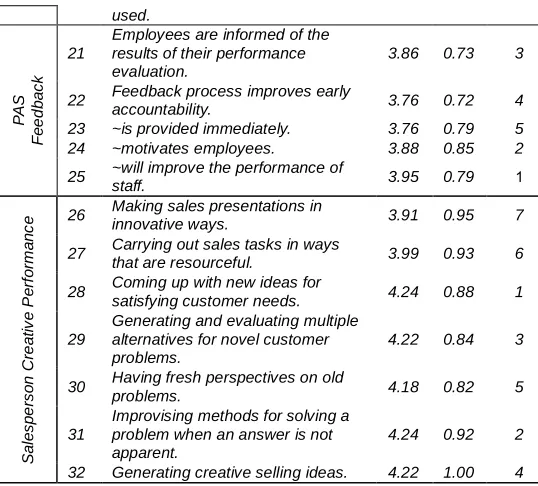
Salespersons‘ attitudes towards performance appraisal systems and creative performance were described through mean (M) and standard deviations (S.D.). The results are shown in table 2 and indicate positive attitudes as all of the statements are above the virtual mean of 3.00. The results demonstrate that there are more positive attitudes from salespersons towards creative performance than towards performance appraisal systems. Table 3 demonstrates the descriptive statistics of the variables used in the study. This shows that the mean (M) of PAS was equal to 3.74 with S.D. equaling 0.55. The sub-arithmetic mean values of the dimensions that were used to measure PAS in this study ranged between 3.84 and 3.60 which suggests that respondents reported slightly higher levels of PAS. The ‗feedback‘ sub-variable was the top-ranked amongst the PAS sub-variables (M= 3.84; S.D.= 0.6), while ‗professionalism‘ sub-variable came in last place (M= 3.6; S.D.= 0.8). However, when the mean of the salesperson creative performance is considered, it shows a dependent variable reaching 4.74 with S.D. equalling 0.55. This suggests that there were high-level attitudes provided by respondents in relation to creative performance.
TABLE3
DESCRIPTIVE STATISTICS AND THE CORRELATION MATRIX OF THE
STUDY VARIABLES
Mean S.D. Correlation Matrix Cronbach 's Alpha 1- Salesperson CP 4.14 .68 1 %91.9
2- Professionalism 3.60 .80 .314*
* 2 %82.2
3- PAS Goals 3.71 .82 .351* *
.582*
* 3 %80.4
4- PAS Criteria 3.73 .83 .369* *
.509* *
.661*
* 4 %81.0
5- PAS Methods 3.82 .72 .336* * .306* * .276* * .285*
* 5 %83.1
6- PAS Feedback 3.84 .60 .456* * .264* * .422* * .499* * .344* * %82.5
7- Total score PAS 3.74 --- .490*
* --- --- --- --- %95.3 ** Sig. (1-tailed) 0.01
Furthermore, Table 3 is a correlation matrix that demonstrates that Pearson‘s test shows a statistically significant positive correlation between performance appraisal systems and creative behavior (r = 0.49; P value 0.05). There is also a statistically significant positive correlation demonstrated between each of the five PAS dimensions identified earlier in the paper and creative behavior. This has been shown through the Pearson‘s test. The correlations identified here were between 0.46 and 0.31 (P value 0.05). The correlation matrix indicates that the Pearson‘s test does not identify any issues relating to inter-correlations or very high inter-associations across the independent variables. All the correlations ranged between 0.66 and 0.26 (P value 0.05). Multiple regression analysis was carried out to test the hypothesis and the direct relationship between the independent variables and dependent variable. The results are outlined in tables 4 and 5. Firstly, table 4 provides a summary of the multiple regression model. The Durbin-Watson test result of (2.138) is an indicator that there is no auto-correlation between the factors as this result is close to zero [65]. In Table 5 the VIF value is demonstrated with VIF being less than 10 and Tolerance (Tol.) values being greater than 0.01 for all variables. This suggests that there is no multi-collinearly between variables. Data analysis has also shown that there are no highly skewed or kurtosis variables which can falsify relationships and the significance of tests.
TABLE4
REGRESSION MODEL SUMMARY
R R2 Adjusted R2 F Sig. Durbin-Watson .527 .278 .261 16.844 .000 2.138 Dependent Variable: Salesperson Creative Performance.
Predictors: (Constant), PAS Professionalism, PAS Goals, PAS Criteria, PAS Methods, PAS Feedback.
Table 4 demonstrates that the R2 test result of 0.278 can be accepted for the regression analysis. It suggested that all independent variables have explained salesperson creative performance at 28%. Moreover, the F value of 16.844 and the significance level of P value 0.05 show that the five predictor variables (professionalism, goals, criteria, methods and feedback) are unequal and could be used to predict the dependent variable (i.e. salesperson creative performance). This has proven that the five independent variables were all individually and significantly important to the dependent variable. This proves that the attitude of salespeople toward performance appraisal systems is a contributing factor to their creative performance. Therefore, the research main hypothesis (H1) is supported. From the adjusted R2 value (R2 = 0.26) the five factors contributed 26% to the dimension of salesperson‘s creative performance.
TABLE5
RESULTS FROM MULTI-REGRESSION MODEL
B Std.
Er. Beta t Sig
. Tol. VIF
Constant 1.48
4 .296 --- 5.01
7 .00
0 --- --- Professionalis
m
0.09
3 .062 .110 1.50
7 .13
3 .61
4 1.629
PAS Goals 0.05
6 .069 .067 0.80
1 .42
4 .47
0 2.130
PAS Criteria 0.056 .067 .069 0.840 .402 .483 2.071
2615
7 5 3 0
PAS Feedback 0.35
1 .078 .309 4.48
3 .00
0 .69
2 1.445 Dependent Variable: Salesperson Creative Performance
However, the results that are shown in Table 5 suggest that from the five factors, it is only the PAS methods and PAS feedback that have a significant influence (P value 0.05) over the salesperson creative performance with a high Beta score of 0.16 and 0.31 respectively. These results also show that PAS professionalism, PAS goals, and PAS criteria have a lower impact (P value > 0.05) with low Beta scores of 0.11, 0.07 and 0.07 respectively.
5 DISCUSSION
The demographics of respondents is outlined in table 1. This shows that 61% of respondents were male and 39% female. The imbalance between male and female could be due to there being fewer women working in the private sector over the public sector in Jordan [66]. The majority of respondents were in the 25-34 age range (43%) with under 25s accounting for a third of the respondents (33%). This may indicate that Jordanian companies advertise their salesperson job vacancies with no requirements of a high level of experience which would impact on the candidates that apply for and then take the vacancies. Information on academic qualifications was also gathered. Most of respondents (68%) have an undergraduate degree representing the majority of respondents. The lowest academic qualification represented was a postgraduate degree with only (11%) of people being in this category. From analyzing the results, it can be concluded that salespeople have high positive attitudes towards their creative performance (4.14 on a scale of 5). Table 1 demonstrates that salespeople‘s creative behavior is most related to their ability to ―come up with new ideas for satisfying customer needs‖ and ―improvising methods for solving a problem when an answer is not apparent‖. These results show that there is a direct link between creative behavior and demonstrating innovation as they are allowed to use their initiative, experience and skills to improve the customer experience and create a positive solution. These results correlate with findings by George & Zhou [35] and Slåtten et al. [67], all of whom have theorized that creative engagement between sales staff and customers in the service industries will results in more innovative ideas and lead to more positive results. The main focus on this research was to explore whether there is a positive relationship between performance appraisal systems and the creative behavior of salespeople. The hypothesis stated that when an effective appraisal system exists that demonstrates real and effective results then there will be a positive correlation towards creative behavior. Table 4 shows that there is strong statistical evidence between these factors. These results correlate with Ismail and Rishani‘s [68] findings that suggest that performance appraisal systems can be used to stimulate and develop creativity in the workplace. Furthermore, it can be concluded that the PAS within this study were development PAS in line with the findings of Boswell and Boudreau [69] who stated that development performance appraisal systems can improve employees‘ working attitudes, increase their experience through subsequent actions taken and courses arranged, enhance employees‘ knowledge and skills, and further enhance job satisfaction. The results suggest that constructive feedback
has an important part to play in the creative behavior of salespeople as it has a positive effective on their morale, job satisfaction and confidence. This in turn will lead to them using more creative and engaging techniques in their role. This is in line with Curzi et al.‘s [48] findings relating to how supportive feedback within appraisals will encourage creativity. This study has provided empirical evidence that certain performance appraisal system characteristics, specifically the methods and feedback, will have a signaling function affect on the employees‘ perception of the system and their own creativity. This correlates with earlier statements made in relation to signaling theory and how behaviors are elicited through particular actions.
6 IMPLICATIONS
6.1 Managerial Implications
One of the outcomes of the study is that there are important implications for management. Companies need to ensure that they have effective and robust performance appraisal systems in place as they will provide a means to develop and nurture creativity if used correctly. Management must recognize the causal link between dynamic performance of their sales team and the company gaining a competitive edge due to the creative practices employed by their staff. Without such support, there could be a lack of creativity which will result in poor customer interactions and may lead to negative customer feedback. Businesses could also take advantage of the results to develop systems that create a positive company culture through a dynamic and engaged workforce. By identifying how performance appraisal systems can be effective in the workplace, specifically for sales outcomes, managers and decision-makers can develop policies and procedures that will enhance the working environment of staff which in turn will reduce the instances of negative behavior and poor performance. A regular review of performance appraisal systems is recommended to ensure that they continue to support the development of creative behavior and that they can identify any issues that need resolved. Information gathered with performance appraisal systems can influence the development of job roles and criteria, including the need to be creative and innovative. A factor that also needs considered is limiting the level of subjectivity within appraisal systems by having multiple personnel or stages within the process. This, alongside timely feedback and regular engagement, will result in positive outcomes for managers and businesses.
6.1 Theoretical Implications
This study has filled a gap by exploring the relationship between performance appraisal systems and the creative behavior of salespeople. It has provided a significant contribution to the literature available in a country-specific context meaning that it allows businesses within Jordan to specifically understand this issue within their own context. Moreover, the findings from this study supports the ‗signaling theory‘ indicating that PAS‘s are able to elicit the desired creative behavior particularly when employees perceive these systems as effective. Finally, added value has been created for researcher through the development of an appropriate scale to measure performance appraisal systems within a sales industry within a developing country context.
2616
SUGGESTIONS
As will all research, this study is subject to various limitations and constraints, specifically relating to it being a small-scale study in a set location. It must be recognized that these limitations could impact on the instrument design, data collection techniques and how generalizable the results are. The sample size in the research was relatively small and there may also be an over or under representation of certain groups within the sample due to the limitations of who the study could be carried out with. Therefore, it is suggested that the study is replicated across a wider demographic to further test the results and hypothesis. The second limitation is that the study involves self-reporting for assessing the perception of creative performance. This could be enhanced by providing further questionnaires, direct to organizations, as well as employees meaning that data is gathered from both sides. There could also be perspectives gathered from managers and customers – everyone involved in the sales process. This study also did not take into account organization-specific issues such as company culture, managerial style, marketing orientation or how sales staff work. More in-depth research could explore these factors in relation to the results of salespeople to demonstrate whether they have a factor, above and beyond the performance appraisal systems. Links between the PAS and other internal factors could also be identified. This study used a cross-sectional survey methodology therefore an alternative approach of a longitudinal study providing several data points over time could be beneficial for more concrete results. Finally, as this study was conducted in Jordan it can only be generalized to that population. An enhancement would be to conduct a study across multiple nations.
8
REFERENCES
[1] Galanakis, K., & Passey, S. (2001, February). The creative factory: An innovation systems model using thinking approach. In The R & D Management Conference (pp. 7-9).
[2] Wang, G., & Netemeyer, R. G. (2004). Salesperson creative performance: conceptualization, measurement, and nomological validity. Journal of Business Research, 57(8), 805-812.
[3] Amabile, T. M. (1988). A model of creativity and innovation in organizations. Research in organizational behavior, 10(1), 123-167.
[4] Davila, A., Foster, G., & Li, M. (2009). Reasons for management control systems adoption: Insights from product development systems choice by early-stage entrepreneurial companies. Accounting, Organizations and Society, 34(3-4), 322-347.
[5] Moulang, C. (2015). Performance measurement system use in generating psychological empowerment and individual creativity. Accounting & Finance, 55(2), 519-544.
[6] Amabile, T. M. (1983). The social psychology of creativity: A componential conceptualization. Journal of personality and social psychology, 45(2), 357-376 [7] Florida, R., & Goodnight, J. (2005). Managing for
creativity. Harvard business review, 83(7), 125-131. [8] Castro-González, S., Bande, B., & Fernández-Ferrín,
P. (2019). Responsible Leadership and Salespeople‘s Creativity: The Mediating Effects of CSR Perceptions. Sustainability, 11(7), 2053.
[9] DeNisi, A. S., & Murphy, K. R. (2017). Performance
appraisal and performance management: 100 years of progress?. Journal of Applied Psychology, 102(3), 421-433.
[10]Idowu, A. (2017). Effectiveness of Performance Appraisal System and its Effect on Employee Motivation. Nile Journal of Business and Economics, 3(5), 15-39.
[11]Coates, G. (2004). En‐Trusting Appraisal to the Trust. Gender, Work & Organization, 11(5), 566-588. [12]Armstrong, M. (2009). Armstrong's Handbook of
Performance Management: An Evidence-Based Guide to Delivering High Performance (Fourth). London: Kogan Page Publishers.
[13]Eberhardt, B. J., & Pooyan, A. (1988). The effects of appraisal system redesign on perceptions of and satisfaction with performance appraisal: A quasi-experiment. Journal of Business and Psychology, 3(2), 230-241.
[14]Berman, E. M., Bowman, J. S., West, J. P., & Van Wart, M. R. (2012). Human resource management in public service: Paradoxes, processes, and problems (Fourth). SAGE Publications.
[15]McConkie, M. (1979). A clarification of the goal setting and appraisal processes in MBO. Academy of Management Review, 4(1), 29-40
[16]Roberts, G. E. (2003). Employee performance appraisal system participation: A technique that works. Public personnel management, 32(1), 89-98. [17]Khoury, G. C., & Analoui, F. (2004). Innovative
management model for performance appraisal: the case of the Palestinian public universities. Management Research News, 27(1/2), 56-73.
[18]Selvarajan, T. T., & Cloninger, P. A. (2012). Can performance appraisals motivate employees to improve performance? A Mexican study. The International Journal of Human Resource Management, 23(15), 3063-3084.
[19]Armstrong, M., & Taylor, S. (2014). Armstrong's handbook of human resource management practice (Thirteenth). Kogan Page Publishers.
[20]Scott, S. G., & Bruce, R. A. (1994). Determinants of innovative behavior: A path model of individual innovation in the workplace. Academy of management journal, 37(3), 580-607.
[21]Woodman, R. W., Sawyer, J. E., & Griffin, R. W. (1993). Toward a theory of organizational creativity. Academy of management review, 18(2), 293-321.
[22]Mumford, M. D., & Gustafson, S. B. (1988). Creativity syndrome: Integration, application, and innovation. Psychological bulletin, 103(1), 27-43.
[23]Robbins, S., & Judge, T. (2011). Organizational behavior (Fourteen). New Jersey: Pearson Prentice Hall.
[24]Torrance, E. P. (1988). The nature of creativity as manifest in its testing. In R. J. Sternberg (Eds.), The nature of creativity: Contemporary psychological perspectives (pp. 43–75). Cambridge University Press.
2617
[26]Janssen, O., Van de Vliert, E., & West, M. (2004). The bright and dark sides of individual and group innovation: A special issue introduction. Journal of Organizational Behavior, 25(2), 129-145.
[27]Porter, M. E., & Stern, S. (1999). The new challenge to America‘s prosperity: Findings from the innovation index. Council on Competitiveness.
[28]Kotler, P., & Keller, K. L. (2012). Marketing management. Global ed. (Thirteenth). Harlow: Pearson Education.
[29]Williams, W. M., & Yang, L. T. (1999). Organizational Creativity. In R. J. Sternberg (Eds.), Handbook of creativity (pp. 373–391). Cambridge University Press. [30]Guilford, J. P. (1967). Creativity: Yesterday, today and
tomorrow. The Journal of Creative Behavior, 1(1), 3-14.
[31]Oldham, G. R., & Cummings, A. (1996). Employee creativity: Personal and contextual factors at work. Academy of management journal, 39(3), 607-634.
[32]Gong, Y., Huang, J. C., & Farh, J. L. (2009). Employee learning orientation, transformational leadership, and employee creativity: The mediating role of employee creative self-efficacy. Academy of management Journal, 52(4), 765-778.
[33]McCrae, R. R. (1987). Creativity, divergent thinking, and openness to experience. Journal of personality and social psychology, 52(6), 1258-1265.
[34]Tierney, P., & Farmer, S. M. (2002). Creative self-efficacy: Its potential antecedents and relationship to creative performance. Academy of Management journal, 45(6), 1137-1148.
[35]George, J. M., & Zhou, J. (2002). Understanding when bad moods foster creativity and good ones don't: the role of context and clarity of feelings. Journal of applied psychology, 87(4), 687-697.
[36]Amabile, T. M., Barsade, S. G., Mueller, J. S., & Staw, B. M. (2005). Affect and creativity at work. Administrative science quarterly, 50(3), 367-403.
[37]Sternberg, R. J., & Lubart, T. I. (1999). The concept of creativity: Prospects and paradigms. In R. J. Sternberg (Eds.), Handbook of creativity (pp. 3–15). Cambridge University Press.
[38]Mumford, M. D., & Gustafson, S. B. (1988). Creativity syndrome: Integration, application, and innovation. Psychological bulletin, 103(1), 27-43. [39]Lassk, F. G., & Shepherd, C. D. (2013). Exploring the
relationship between emotional intelligence and salesperson creativity. Journal of Personal Selling & Sales Management, 33(1), 25-37.
[40]Martinaityte, I., Sacramento, C., & Aryee, S. (2019). Delighting the customer: Creativity-oriented high-performance work systems, frontline employee creative performance, and customer satisfaction. Journal of Management, 45(2), 728-751. [41]Locander, D. A., Weinberg, F. J., & Locander, W. B.
(2018). The Mediating role of sales department innovation orientation on creative selling. Journal of Managerial Issues, 30(4), 463-403.
[42]Yoo, J., & Arnold, T. (2019). Frontline employee authenticity and its influence upon adaptive selling
outcomes: Perspectives from customers. European Journal of Marketing. 53(11), 2397-2418.
[43]Aguinis, H. (2013). Performance management (Third). Boston: Prentice Hall.
[44]Kuvaas, B. (2006). Performance appraisal satisfaction and employee outcomes: mediating and moderating roles of work motivation. The International Journal of Human Resource Management, 17(3), 504-522. [45]Sudin, S. (2011). Fairness of and satisfaction with
performance appraisal process. Journal of Global Management, 2(1), 66-83
[46]Aleassa, H. M. (2014). Performance appraisal satisfaction and counterproductive behaviors: Direct and moderating effects. International Journal of Business Administration, 5(1), 76-89.
[47]Shipton, H., West, M. A., Dawson, J., Birdi, K., & Patterson, M. (2006). HRM as a predictor of innovation. Human resource management journal, 16(1), 3-27
[48]Curzi, Y., Fabbri, T., Scapolan, A. C., & Boscolo, S. (2019). Performance Appraisal and Innovative Behavior in the Digital Era. Frontiers in psychology, 10, 1659.
[49]Niu, H. J. (2014). Is innovation behavior congenital? Enhancing job satisfaction as a moderator. Personnel Review, 43(2), 288-302.
[50]Domínguez, E. S. (2013). Work stressors and creativity. Management, 16(4), 479-503.
[51]Blau, P. M. (1968). Social exchange. International encyclopedia of the social sciences, 7, 452-457. [52]Takeuchi, R., Lepak, D. P., Wang, H., & Takeuchi, K.
(2007). An empirical examination of the mechanisms mediating between high-performance work systems and the performance of Japanese organizations. Journal of Applied Psychology, 92(4), 1069-1083.
[53]Dechev, Z. (2010). Effective Performance Appraisal–a study into the relation between employer satisfaction and optimizing business results. Erasmus University Rotterdam.
[54]Monis, H., & Sreedhara, T. N. (2010). Correlates of Employee Satisfaction with Performance Appraisal System in Foreign MNC BPOs Operating in India. Annals of the University of Petroşani, 10(4), 215-224.
[55]Iqbal, N., Ahmad, N., Haider, Z., Batool, Y., & Ul-ain, Q. (2013). Impact of performance appraisal on employee‘s performance involving the moderating role of motivation. Arabian Journal of Business and Management Review, 3(1), 37-56.
[56]Al-Ashqar, H. (2015). The effectiveness of electronic performance appraisal program in evaluating the performance of UNRWA employees. The Islamic University.
[57]Agnihotri, R., Rapp, A. A., Andzulis, J. M., & Gabler, C. B. (2014). Examining the drivers and performance implications of boundary spanner creativity. Journal of Service Research, 17(2), 164-181.
[58]Wang, G., & Miao, C. F. (2015). Effects of sales force market orientation on creativity, innovation implementation, and sales performance. Journal of Business Research, 68(11), 2374-2382.
2618
labor on work engagement and boundary spanner creativity. Asia Pacific Journal of Innovation and Entrepreneurship, 11(2), 214-232.
[60]Rostami, A., Gabler, C., & Agnihotri, R. (2019). Under pressure: The pros and cons of putting time pressure on your salesforce. Journal of Business Research, 103, 153-162.
[61]Hair, J. F., Wolfinbarger, M., Money, A. H., Samouel, P., & Page, M. J. (2015). Essentials of business research methods (Second). Harvard: Routledge. [62]Ismail, H. N. (2016). Training and organizational
commitment: exploring the moderating role of goal orientation in the Lebanese context. Human Resource Development International, 19(2), 152-177.
[63]Salganik, M. J., & Heckathorn, D. D. (2004). Sampling and estimation in hidden populations using respondent‐driven sampling. Sociological methodology, 34(1), 193-240.
[64]Smale, A., Björkman, I., & Sumelius, J. (2012). HRM integration mechanism usage in MNC subsidiaries in China. Personnel review, 41(2), 180-199.
[65]Osborne, J., & Waters, E. (2002). Four assumptions of multiple regression that researchers should always test. Practical Assessment, Research & Evaluation, 8(2), 1–9.
[66]Al-Adamat, A.M., & Al-Adamat O.A., (2019). Impact of Social Support Resources on Post- Purchase Dissonance: Evidence from Jordan. International Journal of Business and Social Science, 10(1), 53-62. [67]Slåtten, T., Svensson, G., & Sværi, S. (2011).
Empowering leadership and the influence of a humorous work climate on service employees' creativity and innovative behaviour in frontline service jobs. International Journal of Quality and Service Sciences, 3(3), 267-284.
[68]Ismail, H. N., & Rishani, M. (2018). The relationships among performance appraisal satisfaction, career development and creative behavior. The Journal of Developing Areas, 52(3), 109-124.