Podands
A thesis presented to the University College London in partial fulfilment of
the requirements for the degree of Doctor of Philosophy
by
Yiu-Fai Ng
UGL Chemistry Department
Christopher Ingold Laboratories
20 Gordon Street
London W C 1H OAJ
ProQuest Number: 10015818
All rights reserved
INFORMATION TO ALL USERS
The quality of this reproduction is dependent upon the quality of the copy submitted.
In the unlikely event that the author did not send a complete manuscript
and there are missing pages, these will be noted. Also, if material had to be removed,
a note will indicate the deletion.
uest.
ProQuest 10015818
Published by ProQuest LLC(2016). Copyright of the Dissertation is held by the Author.
All rights reserved.
This work is protected against unauthorized copying under Title 17, United States Code.
Microform Edition © ProQuest LLC.
ProQuest LLC
789 East Eisenhower Parkway
P.O. Box 1346
also
Abstract
Abstract
This thesis describes the syntheses and host-guest properties of some anion receptors. These have been designed as mimics for the initial interactions of peptides with small molecules which mainly involves electrostatic binding. Treatment of substituted bromomethyl benzenes and naphthalenes with 1,4-diazabicyclo[2.2.2]octane (DABCO) gave a series of polycations with different substitution patterns. These patterns ensured different degrees of conformational freedom and “restricted” molecules were compared with “non-restricted” analogues. Nuclear Magnetic Resonance techniques were extensively used to investigate the behaviour of these polycations with simple anionic guests. Association constants and stoichiometries of the complexes were determined using NMR titrations and Job’s plots, respectively.
Specific recognition of ferricyanide over ferrocyanide was observed with these polycations. X-ray crystal structure analysis on some of the resulting complexes revealed interesting information regarding the conformation adopted by these polycations. The crystal structure also indicated that structured water molecules were involved in cation-anion binding.
Acknowledgements
Most importantly, I would like to express my appreciation to Professor Peter Garratt for his most valuable advice, support and encouragement during the course of this project and for giving me so much help with this thesis.
I would also like to thank all the members of the Garratt group, including Ashley for his useful advice; Kuan for sharing his knowledge in chemistry; Letitia for being my lab-mate; Maria for buying me tea all the time; and Najeeb for keeping me entertained in the lab.
I am very grateful to Professor David Williams and Jorg for helping me with the electrochemistry; to Professor Roger Wrigglesworth for his weekly advice at the beginning of this project and being one of my referees; and to Dr Jonathan Steed at King’s College, London for the crystal structure analysis.
Thanks also go to the UGL Chemistry Department staff, especially Soraya for lending me glassware; Jill Maxwell for NMR and elemental analysis; and Peter Leighton for making sure I do everything by the book.
Contents
Contents
Abstract 3
Acknowledgements 4
Contents 5
Glossary 7
1 Introduction 8
1.1 Electrostatic Effects 9
1.1.1 Ionisation of Acids 10
1.1.2 Kirkwood-Westheimer Model 11
1.2 Molecular Recognition 12
1.2.1 Artificial Anion Hosts 12
1.2.2 Azonia Compounds 13
1.2.3 Oligopyrrole-Derived Receptors 20
1.2.4 Guanidinium-Based Receptors 22
1.2.5 Other Cationic Hosts 25
1.3 Water 28
1.3.1 Physical Properties of Water 28
1.3.2 Complexation in Water 31
1.4 Electrochemistry 33
1.4.1 Cyclic Voltammetry 34
1.4.2 Self-Assembling Monolayers 36
1.5 Aim of Project 37
2 Results and Discussion 38
2.1 Syntheses of Dicationic Compounds 38
2.2 Syntheses of Tricationic Compounds 44
2.3 Syntheses of Tetracationic Compounds 47
2.4 Syntheses of Tetracationic Thiols 54
2.6 Nuclear Magnetic Resonance Techniques 58
2.6.1 Theory of NMR Titration 58
2.6.2 Method of Continuous Variations 61
2.7 Results of Binding Studies 64
2.7.1 Dicationic Compounds 65
2.7.2 Tricationic Comopunds 70
2.7.3 Tetracationic Compounds 71
2.8 Selective Crystallisation - Simple Molecular Recognition Experiment 74
2.9 Electrochemistry 83
2.9.1 Double-Layer Capacitance 84
2.9.2 Oxidation of Ferrocyanide Ions 85
2.9.3 Oxidation of Bromide Ions 90
3 Experimental 94
3.1 Synthesis 94
3.2 Starting Materials for Synthesising Cationic Compounds 96
3.3 Syntheses of Monocationic Compounds 106
3.4 Syntheses of Dicationic Compounds 107
3.5 Syntheses of Tricationic Compounds 110
3.6 Syntheses of Tetracationic Compounds 112
3.7 Syntheses of Polyanionic Compounds 119
3.8 NMR Titrations and Job Plots 122
3.9 Electrochemistry 128
References 129
Appendix A - NMR Spectra of Cationic Compounds 134
Glossary
Glossary
ADP adenosine diphosphate AMP adenosine monophosphate ATP adenosine triphosphate br broad unresolved signal br-d broad doublet
br-m broad multiplet br-s broad singlet br-t broad triplet
CDCI3 deuterated chloroform
CV cyclic voltammogram
d doublet
DABCO 1,4-diazabicyclo[2.2.2]octane □e-DMSG deuterated dimethylsulfoxide DIPAD diisopropyl azodicarboxylate D2O deuterium oxide
FAB fast electron bombardment IR infra-red
J coupling constant K association constant
m multiplet
MCPBA m-chloroperbenzoic acid Mp melting point
MS mass spectroscopy
NMR nuclear magnetic resonance
s singlet
SAM self-assembling monolayer
t triplet
1
Introduction
“Molecular Récognition” is the basis of many biochemical processes but it is only during the last two decades that the attention of organic chemists has turned towards the design and synthesis of molecules that can recognise other molecules. This type of recognition is normally achieved through a reversible formation of a complex between a large organic molecule (the host) and a comparatively smaller species (the guest). Distinction between two different guests is based upon different association constants of the complexations^.
H + G-]
HG-|
K-j
H + Gg
HG2
K2
H
+
G-|
+
G2 *■ - — HG-] + G2
Ki > K2
Since the formulation of the lock-and-key analogy by Emil Fischer^ more than 100 years ago, molecular recognition has been one of the most important concepts in structural biology and also has an influence on the theory of host-guest complexes and crystal packing. If we neglect dynamic aspects and remain in the framework of the rigid-body approximation, we may consider the association between host and guest molecules as fitting a key into its lock.
Introduction
1.1
Electrostatic Effects
Electrostatic Interactions play a central role in a variety of biological processes. A detailed characterisation of the strength and nature of these interactions require an understanding of the physical chemical properties of the molecules in aqueous solution. Coulombic forces largely dominate the long range electrostatic interaction between ions which means that they are likely to be primarily responsible for the departure from ideality in ionic solutions and to dominate all the other contributions to non-ideality. This domination is the basis of the Debye-Hückel theory of ionic solutions, which was derived by Peter Debye and Erich Hückel in 1923®.
Since oppositely charged ions attract each other, cations and anions are not uniformly distributed in solutions: anions are more likely to be found around cations, and vice versa. Overall the solution is electrically neutral, but near any given ion there is an excess of counter ions, the ions of opposite charge. Averaged over time, more counter ions than like ions pass by any given ion, and they come and go in all directions. This time-averaged sphere around a given ion has a net charge equal in magnitude but opposite in sign to that on the central ion, and is called its ionic atmosphere. The energy of any given central ion is lowered as a result of its Coulombic interaction with its ionic atmosphere. This model leads to the result that at low concentrations the ionic activity coefficient can be calculated from the Debye-Hückel limiting law given by Equation 1.
log Y± = - |z+z_l (1)
where A is a constant and is equal to 0.509 (mol kg'V^^ for an aqueous solution at 25 °C, y± is the mean activity coefflent of the ions, z+ and z. are the ionic charges and I is the ionic strength of the solution. The reason why the term limiting law is applied to Equation 1 is that all solutions are expected to conform in the limit of arbitrarily low molality. However, when the ionic strength of the solution is too high for the limiting law to be valid, it is found that the activity coefficent could be estimated from the extended Debye-Hückel law (Equation 2).
log Y± = - |z+z_| A /^
1 + B /^ (2)
where 6 is second constant. Although 6 can be interpreted as a measure of the closest
1.1.1 Ionisation of Acids
In the ionisation of an acid, a proton is removed against the electrostatic force created by the incipient negative charge that is then left behind on the anion. When a second proton is removed from a symmetrical polybasic, the second proton must be removed not only against a similar force, but also against the additional force created by the negative charge derived from the first ionisation. Thus, for example, the ionisation of the second proton that is removed in the ionisation of the monoanion of phosphoric acid in water takes place in the presence of a residual negative charge. Because of the extra electrostatic work required to remove a proton from this anionic residue, the second ionisation constant of phosphoric acid is less than the first by a factor of about 10^. The example of phosphoric acid provides a measure of the possible magnitude of electrostatic effects.
g
Bjerrum calculated the work of removing the second proton from a symmetrical dibasic acid in the electrostatic field of the negative charge left over from the first ionisation as
AAF = Ne^/Dr = RT ln(Ki/4K2) (3)
where N is the Avagadro’s number, e is the electronic charge, r is the distance between the protons of the dibasic acid, and D is the dielectric constant of water.
In 1932, Eucken^ published the corresponding electrostatic formula for the effect of a dipole on the ionisation constant of a substituted acid, that is
AAF — Ne jJ. C O S 0/D /^ — RT ln(Ksubstituted/Kijnsubstituted) (4)
where is the dipole moment of the substituent, 0 is the angle the moment makes with the line joining its centre to the ionising proton, D is the dielectric constant of empty space taken as
1.00.
g T
Neither equation, that for water nor that for empty space , worked very well. In particular, Bjerrum’s formula was wildly wrong for small molecules such as phosphoric acid; it grossly
Introduction
1
.
1.2
Kirkwood-Westheimer Model910
In 1938, Kirkwood and Westheimer ' introduced a model in which the charges or dipoles were contained in a sphere or prolate ellipsoid of low dielectric constant, representing the molecule, surrounded by water of dielectric constant 80. They then worked out the electrostatics by classical physics (Figure 1.1).
\ \ V
\ D = 80
D = 2
Figure 1.1 - Kirkwood-Westheimer model
Although this is a simplified model, it is less crude than that of Bjerrum, who placed the charges directly in water, or that of Eucken, who replaced the water by empty space. It has, at least, the advantage of consistency for both charges and dipoles. The equations have the same form as those of Bjerrum and of Eucken, but with an effective dielectric constant. De, substituted for the dielectric constant in those equations; all the mathematical complexity relates to the calculation of the effective dielectric constant. More recently, other investigators have sought simpler equations to calculate the effective dielectric constant for charges immersed in proteins. They have come up with semi-empirical formulae that are useful and quite satisfactory for this
1 1
important application. In 1988, Pickersgill reported that the charge-charge interaction energies in small proteins can be calculated using simple distance-dependant effective dielectric model. Mehler and co-workers successfully modelled the electrostatically dependant
1.2 Molecular Recognition
In 1987, Cram, Pedersen and Lehn shared the Nobel Prize in chemistry for their pioneering work in the molecular recognition area. The discovery of crown ethers by P e d e r s e n ^ a n d
17 18
their subsequent development by others, particularly Cram and co-workers ’ , has been well documented. 18-Crown-6 1 has been shown to form complexes with potassium cations 2,
alkylammonium cations 3, and a number of other species. Binding to cationic guests is through electrostatic interactions, and although binding to alkylammonium cations is often depicted as involving specific hydrogen bonding as shown in 3 it is perhaps more satisfactory to think of this binding as net attraction between the array of negative and positive charges presented by the guest cation and the crown ether.
r o
r ? - /
C )
C-iO
0
X-
X-These early reports provided the starting point for the field of host-guest chemistry, also known 19
as molecular recognition. In 1974, Cram stated that In host-guest chemistry, the host molecule is the larger, and the guest molecule is the smaller of the two. The host molecule must “recognise” by complexing best those guest molecules that contain the array of binding sites and steric features that complement those of the host. The self-evident postulate that two objects cannot occupy the same space at the same time indicates that host and guest, the host and guest must be compatible with respect to shape if they are to complex. The simple attraction of positive and negative charges accounts for much of the binding between host and guest molecules’.
1.2.1 Artificial Anion Hosts
About 30 years ago, the non-covalent encapsulation of halide anions into a preformed 20 22
Introduction
■ (C H 2 )
(CH2)
-'(CH2
)n-The origin for the discrimination of the simple tetrahedral oxyanions phosphate and sulfate by their respective binding proteins was thus traced back to the ability of the phosphate to act as a hydrogen-bond donor in a delicately balanced network of hydrogen bonds deeply buried in the interior of the protein^^’^^. In spite of this growing insight into anionic binding, the construction of hosts evolved more rapidly, presumably owing to better established concepts for ligand design.
1.2.2 Azonia Compounds
Cationic hosts capable of forming ion pairs with anions in solution are most easily prepared by protonation of suitable basic compounds. Since many anions possess some basic properties as well, host-guest binding in these cases depends on relative proton affinities in interconnected multiple equilibria. In water as a solvent, protonation equilibria are readily established and the corresponding pKa values of individual groups may be determined from titration curves. It is no surprise, therefore, that water was the solvent of choice to study anion binding to a great variety of protonated polyaza compounds. Due to the high dielectric permittivity and high hydrogen-bond donor-acceptor ability of water, electrostatic ion pairing is hampered to the extent that significant association at moderate concentrations can only be observed with multiply charged species. On the other hand, the mutual interaction rapidly increases with number of charges so that great thermodynamic stability can be attained on complexation of highly charged ions. Of course, the state of protonation depends on pH and, as a general rule, several differently protonated species constitute the ensemble of hosts at any given value of pH. As a corollary, the host-guest association observed in the actual experiment is an integral event that may be divided by regression calculation into singular contributions from all of the species involved. In this case, the respective association constants may contain relatively large errors. Moreover, it is not straightforward to derive information about complex structures from the analysis of trends in the binding constants. Relating the binding effect to host structure is essential for selectivity development which contributes the basis of molecular design.
22
compound as in 5. It was found that bromide ion is encapsulated by 4 less favourably than chloride, and no encapsulation of iodide ion was detected. This suggests that the size of the cavity is an important factor for halide encapsulation.
This result had a lasting effect on the further development of host-guest chemistry with anions. Guided by the high interest in azacrown ethers and cryptands as cation complexing agents, the convenient preparations of this class of compounds have been found ’ . Following the work of Stetter^^, azamacrocycles could be readily obtained by condensing an a,co-dicarboxylic acid chloride 6 with an open-chain a,rn-diamine 7 using high dilution conditions (Scheme 1.1). In
general, moderate to fair yields of macrocyclic bisamides 8 were obtained which in turn were
reduced by ÜAIH4 or borane/THF to afford the secondary amines 9. Further elaboration by
alkylation or acylation led to the formation of lariat compounds or polycyclic cryptands that were amenable to protonation and thus could serve as anion hosts.
V o . MR, r ' ' î n
R + R' ;---— ---► R R'
\ ç . \
I high dilution 1 1^ JO
O
6 7 8
reduction
R R'
acylation alkylation
Scheme 1.1
Introduction
10
H s N '^ N '^ N ’^ N H s
H H11
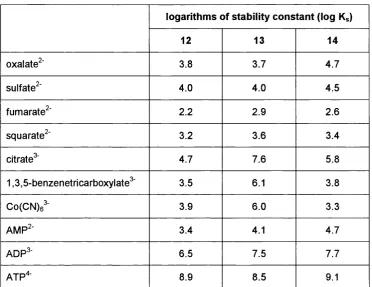
Polyprotonated azacrown ethers possess a greater charge density and consequently present a higher Coulombic attraction for anion association. On the basis of this concept, it is only rational to place as many ammonium groups as is synthetically feasible in close vicinity in order to maximise the electrostatic attraction for the anionic guest. Limitations, however, arise when the distance between cationic centres becomes too small. The experimental determination of the pKa constants for the two most acidic protonation steps pKaa and pKa^, in the series 12-14 reveals that very low pH values are required to convert di- or tricationic ammonium salts to tetracationic species if the separation of charge is less than that provided by a propane spacer unit (Table 1.1).
H
C
N N— \N N— ^
H l ^ H
C
N N— V
N N—^
12
13 14pKai pKaz pKaa pKa4
1 2 10.7 9.7 1.7 < 1
13 1 0 . 8 9.6 6.9 5.4
14 1 1 . 8 11.4 1 0 . 6 8.9
Table 1.1
Aiming at the complexation of biologically important anions under physiological pH conditions, the diminution of host volume by using ethylene connections of cationic centres is not a viable route. Rather, an increase in nominal charge by enlargement of the marcocycle^®’^^ or through annexing amino-functionalised side arms pending from smaller azacrown
32
logarithms of stability constant (log Kg)
12 13 14
oxalate^' 3.6 3.7 4.7
sulfate^' 4.0 4.0 4.5
fumarate^' 2 . 2 2.9 2 . 6
squarate^' 3.2 3.6 3.4
citrate^ 4.7 7.6 5.8
1,3,5-benzenetricarboxylate^' 3.5 6 . 1 3.8
Co(CN)6^ 3.9 6 . 0 3.3
AMP^' 3.4 4.1 4.7
ADP^' 6.5 7.5 7.7
ATP'*' 8.9 8.5 9.1
Table 1.2 - Selected logarithms of stability constants for anion binding by
polyammonium macrocycles 12,13 and 14 in water31
31
Pertinent binding data with a variety of anions are collected in Table 1.2 , where logarithm of the stability constant is shown as log Kg. Coulombic interactions apparently dominate host-guest binding as can be seen from the increase in complex stability with charge. At the same time, only a moderate dependence of the stabilities on structure can be noted.
N N
H
N
N H H
15
Introduction
log Ks 15
F' 4.1
Cl 3.0
Br 2 . 6
1 2 . 2
Ns 4.3
s o /
4.9Oxalate^ 5.0
Malonate^' 3.1
AMP^' 3.9
ATP"*' 8 . 0
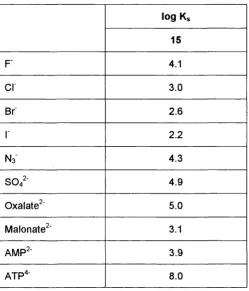
Table 1.3 - Logarithms of stability constants fo r anions with macrocycle 1533-36
Comparing the log Ks values it became apparent that strong binding is based on an inclusion process by which the guest anion penetrates into the molecular cavity of the host that is expanded by the electrostatic repulsion of the positive charges^^’^®. Several X-ray crystal structures confirmed that the guest is fixed by an oriented set of hydrogen bonds in the host cavity^^’^®. Viewing the ellipsoidal shape of the cavity and the topology of nitrogen hydrogen-bonding sites, it seems plausible that the azide anion having an optimal complementarity to the host cavity shows extraordinarily high complex stability. Spherical anions, such as halides, fit less well, and the decrease in binding going from fluoride to iodide argues in favour of hydrogen bonding as a major binding force.
^ÇH3
+ / ^ y 16 X = -(CH2)er
H3C - N C7 \ /
'N
17 X —
(CH2)g-CH3Both quaternary ammonium compounds were freely soluble in water without detectable aggregation and proved to be hosts for a broad variety of anions in water, always adhering to 1:1 host-guest stoichiometry^®"^^. On the basis of NMR titration data, as well as X-ray crystal structures of 17 with iodide^^, guest binding occurred by inclusion complexation. Iodide fits rather comfortably into the smaller tetrahedral host 16. The good fit allows efficient stabilisation by dispersion interactions with this halide ion which becomes apparent also in preferential transport of iodide over chloride in membrane carrier studies^^. Larger anions such as p-nitrophenolate cannot be complexed by 16 but only by the bigger host 17, thus providing additional evidence for an encapsulation process. The quaternary ammonium inclusion hosts are chemically stable compounds and opened the option to study reacting systems depending on host-guest binding without interference from pH effects.
Introduction
host + \
C - 3 cosubstrate
inhibition
monomolecular reaction products
N '
bimolecular reaction products
Scheme 1.2
J
In order to maximise Coulombic binding while conserving the option for stacking interactions
44
with aromatic guest moieties, the octacationic cyclophanes 18 were designed
N -(C H2)n“ N
N N -(C H2)n“N N
+ \ / + + \ / +
18 n = 3, 4, 5
ATP do not vary appreciably with the ring size and in absolute terms are of the same magnitude as found with tetracationic quaternary ammonium cyclophanes. The use of diazabicyclo[2.2.2]octane (DABCO) building blocks in the construction of host 18 was inspired by the success of this moiety to serve as membrane transfer agent for ATP and other nucleotides after quaternisation with hydrophobic moieties^®"^^. Thus the tetracation 19, like several other compounds of similar design, formed 1 : 1 complexes with nucleotide
triphosphates and extract ATP from very dilute aqueous solution into chlorohydrocarbon phases^®. Their use in membrane transport, however, was severely hampered by their detergenic properties leading to disruption of liposome vesicles.
I
1
19
1.2.3 Oligopyrrole-Derived Receptors
Introduction
Ru
20
NH HN
21
The anion-binding capacity of porphyrins is totally dependent on the presence of the metal ion. The free tetrapyrrolic ligand has no anion-binding power due to the small size of the porphyrin 49 cavity which does not allow the use of the convergent N-H dipoles for anion stabilisation Expansion of the porphyrin cavity by the incorporation of more pyrrolic or other spacer moieties appeared as a rational remedy. Sessler and co-workers prepared a large number of ring extended porphyrins among which the sapphyrins were shown to possess anion-binding properties^®’®®. Sapphyrin 21 contains an unique disposition for anion inclusion based on its planar pentapyrrolic skeleton of aromatic character which forces three N-H bonds to point with their positive ends towards the centre of a cavity. Another two protons may be added to form a symmetric array of hydrogen-bonding sites that is almost perfectly predisposed for anion encapsulation. It was found that the diprotonated sapphyrin 21 formed a very stable complex with fluoride in methanol solution. The X-ray crystal structure shows a fluoride guest completely encircled by the dicationic aromatic macrocycle. For steric reason, the larger halides chloride
51 and bromide cannot be bound in this inclusion mode
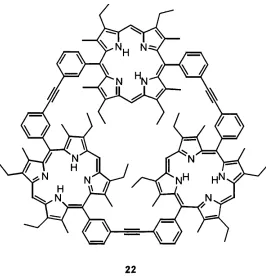
Following a building block approach, Sanders et al. used prophyrins as construction elements. The giant cage molecule 22 was obtained by covalent connection of three porphyrin macrocycles and formed a hexaprotonated cation [22*H6]®^ with acid®^. When this compound was dissolved with the cluster anions [PW i2 0 4o]^’ or [SiW i2 0 4o]''' in m-nitrobenzyl alcohol matrix
and subjected to fast atom bombardment (FAB) mass spectroscopy, signals corresponding to 1:1 host-guest complexes were observed. Since small anions, which should be at least as volatile as the big cluster anions, could not be detected in the host-guest complexes with protonated 2 2, it suggests that it is the complementarity in size, shape and charge that cause
1.2.4 Guanidinium-Based Receptors 22
The guanidinium group as present in the side chain of arginine is ubiquitous in enzymes that binds anionic substrates and is also involved in the stabilisation of protein tertiary structures via internal salt bridges with carboxylate functions. The reason for the strong interaction with oxyanions lies in the particular binding pattern featuring two parallel hydrogen bonds together with an electrostatic interaction (Figure 1.2), a structural motif that can be found in many crystal structures of enzyme complexes with oxyanionic substrates as well as in simple guanidinium salts.
" ■ N - "
H H
R
o
O -RFigure 1.2 - Binding pattern of guanidinium groups with oxyanions
Introduction
which guarantees protonation over a wide pH range. On the other hand, the exploitation in host-guest chemistry is hampered by the very effective solvation of the guanidinium function in water and its lower charge density as compared to that of ammonium-based receptors, leading to weaker electrostatic interactions. In spite of these disadvantages, the attractive features of the guanidinium group have led to the development of an appreciable number of artificial
55 guanidinium-based receptors for anions'
The first examples of macrocyclic guanidinium-based receptors were reported by Lehn et al.^^ who synthesised compounds 23 and 24. Both of these compounds showed only weak complexation with P O / ' which was thought to be governed by electroststaic interactions. This was confirmed by a more extensive study of several polyguanidinium hosts which revealed that binding of phosphates and carboxylates was influenced by a macrocyclic as well as a chelate effect. Guest selectivity was primarily dependent on the charge density of the anions®^.
N -H H-^J
H2N rr((+ -*J}=^NH2
1^—H H—N
23 24
Simple bisguanidinium compounds like 25, synthesised by Hamilton and co-workers , were found to complex phosphodiesters and gave rate enhancements for transestérification by a
59
factor of 300 . A monoguanidinium receptor increased the reaction rate only 2.5-fold, indicating the importance of the cleft-like arrangement of the guanidinium groups in 25 for co operative binding.
NH2 NH2
•1
'1
H2N ^ 'N '* ^ * ^ 'N /'^ N H2
25
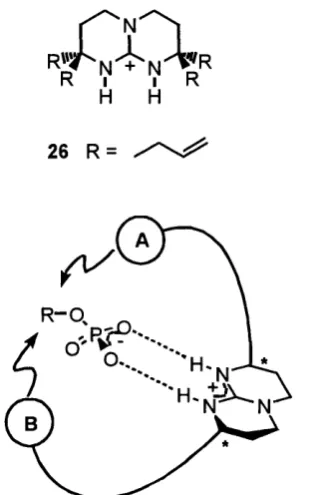
hydrophobic hydrocarbon residues. Further manipulation of substituents could introduce other binding sites to increase specificity of guest binding (Figure 1.3). It was found that even the simple compound 26 formed an ion pair with p-nitrobenzoate of great stability in chloroform60
K I I K
H H 26 R =
Figure 1.3 - The host-guest binding concept of chiral bicyclic guanidinium groups.
The first exploitation of the chirality of these bicyclic guanidines for enantioselective recognition 61
was reported by de Mendoza and co-workers , who attached aromatic moieties to the parent framework to give receptor 27. Aromatic carboxylic guests could interact with two different recognition sites comprising guanidinium-carboxylate ion pairing and aromatic n stacking. With chiral carboxylates, diastereomeric complexes were formed and it was found possible to extract N-acetyl- and N-BOC-tryptophan from a racemic aqueous solution into chloroform with moderate selectivity (17% diastereomeric excess).
H H
27 R =
Introduction
Even the parent anchor group 28 formed diastereomeric host-guest complexes with racemic G2
aliphatic carboxylates such as N-acetylalanine or 2-methylbutyrate in acetonitrile . Here, the bulky silyl ether groups seem to be sufficient to form a chiral cleft around the guanidinium binding site.
In order to recognise underivatised amino acids in their zwitterionic form, de Mendoza introduced host 29, which is built upon 27, but has an additional recognition site for the
63
ammonium moiety . In single-point liquid-liquid extraction experiments, selectivity for aromatic amino acids such as tryptophan and phenylalanine was found supporting a three-point binding mode.
N ' + 'N
(H3C)3C
1
H 3 C - NN—^ CH.
29 30
A similar receptor 30 was used by Schmidtchen and co-workers®^ in a more detailed study on the extraction of ^"^C-labeled amino acids. Here, a triazacrown ether having an intrinsically better selectivity for the complexation of primary ammonium cations was attached by a stable thioether bridge to the guanidinium anchor function. For the first time, even quite hydrophilic amino acids such as serine and glycine could be transferred to the organic phase, with clean 1:1 host-guest stoichiometry. Maximum extractability was reached at pH 9, indicating that the amino acids were extracted in their zwitterionic forms.
1.2.5 Other Cationic Hosts
Azacrown ethers and cryptands after protonation make very successful anion hosts, and can serve in their basic form as ligands for a number of transition metal cations with well-defined coordination geometries. Bicyclic cryptate 15, for instance, was shown to complex Cu(ll) ions, one at each hemisphere of nitrogen sites, to give the binuclear complex 31 which, in spite of the presumed distorted tetrahedral ligation geometry of the metal ions, still contains a void space in the centre of the structure ready for encapsulation of an anion such as chloride65
31
Cyclodextrins are an important class of natural hosts that have no known function in living systems . y3-Cyclodextrin 32 represents a classic example of a host compound for molecular recognition in water®^. It provides cavities of variable size which offer a hydrophobic environment rimmed by arrays of highly hydrophilic hydroxy groups. As a general rule, guest molecules which are not well hydrated in water but are of the correct complementary size to fit into the molecular cavity will associate with this class of host compounds.
OH . . r y HO 32
Introduction
c e g o
B reslow et al. ’ modified 32 with two imidazole heterocyces to give bisimidazolylcyclodextrin 33 which can catalyse the cleavage of anionic catechol phosphate and thus mimic certain nucleases. It also showed an impressive regioselectivity of phosphate cleavage which made this model resemble real enzymes (Scheme 1.3).
OH
CM
O -P O
H3C '
50 : 1
33
Scheme 1.3
N—R +
+ e
R - N
+ e
No binding
W eak binding
R -N l-R
Scheme 1.4
Strong binding
1.3 Water
1.3.1 Physical Properties of Water
72
Some of the notable physical properties displayed by water are the following: (i) negative volume of melting; (ii) density maximum in the normal liquid range at 4 °C; (iii) isothermal compressibility minimum in the normal liquid range at 46 °C; (iv) numerous crystalline polymorphs; (v) high dielectric constant; (vi) anomalously high melting, boiling, and critical temperatures for low-molecular-weight substance that is neither ionic nor metallic; (vii) increasing liquid fluidity with increasing pressure; and (viii) high-mobility transport for and OH' ions.
Introduction
non-linear arrangement, is ideally suited to engage in hydrogen bonding. It can act both as a donor and as an acceptor of hydrogens. This dual ability is illustrated by the crystal structure of ordinary hexagonal ice, a fragment of which is displayed in Figure 1.4.
" " V o / " '
" V "
O.— H - - - 0 ,.-H \ .
V
-H H
I I
' o
-I V O....
•o...
. . - O
/
o - " / ... / ...
'"O• H
H...
Figure 1 .4 - Structure of hexagonal ice. Covalent bonds are shown as solid lines and
hydrogen bonds as dashed lines.
Each water molecule in the crystal has four nearest neighbours to which it is hydrogen-bonded. It acts as hydrogen donor to two of the four and accepts hydrogens from the remaining two. These four hydrogen bonds are spatially arranged with local tetrahedral symmetry: that is the oxygen atoms of the neighbours occupy the vertices of a regular tetrahedral surrounding the oxygen atom of the central molecule.
The behavious of water toward nonpolar solutes has long been recognised as unusual. This peculiarity and its effects have given rise to the popular phrases “hydrophobic effect” and
72
“hydrophobic bond” . Typical nonpolar solutes are the noble gases, hydrocarbons such as methane and cyclopropane, and sulfur hexafluoride. None can readily hydrogen bond to water, and all are sparingly soluble. The process of isothermally dissolving such substances in water is accompanied by a significant negative entropy that quite naturally has been interpreted as a “structure-making” phenomenon in that solvent. Any acceptable molecular theory must account for this hydrophobic interaction.
sufficient room is available to accommodate that molecule while at the same time not causing too much additional damage to the already defective hydrogen bond network. The crystal structures of the clathrate hydrates for many of these nonpolar substances show that such rearrangements are possible.
Computer simulation offers the best opportunity to understand details of the solvation process at the molecular level. Several studies^^'^^ seem to agree that insertion of a single space filling but otherwise essentially inert solute solute molecule spontaneously causes the network to rearrange toward formation of a local clathrate-like convex cage. The cage is usually far from perfect. Although there is some strengthening of hydrogen bonds in the cage relative to the case in pure water, substantial strain and disorder remain. Evidently the surrounding medium with its own strained and broken bonds exerts strong forces and torques on the solvent sheath,
72 which cause geometric disruption .
The negative entropy for the solution of nonpolar molecules resides partly in the strengthening of the bonds in the imperfect solvation cage. But it is also related to the fact that molecules in that cage layer around the solute have markedly reduced orientational options. Because of the energetic advantage of having hydrogen bonds rather than of not having them, each solvation sheath water molecule strongly prefers to place its tetrahedral bonding directions (OH covalent bonds, and the lone pair directions) in a straddling mode (Figure 1.5). This arrangement permits bonding to other solvation layer water molecules and always avoids pointing one of the four tetrahedral directions inward toward the region occupied by the inert solute, which would
72
waste a possible hydrogen bond . Computer simulation unequivocally supports these orientational preferences.
Nonpolar solute molecule
Figure 1.5 - Orientational preference for water molecules next to a nonpolar solute.
In order to preserve intact the maximum number of hydrogen bonds, the water
molecules tend to straddle the inert solute, pointing two or three tetrahedral
Introduction
1.3.2 Complexation in Water
In 1990, Diederlch et a/7® studied the stablility of complex 34 in a total of 18 solvents including water. It was found that the complexation strength decreases steadily from water to nonaqueous polar solvents, to dipolar aprotic solvents, and finally to apolar solvents like carbon disulfide. The large difference in binding strength results almost exclusively from solvation
N
N-34 effects.
2,2,2-Trifluoroethanol is a solvent which comes close to water in its ability to promote apolar complexation^®. Strong complexation is also observed in ethylene glycol and in formamide. Binding is strongest in solvents characterised by low molecular polarisabilities and by high cohesive interactions. Solvent molecules with high cohesive interactions interact more favourably with bulk solvent molecules than with the complementary apolar surfaces of free host and guest, and therefore, entropie energy is gained upon the release of surface-solvating molecules to the bulk during the complexation step. Water has the highest cohesive interactions and possesses by far the lowest molecular polarisability. Both effects taken together make it the best solvent for complexation75
A large number of studies of synthetic receptors in aqueous media have been well documented^®"^®. In water, a cation will be very well solvated. The binding cavities of the synthetic receptors must compete with aqueous solvation if a cation is to bind tightly. The importance of studies in aqueous media is that they can have significant implications for biological recognition. If a synthetic receptor can pull an organic cation out of water and into a
80 nominally hydrophobic binding site, then perhaps nature can adopt a similar strategy
effect can be difficult. Also, in order to make synthetic receptors water soluble, one must often append polar groups that are typically charged. The possibility of conventional electrostatic interactions between cationic guests and these polar groups can complicate analysis of binding
80 studies
It was discovered that, in all cases, the deoxygenation of certain hydroxyl groups essentially abolished binding, and this brought attention to the fact that all the epitopes were amphiphilic in
81
character . In the case of complex oligosaccharides, the epitopes normally involved a cluster of two to four hydroxyl groups, and these were designated the key hydroxyl groups. Since, prior to complex formation, the polar groups of both the epitope and the receptor site were surely extensively hydrated, water molecules would have to be displaced for the complex to
QO QO
form ’ . In view of the directional demands for the formation of hydrogen bonds , a high degree of complementarity was necessary, otherwise dehydration would be energetically
83
difficult and complex formation strongly discouraged . For this reason, the water molecules of the hydration shell were considered a hindrance to access to the receptor site by
non-85
complementary structures, and the hydrated polar gate concept was proposed . Paraphrasing Emil Fischer^, the hydrated polar groups within the combining site were viewed as a locked gate that could be opened only by the key polar groups of the epitope. In this context, water molecules are intimately connected to the specificity of binding. With regard to structural requirements for effective binding, it is noteworthy that simple monosaccharides often display low but detectable activities . It was exciting to learn, through the use of deoxy congeners, that a strong recognition of an oligosaccharide normally involved key hydroxyl groups on more
87
than one sugar unit . It is also noteworthy that, in order to effect complementarity, stereoelectronically well stabilised water molecules are often occluded within the complex®®’®®. It was estimated that the cost in entropy for the imprisonment of a single water
i90 molecule can be as high as 2 kcal mol'
91
Recently, Braga and co-workers stated that water molecules can play an important role in stabilisation of organometallic solids by participating in both OH-O and CH-O interactions. They also suggested that hydrogen bonds, both of conventional OH-O and controversial CH-O types, afford a pattern of interactions in common between organics, organometallics and water that can be utilised to engineer crystalline materials on the basis of the complementarity between donors and acceptors. The study recently reported by Abe and co-workers suggested that water molecules reduce the number of ionic contacts between cationic and anionic species and
Introduction
It should be stressed that the hydrogen-bond structure of water and its Interactions with the surroundings still represent a key issue in the study of highly hydrated systems®^. Additional information on water binding can be of some importance in the study of biological macromolecules^®.
1.4 Electrochemistry
Electrochemistry is primarily concerned with charge transfer at the boundary between an electronically conducting or semi-conducting phase and an ionically conducting phase, such as a liquid, molten or solid electrolyte. By extension, the subject has traditionally included the study of ionic equilibria and dynamic processes taking place within ionic electrolytes, particularly from the perspective of those processes determining the concentration of electroactive species at or near the electrode surface.
The overall electrochemical oxidation and reduction reactions of organic and organometallic molecules often comprise complex sequences of electrochemical and chemical steps. In the shorthand notation now universally used, an electrochemical step is designated with the identifier E and is defined as a step involving loss or gain of an electron at the electrode solution interface. Chemical steps, designated with the letter 0 , can be surface chemical reactions involving reactants. Most investigators have concentrated on the chemical steps.
Q — ► H Q ^ ► HQ*
Q Q * ‘ HQ‘
Q Q * ' --- ► HQ*
0 ^
H j Q * ^
■
H z Q ( C E C E )c
E----
► H s Q * ^■
—
► H z Q ( E C C E )E
----
►
H Q -•
C—
► H2Q ( E C E C )The coexistence of the reactant and various intermediates in the layer of solution close to the electrode surface leads to the possibility of the simplest of all the homogeneous chemical reactions, an electron-transfer reaction. These solution electron-transfer (SET) reactions are the subject of this section. For example, in the ECEC scheme mentioned above, it is almost always the case that the neutral radical, HQ*, formed by protonation of the anion radical, is capable of being reduced by the anion radical itself.
H Q * + Q *- — ► HQ- + Q
Thus, under certain circumstances, reduction of HQ* in solution (a C step) is essentially the exclusive route, completely dominating the direct reduction of HQ* at the electrode (an E step).
It was in the context of the ECE family of reactions that the importance of SET reactions was 98 99
first demonstrated. The concept was introduced by Hawley and Feldberg ' , and Savéant and co-workers developed the theory in its most complete form^®®’^®^. SET reactions have been considered as steps in a variety of electrode reaction schemes, and in some cases they exert a dramatic influence on the current-potential-time response. The most frequently employed experimental techniques are the various types of voltammetry.
1.4.1 Cyclic Voltammetry
Cyclic voltammetry, which was employed in this project, was first introduced by Matheson and 102
Introduction
cathodic current +ve
current / A
potential / V
anodic current -ve
Figure 1 .5 -ty p ic a l cyclic voltammogram
Figure 1.5 shows a typical current/potential curve in a cyclic voltammetry experiment. Initially the potential is low and the cathodic current is due to the migration of ions in the solution. However, as the potential approaches the reduction potential of the reducible solute, the cathodic current grows. Soon after the potential exceeds the reduction potential, the current declines on account of the concentration polarisation of the electrode, since now there is a shortage of reducible solute close to the electrode. This initial half of the cyclic voltammetric curve is given by equation 5.
E — E\ — vt (5)
where E\ is the initial potential selected so that no net charge transfer takes place at this potential and v is the sweep rate in volts se c '\
After the potential begins to fall there is a rapid change in current on account of the high concentration of oxidisable species close to the electrode. When the potential is close to the potential required to oxidise the reduced species, there is a substantial anodic current until all the oxidation is complete, and the current returns to zero. The overall shape of the cu ve gives details of the kinetics of the electrode process. For the reverse potential sweep, the potential E is given by equation 6.
E = El - 2Xv+ vt
(6)
1.4.2 Self-Assembling Monolayers
Interest in self assembling monolayers (SAMs) has focussed on a number of systems, including chlorosilanes on s i l i c o n ^ c a r b o x y l i c acids on metal oxides^®® and
106
organosulfur compounds on gold . Sulphur-containing SAMs on gold surface have recently received much attention, it being well established that long-chain alkanethiols form
well-107 109
organised, electrically insulating monolayers on the gold surface ' . Most of the literature describes the properties of simple alkanethiols attached to the gold surface and it seemed probable that monolayers of polythiols in which a non-terminal methylene group is replaced by a positively charged group would exhibit new and different electrochemical properties. The packing of these charged alkanethiols on gold surfaces may also be quite different to that observed with the uncharged alkanethiols and this may also affect the behaviour of the monolayers.
The ability of a monolayer to block the electron transfer of a depolariser in solution is a measure of defectiveness. A freely diffusing electroactive species will react exclusively at defect sites of the monolayer. While uncharged monolayers with long alkane chains provides a substantial barrier for heterogeneous electron transfer^ the apparent blocking behaviour can
1 1 0 113
be dramatically affected by incorporating polar or ionic sites " into absorbents. Three effects can be expected. First, a repulsive interaction between ionic groups of the absorbate will destabilise the monolayer and promote permeability and defectiveness. Second, a positively charged monolayer will cause the double layer potential to be more positive compared to the double layer of a neutral monolayer. The effective potential difference driving the redox reaction will, therefore, be shifted to a more negative value. This shift in the potential difference leads to a decrease of the apparent heterogeneous rate constant (kapp) for the
113
anodic reaction and to an increase of kgpp of the cathodic reaction . This behaviour is independent of the charge of the redox couple in solution. Third, the effective concentration of an ionic redox system, and thus kapp, is affected by the charge of the groups in the monolayer and by the charge of the electroactive species. A positively charged monolayer with terminal groups such as -NR^^, (R = H, C H3) will repel cationic species and more or less block the
oxidation of Ru(N 1-13)6^^. Such monolayers show no blocking behaviour to the negatively
? 111 113
charged species Fe(CN)6 ' ' , but this species is blocked by monolayers containing
1 1 0 113
Introduction
1.5 Aim of Project
Most studies of molecular recognition have concentrated on hydrogen bonding and 7i-stacklng In non-aqueous environment. Electrostatic Interaction In aqueous solution, however, Is less well studied. In this project, we Intended to synthesise a series of relatively simple anion receptors containing a number of positive charges through the use of quaternary ammonium centres. Using these positively charged receptors, we hoped to study their electrostatic complexation with simple organic anions In aqueous solution. To examine these Interactions, we Intended to use NMR titration and Job’s method to determine their association constants and stoichiometries of the complexes. Using ferro- and ferricyanide as anions, we were Interested to determine the selectivity of these receptors and to form crystals which could be studied In detail with X-ray crystallography.
2 Results and Discussion
In this chapter, we describe the syntheses of a series of dications, trications and tetracations based on substituted benzenes and naphthalenes, and the preparation of a number of polyanionic compounds. The results of a series of NMR titrations and Job plots, providing the association constants and stoichiometries of different complexes, are also listed and discussed. Molecular recognition with these polycations, using potassium ferro- and ferri cyanide, and cyclic voltammetry of related highly charged thiols on a gold surface are also described.
2.1
Syntheses of Dicationic Compounds
In order to introduce positive charges into these compounds, a commercially available base DABCO (1,4-diazabicyclo[2.2.2]octane) was used. It has been found that DABCO reacts readily with alkyl halides to give halide salts, resulting in a positively charged nitrogen atom on the DABCO^^^’^^®. It has also been shown that DABCO can further react so that both
116
nitrogen atoms become positively charged (Scheme 2.1).
N N --- ► N N - R ^ ^ X — Cl, Br, I ^ y
! ^ D V / \ + +
___ ► N N - R - N ' 'N
X — Cl, Br, I 2 X"
+ R'X
N N -R --- ► R'— N N - R ^ ' X- X =
ci,
Br, I 2 X-Scheme 2.1
117
2,5-Results and Discussion
y
x
35
(HCHO)n
HBr, HO Ac
38
36
(HCHO)n
HBr, HO Ac
39
(HCHO)n
HBr, HO Ac
Br
37
Scheme 2.2
40
A possible mechanism for this reaction is outlined in Scheme 2.3. Formaldehyde is first protonated and the resulting oxonium ions undergoes electrophilic attack by the benzene followed by re-aromatisation. The resulting benzyl alcohol is protonated and then substituted by bromide to give a mono-bromomethylated benzene. A similar, second substitution provides a second bromomethyl substitution.
OH
repeat
Br
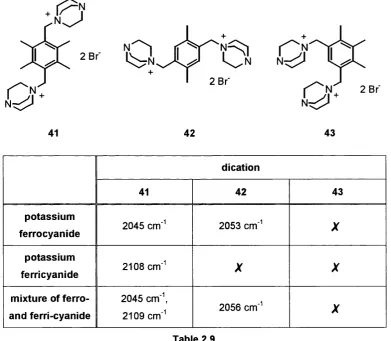
Treatment of the bromomethylated compounds 38, 39 and 40 with DABCO in acetonitrile for 48 hours gave the tetraalkylammonium salts 3,6-bis(DABCO-N-methyl)-1,2,4,5-tetramethylbenzene dibromide (41), 2,5-bis(DABCO-N-methyl)-1,4-dimethylbenzene dibromide (42) and 4,6-bis(DABCO-N-methyl)-1,2,3-trimethylbenzene dibromide (43) as white solids (Scheme 2.4).
DABCO
C H3C N
38
2 B r'
O
41
39
DABCO
C H3C N
42
Br
40
DABCO
C H3C N
2 B r'
43 Scheme 2.4
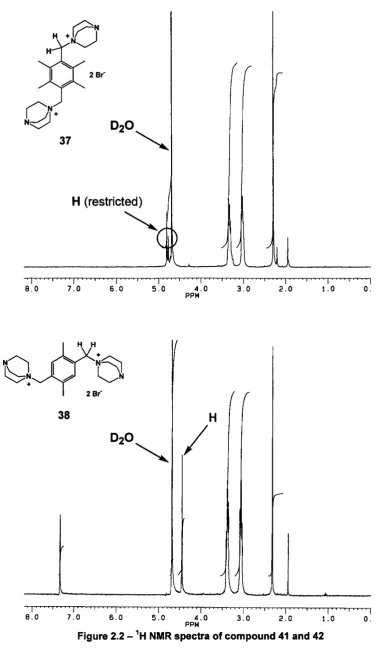
Fast atom bombardment (FAB) mass spectra of compound 41, 42 and 43 showed ions corresponding to the loss of one bromide anion. The NMR spectra showed the correct number of protons according to the integration. Methylene signals were observed in the region 5 4.93-4.59, DABCO signals in the region 5 3.45-3.16 and methyl signals in the region 5 2.46-2.32. The ^^C NMR spectra showed the correct number of non-identical carbon atoms.
Results and Discussion
2 Br
D2O
37
H (restricted)
I I'
f r
U
u
8 . 0 7 . 0 6 . 0 5 . 0 4 . 0 3 . 0 2 . 0 1 . 0 0, PPM
2Br‘
D2O
PPM
The small signal adjacent to the methylene signal might be an impurity rather than a restricted conformation, and this should be resolved by variable temperature NMR. However, compound 41 was found to be only soluble in water or deuterium oxide which cannot be heated over 90 °C during a variable temperature NMR experiment. Thus, an alternative counter anion, hexafluorophosphate, was introduced to replace bromide ions in order to attempt to increase the solubility in organic solvents.
Compound 41 in aqueous solution was converted into its hexafluorophosphate salt 44 by addition of a saturated aqueous solution of potassium hexafluorophosphate, and it precipitated out of solution (Scheme 2.5).
2 Br’
O
41
KPFc HoO
2
PFg-44
Scheme 2.5
With hexafluorophosphate as the counter anion, compound 44 is soluble in dimethyl sulfoxide which, with a boiling point of 189 °C, can be heated to a much higher temperature than deuterium oxide during a variable temperature NMR experiment.
Variable temperature NMR was performed on compound 44 using deuterated dimethyl sulfoxide on a Varian VXR-400 NMR spectrometer. After heating to 100 °C, the temperature was brought back down to room temperature and no decomposition of the compound was observed. This procedure was carried out twice to ensure that this result could be reproduced. From the resulting spectra, it can be seen that the coalescence temperature for the diastereotopic methylene protons in 44 (Scheme 2.6) is approximately 90 °C. The rotational barrier was calculated to be approximately 80 kJmol'V The changes in the appearance of the methylene signal from room temperature to 100 °C are shown in Figure 2.2.
Results and Discussion
100 °C
90 °C
80 °C
60 °C
40 °C
25 °C
2.2
Syntheses of Tricationic Compounds
N +
3 Br'
45
Compound 45 was made by a similar method to that described previously for the dicationic compounds. 2,4,6-Tris(bromomethyl)-trimethylbenzene (47) was prepared from 1,3,5-trimethylbenzene (48) by reacting with HBr, paraformaldehyde and acetic acid. On treating compound 47 with quinuclidine in acetonitrile, compound 45 was obtained as a white solid in 52% overall yield (Scheme 2.7).
(HCHO), HBr, HO Ac
3 Br'
CH3CN N
+
45
48 47
Scheme 2.7
The FAB mass spectrum of 45 showed a 1:2:1 triplet at m/z 652 for C3 3H5 4N3^®Br®^Br which has
the correct isotope pattern for two bromine atoms and corresponds to the loss of one bromide ion. The integration of the ^H NMR spectrum showed the correct number of protons with the appropriate chemical shifts and the ^^0 NMR showed the correct number of non-identical carbon atoms.
Compound 46 was made in an attempt to demonstrate that it was possible to use such polycations to distinguish between enantiomeric anions. Following the procedure of Langlois at
118