CLASSIFICATION AND ANALYSIS OF ANCI}~T MAYA BURIALS .AND BURIAL CUSTOMS
by
William Bruce Maxwell Welsh
Upojl¥E:~ l i I I .JF
LONDO,.. INSTITUTE OF .-CHAEOLOGY
L1MtA~Y.
Abstract
The burials and burial customs were analysed in order to learn more about some social and religious aspects of the Classic lowland Maya.
The Maya did not seem to have buried their dead in cemeteries.
Instead, burials were made beneath, or adjacent to, their homes. However, buildings that were usually located on the eastern perimeter of residential plazas were built with the sole intention of housing burials. These are called household shrines, and were constructed to accommodate interments of the more eminent inhabitants of these plazas. Residents of the most eminent wealth and status had their burial reserved for temples. The burials of
9
known, and several suspected, Maya kings have been found in temples. In almost every instance of a temple and household shrine burial, some sort of construction, ranging in size from an altar or stair block to an entire temple, was erected as a memorial. Rituals were then conducted on these memorials to commemorate the person buried below. This is apparently a form of ancestor worship or veneration. There are so many buildings and constructions in ceremonial centres associated with interments that, for the Maya at least, monumental architecture was related to the veneration of ancestors.
Evidence also exists for the practice of human sacrifice. Not just one, but four different forms of sacrifice were found. All four may have been related to, and involved with, ancestor veneration. This evidence eonfirms recent interpretations about sacrifice that were based on ancient art and iconography.
In total, some 20 different burial customs are identified as being Pan ~~ya. Identification of regional customs was more difficult, and
TABLE of CONTENTS
Abstract
Table of Contents List of Tables List of Figures Acknowledgements Chapters
1. Introduction 2. Grave Typology
3.
The Locational and Structural Context of the Burials 4. Methods of Disposal of the Dead5.
Head Orientation6.
Urn and Pot-Skull Associated Burials7.
Skeletal Mutilation8. Grave Type and Grave Context
9.
Grave Goods10. Social Implications of the Burial Data 11. The Evidence for Human Sacrifice
12. Ancestor \o:orship 13. Maya Burial Customs
14.
Conclusions Bibliography AppendicesI. Burial Data Tables
11. Illustrations of Grave Types and Varieties Ill. Additional Burials Not in the Analysis
2
4
5
13 15
17
27
55
70
94
110
129 139 155 216 236 260
299
~25
329
342
441
LIST of TABLES
1.
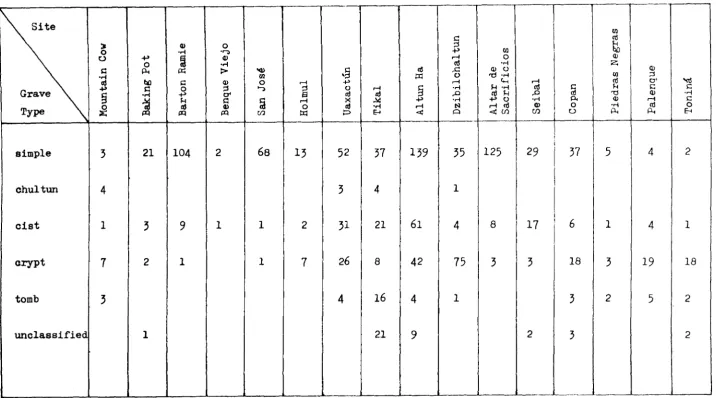
The distribution of grave types per site 502.
The distribution of grave varieties per site52-3
3.
The number of primary&
secondary, single or multiple, 73interments per site. Includes the number of cremations and empty graves found in the sample.
4.
Skeletal position per grave type at Mountain Cow77
5.
Skeletal position per grave type at Baking Pot 776. Skeletal position per grave type at Barton Rarnie 78 7. Skeletal position per grave type at San Jos~ 78 8. Skeletal position per grave type at Holmul 80
9.
Skeletal position per grave type at Uaxactlin 80 10. Skeletal position per grave type at Tikal 82 11. Skeletal position per grave type at Al tun Ha 84 12. Skeletal position per grave type at Dzibilchaltun 84 13. Skeletal position per grave type at Altar de Sacrificios 86 14. Skeletal position per grave type at Seibal 8615.
Skeletal position per grave type at Co pan 88 16. Skeletal position per grave type at Piedras Negras 8817.
Skeletal position per grave type at Falenque 89 18. Skeletal position per grave type at Tonin' 89 19. Total number of flexed and extended skeletons in simple, 91cist, crypt and tomb
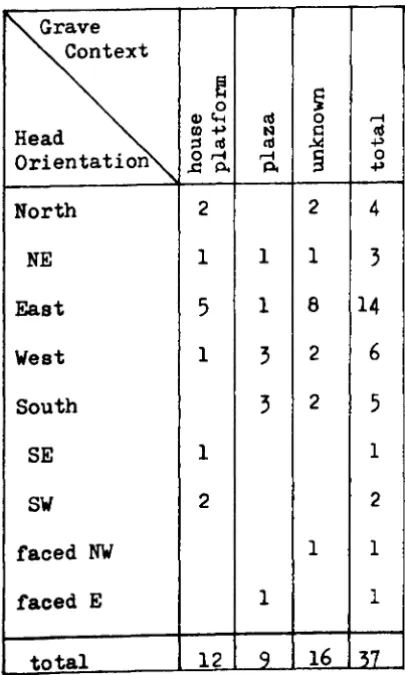
20. Head orientation per grave context at Mountain Cow 96 21. Head orientation per grave context at Baking Pot 96 22. Head orientation per grave context at Barton Ramie 98 23. Head orientation per grave context at San Jos~ 98
6
25. Head orientation per grave context at UaxactUn 26. Head orientation per grave context at Tikal 27. Head orientation per grave context at Altun Ha 28. Head orientation per grave context at Dzibilchaltun
29. Head orientation per grave context at Altar de Sacrificios 30. Head orientation per grave context at Seibal
31. Head orientation per grave context at Copan
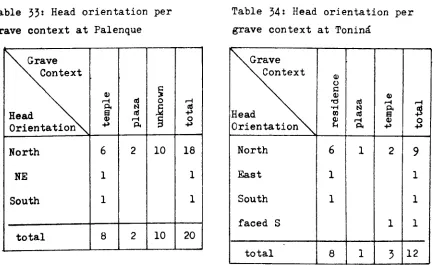
32. Head orientation per grave context at Piedras Negras 33. Head orientation per grave context at Palenque
34. Head orientation per grave context at Tonina
35. The burials with a bowl or metate, over or under, a skull 36. Urn burials
37. Burials of severed skulls in, between or under, bowls 38. Burials with shell (conch) over skull, face or mouth 39. Distribution of the various bowl and shell mode burials 40. Burials consisting of skeletons with evidence of mutilation 41. Age
&
sex of the mutilated skeletons42. The context of the mutilated interments
43. The number of mutilated interments per grave type 44. Grave type per grave context at Mountain Cow 45. Grave type per grave context at Baking Pot 46. Grave type per grave context at Holmul 47. Grave type per grave context at UaxactUn 48. Grave type per grave context at Tikal 49. Grave type per grave context at Altun Ha 50. Grave type per grave context at Dzibilchaltun
51. Grave type per grave context at Altar de Sacrificios
7
TABLES
52.
Grave type per grave context at Seibal 14853.
Grave type per grave context at Copan 14854.
Grave type per grave context at Piedras Negras 15055.
Grave type per grave context at Palenque 150 56. Grave type per grave context at Tonin~ 15257.
Overall correlation of most grave types and grave contexts 152 58. The mean number of grave goods per grave for each context at 159Moun tain Cow
59.
The mean number of grave goods per grave for each grave type 160 at Mountain Cow60. The mean number of grave goods per grave for each context at 162 Baking Pot
61. The mean number of grave goods per grave for each grave type
163
at Baking Pot
62. The mean number of grave goods per grave for each grave type 165 at Barton Ramie
63.
The mean number of grave goods per grave for each adult, 166 child, adult male&
adult female interment at Barton Ramie64. The mean number of grave goods per grave for each context at 168 San Jos~
65.
The mean number of grave goods per grave for each adult,169
child, adult male
&
adult female interment at San Jos~66. The mean number of grave goods per grave for each context at 171 Holmul
67. The mean number of grave goods per grave for each grave type 172 at Holmul
8
TABLES
69. The mean number of grave goods per grave for each grave type 175 at Uaxact-6.n
70. The mean number of grave goods per grave for each adult, 176 child, adult male
&
adult female interment at Uaxact-6.n71. The mean number of grave goods per grave for each context at 178 Tika1
72. The mean number of grave goods per grave for each grave type 179 at Tika1
73. The mean number of grave goods per grave for each adult, 180 child, adult male
&
adult female interment at Tikal74. The mean number of grave goods per grave for each context at 182 Altun Ha
75. The mean number of grave goods per grave for each grave type 183 at Altun Ha
16. The mean number of grave goods per grave for each adult, 184 child, adult male
&
adult female interment at Altun Ha77. The mean number of grave goods per grave for each context at 186 Dzibilchaltun
78. The mean number of grave goods per grave for each grave type 187 at Dzibilchal tun
79. The mean number of grave goods per grave for each adult, 188 child, adult male
&
adult female interment at Dzibilchaltun80. The mean number of grave goods per grave for each context at 190 Altar de Sacrificios
81. The mean number of grave goods per grave for each grave type 191 at Altar de Sacrificios
9
TABL;~S
82. Altar de Sacrificios.
83. The mean number of grave goods per grave for each context at
194
Seibal84. The mean number of grave goods per grave for each grave type
195
at Seibal85. The mean number of grave goods per grave for each adult,
196
child, adult male&
adult female interment at Seibal86. The mean number of grave goods per grave for each context at 198 Copan
87.
The mean number of grave goods per grave for each grave type199
at Copan
88. The mean number of grave goods per grave for each adult and 200 child interment at Copan
89. The mean number of grave goods per grave for each context at 202 Palenque
90. The mean number of grave goods per grave for each grave type 203 at Palenque
91.
The mean number of grave goods per grave for each context at 205Tonin~
92. The rank order of the sites on the basis of wealth as represented by the percentage of burials with 20 or more grave goods per site
93. The rank order of sites on the basis of wealth as represented by an index of the average number of grave goods per burial per site
94.
The rank order of sites on the basis of wealth asrepresented by the single richest burial (number of items) per site
210
211
10 TABLES
95.
The rank order of sites on the basis of wealth as represented by an index of the average number of items of jade per burial per site96.
The best furnished housemound, residential and palace burials, i.e. with 20 or more items214
223
97.
The approximate date of the best furnished temple, household225
shrine and ceremonial platform burials, i.e. with 20 or more items
98. The best furnished temple, household shrine and ceremonial platform burials, i.e. with 20 or more items
99.
The burials of the known Maya rulers100. Burials containing stingray spines, obsidian lancets, or some other artefact associated with bloodletting
101. Adult(s) and child(ren) burials
102. Primary interments accompanied by (a) sacrificial victim(s)
103.
Dedicatory cache burials104. Sacrifice by mutilation burials
105. The household shrines located on the eastern perimeter of residential plazas
106. The household shrines with an uncertain or non-eastern location
107. Temple and ceremonial platform burials
108. Burials commemorated with a temple or ceremonial platform 109. Temple burials with a structural memorial
110. Bench burials
Ill. Burials with the removal of face or skull 112. The prevailing head orientations
227-31
233
238-39
241-42
244-46
249-50
253-55
263-64
268
270-74
276
278-79
281
11 TABLES
113. Site distribution of unusually high or low instances of Pan
Maya burial customs and the few regional customs
LIST of TABLES in APPENDIX I
I Mountain Cow 356
II Baking Pot 358
III Barton Ramie 360
IV Benque Viejo 361
V San Jos~ 368
VI Holmul 313
VII Uaxact6n
315
VIII Tika1
383
IX Al tun Ha 391
X Dzibilchaltun 409
XI Altar de Sacrificios 411
XII Seibal 426
XIII Copan 430
XIV Piedras Negras 435
XV Palenque 436
1.
2.
LIST of FIGU~S
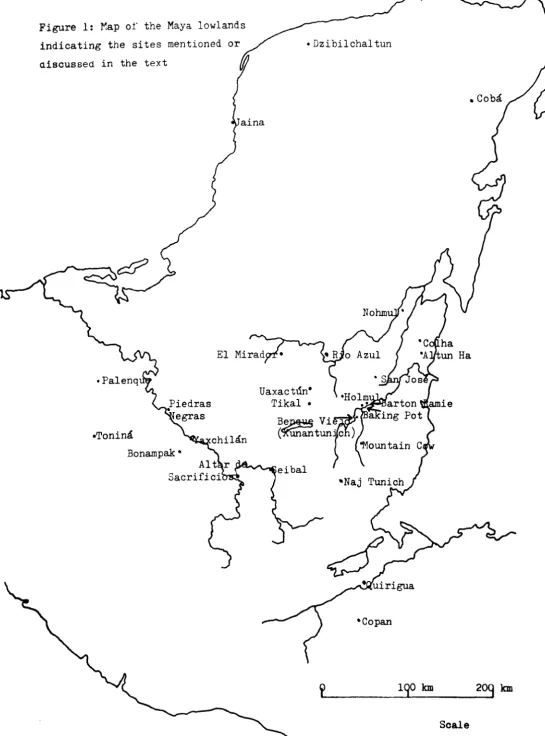
Map of the Maya lowlands indicating the sites mentioned or discussed in the text
Typical residential plaza with 'household shrine' on the eastern perimeter
Map designating the prevailing head orientations of the deceased at each of the 16 sites
Map illustrating the areas of primary architectural styles of the lowland Maya
Map illustrating suggested areas of regional burial customs (based on unusually high or low instances of some Pan Maya practices)
22
265
313
322
LIST of FIGURES in APPENDIX 11
Il:l Grave Type 1:1 443
Il:2 Grave Type 1:2 444
II:3 Grave Type 1:3 445
II:4 Grave Type 1:4 446
Il: 5 Grave Type 1:5 447
II:6 Grave Type III:l 448
Il:7 Grave Type III: 2 449
Il:8 Grave Type Ill: 3 450
II :9 Grave Type IlI:4 451
Il:10 Grave Type IIl:5 452
Il:ll Grave Type IV: 2 453
II:12 Grave Type IV:3 - Examples A & B 454
Acknowledgements
This thesis could not have been written without the help and support of many people.
First of all, I must give special thanks to my supervisor, Dr. Warwick Bray. He at all times made himself available for advice and guidance, as well as the occasional sounding board for some pretty outrageous ideas about death and the afterlife. He made certain I understood what he thought about some of theml
Secondly, I must thank all those who made the collection of the data possible. First there is Professor Gordon Willey who invited me to the Peabody Museum to consult unpublished data and discuss things 'Maya' with him; then to Dr. Gair Tourtellot who allowed me to consult the unpublished Seibal material and sent me an early draught of his report; to Dr. Bill Haviland who provided me with some of the unpublished Tikal burial data; to Dr. David Pendergast who allowed me to consult his unpublished reports of the burials from Groups D and E, Altun Ha; and to Professor Bob Sharer and Dr. Chris Jones for passing on some of their Quirigua reports. To each of these gentlemen I am indebted for their extraordinary kindness, unselfish-ness and assistance. I shall never forget their help.
In a similar vein, I should like to thank Dr. Marshall Becker for his kind assistance. Discussions with him have helped to put many things in proper perspective. I hasten to add, however, that any examples of non sequiturs or muddled thinking in this report are entirely my own.
Thirdly, I should like to thank the many staff at the Institute of Archaeology who assisted one way or another in the production of this magnum opus. Special mention must be made to Professor Evans, Mrs. Hunt, Mrs. Brown and Miss Witchell, all of whom helped arrange the travel grant
16
Mrs. Shelagh Meade and Dr. James Ritchie for their help with illustrations, proofreading and their constant encouragement.
Finally, I must thank my parents to whom this work is dedicated. My attempts to investigate and understand human history, development and society were ultimately inspired by them. Despite the many miles that now separate us and the many years that have passed since I began, their moral, and at times, financial, support was constant. I would never have embarked upon, nor completed, this work without them.
Bruce Welsh London
CHAPTER ONE
Introduction
Death is an inevitable outcome of every human life, indeed, of every living thing. It cannot be avoided. But only human beings, or so we lieve, are capable of appreciating this fact. Moreover, human beings be-lieve that somehow or another an individual continues his/her existence in another world after bodily death. One of the earliest indications we have of such belief comes from a Neanderthal burial in Shanidar Cave, Iraq
(Solecki 1971). In one of the first instances of the use of pollen analysis, it was found that the group of Neanderthals had been buried with about 8 species of plant,
7
of which could be used for medicinal purposes. Pre-sumably the survivors had expected the plants to "revive" the deceased to a new life elsewhere. That was 60,000 years ago. Since then just about every human culture, if not all, has developed some sort of belief system about life after death. Beliefs vary but they usually entail an existence of another life in another world which is not thought to be terribly different from life on earth. Thus every human society does not consider death as an end in itself so much as an end to existence on this earth and the begin-ning of a new life in the hereafter, whatever and wherever that may be.In effect, death is a rite of passage: those rites which accompany the important changes of place, state, social position and age in an indvidual's life (Van Gennep 1960). These changes are more or less permanent, and
though there may be a further change of status at a later date, one is not expected to return to the original state from which one has moved on. The life changes with which rites of passage are normally associated are
puberty, marriage, birth of a first child, accession to a throne, entry to a secret society and death.
19
person who has died. This is followed by a liminal or transitional phase in which the individual(s) is no longer in the former state but not yet entered the new. This is the period when important rituals are performed, i.e. the marriage ceremony, rituals of accession, initiation rites or funeral rites. The third phase is the final entry of the individual(s) into the new status, i.e. the couple become man and wife, heir to the throne becomes king, or the deceased is finally buried. With respect to death, the rite of passage consists of an individual dying, of rituals be-ing performed to bless the deceased and assist his/her passage to the here-after, and the burial or cremation of the body to indicate the final separ-ation from the living world and the arrival into the next.
An additional association develops during rites of passage: a change in the relationship between the observers and the participant (victim?). For example, after the initiation into a secret society the entrant learns all the secrets and is treated as a brother. Beforehand, he was an outsider and ignored. After marriage the couple receive property rights, a home and an established role in the community, whereas beforehand they had none. With respect to death, there is a change in the relationship between the deceased and those still living. There are the important matters about who is to take over the property rights, wealth, responsibilities, social
position, etc. of the dead individual. Future communication with the de-ceased in the afterlife may be expected under special conditions and rituals in order to receive advice, give thanks, or ask the ancestor to act as an intermediary in communication with the gods. Thus, death, with all its rituals and repercussions, is an inevitable but very important event in human existence.
20
involving burial to ensure a successful transfer trom this world to the next. The purpose of the present analysis is to extract and identify, by archaeolog1cal means, many of the burial customs and practices of the ancient Maya. Most archaeologically identifiable customs will be those directly related to the manner and placement of burial, the what, how and where of burial. It may even be possible to suggest why in some instances. Ascertaining whether and what rituals occurred at the time of death and
interment should also be pOSSible, though precisely what the rituals were is not likely to be evident archaeologically. The importance of death and burial for the ancient Maya will still be revealed.
Background
Lowland Maya burials have been a source of attraction to archaeologists and other investigators for a considerable time. Excavations of burials have been recorded since late last century (e.g. Gordon
1896).
Some of the early excavations were more treasure hunts than careful archaeological ex-cavation (e.g. Gann1916;
Gann&
Gann1939).
Unfortunately, it has been, and is, common knowledge that burials are a source of some of the most artistically exquisite, and materially most valuable items of the culture. Hence burials have been sought and looted by treasure hunters right up to21
of others at Tikal, Willey et al. (1965) at Barton Hamie, Tourtellot (in press) at Seibal, and Smith (1972) at Altar de Sacrificios. In other in-stances, burial descriptions have been of a poorer standard often because such excavation was so incidental, e.g. Thompson (1931) at Mountain Cow, the reports were not completed by the original excavator, creating limited and confused descriptions from inadequate communication, e.g. Gordon (1896) at Copan, and Merwin
&
Vaillant (1932) at Holmul; or because the burials were badly disturbed, e.g. Longyear (1952) at Copan. They nonetheless still provide useful descriptions. Other reports do not, e.g. Moedano (1946) and Pina Chan (1948) on Jaina. Their reports lack vital information on burialcontext and are too incomplete to be of much use, a rather exasperating consequence because Jaina seems to have had an unusually large number of burials.
The value of these reports, however, is limited. Each is primarily restricted to a description and discussion of the burials at the respective sites. As a result, the uniqueness or universality of some burial customs is not well known nor the general implications completely understood. There have been too few attempts to synthesize and analyze these data generally. In fact, there have only been three.
Ricketson (1925) made the first attempt. But there was too little and too unreliable information to provide any sound conclusions about low-land Maya burial customs. But i t was a start. Some 40 years later, Ruz (1968) produced a voluminous tome summarizing many of the burial practices he had observed of the lowland Maya as well as virtually every other
anCient, native culture in Mesoamerica. It was a grand piece of work but so all encompassing that many of the finer points became lost. It also lacked precision and provided no defined analytical approach.
Figure 1: r'.ap 01' the Maya lowlands indicating the sites mentioned aiscU8sed in the text
.Tonin~
Bonampak •
• Dzibilchal tun
UaxactUne Tikal e
2<X]
km23
burials, Rathje (1970) presented us with the third attempt. He did not present any further revision of burial customs. Instead, he outlined a method of analysis and provided a number of hypotheses regarding the social, political and economic implications of Classic, lowland Maya burials. At
the time of writing, however, there were still only a limited number of
reliable burial data with which to work and therefore his tests and hypo-theses could at best be considered tentative. Since his article was written there has been a substantial increase in the amount of burial data, but no further attempt to synthesize and analyze the data as Rathje had done. Given the amount of burial data now available, any synthesis and analysis should prove more fruitful. This work is an attempt to do just this.
There have been, however, unavoidable restrictions placed on the burial data collected. Data from 16 sites were acquired, some published, some not, and with
3
exceptions, all the known burial data for each site. The3
ex-ceptions are Tikal, Altun Ha and Copan. For Tikal and Altun Ha, all the data were simply not available, but I was provided with substantial unpub-lished information for both, i.e. Haviland (in press) and Pendergast (in press), to acquire workable samples of 107 burials for Tikal and 255 for Altun Ha. Information on methods of disposing of the dead was not available with some of the Tikal sample, however. With respect to Copan, it hassimply not been possible to consult the data from the recent Copan excav-ations. Consequently, these are not included and I have had to rely on the data from the much earlier Copan excavations, i.e. Gordon (1896) and
Longyear (1952). Data from cave burials have not been included eitner. These were left out for 2 reasons: because few descriptions of such burials were available - Pendergast (1971) being one of the few - though more are now being discovered and described, e.g. Naj Tunich (Brady
&
Stone 1986)and Loltun (Lic6n 1986), and I am of the opinion that cave burials may have
24
considered separately.
It has also been necessary, primarily because of the amount of infor-mation, to restrict the chronological and geographical expanse of the analysis. It concentrates on lowland Maya burials of the Late Preclassic and Classic periods. A handful of Postclassic burials are included but only on account of their presence in a few site samples.
The Study
Perusal of any of the previous descriptions of lowland Maya burials would reveal inconsistent and confused definitions of the terminology re-lating to burials, and of classifications of graves. The first procedure in this study, therefore, was to establish a well defined classification scheme of graves, and to define some of the terms that have been employed in relation to lowland Maya burials.
The second step was to determine the structural context of burials, i.e. classify the type of structure in which they were found. On account of the limited remains of some structures, inadequate descriptions by the excavators, or the simple ambiguity of a building's purpose (and function), it was not always possible to determine the preCise nature of some struc-tures containing burials. Determinations were made where possible.
Upon establishing grave type and grave context, all available data relating to date, provenance, skeletal poSition, and amount and type of grave furniture for every burial in each site were listed in Appendix I. The information includes approximate date, location, structural context, grave type, number of bodies, skeletal pOSition, head orientation, age and sex, presence of skeletal mutilation*, bowl over skull association, shell *This refers to mutilation done at or after the time of death. It does not
25
over skull association, urn mode association, ~d the amount and variety of grave goods. Since these aspects of the burials are discussed, and cor-relations of some of the data made in the text, such a catalogue is neces-sary for consultation purposes. Several correlations of the different aspects of burial are made and their significance discussed, but other obvious correlations are not made. The reason is this. It was discovered that grave context was an important factor in burial. The type of building selected for a burial seems to have depended upon an individual's wealth and status. The type of grave and the number and variety of grave goods also depended upon this wealth and status. Correlations clearly demon-strate this. Thus, the type and wealth of graves found, depended on the type of buildings excavated. Site excavation strategy can therefore create a sample error. Consequently, a simple distribution of grave type would be meaningless unless correlated with grave context. 'l'he same would apply to the distribution of grave wealth. But a related consequence is that cor-relation with ceramic phase becomes difficult since any distribution can result, not from any chronological trend, but from the type of structures that were excavated dating to that period. So no correlations with ceramic phase were made.
~e next section is an analysis of some of the social implications of the burial data and burial practices. The discussion is enhanced with references to ancient Maya art and iconography, and the ethnohistoric lit-erature to substantiate any claims that are made. Three items receive special attention: the apparent association between an individual's status, grave wealth, and the structural context of the burial, the apparent extent and variety of sacrifice; and the evidence for the practice of ancestor worship. It is
1n
this section that the importance of death and the burial practices are revealed.dis-26
covered. Ruz (1968) already recognized some of them. But I do not simply relist the customs he observed, e.g. jade bead in the mouth. There is little need for doinG so. Instead, the discussion concentrates on those practices which became apparent from the present analysis and from which more details and the social implications may be gleaned. I do not seek to relate the customs to ~aya mythology. Such a study would be interesting but too voluminous to be undertaken here. The section closes with an attempt to distinguish some of the regional from the pan lowland Maya burial customs.
CHAPTER TWO
~
\
Grave Typology
Numerous definitions of graves have been presented by several authors, but no co-ordinated or consistent typology has been used. Each author has only been concerned with classifying burials or graves within their respec-tive sites. A single te~, e.g. cist, o~ten means two different things to different authors. The same applies to crypts, chambers, vaults, vaulted chambers, etc. In other words, there has not been an agreed definition of any grave types and as a result there has not been any consistent application of a specific grave type terminology. It is hoped this may be solved now by establishing a classification scheme o~ lowland Maya graves based on grave morphology. Before presenting this scheme and its definitions, let us first examine some of che prcvio~s ones.
UaxactUn
Ricketson
&
Ricketson (1937) first explain the conditions in which skeletal material was found at Uaxacttin. There were 2 conditionsl the inhumation of human remains in graves, to which they refer as burials, and the inhumation of skulls associated with pottery in hollowed out spaces, to which they refer as cists (ibid.:139).
In the former it is evident that a human body had been interred even if the skeleton was not complete, and in the latter it is evident that the burial of skulls alone had a ceremonial purpose (ibid.). I suspect the latter may be indicative of not just ceremony, but also sacrifice. In either case, both should be con-sidered inhumations. The Ricketsons go on to distinguish cist, the inhum-ation of skulls with pottery in hollowed out spaces, from oache, the29
cists, but not caches.
As useful as these conditions and distinctions of inhumation may be, they are more concerned with grave contents and methods of disposing of the dead rather than grave morphology, and so not quite the information now sought. At least it was a beginning.
It was R.E. Smith who went on to provide a classification of graves from the Uaxactlin material. There were
4
types defined as follows (R.E. Smith1937: 195):
1) simple - simple burial signifies the deposition of human remains in the ground or within a structure without any covering protection other than earth or rubble;
2) cist - cist burial is a hollo·,}ed Out space having a defini te boundary within which human rem~ins or other objects were placed with intent, cere-monial or otherwise. The burial .... 'as usually secondary, and consisted of bones in a pottery vessel placed in the cist;
3) crypt - crypt burial is a more complica:ed affair involving the
con-struction of a coffin-shaped grave built of cut stones. The sides, normally made of roughly hewn blocks and mortar, were built on a plastered floor and the chamber was roofed with capstones. The crypt type of mortuary vault varies considerably in length but is generally about 60 cms. broad and 60 ems. deep;
4) burial chambers - burial chambers are the largest mortuary constructions. They are rooms either built especially for the interment or ready made and sealed up after the body has been placed within.
Smith's definitions seem to be a fairly orderly arrangement. However, he defined cist in terms of methods of disposal of the body, not grave mor-phology, and the definition of burial chambers is vague and actually refers to 2 types of chamber.
30
A.L. Smith presented a classification which defined
5
types of graves,again based on data from UaxactUn. The 5 types are defined as follows
(A.L. Smith 1950: 88; 1972: 212):
1) simEle - simple grave is an inhumation in an unlined hole in the ground or inclusion of a body in fill during construction;
2) cist - it is a grave with definite outlines, usually the sides of an ex-cavation into structural fill, or occasionally sides with stone walls, but no capstones;
3) crypt - crypt is a more carefully walled grave with capstones, sometimes a plastered floor, and which mayor may not have been filled with earth; 4) chamber a - it is a very large chamber speCially constructed for mor-tuary purposes;
5) chamber b - it is a large chamber originally constructed for purposes other than mortuary, i.e. as a chultun.
A.L. Smith's definitions are an improvement over R.E. Smith's because
he has distinguished the 2 different types of chambers that R.E. Smith did not and each type is defined with reference to grave morphology. The one shortcoming is that the definitions of chamber a and chamber b are somewhat vague. But these are a considerable improvement and this is clearly demon-strated by the fact that most other Mayanists who have since attempted to classify lowland Maya graves have used A.L. Smith's as a basis.
Co pan
Longyear presented another typology based upon the Copan excavations of the 1890's (Gardon 1896) and 1938-46 (Longyear 1952). The burials are classified into 2 types, graves and tombs, and defined as follows (Longyear 1952:
35
&
40 and Gordon 1896: 29-30):31
definite boundaries of slabs or cut stones. The bodies and artefacts are placed in a hole dug into the ground and are usually covered up without further mortuary embellishment, although rarely a few boulders may be placed around, or even over, the corpse;
2) tombs - tombs at Copan are usually small chambers, of either slabs and boulders or of squared stone blocks, often containing small niches in the walls and sometimes being roofed by corbeled arches.
Longyear's definitions have more specific references to grave mophology than A.L. Smith's but tend to include too many variables. It would have been better had a distinction been made of simple graves with no definite boundaries from those with a few boulders placed around or over the corpse. A distinction of tombs with corbeled arches from those without should also have been made. The definitions are at least useful and can be improved by distinguishing some of the morphological variables mentioned. This would create more grave types with each type referring to a specific group of morphological attributes. It i~ also unfortunate that Longyear used the
term grave for one of his types because a dictionary definition of grave refers to different types of excavations, holes, or structures made for the interment and accommodation of the dead, not a single, simple type.
Piedras Negras
Next is Coe's classification of graves based on the excavations at Piedras Negras. He classified his graves into
4
types and defined them as follows (Coe 1959: 120):32
single course, rough stone perimeter - and thus corresponds to the A.L. 3mith crypt;
3) covered burial chamber - Satterthwaite distinguished this from the pre-ceding by its having a greater vertical distance between the floor of the chamber and its cover. It is again similar to the A.L. Smith definition of crypt but also includes the parameter of greater vertical distance. It is represented by Piedras Negras Burial 1;
4) tomb - a comparatively large mortuary structure with definite walls that rise to a roof that may either be flat or vaulted, and definitely larger than is required to simply layout a corpse. This type is represented by Burials
5
&
10 and is equivalent to the A.L. Smith chamber a.The advantages of Coe's scheme are that he confines his definitions to variations in physical attributes and spacial dimension of grave morphology, and bases them on the definitions already established by A.L. Smith. The one problem revolves around the introduction of new terms that in fact re-fer to previously defined terms of A.L. Smith. It would have been simpler had Coe used the same terminology, but at least he attempts to equate his
terms and definitions with A.L. Smith's. Despite the unnecessary new ter-minology, it is an attempt at consistency.
Dzibilchaltun
Another archaeologist who classified graves on the basis of A.L. Smith's definitions is Andrews V. From the graves discovered at Dzibil-cha1tun
5
types were distinguished, or so he says, but in fact only four were distinguished (Andrews&
Andrews 1980:314):
1) simple grave - as defined by A.L. Smith;
33
usually contained an infant or child and most often rested in an unlined hole in structural fill. They were moderately common throughout the se-quence. No skeleton remains in urns ever showed any signs of burning and cremation does not appear to have been practised at any period at Dzibil-chaltun;
3) cist - as defined by A.L. Smith;
4) crypt - this type, which in its most characteristic form began during the Copo 1 ceramic phase, remained the preferred type until the Postclassic. There was little variation, except in length, and it is referred to as the
standard Copo crypt since over 9~/o of the examples date from this phase. This type is similar to A.L. Smith's crypt and Coe's covered burial cist.
This typology follows A.L. Smith's without adding any new terminology as Coe had done, and hence goes some way in achieving a measure of consis-tency. However, identifying urn burial as a grave type makes the same sort of mistake R.E. Smith made with his definition of cist burials: they both actually refer to a method of disposing of a body in a grave, rather than a grave type based on its morphological characteristics.
Tonin~
Following their excavation of the site of Tonin~, Becquelin and Baudez present their version of a classification of lowland Maya graves. It is as follows (Becquelin
&
Baudez1979: 133):
1) fosse (simple) - an unlined hole in the ground or fill;
2) niche (urn burial) - a planned cutting in construction fill in order to receive a cremation urn;
}) ciste (cist) - a box with outlined sidewalls, usually vertically placed stone slabs, and a ceiling of stone blocks;
34
stone slabs) supporting a flagstone ceiling;
5) tombeau (tomb) - a large vaulted stone chamber.
This is another useful classification which, although not explicitly based on A.L. Smith's definitions, does have some correspondence to his types:- fosse is equivalent to Smith's simple grave, ciste is equivalent to Smith's crypt, tombe is a rather more sophisticated version of Smith's crypt, but still recognizable as such, and tombeau is equivalent to Smith's chamber a. There is nothing equivalent to Smith's chamber b a chultun -but then none was discovered at Tonina. A.L. Smith's cist type, or what is in fact a pit, is implied in Becquelin's and Baudez's fosse type. Thus, there is some consistency. The one problem is the classification of niche as a grave type. As previously mentioned, an urn burial refers to a method of disposal of a human corpse and is not a reference to grave morphology, and hence should not be included in any grave typology. Otherwise, their typology is useful as applied to Tonina graves.
Seibal
Following extensive excavations at Seibal, Tourtellot presents another classification of Maya graves. The scheme was established to fit the mor-phology of Seibal graves (Tourtellot: in press), and from this he classifies the graves (receptacles) into 8 types. The definitions are based upon con-sideration of deliberate intrusion, walling, flooring and covering, and are an extension and subdivision of A.L. Smith's. The scheme is as follows (Tourtellot: in press):
A) Earthen graves
.~' .. '
35
2) pit - interment in a hole whose outline was visible; B) Stone graves
3) slab - part of a body lay on a stone slab intentionally placed for it;
4) cist - a stone-lined pit;
5) cap - an unlined pit containing capstones lying over the skeleton but not resting on the walls of the pit;
6) cap-slab - skeleton sandwiched between slabs placed above and below it; 7) pit crypt - an unlined pit covered by capstones resting on the sidewalls; 8) crypt - a stone lined pit covered by capstones. It is called a head crypt when the stones surrounded the skull area only.
Tourtellot goes on to mention that no tombs or chambers, no urn burials and no evidence of cremation were found at Seibal. So none of these was included in his classification. What we have is a scheme based on A.L. Smith's definitions but with more types in order to account for the
additional variety existing at Seibal. Tourtellot is the only one of our authors who takes into account the extensive variety in grave morphology, variety which may be particularly evident at Seibal but which is certainly not exclusive to it. There is here the makings of a rather good classific-ation simply because Tourtellot has based his types and definitions on A.L. Smith's scheme, defined his types on the basis of grave morphology only, and established more types which take into account the variety of grave morphology, a point to which we shall return when discussing the framework of a type-variety classification of lowland Maya graves.
Loten
&
Pendergast Classification1) oist - a small pit, generally with stone lining and cap, used either as a cache container or for storage;
2) crypt - a) a chamber for a burial, either built for the purpose or re-used. It houses a burial that does not occupy all the space provided; b) in northern Yucatan, a masonry lined and capped grave not appreciably larger than the volume of its contents;
3) grave - a burial housing that is not appreciably larger than the volume of the contents. A grave may be capped and/or lined with masonry (often re-used facing stones), or may lack these features, whether it is cut into an existing structure and capped by subsequent construction, or is contained within core;
4) ~ - an elite interment: the term encompasses the crypt together with its funerary contents and furnishings, including pre and post interment offerings in, on, or by the tomb.
Their definitions are rather different from previous ones. For them, a cist is not even considered a stone-lined container for interments but one for caches or storage. Instead of cist, they use the term grave to apply to stone-lined containers for interments, and in this respect the definition is similar to Coels covered burial cist, and the Becquelin and Baudez ciste. But the Loten and Pendergast definition includes graves that may lack stone lined features, leaving a rather flexible morphology in a single definition. As previously noted, a dictionary definition of grave refers to the
struc-ture(s), of whatever dimension and construction, made to accommodate the dead, not a Single, simple type. Their definition is so loose as to almost imply this but they do not spell it out, and confuse the issue with refer-ence to masonry lining or cap. Such inability to adopt single terms of re-ference also exists with their definition of tomb, which refers to the con-tents of a burial as well as the structure housing it, to which they refer
37
how a tomb is different, especially since their definition of crypt makes no reference to contents. This imprecision leaves confused definitions and confused readers.
Ruz Classifications
No discussion of previous typologies of Maya graves would be complete 'Ni thout cOflrnenting on the work of rtuz. Ruz, best known for his discovery of Pacal's tomb in the Temple of Inscriptions, Palenque (Ruz
1954
&
1973),
conducted a rather extensive, but nevertheless limited, survey of Maya burial customs (Ruz
1965
&
1968).
He provides useful, but general, obser-vations on the types of graves found at many sites, and the prevalent types for each chronological phase. In so doing, he presented 3 differentclassification schemes. In the first he distinguished
5
types of grave (Ruz1965: 441):
1) simple - merely holes in the ground or in the fill of a building without special features;
2) caves or chultuns - funerary use of natural caves and hollows, or cis-terns dug in the ground;
3) cists - better defined burial than simple ones with crudely constructed walls of stone to outline them, without lids, and generally smaller than an extended body;
4) graves - types of coffins constructed of masonry or slabs, with a cover, with or without a stucco floor, and large enough for at least one extended body,
5) chambers - rooms of varying size, of at least a man's stature in height, with well constructed masonry walls and vaulted roofs.
38
receptacle that is effectively equivalent to A.L. Smith's crypt. Why he used the term grave, rather than remain with crypt, is a bit puzzling be-cause grave simply refers to the excavation in the earth for the interment of a body. Its use here is unnecessarily confusing. The one other minor difference between the Xuz and A.L. Smith classifications is that Ruz simply refers to Smith's chamber b as a chultun or cave. I prefer Ruz's terms to Smith's, but six of one ••••••
In the second classification, Ruz establishes 8 types of interment which are as follows (Ruz 1968: 80-81):
1) simple - extended in soil with no borders; 2) cave or chultun;
3) ~ - burial with outlined walls, but rarely with roof or floor. Most often found in mounds or below dwellings;
4) tomb with sidewalls, roof and floor of stone;
5) room with a structure which becomes selected for funerary purposes; 6) sarcophagus of stone with capstone, and which is usually found in a chamber tomb;
7) urn burial;
8) placing of a body just under the floor of a temple or dwelling. He then expands this classification into a third one based on the placement of the interred. The classification is as follows (ibid.:
149):
1) in soil with no protection; 2) in soil with bowl over skull; 3) in caves;
4) in cenotes;
5) in chultuns;
6) in house platforms;
1) in the interior of ceremonial structures;
39
9) in funerary mounds;
10)
in cists;11)
in tombs;12)
in funerary chambers;13)
in sarcophagi;14)
in urns.These 2 classification schemes, however, are confusing. Ruz does not in fact define grave types in either classification. What he has done is mix 2 discrete forms of criteria to produce, first, a type based on where and in what the deceased individuals were placed, and second, a type re-ferring to grave morphology but without actually specifying the
morphological details or defining the types. As a result, the classific-ations are confused and confusing. They are nevertheless of interest be-cause although neither classification defines or classifies graves, burials are classified according to the different methods and places of disposing of the dead.
40
of A.L. Smith.
However, this propensity to produce grave typologies on the basis of data from individual sites is not the only factor creating difficulty in establishing an overall classification. It is compounded by other authors using terms which are not defined, providing poor and inadequate descrip-tions, or providing good descriptions but no terminology. At Mountain Cow, for example, Thompson
(1931)
describes many graves as vaulted chambers with-out clearly defining what he means by vaulted chamber, and applying the term to graves in which there is either considerable descriptive variety or inadequate description. His description of Vaulted Chamber 11, Tzimin Kax (ibid.:295-303),
indicates that it is what the term implies. But his description of Vaulted Chamber X, Tzimin Kax (ibid.:317)
is of a grave of considerably less sophistication, while the descriptions of Vaulted Chamber IX, Tzimin Kax, and Vaulted Chamberrv,
Cahal Cunil (ibid.) are too inade-quate to ascertain precisely what they are. The same problem exists with Merwin's and Vaillant's(1932)
description of Holmul burials, and ifany-thing their description is much worse. Much of the time it is uncertain whether they are referring to pits, chambers, vaults, rooms or whatever else as receptacles for bodies. This particularly applies to the Str. B, Group 11 burials. Inadequate grave descriptions also prevail in the site descriptions of Copan, Palenque and Tikal (though in the last instance it is because I was unable to acquire much of the data). Then there are those authors who provide good descriptions but rarely classify the graves under
frustrat-41
ing.
Caches, Burials, Graves and Interments
Before presenting the grave typology a comment on the difference be-tween caches and burials is necessary. Burials are interments of human skeletal material and associated objects in a grave (A.L. Smith 1912: 212). Cache refers to one or more objects found together and whose grouping and Situation, excluding burials, imply intentional interment as an offering (Coe 1959: 77). But there are a few instances in which human remains have been placed in a clearly dedicatory fashion with the usual votive offerings, e.g. Burials E2l-23 and A27 at UaxactUn, each consisting of a human skull placed between 2 cache bowls (see Table 103 for other examples). Should such dedicatory offerings be classified as caches or burials? In my
opinion, offerings containing human skeletal material should be considered as burials. Why? Because regardless of whether they are dedicatory offer-ings or not, their presence does inform us of one of the methods of inter-ment or disposal of the dead by the lowland Maya. Thus, I intend to record every interment of skeletal material as a burial, including the skull bur-ials, C-l3/34 and C-13/35 of Altun Ha, which were not recorded as burials by Pendergast (1982: 198). An exception to this rule applies to the many problematical deposits, especially at Tikal, which, because of disturbance made to the original primary burial, each now consists of a secondary inter-ment. Having been disturbed, problematical deposits can not really inform us about the original method of interment. Hence, I have ignored most problematical deposits but included some from Seibal, Tikal and Altun Ha, merely to acknowledge their existence. I should also admit that I have simply not been in a position to record most of them.
42
grave. Burials are interments of human skeletal material with or without associated objects in a grave (A.L. Smith 1972: 212). Graves are the dif-ferent types of excavations, holes, pits or receptacles designed to accom-modate the dead. The fact that grave and burial refer to two different
things has frequently been overlooked by many archaeologists, but the dis-tinction must be kept in mind. Any mode of burial, i.e. method of disposal, may, in principle, occur in any type of grave. It should now be made very clear that the following classification is a grave typology based on grave morphology.
The Classification of Graves
It is apparent from the review of previous grave classifications that these contain differences and inconsistencies. This occurred because each classification was based on the grave morphology from a single site. A comprehensive and consistent typology must draw upon data collected from as many sites as possible. Consequently, my own typology and classification
is based on the morphology of 1170 graves from 16 different sites, and al-though by no means exhaustive it is hoped and expected that the size and variety of the sample will incorporate all the morphological differences in lowland Maya graves.
The classification closely follows the types established by A.L. Smith as well as accounts for the extensive variety revealed by Tourtellot. One way of describing the total morphological range of Maya graves is by a type-variety system of classification. The system consists of types based on defined morphological attributes, and varieties within each type based on minor attribute variations.
43
unknown or unclassifiable categJry, with 16 varieties (see Appendix 11). Type I) Simple:
Interment in an unlined hole or pit in the ground or structural fill, or inclusion of a body in fill during construction. Any stone that may be present was not intentionally placed for interment, but used if available. Varieties:
1) simple - formless grave in construction fill opportunistically made dur-ing structural reconstruction;
2) pit - unlined hole or pit dug into soil, bedrock, fill or rubble; 3) ceiling slab - the corpse, or portion of it, i.e. the head, rested on stone slab of a pre-existing stone capped grave;
4) blocked up room - technically should be included with simple variety but is considered a separate variety to account for the confused descriptions of burials in Rooms 1 to 4, Str. B, Group 11, Holmul, and the graves of Burials Tl-40, Copan, and 18, Mountain Cow;
5) interment placed between existing stone lined graves, benches or room walls and thus forming the illusion of being stone lined when in fact there was no special grave preparation.
Type 11) Chultun:
Large chamber originally dug out of the soil and/or bedrock for purposes other than mortuary, and with or without a shaft. No varieties.
Type In) Cist:
44
Varieties:
1) haphazard cist - randomly piled or placed stones lying directly on, or haphazardly placed around, corpse; probably so placed in order to separate burial from others surrounding it and thus, although the placing of the stones may appear haphazard, the act of placing them was intentional; 2) partial cist - use of rough, unshaped stones of rubble fill placed as a partial or incomplete lining around, under or over, body. Rather similar to above variety but less haphazard in appearance. Frequent use of exist-ing structural walls as additional linexist-ing to grave;
3) head cist - grave in which some sort of stone, mortar or plaster lining has been placed on, under or around cranium of corpse for protection, and with little or no attention paid to protecting the rest of the body;
4) capped pit - an unlined, or partly walled pit, partly or totally covered by capstones resting on at least one, but normally both, sidewalls;
5) uncapped cist - grave partly or completely lined by a crude ring of unshaped stones, boulders, or rough, vertically placed slabs. Some grave walls may be covered with plaster. None was capped.
Type IV) Cmt:
Grave constructed with partly or completely stone lined walls and always covered by capstones for a ceiling. Mayor may not have a plastered floor. Some crypts were more complex or elaborate than others by their greater dimensions and/or more carefully placed stones in a more complex stone wall construction, i.e. well cut horizontally placed stone slabs, as opposed to vertically positioned, roughly shaped slabs.
Varieties:
45
capstone;
2) simple crypt - grave whose walls are usually lined, or partly lined, with vertically placed stone slabs or unshaped stones, and roofed with capstones. Walls, floor and capstones may be covered with plaster. Height of 10-75 cms.;
3) elaborate crypt - grave whose walls are lined with stone slabs, often horizontally placed, and capped with cut and dressed capstones. Mayoc-casionally have ~one floors, niches in walls, and/or benches along side-walls. Walls, floor and/or capstones sometimes covered in plaster. May contain an antechamber. Height is higher than the simple crypt variety, ranging from 40 to
135
ems.Type V) Tomb:
An elaborate stone lined or rock-cut chamber of considerable dimensions, far exceeding those of the corpse. Usually contains a shaft leading down to the chamber, with an occasional antechamber. Height is sufficient for a human to stand, i.e. ca.
135
ems. or more. Tombs may be vaulted or have vertical walls with a cap. Walls, floor and ceiling are usually plastered and/or painted.Varieties:
1) unspecified tomb - insufficient description to determine precise nature of construction and/or dimensions, but accept author's implication that it was a tomb;
2) rock-cut tomb - large chamber cut out of bedrock, complete with shaft and steps leading to tomb entrance. Walls and ceiling usually covered in plaster and line paintings;
3) stone lined tomb - large chamber lined with stone and either vaulted or capped with stone slabs. May have shaft and steps leading to chamber. Type VI) Unclassifiable or Unknown
disturbed to determine morphology. Hence, it was not possible to know what these graves were nor how to classify them.
As with any typology this one is not perfect and there are admittedly a few graves which could fit into a couple of varieties. There is an es-pecially fine line between haphazard cist and partial cist, partial cist and uncapped cist, and elaborate crypt and tomb. Graves exist which could fit in either of the above combinations. Nevertheless, although a final
decision to place a grave in a specific variety is subjective, I have at-tempted to follow morphology as closely as possible where description
allows, and to classify each grave according to the main morphological char-acteristics (see grave type illustrations, Appendix 11).
Nature of Sample
In constructing this typology, 1170 graves from 16 different sites have been used. This sample, however, is by no means exhaustive. Burials from some of the 16 sites were not included because of either inadequate description of the graves and/or burials, or because the data on some of the graves were not published and not easily obtainable. I did manage, however, to acquire unpublished data on the sites of Seibal*, Altun Ha* and Tikal*, and I have used this information in the sample. I have not used the pub-lished data from certain sites, e.g. Quirigua and Colha, because the number of burials at these sites is not enough to provide any significant appraisal of the burial pattern within each site. But the mere three burials
from Thompson's excavations at Benque Viejo (1940) are included because of the site's proximity to several other Belizean sites whose graves are also
47
included in the sample. Together, they may reveal information on regional patterns of burial practice and grave construction. The data on the bur-ials mentioned by Gann (1912, 1916 & 1918), Gann & Gann (1939), and Joyce et al. (1921, 1928 & 1929) were not included because of the inadequate description of burials and graves, and the lack of information regarding context and location of either the burials or the mounds in which the burials were found. Furthermore, Gann's description of burials and burial mounds may not be very reliable because of the imprecise way in which he associates burials with grave goods found in the burial mounds, and because of the absence of any commentary on the possible dating of some burials. None of the burials from Jaina was included because the published data (Moedano 1946 and Pina Chan 1948) do not provide information on grave morphology, burial context, nor possible dates of the burials. Finally, burial data from a few sites that have recently been published appeared too late to be incorporated in the analysis but are listed and commented upon in Appendix Ill. As a result, my sample is not exhaustive.
The following is a list of the sites comprising the sample, and the number of burials from each site:
1) MOUNTAIN COW (Thompson 1931) - 18;
2) BAKING POT (Bullard
&
Bullard 1965; Ricketson 1931; and Willey et al. 1965) -27
(7, 15, and 5 burials, respectively);3) BARTON RAMIE (Willey et al. 1965) - 114; Burials 2, 3
&
4 of Mound 147 were so mixed I have considered them as a single, multiple burial, 147-2, and not separately as originally published (ibid.: 142 & 554), and Burials11
&
12 of Mound 123 are considered a single burial of a mother and child,Burial 123-11, as originally suggested but for some reason presented sep-arately (ibid.: 118
&
549);48
5) SAN JOSS (Thompson 1939) - 70; Burials B4
&
B5 were so mixed they are considered as one burial, B4, and not separately as Thompson had done (ibid.: 199);6) HOLI~ (Merwin
&
Vail1ant 1932) - 22; Burials B17-B19 were so mixed I have considered them as a single, multiple burial, B17, and not as individ-ual interments; Burials B3&
B4, although disturbed, consisted of only one body and should therefore be considered as one burial, B3; and Burials B13 and B14 were so mixed they are best considered as one burial, B13 (ibid.: 29-38);7) UAXACTUN (Ricketson
&
Ricketson 1937; A.L. Smith 1932, 1937, 1950 and 1973; R.E. Smith 1937; and Wauchope 1934) - 116; Group E burials from Ricketson&
Ricketson; Structure A-I burials from R.E. Smith; housemound burials from Wauchope; and the rest from A.L. Smith;8) TIKAL (Adams
&
Trik 1961; Coe 1962, 1963, 1965, 1965a&
1967; Coe and Broman 1958; Coe&
McGinn 1963; Coggins 1975; Haviland (in press); Shook and Kidder 1961; and Trik 1963) - 107;9) ALTUN HA (Pendergast 1969, 1979, 1982
&
in press) - 255; includes 2 skull burials, C-13/34&
C-13/35, which were not listed as burials by Pendergast (1982: 198) and a separation of Burial C-23/1 into 3 separate interments, a, b, and c, as implied by Pendergast (ibid.: 250);10) DZIBILCHALTUN (Andrews
&
Andrews 1980; and Folan 1969) - 116; Burial 96-6 is separated into two burials, 6a and 6b, since the two appear to have been distinct, non-contemporary interments (Andrews&
Andrews 1980:214);
11) ALTAR DE SACRIFICIOS (A.L. Smith 1972) - 136;
12) SElBAL (Sab1off 1975; A.L. Smith 1982; Tourte11ot 1982