IJIRT 145205
INTERNATIONAL JO URNAL OF INNOVATIVE RESEARCH IN TECHNOLOGY665
Influence of Process Parameters on Micro hardness of
AA7075/MWCNT Surface Composites Fabricated
through Friction Stir Processing
Syed Azeem Pasha
1, Ravinder Reddy P
2, Laxminarayana P
3, Buschaiah K
4 1Mech. Eng. Dept., Deccan College of Eng. & Tech., Hyderabad, Telangana, India
2Mech. Eng. Dept., C.B.I.T., Hyderabad, Telangana, India
3,4Mech. Eng. Dept., UCE, Osmania University, Hyderabad, Telangana, India
Abstract- The S urface metal matrix composites
(S MMC) exhibit a unified combination of high tribological properties at the surface and toughness of the interior bulk metal. In the present work an attempt is made to fabricate S MMCs via Friction S tir Processing (FS P) by embedding Multiwall Carbon Nanotubes (MWCNT) in the Aluminum Alloy 7075 surface layers. During FS P, Rotational S peed (RS ), Traverse S peed (TS ) and the No. of FS P Passes (NoP) are varied so as to obtained a variety of S MMC billets. The S MMCs are subjected to Vickers Hardness tests to evaluate their Micro hardness across the stir zone. Taguchi technique is adopted to carry out the set of FS P experiments. The test results revealed that there is a steep enhancement in the micro hardness at the stir zone. The RS and NoP have a significant effect on micro hardness while the TS has a diverse effect on the same. The Taguchi main effect plots are extracted to analyze and also to estimate the optimal process parameters accordingly.
Index Terms- FS P, Micro hardness, Rotational S peed, S MMC, Traverse S peed.
I. INTRODUCTION
Surface metal matrix composites (SMMC) exhibit a unified combination of high tribological properties at the surface and toughness of the interior bulk metal when compared with both Metal Matrix Composites (MMC) and monolithic materials [1]. Mishra et al. [2] explored the potential of FSP technique in fabricating silicon carbide (SiC) reinforced surface composite layer on aluminum (Al) 5083 alloy. Since then, a variety of surface composites based on magnesium, copper, titanium and steel have been
IJIRT 145205
INTERNATIONAL JO URNAL OF INNOVATIVE RESEARCH IN TECHNOLOGY666
Affected Zone (TMAZ) and the Base Metal (BM). The Stir zone is where the SMMC is considered to be formed.
II. MATERIALS AND METHODS
A. Matrix Material (Base metal)
Alluminium Alloy, AA7075 is used as matrix material. The main alloying elements and important properties of AA7075 are as follows:
Table 1 Chemical composition of AA7075 (in wt %)
Si Fe Cu Mn Mg Cr Zn Al
0.4 0.5 1.2 to 2
0.3 2.1 to 2.9
0.18 to 0.28
5.1 to 6.1
Balance
As received AA7075 flats of 6.3 mm thick were cut to 100 mm x 60 mm size by power saw. The Microhardness of as received AA7075 is 67 Hv.
B. Multiwall Carbon Nanotubes (MWCNT)
The MWCNT consist of multiple layers of graphite superimposed and rolled in on them to form a tubular shape. Such cylindrical graphitic polymeric structures have novel properties that make them potentially useful in a wide variety of applications in the field of material science. The important properties of MWCNT that include are Outer Diameter, 5-20 nm, length 1 to 10 microns, bulk density 0.2 to 0.35 g/cc.
C. FSP Machine and Tool
The entire FSP work was carried out on Semi-Automatic type Vertical Milling Machine, 10 HP, H.M.T. make, whose maximum speed is 3000 rpm. The FSP tool in H13 steel is made with square pin of 4.24 mm side and 4.7 mm long with tool Shoulder diameter of 20 mm hardened to 570 Hv by heat treatment process.
III. EXPERIM ENTA L
The FSP input process parameters such as Rotational Speed, Traverse Speed and No. of FSP passes are varied in three different limits as shown in table 2. The other input parameters that were maintained constant during the process are axial load 5kN, Tool tilt angle 2 and the Volume% of MWCNT at 10%. Table 2 FSP Parameters and their levels
Factor Level
1
Level 2
Level 3 (A) Rotational Speed
(rpm) 900 1200 1500
(B) Traverse Speed
(mm/min) 30 50 70
(C) No. of FSP Passes 1 2 3
To accommodate above mentioned MWCNT
reinforcement particles, a rectangular slot of 1mm width and 2mm deep is cut all along the length and 1 mm offset to the centre line of the AA7075 billet. The Design of Experiments was framed by Taguchi technique. According to the factors and their levels, Taguchi L9 Orthogonal Array was found to be suitable for carrying out the experiments. The design matrix of L9 Orthogonal Array for FSP experiments is as follows:
Table 3 Process parameters as per L9 OA Design Matrix
Exp. No.
Rotational Speed (rpm)
Traverse Speed (mm/min)
No. of Passes
1 900 30 1
2 900 50 2
3 900 70 3
4 1200 30 2
5 1200 50 3
6 1200 70 1
7 1500 30 3
8 1500 50 1
9 1500 70 2
Initially, the rectangular slot is cleaned thoroughly and filled with MWCNT powder. The capping (initial) pass was carried out by a pinless tool so as to prevent the possible spilling of MWCNT powder during the FSP passes. Subsequently, the FSP experiments were carried out as per the design matrix.
The Digital Display Micro Hardness Tester - LHV-1000B is used to carry out the tests. The measuring Range of the tester is 5-3000 HV with the Test Force ranging from 10 to 1000 gf. The test load considered is 200 gf and dwell time is 10 seconds.
IJIRT 145205
INTERNATIONAL JO URNAL OF INNOVATIVE RESEARCH IN TECHNOLOGY667
microhardness is measured at the stir zone by the indentation made at 1.5 mm beneath the top surface of sample. The microhardness values are measured from the centre of the stir zone on either side (advancing and retreating) at an interval of 1 mm on both side at 7 difference points (3 points on either side and a centre point). The average Vickers Microhardness (HV) at the stir zone is recorded and tabulated in the design matrix.
(a)
Fig. 1 Schematic of the AA7075 billet for FSP Exp IV. RESULTS AND DISCUSSION
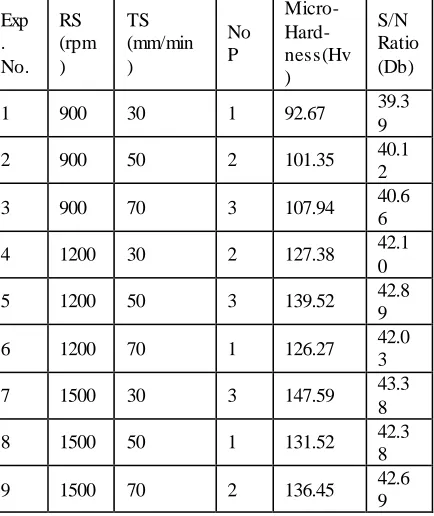
The S/N Ratios of the Microhardness values are extracted using the statistical software Minitab-17. Table 4 Microhardness and S/N Ratios
Exp . No.
RS (rpm )
TS (mm/min )
No P
Micro- Hard-ness(Hv )
S/N Ratio (Db)
1 900 30 1 92.67 39.3
9
2 900 50 2 101.35 40.1
2
3 900 70 3 107.94 40.6
6
4 1200 30 2 127.38 42.1
0
5 1200 50 3 139.52 42.8
9
6 1200 70 1 126.27 42.0
3
7 1500 30 3 147.59 43.3
8
8 1500 50 1 131.52 42.3
8
9 1500 70 2 136.45 42.6
9 An analysis of the tabulated results reveals that the S/N ratio for the 7th FSP Experiment is found to be
higher. Further, the analysis of these results is carried out in the subsequent results tables and plots.
Fig. 2 AA7075/MWCNT SMMC billet from FSP Exp - 2
Taguchi Analysis: Microhardness (Hv) versus RS(rpm), TS(mm/min), NoP
Table 5. Response Table for Signal to Noise Ratios Larger is better
Level RS(rpm) TS(mm/min) NoP 1 40.04 41.61 41.25
2 42.34 41.80 41.64 3 42.82 41.80 42.31 Delta 2.78 0.19 1.06 Rank 1 3 2
Table 6. Response Table for Means Level RS(rpm) TS(mm/min) NoP 1 100.7 122.5 116.8
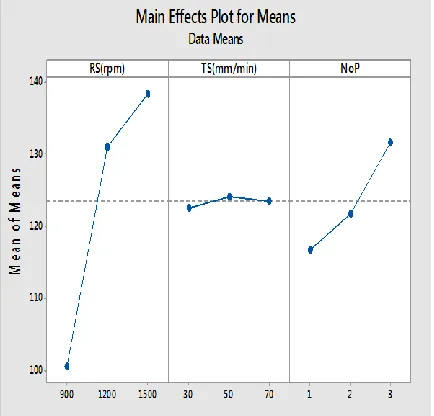
2 131.1 124.1 121.7 3 138.5 123.6 131.7 Delta 37.9 1.6 14.9 Rank 1 3 2
From the above response tables for S/N ratios and Means that is table 5 and table 6, it may be reported that, the influence of the Rotational Speed (RS) is highest on the microhardness of the SMMC samples fabricated through FSP. The No. of Passes of FSP stands second to influence the microhardness of the SMMCs. It is also learnt from the tables that, the effect of the Traverse Speed (TS) is diversified on the
microhardness of SMMCs.
IJIRT 145205
INTERNATIONAL JO URNAL OF INNOVATIVE RESEARCH IN TECHNOLOGY668
From the Main Effect Plot for S/N ratios and Means of the Microhardness Vs the RS, TS and NoP, (Fig. 2 and 3) it is predicted that the optimal set of process parameter is A3B2C3, that is the RS at 1500 rpm, TS at 50 mm/min and No. of Passes (NoP) at 3 passes, from which the maximum (the best) value of Microhardness of the SMMC billets is expected.
Fig. 4 Main Effect Plot for Means (Data Means)
General Linear Model: S/N Ratio versus RS(rpm), TS(mm/min), NoP
Factor coding (-1, 0, +1) Factor Information
Factor Type Levels Values RS(rpm) Fixed 3 900, 1200,1500 TS(mm/min) Fixed 3 30, 50, 70 NoP Fixed 3 1, 2, 3
Table 7 Analysis of Variance (ANOVA)
Source D
F Adj SS
Adj MS
F-Valu e
P-Valu e
RS(rpm) 2 13.254
4
6.6272 0
220.8 2
0.00 5 TS(mm/mi
n) 2 0.0715
0.0357
4 1.19
0.45 6
NoP 2 1.7389 0.8694
4 28.97
0.03 3
Error 2 0.0600 0.0300
1
Total 8 15.124
8
Model Summary
S R-sq R-sq(adj) R-sq(pred) 0.173237 99.60% 98.41% 91.96%
From the ANOVA table if P-value is observed, it can be revealed that, the P-values for RS and NoP provide a significant remark that furnishes a validity for the model, while the P-value for TS gives a not-significant remark, as the P-value is more than 0.05. From the Model summery the R-Square value is 99.60% which a very good variations in the responses can be observed by changing the factors.
Confirmation Test:
With the obtained optimal set of process parameter, A3B2C3, that is the RS at 1500 rpm, TS at 50 mm/min and No. of Passes (NoP) at 3 passes, the FSP confirmation tests were conducted and the average value for microhardness is obtained as 145.67 Hv. The difference of the microhardness values obtained by optimal set of process parameters and from the Taguchi Design Matrix is
147.59 – 145.67 = 1.92 (1.3%)
which can be a considerable range. Thus the Maximum Microhardness from the optimal set of the process parameters is obtained as 147.59 Hv for AA7075/MWCNT.
IJIRT 145205
INTERNATIONAL JO URNAL OF INNOVATIVE RESEARCH IN TECHNOLOGY669
From the interaction plots for Hardness, the factors RS and TS show dependency between 1200 rpm at 45 mm/min and also at 55 mm/min at 1500 rpm. While the NoP does not show any dependency on RS at all the three levels. It is also observed that there exist dependency of NoP on TS almost at three levels.
V. CONCLUSIONS
Following are the conclusions drawn from the Friction Stir processing of the AA7075 with MWCNT to fabricate the Surface MMCs.
AA7075/MWCNT Surface composites are
fabricated through Friction Stir Processing Process parameters such as RS, TS and NoP are
varied intentionally to variety of SMMCs. Taguchi DOE is adopted with L9 Orthogonal
Array to carry out FSP experiments.
Microhardness of the SMMC samples and the S/N ratios of the same is obtained using Minitab -17 software.
Response table and Main Effect plots are obtained from Minitab to reveal the significant factors and their level.
Optimal set of process parameters are extracted from the plots.
Confirmation tests are conducted with optimal set of process parameters to obtain the average microhardness value.
The value of Microhardness from the
confirmation test found in the comfortable acceptance, hence confirmed.
The ANOVA is conducted to find most significant factor and the relevant interactions plots are extracted to comment and conclude.
REFERENCES
[1] Essam R. I. Mahmoud et. al ‘Fabrication of Surface-Hybrid-MMCs Layer on Aluminum Plate by Friction Stir Processing and Its Wear’ I.J. Materials Transactions , Japan Institute of Metals Vol. 50, No. 7 (2009) pp. 1824 to 1831. [2] R.S.Misra, Z.Y.Ma and I. Charith, ‘Friction Stir
Processing: a novel technique for fabrication of Surface Composite’ Materials Science and Engineering A341 (2003) 307-310
[3] Meng, C., Cui, H.-c., Lu, F.-g., Tang, X.-h., 2013. Evolution behavior of TiB2 particles during laser welding on aluminum metal matrix composites reinforced with particles. Transactions of Nonferrous Metals Society of China 23, 1543-1548. doi:10.1016/s1003-63 [4] Essam R. I. Mahmoud et. al ‘Fabrication of
Surface-Hybrid-MMCs Layer on Aluminum Plate by Friction Stir Processing and Its Wear’ I.J. Materials Transactions , Japan Institute of Metals Vol. 50, No. 7 (2009) pp. 1824 to 1831. [5] Lee CJ, Huang JC, Hsieh PJ ―Mg based nano-
composites fabricated by Fricion Stir Processing. Scripta Materialia 54(2006) pp 1415 to 1420 [6] D.J.Llyod, ‘Particulate reinforced Aluminum and
Magnesium Matrix Composites’ Journal of International Materials Review, Vol.39 1994, Issue 1
[7] Rosso M, ‘Ceramic and metal matrix composites: Routes and properties’ Journal of Materials Processing Technology 2006, 175 (1), 364–375.
[8] Zadra and Girardini
[15Zadra, M.; Girardini, L. ‘High-performance, low-cost titanium metal matrix composites’. Materials Science and Engineering: A 2014, 608, 155–163.
[9] Moustafa, S.F.; Abdel-Hamid, Z.;
Abd-Elhay, A.M. ‘Copper matrix SiC and
Al2O3particulate composites by powder
metallurgy technique’. Materials Letters 2002, 53 (4), 244–249.
[10]Kayikci, R.; Savaş, O. ‘Fabrication and
properties of functionally graded
Al/AlB2composites’. Journal of Composite
Materials 2014. doi:0021998314541490. [11]Manna, A.; Bains, H.S.; Mahapatra, P.B.
‘Experimental study on fabrication of Al— Al2O3/Grp metal matrix compos ites’. Journal of
Composite Materials 2011, 45 (19), 2003–2010. [12]P.R. Guru, F.Khan MD, S.K.Panigrahi,
G.D.Janaki Ram, ‘Enhancing strength, ductility and machinability of a Al-Si cast alloy by
Friction Stir Processing’ Jounal of
Manufacturing processes, 18 (2015), 67-74. [13]R. M. Miranda, J. Gandra and P.Vilaça Surface
IJIRT 145205
INTERNATIONAL JO URNAL OF INNOVATIVE RESEARCH IN TECHNOLOGY670
[14]T.R.Mc.Nelley, ‘Friction Stir Processing(FSP): refining microstructure and improving proeprties’ Rev. metal. Madrid, 46 (Número Extraordinario), 149-156, 2010, ISSN: 0034-8570, doi: 10.3989/rev metalmadrid.19XIIPMS [15]C. Hamilton, M.St.Weglowski, S.Dymek,
P.Sedek, ‘Using a coupled thermal/material flow model to predict residual stress in friction stir processed AlMg9Si’, Journal of Material Engineering and performance 24 (2015) 1305-1312.