International Journal of Civil & Environmental Engineering IJCEE-IJENS Vol: 15 No: 04 1
Assessment Of Domestic Greywater
Reuse In Jordan
And Its Relationship With Socio-Economic Variables
Eham S. Ajlouni
1*, Kholoud S.O. Al-Ajlouni
21* Department of environmental health, Ministry of health, Amman, Jordan. e-mail: [email protected], Phone 00962797156397.
2 Department of chemical engineering, Al-Balqa’ Applied University, Jordan. [email protected]
Abstract--
Water share in Jerash governorate is only 71 litres per capita per day, which is the lowest is Jordan. In general, the volume of greywater accounts between 50% and 80% of domestic household water uses. So, the aim of work was to determine the percentage of greywater reuse; to identify types of greywater reused; and to find the relationship of greywater reuse with socio-economic variables of heads of families. Survey research was applied, and interviewer-administered questionnaires were used. It was found that Percent of greywater reuse was less than half of the sample population; in which laundry wastewater was reused in the first place followed by wastewater from kitchen, mainly for flushing toilet. Statistical analysis showed high significant relationship between monthly income of the family and reusing all types of greywater; laundry wastewater reuse has significant relationship with gender; dishwashing wastewater reuse has significant relationship with age, while bath wastewater reuse has significant relationship with age, and education of husbands.
Index Term--
Greywater, Jerash governorate, Jordan, laundry wastewater, socio-economic.
1. INTRODUCTION
The use of domestic greywater is increasingly common in both developed and developing countries, especially for irrigation. It is estimated that the total amount of greywater constituting the largest potential source of water saving, if consider reusing (Matos et al., 2012). Greywater is simply defined as wastewater comes from sinks, showers and baths (Al-Mashaqbeh et al., 2012). While light greywater (LGW) definition excludes wastewater from the washing machine, dishwasher and kitchen sink (Matos et al., 2012).
In general, the volume of greywater accounts between 50% and 80% of the domestic household water uses. However, its quality is highly variable due to the source. Greywater contains the same contaminants (organic compounds, nutrients and pathogens) as raw sewage water (Al-Mashaqbeh et al., 2012). It may contain grease, food particles, hair and other impurities; but it does not normally contain human waste unless laundry tubs or basins are used to rinse soiled clothing or baby’s diapers (Salukazana et al., 2006).
Greywater contributes significantly to parameters such as biochemical oxygen demand (BOD), chemical oxygen demand (COD), total suspended solids (TSS), ammonium (NH4+), total phosphorous, boron, metals, salts, surfactants, synthetic chemicals, oils and greases, xenobiotic substances,
and microorganisms. All of these components have potential negative environmental and health impacts (Matos et al., 2012). The health hazards may arise from three sources: (1) high concentration of pathogens, including bacteria, protozoa, viruses and parasites; (2) Chemical pollution by dissolved salts like nitrogen, sodium, phosphates and chloride, boron; or by organics like oils, fats, detergents, soap and xenobiotic compounds which may affect plant growth; (3) Physical pollution by particles of food, dirt, fiber which may decline soil structure, and clog flow tracks of groundwater. However, this can be greatly reduced by crop restriction, modifying irrigation techniques and human exposure (Salukazana et al., 2006; Matos et al., 2012).
On the other hand, reusing greywater is potentially beneficial for a number of reasons, including reducing the demand for potable water use; reducing environmental degradation; reducing eutrophication and health hazards through pooling of wastewater; reclaiming potentially wasted nutrients; and encouraging people to use friendly environment chemicals in their households (Salukazana et al., 2006). Furthermore, the potential ecological benefits of greywater recycling are many, like reduce fresh water extraction; less impact from septic tanks and treatment plants; and less energy and chemical pollution from treatment (Wikipedia , 2012).
The domestic generated greywater volume in Jordan was approximately estimated about 50 liters per capita per day (Faruqui and Al-Jayyousi, 2002). Moreover, there are documented applications of reusing greywater in Jordan, in which the government, in the year 2003, provided over 750 low-income households with greywater treatment units. However, without proper treatment of greywater, it may increase levels of elements that are harmful to soil and trees or crops (Macllwaine, 2003). Furthermore, based on a survey, some people in Deir Alla (in Balqa governorate/Jordan), though a low percentage (<5%), mentioned that they were reusing greywater, coming out of the sinks and showers, for some domestic purposes like washing backyards and wiping the surrounding surfaces of owned lands (Al-Mashaqbeh et al., 2012).
International Journal of Civil & Environmental Engineering IJCEE-IJENS Vol: 15 No: 04 2 relationship between greywater reuse and socio-economic variables of heads of families.
Source: ministry of environment 2005 Fig. 1. Overview of Jerash Governorate It has been reported that about half of the households got
municipal water every two weeks, and about half of the families who receiving municipal water consumed 5-8 cubic meters per month. It was hard to estimate quantity of water used for each domestic activity, but laundry was the most consuming one, followed by dish washing.
2. MATERIAL AND METHODS
Jerash Governorate has the smallest area of the 12 governorates of Jordan, yet it has the second highest density in
International Journal of Civil & Environmental Engineering IJCEE-IJENS Vol: 15 No: 04 3
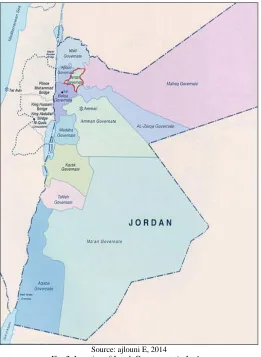
Source: ajlouni E, 2014
Fig. 2. Location of Jerash Governorate in Jordan
The governorate was divided into clusters, in which each cluster had 2500 persons.The total clusters were 65, and then seven clusters were selected by probably proportionate to size. 5 clusters were drawn from Jerash sub-district, 1 cluster from Mastaba sub-sub-district, and 1cluster from Burma sub-district. Within each cluster, houses were drawn randomly.
848 houses were selected, and interviewer-administered questionnaires were used to collect data from heads of households. The questionnaire consisted of four sections, aimed to identify socio-economic characters; water resources used by citizens of Jerash Governorate for drinking and domestic purposes; and how they adapt with water cut-off or
International Journal of Civil & Environmental Engineering IJCEE-IJENS Vol: 15 No: 04 4
Source: General Budget Department, 2010 Fig. 3. Administrative Sub--districts of Jerash Governorate
3. RESULTS AND DISCUSSION
It was found that ages of husbands ranged from 23 to 87 years old with a mean of 43.3 years
old. 62.7% of them were aged from 30 to less than 50 years old; 4.5% of them were less than 30 years old; while 4.2% were 70 years or older. On the other hand, ages of wives ranged from 18 to 78 years old, with a mean of 39.5 years old. 65.7% of them were 30 to less than 50 years old. On the other hand, 16.4% of them were less than 30 years old, while in turn around 2% were 70 years or older. For level of education: 35.8% of husbands were secondary educated, followed by university educated (23.5%); and the least percent was illiterate (5.8%). While level of education of wives varied between illiterate (10.1%) to university (31.0%). Secondary education (21.4%) was the second high level among these wives. As noticed that percentage of university education
among wives was higher than among husbands, which can be attributed to social factor (to avoid spinsterhood, or parents and bride no longer pay attention to level of education of groom). Furthermore, 42.0% of the families had 100-300 JD monthly income, followed by 301-500 JD monthly income group (28.1% of families). Few families have less than 100 JD (3%) or more than 900 JD (1.7%) as monthly income. 3.1 Water consumption methods in households
It was found that 49.8% of the households got water every two weeks, while about 11.99% got water once per month to three months. On the other hand, 18.8% got municipal water once a week and 1.5% of the households got it two times per week. As shown in table (1) that in summer, 25.1% of the households which receiving municipal water, consumed 5-6 meters, followed by 7-8 meters (24.5%) per month.
Mastaba Sub-district
Burma Sub-district
International Journal of Civil & Environmental Engineering IJCEE-IJENS Vol: 15 No: 04 5 Table I
Monthly consumption of municipal water in summer and winter seasons, in Jerash Governorate, in 2012/2013
Consumption in cubic meters
In summer In winter
No. % No. %
1.0 – 2.0 m3 24 3.8 62 9.7
3.00 – 4.0 m3 78 12.2 196 30.7
5.00 – 6.0 m3 160 25.1 202 31.7
7.00 – 8.0 m3 156 24.5 110 17.2
9.00 – 10.0 m3 86 13.5 38 6.0
more than 10 m3 134 21.0 30 4.7
Total 638 100.0 638 100.0
While in winter 31.7% of the those households consumed 5- 6 meters of the water municipal, and 30.7% consumed 3-4 meters per month.
3.1.1 Drinking
3.1.1.1. Dwellers: It was found that number of household dwellers ranged from 1 to 15 persons (Mean ± SD = 6.16 ± 2.4 persons, Median =6.0 persons). 59.3% of the families had less than 7 persons, in which 35.1% of the families had 5 or 6 persons in the house.
3.1.1.2 Household animals: It was found that raising livestock / birds, at houses was common. 25.19% of the studied houses (that is 204 houses) have livestock/birds. Among them, 38.2% of the families raised more than one type of livestock and domesticated birds; while 16.7% had goats, 12.7% had sheep, and 7.8% had cows. Methods of watering animals vary according to their type. 51.75% used tubs for watering livestock, while 24.51% used buckets.
3.1.2 Irrigation
43.7% of the studied houses had a home garden. The range of home garden areas was from 1 square meter to 25000 square meters. Furthermore, Fruit, herbs, trees, vegetables, and flowers were planted. The most dominant was olive trees, followed by decoration trees and flowers, then grapes. Among those having home gardens, 64.24% used hose only, while 2.42% used drip irrigation. Others used tubs (30.92%), or combination of hose and tub (2.42%).
3.1.3 Washing
3.1.3.1 Clothes: Based on respondents 42.72% of families washed clothes twice per week (Mean ± SD = 2.17 ± 1.284, Median = 2.00), followed by once per week (30.37%). Those
doing laundry 4 times or more per week were close (3.95%, 4.19% respectively), which indicated presence of children, elder people or patients. Furthermore, it was found that households using ordinary washing machines (61.73%) were more than those using automatic machines (37.28%).
3.1.3.2 Body: With respect to method of body washing most of the families (63.5%) used shower for body washing, and those who used bucket (26.4%) came on the second place. Also, only 1% of the families used full bath tub in body washing which is common sense, since water quantity is generally low in the governorate.
3.1.4 Toilet
It was found that 46% of the families had one water-closet, and 1.2% of the selected households had more than 3 water-closets. Moreover, the majority (64.9%) used bit latrines, 6.2% had flush latrines only, and 29.1% of the houses had both types of latrine. However, among those who had flush latrines, 54.9% used siphon, on contrast 11.3% used bucket, and the rest used water taps for flushing toilets. This finding is consistent with a pervious study done in Al-Me’rrad area -in Jerash governorate, in 2005- (DOS, 2013).
3.2 Measures of water Conservation in households
Many methods and tactics are used in houses to conserve water and reduce quantities, which all are well acknowledged techniques in all over Jordan.
3.2.1 Tanks
International Journal of Civil & Environmental Engineering IJCEE-IJENS Vol: 15 No: 04 5 Table II
Types of water tanks by administrative sub-districts in 2012/2013
Type of available tank
Total
No. %
Roof 804 99.26
Ground 198 24.44
Underground
Own 310 38.27
In common 30 3.70
3.2.2 Greywater reuse
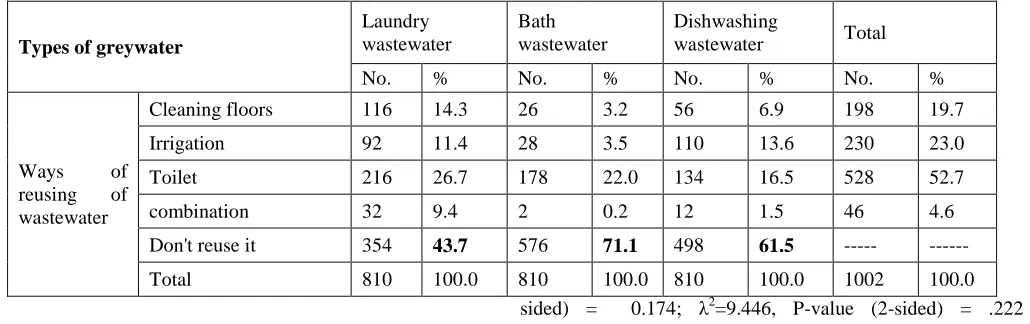
Table (3) illustrates distribution of types of greywater among the studied households. As shown that laundry wastewater (56.3% of those reuse greywater) was more common than
dishwashing wastewater (38.5%) and bath wastewater (28.9%). Also, the table shows that greywater reuse was more for flushing toilet (52.7% of those reuse greywater) than garden irrigation (23.0%) or cleaning floors (19.7%).
Table III
Ways of reusing greywater inside houses in Jerash governorate in 2012/2013
Types of greywater
Laundry wastewater
Bath wastewater
Dishwashing
wastewater Total
No. % No. % No. % No. %
Ways of
reusing of wastewater
Cleaning floors 116 14.3 26 3.2 56 6.9 198 19.7
Irrigation 92 11.4 28 3.5 110 13.6 230 23.0
Toilet 216 26.7 178 22.0 134 16.5 528 52.7
combination 32 9.4 2 0.2 12 1.5 46 4.6
Don't reuse it 354 43.7 576 71.1 498 61.5 --- ---
Total 810 100.0 810 100.0 810 100.0 1002 100.0
3.2.2.1 Statistical analysis: To find out the relationship between greywater reuse and socio-economic factors, statistical analysis was performed, using SPSS.
1) Laundry wastewater
It was found that there was a significant relationship between reusing laundry wastewater and
both husband’s age and level of eduction (λ2 = 22.474 , P-value (2-sided) = 0.033; λ2=16.046,P-value (2-sided) =.025 consecutively).
However there was no significant relationship with both wife’s age and level of education (λ2 = 16.400 , P-value (2-
sided) = 0.174; λ2=9.446, P-value (2-sided) = .222 consecutively).
2) Dishwashing wastewater
There was a significant relationship between both wife’s age, husband’s age and reusing of wastewater from the kitchen (λ2 = 23.997 , P-value (2-sided) = 0.02; (λ2 = 23.835, P-value (2-sided) = 0.021 consecutively). On contrast, there was no significant relationship with level of education for both wives and husbands (λ2
International Journal of Civil & Environmental Engineering IJCEE-IJENS Vol: 15 No: 04 6
Fig. 4. Distribution of dishwashing wastewater reuse among husbands in Jerash governorate, in 2012/2013
3) Bath wastewater
There was significant relationship between reuse of bath wastewater and both wife’s age (λ2=22.649 , P-value (2-sided)
= 0. 031), husband’s age and his level of education (λ2 = 23.951, P-value (2-sided) = 0.021; λ2=15.815, P-value (2-sided) = .027 consecutively).
International Journal of Civil & Environmental Engineering IJCEE-IJENS Vol: 15 No: 04 7
Fig. 6. Distribution of bath wastewater reuse among husbands in Jerash governorate, in 2012/2013 But there was no significant relationship with wife’s education
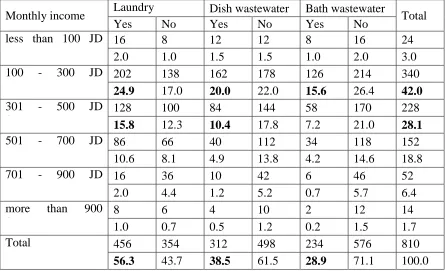
(λ2=11.292, P-value (2-sided) = .126). With regards to monthly income and reusing greywater (illustrated in table
IV), there were hign significant relation ships with all types of greywater.
Table IV
Distribution of bath wastewater reuse among husbands in Jerash governorate, in 2012/2013
Monthly income
Laundry
wastewater
Dish wastewater
Bath wastewater
Total
Yes
No
Yes
No
Yes
No
less than 100 JD
f
16
8
12
12
8
16
24
%
2.0
1.0
1.5
1.5
1.0
2.0
3.0
100
-
300
JD
f
202
138
162
178
126
214
340
%
24.9
17.0
20.0
22.0
15.6
26.4
42.0
301
-
500
JD
f
128
100
84
144
58
170
228
%
15.8
12.3
10.4
17.8
7.2
21.0
28.1
501
-
700
JD
f
86
66
40
112
34
118
152
%
10.6
8.1
4.9
13.8
4.2
14.6
18.8
701
-
900
JD
f
16
36
10
42
6
46
52
%
2.0
4.4
1.2
5.2
0.7
5.7
6.4
more
than
900
f
8
6
4
10
2
12
14
%
1.0
0.7
0.5
1.2
0.2
1.5
1.7
Total
f
456
354
312
498
234
576
810
%
56.3
43.7
38.5
61.5
28.9
71.1
100.0
For laundry (λ2=16.174 , P-value (2-sided) = 0. 006), for dishwashing wastewater (λ2=31.881 , P-value (2-sided) = 0. 000), for bath wastewater (λ2
=24.818 , P-value (2-sided) = 0. 000)
3.2.3 Saving utilities
According to answers of the respondents, only 6.42% were using saving utilities, which was a low percent.
3.2.4 Others
International Journal of Civil & Environmental Engineering IJCEE-IJENS Vol: 15 No: 04 8 floors, compared to 5.4% of households used to rinse floors.
On other hand, 19.2% had rugs or carpets over floors. Furthermore, it was found that 65.68% of the selected households had vehicles. For those who had motor vehicles, 71.8% used bucket for cleaning their vehicles, or hose (20.2%); and only 6% of them went to car washing stations.
DISCUSSION
The majority of the study sample was between 30 to 50 years old, and their education was mainly secondary, and to a lesser percentage university education. And according to Anbat newspaper (February 18th, 2013), the poverty line in Jordan in 2012 was 366 JD per month for a standard family (consists of 4-5 members), which put more than 45% of the sample population under poverty line. Moreover, it had been reported in 2004 that Jerash governorate was the fourth lowest income of families in Jordan (Hailat, 2005). This was supported with results of household income and expenditure surveys 2006 and 2008.
People in the sample considered laundry is the most water consuming activity at houses, then washing dishes followed by cleaning the house. It was found that they depend mainly on roof tanks to reserve water. Percent of those who reused greywater (without treatment) was less than 50%, laundry wastewater was reused in the first place, followed by wastewater from kitchen, often for flushing toilet. Other uses of greywater were garden irrigation followed by cleaning the floors. The percent was not high because there are disadvantages for reusing domestic greywater, such as unpleasant view, bad smell, staining toilet, effort and time needed for collecting manually wastewater, and problem of mesh clogging –if mesh is used-; in addition to harmful effects on plants and soil. A survey in the farming community of Deir Alla conducted by Royal Scientific Society showed that farmers were willing to accept reuse treated greywater for irrigation. However less than 5% of them reused greywater (without treatment) which came from their houses, for flushing toilet and cleaning their yards (Al-Mashaqbeh et al., 2012).
It is worth to mention that using laundry wastewater for irrigation should be used with cautious, for laundry products can be harmful to plants. Most soaps and detergents - including baking soda - contain sodium compounds. High levels of sodium can cause discoloration and burning of leaves, and can contribute toward an alkaline soil condition. Acid-loving plants may experience some chlorosis or yellowing of the foliage, due to the alkaline nature of the greywater (Qaqish, 2003; MacIlwaine and Redwood, 2010). As noticed that the percent of reusing dish washing wastewater was less than reusing laundry wastewater , may be because of less quantity of dishwashing wastewater, or high amount of lipids resulted from food residues, or it may need installing fixtures specifically for colleting dishwashing wastewater. Usually the dishwashing wastewater contains detergent, organic matter, oils, and chlorine solution, which have negative effects on home garden (MacIlwaine, 2003), on floor or toilet. A study in 2011, used mixed greywater (that is
laundry, kitchen, and bathroom) sourced from household for irrigation plants, compared with tap water irrigation and hydroponic nutrient solution. The results indicated that soil irrigated by mixed greywater showed increased electrical conductivity and increased concentrations of metals over time, coupled with an increase in sodium and metal concentrations in crops (Rodda et al., 2011). Another study conducted in South Africa, aimed to show the effects of laundry greywater irrigation on soil characteristics and growth of specific plants. It is found that the combination of high electrical conductivities, high sodium concentrations and high sodium adsorption ratios in greywater and in greywater-irrigated soils suggested that prolonged application of laundry greywater may cause adverse physicochemical change in soils. Values of soil specific hydraulic conductivity (Ks) indicated that the application of liquid laundry detergent to soil caused severe soil hydrophobicity (i.e. the property of being water-repellent; tending to repel and not absorb water). The observed effects of laundry greywater on soil characteristics suggested that chronic application would require steps to mitigate deterioration of soil (Taylor et al., 2008). The most concern is sodium, in which high level of sodium concentration can damage soil permeability and structure, ultimately reducing crop yields (Macllwaine, 2003). A study was conducted in a rural house, in North Ghor (in Irbid governorate), in which the clay soil was irrigated by output mixed greywater, which stored in a tank. It was found that TDS, chloride, sodium, boron, and SAR complied with national standard number 60 for agriculture, while pH (8.6) and fecal coliform (was more than 1600) were above the standard (Macllwaine, 2003). According to Jordanian researchers, occasional leaching with fresh water may reduce build up of salts and organic matter in soils irrigated with greywater (Al-Hamaiedeh, 2010).
International Journal of Civil & Environmental Engineering IJCEE-IJENS Vol: 15 No: 04 9 greywater is unclear (Al-Mashaqbeh et al., 2012). Moreover,
findings of the survey in Deir Alla suggested that water scarcity was the main determinant of willingness to reuse the greywater compared with socio-economic variables such as income and education level (Al-Mashaqbeh et al., 2012).
4. CONCLUSIONS
It can be concluded that disadvantages of wastewater play an important role in avoiding reusing domestic untreated greywater, while monthly income is an important factor for reusing greywater.
ACKNOWLEDGMENTS
Authors would like to thanks Prof. Dr. Samia Galal, Prof. Dr. Linda Mechial, Prof. Dr. Mohammad Subarrini, Dr. Ashraf Wahda for their comments. Also, present sincere thanks to Dr. Abdalla Ajlouni, Mr. Mohamed Ajlouni, Mr. Hesham Ajlouni, and Miss Aisheh Ajlouni for helping in collecting data. And finally would like to thanks all respondents in Jerash governorate for cooperating and responding.
REFERENCES
[1] Ajlouni E., (2014), Assessment of Environmental and Health
Impacts of Water Resources uses in Jerash Governorate/ Jordan
During 2000-11, Based on Demographic Change, PhD thesis,
High Institute of Public Health, Alexandria, Egypt.
[2] Al-Hamaiedeh HM., (2010), Effect of treated grey water reuse in irrigation on soil and plants, Desalination, 256, 115–119.
[3] Al-Mashaqbeh O.A., Ghrair A.M., Megdal S.B., (2012), Grey
Water Reuse for Agricultural Purposes in the Jordan Valley:
Household Survey Results in Deir Alla, Water, 4 (3), 580-596.
[4] Department of Statistics/ economic statistics directorate/work
statistics department, (2013), Work statistics in Jordan during 2007-2011, DOS ,Amman.
[5] Department of Statistics, (2013), on line at:
http://www.dos.gov.jo/dos_home_e/ main/index.htm,
[6] (Accessed on 12 June 2013).
[7] Faruqui N., Al-Jayyousi O., (2002), Greywater reuse in urban
agriculture for poverty alleviation—A case study in Jordan, Water Intern, 27, 387–394.
[8] Hailat N., (2005), Socio-economic, Agricultural, Health and
Environmental Study for Watershed Management in Al-Me’raad - Jerash/Jordan, JUST , Irbid.
[9] McIlwaine S., (2003), Greywater Reuse in Other Countries and its
Applicability to Jordan, CSBE , Amman.
[10] Macllwaine S., (2003), Greywater use in Jordan, CSBE, Amman.
[11] MacIlwaine S., Redwood M., (2010), Greywater Use in the
Middle East: Technical, Social, Economic and Policy Issues, CSBE, Amman.
[12] Matos C., Sampaio A., Bentes I., (2012), Chapter 9: Greywater
Use in Irrigation: Characteristics, Advantages and Concerns, In García-Garizábal I., Abrahao R. (Ed.), Irrigation - Water Management, Pollution and Alternative Strategies, DOI: 10.5772/30026
[13] Ministry of environment of Jordan, (2005), Integrated watershed
management project: Jerash study area baseline report, MOE , Amman .
[14] Qaqish L.M., (2003), Effect of Grey Water Irrigation on Soils and
Crops, Master Thesis, Jordan University of Science and Technology, Irbid.
[15] Rodda N., Salukazana L., Jackson S., Smith M., (2011), Use of
domestic greywater for small scale irrigation of food crops: Effects on plants and soil, Physics and Chemistry of the Earth, 36(14), 1051-1062.
[16] Salukazana L., Jackson S., Rodda N., Smith M,, Gounden T.,
McLeod N,, et al., (2005), Re-use of grey water for agricultural
irrigation. Paper presented at the Third international conference on ecological sanitation, International Convention Centre, Durban, South Africa, 23 - 27 May.
[17] Taylor G.T., Pammenter N.W., Rodda N.H., (2008), The Effects
Of Laundry Greywater Irrigation On Soil Characteristics And Growth Of Swiss Chard (Beta Vulgaris) And Sweet Pepper (Capsicum Annuum), School Of Biological And Conservation Sciences, University of KwaZulu-Natal (Westville Campus), Westville.
[18] Wikipedia, (2012), Greywater, on line at :